

You won’t get this if you don’t follow F1 and you don’t understand the Finnish people. He is a completely different person off camera and is really making fun of life on screen by not being a TV persona.

Yamamoto’s Master Plan for Pearl Harbor Attack
Yamamoto was educated in the US and knew us well. He also knew that we were a sleeping industrial giant. He was well aware of the 2nd Amendment and how much we believed in it (We still do for the Islamic Jihad Terrorists). He also knew he couldn’t attack the US, but a surprise attack would and could cripple us for a while until the industrial might of a sleeping giant was woken up. Luck was not on his side that day as the US Carriers were out at sea and the Battleships (an aging, but vital weapon) was all that was harbored in Pearl Harbor.
Here is the take by the Pacific War.com

JAPANESE PREPARATIONS FOR THE ATTACK ON PEARL HARBOR


Admiral Yamamoto plans the Destruction of the United States Pacific Fleet

These aircraft are superb reproductions of the Nakajima Type 97 carrier torpedo bombers (Allied code-name “Kate”) that attacked the United States Pacific Fleet at Pearl Harbor. They were used in the gripping and historically accurate 20th Century Fox film Tora, Tora, Tora! (1970).
In conformity with this traditional approach to naval warfare, the Japanese Naval General Staff intended to limit naval operations in support of Japan’s military thrust into South-East Asia to offensive actions against local American, British and Dutch naval forces defending their country’s colonial possessions in South-East Asia. To the conservative admirals of the Naval General Staff, a direct confrontation in the central Pacific Ocean between their navy and the United States Navy was unthinkable.
In early 1941, Vice Admiral Isoroku Yamamoto was appointed Commander-in-Chief of Japan’s Combined Fleet, and he immediately took issue with the cautious policy of the Japanese Naval General Staff. Yamamoto did not believe that the United States Pacific Fleet would remain idle at Pearl Harbor while Japan attacked and seized America’s Philippines, and British and Dutch colonial possessions in South-East Asia. He believed that Japan must cripple the United States Pacific Fleet at the same time as it launched its attacks on countries of South-East Asia.
With this firm conviction, Admiral Yamamoto began to consider a surprise carrier-launched air attack on the United States Pacific Fleet at its Pearl Harbor base timed to coincide with Japan’s military aggression in South-East Asia. Yamamoto instructed Rear Admiral Takijiro Onishi, Chief of Staff of the 11th Air Fleet, to assess the feasibility of an attack on Pearl Harbor by carrier-launched aircraft. Onishi enlisted the assistance of Commander Minoru Genda, a brilliant staff officer and tactician serving with Japan’s 1st Air Fleet. Genda studied the problem and came to the conclusion that an attack on Pearl Harbor could succeed if (a) the attack took the Americans completely by surprise, (b) the attack occurred early on a Sunday morning when American defence preparedness would be at a low level, (c) all six of Japan’s best aircraft carriers were used, and (d) highly skilled aircrews were used in the attack. To ensure complete surprise, Genda’s plan precluded alerting the Americans to their danger by a prior declaration of war.
Admiral Yamamoto’s plan for a surprise peacetime attack on the United States Pacific Fleet at Hawaii would involve a strike force which included Japan’s six largest and most powerful aircraft carriers. His task was made much easier by President Roosevelt’s decision to relocate the United States Pacific Fleet from California to Hawaii. As Yamamoto saw it, the destruction of the American Pacific Fleet would give Japan time to seize the Philippines, Malaya, British Borneo, Burma and the Netherlands East Indies (now Indonesia), and gain access to the oil, minerals, rubber and other resources that Japan needed to sustain its aggressive war machine. He was hopeful that, with its Pacific Fleet destroyed or crippled, the Americans would be willing to accept a peace settlement that allowed Japan to keep its new conquests in South-East Asia.
The Japanese Naval General Staff initially rejected Admiral Yamamoto’s plan for an attack on Pearl Harbor as being too great a gamble. They doubted that surprise could be achieved when the strike force would be at sea for two weeks before the attack. Japan had eleven aircraft carriers, and the admirals felt that Yamamoto’s plan could put at risk their six best carriers. They also felt that diverting Japan’s six most powerful aircraft carriers to Hawaii would leave the southern attacks on the Philippines and British Malaya dangerously unprotected. In the end, Yamamoto only overcame their opposition by threatening to resign.
Although the admirals of the Naval General Staff were reluctantly persuaded by Yamamoto to abandon the policy of defensive naval war in favour of attack, the years of night warfare training and the highly accurate, long range torpedoes associated with the defensive policy would give the Japanese Imperial Navy a significant edge over Allied navies in night actions during the Pacific War.
Training for the Pearl Harbor Attack
Early in 1941, despite the fact that the Chief of the Naval General Staff, Admiral Osami Nagano, had not yet approved a surprise attack on Pearl Harbor, Admiral Yamamoto directed that intensive planning and training for such an attack was to be undertaken.
Japanese naval aircrews had already honed their war skills flying sorties against the poorly equipped and trained Chinese air force and army. However, Pearl Harbor offered special challenges to an enemy force proposing to use air-launched torpedoes. The harbor was comparatively shallow and a large area in the centre of the harbor was occupied by Ford Island. The American battleships were moored on the eastern side of Ford Island. The water area between the battleships and the eastern shore of the harbor was narrow. Japanese torpedoes would have to be redesigned for use in shallow harbor waters, and torpedo aircrews would have to learn to drop their torpedoes with great precision so that they would land in the narrow stretch of water between the eastern shore of the harbor and the battleships. The Japanese aircrews went about this training with great enthusiasm and dedication. By November 1941, they were ready for the attack.
On 3 November 1941, the Chief of the Japanese Naval General Staff finally gave his approval to Admiral Yamamoto’s plan to attack the United States Pacific Fleet at its Pearl Harbor base.
The Japanese Carrier Strike Force departs for Hawaii
To distract the American government while it secretly positioned a powerful aircraft carrier strike force for the “sneak attack” on Pearl Harbor, the Japanese government had ordered its envoys in Washington to engage the American government in intensive diplomatic negotiations.AdmiralYamamoto’s aircraft carrier strike force, under the command of Vice-Admiral Chuichi Nagumo, left Japan on 26 November 1941.

The fast and powerful aircraft carrier Akagi was regarded as the “Queen” of the Japanese Imperial Navy. It is shown here in 1941. It was the flagship of Vice Admiral Chuichi Nagumo for the attack on Pearl Harbor.
Preserving strict radio silence, Nagumo’s carriers steered well clear of normal shipping lanes and headed for a stand-by point about 1,000 miles (1,600km) north of Hawaii. The carrier strike force comprised Japan’s six largest fleet aircraft carriers, Akagi, Kaga, Soryu, Hiryu, Shokaku, and Zuikaku. Each of these aircraft carriers would later play a role in the major sea battles closely related to Australia’s survival in 1942. The last two would take part in the crucial Battle of the Coral Sea. The first four would take part in the pivotal Battle of Midway. The carriers were supported by battleships, cruisers, destroyers and submarines.
Japan’s Prime Minister Tojo threatens Britain and America with War
In the last week of November 1941, at a time when Admiral Nagumo’s aircraft carriers were sailing towards Pearl Harbor with hostile intent, Japan’s militarist Prime Minister, General Hideki Tojo, issued a blunt warning to Britain and the United States that Japan would “purge East Asia of US -British power with a vengeance”. General Tojo’s threat appeared on the front page of the New York Herald Tribune on Sunday, 30 November 1941, exactly seven days before the Japanese attack on America’s Pacific Fleet at Pearl Harbor.
Despite the clear threat of war contained in Tojo’s warning, and despite having no knowledge of the whereabouts of Japan’s six largest fleet aircraft carriers, no steps were taken at Hawaii to bring the United States Pacific Fleet or the United States Army Air Corps to a state of war alert.
The Americans had broken the Japanese diplomatic code in September 1941, and were able to read coded messages from Tokyo to Japan’s embassies in Berlin and Washington. The United States government knew that Japan had warned its diplomats in Washington that certain unspecified events would occur after 29 November 1941. However, the Americans believed that the warning fore-shadowed possible aggressive moves by Japan against the Philippines or British or Dutch colonial possessions in South-East Asia. Although they did not believe that an attack on Pearl Harbor was planned by the Japanese, the American commanders in Hawaii took steps to guard against possible hostile action by Japanese submarines and sabotage to military aircraft or installations on the main island of Oahu. To guard against sabotage, Major General Short lined up his aircraft on the runways as if for an inspection. They would prove easy targets for Japanese aircraft when the attack came.
The Order to attack the United States Pacific Fleet
When the Japanese aircraft carrier strike force reached its stand-by point north of Hawaii, it waited to receive either final confirmation to proceed with the attack on Pearl Harbor or an order to return to Japan. On 1 December 1941, the Japanese government reached a firm decision to make war on the United States. On 2 December 1941, a radio signal containing the code words “climb Mount Niitaka” was received by Vice Admiral Nagumo aboard his flagship Akagi. The code message was an order to attack Pearl Harbor on Sunday, 7 December 1941. The Japanese were well aware that most Americans at this time observed Sunday as a holy day, and they had carefully timed the surprise attack to occur when many Americans in Hawaii would be preparing for or attending church services.
Surprise was considered vital to the success of the attack on the American fleet. There would be no prior declaration of war to alert the Americans to their danger.
Admiral Nagumo’s carrier strike force refuelled at sea on 5 and 6 December. Its approach to Hawaii was screened from American reconnaissance aircraft by low, dense cloud cover.
Japanese intelligence informed Nagumo on 6 December that the American battleships and a large number of smaller warships were in Pearl Harbor. However, Nagumo’s primary targets were the American aircraft carriers, and they were all absent from the harbor. The Japanese believed that the American aircraft carriers Lexington, Saratoga, Enterprise and Yorktown were all based at Pearl Harbor at this time. Their intelligence was faulty. Having undergone routine dry-docking, Saratoga was at San Diego on the American west coast. Yorktown was stationed with the newly commissioned Hornet in the Atlantic at this time. Only Lexington and Enterprise were actually based at Pearl Harbor on 6 December 1941, and fortunately for the United States and Australia, both carriers were at sea when the Japanese attack took place. Despite this setback, Nagumo was under orders to proceed with the attack.
On 6 December 1941, President Franklin D. Roosevelt intervened personally in the cause of peace by sending a direct appeal to the Emperor of Japan. It fell on deaf ears in Tokyo. The Japanese government was determined on war and had no intention of recalling the Japanese carrier force.
 Review of 20th Century Fox Pearl Harbor attack film “Tora! Tora! Tora! (1970)
Share this:

World’s Most Emotional Countries and Why
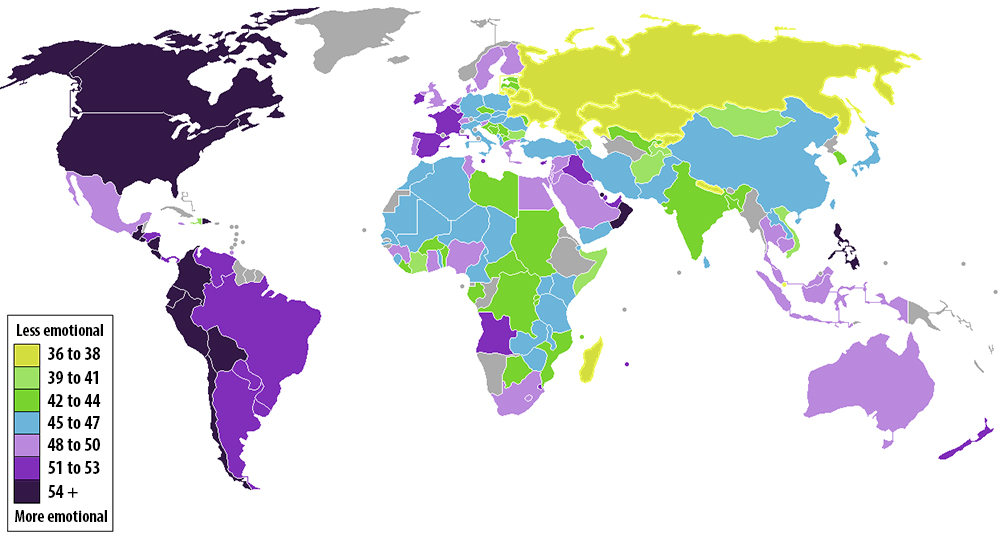 This is not my data, rather a Bloomberg study. What I can’t figure out is how the US is so emotional except for the political discord recently (the article below says they are happy). I much more expected it from the Latin countries.
According to Bloomberg, the source of this map, here are the real reasons:
Singapore is the least emotional country in the world. ”Singaporeans recognize they have a problem,” Bloomberg Businessweek writes of the country’s “emotional deficit,” citing a culture in which schools “discourage students from thinking of themselves as individuals.” They also point to low work satisfaction, competitiveness, and the urban experience: “Staying emotionally neutral could be a way of coping with the stress of urban life in a place where 82 percent of the population lives in government-built housing.”
The Philippines is the world’s most emotional country. It’s not even close; the heavily Catholic, Southeast Asian nation, a former colony of Spain and the U.S., scores well above second-ranked El Salvador.
Post-Soviet countries are consistently among the most stoic. Other than Singapore (and, for some reason, Madagascar and Nepal), the least emotional countries in the world are all former members of the Soviet Union. They are also the greatest consumers of cigarettes and alcohol. This could be what you call and chicken-or-egg problem: if the two trends are related, which one came first? Europe appears almost like a gradient here, with emotions increasing as you move West. (their emotions are sedated)
People in the Americas are just exuberant. Every nation on the North and South American continents ranked highly on the survey. Americans and Canadians are both among the 15 most emotional countries in the world, as well as ten Latin countries. The only non-American countries in the top 15, other than the Philippines, are the Arab nations of Oman and Bahrain, both of which rank very highly. (they have it good there)
English- and Spanish-speaking societies tend to be highly emotional and happy. Though the Anglophone nations of the world retain deep cultural links, it’s not clear if Spain’s emotional depth has anything to do with Latin America’s. According to Gallup, “Latin America leads the world when it comes to positive emotions, with Panama, Paraguay, and Venezuela at the top of that list.” Yes, even Hugo Chavez’s Venezuela is apparently filled with happy people. (they have to say that or be imprisoned)
Africans are generally stoic, with some significant exceptions. The continent is among the world’s least emotional, though there is wide variation, which serves as a non-definitive but interesting reminder of Africa’s cultural diversity. Each could be its own captivating case study. It’s possible that South Africa’s high rating has to do with its cultural ties to Western Europe, for example, and Nigeria’s may have to do with the recent protest movement in the south and sectarian violence in the north. (life is tough for them, they cope)
The Middle East is not happy. Gallup notes, “Negative emotions are highest in the Middle East and North Africa, with Iraq, Bahrain, and the Palestinian Territories leading the world in negative daily experiences.” Still, that doesn’t quite fully explain the high emotions in the Levant and on the Arabian peninsula, compared to the lower emotions in Libya, Algeria, and Morocco. Perhaps this hints at how people in these countries are being affected by the still-ongoing political turmoil of the Arab Spring. (they are rife with terrorists who brim with hate)
What am I missing? Every color-coded national boundary here tells a story. Why is Haiti so bereft of emotion compared to its neighbors? Why is Angola so heavy with feeling? Leave your thoughts in the comments or reach me on social media. (Haiti was founded on voodoo so they believe in the devil).
Share this:

Should You Pay Off Your Mortgage?
This goes with my series of “How and average Joe can become a Millionaire”.
I am not the author, but this is one of the most important financial decisions you’ll make (the other is tithing) The whole article can be found here:
One of my good friends, “Judge Rob,” is a local, elected judge who also owns a small family business. Judge Rob paraphrased Warren Buffett when we were discussing mortgages over a recent breakfast, saying, “If I knew where I was going to live for the next decade or so, I would buy a house with a long-term mortgage.” The idea is that a mortgage is a good hedge against inflation because you pay it off with much cheaper dollars down the road.
Today, many pundits point to low interest rates and encourage people to borrow as much as they can while interest rates are low. While they do have a good point, deciding when to pay off my own mortgage caused a great deal of conflict between the logical and emotional parts of my brain.
In the early days of black-and-white television, much of the programming was old, silent movies. Who can forget the little old widow, confronted by the evil, rich banker, who licked his chops at the opportunity to throw her out as her mortgage payment came due? As the deadline got closer, the piano would bang louder and faster, and somehow Widow Nell would make her payment in the nick of time. Was I programmed by my generation’s version of Sesame Street?
There’s Something to Being “Old School”
I spent a good bit of my breakfast with Judge Rob in “Yes, but!” mode. Here’s why.
When I was contemplating paying off my mortgage, I spoke with a CPA who also happened to be a financial advisor recommended by a good friend. I explained that I was self-employed, so my income fluctuated, and my mortgage was my largest monthly bill. I suggested that there could be some emotional benefit to paying it off. Less stress perhaps?
He insisted that I could invest and out-earn the cost of my first mortgage. He pooh-poohed the idea of paying it off to calm my nerves, and kept repeating that I could easily invest my money and earn more after taxes than the cost of the first mortgage.
When I asked if his mortgage was paid off, he responded with, “Oh, hell yes!” I was flabbergasted. How could he advise me to do one thing when he’d done the exact opposite? He explained that his wife was from Germany – the old school where you pay your bills, don’t borrow money, and stay out of debt.
Then I asked him, “Once you paid off your mortgage, did you sleep better at night?” He pondered a bit and said, “Yeah, I guess I did. I no longer worried about it. No matter how bad things got, we would still have a roof over our heads.”
When I asked Vedran Vuk, our senior research analyst, about when to pay off a first mortgage, he made some excellent points. First, you should no longer view your house as an investment that’s going to rapidly appreciate as it did in the past. A house is a home, and you should look at it that way. Second, right now a mortgage can make sense from an investment perspective. If you can borrow money at 3.5%, invest it, and earn a guaranteed higher return on it, you’ll come out ahead.
The real question becomes: where can you find a guaranteed greater return, even with the low mortgage rates available today? The government is committed to keeping interest rates artificially low for the foreseeable future. Yields on CDs and high-quality bonds are pathetic.
I just checked my brokerage account, and the longest CD they have available is a five-year CD paying 1.15%. A 30-year Treasury bond will pay 2.8%. Neither holds any appeal for me, particularly if I were investing with borrowed money.
If you’ve found an investment that’s a lead-pipe cinch – one that’s absolutely, positively going to pay off – and a low mortgage rate, you may want to roll the dice. However, I want to add one more note of caution.
The upcoming issue of Money Forever‘s premium subscription, which we’re releasing on December 18, takes an in-depth look at reverse mortgages, one of the most controversial ways to help fund your retirement. Our team will explain reverse mortgages in easily understood terms, highlight pitfalls to avoid, and explain how a reverse mortgage is a good way for some (but not all) folks to fund their retirement and maintain their lifestyle.
Before obtaining a reverse mortgage you must go through HUD counseling. While researching our upcoming report, I came across a study of over 20,000 people who had been through HUD counseling between September 2010 and November 2010. A few statistics really jumped off the page!
In 2000, the average age of people receiving reverse mortgages was 73 years old. By November 2010, the average age had dropped to 71.5, and it’s continuing to decline. In other words, retirees are tapping into their home equity at an increasingly younger age, many because they have no other choice.
It was also interesting to learn why these folks wanted a reverse mortgage. In the 70-and-older group, 38% still had mortgage debt. Seventy-one percent owed 25% or more on the current value of their home, and 33% had a mortgage in excess of 50% of the value of their home. Many wanted a reverse mortgage because they could not service their existing debt. A reverse mortgage is based on the net equity in your home. If their homes were paid for, meaning no huge house payment, perhaps they could have put off the reverse mortgage for a few more years. The older the applicant, the higher monthly payment they receive.
I wonder how many of these folks lost money betting on their lead-pipe cinch investment because they had been nudged along by their CPA.
My point is simple. For most baby boomers and retirees, their home is their largest asset. You don’t want to live like the little old widow in a black-and-white film, worrying about getting thrown out of your home, particularly if you’re no longer working.
Nevertheless, if you had a mortgage with a 3.5% interest rate and we were still living in a world where a top-quality bond or CD would pay you 5% or more, it could make sense to take advantage of it. But that’s not the world of today.
Ideally, you would pay off your mortgage and then use the money you’d been setting aside for payments to build a nice portfolio. For many folks, home equity is like a security blanket – and a potential source of income for when they may really need it.
The Judge’s Word Isn’t Always Law
As I left our breakfast meeting, I shared a few parting comments with Judge Rob. The mortgage conundrum has both financial and emotional factors. Paying off your mortgage is a milestone; it really does change your life. I certainly sleep better, and my blood pressure probably dropped ten points. It was the point when my wife and I actually started accumulating true wealth.
Once I paid off my mortgage, I never looked back.
Share this:

Economy Signs in the USA and EU that WE ARE IN DECLINE, PROTECT YOURSELVES
Two disturbing articles came my way. I watch the economy and look for trends. I found two that are similar because of political policies, yet would be so easy to fix if the respective governments would stop spending, handing out money to those who don’t deserve it, stop handing to themselves and stop the regulations.
We are headed into a depression and it appears that is what the governments want. History shows they can control a distressed population more easily than a productive, self-reliant successful one…so the preponderance of evidence shows it is intentional.
You’ve been warned, get out of debt, get a strong cash position, stock up on supplies (they are much cheaper now before inflation) and do everything you can to be self reliant rather than convenient. This is against all the pundits who want you to buy into this is just a phase, just like right about 1926.
Here they are.
THE USA
Link to the full article here:
#1 According to the World Bank, U.S. GDP accounted for 31.8 percent of all global economic activity in 2001. That number dropped to 21.6 percent in 2011. That is not just a decline – that is a freefall. Just check out the chart in this article.
#2 According to The Economist, the United States was the best place in the world to be born into back in 1988. Today, the United States is only tied for 16th place.
#3 The United States has fallen in the global economic competitiveness rankings compiled by the World Economic Forum for four years in a row.
#4 According to the Wall Street Journal, of the 40 biggest publicly traded corporate spenders, half of them plan to reduce capital expenditures in coming months.
#5 More than three times as many new homes were sold in the United States in 2005 as will be sold in 2012.
#6 America once had the greatest manufacturing cities on the face of the earth. Now many of our formerly great manufacturing cities have degenerated into festering hellholes. For example, the city of Detroit is on the verge of financial collapse, and one state lawmaker is now saying that “dissolving Detroit” should be looked at as an option.
#7 In 2007, the unemployment rate for the 20 to 29 age bracket was about 6.5 percent. Today, the unemployment rate for that same age group is about 13 percent.
#8 Back in 1950, more than 80 percent of all men in the United States had jobs. Today, less than 65 percent of all men in the United States have jobs.
#9 If you can believe it, approximately one out of every four American workers makes 10 dollars an hour or less.
#10 Sadly, 60 percent of the jobs lost during the last recession were mid-wage jobs, but 58 percent of the jobs created since then have been low wage jobs.
#11 Median household income in America has fallen for four consecutive years. Overall, it has declined by over $4000 during that time span.
#12 The U.S. trade deficit with China during 2011 was 28 times larger than it was back in 1990.
#13 Incredibly, more than 56,000 manufacturing facilities in the United States have been shut down since 2001. During 2010, manufacturing facilities were shutting down at the rate of 23 per day. How can anyone say that “things are getting better” when our economic infrastructure is being absolutely gutted?
#14 Back in early 2005, the average price of a gallon of gasoline was less than 2 dollars a gallon. During 2012, the average price of a gallon of gasoline has been $3.63.
#15 In 1999, 64.1 percent of all Americans were covered by employment-based health insurance. Today, only 55.1 percent are covered by employment-based health insurance.
#16 As I have written about previously, 61 percent of all Americans were “middle income” back in 1971 according to the Pew Research Center. Today, only 51 percent of all Americans are “middle income”.
#17 There are now 20.2 million Americans that spend more than half of their incomes on housing. That represents a 46 percent increase from 2001.
#18 According to the U.S. Census Bureau, the poverty rate for children living in the United States is about 22 percent.
#19 Back in 1983, the bottom 95 percent of all income earners in the United States had 62 cents of debt for every dollar that they earned. By 2007, that figure had soared to $1.48.
#20 Total home mortgage debt in the United States is now about 5 times larger than it was just 20 years ago.
#21 Total credit card debt in the United States is now more than 8 times larger than it was just 30 years ago.
#22 The value of the U.S. dollar has declined by more than 96 percent since the Federal Reserve was first created.
#23 According to one survey, 29 percent of all Americans in the 25 to 34 year old age bracket are still living with their parents.
#24 Back in 1950, 78 percent of all households in the United States contained a married couple. Today, that number has declined to 48 percent.
#25 According to the U.S. Census Bureau, 49 percent of all Americans live in a home that receives direct monetary benefits from the federal government. Back in 1983, less than a third of all Americans lived in a home that received direct monetary benefits from the federal government.
#26 In 1980, government transfer payments accounted for just 11.7 percent of all income. Today, government transfer payments account for more than 18 percent of all income.
#27 In November 2008, 30.8 million Americans were on food stamps. Today, 47.1 million Americans are on food stamps.
#28 Right now, one out of every four American children is on food stamps.
#29 As I wrote about the other day, according to one calculation the number of Americans on food stamps now exceeds the combined populations of “Alaska, Arkansas, Connecticut, Delaware, District of Columbia, Hawaii, Idaho, Iowa, Kansas, Maine, Mississippi, Montana, Nebraska, Nevada, New Hampshire, New Mexico, North Dakota, Oklahoma, Oregon, Rhode Island, South Dakota, Utah, Vermont, West Virginia, and Wyoming.”
#30 Back in 1965, only one out of every 50 Americans was on Medicaid. Today, one out of every 6 Americans is on Medicaid, and things are about to get a whole lot worse. It is being projected that Obamacare will add 16 million more Americans to the Medicaid rolls.
#31 In 2001, the U.S. national debt was less than 6 trillion dollars. Today, it is over 16 trillion dollars and it is increasing by more than 100 million dollars every single hour.
#32 The U.S. national debt is now more than 23 times larger than it was when Jimmy Carter became president.
#33 According to a PBS report from earlier this year, U.S. households that make $13,000 or less per year spend 9 percent of their incomes on lottery tickets. Could that possibly be accurate? Are people really that foolish?
#34 As the U.S. economy has declined, the American people have been downing more antidepressants and other prescription drugs than ever before. In fact, the American people spent 60 billion dollars more on prescription drugs in 2010 than they did in 2005.
THE EUROPEAN UNION
Link to the full article here:
The following are 11 facts that show that Europe is heading into an economic depression…
1. The economies of 17 out of the 27 countries in the EU have contracted for at least two consecutive quarters.
2. Unemployment in the eurozone has hit a brand new all-time record high of 11.7 percent.
3. The unemployment rate in Portugal is now up to 16.3 percent. A year ago it was just 13.7 percent.
4. The unemployment rate in Greece is now up to 25.4 percent. A year ago it was just 18.4 percent.
5. The unemployment rate in Spain has hit a brand new all-time record high of 26.2 percent. How much higher can it possibly go? This is already higher than the unemployment rate in the United States ever reached during the Great Depression of the 1930s.
6. Youth unemployment levels in both Greece and Spain are rapidly approaching the 60 percent level.
7. Earlier this month, Moody’s stripped France of its AAA credit rating, and wealthy individuals are leaving France in droves as the socialists implement plans to raise taxes to very high levels on the rich.
8. Industrial production is collapsing all over Europe. Just check out these numbers…
You don’t have to be an economic genius to understand that the perpetual uncertainty over the Eurozone’s future has led to a widespread freeze on industrial investment and development. Industrial production is collapsing at an accelerating rate, falling 7% year-on-year in Spain and Greece, 4.8% in Italy, and 2.1% in France.
9. There are even trouble signs in the “stable” economies in Europe. In Germany, factory orders in September were down 3.3 percent from the month before, and retail sales in October declined 2.8 percent from the previous month.
10. The debt of the Greek government is now projected to hit 189 percent of GDP by the end of this year.
11. The Greek economy has shrunk by more than 7 percent this year, and it is being projected that the Greek economy will contract by another 4.5 percent in 2013.
But sometimes you can’t really get a feel for how bad things really are over there just from the raw economic numbers.
Many people that are living through these depression-like conditions are totally giving in to despair. Just check out the following example from an RT article from earlier this year…
A 61-year-old Greek pensioner has hung himself from a tree in a public park after succumbing to the pressure of crushing debt. A note in his pocket indicates he is merely the latest in a rash of economic crisis-induced suicides.
The pensioner’s lifeless body was found dangling by an attendant in a public park not far from his home in the suburb of Nikaia, Athens. The attendant also found a suicide note in the man’s pocket, The Athens news reports.
The man, identifying himself as Alexandros, said he was a man of few vices who “worked all day.” However, he blamed himself from committing one “horrendous crime”: becoming a professional at the age of 40 and plunging himself into debt. He referred to himself as a 61-year-old idiot who had to pay, hoping his grandchildren would not be born in Greece, as the country’s prospects were so bleak.
Share this:

Best Zig Ziglar Quotes
I heard him speak once, and it was inspiring. He was late in life but still had much youth in his presentation. I wish I could come up with such inspiring messages:
- Money won’t make you happy… but everybody wants to find out for themselves.
- People often say motivation doesn’t last. Neither does bathing—that’s why we recommend it daily.
- Money isn’t the most important thing in life, but it’s reasonably close to oxygen on the “gotta have it” scale.
- Money will buy you a bed, but not a good night’s sleep, a house but not a home, a companion but not a friend.
- People don’t buy for logical reasons. They buy for emotional reasons.
- If you can dream it, you can achieve it.
- Building a better you is the first step to building a better America.
- Your attitude, not your aptitude, will determine your altitude.
- Little men with little minds and little imaginations go through life in little ruts, smugly resisting all changes which would jar their little worlds.
- Sometimes adversity is what you need to face in order to become successful.
- Every choice you make has an end result.
- Every obnoxious act is a cry for help.
- Expect the best. Prepare for the worst. Capitalize on what comes.
- Failure is a detour, not a dead-end street.
- I believe that being successful means having a balance of success stories across the many areas of your life. You can’t truly be considered successful in your business life if your home life is in shambles.
- If God would have wanted us to live in a permissive society He would have given us Ten Suggestions and not Ten Commandments.
- If you can dream it, then you can achieve it. You will get all you want in life if you help enough other people get what they want.
- If you don’t see yourself as a winner, then you cannot perform as a winner.
- If you go looking for a friend, you’re going to find they’re very scarce. If you go out to be a friend, you’ll find them everywhere.
- If you learn from defeat, you haven’t really lost.
- If you treat your wife like a thoroughbred, you’ll never end up with a nag.
- If you want to reach a goal, you must “see the reaching” in your own mind before you actually arrive at your goal.
- It was character that got us out of bed, commitment that moved us into action, and discipline that enabled us to follow through.
- It’s not what you’ve got, it’s what you use that makes a difference.
- Many marriages would be better if the husband and the wife clearly understood that they are on the same side.
- If you treat your wife like a thoroughbred, you’ll never end up with a nag.
- People often say that motivation doesn’t last. Well, neither does bathing – that’s why we recommend it daily.
- Statistics suggest that when customers complain, business owners and managers ought to get excited about it. The complaining customer represents a huge opportunity for more business.
- Success is dependent upon the glands – sweat glands.
- The foundation stones for a balanced success are honesty, character, integrity, faith, love and loyalty.
- The way you see people is the way you treat them.
- When you are tough on yourself, life is going to be infinitely easier on you.
- You cannot perform in a manner inconsistent with the way you see yourself.
- People who have good relationships at home are more effective in the marketplace.
- You cannot climb the ladder of success dressed in the costume of failure.
- Positive thinking will let you do everything better than negative thinking will.
- Success is the maximum utilization of the ability that you have.
- Remember that failure is an event, not a person. You cannot tailor-make the situations in life but you can tailor-make the attitudes to fit those situations.
- You do not pay the price of success, you enjoy the price of success.
- You were born to win, but to be a winner, you must plan to win, prepare to win, and expect to win.
- Remember that failure is an event, not a person.
- You will get all you want in life, if you help enough other people get what they want.
- There has never been a statue erected to honor a critic.
- Expect the best. Prepare for the worst. Capitalize on what comes.
- If you go looking for a friend, you’re going to find they’re scarce. If you go out to be a friend, you’ll find them everywhere.
Share this:

Kiss Your Password Security Goodbye
You may think that you have good password security. More likely, you are like most people who re-use the same password for many accounts, don’t change it often enough and use your pet’s name or some other easy to find information that makes break in easy.
Face it, we are lazy, lax and don’t understand security and privacy. Nor do we understand the nature of identity theft until you are a victim.
So, unless your are fastidious about changing with complete randomness and creativeness, fugetaboutit, you’re toast…..here’s why.
THE BACKGROUND
It’s not a well-kept secret, either. Just a simple string of characters—maybe six of them if you’re careless, 16 if you’re cautious—that can reveal everything about you.

Your email. Your bank account. Your address and credit card number. Photos of your kids or, worse, of yourself, naked. The precise location where you’re sitting right now as you read these words. Since the dawn of the information age, we’ve bought into the idea that a password, so long as it’s elaborate enough, is an adequate means of protecting all this precious data. But in 2012 that’s a fallacy, a fantasy, an outdated sales pitch. And anyone who still mouths it is a sucker—or someone who takes you for one.
No matter how complex, no matter how unique, your passwords can no longer protect you.
Look around. Leaks and dumps—hackers breaking into computer systems and releasing lists of usernames and passwords on the open web—are now regular occurrences. The way we daisy-chain accounts, with our email address doubling as a universal username, creates a single point of failure that can be exploited with devastating results. Thanks to an explosion of personal information being stored in the cloud, tricking customer service agents into resetting passwords has never been easier. All a hacker has to do is use personal information that’s publicly available on one service to gain entry into another.
This summer, hackers destroyed my entire digital life in the span of an hour. My Apple, Twitter, and Gmail passwords were all robust—seven, 10, and 19 characters, respectively, all alphanumeric, some with symbols thrown in as well—but the three accounts were linked, so once the hackers had conned their way into one, they had them all. They really just wanted my Twitter handle: @mat. As a three-letter username, it’s considered prestigious. And to delay me from getting it back, they used my Apple account to wipe every one of my devices, my iPhone and iPad and MacBook, deleting all my messages and documents and every picture I’d ever taken of my 18-month-old daughter.
The age of the password is over. We just haven’t realized it yet.
Since that awful day, I’ve devoted myself to researching the world of online security. And what I have found is utterly terrifying. Our digital lives are simply too easy to crack. Imagine that I want to get into your email. Let’s say you’re on AOL. All I need to do is go to the website and supply your name plus maybe the city you were born in, info that’s easy to find in the age of Google. With that, AOL gives me a password reset, and I can log in as you.
First thing I do? Search for the word “bank” to figure out where you do your online banking. I go there and click on the Forgot Password? link. I get the password reset and log in to your account, which I control. Now I own your checking account as well as your email.
Read More:
This summer I learned how to get into, well, everything. With two minutes and $4 to spend at a sketchy foreign website, I could report back with your credit card, phone, and Social Security numbers and your home address. Allow me five minutes more and I could be inside your accounts for, say, Amazon, Best Buy, Hulu, Microsoft, and Netflix. With yet 10 more, I could take over your AT&T, Comcast, and Verizon. Give me 20—total—and I own your PayPal. Some of those security holes are plugged now. But not all, and new ones are discovered every day.
The common weakness in these hacks is the password. It’s an artifact from a time when our computers were not hyper-connected. Today, nothing you do, no precaution you take, no long or random string of characters can stop a truly dedicated and devious individual from cracking your account. The age of the password has come to an end; we just haven’t realized it yet.
Passwords are as old as civilization. And for as long as they’ve existed, people have been breaking them.
In 413 BC, at the height of the Peloponnesian War, the Athenian general Demosthenes landed in Sicily with 5,000 soldiers to assist in the attack on Syracusae. Things were looking good for the Greeks. Syracusae, a key ally of Sparta, seemed sure to fall.
But during a chaotic nighttime battle at Epipole, Demosthenes’ forces were scattered, and while attempting to regroup they began calling out their watchword, a prearranged term that would identify soldiers as friendly. The Syracusans picked up on the code and passed it quietly through their ranks. At times when the Greeks looked too formidable, the watchword allowed their opponents to pose as allies. Employing this ruse, the undermatched Syracusans decimated the invaders, and when the sun rose, their cavalry mopped up the rest. It was a turning point in the war.
The first computers to use passwords were likely those in MIT’s Compatible Time-Sharing System, developed in 1961. To limit the time any one user could spend on the system, CTSS used a login to ration access. It only took until 1962 when a PhD student named Allan Scherr, wanting more than his four-hour allotment, defeated the login with a simple hack: He located the file containing the passwords and printed out all of them. After that, he got as much time as he wanted.
During the formative years of the web, as we all went online, passwords worked pretty well. This was due largely to how little data they actually needed to protect. Our passwords were limited to a handful of applications: an ISP for email and maybe an ecommerce site or two. Because almost no personal information was in the cloud—the cloud was barely a wisp at that point—there was little payoff for breaking into an individual’s accounts; the serious hackers were still going after big corporate systems.
So we were lulled into complacency. Email addresses morphed into a sort of universal login, serving as our username just about everywhere. This practice persisted even as the number of accounts—the number of failure points—grew exponentially. Web-based email was the gateway to a new slate of cloud apps. We began banking in the cloud, tracking our finances in the cloud, and doing our taxes in the cloud. We stashed our photos, our documents, our data in the cloud.
Eventually, as the number of epic hacks increased, we started to lean on a curious psychological crutch: the notion of the “strong” password. It’s the compromise that growing web companies came up with to keep people signing up and entrusting data to their sites. It’s the Band-Aid that’s now being washed away in a river of blood.
WHERE AND WHEN IT BEGAN (SORT OF)
No one can be sure except that since passwords were first used, there were bad guys trying to hack into them. Here is an exposition of how it became an epidemic:
In 2009, a minor gaming website called Rockyou.com was hacked; although you’ve probably never heard of the site, the hack has probably affected you or someone you know. Almost every genuine hack over the last three years can be traced back to the Rockyou leak.
The reason it was so significant is it totally changed the way hackers do business. Before Rockyou, hackers had to build word lists of potential passwords using traditional dictionaries; the 14 million or so Rockyou passwords provided an instant database showing how people actually construct their passwords.
We’re all familiar with the hoops passwords make us jump through – requiring both letters and numbers, the use of upper-case and lower-case letters, a minimum number of characters, and the use of punctuation. Of course,we’re all human, so we want passwords to be easy to remember while fulfilling these arcane rules.
The list leaked from RockYou confirmed our grammatical bias: upper case letters tend to start words, while special characters or numbers come at the end. One of the most common ways to combine letters and numbers memorably was to add names & dates together – so Patton1945 or Napoleon1815 were common, for example.
Publicly available data makes this even easier; for example, databases are available containing the name of every Facebook user. These, when combined with every 4-digit number combination and a dictionary list of common words will break as many as 40 per cent of internet users’ accounts within minutes. This creates an even greater problem, as many people reuse passwords, meaning one crack can compromise multiple accounts.
Most people have multiple different internet accounts; collecting data and monitoring user activity through these accounts is at the core of many websites’ business models. The temptation to reuse important passwords for trivial sites that require a sign-in, like price comparison sites, restaurant bookers, dating sites or online shops, is almost irresistible. Of course, many of these sites are far from secure.
The Rockyou leak started a chain reaction; a huge number of sites have been hacked since, releasing even more password data. Equally, technology has advanced enormously. The sort of PC you can buy in Currys can attempt 8.2 million password combinations per second. Cryptographic feats that were the stuff of legend in the Second World War could be done on your iPhone; the sort of 16-digit passcodes thought uncrackable during the Cold War are now within the reach of cracking by skilled hackers with low budgets. Goodness only knows what state-sponsored outfits in the US or China can do.
If you look in the lists of passwords and usernames leaked online, it’s fairly easy to find yourself; with the huge amount of websites we sign up to these days, it’s almost inevitable that at least one of the sites where you have an accounts has been hacked in the last two years. I was able to find my own cracked username and password (taken from a hacked wargaming forum) with a little diligent searching. The biggest damage that could be done to me from that leak is losing control of my forum account; if I’d reused that password elsewhere, it could have been catastrophic.
Of course, each character you add to your password ramps up the time it takes to crack; adding even one letter can take crack time from hours to days, putting you into the category of not “unbreakable” – I doubt such a thing exists – but simply not worth the hassle.
The current best advice is to have passwords composed of 20 characters, with no real words, and your gobbledegook has to include upper and lower case letters, symbols, numbers and punctuation, all randomly scattered through the word. On top of that, you need to have a different password for every site you use and change your password for all of them every three months.
Share this:

Benghazi Issues and Facts That Are Being Put Together Like a Jigsaw Puzzle
Back in the 70’s, we had Watergate. Some people broke into an office of the opposing party and it was scandalous. People went to jail, a president resigned and we had morals.
Benghazi has happened and 4 people died despite prior attacks and cries for more protection before and during the attacks. It will probably be swept under the rug except for the sex scandal. Although people may go to jail it is unlikely. The president will be protected by the biased media and this will slide off of him like Teflon.
The attorney general who appears to be complicit in this and other scandals will also likely be untouched. The Secretary of State to whom the embassy reported to will also escape justice as she has in the other times she has broken the law (Whitewater, travelgate……)
For now, here is a collection of where we stand. Hopefully history will document the injustice that was done.
Don’t ever use Gmail if you want privacy
Patraeus could be prosecuted for Adultery, he might sing like a bird if offered a deal.
Hillary was informed about the Benghazi debacle on 8/16
To no one’s surprise, Eric Holder knew about Benghazi reports for months
Classified documents found on Broadwell’s computer
FBI suppressed Beghazi scandal to protect Obama 10/10/12
The veteran agent related to me that FBI agents assigned to the case were outraged by what were they were told by senior officials: The FBI was going to hold in limbo their findings until after the election.
“The decision was made to delay the resignation apparently to avoid potential embarrassment to the president before the election,” an FBI source told me. “To leave him in such a sensitive position where he was vulnerable to potential blackmail for months compromised our security and is inexcusable.”
Petraeus might have leaked secret prison information to Paula Broadwell
On Saturday, The New York Times reported that House Majority Leader Eric Cantor spoke to an FBI whistle-blower two weeks ago who accused Petraeus of not only having an extramarital affair but potentially jeopardizing the security of classified information.
During the same university speech, Braodwell may have also divulged information that Petraeus knew “within 24 hours” of CIA annex’s request for reinforcements, reported Israel National News.
“The challenging thing for Gen. Petraeus,”she stated, “is that in his new position, he’s not allowed to communicate with the press. So he’s known all of this – they had correspondence with the CIA station chief in Libya, within 24 hours they kind of knew what was happening.”
Earlier she had said the military could have sent reinforcements.
“They were requesting the – it’s called the C-in-C’s In Extremis Force – a group of Delta Force operators, our very, most talented guys we have in the military. They could have come and reinforced the consulate and the CIA annex.”
Patraeus successor Allen caught up in scandal
Guys, keep your zipper shut!
Senator Feinstein wants to get to the bottom of this.
“It’s been like peeling an onion,” she said.
Petraeus’ resignation follows an FBI investigation that, as Mitchell said, “morphed into an investigation about the possibility of national security secrets” as Petraeus’ alleged extramarital affair with biographer Paula Broadwell was revealed.
According to NBC News:
Officials tell NBC News that the affair was revealed because Broadwell sent anonymous, threatening emails to Jill Kelley, 37, described as a close friend of the Petraeus family. Kelley, who lives in the Tampa, Fla. area, was a volunteer social liaison to MacDill Air Force Base in Tampa.
Investigating who sent the emails to Kelley, the FBI discovered the connection between Petraeus and Broadwell, officials say.
As Mitchell summarized NBC News’ reporting on the relationship between Broadwell, Kelley, and Petraeus, Feinstein interrupted: ”Well, this is all news to me. We were not told this. This is the first time I’ve learned of this. This makes me think, ‘Well, how many other things are there, too?’”
NBC News also reports:
According to reporting by NBC’s chief justice correspondent Pete Williams, a senior law enforcement official said a call to a congressional staffer came from an agent who was initially involved in the investigation but who was later removed from the case because he knew an associate of one of the people being investigated. The agent knew someone on the Hill and called that person, a Republican staffer, according to the official. But that phone call had no effect on either the course of the investigation, the involvement of Mueller — who was following it closely long before Cantor called him — or the decision to notify Clapper, the official says.
Share this:

November 10, 2012; The 237th Anniversary of the Marines
First to Fight, the Marines are one of the 5 Military Branches that protect and serve our country. They have protected our freedom and the countless lives of many around the world. I am a big supporter of the military and celebrate each branch for what they offer.
BACKGROUND
Marine Corps History
 On November 10, 1775, the Continental Congress passed a resolution stating that “two battalions of Marines be raised” for service as landing forces with the fleet. This established the Continental Marines and marked the birth of the United States Marine Corps. Serving on land and at sea, early Marines distinguished themselves in a number of important operations, including their first amphibious raid on foreign soil in the Bahamas in March 1776, under the command of the Corps’ first commandant, Capt. Samuel Nicholas. The 1783 Treaty of Paris ended the Revolutionary War and as the last of the Navy’s ships were sold, the Continental Navy and Marines disbanded.
Following the formal re-establishment of the Marine Corps on July 11, 1798, Marines fought in conflicts with France, landed in Santo Domingo and conducted operations against the Barbary pirates along the “Shores of Tripoli.”
Marines participated in numerous operations during the War of 1812, including the defense of Washington at Bladensburg, Md. They also fought alongside Andrew Jackson in the defeat of the British at New Orleans. Following the War of 1812, Marines protected American interests around the world in areas like the Caribbean, the Falkland Islands, Sumatra and off the coast of West Africa, and close to home in operations against the Seminole Indians in Florida.
During the Mexican War, Marines seized enemy seaports on both the Gulf and Pacific coasts. While landing parties of Marines and Sailors were seizing enemy ports, a battalion of Marines joined General Winfield Scott’s army at Pueblo and marched and fought all the way to the “Halls of Montezuma,” Mexico City.
Although most Marine Corps service during the Civil War was with the Navy, a battalion fought at Bull Run, and other units saw action with blockading squadrons at Cape Hatteras, New Orleans, Charleston and Fort Fisher. During the last third of the 19th century, Marines made numerous landings around the world, especially in the orient and the Caribbean.
Following the Spanish-American War in 1898, Marines fought during the Philippine Insurrection, the Boxer Rebellion in China, in Nicaragua, Panama, The Dominican Republic, Cuba, Mexico and Haiti.
In World War I, Marines distinguished themselves on the battlefields of France, as the 4th Marine Brigade earned the title of “Devil Dogs” for actions at Belleau Wood, Soissons, St. Michiel, Blanc Mont and the final Muesse-Argonne offensive. Marine aviation, which began in 1912, was used for the first time in a close-air support role during WWI. More than 309,000 Marines served in France and more than a third were killed or wounded in six months of intense fighting.
During the two decades before World War II, the Marine Corps began to more completely develop its doctrine and organization for amphibious warfare. The success of this effort was proven at Guadalcanal, Bougainville, Tarawa, New Britain, Kwajalein, Eniwetok, Saipan, Guam, Tinian, Peleliu, Iwo Jima and Okinawa. By the war’s end in 1945, the Corps had grown to include six divisions, five air wings and supporting troops, about 485,000 Marines. Nearly 87,000 Marines were killed or wounded during WWII and 82 earned the Medal of Honor.
As the Marine Corps attempted to modify the Fleet Marine Force (FMF) for operations in the nuclear age, the Corps began a decade long struggle to save the FMF and, in affect, its own existence. The Marine Corps had peaked in strength in 1945 at nearly half a million men in six divisions and five aircraft wings. The postwar Corps shrank to fit federal budgets rather than adjust realistically to fit the contingency needs of the Cold War era. Available manpower fell to 83,000 men in 1948 and dropped to just over 74,000 by the spring of 1950. About 50,000 men were assigned to the operating forces, but the FMF had only about 30,000 men in the two skeltal divisions and aircraft wings. Fewer than 12,000 Marines comprised FMFPac which included the 1st Division at Camp Pendleton and the 1st Marine Aircraft Wing (MAW) at El Toro, California. On the East Coast, the 2d Division at Camp Lejeune and the 2d MAW at Cherry Point, making up FMFLant, numbered just under 16,000 Marines. At the outbreak of the Korean War, no Marine unit of any size was based or deployed in the Far East.
The Corps’ supporting establishment was so small and its tasks for maintaining Marine Corps bases so extensive that many FMF troops spent more time housekeeping than training. The Marine Corps share of the federal budget was simply not enough to buy adequate manpower, training, or new equipment. The main threat to the nation was seen in inflation and unbalanced budgets rather than in the Soviet armed forces. On the eve of the Korean War, the FMF seemed doomed to fall to six battalion landing teams and twelve squadrons in 1950.
While Marine units were taking part in the post-war occupation of Japan and North China, studies at Quantico, Va., concentrated on attaining a “vertical envelopment” capability for the Corps through the use of helicopters. Landing at Inchon, Korea, in September 1950, Marines proved that the doctrine of amphibious assault was still viable and necessary. After the recapture of Seoul, the Marines advanced to the Chosin Reservoir only to see the Chinese Communists enter the war. In March, 1955, after five years of hard fighting, the last Marine ground forces were withdrawn. More than 25,000 Marines were killed or wounded during the Korean War.
The realities of the Korean War brought major changes in the basing and deployment of Marine Corps forces. The Corps strength ballooned to 192,000 men in June 1951, to 232,000 a year later and nearly 250,000 by June 1953. More than half the troops actually served in the operating forces, and the 1st Marine Division and 1st MAW, operationally employed in Korea, were kept up to strength. In the meantime, the 2d Marine Division and 2d MAW reached full strength for their European contingencies. In June 1951 Headquarters activated the 3d Marine Brigade, built around the 3d Marines at Camp Pendleton. In 1952 the brigade expanded to become the 3d Marine Division, and the same year the 3d MAW formed and occupied a new base in Miami. In another important reorganization, Headquarters in 1951 formed an organization known as Force Troops in order to provide the heavy artillery and other combat support and combat service support units necessary to sustain a Marine division in a land war.
The three-division/three-wing force structure decreed by the June 1952 passage of the Douglas-Mansfield Act, gave legislative support to the stated roles and missions of the Corps. The defense assumptions and programs of the Eisenhower Administration, however, left the Marine Corps role, and the corresponding basing and deployment strategy, less clearly defined. The emphasis on strategic forces over conventional forces, coupled with domestic economic implications of high defense costs and unbalanced federal budgets, challenged Marine Corps leaders of this period.
During the years 1953 to 1955, significant changes in the basing and deployment of Marine forces were realized. The 3d Marine Division deployed from Camp Pendleton to the Far East in the summer of 1953. Based in Japan, the Division followed regimental landings in Japan and Okinawa with a full-dress division landing exercise on Iwo Jima in March 1954. Significantly, the division began redeploying from Japan to Okinawa in 1955 and by February 1956 the Headquarters of the 3d Marine Division was moved to Okinawa where its remains today. Teamed with the 3d Division, the bulk of the 1st Marine Aircraft Wing, in Japan with headquarters at Atsugi, provided the air portion of a ready U.S. expeditionary force in the Far East.
The 1st Marine Division, meanwhile, which had been in Korea since the summer of 1950, was returned to Camp Pendleton in 1955. The 3d MAW during the same period moved from the East to the West Coast to support Pacific deployments.
In 1954, the 1st Provisional Marine Air-Ground Task Force, built around a reinforced infantry regiment and a reinforced air group, was established at Hawaii in response to strategic requirements in the Pacific Theater. One reinforced regiment of the 3d Marine Division, together with elements of the 1st Marine Aircraft Wing were shifted from the Far East to Oahu to build the task force, later called the 1st Marine Brigade, to desired strength.
On the other side of the world, the commitment of a Marine battalion landing team to the Sixth Fleet in the Mediterranean, which began in 1948, continued except for brief periods in 1950-51 and 1955. During the Korean War, this practice was briefly interrupted due to wartime needs and during 1955 a reduction in amphibious shipping forced the termination of the rotating assignment for nearly a year. The deployment to the Sixth Fleet was designed to give the fleet commander a ready landing force in an area left unstable in the aftermath of World War II.
Events in the Far East from 1955 on likewise pointed out the need for a ready battalion of Marines afloat with the fleet, and from 1960 on, the 3d Marine Division maintained such a floating battalion under Commander Seventh Fleet.
In July 1958, a brigade-size force landed in Lebanon to restore order. During the Cuban Missile Crisis in October 1962, a large amphibious force was assembled, but not landed. In April 1965, a brigade of Marines landed in the Dominican Republic to protect Americans and evacuate those who wished to leave.
The period from 1956-1960 witnessed the Corps’ continuing development of a permanent base structure to support its force in readiness mission as well as the procurement of supplies and equipment for a wide range of contingencies. Bases were developed stateside for cold-weather training at Pickel Meadows, and for desert warfare and supporting arms training at Twentynine Palms, both in California. Budget cuts and resulting reduced end strengths, however, became formidable obstacles to meeting desired manning levels for FMF units. The reductions resulted in all three divisions being placed on reduced manning levels in 1957 and total Marine Corps strength fell below 200,000. Commandant of the Marine Corps Annual Reports for the years 1957 through 1960 reflect the reduced manning levels throughout the FMF, stating of the Divisions and Wings, “their capability for sustained combat has been seriously diminished.” Reserve training also suffered during this period due to lack of funding.
By 1960, Marine Corps strength had fallen to 170,000 – down 30,000 in just three years. Over the same period the Marine Corps “green dollar” budget dropped from an already austere $942 million in FY1958 to $902 million in FY1961. Certain elements of the FMF had to be placed in cadre status. Perhaps just as damaging to the Corps’ readiness posture was the low priority given in the “blue dollar” budget to the construction of amphibious shipping and particularly helicopter-carrying ships, which threatened the development of the vertical assault mission.
To improve readiness in the Pacific, a system was implemented to rotate infantry battalions between the 3d and 1st Divisions. Beginning in 1959, the “transplacement” program had battalions forming and training in the 1st Division, then deploying to Okinawa for fifteen months’ service as a cohesive unit. The 2d Division began a similar program in 1960 which aided personnel stability and continuity, but as in the Pacific, it meant that several battalions could not be easily deployed in a crisis.
Nevertheless, in 1960 the Marine Corps began a five-year surge in its readiness that brought it to its highest level of peacetime effectiveness by the eve of the Vietnam War. The results of the Presidential election of 1960, coupled with internal redirection in the Corps, combined to form the highly favorable conditions for the Marine Corps to consolidate its amphibious force in readiness mission. The “Flexible Response” strategy of the new administration was ideally suited to the Marine Corps — stressing conventional force improvements in manpower, equipment modernization, and strategic mobility. Marine Corps budgets grew, as did the strength ceilings, and just as significantly, improvements were realized in obtaining amphibious shipping. During this period, as well, Headquarters enhanced the readiness of the Reserve with the formation of the 4th Marine Division and 4th Marine Aircraft Wing in the Marine Corps Organized Reserve.
The combination of increased amphibious exercises and contingency deployments kept the tactical units of the FMF busy during the early 1960s. The size of the possible Marine role in Europe grew as Headquarters aimed at a larger role in NATO. In 1964 II MEF conducted Operation Steel Pike I, an amphibious exercise in Spanish waters that exceeded all earlier exercises in both the size of the Marine force deployed and the distance covered. An amphibious force of 60 ships carried 22,000 Marines and over 5,000 vehicles to the amphibious objective area.
While FMF Atlantic forces were being exercized in Europe, the Caribbean, and Africa, FMF Pacific units trained throughout the Far East, Hawaii, and California. In 1964 there were 45 landing exercises worldwide, and by the beginning of the major U.S. involvement in Vietnam, in 1965, the FMF, both regular and Reserve, was as effective a force as the Corps had ever fielded in peacetime.
The landing of the 9th Marine Expeditionary Brigade at Da Nang in 1965 marked the beginning of a large-scale Marine involvement in Vietnam. By the summer of 1968, after the enemy’s Tet Offensive, Marine Corps strength in Vietnam rose to about 85,000. The Marine withdrawal began in 1969 as the South Vietnamese began to assume a larger role in the fighting. The last ground forces left Vietnam by June 1971. The Vietnam War, the longest in the history of the Marine Corps, exacted a high cost, with more than 13,000 Marines killed and 88,000 wounded.
The Vietnam War proved to be the ultimate test of the Corps’ basing and deployment decisions of the 1950s and early 1960s. From the March 1965 landing of Marine ground troops as Da Nang until the departure of the last large Marine units in June 1971, the war impacted drastically on all Marine forces within and outside the III Marine Amphibious Force. Peak Marine strength in Vietnam was reached in 1968 when more than 85,000 Marines were in Vietnam out of a Marine Corps numbering just over 300,000.
By 1972 the Marine Corps was once again down to 200,000 men and post-Vietnam redeployments had returned the Corps to the same basing and deployment patterns that had been in effect from 1960 to 1965. The 3d Marine Division was back on Okinawa and the 1st Marine Brigade had been reconstituted in Hawaii. The 1st Marine Division was back in Camp Pendleton and the 3d MAW remained at El Toro. On the East Coast, the 2d Marine Division and 2d MAW remained in North Carolina.
In July 1974, Marines evacuated U.S. citizens and foreign nationals during the unrest in Cyprus.
During the 1970s, the Marine Corps assumed an increasingly significant role in defending NATO’s northern flank as amphibious units of the 2nd Marine Division participated in exercises throughout northern Europe.
As it moved into the 1970s, the Marine Corps once again faced close scrutiny of its missions, force structure, and personnel policies. The Marine Corps continued to emphasize global strategic flexibility and reemphasized the Corps’ amphibious mission, developing the concept of “sea-basing,” which aimed at greatly increasing sea-borne logistic support. At the same time, FMF Atlantic launched its first time NATO exercise outside the Mediterranean when a Marine Amphibious Unit (MAU) conducted maneuvers in Norway and northern Germany in 1975. These exercises, which became annual and expanded to brigade size, and their underlying mission of preparing to assist in the defense of NATO’s Northern flank, represented the Marine Corps single most significant change in deployment patterns until the end of the decade.
The revolution in Iran, the seizure of the U.S. Embassy and hostages there, and the Soviet intervention in Afghanistan in 1979 gave impetus to a Department of Defense plan to improve U.S. non-NATO military capability. The Rapid Deployment Force was created in response to the realization of the range of contingencies short of general war that faced the United States. In particular, the CONUS-based joint task force, with designated forces from all four services, was created with responsibility for operational planning, training, and exercises for designated rapid deployment forces worldwide with the initial focus on Southwest Asia and the Indian Ocean. The new force widened the FMF’s force in readiness role without compromising its amphibious mission.
The Corps played a key role in the development of the Rapid Deployment Force, a multi-service organization created to ensure a flexible, timely military response around the world. The Maritime Pre-Positioning Ships (MPS) Program was instituted in late 1979 with the goal of providing three Marine amphibious brigades ready for airlift to potential crisis areas where they would unite previously positioned ships carrying their equipment and supplies. The MPS concept gave the Marine Corps and the U.S. a significant new dimension in mobility, sustainability, and the global response.
An increasing number of terrorist attacks on U.S. embassies around the world took place in the 1980s. In August 1982, Marines landed at Beirut, Lebanon, as part of a multinational peacekeeping force. For the next 19 months these units faced the hazards of their mission with courage and professionalism. In October 1983, Marines took part in the highly successful, short-notice intervention in Grenada.
In December 1989, Marines responded to instability in Central America during Operation Just Cause in Panama to protect American lives and restore democracy.
The Iraqi invasion of Kuwait in August 1990 led to the largest movement of Marine forces since World War II. Between August 1990 and January 1991, 24 infantry battalions, 40 squadrons (more than 92,000 Marines) deployed to the Persian Gulf as part of Operation Desert Shield. The air campaign of Operation Desert Storm began Jan. 16, 1991, followed by the main overland attack Feb. 24 when the 1st and 2nd Marine Divisions breached the Iraqi defense lines and stormed into occupied Kuwait. Meanwhile, the threat from the sea in the form of Marine Expeditionary Brigades held 50,000 Iraqis in check along the Kuwait coast. By the morning of Feb. 28, 100 hours after the ground war began, the Iraqi army was no longer a threat.
In December 1992, Marines landed in Somalia marking the beginning of a two-year humanitarian relief operation there. In another part of the world, land-and carrier-based Marine Corps fighter-attack squadrons and electronic warfare aircraft supported Operation Deny Flight in the no-fly zone over Bosnia-Herzegovina. During April 1994, Marines once again demonstrated their ability to protect American citizens in remote parts of the world when a Marine task force evacuated 142 U.S. citizens from Rwanda in response to civil unrest in that country.
Closer to home, Marines went ashore in September 1994 at Cape Haitian, Haiti, as part of the U.S. force participating in the restoration of democracy in that country. At the same time, Marines were actively engaged in providing assistance to America’s counter-drug effort, battling wildfires in the western United States, and aiding in flood and hurricane relief operations.
WORLD WAR II
Not to diminish any other time in their history, but to call out a particular time of sacrifice before technology and exemplifying hand to hand combat to save the world from oppression, I found this:
World War II

Photograph of the USMC War Memorial, which depicts the flag-raising on Iwo Jima. The memorial is modeled on Joe Rosenthal’s famous Raising the Flag on Iwo Jima.
In World War II, the Marines played a central role in the Pacific War. The battles of Guadalcanal, Bougainville, Tarawa, Guam, Tinian, Cape Gloucester, Saipan, Peleliu, Iwo Jima, and Okinawa saw fierce fighting between Marines and the Imperial Japanese Army.
Philip Johnston proposed the use of Navajo as a code language to the Corps. The idea was accepted, and the Navajo code was formally developed and modeled on the Joint Army/Navy Phonetic Alphabet.
During the battle of Iwo Jima, photographer Joe Rosenthal took the famous photograph Raising the Flag on Iwo Jima of five Marines and one Navy Corpsman raising the American flag on Mt. Suribachi. Secretary of the Navy James Forrestal, having come ashore earlier that day, said of the flag-raising, “…the raising of that flag on Suribachi means a Marine Corps for the next five hundred years.” The acts of the Marines during the war added to their already significant popular reputation. By the end of the war, the Corps expanded from two brigades to six divisions, five air wings, and supporting troops, totaling about 485,000 Marines. In addition, 20 defense battalions and a parachute battalion were set raised.[43] Nearly 87,000 Marines were casualties during World War II (including nearly 20,000 killed), and 82 were awarded the Medal of Honor.[44]
Despite Secretary Forrestal’s prediction, the Corps faced an immediate institutional crisis following the war due to the low budget. Army generals pushing for a strengthened and reorganized defense establishment attempted to fold the Marine mission and assets into the Navy and Army. Drawing on hastily assembled Congressional support, and with the assistance of the so-called “Revolt of the Admirals,”the Marine Corps rebuffed such efforts to dismantle the Corps, resulting in statutory protection of the Marine Corps in the National Security Act of 1947.[45] Shortly afterward, in 1952 the Douglas-Mansfield Bill afforded the Commandant an equal voice with the Joint Chiefs of Staff on matters relating to the Marines and established the structure of three active divisions and air wings that remain today.
Finally, what makes the title Marine so valuable? Click to find out!
SEMPER FI
Share this:

The State of Healthcare Firsthand, From the Doctor
I went to a hospital today to have a procedure done. When the nurse apologized for the quantity of paperwork, I casually mentioned that things might become more complicated with Obamacare.
I was not ready for the answer. Actually, being in a very socially liberal city and healthcare system, I thought I was going to hear support for the program. I instead was told how government has corrupted the system, made it worse for both Doctors and patients and other horror stories. I replied that the government has not helped healthcare in a long time to which the nurse responded that the decline of morals in our culture was the beginning of the problem. How correct this nurse was.
Next, I met with the Doctor to go over what the procedure was going to entail. I again mentioned whether the healthcare system was affecting his job. Again I received a surprise answer.
The doctor told me of his passion for his practice all of his life. He then told me that what is being done to us by Washington has him considering getting out. He was honorable enough to not practice if he couldn’t do his best. It was a John Galt conversation. There are others like this doctor. I’ve found that if you are contemplating your retirement in your mind, you are already in the process of retiring.
To a person, the hospital staff admitted that Washington and the damage they have done and are doing to our healthcare system makes it worse for patients and providers. This is not a partisan statement for the record.
Let me point out that this was a highly successful practice with state of the art equipment and professional personnel making these perspicacious comments to me.
It was clear that they wanted to help people and do their job, but our own government is in the way. It seems obvious that they have overstepped their role in making sure that medicine is safe and lawful.
If I hadn’t heard it from the horse’s mouth, I wouldn’t have known. I did go in looking for a cure, but I left with a dose of information. It is easy to conclude that we need to fix or excise Washington from the healthcare system and put it back in the hands of the doctors.
After 18 years in private practice, many good, some not, I am making a very big change. I am leaving my practice.
No, this isn’t my ironic way of saying that I am going to change the way I see my practice; I am really quitting my job. The stresses and pressures of our current health care system become heavier, and heavier, making it increasingly difficult to practice medicine in a way that I feel my patients deserve. The rebellious innovator (who adopted EMR 16 years ago) in me looked for “outside the box” solutions to my problem, and found one that I think is worth the risk. I will be starting a solo practice that does not file insurance, instead taking a monthly “subscription” fee, which gives patients access to me.
I must confess that there are still a lot of details I need to work out, and plan on sharing the process of working these details with colleagues, consultants, and most importantly, my future patients.
Here are my main frustrations with the health care system that drove me to this big change:
- I don’t feel like I can offer the level of care I want for my patients. I am far too busy during the day to slow down and give people the time they deserve. I have over 3000 patients in my practice, and most of them only come to me when there are problems, which bothers me because I’d rather work with them to prevent the problems in the first place.
- There’s a disconnect between my business and my mission. I want to be a good doctor, but I also want to pay for my kids’ college tuition (and maybe get the windshield on the car fixed). But the only way to make enough money is to see more patients in my office, making it hard to spend time with people in the office, or to handle problems on the phone. I have done my best to walk the line between good care and good business, but I’ve grown weary under the burden of having to make this choice patient after patient. Why is it that I would make more money if I was a bad doctor? Why am I penalized for caring?
- The increased burden of non-patient issues added to the already difficult situation. I have to comply with E/M coding for all of my notes. I have to comply with “Meaningful Use” criteria for my EMR. I have to practice defensive medicine to avoid lawsuits. I have more and more paperwork, more drug formulary problems, more patients frustrated with consultants, and less time to do it all. My previous post about burnout was a prelude to this one; it was time to do something about my burn out: to drop out.
Here are some things that are not reasons for my big change:
- I am not angry with my partners. I have been frustrated that they didn’t see things as I did, but I realize that they are not restless for change like I am. They do believe in me (and are doing their best to help me on this new venture), but they don’t want to ride shotgun while I drive to a location yet undisclosed.
- I am not upset about the ACA (Obamacare). In truth, the changes primary care has seen have been more positive than negative. The ACA also favors the type of practice I am planning on building, allowing businesses to contract directly with direct care practices along with a high-deductible insurance to meet the requirement to provide insurance. Now, if I did think the government could fix healthcare I would probably not be making the changes I am. But it’s the overall dysfunctional nature of Washington that quenches my hope for significant change, not the ACA.
What will my practice look like? Here are the cornerstones on which I hope to build a new kind of practice.
- I want the cost to be reasonable. Direct Care practices generally charge between $50 and $100 per patient per month for full access. I don’t want to limit my care to the wealthy. I want my practice to be part of a solution that will be able to expand around the country (as it has been doing).
- I want to keep my patient volume manageable. I will limit the number of patients I have (1000 being the maximum, at the present time). I want to go home each day feeling that I’ve done what I can to help all of my patients to be healthy.
- I want to keep people away from health care. As strange as this may sound, the goal of most people is to spend less time dealing with their health, not more. I don’t want to make people wait in my office, I don’t want them to go to the ER when they don’t need to. I also don’t want them going to specialists who don’t know why they were sent, getting duplicate tests they don’t need, being put on medications that don’t help, or getting sick from illnesses they were afraid to address. I will use phones, online forms, text messages, house calls, or whatever other means I can use to keep people as people, not health care consumers.
- People need access to me. I want them to be able to call me, text me, or send an email when they have questions, not afraid that I will withhold an answer and force them to come in to see me. If someone is thinking about going to the ER, they should be able to see what I think. Preventing a single ER visit will save thousands of dollars, and many unnecessary tests.
- Patients should own their medical records. It is ridiculous (and horrible) how we treat patient records as the property of doctors and hospitals. It’s like a bank saying they own your money, and will give you access to it for a fee. I should be asking my patients for access to their records, not the reverse! This means that patients will be maintaining these records, and I am working on a way to give incentive to do so. Why should I always have to ask for people information to update my records, when I could just look at theirs?
- I want this to be a project built as a cooperative between me and my patients. Do they have better ideas on how to do things? They should tell me what works and what does not. Perhaps I can meet my diabetics at a grocery store and have a dietician talk about buying food. Perhaps I can bring a child psychologist in to talk about parenting. I don’t know, and I don’t want to answer those questions until I hear from my patients.
This is the first of a whole bunch of posts on this subject. My hope is that the dialog started by my big change (and those of other doctors) will have bigger effects on the whole health care scene. Even if it doesn’t, however, I plan on having a practice where I can take better care of my patients while not getting burned out in the process.
Is this scary? Heck yeah, it’s terrifying in many ways. But the relief to be changing from being a nail, constantly pounded by an unreasonable system, to a hammer is enormous.
Share this:

France’s Rich Jumping Ship To Switzerland. The Effect of Raising Taxes
THE CAUSE – VIA USA TODAY
THE RESULT
“In the north, we are hearing that more and more people are preparing to leave the country,” said Sebastien Huyghe, a conservative UMP lawmaker. “This autumn, a number of people may make their arrangements.
“The 75% tax will not fill the country’s coffers; instead, it sends a strong signal that will both scare away those who have the means to create jobs, and prevent others from coming and investing in France,” he said.
Economists and analysts say the super-tax is more symbolic than effective, saying it would affect only 2,000 to 3,000 French households while adding little to state revenue.
“From a strictly budgetary and economic point of view, the impact will be marginal, but the Socialists expect a political effect, and they are right,” said Thierry Pech, editor-in-chief of Alternative Économiques monthly magazine. “There is a deep resentment (by the public) against the ultra-rich, one that could feed populism.”
Many French say these super-rich must contribute more, and those seeking tax exile betray the very country that gave them the savoir-faire that led to their international success, a sort of French version of the “You didn’t build that” claim that President Obama leveled against successful businesspeople in America.
“Has (Arnault) thought about all the help he has received from French investors and from the French state itself to make it where he is now?” asks French taxpayer Olivier Weber in Paris.
Last year, 16 business tycoons and other holders of French fortunes wrote an open letter in the French weekly magazine Le Nouvel Observateur with the title “Tax us!”, saying that after benefiting from the “French model,” they were willing to pay more in times of crisis. But that was before a super-tax.
Many of them have changed their minds, such as Jean-Paul Agon, the chief executive of L’Oréal, the biggest cosmetics company in the world.
“If there is such a new tax rule, it’s going to be very, very difficult to attract talent to work in France, almost impossible at a certain level,” he told The Financial Times.
Even Stéphane Richard, CEO of telecom company Orange , who is close to the Socialist party, is worried about the “accumulation” of taxes and the impact on the French economy.
“I’m worried that we start by taxing the rich, and that’s it,” he told French daily Le Monde. “It’s one thing to call on economic patriotism, it’s another to organize a looting (of the rich) that will turn on the tax exile machine.”
Some French shrug their shoulders with typical Gallic distaste
“It’s normal to pay your taxes — it’s important — it means you belong to a community,” said Christine Templier, 38.
IS THE USA GOING DOWN THIS PATH?
Share the wealth has been the mantra of the current government. Current policies emulate France, Greece and the PIIGS. Based on our tax system, we certainly seem to be headed in the direction of not having enough taxpayers to pay for the entitlements.
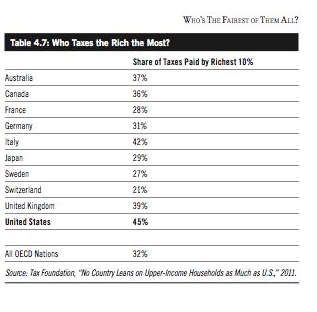
It is said that the 1% need to pay more. In fact, if you confiscated 100% of their wealth, it wouldn’t make a dent in the deficit. It causes division and class warfare. It clearly defies the history of success where “a rising tide raises all boats”.
SO WHAT IS THE ANSWER?
Besides the obvious of spending less, which congress does not have the ability on either side to do, grow the base of taxpayers and more revenue will come in. JFK and Reagan (and other Presidents) proved this so we have history to support this. In fact, the largest year of tax revenue ever by the government was 2007. There are far more complex economic theories, but increase a tax base who are not afraid to spend more, and tax revenue will rise.
CONCLUSION
I don’t think Zuckerberg, Gates and Buffet will leave America if they raise taxes, but many are leaving California (at 2000 per week). If you look at history, we can do more by having an economy that is growing for everyone. By not singling out a specific group, we get the rising tide and an economy shift with more jobs and more tax revenue.
As for the rich French, many are now in Switzerland.
Maybe there will be a lesson in here for them and they can get their tax base back.
Share this:

The Escape Key and The Guy Who Invented Ctl-Alt-Del….and Why
I worked in the PC Group, wisely sold to Lenovo years ago. On the 20th anniversary, they looked for interesting tidbits from those who invented the PC.
David Bradley worked down the hall from me. He’s the guy who invented Ctl-Alt-Del. I asked him why and he told me DOS 1.0 keep crashing, so he wrote a quick and dirty program to restart the computer quickly without having to turn it off.
Later, David was kind enough to give me a copy of his personal copy of DOS 1.0 and Visicalc, a program for which I was a giant at using. I still have it in my original IBM-PC I picked up off the trash pile while working there.
His best line though was when they had a reunion of the PC development team and Dave said to a reporter in front of everyone that he wrote the program, but Bill Gates made it famous.
THE ESC KEY
Bob Bemer invented this key. I never worked with Bob, but per the NY Post, it goes like this:
The key was born in 1960, when an I.B.M. programmer named Bob Bemer was trying to solve a Tower of Babel problem: computers from different manufacturers communicated in a variety of codes. Bemer invented the ESC key as way for programmers to switch from one kind of code to another. Later on, when computer codes were standardized (an effort in which Bemer played a leading role), ESC became a kind of “interrupt” button on the PC — a way to poke the computer and say, “Cut it out.”
Why “escape”? Bemer could have used another word — say, “interrupt” — but he opted for “ESC,” a tiny monument to his own angst. Bemer was a worrier. In the 1970s, he began warning about the Y2K bug, explaining to Richard Nixon’s advisers the computer disaster that could occur in the year 2000. Today, with our relatively stable computers, few of us need the panic button. But Bob Frankston, a pioneering programmer, says he still uses the ESC key. “There’s something nice about having a get-me-the-hell-out-of-here key.”
I, KEYBOARD
Joseph Kay is a senior scientist at Yahoo! Research.
Why do outmoded keys, like ESC, persist? Our devices have legacies built into them. For more than a hundred years, when you wanted to write something, you sat down in front of a typewriter. But computers look different now — they’re like smartphones. It will be interesting to see whether in 10 or 15 years the whole idea of a keyboard will seem strange. We might be saying, “Remember when we used to type things?”
How would we control computers in this future-without-typing? Think of the Wii and Kinect, or even specialized input devices for games like Guitar Hero or Dance Dance Revolution. All might be bellwethers for the rest of computing. We might see a rise in all sorts of input, like voice recognition and audio control — think about Siri.
Share this:

World Record Parachute Jump By Felix Baumgartner, A Round Up Of Coverage and Issues
Here is the video of the jump above.
Here is the video from his chest camera:
Here is a view of all angles of the jump:
http://gizmodo.com/watch-felix-baumgartners-space-jump-from-every-angle-i-1445173582?utm_source=feedburner&utm_medium=feed&utm_campaign=Feed%3A+gizmodo%2Ffull+%28Gizmodo%29&utm_content=Bloglines
On October the 9th, Felix Baumgartner will jump from the edge of space at 120,000 feet, breaking the speed of sound as well as all the records for a human parachuting.
Normally, this would have been only mildly interesting, but I went to school with Fred Kittenger, son of current record holder Joe Kittenger. Fred was one of the nicest, most motivated young men that I went to school with. Unfortunately, his father didn’t seem to be a part of it.
Nevertheless, I was still fascinated with the feat and I liked Fred, plus it was a tremendous show of testicular fortitude which I admired. Many died trying to break his records and given the technology then vs. now, it was quite a feat.
KITTENGER PLUNGE
Kittinger made his highest jump, and set the still unbroken high altitude jump record, on the third and last jump of Project Excelsior. On Aug. 16, 1960, Kittinger lifted off from an old abandoned airstrip north of Tularosa, New Mexico in an open gondola; his pressure suit was his only defense from the harsh environment of near space. At the tests starting altitude of 102,800 feet, Kittinger had 99.2 percent of the atmosphere beneath him.
Then he jumped, and the Beaupre multistage parachute system worked perfectly. After a 13 second free fall, a 6-foot parachute opened and stabilized his fall — this is the one that prevented the spin dummies that had fallen before experienced. After another four minutes and 36 seconds he was down to about 17,500 feet where the main 28-foot parachute opened. He floated the rest of the way to Earth.
BAUMGARTNER’S TECHNOLOGY
Francis F. Beaupre came up with the system built around a series of parachutes that would deploy in sequence to stabilize the pilot. Here’s how the sequence was designed:
Right after bailing out, the pilot would pull a cord to release an 18-inch pilot parachute after a few seconds of delay. Once it was fully inflated, the pilot chute would pull out a 6-foot diameter stabilization parachute. Next would come the main parachute release. It would inflate partway until the pilot passed through 14,000 feet as measured by an aneroid barometer on his person. Passing this altitude would trigger full release of the 28-foot diameter main parachute. It would inflate fully, and he’d make a soft landing on Earth.
Beaupre’s stabilization parachute system worked at altitudes where jet aircraft were normally flying, but it needed to work higher. Aircraft like the X-15 were brushing the fringes of space, and they would need a safe way to bailout of the rocket plane just like pilots did from jet aircraft. So the Aeromedical Research Laboratory at Holloman Air Force Base began a series of high altitude parachute tests where pilots jumped from balloons. This was Project Excelsior.
Project Excelsior wasn’t a long term project. There were just three tests, but they were manned, most famously by then Captain Joseph W. Kittinger Jr.
Here are the 5 biggest risks to making it safely or biting the big one.
Felix talks about the risks, the jump, the record and more.
Red Bull Status Update, Countdown and Information
I wish him luck and hope he makes it. It certainly is a ballsy feat.
For fun, here is a link to 8 of the craziest skydives in history
It even set the record for most live web streams.
Felix hits Mach 1.24, faster than the auto land speed record
Engineering issues that had to be overcome
Share this:

Doug Casey on American Socialism
I was hoping this was not true, but it is his Doug’s point of view.
(Interviewed by Louis James, Editor, International Speculator)
[Skype rings. It’s Doug, as expected.]
L: Hi, Doug. I got the Alan Colmes article you sent. I can see why it got your goat – guess you’ve got a good rant in mind?
Doug: I don’t approve of rants. It’s true that I have strong opinions, and I’m not afraid to express them – but a considered and defensible opinion, even if it’s delivered with conviction, is essentially different from an emotional outburst.
L: Okay, sorry. No rants. But if the other side starts name-calling, we can be forgiven for a little emotion on our side – how does one answer a snarky dismissal of anyone who doesn’t agree with so-called progressives, labeling them “regressives”?
Doug: I’m certainly not above delivering an appropriate and well-deserved insult. An insult is really all that the lame attempts of progressives to shame people into voting for Obama deserve. From a long-term perspective, it certainly doesn’t much matter who wins the coming election; Romney would be just as great a disaster for what’s left of America as Obama, just in slightly different ways, with different rhetoric.
It’s interesting how certain breeds of statist are now re-labeling themselves as “progressives.” I guess they like the sound of the root word – progress – even though they only want progress towards collectivism. They used to call themselves “liberals,” a word which in America used to stand for free minds and free markets. But they appropriated it and degraded it – classical liberals had to rechristen themselves “libertarians.” World-improvers, political hacks, and busybodies in general are excellent at disguising bad ideas with good words, ruining them in the process.
It’s said that “Sticks and stones may break my bones, but words can never hurt me.” But that’s actually untrue; propaganda is a very effective weapon. As Orwell pointed out, if you control the language, you control people’s thinking; and if you control people’s thinking, you control their actions. So I despise the way these types manipulate words.
As for the case at hand, one of the things that annoys me most about Colmes’ vapid article is his dishonest and misleading, albeit conventional, defense of the New Deal – America’s first great lurch towards socialism. He defends all the harm it’s done as a wonderful thing. He repeats the fiction that the New Deal rescued the economy from the last depression. It actually made the Depression deeper, and made it last longer.
L: Do tell.
Doug: Well, to start with, Colmes, a self-appointed whitewasher of American socialism, begins by resting his case on the claim that it is American socialism that has made America exceptional. It’s quite a bold assertion, since socialism as well as fascism are antithetical to everything that was good about America. He really is a cheeky bastard.
L: He calls his socialism “liberalism.”
Doug: Yes, but that too is an Orwellian perversion. As always, we should start with a definition. Around the world, you ask people what a liberal is, and they say something that at least relates to the word’s original meaning: liberals favor liberty. And that’s not just the civil liberties defended by the ACLU, but also economic liberty – meaning freedom to engage in free trade with others. The free market.
But back in the 1930s, socialists like Norman Thomas started to realize that they were never going to persuade the majority of Americans to accept socialism outright, so they changed the name and embarked on a deliberate campaign to implement their agenda, one piece at a time, calling it liberalism. And who could be against that?
L: I’ve read that most of Thomas’ 1932 platform has now become law in the US.
Doug: I believe that’s true. Take a look at this Word document [it will download automatically]. Actually, the same is true of Marx’s Communist Manifesto. But back to today, Colmes’ claim is absolutely ridiculous. Social Security, Medicare, and progressive income taxes have not made America exceptional, but just the opposite; they’ve made it like all the other socialist and fascist countries that cover the face of the globe like a skin disease. They are burdens that have slowed the economy and distorted people’s incentives and ideas.
These programs have, perversely, hurt the poor – the very people they’re supposed to help – the most. They’ve acted to corrupt them and cement them to the bottom of society. They’ve destroyed huge amounts of capital, which would otherwise have raised the general standard of living, redirecting it from production toward consumption. These coercive ideas all originated and were first implemented in Europe before so-called liberals foisted them on Americans, in the name of freedom. It’s quite Orwellian, the way they’ve twisted concepts to mean the opposite of what they once did.
L: Some people would argue that things like Social Security liberate them – free them from fear of poverty in old age.
Doug: That claim shouldn’t be worth answering – but it must be answered, because Boobus americanus believes it. It’s a classic “big lie.” Say it often enough, and people think it’s true. In fact, Social Security acts to impoverish the country, by destroying the incentive to save.
L: How so?
Doug: By taking almost 15% of a person’s wages right off the top, Social Security makes it much harder for a poor person to save money. Worse yet, it makes people think they don’t need to save for themselves; it gives them a false sense of security. Even worse is that the money never really belongs to the presumed recipient; it’s simply another unsecured obligation of a bankrupt government.
Social Security payments should at least be set aside as discrete accounts in each person’s name, and become assets for them. If that money were placed in an individually owned pension plan, with just average management, the results would be many times what people now hope to get. And the plan wouldn’t be a burden to future taxpayers. Social Security is, in fact, just a gigantic Ponzi scheme, where the next generation of young people is forced to support the last generation of old people.
Worst of all, the program causes people to be irresponsible. This is a disaster, because a free society can only exist when everyone takes personal responsibility seriously. It’s a swindle, and it corrupts everyone. No wonder parents can no longer rely on their own children to support them in old age. Maybe the Chinese will lend the US government the money it needs to pay its Social Security obligations…
But the numerous practical failures of a program like Social Security are not the main problem.
The primary problem with a scheme like Social Security is that it’s not voluntary; it’s coercive, which makes it unethical. You can’t force people to do what you think is right and then claim to be liberating them. Alleged freedom from fear of poverty in old age in exchange for theft of wages in the present – and the correct word for taking people’s money without their consent is “theft” – is not liberal in any defensible meaning of the world. It’s brute, “might-makes-right” power clothed in noble-sounding words.
L: Colmes says that Social Security keeps 40% of seniors above the poverty line today, and “helps families with disabilities and those who have lost loved ones.” That’s a bad thing?
Doug: No one seriously thinks they’ll be able to have a decent quality of life on Social Security retirement income alone. Why do you think so many senior citizens are working at Walmart or the like? Colmes is committing the same error Bastiat pointed out 200 years ago; choosing to value immediate, direct, and visible benefits, but ignoring the delayed and indirect costs, which only become obvious later.
The long-term costs of Social Security, Medicare/Medicaid, food stamps, and so forth include bankrupting the country, among other economic consequences. But even more disturbing and damaging is the degradation of once self-reliant people to subservience and dependence, which is what happens when government assumes responsibilities that adult individuals should bear themselves.
For example, Social Security disability benefits are being used as an alternate income source by the unemployed. As of August, 2012, there were about 10.8 million people collecting disability income – that’s a larger number than the entire population of most US states, and up from 8.1 million in 2007, when the Greater Depression began. It can be a great scam, claiming PTSD, unprovable back pain, or a mood disorder. There’s a whole class of ambulance-chasing lawyers that takes these cases on contingency.
L: What about the individuals who try and can’t bear the responsibilities of adulthood?
Doug: The programs exist and have not prevented that from happening; there are plenty of homeless people today. I would argue that most of them are in that position because they’ve developed bad habits. There would be a lot fewer of them if they didn’t get taught from childhood that assuring their own lives and well-being is really the state’s responsibility, not their own. The system is failing these people, but again, that’s beside the point; two wrongs don’t make a right. The whole idea of a government “safety net” is wrong, in principle and practice.
Ideas have consequences in the physical world, and lies, twisted words, and self-contradictory, impossible claims can be extremely damaging. You can’t liberate people by putting them in financial chains.
L: I understand the principles, but many people don’t – or just don’t care. People like Colmes see the parks built by the Civilian Conservation Corps and the infrastructure built by the Works Progress Administration as unmitigated goods, the work given to all the millions employed by the government as life-saving, and the idea of helping those in need to be a moral imperative they don’t question.
Doug: The average person has been handed this party line throughout his life, from teachers in government schools to talking heads on TV. He’s been discouraged from thinking critically or independently. We have two widely shared myths – that Roosevelt’s New Deal cured the Depression and Johnson’s Great Society cured poverty – although both beliefs are counterfactual. It’s pretty much as Will Rogers liked to say: “It isn’t what we don’t know that gives us trouble; it’s what we know that just ain’t so.”
Now a new myth is being hatched, that Obama and Bernanke’s quantitative easing saved the economy. But that will never catch on; it will be totally debunked over the next few years as they destroy both the dollar and the economy.
Colmes seems completely unaware that government programs have costs. The money used to pay the Civilian Conservation Corps and Works Progress Administration workers had to come from somewhere – where? It’s either forcibly taken from current taxpayers, who then can neither enjoy it nor invest it as they prefer – or it comes from taking on debt, which means future taxpayers, who are thereby turned into indentured servants. That money was redirected from whatever uses those who earned it had for it, and put to uses government employees deemed best.
The political process, of course, has a perverse tendency to result in “pork” spending on the most useless, wasteful, and idiotic programs imaginable. It goes for things that are politically productive for the people who control the state, not necessarily economically productive for either society or the taxpayers. But again, this is all secondary to the ethics of the matter; that is vastly more important.
Parks are nice, but should the money to build them have been taken from entrepreneurs struggling to build businesses in the 1930s? Or single mothers in, say, Harlem, struggling to feed their families? It’s the little people who can’t afford the lawyers and accountants needed to cut tax bills who suffer the most.
Coercing people to do what politicians decide is simply unethical.
L: What about the argument that it’s not coercion if the people voted for the politicians who passed the laws that created these programs?
Doug: Essentially another big lie. In the first place, people vote for politicians – who rarely keep promises – not for laws at the federal level. None of these laws were enacted by the people. Second, unless you could get unanimous consent of every person affected, it would still be coercive to people who have committed no crime and want no part of it, and thus unethical.
If 51% of the people vote to enslave 49% of the people, that doesn’t make that slavery right. If 99% vote to enslave 1% – something many of the ignorant, torch-wielding masses seem to be clamoring for these days – it’s still wrong. Ethics is not a matter of popularity contests.
Anything that society wants or needs can, should, and will be provided by entrepreneurs working for a profit.
L: Can you elaborate on that? It’s all fine to criticize stupid ideas, but unless you offer a constructive alternative, what’s the point?
Doug: Indeed. We’re talking about products and services that people regard as necessary or beneficial for society as a whole, but which they say private enterprise wouldn’t provide adequately. Roads, schools, and post offices are frequently cited examples.
Government post offices were a bad idea to begin with – even back in the 1800s when most people thought they were vitally important, a man named Lysander Spooner set up a private company to deliver mail – and do so for less than the government charged. This superior service upset the apple cart, and was outlawed and shut down. Today, everyone knows that UPS and FedEx do a better job than the post office; no sensible person trusts the government when it absolutely, positively has to get there. Between that and email, the post office should have been shut down, rather than propped up, long ago. It now costs taxpayers on t he order of $12 billion a year.
Similarly, there’s a history of private roads going back to previous centuries. The fist transcontinental highway, the old Route 66, was paved with private money. There are private roads in the US and around the world today. It’s simply not true that you need a government to build things that people actually need. You need government roads about as much as you need government cars.
We’ve covered schools and education. The schools are absolutely the last thing the state should do…
L: What about things like the military, police, and courts?
Doug: Well, I would argue that even those should be handled by the private sector, but I understand that many people can’t get away from the idea that these services are core government functions that should not be privatized. That’s because they fear they would not be fair and impartial – though it’s a cruel joke to think that government courts today are fair and impartial. At any rate, I could live with it if government were limited to these core functions; but police and courts are only a tiny fraction of what government does today.
There’s great danger in having the government do anything, quite frankly. But it could be better if more people like Ron Paul or my friend Marc Victor were in office. Check out Victor; he has the potential to be the next Ron Paul – on steroids.
L: Understood: if no one can make a buck providing some good or service, how vital can it be? Anything people actually want will be provided by entrepreneurs, making a profit. And like you, I too like to start by asking what is right, before I ask how much it costs. But most people just don’t seem to think this way. That’s why I keep coming back to the practical arguments. It seems that, regardless of one’s politics, it should matter that the state’s coffers are empty.
Colmes argues that by 2022 Obama’s Affordable Care Act “will provide coverage to 33 million Americans who would otherwise be uninsured.” He doesn’t mention that mandated government spending and interest payments have already taken over the entire federal budget. Even now, with a $1.5 trillion deficit, most of the $700 billion for the military, the $227 billion for interest on the national debt and the $646 billion for regular government services is borrowed every year. The whole thing is an impossible pipe dream that absolutely ensures the bankruptcy of not just the US government, but American society itself.
Doug: It seems insane – people wouldn’t believe us if we’d written this into a story some years ago.
But you can see the scary truth in the news every day; people in Europe’s totally broke and failing economies protest violently in the streets for their governments to spend more money those governments don’t have and won’t be able to borrow. Colmes exhibits this same breathtaking unwillingness to face the facts. He talks about one in seven people being on food stamps, as though it were a good thing. He talks about how politicians voted to extend unemployment benefits with money they don’t have as though that’s an unquestionably good thing to do.
L: So is Colmes an evil manipulator or a misguided dupe?
Doug: I don’t see how any intellectually honest person can write a long article praising a whole alphabet soup of government agencies without ever once admitting their failure, asking how much they cost, or examining the ethical basis for their existence. So I suspect he’s both a knave and a fool.
Colmes’ article encapsulates wrong-headedness and willful ignorance in exactly the same way that Paul Krugman and Thomas Friedman invariably do. They’re all very destructive people. Since they don’t appear to be stupid – in the sense of having low IQs – I’m forced to assume they’re ill-intentioned.
L: So… What’s in it for him to circulate such obviously biased and misleading opinions?
Doug: Perhaps he’s simply a sociopath who gets pleasure from destruction. Or perhaps he’s just motivated by fame and money and has found a profitable gig. Despite being an apologist for socialism, the man hosts a talk show and writes books which make him money; he doesn’t do it pro bono. He has identified a market and is making money, pursuing his own self-interest, deliberately or unwittingly to the detriment of society.
L: Just like a politician.
Doug: He sees the government as the solution to every problem. But since government is pure coercion by its very nature, you can count on it to do the wrong thing – and often even the exact opposite of the right thing.
L: It’s perverse.
Doug: [Laughs] Took the words out of my mouth.
L: Investment implications?
Doug: Nothing specifically related to Colmes. He’s just another sign of the degradation of America, yet another data point supporting my view that the US is probably past the point of no return. The place that was once America is going through the wringer, and so is the rest of the world. And the way to deal with that is what we’ve been saying for some time now: rig for stormy weather.
L: Liquidate, consolidate, speculate, create – and internationalize.
Share this:

2nd Amendment, Who Are the Militia by Allen West
I saw this question by analyst James Governor in an obviously sarcastic tweet a while back during a twitter debate on the 2nd Amendment. I did not want to engage in a useless waste of time in a twitter-fest.
We are protecting ourselves against the government, whether it be in 1776 against the British or today against the socialists trying to ruin the USA. It’s what keeps us from getting arrested for dank memes by the government.
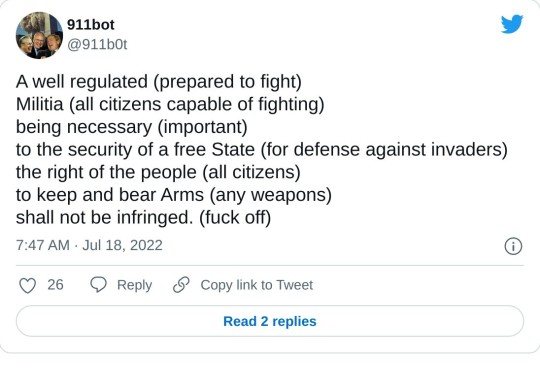
I also did not have as eloquent answer as Allen West, Representative from Florida. An African-American tells how even whites would be held in slavery were it not for the 2nd Amendment as well a lesson in history as to who are the militia and why it exists. Lessons that real Americans know. Commies want to take away guns to control the population, right James?
Allen is a true American hero and forgetting the 2nd Amendment issue, is the standard for which politicians should be held to for integrity.
Here, he defines the enemy:
Also, he notes there are never any anti-gun protesters or appeasers at NRA events. At least they are smart enough for that.
I also note that the cities with the highest crime have the most limited concealed carry laws.
It is about preserving order.
An armed man is a citizen, an disarmed man is a subject.
George Washington: “Firearms are second only to the Constitution in importance; they are the peoples’ liberty’s teeth.”
For those that have questions about why we have guns or that we should ban them, please answer these questions first.
1. How will you get all the guns?
2. How will you stop the bad guys like the Taliban and Al Qaeda from using other weapons?
3. When in history was man not covetous enough to use force to take his neighbor’s property?
4. Prisoners are able to make weapons in prison without gunsmith ability, how will you stop criminals from making guns?
5. The best protection from terror and attack are the best defense or the greater ability for offense. You have now taken that away. What is your protection?
6. When in the history of man have we not been at war somewhere in the world?
So here is the answer. Send your complaints to Allen, but be prepared for a beat down like you’ve never experienced.
Below, Yamamoto was the Commander of the Japanese Forces and architect of the Pearl Harbor attack. He was educated and lived in the US.

Share this:

How Warren Buffet Ends The Deficit in 5 Minutes
Warren Buffett, in a recent interview with CNBC, offers one of the best quotes about the debt ceiling …
“I could end the deficit in 5 minutes,” he told CNBC. “You just pass a law that says that any time there is a deficit of more than 3% of GDP, all sitting members of Congress are ineligible for re-election.”
The 26th amendment (granting the right to vote for 18 year-olds) took only 3 months and 8 days to be ratified! Why?
Simple! The people demanded it.
That was in 1971 – before computers, e-mail, cell phones, etc.
Of the 27 amendments to the Constitution, seven (7) took one (1) year or less to become the law of the land – all because of public pressure. Warren Buffet is asking each addressee to forward this email to a minimum of twenty people on their address list; in turn ask each of those to do likewise. In three days, most people in The United States of America
will have this message.
1. No Tenure/No Pension
A Congressman/woman collects a salary while in office and receives no pay when they’re out of office.
2. Congress (past, present & future) participates in Social Security.
All funds in the Congressional retirement fund move to the Social Security system immediately. All future funds flow into the Social Security system, and Congress participates with the American people. It may not be used for any other purpose.
3. Congress can purchase their own retirement plan, just as all other Americans do.
4. Congress will no longer vote themselves a pay raise.
Congressional pay will rise by the lower of CPI or 3%.
5. Congress loses their current health care system and participates in the same health care system as the American people.
6. Congress must equally abide by all laws they impose on the American people.
7. All contracts with past and present Congressmen/women are void effective 12/1/12.
The American people did not make this contract with Congressmen/women.
Congress made all these contracts for themselves.
Serving in Congress is an honor, not a career.
The Founding Fathers envisioned citizen legislators, so ours should serve their term(s), then go home and back to work.
If each person contacts a minimum of twenty people then it will only take three days
for most people (in the U.S.) to receive the message.
Don’t you think it’s time?
Share this:

Revenge is Sweet, Especially When It Is Fair
“Few things are more satisfying than seeing your own children have teenagers of their own.” – Doug Larson
Share this:

Why Newspapers and The News Are Not Only A Dying Model, But Dead
“I do not take a single newspaper, nor read one a month, and I feel myself infinitely the happier for it.” – Thomas Jefferson
I don’t subscribe to the newspaper anymore, but I got one this morning. I’m sure that it was a teaser to try to get me to subscribe. Upon reading it, I realized I already knew everything in the paper except the local high school football scores from games after I went to bed.
A DYING MODEL
The subscription rates to newspapers are dying, not even a slow death. Similarly, the evening news is also a dinosaur. They report what we knew as much as a full day before.
I am on twitter and read blogs all day long. I occasionally go to the news sites, but as I discuss below, their bias (I hold both left and right guilty equally here) usually makes me fact check what I’m trying to find out which defeats the purpose of fact-finding, especially if it involves politics. That subject is pretty much unavoidable these days.
Nevertheless, I enjoy many other subjects which you could read about it on other blog entries if you have nothing better to do, and I find good information about them that is interesting and INSTANT.
I’m a boomer, although a technically savvy one having been in the IT industry all my life. The Gen X,Y, millennials, and whomever follows them demand even more instantaneous everything virtually dooming the news model of our prior generation. Thank you Internet.
THE END OF THE BASTIONS OF NEWS

We have establish that we are now used to getting information instantaneously. The other reason that the model is dying is that they are biased. This is ok if you are a neo-con or a loony lefty, but for everyone else (the other 80% given 10% on the edges of left and right) we don’t trust them anymore.
Once, these two sources were the basis of our world and local information. Besides being static rather than dynamic, they also have stopped being factual sources of information, rather they are partisan, with Fox on one side and CBS, NBC, ABC, CNN, NBC, MSNBC, NYT, WAPO, LA TImes, Reuters, AP, HuffPo, Local News, Local Papers and most other news sources on the other side of issues. All are positioned in a place that position the facts from a point of view. Some of them blatantly lie. Reporting was supposed to be the facts of the story that let the reader make up their mind on their position.
We’ve actually learned that the news has been biased for at least as long as there has been television, we just didn’t have the instant fact checking that the internet and the other sources have provided.
There is a joke from Bernie Goldberg that said if they had been reporting on Moses at Mt. Sinai, the headline would read “Moses get the 10 Commandments from God, and here are the two that we think are important to you”.
Walter Cronkite said that the Viet Nam war was lost during the time that we were winning. LBJ said that if he’d lost Cronkite, he’d lost America. We’ve since learned that the then “most trusted man in America” was also one of the most biased.
LIFE MOVES ON
Other things have died and we have lived and moved on. Black and white TV, network only channels vs. cable TV and landline phones vs. mobile (cell for those in the US) phones. Such is the fate of newspapers and TV network news. Here is just one fact concerning the NYT declining rates. I’m sure you could find somewhere that their subscriptions are increasing, but this would seem deceitful given the nature of digital delivery.
So am I disturbed by this trend? Actually I didn’t even notice it until I saw the paper in my yard this morning. I haven’t subscribed for news in many years (note: I get the Sunday paper for the coupons as long as they pay for the 1 day delivery – my sister calls me a tightwad but it leads to becoming this).
I get my news from the above stated sources and know more about what is going on than the anchors have time to present in their biases manner.
So as they say, life moves on.
Share this:

Do We Need Bosses Anymore?
I took this idea from “Should we Banish Bosses” by Wendy Appal.
She sums it up like this:
The most valuable things my former bosses did was to share information from above and across the  organization; to set the vision and direction; to jointly set my goals and objectives; to advocate for me and my ideas; to make sure I got salary increases and bonuses; to approve vacation dates.
My former bosses also held me accountable to honor my agreements and commitments, to adhere to the organization’s ethics and standards and to be the best I could be.
One of the most unnecessary functions they performed was the annual performance review. By the time I got my review, the information was so stale, it grew mold and had to be tossed.
A comprehensive list of destructive boss behaviors can be found in the Forbes article. If the list weren’t so real and tragic, it would be funny.
Ideally, bosses are available to advise and counsel, to sooth and encourage, to help build confidence, to motivate and inspire … Ideally a boss is someone who is wise and transmits that wisdom to help their direct reports develop, grow and thrive both personally and professionally.
If part of the problem is the title Boss / Manager, I continued to wonder, what alternative is there?
This took me to “The 31 Signs You are a Horrible Boss”
No one starts out their career trying to be a horrible boss. Yet, it’s amazing what a vast majority of folks seem to accomplish this feat with absolutely no training whatsoever.
Maybe we’re born bad bosses. It just comes naturally.
Hopefully, you can shake off some of the worst traits.
The first step for any addict is recognizing his or her problems. So, start by reviewing the list below.
How many of these do you violate?
These are the 31 telltale signs you are a horrible boss — and what you probably think of each of these points:
While I’m not going to go through all 31, I will call out a few that stuck out for me.
8. There’s constant turnover in your group. People are constantly quitting or being asked to transfer out. Change is good. New blood on the team helps bring in new perspectives. So what if some people left? They weren’t up to the challenge of what you’re building here. It’s not for everyone. It takes a special person to be able to work under you.
This was my last boss at IBM. I got a review that said be more independent, but run everything through me. People left in droves.
Here is the list of thing good bosses should never do courtesy of Leadership Freak
Not doing is one side of finding success.
- Never let the bottom line be the bottom line.
- Never pretend things are ok when they aren’t.
- Never let what you’ve never done be the reason not to try.
- Never get ahead by resenting those who get ahead. – This one is for my boss who is now the Director of PR for Lenovo
- Never let those who aren’t doing something prevent you for doing something.
- Never do on the road what you wouldn’t do at home.
- Never trust anyone who never admits mistakes.
- Never achieve greatness through negativity.
- Never pretend you can do what you can’t.
- Never let others fail before doing everything appropriate to help them succeed.
- “An executive has never suffered because his subordinates were strong and effective.” Peter Drucker
- Never find wisdom in excuses, defensiveness, or blame.
- Never think of loyalty as a gift.
- Never waffle when it comes to taking responsibility.
- Never waver when it comes to giving credit.
- Never make excuses. “Never make excuses. Your friends don’t need them and your foes won’t believe them.” JohnWooden
Bonus: Never create the future by recreating the past.
Share this:

Why Doesn’t Honey Spoil?
For something to spoil there has to be something to spoil it. Honey is almost unique among organic compounds in that it constitutes a “perfect storm” or attributes against spoilage:
Most honey is a supersaturated, the rest is a saturated solution of sugar. Sugar acts hygroscopic, that means it attracts water. Bacteria and some other microorganisms that come in contact with this solution are being desiccated (water is drawn from them into the solution) and explode (ok, ok, they kind of just shrivel, but I like the idea of them blowing up) and die.
This supersaturation of sugar also inhibits the growth of yeast and other fungal spores.
Its pH is 3.26 to 4.48, a killing field for bacteria. Combined with the above-mentioned supersaturation you have both a pH that weakens bacterial walls and a hygroscopic environment. Them bacters don’t stand no chance.
And if all that isn’t enough, bees process honey by means of an enzyme called glucose oxydase which modifies sugar into gluconic acid ( D-glucono-δ-lactone, a contributor to the above-mentioned pH) and hydrogen peroxide. You might know glucose oxidase from something else: it used to be called “Penicillin A” and is now known as Notatin. Poor bacteria, eh?
This is, by the way, why you should never leave a jar of honey standing open. The supersaturated sugar solution will absorb moisture from the air and gradually become weaker, losing its anti-bacterial properties.
One last warning: honey is, as we discover above, rather safe. It does, however, sometimes contain inactive spores of Clostridium botulinum, the bacterium responsible for botulism. Healthy humans don’t get sick from that but infants whose intestinal tract dilutes the honey without digesting it quickly can get sick from it. There is honey that has been radiated with gamma rays to kill those spores dead for good that can be purchased for lots of money. Just wait until the kid is a year old or so and you’ll be safe.
Share this:

The Guarantee of Hyperinflation
Economist John Williams of Watchdog.com describes why we will suffer from hyperinflation that will begin no later than 2014 and why.
Open ended QE will cause treasury debt which leads to long range insolvancy of the US Government. If they had to report income under GAAP (Generally Accepted Accounting Principles) rules, we are losing $5 trillion annually. Taking 100% of peoples income would still not pay for this debt.
We are broke.
Government has been kicking the bucket down the road and the result will be inflation.
The global loss of confidence in the dollar happened with the raising of the debt ceiling last year.
The Fed’s primary goal is to keep the banking system solvent. They haven’t done anything to stimulate the economy.
More evidence that inflation is just around the corner from the Federal Reserve Bank of Dallas.
Share this:

What Are The Biggest Time Wasters of Your Life
I found this from Anuj Agarwal, Founder Feedspot.com. but I wish I’d known about it earlier in life as I could have been more productive.
I’d like to explore what you feel is the biggest waste of time in your life. It could be standing in line, it could be pumping gas, it could be sitting on hold, or watching TV. Or, it could be reading a book (instead of listening to it while you work out and/or do the dishes), doing your taxes, or filling out paperwork for a rebate. Anything’s open.
What I’m after are essentially business ideas that anyone can go out and pursue as a startup if they wanted to.
Common things:
- Anger
- Worry
- Regret
- Procrastination
- Watching TV
- Dwelling on the past
- Not learning from past mistakes
- Trying to change things outside of your control
- Seeking revenge
- Quarreling
- The Internet/Social Media
- Thinking too much about the future
- Working hard and nothing is coming out of it.
- Facebook (2)
- The fear of missing out. – If you feel anxious because you constantly feel like you’re missing out on something happening somewhere else, you’re not alone. We all feel this way sometimes. But let me assure you,you could run around trying to do everything, and travel around the world, and always stay connected, and work and party all night long without sleep, but you could never do it all. You will always be missing something. So let it go, and realize you have everything right now. The best in life isn’t somewhere else; it’s right where you are, at this moment. Celebrate the perhaps not altogether insignificant fact that you are alive right now. This moment, and who you are, is absolutely perfect. Take a deep breath, smile, and notice how lovely it is.
- Avoiding pain and defeat. – Not to spoil the ending for you, but everything is going to be OK – you just need to learn a lesson or two first. Don’t run from the realities of the present moment. The pain and defeat contained within is necessary to your long-term growth. Remember, there is a difference between encountering defeats and being defeated. Nothing ever goes away until it teaches you what you need to know, so you can move on to the next step.
- Holding on to what’s no longer there. – Some of us spend the vast majority of our lives recounting past memories, and letting them steer the course of the present. Don’t waste your time trying to live in another time and place. Let the past, go. You must accept the end of something in order to begin to build something new. So close some old doors today. Not because of pride, inability or egotism, but simply because you’ve entered each one of them in the past and realize that they lead to nowhere.
- Retelling a self-defeating story. – If we continue to repeat a story in our head, we eventually believe that story and embrace it – whether it empowers us or not. So the question is: Does your story empower you? Don’t place your mistakes on your mind, their weight may crush your current potential. Instead, place them under your feet and use them as a platform to view the horizon. Remember, all things are difficult before they are easy. What matters the most is what you start doing now.
- Attempting to fit in by becoming someone else. – The hardest battle you’re ever going to fight is the battle to be you, just the way you are in this moment. We cannot find ourselves if we are always searching for, or morphing into, someone else. In this crazy world that’s trying to make you like everyone else, find the courage to keep being your awesome self. Be your own kind of beautiful right now, in the way only you know how.
- The picture in your head of how it’s supposed to be. – What often screws us up the most in life is the picture in our head of how it’s supposed to be. Although every good thing has an end, in life every ending is just a new beginning. Life goes on – not always the way we had envisioned it would be, but always the way it’s supposed to be. Remember, we usually can’t choose the music life plays for us, but we can choose how we dance to it.
- Berating yourself for not being perfect. – Don’t be too hard on yourself. There are plenty of people willing to do that for you. Do your best and surrender the rest. Tell yourself, “I am doing the best I can with what I have in this moment. And that is all I can expect of anyone, including me.” Love yourself and be proud of everything that you do, even your mistakes. Because even mistakes mean you’re trying.
- Waiting, and then waiting some more. – Stop waiting for tomorrow; you will never get today back. It doesn’t matter what you’ve done in the past. It doesn’t matter how low or unworthy you feel right now. The simple fact that you’re alive makes you worthy. Life is too short for excuses. Stop settling. Stop procrastinating. Start today by taking one courageous step forward. If you are not sure exactly which way to go, it is always wise to follow your heart.
Share this:

Talk Like A Pirate Day
 The pirate speaks,”Today be Talk Like a Pirate day. I haven’t blogged about it in a while, but it be very important t’ enjoy somethin’ this distractin’ from your work. Go t’ talklikeapirateday.com and learn about this important, yet unappreciated day. Celebrate hero’s like Blackbeard instead o’ worryin’ about cowards like the yellow belly in ye old Whitehouse. True Pirates would attack t’ muslims and defeat them like true men. We’d use our cutlass and six pounders t’ defeat them and free t’ world.”

Share this:

Keynesian Policies Keep Failing
It’s not that the Keynesians aren’t smart, nor poorly educated, nor bad economists (at least they studied it to make their economic position), rather it is that they are not students of history. I may have to argue that they are bad economists later though as it has yet to work and is failing again.
Here are 2 articles:
Moving beyond contorted Keynesian Logic.
So what kind of Keynesian world are Bernanke and the other wise ones in Washington shaping for us?
Keynesians see a depression as a lack of aggregate demand — as opposed to Austrians who know a depression is the required cleansing of the malinvestments created by the preceding boom of the government’s making. Policy makers, following the Keynesian playbook, enact policies to stimulate aggregate demand and offset the fall in private investment. On the fiscal-policy side, Keynesians advocate higher government spending. On the monetary side, they insist on lowering interest rates to zero if necessary.
The world has recent experience with attempts at resuscitating a bubble economy. The Bank of Japan cut interest rates six times between 1986 and early 1987 and all that new money caused the Japanese economy to bubble over. As Bill Bonner and Addison Wiggin write in Financial Reckoning Day Fallout,
the problem with all money is that it is as fickle and unreliable as a bad girlfriend. One minute she goes along with the flow. The next minute she turns silly and bubbly. And then, she gives you the cold shoulder.
The prolonged period of low interest rates created one of the largest domestic bubbles in the world. For a brief moment in 1990, the Japanese stock market was bigger than the US market. The Nikkei-225 reached a peak of 38,916 in December of 1989 with a price-earnings ratio of around 80 times. At the bubble’s height, the capitalized value of the Tokyo Stock Exchange stood at 42 percent of the entire world’s stock-market value and Japanese real estate accounted for half the value of all land on earth, while only representing less than 3 percent of the total area. In 1989 all of Japan’s real estate was valued at US$24 trillion which was four times the value of all real estate in the United States, despite Japan having just half the population and 60 percent of US GDP.
“The Japanese asset bubbles were identical to other asset bubbles in the sense that they were essentially inflated by credit,” writes Asian bank regulator Andrew Sheng in his book From Asian to Global Financial Crisis.
Banks lent to highly leveraged developers to buy real estate against inflated collateral values, which then fueled the bubble further. Asset prices bore no realistic relationship to their return on capital, particularly since cost of funding was exceptionally low. The minute the credit stopped, the bubble began to deflate, and the main victims were the banks themselves.
After the bubble popped in Japan, that government pursued a relentless Keynesian course of fiscal pump priming and loose fiscal policy with the result being a Japan that went from having the healthiest fiscal position of any OECD country in 1990 to annual deficits of 6 to 7 percent of GDP and a gross public debt that is now 227 percent of GDP. “The Japanese tried to cure an alcoholic with heroin,” writes Bonner. “Now, they’re addicted to it.”
Japan’s monetary policy was to aggressively lower rates to .5 percent between 1991 and 1995 and has operated a zero-interest policy virtually ever since.
Between 1992 and 1995, the Japanese government tried six stimulus plans totaling 65.5 trillion yen and they even cut tax rates in 1994. They tried cutting taxes again in 1998, but government spending was never cut. Also in 1998, another stimulus package of 16.7 trillion yen was rolled out nearly half of which was for public-works projects. Later in the same year, another stimulus package was announced, totaling 23.9 trillion yen. The very next year an ¥18 trillion stimulus was tried, and, in October of 2000, another stimulus for 11 trillion was announced. As economist Ben Powell points out, “Overall during the 1990s, Japan tried 10 fiscal stimulus packages totaling more than 100 trillion yen, and each failed to cure the recession,” with Japan’s nominal GDP growth rate below zero for most of the five years after 1997.
After five years in an economic wilderness, the Bank of Japan switched, during the spring of 2001, to a policy of quantitative easing — targeting the growth of the money supply instead of nominal interest rates — in order to engineer a rebound in demand growth.
The move by the Bank of Japan to quantitative easing and the large increase in liquidity that followed stopped the fall in land prices by 2003. The Bank of Japan held interest rates at zero until early 2007, when it boosted its discount rate back to 0.5 percent in two steps by mid year. But the BoJ quickly reverted back to its zero interest rate policy.
In August of 2008, the Japanese government unveiled an ¥11.5 trillion stimulus. The package, which included ¥1.8 trillion in new spending and nearly ¥10 trillion in government loans and credit guarantees, was in response to news that the Japanese economy in July suffered its biggest contraction in seven years and inflation had topped 2 percent for the first time in a decade.
Newswire reports said the new measures would include assistance to the agriculture sector, support for part-time workers to find better employment, and rebates on toll roads. Additional spending was also to flow to healthcare, housing, education, and environmental technology.
Just this past April, the Japanese government announced another ¥10 trillion stimulus program. This was after Japan’s economy shrank by a record 15.2 percent annual rate in the first quarter of 2009. This drop was on the heels of a 14.4 percent drop in the fourth quarter of 2008.
Last month, Reuters reported that the Bank of Japan reinforced its commitment to maintaining very low interest rates and may provide even further easing. “The bank said that it would not tolerate zero inflation or falling prices.” The bank left its policy rate at .1 percent and analysts see the rate staying low possibly until 2012.
According to Reuters, the Japanese government “is fretting over the risk of the economy flipping back into recession and is pushing the bank for action.” Economy flipping back into recession? Are they kidding? Japan’s GDP at the end of this year will be no higher than it was in 1992–17 lost years.
“After 17 years of bailouts and stimulus programs, the Japanese should be getting good at them,” write Bonner and Wiggin. “But it’s a little like a guy who’s getting good at suicide — if he’s so good at it, you’d think he’d be dead already.”
But Keynesians are wont to grade on a curve. Nobel laureate and New York Times columnist Paul Krugman, for one, points to Japan’s fiscal stimulus packages as having “probably prevented a weak economy from plunging into an actual depression.”
And finally, here is a video on Keynesian Economics.
Share this:

Things Airline Pilots Won’t Tell You
A collection of stories written by pilots
I’m an airline pilot flying domestically under the banner of a major airline. Most people are unaware of how much of their flying is done by a “regional” airline. Regional airlines today fly a huge percentage of the actual seat miles flown for their Major airline partner (Delta, United, US Air, etc.). However we are paid a fraction of what the major airline pilots are paid, and even these major airline pilots are paid significantly less than their counterparts several years ago.
Many regional airline first officers make the same as your friendly pizza delivery driver. (It is typical for most of them to make no more than 16K/year the first year.)Here are a few things we won’t tell you:-Don’t drink the coffee. The potable water the aircraft is serviced with is absolutely disgusting. Chemicals are inserted into the water tanks to prevent bad things from growing, but the bad taste of the coffee isn’t the coffee–its the chemicals…
Many regional airline first officers make the same as your friendly pizza delivery driver. (It is typical for most of them to make no more than 16K/year the first year.)Here are a few things we won’t tell you:-Don’t drink the coffee. The potable water the aircraft is serviced with is absolutely disgusting. Chemicals are inserted into the water tanks to prevent bad things from growing, but the bad taste of the coffee isn’t the coffee–its the chemicals…
-We don’t know where we are most of the time… (kidding for the most part) In all actuality there are much more sophisticated avionics units on most small general aviation aircraft. Those units display many aspects of geographic awareness where most of ours simply display the route that we programmed in the flight management computer before departure. We can tell you how far away we are from the next navigation facility and where we are in general terms, but aside from that and what we can see out the window, we typically only have a general idea of where we are when at cruise altitude. Of course we all carry maps, but not too many of us will open the map and follow our progress on a 3 hour flight. (That all changes as we begin descending toward the airport. Situational Awareness is extremely important then.)
-We forget about the fasten seatbelt sign all the time. When you look up at the sign (and disregard it typically) and it has been illuminated for the last 45 minutes in smooth air, we simply forgot. Lots of guys will leave it on all the time. However, sometimes we do have reports of choppy air ahead and will leave it on until we either experience it or take a wild guess that the air ahead will be smooth.
Some of us carry guns. This is certainly public knowledge, but Federal Flight Deck Officers can carry a firearm in the cockpit. Lots of protocol exists to ensure that the training, concealment, and utilization is standardized.
They never announce, “That was close !!” As in, a near mid-air encounter with other air traffic.Only from personal experience and asking the pilot as I disembarked from the aircraft, can I relate this story.Landing at Newark airport in 1986, I was sitting in a window seat about mid section, left side of the plane. I was looking out of the window for a good view of NYC. After seeing that, I was watching the area around the airport as we came in to land. We were about 300′ altitude, or less, and all of a sudden I was stunned to see another plane taking off. It was very close as it took off, nearly underneath our plane as it was climbing out. I don’t know how close we were, just that I could see the passengers in the windows of the other plane close enough to see if they were male or female. My view only lasted about 5 seconds, but I thought they were my last! When I got to the front of the plane and the pilot was standing there I said, “That was close…?” He said, “No, not really.” Very calmly.
I wonder how often that happens, and I bet they NEVER tell the passengers that piece of news!
Most pilots won’t tell you that “air traffic control delays” aren’t really ATC’s “fault”; these delays would be better termed “overscheduling delays”.The vast majority of what the airlines and system term “ATC delays” are actually from a pretty simple supply-and-demand situation. There’s too many airplanes (demand) trying to land in a limited number of arrival slots (supply) at a given airport over a given time period.Airports have what are known as “arrival rates”. A standard, one-runway airport with well-designed taxiways (including “high speed” taxiways) can safely handle, in good weather, around 60 operations an hour- one per minute.
This can be 60 landings in an hour, or 60 takeoffs in an hour, or 30 of each, or whatever combination you want to come up with, but that’s about the limit.
(This is a bit of an oversimplification with really good design, you can usually depart faster than arrive, but bear with me for now.)
So say you’ve got this airport, and say it’s got more than enough gates for all the airlines and planes that want to use it. The only limiting factor is that 60/hour number, right?
Yeah- until crappy weather shows up. Now they can only land 30 planes per hour.
Unfortunately, the ATC system- run by the FAA- does not regulate how many flights can be scheduled into an airport. (That’s what deregulation gave us.) So the airlines that operate in there all schedule as many as they think they can get passengers for.
So during this hour, the airlines have scheduled 60 arrivals, but only 30 planes can land because it’s a cloudy, rainy day.
What happens to the other 30 flights? They get delayed.
And who delays them? ATC.
And what do the airlines call these delays? “Supply and demand delays”? “Weather delays?” Nope.
“ATC delays.”
But the reality is that they’re overscheduling delays. If the airlines and/or the airports would limit the number of flights to the BAD weather limits, the number of delays in the system would be massively shrunk.
That the Airbus A320 is known to have routine cockpit power outtages. And that this plane that you are on right now, which is among the most popular in the world, might not be fixed!
Such as United Flight 731 which “had no way to communicate with air traffic controllers or detect other planes around them in the New York City area’s crowded airspace.” [1]That “France-based Airbus told NTSB investigators in 2008 that 49 electrical failures similar to the Newark emergency happened on its planes in the U.S. and abroad before that episode. Nearly half involved the loss of at least five of six cockpit displays.” [1]And…that a mere 46 hours and $6,000 is the only thing holding back every single plane in the air from this crucial upgrade due to “economics”
The Airbus A320 family includes the A318, A319, A320 and A321 models — passenger jets with 100 to 220 seats.
And you wonder why I take trains and boats????
Note: these came from other people and I don’t guarantee 100% accuracy
Share this:

9/11, 11 Years Later…A Roundup of Posts



Today we remember the 11th anniversary of the worst attack against America on our home soil. This year, it is mildly different as the perpetrator, Osama Bin Laden is now dead due to the bravery of Seal Team 6 (video of the actual operation here).
I congratulate the president on executing the mission to attack him, although it would have been better if we had been able to waterboard him for more information. I believe that except for the most rabid of pacifists, most Americans would have been happy to give the same order.
Likewise, we should give credit to the Bush administration for setting up the intelligence network and the extracting and the correlation of the intelligence that lead to his demise. So a great number of people who contributed should share in the credit and be praised for a job well done.
Here is a round up of coverage during the day regarding this anniversary. I’ll gladly include any other coverage that is respectful and accurate.
We could have captured Osama before 9/11 but let him get away
Fortunately, we didn’t close Guantanamo Bay
Enhance interrogation on KSM helped find OBL
How and why we failed to coordinate the evidence about 9/11
The makings of the next attack which could be nuclear
Rudy Guilinani: The Pain Stays, the Fight Goes On
American’s prepare to mark the anniversary of 9/11
United Airlines Flight 175 South Tower 9:03 a.m.
American Airlines Flight 11 North Tower 8:46 a.m.
5 words and 2 numbers – the note from the 84th floor
9/11: Remembrance, Resolve, Action
9/11: Americans remember attacks on 11th Anniversary (Photos)
Allen West’s statement on the 9/11 Attacks
I post this to remind those like Junaidah Dahlan, who got offended because I blogged that Islam produced the terrorists, but the facts show that it is true. Almost every terrorist attack is Muslim Junaidah. Go be offended somewhere else and for a real reason.
Share this:

The Best News For PowerPoint Users Since Its Creation
From this link, Jeff Bezos says it is the end of PowerPoint.
To be honest, I don’t really give a flying fig or a rats rump about either Bezos or his product, but PowerPoint has always been a crutch that rarely connects emotionally with the audience. Of all the tools we’ve used, it must rank lowest on the rung of real importance when compared with the time wasted compared to other tools.
The author explains it:
In no way am I advocating that you ditch PowerPoint. I am recommending that you ditch PowerPoint as we know it—dull, wordy, and overloaded with bullet points. Image-rich presentations work effectively because pictures appeal to the right hemisphere of the brain—the emotional side. You can have great ideas backed up by data and logic, but if you don’t connect with people emotionally, it doesn’t matter.
START FROM THE BEGINNING
Back in the dark ages, companies used overhead projectors and presented “foils”. This was the forerunner to PowerPoint only you had to manually change them. Given the projector fails I’ve seen, it at least was more reliable, albeit archaic.
It was a hoot to watch people try to figure out how to configure a projector or a multi-media room to get their PC to connect. Entire sessions have had to be conducted without PowerPoint due to operator or machine error. For the most part, they were likely more productive meetings.
THE DEARTH OF OUR EXISTENCE BEGINS AND CREATES MANY JOBS
The jobs being created were PowerPoint slide creators. A pretty easy job if you were ahead of the curve. The only caveat was unrealistic executives who thought they were presenting to the UN. One VP of Social Business Evangelism at my last company used to put us through 20 changes minimum, often commenting that it was not what she wanted. When asked what it was, the comment was usually, “I don’t know what I want, just go fix it and bring me back what I want”. On a humorous note, one time we brought back version one as a ruse and she commented now that is what I really wanted to begin with, why didn’t you bring me this to start with? Go figure.
THE HUMAN PROBLEM
A big problem with PowerPoint is that it rarely could tell the story on its own, and that it depends on the human presenting it. My favorite observation during analyst briefings was the game that they played to try to get the executives off their slides and onto a tangent. It was my job to get them to stay on topic, but for fun I let it stray…even nodding to the analyst to let them know I knew what the game was.
Also, everyone goes to the page count to see the torture they will be put through. That in itself is an indicator of its usefulness. At one meeting, there were 137 charts by the GM of our group. There was a collective groan by all, and a cheer when it got interrupted by a fire drill. Hardly anyone returned for the finish.
So basically as a tool it is deficient and a serious time suck. It also is held up as the idol of meeting communications similar to how executives fret over a press release as if it was what anybody actually read or re-quoted. I’ve got news for you guys, we could actually do without both.
A GENERATION OF SLACKERS
What also chaffed my behind was that those held up as PowerPoint experts created a job niche that in reality was a re-cycle exercise. Once you knew the executive, you could re-use their charts with minor changes and act like it was some big production….then kick back and act like it was a Renoir.
IF YOU HADN’T NOTICED…..
I loathe PowerPoint. I have been working with office suites since the introduction of Visicalc. I’ve always been able to master them down to a coding level, but I rank PowerPoint at the bottom of my list of usefulness. Worse than this were knock-offs like Symphony that even the company that created it wouldn’t use it except for the division responsible for it.
I’ve always been far more engaged by a speaker who could tell a story in words and be effective. Ahead of that is a genuine discussion without the high school drama of charts. You always have to send documentation after a meeting anyway, so dispensing with this for an engagement tool always mirrored the way people have interacted over the years. In reality, it wasn’t the next best thing.
Share this:

EU to Force Diversity to 40%, Good or Bad?
I read a recent article documenting that the EU is requiring 40% Women on their company’s boards. Having a diverse set of views and opinions is good for a company rather than cronyism that could lead to all kinds of incestual behavior, which many can find evidence of.
THE CAVEAT
The diversity should come from talent and competence rather than by law or Force Majeure from induced shame. Without this step, the forced diversity could overlook a true leader or worse, pick those who could lead a company in the wrong direction, or be an empty suit (or dress).
The EU Justice Commissioner Viviane Reding is proposing to introduce legislation at commission level to force private companies with over 250 employees or who are listed on the stock exchange to have at least 40% women making up their boards.
To try and tell a private company who are the real creators of wealth how the should administer themselves is a step too far and one that could prove detrimental for Europe; particularly if companies decide to headquarter themselves elsewhere.
Listening to RTE News at One on the Radio earlier they were interviewing some woman (can’t recall her name) who was in favor of this, and wait for it, because “men focus too much on the bottom line”! The absolute cheek of them, to actually think a company should maximise it profits 
Gender quotas will not help Europe’s boardrooms, what they will do is ensure that women are appointed to boards who are currently not viewed as capable of running a company. This can only be bad for private companies in the long run, if in fact they can any longer be called private if the EU is dictating who should run them.
WE’VE BEEN DOWN THIS PATH BEFORE
I’ve witnessed the intrusion of diversity and have observed it’s successes and failures. Many (of all minorities) have had doors opened to them that were previously closed. It has turned out many leaders other than the old boys Ivy league club which created a glass ceiling.
Unfortunately, it has promoted unqualified people to positions to fill quota’s over the more qualified candidate.
At one company I worked for, the VP of HR killed a commercial for our company because the actors were eating lasagna. Why is this bad, because they were African-American and stated that it was not a meal they would eat. Another female VP of Marketing is avoided like the plague because of her terroristic behavior towards employees. She also routinely would promote “not men” because of their gender. A typical male executive would have been fired for this. These are but a couple of examples, but the list of abuses goes on because they can lean on diversity, but that belies the point of hiring the best candidate for the job rather than filling a quota
Share this:

Why I Don’t Need an Alarm Clock
This is how I get up in my house……every day although an occasional face lick may come with it. I still love my dog though.

Share this:

The PC is Toast, Or Maybe Just a Toaster
Gone are the glory days when the PC would rule over the vaunted Mainframe, putting power at desks without the overbearing DP department overcharging and under delivering past the due date.
What has evolved though is a commodity product that is at best a commodity like a toaster. You can buy one anywhere to toast your productivity suite, cloud connection or corporate image. Further, the once dominant Wintel model is being out-cooled by Apple, and outdated by tablet computing.
First, I was mildly shocked when I learned that Lenovo had a policy where you get an allowance and use what you want to, regardless of who made it. Next comes the inevitable…..
While this isn’t really new news, in fact it’s been a theme for a while now. But it was confirmed by the lackluster performance of HP, Dell and other manufacturers. Even IBM, the company that really put the PC in the office of businesses is famous for dumping the low margin business to Lenovo who lucked out in marketshare due to the HP and Dell screw-ups. This will be short lived as soon as Apple finishes mopping up in China and the real Lenovo cash cow gets malnourished.
All Things Digital confirms the facts via DRAM supply:
As a signpost on the road to the so-called Post-PC Era we’ve been hearing about for so many years, this one is pretty hard to argue with: As of this year, personal computers no longer consume the majority of the world’s memory chip supply.
And while it may not come as a terrible surprise to anyone who’s been paying attention to personal technology trends during the last few years, there’s nothing like a cold, hard number to make the point crystal clear.
Word of this tipping point came quietly in the form of a press release from the market research firm IHS (the same group formerly known as iSuppli). The moment came during the second quarter of 2012. For the first time in a generation, according to the firm’s reckoning, PCs did not consume the the majority of commodity memory chips, also known as DRAM (pronounced “DEE-ram”).
During that period, PCs accounted for the consumption of 49 percent of DRAM produced around the world, down from 50.2 percent in the first quarter of the year. The share of these chips going into PCs — both desktop and notebooks — has been hovering at or near 55 percent since early 2008, IHS says.
As shifts in market share statistics go, it at first seems insignificant until you consider the wider sweep of memory chips in the history of the modern technology industry. PCs have consumed the majority of memory chips since sometime in the 1980s. IHS couldn’t say when exactly when the first personal computers started showing up in appreciable numbers in homes and businesses.
And where are all those memory chips going? Tablets and smartphones for starters. IHS says that phones consumed more than 13 percent percent of memory chips manufactured, and it expects that figure to grow to nearly 20 percent by the end of this year. Tablets — including the iPad — consumed only 2.7 percent of the world’s memory chip supply. The remaining 35 percent, which IHS classifies as “other,” includes servers, professional workstations, and presumably specialized applications like supercomputers and embedded systems.
And given their rates of growth, IHS expects phones and tablets combined to consume about 27 percent of the world’s memory by 2013, while by that time PCs will consume less than 43 percent, making the decline, in the firm’s estimation, irreversible.
Even the much hyped Windows 8 launch doesn’t really do much. WRAL goes on to say:
Dell executives also indicated that the company is unlikely to get a sales lift from the Oct. 26 release of Microsoft Corp.’s much-anticipated makeover of its Windows operating system. That’s because Dell focuses on selling PCs to companies, which typically take a long time before they decide to switch from one version of Windows to the next generation.
HP’s screw up came when they tried to become an IBM clone. Dell had their own set of issues as reported by the AP:
Coming off a five-year stretch of miscalculations, HP is in such desperate need of a reboot that many investors have written off its chances of a comeback.
Consider this: Since Apple Inc. shifted the direction of computing with the release of the iPhone in June 2007, HP’s market value has plunged by 60 percent to $35 billion. During that time, HP has spent more than $40 billion on dozens of acquisitions that have largely turned out to be duds so far.
“Just think of all the value that they have destroyed,” ISI analyst Brian Marshall said. “It has been a case of just horrible management.”
Marshall traces the bungling to the reign of Carly Fiorina, who pushed through an acquisition of Compaq Computer a decade ago despite staunch resistance from many shareholders, including the heirs of HP’s co-founders. After HP ousted Fiorina in 2005, other questionable deals and investments were made by two subsequent CEOS, Mark Hurd and Leo Apotheker.
HP hired Meg Whitman 11 months ago in the latest effort to salvage what remains of one of the most hallowed names in Silicon Valley 73 years after its start in a Palo Alto, Calif., garage.
The latest reminder of HP’s ineptitude came last week when the company reported an $8.9 billion quarterly loss, the largest in the company’s history. Most of the loss stemmed from an accounting charge taken to acknowledge that HP paid far too much when it bought technology consultant Electronic Data Systems for $13 billion in 2008.
HP might have been unchallenged for the ignominious title as technology’s most troubled company if not for one its biggest rivals, Dell Inc.
Like HP, Dell missed the trends that have turned selling PCs into one of technology’s least profitable and slowest growing niches. As a result, Dell’s market value has also plummeted by 60 percent, to about $20 billion, since the iPhone’s release.
That means the combined market value of HP and Dell — the two largest PC makers in the U.S. — is less than the $63 billion in revenue Apple got from iPhones and various accessories during just the past nine months.
So now you can go to a consumer electronics store or go online and pick up a PC, a video game and a toaster, all about the same difficulty of decision. The model is dying and a new paradigm is taking place somewhere between mobile devices and tablets with a combination likely just around the corner, but your Thinkpad is a gravestone in the near future.
It is now reported that Mobiles are the devices most turned to for online activity, banking and other internet activity.
“Cell users now treat their gadget as a body appendage,” Lee Rainie, the Director of the Pew Research Center’s Internet & American Life Project, told Mashable. “There is striking growth in the number of people who are taking advantage of the growing number of functions that these phones can perform and there isn’t much evidence yet that the pace of change is slowing down.”
The study, released yesterday by Pew Internet concludes that cellphone usage is increasing in basically every department, especially online activities. One in two people now check their email on their phone, up from 19% in 2007 and the number of Americans surfing the web on-the-go has doubled too, going from 25% in 2008 to 56% today.
People are also starting to be less reluctant to use their phones for sensitive activities that were almost considered taboo in a recent past, like online banking. Almost one in three Americans (29%) now use their phones to check their bank account, a considerable increase from just one year ago, when only 19% did. And one in three people are using their mobile device to look for health information as well. Just two years ago that figure was as low as 17%.
Phones are also becoming a substitute for other traditional devices like photo and video cameras. 82% of people who responded to the survey use their phones to snap pictures and 44% use it to record videos
Share this:

Thought For the Day: Shut Up and Be Smarter
 Mostly for the media, but I’m sure it fits many you already know.
Share this:

20 Years Ago Today, Hurricane Andrew and 175 MPH Winds Bore Down on Florida Like an Atomic Bomb
 If you look dead east to the hurricane, you’d find where I lived 20 some odd years ago. It hit like an atomic bomb that make south Florida look like Hiroshima.
It sounded like a freight train all night long. We had a new born and were mighty scared for hours. Fortunately, it moved fast and was over by the next day.
I had to crawl out of a window with a chain saw to cut a tree off of my front door so that we could get out of the house. We were lucky as it was a relatively compact storm and hit only about 40-50 miles south of where our house was. That was the difference between our house standing vs. being a pile of bricks.
Share this:

When You Feel Like Slapping Someone Who Needs It
 Mostly the media and the double speak of certain candidates….and the double standard of who is held responsible for what.
Share this:

Elvis Died On This Day and Madonna Was Bornalso
Not that I care anymore, about any of them.
Also, the Giffords (Kathy and Frank) were born this day.
But the most famous thing is that Elvis died this day in 1977, on the toilet
Here’s a throwback to 1986 – Core Introduces New PC where I was a spokesman for the company…..
Here is a quote that notes I’ll vanquish my foes:
From the cradle to the grave, fighting, rightly understood, is the business, the real, highest, honestest business, of every son of man. Every one who is worth his salt has his enemies, who must be beaten, be they evil thoughts and habits in himself or spiritual wickedness in high places, or Muslim terrorists, or Border-ruffians, or Bill, Tom, or Harry, who will not let him live his life in quiet till he has thrashed them.
Share this:

Rod Stewart – Stay With Me
Whenever I need a pick me up when working out or just riding in the car, this is the song that does it for me. I even blew a speaker to this song when I turned it up too loud. I’m still proud of that.
So if you need a pick me up that is as good as a 5 hour energy, take a listen.
Share this:

Milton Friedman Would have been 100, Still One Of The Best Economists Ever
Economists have either followed Friedman or Keynes for Economic Theory over the last century. Keynes is being used currently and you can judge the results for yourself. For me, it does not seem to work, nor has history shown it to have worked for any of the presidents who have based their administration on Keynesian theory anywhere in the world.
I quote one of the best authors of our generation on economics for this article.
If Milton Friedman were alive today — and there was never a time when he was more needed — he would be one hundred years old. He was born on July 31, 1912. But Professor Friedman’s death at age 94 deprived the nation of one of those rare thinkers who had both genius and common sense.
Most people would not be able to understand the complex economic analysis that won him a Nobel Prize, but people with no knowledge of economics had no trouble understanding his popular books like “Free to Choose” or the TV series of the same name.
In being able to express himself at both the highest level of his profession and also at a level that the average person could readily understand, Milton Friedman was like the economist whose theories and persona were most different from his own — John Maynard Keynes.
Like many, if not most, people who became prominent as opponents of the left, Professor Friedman began on the left. Decades later, looking back at a statement of his own from his early years, he said: “The most striking feature of this statement is how thoroughly Keynesian it is.” No one converted Milton Friedman, either in economics or in his views on social policy. His own research, analysis and experience converted him.
As a professor, he did not attempt to convert students to his political views. I made no secret of the fact that I was a Marxist when I was a student in Professor Friedman’s course, but he made no effort to change my views. He once said that anybody who was easily converted was not worth converting.
I was still a Marxist after taking Professor Friedman’s class. Working as an economist in the government converted me.
What Milton Friedman is best known for as an economist was his opposition to Keynesian economics, which had largely swept the economics profession on both sides of the Atlantic, with the notable exception of the University of Chicago, where Friedman was both trained as a student and later taught.
In the heyday of Keynesian economics, many economists believed that inflationary government policies could reduce unemployment, and early empirical data seemed to support that view. The inference was that the government could make careful trade-offs between inflation and unemployment, and thus “fine tune” the economy.
Milton Friedman challenged this view with both facts and analysis. He showed that the relationship between inflation and unemployment held only in the short run, when the inflation was unexpected. But, after everyone got used to inflation, unemployment could be just as high with high inflation as it had been with low inflation.
When both unemployment and inflation rose at the same time in the 1970s — “stagflation,” as it was called — the idea of the government “fine tuning” the economy faded away. There are still some die-hard Keynesians today who keep insisting that the government’s “stimulus” spending would have worked, if only it was bigger and lasted longer.
This is one of those heads-I-win-and-tails-you-lose arguments. Even if the government spends itself into bankruptcy and the economy still does not recover, Keynesians can always say that it would have worked if only the government had spent more.
Although Milton Friedman became someone regarded as a conservative icon, he considered himself a liberal in the original sense of the word — someone who believes in the liberty of the individual, free of government intrusions. Far from trying to conserve things as they are, he wrote a book titled “Tyranny of the Status Quo.”
Milton Friedman proposed radical changes in policies and institution ranging from the public schools to the Federal Reserve. It is liberals who want to conserve and expand the welfare state.
As a student of Professor Friedman back in 1960, I was struck by two things — his tough grading standards and the fact that he had a black secretary. This was years before affirmative action. People on the left exhibit blacks as mascots. But I never heard Milton Friedman say that he had a black secretary, though she was with him for decades. Both his grading standards and his refusal to try to be politically correct increased my respect for him.
Thomas Sowell is a senior fellow at the Hoover Institution, Stanford University, Stanford, CA 94305. His website is www.tsowell.com.
He also wrote this:
When both unemployment and inflation rose at the same time in the 1970s —”stagflation,” as it was called — the idea of the government “fine tuning” the economy faded away. There are still some die-hard Keynesians today who keep insisting that the government’s “stimulus” spending would have worked, if only it was bigger and lasted longer.
This is one of those heads-I-win-and-tails-you-lose arguments. Even if the government spends itself into bankruptcy and the economy still does not recover, Keynesians can always say that it would have worked if only the government had spent more.
Although Milton Friedman became someone regarded as a conservative icon, he considered himself a liberal in the original sense of the word — someone who believes in the liberty of the individual, free of government intrusions. Far from trying to conserve things as they are, he wrote a book titled “Tyranny of the Status Quo.”
Milton Friedman proposed radical changes in policies and institutions ranging from the public schools to the Federal Reserve. It is liberals who want to conserve and expand the welfare state.
As a student of Professor Friedman back in 1960, I was struck by two things — his tough grading standards and the fact that he had a black secretary. This was years before affirmative action. People on the left exhibit blacks as mascots. But I never heard Milton Friedman say that he had a black secretary, though she was with him for decades. Both his grading standards and his refusal to try to be politically correct increased my respect for him.
Share this:

Will Rogers Gets It Right on Our Government Spending
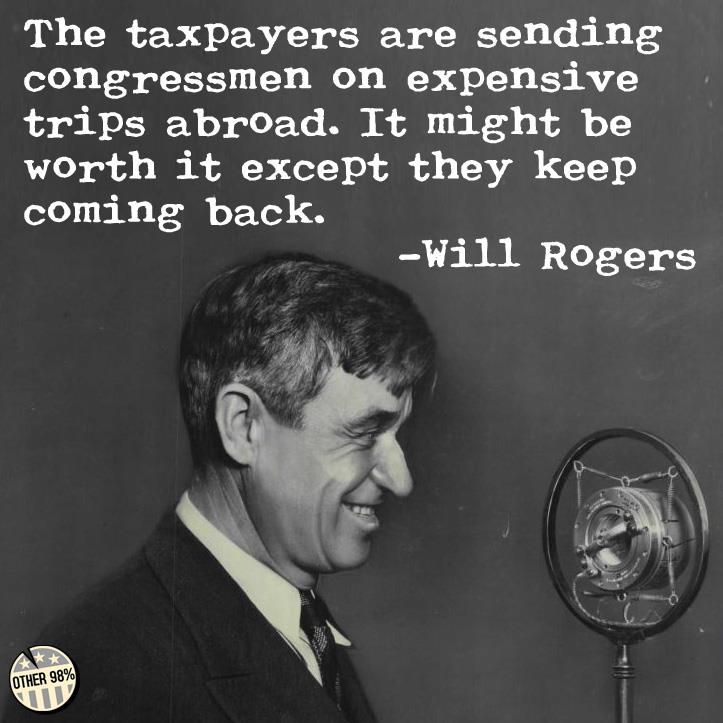
Share this:

Dan Cathy Of Chick-fil-A, A Genuine Person
A true leader who built a business by standing for what he believed in. Now he is being discriminated against by those against discrimination. Hated by those who say they are against hate.
Mr. Cathy goes about the success of Chick-Fil-A and serves, hires and buys from those who say they hate what he believes in. Who is the hypocrite?
UPDATE: Cathy sticks to his guns.
As you can see, he is not picking on any group, rather is giving to what he believes in. Just because you aren’t a politically correct lemming doesn’t make you against something, it is your right to have an opinion. He can run his company the way he so desires. Those who believe otherwise to make a statement by starting their own business and supporting their desired group, rather than trying to change everyone else.
For many months now, Chick-‐fil-‐A’s corporate giving has been mischaracterized. And while our sincere intent has been to remain out of this political and social debate, events from Chicago this week have once again resulted in questions around our giving. For that reason, we want to provide some context and clarity around who we are, what we believe and our priorities in relation to corporate giving.
A part of our corporate commitment is to be responsible stewards of all that God has entrusted to us. Because of this commitment, Chick-‐fil-‐A’s giving heritage is focused on programs that educate youth, strengthen families and enrich marriages, and support communities. We will continue to focus our giving in those areas. Our intent is not to support political or social agendas.
As we have stated, the Chick-‐fil-‐A culture and service tradition in our restaurants is to treat every person with honor, dignity and respect – regardless of their belief, race, creed, sexual orientation or gender. We will continue this tradition in the over 1,600 restaurants run by independent Owner/Operators.

Political correctness has made us a nation tolerant only of “one-legged opinions,” a friend of mine recently observed. We take a stand on a hot issue, but only on one leg at a time, shifting when necessary so as not to offend the beliefs of others—but never standing solidly on two feet.
Like a modern day parable, the story of a lone, courageous businessman has taught us what it means to be guided by truth, rather than political fad.
Dan Cathy is the Chief Operating Officer of Chick-fil-A, a privately owned chain of quick service restaurants with annual sales of $4 billion. The company is ranked the 10th fastest growing retailer in the country, although Chick-fil-A restaurants close their doors every Sunday, the best sales day of the week for those in this business sector.
Cathy recently expressed his belief that marriage is the union of a man and…
View original post 876 more words
Share this:

Gun Control and Our Constitutional Rights, Once Politicians Get Their Foot In the Door…It is the Beginning of the End of Our Rights
My deepest sympathy goes out to the families in Colorado. The killer was an idiot, but if we didn’t have guns he would have found another way to do what he did. He was evil and had his mind made up already. I am not afraid to call evil what it is and history shows they will do what they do with whatever tool they can find. People blow themselves up in the middle east which he may have done the same thing last week. Booby trapping his apartment showed he thought he was going to die anyway.
THE POINT OF THIS POST
What galls me is the politicizing of this tragedy by some who have an agenda. I do not wish to get into left vs. right on this discussion as it is about protecting our constitutional rights. Once they take one away, they can take any or all of them with precedent
I disagree with Mayor Bloomberg, Attorney General Holder, and those who are using this event in order to get rid of our 2nd amendment rights, and we know who they all are. Here are some sentiments from others who agree on the T shirt below. The box is the IQ level of those who think gun control works and would have stopped this madman. Even the UN is trying to take away our right to bear arms.


Steve Chapman discusses it further here:
When someone is ill or anxious to avoid illness, he may be open to any possible treatments. That’s why quack remedies, untested formulas and obvious placebos often find takers. When a mass shooting occurs, the urge to find a cure is powerful. As a rule, though, those that emerge are sugar pills.
A nation with very few guns, exceedingly tight firearms restrictions and little interest in such weaponry would not experience these atrocities as often as ours does. But in a society with hundreds of millions of guns and huge demand for them, as well as high rates of violent crime of all sorts, the challenge borders on the insurmountable.
The tactics of the alleged killer in this case serve gun control supporters as a roadmap to what should be done. He had an AR-15 “assault weapon,” proving we should prohibit these guns. He had a magazine that can hold 100 cartridges, dramatizing the need to restrict magazine capacity. He bought some 6,000 rounds over the Internet, suggesting that the government should outlaw large purchases or monitor anyone who makes them.
All these conclusions sound perfectly plausible. And none of them offers any prospect of averting the next massacre.
Take the danger posed by “assault weapons.” It turns out the one recovered in Aurora, Colo., might have been illegal under the federal ban that was in effect from 1994 to 2004. Sen. Dianne Feinstein, D-Calif., calls for reviving that law on the ground that “these are weapons that you are only going to be using to kill a lot of people in close combat.”
What she and many others don’t realize is that “assault weapons” are functionally indistinguishable from ordinary semi-automatic hunting rifles. They don’t fire more rapidly, they don’t deliver more lethal rounds, and they don’t “spray” bullets. They only look like military arms.
The features that disqualified a gun under the federal ban were ones that didn’t affect destructiveness, such as pistol grips and bayonet mounts. If accused killer James Holmes had been prevented from buying this gun, he could have found plenty of others that would have served his purpose just as well.
Almost everyone who buys an AR-15 uses it to hunt small game or perforate targets. The number of customers who obtain guns like this only “to kill a lot of people in close combat” is just slightly above zero — a market that would be far too small to induce a company to make them.
Holmes reportedly equipped his rifle with a 100-round magazine — compared to the maximum of 10 allowed under the old federal law. But limiting magazine size would most likely be an exercise in futility.
In the first place, a halfway competent shooter can quickly replace an empty magazine with a fresh one, or else switch to another gun. (Holmes allegedly used three and had a fourth.)
The brief interruption a killer needs for reloading is helpful only if someone can seize the moment to subdue him — something more common in movies than in real life. Florida State University criminologist Gary Kleck says he knows of only one mass shooting in which that happened, in 1993. In the 2011 Tucson shooting, the suspect was overcome when his gun jammed after he reloaded.
Tracking anyone who makes large ammunition purchases? David Kopel, research director at the free-market Independence Institute in Denver, points out that more than a billion rounds are sold each year in the United States — many of them in bulk by target shooters who burn through hundreds or thousands every month.
If the Bureau of Alcohol, Tobacco, Firearms and Explosives were to investigate each of these buyers, it would have little time to do anything else. And it would probably catch no criminals, since they would buy in smaller lots to avoid detection.
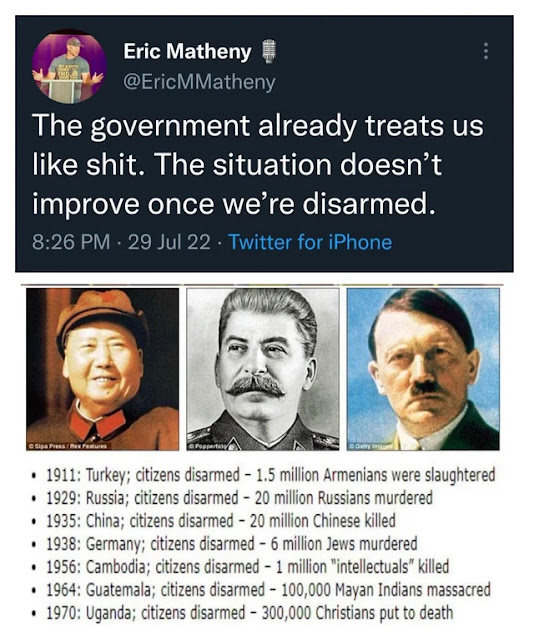
Besides, most of the rounds that Holmes allegedly bought lay idle. The quantity of ammunition he is said to have used could have been obtained in a few purchases that would set off no alarms. The rest of his fearsome stockpile had no bearing on the outcome.
Ideas like these are proposed anytime a mass shooting takes place but lately, at least, never go anywhere. Supporters take that as proof of the vast, unhealthy influence of the National Rifle Association. But it could be Americans just have no appetite for soluti ons that don’t solve.
How well did that work out for those countries? Bad guys have guns and if we take them away from those who are responsible and will defend others, the bad guys have already won. History has proven that.
Share this:

How Not to Succeed At A Job Fair

Share this:

Having A Bad Day? It Could Be Worse
 When you think you’ve got it bad…..be thankful because you could be just one step away from it being worse.
Share this:

Why the 2nd Amendment Matters – By the Japanese Leader of the Pearl Harbor Attack
 This was from the guy that was the architect of Pearl Harbor. He was educated in the US and understood the 2nd Amendment better than the anti-gun activists do today.
Share this:

HOW COMPUTERS ARE MADE


One of the Problems With Big Companies is Their Middle Management
 There has been a dearth of articles about middle management issues with big companies recently. Vanity Fair had a great article about how stacked performance reviews has killed innovation at Microsoft, but it really described the problems with most big companies. The irony was that it pointed out how Microsoft made fun of IBM, yet Microsoft had now repeated the same mistakes they IBM has suffered from for years.
Additionally, not to exonerate any big company, all of which have middle management problems, many also have stacked performance reviews which clearly has caused a big morale problem at companies I worked for which is also documented in the article at Microsoft. From what I’ve heard from my associates around RTP, most of the companies (with the exception of NetApp) including but not limited to IBM, , Lenovo, and many others use this type of employee rating. See Stacked Performance reviews below for a further discussion.
FIRST LINE MANAGERS, ONE OF THE WORST JOBS
When I worked as a plumber, they told me I only had to know 3 things to be qualified. They were; 1) payday is Friday, 2) $h!t flows downhill and 3) the boss is an a$$h0le. This is basically true in a lot of jobs. The first line manager has to usually do their regular job, plus be a people manager for which most aren’t trained for and most are not good at. They have extra work for the same pay just on the promise that they would get ahead, which almost none do. It may finally pay off for some, but only when they reached VP or higher. Directors have to take it from the VP’s, but at least can delegate the crummy work to the first line managers.
The reason this job is such a loser is that while you have to deal with the day to day issues, in this economy your managerial duties are to basically give bad news that there are little to no raises, people are being laid off so be happy you’re still working….also that there won’t be any bonuses this year. I watched these managers get dumped on by their next level of management as they had to do the dirty work (some then got laid off just after they let others go). Very few made it past this level of management as there just are so may executive jobs available, and there are many vying for those positions. Plumbers rule numbers 2 and 3 apply here.
Here is an excerpt from Forbes which describes the problem with middle management.
I watched this phenomenon also ruin morale at my last company and David Williams nails some points starting here:
In my opinion, a company needs leaders—not managers.
What does that a leader look like? We start with two of our 7 Non Negotiables of leadership—we Trust and then we Empower. You know how leaders will typically say “I empower my people”—and then they don’t? The tendency is all too common. (This happened in my last job before I retired. I was told by my then manager to be more independent, but I had to run everything by my him before I did anything, and trusted the opinion of a new hire over my review of a meeting that said new hire didn’t attend…talk about lack of trust and sending mixed messages to your employees).
The minute there’s a mistake it’s like a rope around your neck that snatches back—you either get your head taken off, or you get yanked back so hard the natural reaction is to hunker down and become “less” instead of growing to “more.”
With my own paired leadership partner, Fishbowl president Mary Michelle Scott, we start at the top of the company with a holistic, high altitude view of what we want to achieve. Then we bring in the department captains (there are 3 pairs) and say, “This is what we’re thinking. We think it’s time to open up Canada, the UK and South Africa.”
We give that big piece of meat to the captains. They chew on it for a while and come back with either 1) they don’t like it (generally coupled with a counter proposal), or 2) the multiple ways they see to go about achieving the goal. The captains are leaders who play a core role in the strategy’s formation. Then they run the day-to-day deployment of the strategy that’s been jointly created and set.
Yes, there’s a fine line between leadership and management—but there’s a massive difference as well, I maintain. Our approach makes the groups and leaders autonomous, but also interdependent. They are bright. All voices are heard. We decide on the “best” idea, no matter who originates it, and most of the time, we actually forget who brings the idea forward. Nobody worries about “the glory” because all will benefit as a team (my compensation strategy is here.) They come up with better answers than we could ever hope to achieve on our own.
(Editors note here: My view as the author of this blog is not everyone is cut out to be a manager. There are a lot who think that it is their career path or a way to get ahead, but that doesn’t make them qualified. I had a few managers who just were not people persons. Some middle managers held success against the top achievers when they out-performed the manager, or couldn’t handle the fact that some made more than others including the manager. They shouldn’t have let this guide their decisions, but they did. People like this shouldn’t have been allowed to be managers. This guy also used age discrimination while at IBM to get rid of a competent worker, Bill Gesick and wouldn’t re-hire Sid Baker, a veteran coming back from Iraq and Afghanistan. Further, this person whom his employees named Mr. Feckless bragged that he tried to get rid of me (because I (made more money that he did) as well as bragged at how he gave no extra pay to others, which everyone promptly told me about. I just tried to consistently do good job and was always more successful than he was with work. An example is this success story which I kept him out of on purpose so he couldn’t ruin it. It was how I had to deal with him as did his peer managers as well as his boss (who later told me he wanted to get rid of him and would have had the company not been sold to Lenovo). It is a clear case of a person that should have had a staff job.
Why leaders hear too many questions? – From The Leadership Freak
You’ve delegated tasks rather than results, vision, and resources. Delegating tasks is too granular and suggests your need for granular involvement. Delegating tasks causes others to focus on tasks. Delegating vision along with resources frees good people to make decisions on their own.
You may hear too many questions because you don’t have clear processes and procedures. People ask too many questions when they aren’t sure what’s next. Establishing processes and procedures for repeated activities frees both leaders and employees.
On the other hand: The best leaders/managers I worked for had the following trait.
The captains don’t “manage” every day. They have just one meeting as captains per week. That meeting determines the deployment of strategy. We hand off to the captains—then they hand off to the teams, who hand off to the individuals who deploy day to day, and then they get out-of-the-way (as they resume their own production roles, side by side with their teams.)
Here is some advice on how to manage properly if most would take it.
Yes, there are some management components. But we try to stay away from the temptation to micromanage, which makes people so fearful of making a mistake, they feel they don’t dare to create something courageous. (Note: This happened with another manager who said she wanted each of us to take charge, but just couldn’t leave our work alone until we wound up having to do it as if we were her. This made it very hard for our team as we all had different styles… none of them matched with the manager. This of course killed our creativity and morale as we had to try to do things in the style as if we were her, all the while knowing that we knew how to do our jobs better and knew our area’s deeper. The micro-management ruined our chances to succeed as well as our motivation). We had to report every detail constantly making each task taking five times longer with way more revisions than it could have taken. She was one of the last managers I had, and certainly not a leader .
.
Conversely, the manager I had before her gave me the freedom to succeed by macro managing and encouraged me to try my own ideas which drove me to want to give it everything I have. This fueled my creative juices including starting this blog and joining twitter. I also wanted to help others learn social media, something the following manager didn’t support except by hiring a noob who turned out to be a loafer to basically handle tweet wrap ups.
The link above best describes how to do it this way:
Some managers fear empowering team members because a more powerful team might take some action or a make a decision that the manager would not have made. But you can’t over-control your teams. It’s the responsibility of a manager to know what’s going on but not to micro-manage.
It’s best if you can pick your own team and hire motivated workers who will inspire and enthuse other team members.
That 2nd manager of our Cross Brand team thought that she owned the ability to communicate and this just made it hard for us to get our jobs done. The employees grouped together for self preservation.
The Leadership Freak comments appropriately here:
You may hear too many questions because you’re a control freak (see my micro-manager above). Your people are paralyzed by your need to know, control, and direct details. On a personal note, I don’t think of myself as a control freak, but I am. I mention that because you may not see your freakishness. In my opinion, leaders tend to be control freaks. Don’t toss this possibility aside without thinking it over.
You may hear too many questions because your people lack experience or need training.
You may hear too many questions because you punish rather than learn from mistake makers. Begin honoring both the lessons learned from and the persons with the courage to make mistakes. Obviously, mistakes from negligence, insubordination, or sabotage shouldn’t be honored.
Not all questions are good questions. Some questions indicate poor leadership. Are you hearing too many questions?
ANOTHER MANAGEMENT ISSUE: HOW STACKED PERFORMANCE REVIEWS ARE KILLING INNOVATION
Eichenwald’s conversations reveal that a management system known as “stack ranking”—a program that forces every unit to declare a certain percentage of employees as top performers, good performers, average, and poor—effectively crippled Microsoft’s ability to innovate. “Every current and former Microsoft employee I interviewed—every one—cited stack ranking as the most destructive process inside of Microsoft, something that drove out untold numbers of employees,” Eichenwald writes. “If you were on a team of 10 people, you walked in the first day knowing that, no matter how good everyone was, 2 people were going to get a great review, 7 were going to get mediocre reviews, and 1 was going to get a terrible review,” says a former software developer. “It leads to employees focusing on competing with each other rather than competing with other companies.”
Blog Editors note: At my last company, we also had to compete against equal employee “bands” (level of experience commensurate with pay and responsibility) across the company. This was especially unfair for remote employees as those in the home office of New York had access to the management and knew the strategy well before it was disseminated.
TELECOMMUTERS ARE DISCRIMINATED AGAINST
The millions of Americans who are skipping out on the daily commute may also be losing out on a promotion.
These so-called ‘telecommuters’ are less likely to receive positive performance reviews from superiors than their colleagues who show up in the office, a new study by MIT Sloan Management Review shows.
The report chalks up much of the discrepancy to managerial subjectivity. Managers are less likely to be comfortable with a worker they don’t actually see on a regular basis. In fact, they may become more irritated with someone who they perceive isn’t available at all times. Telecommuting employees are also less likely to reap the benefits of showing up early and leaving work late than their commuting coworkers.
Advances in internet technology have allowed for telecommuting to become more widespread. About 20 percent of workers worldwide report that they telecommute, while 10 percent report that they work from home on a regular basis, according to a recent Ipsos/Reuters poll. That same poll found that 34 percent of workers, when asked, stated that they would telecommute on a regular basis if they could.
But according to some critics, telecommuting creates cause for concern. For instance, telecommuting could prevent workers from being able to fully understand what their managers ask of them, according to PC World. That’s because non-verbal facial expressions are an important component of the workplace that telecommuting, which often takes place over instant messaging or phone, doesn’t allow.
This definitely happened at my last job even though they claimed it was not true. If you did not work in NY (it was an old boys club with both men and women), you didn’t stand a chance for promotion unless you were in the High Potential (HyPo) group, which means you were destined for NY eventually. What was almost funny was that some of the senior management even made fun of those not in NY as if we had a lower IQ. In fact, we knew we could do the same job for 30% less cost of living and didn’t have to go to NY, we just knew that we would only go so far unless we moved there.
I’ve had managers who didn’t trust you if you weren’t there. He projected his own lack of work ethic at home on the team. Each of us were mature responsible workers, except for the middle manager.
One of my favorite worst management lines ever was on the first day of a new job, the manager said to me, “I’m too busy with my new job, you are on your own to figure out how to do your job”. He since has been demoted to a staff job after not succeeding at another company and came back to IBM.
16 THINGS SUCCESSFUL LEADERS NEVER DO – BY LEADERSHIP FREAK
Not doing is one side of finding success.
- Never let the bottom line be the bottom line.
- Never pretend things are ok when they aren’t.
- Never let what you’ve never done be the reason not to try.
- Never get ahead by resenting those who get ahead. – My former boss Ray G.
- Never let those who aren’t doing something prevent you for doing something.
- Never do on the road what you wouldn’t do at home.
- Never trust anyone who never admits mistakes.
- Never achieve greatness through negativity.
- Never pretend you can do what you can’t.
- Never let others fail before doing everything appropriate to help them succeed.
- “An executive has never suffered because his subordinates were strong and effective.” Peter Drucker
- Never find wisdom in excuses, defensiveness, or blame.
- Never think of loyalty as a gift.
- Never waffle when it comes to taking responsibility.
- Never waver when it comes to giving credit.
- Never make excuses. “Never make excuses. Your friends don’t need them and your foes won’t believe them.” JohnWooden
Bonus: Never create the future by recreating the past.
CONCLUSION
We can’t get away from having middle management, but companies need to vet who they let be in that position via a better method. They should also give them better training and most of all, realistically set their expectations of the chances of moving up. If they did this, it would weed out those who are only doing the job to move up or to get paid more. Most however, are doomed to stay there and live with plumbers rules numbers 2 and 3.
Share this:

Does Telecommunting or Working At Home Hurt Your Career?
A new study suggests workers are judged harshly for not showing up at the office. Despite advances in teleworking, smartphones, and Skype, face time, it seems, really does matter.

- Getty Images
- Working from home might not work for you.
Professors, Kimberly Elsbach of the University of California, Davis, and Daniel Cable of London Business School, looked at perceptions of employees’ performance based on whether they were in the office or not. The research measured “passive face time,” which is simply time spent in the office, regardless of whether the staffer is working hard or not.
The results aren’t pretty for employees who would rather work remotely, according to an article Elsbach and Cable wrote in MIT Sloan Management Review.
Workers who are seen at their desks during regular work hours are considered “responsible” and “dependable,” they wrote: “Just being seen at work, without any information about what you’re actually doing, leads people to think more highly of you.”
Work longer hours — early, late, or on weekends — and “rather than just being considered dependable, you can get upgraded to ‘committed’ and ‘dedicated,’” according to the article, which referenced a paper Elsbach and Cable published in the academic journal Human Relations.
Bosses, and peers, often don’t realize they’re forming views of workers’ competence based on whether they’re at their desk, Cable said in an interview with The Wall Street Journal.
“Without us knowing it, we are creating these assumptions about people based on physical presence,” he said. This isn’t just a perception. Bosses’ vague feelings that a worker does a better job can be seen on employee evaluations, especially when they’re encouraged to make subjective calls in performance reviews.
That leads to pay, promotion, and career-trajectory decisions. Cable estimates that more than 60% of companies are still using “1950s-style” evaluations that prioritize such subjective write-ups over hard data on sales wins, customer satisfaction, or other measures of the employee’s business performance.
So what can employees do to counter this pigeonholing, especially those who want to work from home?
If working long hours from the office isn’t an option, employees might consider sending emails early in the morning or late at night, to prove they are on the job at all times. They might also try using their time in the office to build strong connections to co-workers and superiors, like going to lunch with people or organizing in-person meetings?
Meanwhile, managers should be aware that they may be discounting remote workers’ contributions, albeit subconsciously. (Or, they may be monitoring their home-based workers, as The Journal’s Sue Shellenbarger writes.)
“The bottom line is that employees should be wary of work arrangements that reduce their office face time, and supervisors should be wary of using trait-based performance measures, especially when evaluating remote workers,” the article said. “Finally, employees working remotely need to make sure they are evaluated on objective outputs. Barring that, you might consider sending an e-mail to your boss tonight . . . say, around midnight.”
YOU ARE LESS LIKELY TO BE PROMOTED ALSO
According to an MIT study by the Sloan Management Review, you are less likely to get ahead:
The millions of Americans who are skipping out on the daily commute may also be losing out on a promotion.
These so-called ‘telecommuters’ are less likely to receive positive performance reviews from superiors than their colleagues who show up in the office, a new study by MIT Sloan Management Review shows.
The report chalks up much of the discrepancy to managerial subjectivity. Managers are less likely to be comfortable with a worker they don’t actually see on a regular basis. In fact, they may become more irritated with someone who they perceive isn’t available at all times. Telecommuting employees are also less likely to reap the benefits of showing up early and leaving work late than their commuting coworkers.
Advances in Internet technology have allowed for telecommuting to become more widespread. About 20 percent of workers worldwide report that they telecommute, while 10 percent report that they work from home on a regular basis, according to a recent Ipsos/Reuters poll. That same poll found that 34 percent of workers, when asked, stated that they would telecommute on a regular basis if they could.
But according to some critics, telecommuting creates cause for concern. For instance, telecommuting could prevent workers from being able to fully understand what their managers ask of them, according to PCWorld. That’s because non-verbal facial expressions are an important component of the workplace that telecommuting, which often takes place over instant messaging or phone, doesn’t allow.
But this doesn’t excuse managers from giving otherwise stellar employees poor reviews just because they telecommute, Daniel Cable of London Business School and co-author of the MIT Sloan report told The Wall Street Journal. Approximately 60 percent of firms still use highly subjective employee review standards that prioritize manager write-ups over hard data, Cable told WSJ. This often results in managers promoting sub par employees over superior candidates that telecommute.
STACKED REVIEWS
Most corporations are using stacked reviews. This obviously pits employees against each other rather than trying to beat the competition. Stay at home employees are working at a disadvantage here as the in office workers can brown nose their way to places that home workers can’t. Here’s how it works.
Eichenwald’s conversations reveal that a management system known as “stack ranking”—a program that forces every unit to declare a certain percentage of employees as top performers, good performers, average, and poor—effectively crippled Microsoft’s ability to innovate. “Every current and former Microsoft employee I interviewed—every one—cited stack ranking as the most destructive process inside of Microsoft, something that drove out untold numbers of employees,” Eichenwald writes. “If you were on a team of 10 people, you walked in the first day knowing that, no matter how good everyone was, 2 people were going to get a great review, 7 were going to get mediocre reviews, and 1 was going to get a terrible review,” says a former software developer. “It leads to employees focusing on competing with each other rather than competing with other companies.”
FIRSTHAND EXPERIENCE, BAD OFFICE MEMO OF THE YEAR
At IBM, if you don’t go to New York, you don’t get ahead. That is where the club is. The current Senior Vice President, Marketing and Communications said that Raleigh was “Smallville with no chance of going anyone going anywhere if you stay here” at a town-hall meeting with all the communications folks in attendance. Jaws were dropping all over the floor and it was the topic of conversation for days. This was after he gave a speech that was supposed to be about communications careers, but was just an obviously recycled presentation that had been given to a different audience about EPS. Everyone saw through it and no one got why he came to un”motivate” the troops. IBM’s current vice president of external relations publicly made fun of the south as if NY was the mecca of IQ on a global call of all Comms folks. Everyone mentioned how short sighted this was and what a limited view of what different populations worldwide had to offer (there were multiple IM sessions going on around the world on this clear example of prejudice and ego centrism). Despite their high salaries, we are the smart ones spending more time with our kids and paying over 30% less in cost of living. Plus we don’t have to live in New York and work with them especially since this guy yells and cusses you out way more than HR should allow.
I personally turned down 2 offers to move to NY to get ahead. I’d been there many times and knew the unofficial rules that you had to be there to get anywhere. I didn’t want to raise my kids there and my family was more important to me than a job. Because of that, I was labeled someone who didn’t want to climb the ladder which was fine by me, so I worked in the pack and was passed over for promotions after that. My family is much better off having grown up where we wanted to live and I don’t regret it a minute. My kids are killing the NY public school kids at college. Plus, I would never send them to a den of socialism like Columbia or any other schools up there. I need them to get a real education.
But the fact remains, you run a severe risk of not getting ahead if you don’t show up at the office. Many will be able come up with some successful work at home employee story, but only to a certain level…. then you have to be in their face at the office. Either way, it is expected that you’ll check into work at all hours of the night and weekends anyway.
There was one manager in a group I worked for that sent out a “rules of the road” memo (bad office memo of the year) that said if you weren’t working in the office, you weren’t considered really working. Talk about generating trust on your team! He was viewed by his peers as the worst manager of the entire group, I was just lucky to have had the experience of working with him.
OFFICE COOLER TALK
You do miss out on hall meetings that allow you to find out things home workers miss. It allows you to get ahead of the telecommuters on the first news or get into the executives office at a moments notice. That is a drawback, but not enough to call me in. When they sold the building I was working in and asked who wanted to be a home worker, my hand was up faster than Arnold Horshack to get out of there.
The flip side is you have to hear all the office gossip which I was glad to miss. It is too distracting and usually it is never good about anyone, only what they are doing wrong, who is sleeping with whom or what some are getting away with.
Some people need the social interaction and have to be in the office for people contact. I’m perfectly happy to miss that as most of it is idle banter that takes away from productivity. I also don’t miss the hour commute.
Overall, I wouldn’t trade the home office for a cubicle anywhere, anytime. Being at home has more perks.
Share this:

Happy Birthday to My Dog




It is now a year later and my dog is 12 today. The average lifespan of Boxer according to my vet is “around” 8-10 years, so I’m living on borrowed time.
I named her after the dog in Jonny Quest because she had a black face like the dog in the cartoon.
Since I’ve worked at home the whole time we’ve had her, she has been my day pal. Now that my son has gone off to college, she is definitely my dog and I’m very attached to her.
Recently, I watched Marley and Me and I couldn’t bear the thought of losing her. Fortunately, she is still full of energy and looks like she’ll be around for a while.
I’ve posted about her over  the years, some of them being the most read entries I’ve written.
After the story of Shoep and John here is the link I am especially sensitive to her longevity and day to day life. She has had cancer surgery and still has the energy to love my family, although she is especially attached to me. It is mutual.
Here are some of the best of links:
Share this:

July 4th 2012, Top Posts Round-up

 First of all if you read the dates on the gravestone, Happy Birthday Mom.
So it’s Independence Day, declared in 1776 from the rest of the World. The USA has in its short life (compared with other countries) given more to others in benevolence, freed and saved more people, helped former enemies to recover, sacrificed more than others and established a new way of running a country other than a Monarchy. Unlike the Monarchy’s around the world, the land wasn’t taken from others in a border dispute war or outright takeover like those we declared freedom from….. and has contributed more development, medicine and technology than most other countries combined. So why are our leaders trying to run it in a way that has failed?
Ronald Reagan said, “The American dream is not that every man must be level with every other man. The American dream is that every man must be free to become whatever God intends he should become.”
Most of this is a blessing from our Creator, mentioned in all the documents of the Founding Fathers, yet the government of today is trying to leave that model and get back to the type of behavior we declared independence from. Why?
First, let’s start off with the Star Spangled Banner.
Here is a round-up of the best posts for today.
Michelle Malkin – Happy 236th Birthday
John Ransom – Washington’s First Fourth
America joining the One World Crappola from the Daily Kos instead of celebrating why we are different (see our Judeo-Christian history) I tried finding something patriotic just for fairness, but it’s just a different world view I guess
America Haters from the Usual sources, Hollywierd
The other America Haters – The Media
Paul Greenberg – The American Idea
Rasmussen poll – Liberty and Justice for all
Speaker Boehner’s Independence Day Tribute: “Here’s to the Spirit of ‘76”
Joshpundit – America’s Birthday Edition (lots of links here)
Robert Samuelson – Love of Country 2012
Fleming: What Life Was Like in 1776
For levity, The Hot Dog eating contest where an American is the favorite
Finally, here is the Declaration of Independence, from tyranny and taxes. Have we come full circle?
IN CONGRESS, July 4, 1776.
The unanimous Declaration of the thirteen united States of America,
When in the Course of human events, it becomes necessary for one people to dissolve the political bands which have connected them with another, and to assume among the powers of the earth, the separate and equal station to which the Laws of Nature and of Nature’s God entitle them, a decent respect to the opinions of mankind requires that they should declare the causes which impel them to the separation.
We hold these truths to be self-evident, that all men are created equal, that they are endowed by their Creator with certain unalienable Rights, that among these are Life, Liberty and the pursuit of Happiness.–That to secure these rights, Governments are instituted among Men, deriving their just powers from the consent of the governed, –That whenever any Form of Government becomes destructive of these ends, it is the Right of the People to alter or to abolish it, and to institute new Government, laying its foundation on such principles and organizing its powers in such form, as to them shall seem most likely to effect their Safety and Happiness. Prudence, indeed, will dictate that Governments long-established should not be changed for light and transient causes; and accordingly all experience hath shewn, that mankind are more disposed to suffer, while evils are sufferable, than to right themselves by abolishing the forms to which they are accustomed. But when a long train of abuses and usurpations, pursuing invariably the same Object evinces a design to reduce them under absolute Despotism, it is their right, it is their duty, to throw off such Government, and to provide new Guards for their future security.–Such has been the patient sufferance of these Colonies; and such is now the necessity which constrains them to alter their former Systems of Government. The history of the present King of Great Britain is a history of repeated injuries and usurpations, all having in direct object the establishment of an absolute Tyranny over these States. To prove this, let Facts be submitted to a candid world.
He has refused his Assent to Laws, the most wholesome and necessary for the public good.
He has forbidden his Governors to pass Laws of immediate and pressing importance, unless suspended in their operation till his Assent should be obtained; and when so suspended, he has utterly neglected to attend to them.
He has refused to pass other Laws for the accommodation of large districts of people, unless those people would relinquish the right of Representation in the Legislature, a right inestimable to them and formidable to tyrants only.
He has called together legislative bodies at places unusual, uncomfortable, and distant from the depository of their public Records, for the sole purpose of fatiguing them into compliance with his measures.
He has dissolved Representative Houses repeatedly, for opposing with manly firmness his invasions on the rights of the people.
He has refused for a long time, after such dissolutions, to cause others to be elected; whereby the Legislative powers, incapable of Annihilation, have returned to the People at large for their exercise; the State remaining in the mean time exposed to all the dangers of invasion from without, and convulsions within.
He has endeavoured to prevent the population of these States; for that purpose obstructing the Laws for Naturalization of Foreigners; refusing to pass others to encourage their migrations hither, and raising the conditions of new Appropriations of Lands.
He has obstructed the Administration of Justice, by refusing his Assent to Laws for establishing Judiciary powers.
He has made Judges dependent on his Will alone, for the tenure of their offices, and the amount and payment of their salaries.
He has erected a multitude of New Offices, and sent hither swarms of Officers to harass our people, and eat out their substance.
He has kept among us, in times of peace, Standing Armies without the Consent of our legislatures.
He has affected to render the Military independent of and superior to the Civil power.
He has combined with others to subject us to a jurisdiction foreign to our constitution, and unacknowledged by our laws; giving his Assent to their Acts of pretended Legislation:
For Quartering large bodies of armed troops among us:
For protecting them, by a mock Trial, from punishment for any Murders which they should commit on the Inhabitants of these States:
For cutting off our Trade with all parts of the world:
For imposing Taxes on us without our Consent:
For depriving us in many cases, of the benefits of Trial by Jury:
For transporting us beyond Seas to be tried for pretended offences
For abolishing the free System of English Laws in a neighbouring Province, establishing therein an Arbitrary government, and enlarging its Boundaries so as to render it at once an example and fit instrument for introducing the same absolute rule into these Colonies:
For taking away our Charters, abolishing our most valuable Laws, and altering fundamentally the Forms of our Governments:
For suspending our own Legislatures, and declaring themselves invested with power to legislate for us in all cases whatsoever.
He has abdicated Government here, by declaring us out of his Protection and waging War against us.
He has plundered our seas, ravaged our Coasts, burnt our towns, and destroyed the lives of our people.
He is at this time transporting large Armies of foreign Mercenaries to compleat the works of death, desolation and tyranny, already begun with circumstances of Cruelty & perfidy scarcely paralleled in the most barbarous ages, and totally unworthy the Head of a civilized nation.
He has constrained our fellow Citizens taken Captive on the high Seas to bear Arms against their Country, to become the executioners of their friends and Brethren, or to fall themselves by their Hands.
He has excited domestic insurrections amongst us, and has endeavoured to bring on the inhabitants of our frontiers, the merciless Indian Savages, whose known rule of warfare, is an undistinguished destruction of all ages, sexes and conditions.
In every stage of these Oppressions We have Petitioned for Redress in the most humble terms: Our repeated Petitions have been answered only by repeated injury. A Prince whose character is thus marked by every act which may define a Tyrant, is unfit to be the ruler of a free people.
Nor have We been wanting in attentions to our British brethren. We have warned them from time to time of attempts by their legislature to extend an unwarrantable jurisdiction over us. We have reminded them of the circumstances of our emigration and settlement here. We have appealed to their native justice and magnanimity, and we have conjured them by the ties of our common kindred to disavow these usurpations, which, would inevitably interrupt our connections and correspondence. They too have been deaf to the voice of justice and of consanguinity. We must, therefore, acquiesce in the necessity, which denounces our Separation, and hold them, as we hold the rest of mankind, Enemies in War, in Peace Friends.
We, therefore, the Representatives of the united States of America, in General Congress, Assembled, appealing to the Supreme Judge of the world for the rectitude of our intentions, do, in the Name, and by Authority of the good People of these Colonies, solemnly publish and declare, That these United Colonies are, and of Right ought to be Free and Independent States; that they are Absolved from all Allegiance to the British Crown, and that all political connection between them and the State of Great Britain, is and ought to be totally dissolved; and that as Free and Independent States, they have full Power to levy War, conclude Peace, contract Alliances, establish Commerce, and to do all other Acts and Things which Independent States may of right do. And for the support of this Declaration, with a firm reliance on the protection of divine Providence, we mutually pledge to each other our Lives, our Fortunes and our sacred Honor.
The 56 signatures on the Declaration appear in the positions indicated:
Column 1
Georgia:
Button Gwinnett
Lyman Hall
George Walton
Column 2
North Carolina:
William Hooper
Joseph Hewes
John Penn
South Carolina:
Edward Rutledge
Thomas Heyward, Jr.
Thomas Lynch, Jr.
Arthur Middleton
Column 3
Massachusetts:
John Hancock
Maryland:
Samuel Chase
William Paca
Thomas Stone
Charles Carroll of Carrollton
Virginia:
George Wythe
Richard Henry Lee
Thomas Jefferson
Benjamin Harrison
Thomas Nelson, Jr.
Francis Lightfoot Lee
Carter Braxton
Column 4
Pennsylvania:
Robert Morris
Benjamin Rush
Benjamin Franklin
John Morton
George Clymer
James Smith
George Taylor
James Wilson
George Ross
Delaware:
Caesar Rodney
George Read
Thomas McKean
Column 5
New York:
William Floyd
Philip Livingston
Francis Lewis
Lewis Morris
New Jersey:
Richard Stockton
John Witherspoon
Francis Hopkinson
John Hart
Abraham Clark
Column 6
New Hampshire:
Josiah Bartlett
William Whipple
Massachusetts:
Samuel Adams
John Adams
Robert Treat Paine
Elbridge Gerry
Rhode Island:
Stephen Hopkins
William Ellery
Connecticut:
Roger Sherman
Samuel Huntington
William Williams
Oliver Wolcott
New Hampshire:
Matthew Thornton
Share this:

9 Things Successful People Do Differently
Some people are better than others for certain reasons. Some are more political, better trained, work harder and so forth. I read this and it is a good summary of how to be more successful.
Via the Havard Business Review:
1. Get specific. When you set yourself a goal, try to be as specific as possible. “Lose 5 pounds” is a better goal than “lose some weight,” because it gives you a clear idea of what success looks like. Knowing exactly what you want to achieve keeps you motivated until you get there. Also, think about the specific actions that need to be taken to reach your goal. Just promising you’ll “eat less” or “sleep more” is too vague — be clear and precise. “I’ll be in bed by 10pm on weeknights” leaves no room for doubt about what you need to do, and whether or not you’ve actually done it.
2. Seize the moment to act on your goals. Given how busy most of us are, and how many goals we are juggling at once, it’s not surprising that we routinely miss opportunities to act on a goal because we simply fail to notice them. Did you really have no time to work out today? No chance at any point to return that phone call? Achieving your goal means grabbing hold of these opportunities before they slip through your fingers.
To seize the moment, decide when and where you will take each action you want to take, in advance. Again, be as specific as possible (e.g., “If it’s Monday, Wednesday, or Friday, I’ll work out for 30 minutes before work.”) Studies show that this kind of planning will help your brain to detect and seize the opportunity when it arises, increasing your chances of success by roughly 300%.
3. Know exactly how far you have left to go. Achieving any goal also requires honest and regular monitoring of your progress — if not by others, then by you yourself. If you don’t know how well you are doing, you can’t adjust your behavior or your strategies accordingly. Check your progress frequently — weekly, or even daily, depending on the goal.
4. Be a realistic optimist. When you are setting a goal, by all means engage in lots of positive thinking about how likely you are to achieve it. Believing in your ability to succeed is enormously helpful for creating and sustaining your motivation. But whatever you do, don’t underestimate how difficult it will be to reach your goal. Most goals worth achieving require time, planning, effort, and persistence. Studies show that thinking things will come to you easily and effortlessly leaves you ill-prepared for the journey ahead, and significantly increases the odds of failure.
5. Focus on getting better, rather than being good. Believing you have the ability to reach your goals is important, but so is believing you can get the ability. Many of us believe that our intelligence, our personality, and our physical aptitudes are fixed — that no matter what we do, we won’t improve. As a result, we focus on goals that are all about proving ourselves, rather than developing and acquiring new skills.
Fortunately, decades of research suggest that the belief in fixed ability is completely wrong — abilities of all kinds are profoundly malleable. Embracing the fact that you can change will allow you to make better choices, and reach your fullest potential. People whose goals are about getting better, rather than being good, take difficulty in stride, and appreciate the journey as much as the destination.
6. Have grit. Grit is a willingness to commit to long-term goals, and to persist in the face of difficulty. Studies show that gritty people obtain more education in their lifetime, and earn higher college GPAs. Grit predicts which cadets will stick out their first grueling year at West Point. In fact, grit even predicts which round contestants will make it to at the Scripps National Spelling Bee.
The good news is, if you aren’t particularly gritty now, there is something you can do about it. People who lack grit more often than not believe that they just don’t have the innate abilities successful people have. If that describes your own thinking …. well, there’s no way to put this nicely: you are wrong. As I mentioned earlier, effort, planning, persistence, and good strategies are what it really takes to succeed. Embracing this knowledge will not only help you see yourself and your goals more accurately, but also do wonders for your grit.
7. Build your willpower muscle. Your self-control “muscle” is just like the other muscles in your body — when it doesn’t get much exercise, it becomes weaker over time. But when you give it regular workouts by putting it to good use, it will grow stronger and stronger, and better able to help you successfully reach your goals.
To build willpower, take on a challenge that requires you to do something you’d honestly rather not do. Give up high-fat snacks, do 100 sit-ups a day, stand up straight when you catch yourself slouching, try to learn a new skill. When you find yourself wanting to give in, give up, or just not bother — don’t. Start with just one activity, and make a plan for how you will deal with troubles when they occur (“If I have a craving for a snack, I will eat one piece of fresh or three pieces of dried fruit.”) It will be hard in the beginning, but it will get easier, and that’s the whole point. As your strength grows, you can take on more challenges and step-up your self-control workout.
8. Don’t tempt fate. No matter how strong your willpower muscle becomes, it’s important to always respect the fact that it is limited, and if you overtax it you will temporarily run out of steam. Don’t try to take on two challenging tasks at once, if you can help it (like quitting smoking and dieting at the same time). And don’t put yourself in harm’s way — many people are overly confident in their ability to resist temptation, and as a result they put themselves in situations where temptations abound. Successful people know not to make reaching a goal harder than it already is.
9. Focus on what you will do, not what you won’t do. Do you want to successfully lose weight, quit smoking, or put a lid on your bad temper? Then plan how you will replace bad habits with good ones, rather than focusing only on the bad habits themselves. Research on thought suppression (e.g., “Don’t think about white bears!”) has shown that trying to avoid a thought makes it even more active in your mind. The same holds true when it comes to behavior — by trying not to engage in a bad habit, our habits get strengthened rather than broken.
If you want to change your ways, ask yourself, What will I do instead? For example, if you are trying to gain control of your temper and stop flying off the handle, you might make a plan like “If I am starting to feel angry, then I will take three deep breaths to calm down.” By using deep breathing as a replacement for giving in to your anger, your bad habit will get worn away over time until it disappears completely.
It is my hope that, after reading about the nine things successful people do differently, you have gained some insight into all the things you have been doing right all along. Even more important, I hope are able to identify the mistakes that have derailed you, and use that knowledge to your advantage from now on. Remember, you don’t need to become a different person to become a more successful one. It’s never what you are, but what you do.
Heidi Grant Halvorson, Ph.D. is a motivational psychologist, and author of the new book Succeed: How We Can Reach Our Goals (Hudson Street Press, 2011). She is also an expert blogger on motivation and leadership for Fast Company and Psychology Today. Her personal blog, The Science of Success, can be found at www.heidigranthalvorson.com. Follow her on Twitter @hghalvorson

Heidi Grant Halvorson
Heidi Grant Halvorson, Ph.D. is a motivational psychologist and author of the HBR Single Nine Things Successful People Do Differently and the book Succeed: How We Can Reach Our Goals (Hudson Street Press, 2011). Her personal blog, The Science of Success, can be found at www.heidigranthalvorson.com. Dr. Halvorson is available for speaking and training. Follow her on Twitter @hghalvorson.
Share this:

WORKING WITH THE COMPETITION ON A JOINT ANNOUNCEMENT – What went on behind the scenes with Microsoft, IBM and Intel
I wrote a while back about doing a joint announcement with a competitor. Communications wise, it was from the standpoint of Analyst Relations. Since I also did Public Relations for many years, I had the opportunity to lead an announcement with Microsoft and Intel.
CODE NAME FIRESTORM
Recently I came across a press release that I had coordinated on behalf of the Netfinity Server (System X now, update: It has been sold to Lenovo) with Microsoft and Intel in the early 2000’s. In reality, all the work was done between Waggener Edstrom for Microsoft and me for IBM. All other parties weren’t interested enough to contribute as long as their name and content was in the release. It was done to best Oracle in the TPC-C benchmark category (there are multiple TPC benchmarks but this one worked for effect). While the machines pale in comparison to recent server announcements, it was quite an achievement in 2001 terms. The code name internally at IBM was Firestorm and had the high priority and secrecy of a CIA mission with me having to sign a non disclosure agreement that expired on announcement day just to know about it.
HOW IT WAS RUN
We had weekly internal meetings to cover the progress as what was at stake was having DB2 exceed Oracle in database transactions, basically one-upmanship in a bake-off. I coordinated it for IBM even though there was a Software Division product at stake. Since it was run on an IBM server, that established what the importance to the company was and to this day servers are still a critical product to the company (you can’t run software or have services without one). I told the then PR manager for DB2 Lori Bosio, that I would run it for them as they didn’t have much involvement in the benchmark testing (their PR group didn’t even know about it during the testing) so it was cleaner this way. She was a Karen and bossy, then turned out to be a back stabber so my instincts were right. It was already going to be hard enough to work with multiple companies which turned out to be true, so this kept the cooks out of the kitchen. Moving her out of the announcement was vital to being able to get anything done at IBM.
If you recall, there was bad blood between Microsoft and the IBM PC group since the beginning of the PC era (which Netfinity was a part of, until PC’s were sold to Lenovo). It was apparent from the start to the end of this process. I had to also keep the GM of Netfinity, John Callies out of the process as he was a useless suit whose ego commanded his actions which weren’t always good for the division. The GM of the overall PC Group was also hopeless (see the letter below) so I ran the process and kept the ego maniac suit and the helpless suit from ruining things. They were part of the old IBM who got their jobs through working the system rather than competence. It is part of executive ego managing, a tool that everyone needs to know when dealing with executives.
The other PR teams jointly listed in the release didn’t have the spirit of the announcement as their focus, rather it felt like we were in the cold war. This happened even though IBM did all the work (it was built and conducted by IBM technicians, then independently verified by the TPC committee) and handed to the other companies as a freebie. Back then, Microsoft then had the clout of IBM PR during the System 360 and initial PC days when they were king of the hill and could (and did) throw their weight around.
THE PRESS RELEASE BATTLE
As I recall, there were over 30 revisions of the press release before we got to the final (below). It seemed as though every word was contested. This is how it went; I’d send a press release draft around which had the details giving all parties credit and explaining the products and process. A few days later I’d get back a draft which talked about Microsoft with relatively little mention of the process or an understanding of why the benchmark mattered to database users. It was a combination of elbowing IBM out-of-the-way to get headlines and a general lack of understanding of what we were announcing. Intel went along with us as they were confident in our ability to make a successful announcement.
The negotiations went on for about 3-4 weeks prior to the announcement until 2 days before the big day. We couldn’t agree to the verbiage and finally Wag-Ed suggested that we just each write our own press release. While I disagreed with this strategy, we actually agreed to it just to make the deadline and got it approved by the IBM executives. I didn’t want to do it as this inherently would present problems like why are there 2 separate releases if the companies are working together? However, since I knew the reporters I knew I was going to tell them the background off the record. I fully understood that a press release is merely a place holder and a conversation starter. No self respecting reporter would use someone else’s words if they were worth their salt. Only the companies really care what it says.
THE RESOLUTION
The announcement was to be made on a Monday which we could agree on for effect (good PR tactics in those days, especially with IBM/Microsoft/Intel vs. Oracle in the headlines). Our final joint call occurred the Friday before the announcement and was attended by PR teams, spokesmen and company executives (note this was the first time I recall an actual Microsoft executive on these calls). It was on this call that a Senior VP from Microsoft (who reported to Ballmer and Gates) stated through his heavy French accent that having two press releases was a stew-peed idea and which idiot suggested it (I agreed with him). I pointed out that it was Microsoft’s idea which we accommodated. I’ve rarely heard such a gasp of silence as all parties realized what was going on. They quickly agreed to do a joint release and we cobbled together what to me was a very neutral (and useless) document. I silently was grateful that he asked this question that I’d pondered the whole time I dealt with this crew. By then, I was glad to have excluded any other IBM PR groups like Lori because for every person, it adds more than one layer of unnecessary work. I was fed up with Microsoft, Wag-Ed and the whole announcement. The real work was yet to come.
I had known the whole time that this was a press release wording struggle and the real work was going to be done in the one on one’s with reporters after the press release hit the wires. I also was informed that Microsoft was only going to speak with a couple of magazines they viewed as their buddies. I agreed and kept quiet as I knew that this left the door open for us to lead the announcement. One has to have one’s priorities in focus and getting proper coverage was mine. I knew the reporters they wanted to talk to and they wrote my story and told me they didn’t like how pushy the W-E PR team was. See the part about relationships.
It is important to note that a press release is merely a document to get an interview except when a wire service will run it early hours to beat a deadline. It is the relationship that the PR person has with the reporters that is the key to getting results. It didn’t hurt that so many big names were seemingly working together on this and that it had the element of controversy (IBM teams with Microsoft and Intel to beat Oracle) which is a headline grabber. It was then that I knew that things would work out despite our differences.
For strategic purposes, I saved the IBM draft version of the release and used it for my press work as it described more accurately what we were doing, including a better presentation of how Microsoft and Intel contributed. Since Microsoft was only interested in the press release and thought they would get minimal coverage, I didn’t bother telling them and they didn’t care past the document.
THE RESULTS
It turned out that the IBM team did the bulk of the publicity work (we had the most invested so no surprise). There was only a few joint calls with Microsoft and Intel where the executives touted the significance of this benchmark and during which everyone worked together like professionals.
After hammering the phones and working with reporters for days, we received thousands of articles which was a shock to the other PR teams, especially Wag-Ed. While they tried to claim coverage, it was heavily nuanced to the IBM side of the story as we did the actual work both in the test and in the PR effort so no one believed Microsoft’s Wagg-Ed team.
I worked with most of the reporters who covered it to give them the real story of the benchmark, and just left the press release controversy alone. I even fed them the line that we “Blew the doors of the TPC benchmark” which got printed and made it to the halls of Armonk.
THE AFTERMATH
While I was glad it was over, I learned a great deal about working with others such as keeping the big picture in focus. It was one of the years largest announcements for our group and garnered massive coverage. I received my one and only personal email from Lou Gerstner praising the results. He stated that he had no interest in bake-off’s, but that this one was significant given what we had accomplished. This meant a lot as I thought Lou was one of the two best executives I had worked with at IBM, and I had a great deal of respect for his saving and running IBM as a company.
I also received a personal note from the head of our division. The reality was that the IBM PC group had managed to fall to about sixth in the industry by then behind the likes of Dell, Compaq, HP, Acer and E-Machines, and this was one of the more competent things the group did while I was there.
EPILOGUE
If you go to the link at the top of the page, you find that the Analyst joint announcement I did with Oracle was a far better experience, go figure. I received a personal note from the GM however. Note that he got my name wrong which caused me to chuckle and save it for the memories. Execs like Callies and Thomas cost IBM market share and progress. It was surprising that the doors opened some days in the PC division with people like that running the place. It is an indication of why they were 6th behind companies that didn’t exist only a couple of years later. The division fell off the map at IBM and was sold to Lenovo who took it back to the top of the industry.
Overall, it was tenacity over talent, execution over ego but it is how the game is won.

IBM, INTEL, MS CLAIM WORLD’S FASTEST SERVER CLUSTERIBM, Intel and Microsoft announced the world’s fastest server cluster for commercial use, recording performance levels that triple the performance of Oracle running on a Sun Microsystems cluster, at one-third the price. Using the performance measurement technique agreed to by all computer makers (TPC-C), this alliance of leaders in industry standard computing achieved record-breaking results in server and price performance. “This benchmark constitutes a solution that will entirely bypass the normal glitches and costs of second implementations that accompany exponential transaction growth rates,” said Marshall Freiman, CTO, Web Emporium LLC, an IBM customer. “It also offers scalability for e-businesses affected heavily by the transaction spikes associated with the holiday seasons. This is the type of cooperation between industry leaders that we should expect. With IBM, Intel and Microsoft making a move like this, others are bound to follow.” “Scalability concerns for e-businesses are a worry of the past,” said Perry Cain, vice president, Neoteric Solutions, also an IBM customer. “With this benchmark, we receive the cooperative efforts of IBM, Intel and Microsoft yielding a standardized and tested solution with double the transaction capabilities of anything else before. These technologies are no longer dreams of engineers.” IBM, Intel and Microsoft joined forces on this groundbreaking effort to prove that a combination of Netfinity Servers with Pentium III Xeon processors running at 700 MHz (megahertz) with 2 MB (megabyte) L2 cache, IBM DB2 Universal Database and Microsoft Windows 2000 Advanced Server operating system provides a highly scalable environment. This technology combination is ideally suited for data-intensive applications like business-to-business (B2B), e-commerce and Enterprise Resource Planning (ERP). “With this record-breaking event, IBM has once again demonstrated the power of DB2, and has raised the bar for industry-standard servers with Netfinity,” said Ralph Martino, vice president, strategy and marketing, IBM Personal Systems Group. “IBM’s strong, productive relationship with Microsoft and Intel, and our collective ability to achieve extraordinary results as we did with this benchmark, is changing the way the world views industry-standard computing.” “Achieving strong industry-standard benchmark results is one of the leading ways to show the industry and our customers that Windows 2000 is a highly scalable operating system for mission critical enterprise deployments,” said Jim Ewel, marketing vice president for IT infrastructure and hosting at Microsoft. “Beyond the numbers, this benchmark effort illustrates our commitment to working with IBM and Intel to deliver to customers the largest and most reliable enterprise-class solutions.” “This breakthrough performance on Intel-based servers and achieved by IBM’s Netfinity 8500R server showcases the incredible scalability of our large cache Pentium III Xeon processors,” said Raghu Murthi, director of marketing for Intel’s Enterprise Platform Group. “Intel-based servers are designed for large enterprise class implementations and we worked closely with IBM and Microsoft to deliver outstanding performance and solutions tailored to meet the rapidly growing e-Business economy.” Benchmark Configuration DetailsThe configuration included an unprecedented 116 terabytes of physical disk space configured for high availability using RAID 1 and RAID 5 arrays. The Netfinity 8500R servers, containing Netfinity X-Architecture features adopted from IBM S/390 and RS/6000 servers, contributed to this benchmark’s success. Specific features that convinced the benchmark team the servers were up to the test include the 8500R’s expansive memory, the number of processors supported, the number of PCI slots available for add-on components and the amount of LAN I/O for the transfer of data in and out of the system. In addition, the setup utilizes Giganet cLAN interconnects for fast server-to-server communications. Key components of the cluster included:
DB2 Universal DatabaseThis announcement highlights IBM’s leadership in the database market. DB2 demonstrated record-breaking results in transactions and in the ability to manage the world’s largest database of more than 116 TB of online storage – this is equivalent to a stack of paper 3,480 miles high. A proven foundation for B2B applications, DB2 Universal Database Version 7 integrates breakthrough technologies that enable customers to slash development in many cases nearly in half and perform high-speed text searches as much as ten times faster than traditional relational database search engines. DB2’s ability to scale to 1000 nodes, using a single database spread across the cluster offered significant advantages in scaling and management over other data management solutions that follow a federated architecture (i.e., one database instance per machine, each requiring individual management.) Microsoft Windows 2000 Advanced ServerMicrosoft Windows 2000 Advanced Server was configured using a scale out approach to run on each member of the cluster of the Netfinity servers. Scale out architecture ensures that customers creating enterprise solutions will be able to achieve the highest possible levels of scalability and reliability with unmatched price and performance; this benchmark is further evidence of the performance, scalability and economic advantages of the results that can be achieved using Windows 2000 Advanced Server. COM+ is a complete, mature set of component services for quickly building scalable, reliable applications that is delivered in the Windows 2000 Server family of operating systems. COM+, the most popular component model in the world, includes critical scalability and reliability features necessary for building large-scale applications by integrating the features of the Microsoft Transaction Service (MTS) deep into the COM component model. This integration makes it easier for developers to create and use scalable software components in any language, using any tool. Windows 2000 Advanced Server is a solution that includes additional functionality to enhance the availability and scalability of e-commerce and line-of-business applications. The Windows 2000 operating system is the ideal platform for the next generation of business computing; helping organizations Internet-enable their businesses with a reliable, manageable infrastructure that is optimized for existing and emerging hardware. Intel Pentium III Xeonprocessor at 700 MHz with 1MB/2MB of L2 CacheThe new large cache 700MHz version of the Pentium III Xeon processor has a record 140 million transistors. The processor is based on Intel’s advanced 0.18-micron process technology, and offers 1MB and 2MB of Advanced Transfer Cache memory with Advanced System Buffering, which boosts performance by placing a full-speed, level-two cache memory directly on the processor die and increasing the width of the data pathway to the processor. The processor also offers a 100 MHz system bus and on-cartridge voltage management for increased system reliability. The new processors also are built on the same form factor, enabling server manufacturers to use them with existing server platform components, accelerating time to market. For more information about: — IBM Netfinity servers and DB2 Universal Database, visit www.ibm.com — Intel, visit www.intel.com — Microsoft, visit www.microsoft.com. The Transaction Processing Performance Council is a non-profit corporation founded to define transaction processing and database benchmarks and to disseminate objective, verifiable TPC performance data to the industry. About MicrosoftFounded in 1975, Microsoft is a worldwide leader in software, services and Internet technologies for personal and business computing. The company offers a wide range of products and services designed to empower people through great software — any time, any place and on any device. Sun’s Enterprise 6500 cluster achieved 135,461 transactions at a price performance of $97.10 tpmC. IBM, Intel, Microsoft cluster achieved an audited record attested to by TPC-C (Transaction Processing Performance Council, type C benchmark) of 440,879.95 transactions per minute at a price performance of $32.28 per tpmC. Data is current as of July 3, 2000 and is subject to change without notice. For the latest benchmark information, visit www.tpc.org. Solution specification, pricing and availability information is subject to change without notice. Contact John Simonds, IBM, 919-254-9732, jsimonds@us.ibm.com or Deborah Young, Waggener Edstrom for Microsoft, 425-637-9097 deborahy@wagged.com. |
Share this:

How Much They Know About Us, The Perils of Big Data
I wrote this as humor years ago. I thought it was a joke, but due to tracked digital footprint and Big Data, it turns out to be true.
Share this:

Saturday Humor – Joe Isuzu and Monarchy
This series of commercials was especially funny to me, for a particular reason. This is my favorite one of the bunch as it pokes fun in an acceptable way. When this came out, I had just taken a picture of my daughter next to a guard who couldn’t move in a very similar guard-house, so even to this day I find it funny.
I hope you do also.
Share this:

Keys To Being Excellent At What You Do
We’ve found, in our work with executives at dozens of organizations, that it’s possible to build any given skill or capacity in the same systematic way we do a muscle: push past your comfort zone, and then rest. Aristotle Will Durant*, commenting on Aristotle, pointed out that the philosopher had it exactly right 2000 years ago: “We are what we repeatedly do.” By relying on highly specific practices, we’ve seen our clients dramatically improve skills ranging from empathy, to focus, to creativity, to summoning positive emotions, to deeply relaxing.
Like everyone who studies performance, I’m indebted to the extraordinary Anders Ericsson, arguably the world’s leading researcher into high performance. For more than two decades, Ericsson has been making the case that it’s not inherited talent which determines how good we become at something, but rather how hard we’re willing to work — something he calls “deliberate practice.” Numerous researchers now agree that 10,000 hours of such practice is the minimum necessary to achieve expertise in any complex domain.
That notion is wonderfully empowering. It suggests we have remarkable capacity to influence our own outcomes. But that’s also daunting. One of Ericsson’s central findings is that practice is not only the most important ingredient in achieving excellence, but also the most difficult and the least intrinsically enjoyable.
If you want to be really good at something, it’s going to involve relentlessly pushing past your comfort zone, as well as frustration, struggle, setbacks and failures. That’s true as long as you want to continue to improve, or even maintain a high level of excellence. The reward is that being really good at something you’ve earned through your own hard work can be immensely satisfying.
Here, then, are the six keys to achieving excellence we’ve found are most effective for our clients:
- Pursue what you love. Passion is an incredible motivator. It fuels focus, resilience, and perseverance.
- Do the hardest work first. We all move instinctively toward pleasure and away from pain. Most great performers, Ericsson and others have found, delay gratification and take on the difficult work of practice in the mornings, before they do anything else. That’s when most of us have the most energy and the fewest distractions.
- Practice intensely, without interruption for short periods of no longer than 90 minutes and then take a break. Ninety minutes appears to be the maximum amount of time that we can bring the highest level of focus to any given activity. The evidence is equally strong that great performers practice no more than 4 ½ hours a day.
- Seek expert feedback, in intermittent doses. The simpler and more precise the feedback, the more equipped you are to make adjustments. Too much feedback, too continuously can create cognitive overload, increase anxiety, and interfere with learning.
- Take regular renewal breaks. Relaxing after intense effort not only provides an opportunity to rejuvenate, but also to metabolize and embed learning. It’s also during rest that the right hemisphere becomes more dominant, which can lead to creative breakthroughs.
- Ritualize practice. Will and discipline are wildly overrated. As the researcher Roy Baumeister has found, none of us have very much of it. The best way to insure you’ll take on difficult tasks is to build rituals — specific, inviolable times at which you do them, so that over time you do them without having to squander energy thinking about them.
And now a note from me, work harder than the next guy but do it smarter. The above will help guide you but I’ve found that if you can figure out your passion, the resolve to do the rest falls easier into place. Concentrate and focus on what you and your competition are doing, that way you know what the playing field is. Learn the un-written rules of the game as well as any politics that will serve you better than your competition.
Share this:

Memorial Day 2012 Round Up of the Best Posts
Memorial Day, when we remember that many sacrificed for our freedom, many made the ultimate sacrifice.
It pains me to see those who protest against those who serve and served, when their ability to make mendacious and hateful comments against our military are protected by those who defended that right to free speech. Except for Jane Fonda who was over in Viet Nam and conspired with the enemy, John Murtha and John Kerry who served and later demeaned our soldiers, most of these protesters haven’t been there and have no idea of the hell these people go through.

The solemn act of honoring those who have fallen in battle is a custom that seems to have faded in importance to our nation over time.
Nowadays, many Americans have forgotten the meaning and traditions of Memorial Day. At cemeteries across the country, the graves of the fallen are sadly ignored, and worse, neglected.
While there are towns and cities still planning Memorial Day parades, many have not held a parade in decades. Some think the day is for honoring anyone who has died, not just those fallen in service to our country.
Perhaps they do not know how deeply our nation once appreciated those who sacrificed their lives in defense of the principles we hold most dear. Perhaps those very principles of individual sovereignty, freedom and liberty are no longer so important.
It was not always so.
In 1868, on May 5th, Memorial Day, originally called “Decoration Day,” was officially proclaimed by General John Logan, national commander of the Grand Army of the Republic, in his General Order No. 11.
General Logan asked that we cherish “tenderly the memory of our heroic dead, who made their breasts a barricade between our country and its foes. Their soldier lives were the reveille of freedom to a race in chains, and their deaths the tattoo of rebellious tyranny in arms. We should guard their graves with sacred vigilance. All that the consecrated wealth and taste of the nation can add to their adornment and security is but a fitting tribute to the memory of her slain defenders.”
Freedom is never free.
Here is a round-up of coverage.
The importance of Memorial Day
If you leave the blog here, watch this short video narrated by John Wayne on taps:
Memorial Day by Blackfive, a MilBlogger
Times Free Press, note it has the casualties from each war.
US Department of Veterans Affairs listing of Events
Share this:

How An Average Joe Can Be A Millionaire By Doing Simple Principles
 Notice that I didn’t use the words becoming rich. Having a full life, belief in God, friends, family or a passion for doing something is rich. Becoming a millionaire is about money.
Next, this subject has been addressed by the more knowledgeable than I, but I’m going to talk to the average Joe like me, which is the likely reader here.
Finally, I don’t claim to know it all, nor do I claim to be in any financial category. I do observe trends and try to learn from them. Hopefully I’m eating my own dogfood.
HOW IT IS DONE
It is simple math. You either make money or spend less, or a combination of the two. I realize that we have a burdensome government, a tough economy and a next to impossible IRS tax code. In fact the real unemployment number is not what you read in the main stream media, but the U6 rate which as of this writing is 14.5%.
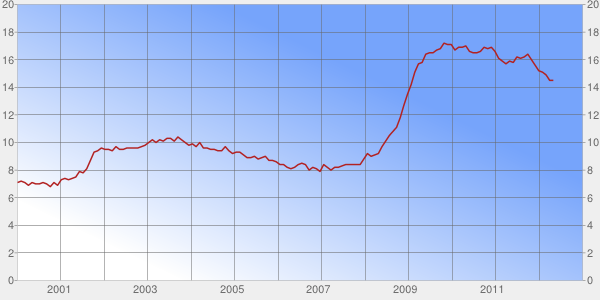
For the purposes of becoming a millionaire, we will assume employment. That means get a job instead of living on entitlements, because that will disqualify you from this discussion.
Sure it is easy to have received Facebook stock or have invented Facebook, but the average millionaire doesn’t have that at their discretion.
USE YOUR MONEY TO MAKE MONEY
This means compounding what you have in ways other than just putting it in the bank. I had a roommate who was a stockbroker and he told me many stories of secretaries making minimum wage who came to him at retirement with 7 figure 401K accounts. They saved in a way that maximized the return on their investment. This usually involves a company match and some diversification. It also assumes that you take risk when you are younger and seek advice or study investing voraciously as it is a mystery to most….despite the fact that everyone thinks they know about it.
Part of your diversification also means not putting everything in the stock market. As an example, real estate has just undergone a busted bubble (thanks to the Community Reinvestment Act which never should have been enacted), but it means there are properties to be had for a song right now and are ripe for the picking. They will grow and become more valuable. My advice is no different from what you’d expect. Start out small and work your way up. That process allows you to learn about what value really is, and compound your earnings into larger investments that have bigger payoffs.
There are many other ways, but the concept is the same, save and invest wisely by starting small and growing your profits and portfolio. You must also study and read or you could throw your money down the drain if you think you know everything. It also involves patience. If you recall the story from my roommate, it was saving and investing over a lifetime
HOW TO LEARN
There are articles ad-infinitum to read about the aforementioned. The other way is to talk to people who have done this. I suggest that you start with Dave Ramsey or Crown Financial Ministries if you are starting out (or are in trouble, or anywhere in between). It is a tried and true method of handling you money.
Who you talk to also matters. There are people who talk in $10’s of thousands, $100’s of thousands, millions or Zuckerberg’s and Gates’. I suggest you seek out those who are in the highest category possible as you need to think big in making and investing. I don’t have coffee with Warren Buffet, but his advice is readily available.
Find those who are successful and ask them how they did it. I’m betting that you’ll find there is no secret code or magic key, they just worked at it and kept their long-term goals of financial independence in mind, and kept check over their human nature.
SAVE YOUR MONEY
The other side of the equation is savings. In other words you need to spend less and when you do, spend wisely. Of the people I worked with at my last job, many were high salaried executives who were in debt because they had a keeping up with (or passing) the Jones mentality. This was especially true of those in the New York area for some reason (but demographics shouldn’t really matter). They had big houses with unfurnished rooms because they were house poor. Living within your means is important which is my next segue.
NEED VS. WANT

Including the basics of food, clothing and shelter, one has to look at the way one buys things. Most buy what they want rather than what they need. If you adopt the buy it tomorrow instead of now mentality, you likely will realize that you don’t really want it as badly as you think.
There is the adequacy (not delusions of adequacy ;-)) vs. luxury mentality also. A Casio, Timex or Seiko watch tell as good of time as does a Rolex, so unless you have money to burn, why are you buying the Rolex? This applies to cars, clothes or virtually any tangible item. Ask yourself, self do I need this/do I need to have the very best/am I showing off or would what I can really afford what I have? I have relatives who have to have the very best, but have wasted as much money as I’ve earned on things to show off.
My son said that some people need to wear their paycheck. You can see them coming down the road in cars that are raised with shiny rims and a 24 thousand watt stereo. Others have to order the best wine, food and show off at restaurants (my brother-in-law).
Back to the person who knows this better than most, here is a story about expensive car drivers:
But what if Ranger Rich is like many people who define rich in terms of income instead of net worth? Certainly many drivers feel the need to display their socioeconomic achievements by acquiring prestige makes of motor vehicles. They may think that those who are successful in generating high incomes drive luxury brands. And correspondingly drivers of more common makes have dull normal income credentials. But the hard data suggest that the level of prestige of a car and the income of its driver are not anywhere near being perfect correlates. In fact, many drivers of luxury makes have neither the levels of income nor net worth which would qualify them as high economic achievers.
Along these lines, Joann Muller, writing for Forbes.com, poses “what the rich people really drive.” She defines rich people in terms of income, not net worth.
. . . the richest people were the most likely to buy luxury brands [39% for people with household income above $250,000 vs. 8% for those people who earn less than $100,000 a year].
. . .61% of people who earn $250,000 or more aren’t buying luxury brands at all.
Her analysis indicates that those households with high incomes are more likely to drive luxury cars. But just because someone is driving a luxury brand it does not necessarily mean that the driver has a high income or a high net worth, for that matter.
Further, here is a story about how the average millionaire deals with car buying.
You have to spend on things that will appreciate, not sparkle. Again, my relatives are the worst offenders who have overspent on toys, baubles, cars and anything else they can waste their money on. It baffles me. When they bought real estate, they over paid, over leveraged and bought for show instead of ROI.
DEBT AND LEVERAGE
This gets most people in trouble. If you can’t pay off your credit card each month, you effectively are paying more for what you bought (because of the interest). Compounding works for debt in the same way as it does for savings. It is the accumulation that is the issue. I’m not just picking on credit cards, anything can be substituted here. If you saved first, you could buy it for less and your want will likely decrease.
For housing, it used to be that you had to put at least 10% down, but due to the above mentioned CRA (can you tell I loathe that legislation?) one could buy a house they couldn’t afford because they were told they qualified for it…. with no money down. You were PLAYED for a fool on this. Living below your means is the best policy.
If you care to splurge on something, it’s OK….just don’t borrow.
The same can be said for leverage. I’ll stay on housing here. Banks will always want you to buy more as the more you borrow, the richer they get. Typically one is paying at least 3 times the amount for a big-ticket item buy leveraging which brings me to my next segue.
PAY OFF YOUR HOUSE
The wisest know that man can not serve two masters. When you have a huge mortgage hanging over your head, it is your boss/master/slave driver/keep you up at night worry/cause of divorce or many other calamities. The bank won’t be calling on you to take your home away nor will you have to file bankruptcy (again, my relatives).
Besides owning a house within or below your means, paying it off early is the best way to get out of debt and improve your cash flow. Take out a mortgage less than 30 years, pay more than the minimum and do everything you can to pay it off early.
Forget the argument that it is a tax deduction. Congress is aiming at trying to take that away as I type. Also, any money you get back on taxes is just an interest free loan to the government at your expense.
By doing this, for most people it will likely be one of the best long-term financial decisions they can make.
CONTROL YOUR DESTINY
Note: I am quoting Dr. Thomas Stanley here. It is better told than I could say it, but it clearly is the moral to the story and what I would have said:
In The Millionaire Next Door I quoted the words of a corporate sales professional, a millionaire whom I interviewed. He like other self made millionaires said that he had a “go to hell fund. . . just in case my employer suggests (insists) that I leave Austin for corporate headquarters in Rottenchester.” He never had to leave Austin and he added, “PTL.” In other words, [the millionaires next door] have accumulated enough wealth to live without working for ten or more years.
I was reminded of these words of wisdom after reviewing an email from Ms. F who currently resides in a lovely community in the Southern United States:
I went to my local library this morning, hoping to borrow The Millionaire Next Door. However, the only available book was in Spanish, so I borrowed “Millionaire Women Next Door” instead. By the time I completed the second paragraph on page 8, I had collapsed in a fit of “craughter” – simultaneously crying and laughing at my sad truth. My newest work assignment is no less than 8,200 miles, 18 hours of flying time and 12 time zones away from everyone who means the most to me in this world. Simply put, the situation stinks, but I had convinced myself that it was necessary to pay the bills. Suffice it to say that I have renewed by concerted efforts to become a cultivator of wealth, and I plan to share my transformation with you soon. Thank you for creating this compilation of evidence-based encouragement!
What precipitated Ms. F “crying and laughing?” Consider the words from Millionaire Women Next Door:
Aren’t you growing tired of being among the ranks of hunter-gatherers? Do you enjoy your hyper consumption lifestyle so much that you must fly out of town every week to earn a paycheck to pay your bills? . . . begin making the transformation to a cultivator of wealth. Think about that the next time you are ten thousand miles from home, surrounded by strangers, and flying in dreadful weather. It is up to you. Do you want to spend your life as a hunter and gatherer of income, earning a million mileage points? . . . those financially indpendent folks. . . . They make their own decisions about their next destination. Right now, you and your career are essentially corporate property. Neither one of you has the luxury of self-determination.
I also stated that:
The [millionaire business] women profiled herein will not tolerate such an existence. They are free. They are cultivators of wealth and satisfied with life. They are in control of their own destiny.
INCOME AS A PERCENTAGE OF WEALTH
More from Frank Stanley, their income is only 8.2% of their wealth:
People who believe that they will never become wealthy generally fulfill this hypothesis. I explained to Brit, who was once a member of the ultimate income statement affluent club, that he has an excellent chance of becoming a millionaire next door type and that the typical millionaire next door is 57 years old. The Bible states that those with faith and hope can achieve a great deal. Even those with faith the size of a grain of mustard seed will likely reach their intended goals.
The will and discipline that this couple demonstrated in paying off its considerable debt is telling. The same determination can be used in setting aside at least 15% of their income for savings and investing.
What should you anticipate as a typical member of the millionaire next door fraternity? One, given the calculation via the Wealth Equation, actual net worth exceeds its expected value by a factor of 2 or more. Two, the market value of the home is less than 20% of net worth. Three, debt totals the equivalent of less than 5% of net worth. Four, annual income tax is the equivalent of about 2% of net worth. Five, total annual realized income is approximately 8.2% of net worth [median], or the equivalent of $8.20 of income for about every $100 of wealth.
This $8.20 figure from my own research is fairly congruent with the findings of other researchers. For example, three scholars employed by the Treasury Department, Johnson, Raub and Newcomb, compared the wealth characteristics of millionaires via 36,352 federal estate returns who passed away in 2007 with the incomes of these decedents when they were living. Those millionaires who were married and under the age of 70 [like the large majority of the millionaire next door types that I have surveyed] realized the equivalent of $8.45 for every $100 of their net worth. This figure is within approximately 3% of the dollar figure ($8.20) that was determined from my surveys.
IN CONCLUSION
There is no conclusion, just work and keep your long term goal in mind. I may talk later about other basic ideas that contribute to this like paying cash instead of credit (briefly mentioned here), couponing, buying the store brand instead of the premium name brand and other tricks. Nevertheless, adhering to the above puts you well on your way to being the average Joe millionaire.
My relatives laughed at me all my life for watching what I spent, how I lived and called me a skinflint. I knew that I had a long term plan for financial security. Today, at retirement age, they work just to keep up. Who’s laughing now?
Share this:

Facebook Overnight Millionaires and Employee Turnover

Update: As predicted, the brain drain has begun with executives leaving and others questioning Zuckerberg’s leadership ability.
As we all know, Facebook will go public in a huge IPO. This will create many mega-millionaires overnight who work there.
I wonder what the drain in human intellectual property will be when they don’t have to work like maniacs anymore.
WHY PEOPLE WORK
Most people work only because they get paid. A common cliche is that work is a 4 letter word. Otherwise, they wouldn’t put up with the job they have, proven by frequent job shifts over a lifetime. They leave for a better opportunity, or a bigger paycheck. My observation (not scientific) is that if the paycheck wasn’t a part of the deal, the job wouldn’t get done.
Then there are a few who really like to work like my Dad. His life was his work (HVAC engineer) and he loved it. My uncle was a pilot who also loved his job. Both regretted their retirement.
Finally, there are a few who love what they do because it is their passion. It has been said that if you do what you really love, it isn’t work. These are usually the most successful people.
MILLIONAIRE HEAVEN
When Facebook goes public and there will be a group of people created who are the overnight millionaires, many will move on. Some of them are the creative minds behind what has made the company the success it has been. Sure you can hire more programmers and throw options at them, but they are in the category of working for a paycheck. Many won’t have the need (some the desire) to work. I watched many friends I had at Amazon become millionaires and quit. They went on to do what they wanted to because they sold stock and had the money to do so.
The people that lived and breathed the Facebook that we know it have and hold the history and the reason that it is what it is today. That knowledge can’t be replaced.
What will be the brain drain at Facebook? I’m sure there are loyal employees who will stay. The executives will likely stay because they already are rich and at that point it is a matter of power, not money. Others, I’m not so sure.
WILL THEY SELL
You bet they will. There is already a lot of insider selling:
Insiders and early Facebook investors are taking advantage of increasing investor demand and selling more of their stock in the company’s initial public offering, the company said Wednesday.
Facebook said in a regulatory filing that 84 million shares, worth up to $3.2 billion, are being added to what’s shaping up to be the decade’s hottest IPO.
Facebook’s stock is expected to begin trading on the Nasdaq Stock Market on Friday under the ticker symbol “FB”.
The entire increase comes from insiders and early investors, so the company won’t benefit from the additional sales.
The biggest increases come from investment firms DST Global and Tiger Global. Goldman Sachs is doubling the number of shares it is selling. Facebook board members Peter Thiel and James Breyer are also selling more shares.
Even the Motley Fool is predicting investors will get burned.
Facebook’s IPO: A Quick Way to Go Broke
Facebook’s IPO will create at least 1,000 millionaires, estimates The Wall Street Journal. Founder Mark Zuckerberg is cashing out $1 billion worth of shares. But most investors who buy shares will get burned…
REASONS TO SELL
Recently, it was stated that Facebook could be a passing fad. This fact is not lost on those looking to make a killing.
If you recall Palm, Friendster, Sony Walkmans and other technologies, or beanie babies and tickle me Elmo’s, fads come and go quickly. As Qui-Gon Jin said: There is always a bigger fish. This means the next bigger and better Social Network or better idea is already being worked on. Innovation drives technology and history has proven it…..ask 3com, Wang, Digital or many others.
We already know that they economy is still in a recession and cash is king. If this IPO is anything like Groupon, it will trend high, then the price will go down and people want the most bang for their buck. I know I’d dump it all and diversify by day 2. I can’t comment as to whether I’d quit as I don’t know the culture, but I’ve worked for paranoid owners before and I know that it is a tough environment. Zuckerberg has publicly stated that it’s good to be paranoid. If that was the case, this is the time to bail.
It’s no secret that Facebook is not fully baked on their mobile strategy or execution yet either. That is a pretty large faux pas.
Worst of all, millions are choosing to not be on Facebook or are just saying no to it. Many of these are in the high wealth category.
A comparison of the two companies from WordStream, a search marketing management company, suggests that Facebook is a much less effective ad medium than Google. (The caveat here is that WordStream is, obviously, rather more dependent on Google than Facebook as a medium.)
So how much brain drain and personnel IP will leave? Time will tell, but I’m sure there are a lot of folks contemplating this issue as I write. The pressure of work, making a killing on stock or losing a fortune takes its toll on the workers.
I had a lot of friends at Cisco when they were flying high in the market. While others played solitaire at the other technology companies, Cisco employees spent half their day watching the stock price to see how high it would go and calculate how rich they were. The problem was that they weren’t vested. I hope that Zuckerberg and lawyers are smart enough to make their employee options at least 3-5 years before they are fully vested to keep the best and brightest there. Still, some might be mailing it in until year 3 while dreaming of being rich.
The average Joe won’t get rich anyway because here are the people who have made the money:
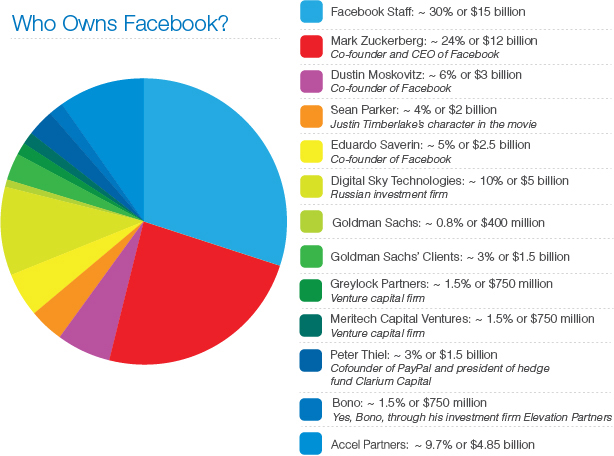
My final comment on the greatest brain drain comes in the form of 2 people, Paul Allan and Steve Wozniak. They got out and went on to different lives, but I’m not sure they still held the passion they had while building their company’s.
Share this:

Carroll Shelby RIP, Life Is Short and You Are Only But a Vapor

Carroll Shelby died last Thursday night. It should be a reminder of how short life really is. He was the longest living heart transplant survivor, but unfortunately, no one can escape death.
He will be remembered as the creator of some of the worlds (American) best sports cars, not to mention beating the Ferrari powerhouse in racing in the 60’s.
OUR LEGACY
However, some of us will vanish quicker than others, but we must remember that we are but a vapor in life, you can’t grasp a vapor. You don’t know today what will happen tomorrow. Don’t boast about tomorrow for you don’t know a day will bring forth (Proverbs 27:1).
Here is a poem about life, all too true. Remember, a cemetery is full of people who have plans.
When I was a child I laughed and wept and time crept;
When I was a youth, I dreamed and talked and life walked;
When I became a full grown man, time ran;
When older still I daily grew and time flew;
Soon I shall be traveling on, time will be gone.
COUNT THE DAYS YOU HAVE
How long will you live? The average American lives to the age of 77 (Shelby was 89):
If you are 15 you have 744 months to live.
If you are 25 you have 624 months to live.
If you are 35 you have 500 months to live.
If you are 45 you have 384 months to live.
If you are 55 you have 264 months to live.
If you are 65 you have 144 months to live.
If you are 75 you have 24 months to live.
After that, you are beating the curve, don’t buy green bananas.
So when it is over, then you have eternity to deal with. Many have contemplated this thought in different ways. The unpredictability and brevity of life reminds us that we are short sighted.
We all contemplate these questions even if you deny it:
Where did I come from? Why am I here? Where will will I go when I die?
Here is a thought to contemplate. Carroll is doing it now.
Share this:

9/11 Trial, First a Circus….
Read the full story here, but making a farce of it seems to be the first objective.
Walid bin Attash used to frequent online dating sites. “Loves to travel — sometimes at a moment’s notice,” bin Attash described himself before his 2003 capture. So writes former CIA veteran Jose Rodriguez in his new book, “Hard Measures: How Aggressive CIA Actions After 9/11 Saved American Lives.”
On Saturday, bin Attash was one of five defendants charged with 2,976 counts of murder for their role in the 9/11 terrorist attacks. It would seem that bin Attash has grown very devout at Guantanamo Bay. His civilian attorney, Cheryl Bormann, wore a hijab and an abaya at the military pretrial hearing. She even suggested that female prosecutors dress in more “appropriate” fashion in deference to the defendants’ “fear of committing a sin under their faith.” According to news reports, distaff prosecutors wore military uniforms with knee-length skirts.
“Is the bin Attash in your book the same guy whose attorney feels she must cover her entire body?” I asked Rodriguez. Yes, he answered. “These people are pretty hypocritical. One thing is their religious beliefs; the other thing is what they do.”
It’s clear from Saturday’s antics that the military tribunal, which is not expected to begin until May 2013, will be a circus. Defense attorneys don’t have much of a claim to the clients’ innocence. In 2007, Khalid Sheikh Mohammed issued a statement in which he proclaimed that he was the mastermind of 9/11, “from A to Z.” In 2008, KSM and his co-defendants told a military court that they were guilty and wanted to be martyred.
When President Barack Obama was elected, he halted military legal proceedings in favor of a civilian trial in New York. Fearing a possible terrorist attack, Congress objected. Under new rules, the military tribunal is back.
Share this:

The Real KSM – I Will Personally Kill You
One of Mohammed’s frequently stated goals was to be put on trial in civilian court in New York — which nearly happened until Congress last year blocked the Justice Department from transferring any Guantanamo Bay detainees to the United States.
INTEL GATHERING: Al Qaeda’s 9/11 mastermind Khalid Sheik Mohammed was held at secret CIA interrogation jails — or “black sites” — like this one in Lithuania (pictured), where he was waterboarded 183 times but did not crack, according to a new book by CIA interrogation boss José Rodriguez Jr. What finally broke the terror chief was being kept awake for 180 straight hours — more than a week — and subjected to loud noises, slaps to the face and stressful positions, such as standing for long periods of time.

José Rodriguez Jr.
“It seemed to us that he was looking for a platform from which he could spout his hatred for all things American, and a trial would certainly present that opportunity,” Rodriguez writes. “It strikes me as more than a little ironic that several years later, Attorney General Eric Holder almost granted KSM his wish.”
Once he became compliant, Mohammed developed a rapport with his interrogators, watching PG-rated movies with them in his cell, and offering a religion-themed overview of the “history of the world.”
“A few months later, he reported that he was ready to continue and build on his earlier presentation. He had one requirement, however. Only those officers who sat through the prerequisite first session should be invited to the [second] session,” Rodriguez recalls.
He even penned “playful” notes to them, Rodriguez says. “Unless you are trying to manipulate me, could you turn up the heat a bit?” the terrorist asked in one missive.
But it was all a facade.
After telling an officer to have a “safe trip” before he left for home, Mohammed continued, “It is not that I wish you well. But if I ever get out of here, I want to personally be the one to kill you.”
By his own admission, Mohammed’s done it before.
“In a confession he later submitted for a potential tribunal in Guantanamo Bay, Cuba, KSM wrote: ‘I decapitated with blessed right hand the head of the American Jew, Daniel Pearl, in the city of Karachi, Pakistan,’ adding, ‘For those who would like to confirm, there are pictures of me on the Internet holding his head.’”
Washington analysts had Mohammed pose holding a sack with a bowling ball in it, so they could compare his arm to those in the video cutting Pearl’s throat.
“Those photos compared to the actual video showed that KSM was not lying to us,” Rodriguez writes. “Just when you thought he had a human face, he would disappoint you.”
Share this:

More on the Gitmo Trials
Trying not to cooperate, the terrorists accomplished their jobs. What is ironic is that in 2008, they already pleaded guilty so they could die as martyrs. If the trial had not been stopped so Attorney General Holder could put them on display, this would have been over.
To provide balanced coverage, I picked a site that is the opposite in ideology from yesterday’s source. I will let the readers make a decision on who covers it fairly. I only care about justice.
The other defendants — Ramzi Binalshibh, Walid bin Attash, Ali Abdul Aziz Ali and Mustafa al Hawsawi – joined Mohammed in refusing to answer questions from Army Col. James Pohl, the judge presiding over the proceedings.
At one point, two defendants got up and prayed alongside their defense tables under the watchful eyes of troops arrayed along the sides of the high-security courtroom.
Bin Attash was put in a restraint chair for unspecified reasons, then removed from it after he agreed to behave.
Lawyers for all defendants complained that the prisoners were prevented from wearing the civilian clothes of their choice, in a proceeding equally slowed by technical legal questions about defense complaints about the court’s authority and access to evidence and translators.
Brigadier General Mark Martins, the chief prosecutor of the Pentagon’s Office of U.S. Military Commissions told Fox News that he “understands the skepticism” about access to evidence, but some still remains classified.
Mohammed’s civilian lawyer, David Nevin, said his client was not responding because he believes the tribunal is unfair. He also suggested Mohammed was not wearing the earphones because it reminded him of being tortured.
All 5 men occasionally looked through what looks like the Koran, magazines, and other reading materials.
Share this:

9/11 Terrorist Trial
I’ll try not to take sides and let justice be served. I’ll post events that are being covered as they occur. I don’t know if KSM was really the mastermind as he claims or has delusions of grandeur. Either way, he has all the appearances of being a troublemaker.
At least it is a military trial instead of a civil trial (he’s not a citizen of the US, rather an enemy) in the US with the ability to get off on a technicality. We should see it to conclusion.
He and the others want to die as martyrs, for the only guarantee in the Koran of reaching heaven is dying in Jihad, although Gitmo may not qualify.
I caught shit from the Muslims at IBM who said they were offended by my calling Muslims Terrorists. Junaidah Dahlan from Accenture started in on my blog and I just said I’m calling it like it is. The terrorists were and almost always are Muslims Junaidah. Take your offense elsewhere
This weekend’s arraignment marks the beginning of the third major effort to bring the 9/11 conspirators to justice. The Obama administration dropped earlier military-commission charges against them when it decided in late 2009 to bring the 9/11 case to federal court in New York. But Congress, not wanting Guantanamo detainees brought to the United States, blocked the civilian trials. Meanwhile, the administration’s own view of the institution was evolving. When President Obama first took office, he froze commission proceedings with the apparent intention of shutting them down. But later that year the administration shifted gears and worked with Congress to make small but important adjustments to the Bush-era Military Commissions Act. These left commission proceedings more closely resembling the norms of a federal court trial.
It’s been a long time since KSM was last in court. In 2008, during an arraignment for a commission that ultimately got cancelled, he quickly pled guilty to multiple murder counts. “This is what I want,” he told the court, in English. “I’m looking to be martyr for long time.”
That case was interrupted for a variety of procedural reasons, and KSM never got his chance. In the intervening years, Congress and the Obama administration reformed the controversial military trials — making it easier to seek capital punishment, by providing detainees with so-called “learned counsel” lawyers specifically skilled at death-penalty cases, which makes such sentences less likely to be reversed on appeal. Last month, after flipping a key detainee to testify against KSM, the government brought charges against KSM and four alleged accomplices for the 9/11 plot. “If convicted,” the Defense Department clarified, “the five accused could be sentenced to death.”
However much the commission procedures have changed, KSM’s ambitions probably haven’t. “He wants to die because it fits into his massively egotistical narrative,” says Josh Meyer, author of the recent book The Hunt for KSM. “He’s like Napoleon. Wasting away in a cell is not his style. Going out in a bang of glory is.”
That calculation means that the 12 U.S. military officers who will decide if a convicted KSM lives or dies will face more than a narrow legal choice. They’ll also, however unfairly for them, have the burden of a policy choice. Should KSM be put to death, it might simultaneously provide a measure of closure for the families of his victims and allow al-Qaida’s remaining acolytes to portray him as a martyr.
Share this:

The WinkelVii
From The Social Network, because for the first time in their lives, they didn’t get what they felt they were entitled to because of who they are.
Share this:

Doctors Disagree on How, But Most Want To Fix Healthcare
From Kevin MD:
Three out of four dentists recommend this tooth brightening toothpaste — make your smile sparkle like never before! Six out of seven plumbers recommend this drain opening de-clogger — make your bathtub drain like never before! Nine out of ten doctors recommend improving the medical system in the United States — make your health care system heal like never before!
But how do we do that?
Do doctors think the Affordable Care Act is the soothing balm for the festering wound that is the economics of the American medical system—paying too much while delivering too little population health? What do our health care experts think about health care reform? Do we think it is a step in the right direction? A step towards doom and damnation? A small step for insurance companies, a huge leap for mankind?
It goes on to say that they need to read the bill to see what is in it.
However, here is what is in the bill click on it to find out what is in the bill and what rights we the people lose like financial control over our own assets and our own doctors. We do lose that despite what congress and the POTUS say to the contrary.
Share this:

Nice Call There On The Need For A Mouse Dvorak
John has always been interesting and very gracious to me (while I was just a flack) whenever we spoke. He should get a kick out of this..

Share this:

Why The Husband Was Banned From Target – Friday Humor
After I retired, my wife insisted that I accompany her on her trips
to Target. Unfortunately, like most men, I found shopping boring and
preferred to get in and get out. Equally unfortunate, my wife is like
most women - she loves to browse.
Yesterday my dear wife received the following letter from our local
Target.
Dear Mrs. S
Over the past six months, your husband has caused quite a commotion
in our store.. We cannot tolerate this behavior and have been forced to
ban both of you from the store. Our complaints against your husband, Mr.
Samsel, are listed below and are documented by our video surveillance
cameras.
1. June 15: Took 24 boxes of condoms and randomly put them in other
people’s carts when they weren’t looking.
2. July 2: Set all the alarm clocks in Housewares to go off at
5-minute intervals.
3. July 7: He made a trail of tomato juice on the floor leading to
the women’s restroom.
4. July 19: Walked up to an employee and told her in an official
voice,’Code 3 in Housewares. Get on it right away’. This caused the
employee to leave her assigned station and receive a reprimand from her
Supervisor that in turn resulted with a union grievance, causing
management to lose time and costing the company money.
5. August 4: Went to the Service Desk and tried to put a bag of M&Ms
on layaway.
6. August 14: Moved a ‘CAUTION – WET FLOOR’ sign to a carpeted area.
7. August 15: Set up a tent in the camping department and told the
children shoppers he would invite them in if they would bring pillows
and blankets from the bedding department to which twenty children obliged.
8. August 23: When a clerk asked if they could help him he began
crying and screamed, ‘Why can’t you people just leave me alone?’ EMTs
were called.
9. September 4: Looked right into the security camera and used it as
a mirror while he picked his nose.
10. September 10: While handling guns in the hunting department, he
asked the clerk where the antidepressants were.
11. October 3: Darted around the store suspiciously while loudly
humming the ‘Mission Impossible’ theme.
12. October 6: In the auto department, he practiced his ‘Madonna
look’ by using different sizes of funnels.
13. October 18: Hid in a clothing rack and when people browsed
through,yelled ‘PICK ME! PICK ME!’
14. October 21: When an announcement came over the loud speaker, he
assumed a fetal position and screamed ‘OH NO! IT’S THOSE VOICES AGAIN!’
And last, but not least:
15. October 23: Went into a fitting room, shut the door, waited
awhile, and then yelled very loudly, ‘Hey! There’s no toilet paper in
here.’ One of the clerks passed out.
Share this:

Life Isn’t Fair, So What is New? Why Are We Trying To Kill The American Dream?
After reading an article by one of the top economists we should listen to, it occurred to me that life isn’t fair, but that alone is fair.
An excerpt from the article starts us off:
Some years ago, for example, there was a big outcry that various mental tests used for college admissions or for employment were biased and “unfair” to many individuals or groups. Fortunately there was one voice of sanity– David Riesman, I believe– who said: “The tests are not unfair. LIFE is unfair and the tests measure the results.”
If by “fair” you mean everyone having the same odds for achieving success, then life has never been anywhere close to being fair, anywhere or at any time. If you stop and think about it (however old-fashioned that may seem), it is hard even to conceive of how life could possibly be fair in that sense.
Even within the same family, among children born to the same parents and raised under the same roof, the first-borns on average have higher IQs than their brothers and sisters, and usually achieve more in life.
Unfairness is often blamed on somebody, even if only on “society.” But whose fault is it if you were not the first born? Since some groups have more children than others, a higher percentage of the next generation will be first-borns in groups that have smaller families, so such groups have an advantage over other groups.
TRYING TO EQUALIZE THE RESULTS HAS LESS CHANCE OF SUCCESS THAN CREATING AN ENVIRONMENT TO SUCCEED
I propose that Life isn’t fair, now get over it and try harder. The American dream is to work hard, be successful and get ahead. We shouldn’t kill that dream which is what is being proposed for those making over $250,000. Further, it was said that “cursed is the ground because of you; through painful toil you will eat of it all the days of your life. it will produce thorns and thistles for you, and you will eat the plants of the field. By the swat of your brow you will eat your food until you return to the ground, since from it you were taken; for dust you are and to dust you will return.”
Some are richer, some are born into more prosperity than others, some are smarter, some have more ambition….the list goes on forever.
Here are two good examples of those that exemplify that some have it easier than others, just for being born into the right family.


To try and make it otherwise is usually a result of envy or jealousy of others success. There is no way to legislate tenacity to succeed, one’s ability vs. others, familial or environmental factors and many other causes. Some have more and do better than others, GET OVER IT.
We live in a country where people have come to because of the American Dream defined as:
The American Dream is a national ethos of the United States in which freedom includes the opportunity for prosperity and success, an upward social mobility achieved through hard work. In the definition of the American Dream by James Truslow Adams in 1931, “life should be better and richer and fuller for everyone, with opportunity for each according to ability or achievement” regardless of social class or circumstances of birth.[1] The idea of the American Dream is rooted in the United States Declaration of Independence which proclaims that “all men are created equal” and that they are “endowed by their Creator with certain inalienable Rights” including “Life, Liberty and the pursuit of Happiness.”[2]
Any effort to equalize things by wealth redistribution is socialistic and doomed to failure. I beg for someone to show me an example of where communism or socialism has succeeded. Ask Greece, the USSR, most European countries….
Why?
Margaret Thatcher once said that ‘The trouble with socialism is that eventually you run out of other people’s money’?
Frank Zappa said “Communism doesn’t work because people like to own stuff.”
TO TRY AND MAKE IT EQUAL ALWAYS FAILS
There has been some talk during regarding those who make over a certain amount should give more, also called redistribution. This is directly from the mouth of a famous person in history:
From each according to his ability, to each according to his need (or needs) is a slogan popularized by Karl Marx in his 1875 Critique of the Gotha Program.
Socialism in general has a record of failure so blatant that only an intellectual could ignore or evade it.
Thomas Sowell
Politicians love to say things like, “We’re just asking everyone to pay their fair share.” But government is not about asking. It is about telling. The difference is fundamental. It is the difference between making love and being raped, between working for a living and being a slave. The Internal Revenue service is not asking anybody to do anything. It confiscates your assets and puts you behind bars if you don’t pay.
Instituting wealth re-distribution, taxing folks who make over $250,000 and then waxing poetically that it is “fair” is no more than an attempt to kill the American Dream. I have a belief however that folks will find a way around it, the disadvantaged will still want to come here for success and
Governments aren’t invested with moral qualities; only people are. This basic understanding of the world is one of the distinctions between the progressives/socialists and conservatives.
A free market will create big differences in wealth. That wealth disparity is simply a byproduct of freedom — vastly diverse individuals competing to serve consumers will arrive at vastly diverse outcomes.
That disparity is not unfair — if it results from free exchange.
The free market (which, sadly, America doesn’t have) is fair. It also produces better outcomes. Even “losers” do pretty well.
A more astute observer than Moore might show how unfair government intervention is. Licenses, taxes, regulations and corporate subsidies make it harder for the average worker to start his own business, to go from being a “little guy” to being an independent owner of means of production. Most new businesses fail, but running your own business is the best route to prosperity and — surveys suggest — happiness, too.
So the conclusion is that Life isn’t fair and there will be some Warren Buffetts, Bill Gates and Mark Zuckerbergs that get richer and they should. If the Government would stay out of the free market, more would prosper. A rising tide floats all boats
After I wrote this, I found this piece of manure on 7/15/12 about US Income inequality.
Nikki Newman and Mark Ehrnstein have plenty in common. They both work at Whole Foods’ headquarters, and they share a passion for the Earth-friendly, healthy and egalitarian values the company espouses.Ask them why they work at Whole Foods, and you get a lot of the same answers.Ask them about their paychecks, though, and you get two different stories.
Newman, the receptionist at the company’s corporate offices, has worked for Whole Foods for six years and now makes about $17 an hour. She lives comfortably in a rented duplex, but she admitted money can get tight on occasion – like the time her dog needed a surprise $750 worth of dental care.
Ehrnstein, on the other hand, is Whole Foods’ global vice president for team member services, a position that pays him a six-figure annual salary. He and his wife, Renee, have worked more than 30 years combined at Whole Foods. They own a 3,151-square-foot home, according to Travis County Central Appraisal District records.
“I feel very grateful to be in the role I’m in, but most of all I feel grateful to work for a company that aligns with my values,” Ehrnstein said. “I feel connections with our team members in that sense. But certainly, the compensation affords different opportunities.”
This is not the stereotypical story of the gap between rich and poor. Few would criticize the wage disparity between Newman and Ehrnstein given their tenures and responsibilities at the company. Plus, the gap from top to bottom is much narrower at Whole Foods than other large grocers because it pays higher entry-level wages and caps executive pay at 19 times the salary of its lowest-paid employee.
To which I say so what. The higher up in the company they are or the more responsibility one has, the more they should earn. Their actions will bear the legal responsibility and shape the course and success of the company.
I don’t give a rats rump that someone has the chance to make more than me. We should have the opportunity to make the most money we can possibly make without the government restricting that chance. That is why we compete, innovate, work and strive for success. I say screw the idea of socialism because that is what makes America great. We compete to be the best and try to out do the other guy. It’s how we (the US) beat the Soviet’s to the Moon, *(humans) invented cars, trains, planes, computers, telephones, cellphones and is also the reason there is Apple, Facebook, Ford, steel, iPads and every other success that has been invented. We have the cure for polio, vaccines and advancements in medicine that socialized societies would never have had the incentive to create.
Now, to put it in quantitative terms, here is an excerpt from Sir Issac Newton via Townhall.com :
The planet Neptune has never been seen by anyone looking at the night sky through just their own eyes. So distant is it from the sun that the light it reflects toward the Earth is so faint that the planet is effectively invisible in the darkness of night. And yet, the outermost large planet of our solar system was discovered by astronomers who knew exactly where to look….
Following William Herschel‘s discovery of Uranus in 1781, the world’s astronomers went to work to observe and describe the seventh planet of the solar system, taking detailed measurements of its trajectory in space.
Forty years later, French astronomer Alexis Bouvard published detailed tables describing Uranus’ orbit about the sun. More than that however, his tables incorporated the lessons learned about planetary orbits from Johannes Kepler and Sir Isaac Newton to chart the path Uranus would follow into the future.
But then, something strange happened. Significant discrepancies between Bouvard’s projected path for Uranus and its actual orbit began to be observed – irregularities that were not observed in the tables he had created to describe the orbital paths of the planets Jupiter and Saturn using the same methods. Soon, observations and detailed measurements confirmed that Uranus was moving along a path that was not described by Bouvard’s careful calculations.
These irregularities led Bouvard to hypothesize that an as yet unseen eighth planet in the solar system might be responsible for what he and other astronomers were observing.
Over twenty years later, astronomer Urbain Le Verrier was working on the problem, taking a unique approach to resolving it.
What made Le Verrier’s work unique is that he applied the math developed by Sir Isaac Newton to describe the gravitational attraction between two bodies to solve the problem. Here, he used Newton’s theory to anticipate where an as yet unknown, but more distant planet also orbiting the sun would have to be to create the effects observed upon the position of the planet Uranus in its orbit.
Le Verrier completed his calculations regarding the position of the hypothetical eighth planet on 1 June 1846. A little over three months later, on 23 September 1846, the planet Neptune was observed for the first time at almost exactly the position in space where Le Verrier predicted it would be, confirming Newton’s gravitational theory in the process.


We’re going to do something similar today to explain why household income inequality in the United States has increased over time, even though there has been no change in individual income inequality.
From Darkness to Discovery
Our first chart below is based on data taken from the U.S. Census’ data [Excel spreadsheet] on the inflation-adjusted median and mean income for all Americans from 1947 through 2010, which we’ve presented in terms of constant 2010 U.S. dollars. For reference, we’ve also indicated the NBER’s official periods of recession in the U.S. during this period with the shaded red vertical bands on the chart:

Next, we took the U.S. Census’ breakdown of inflation-adjusted median income for both men and women for each of these years [Excel spreadsheet] and used the math that applies to log-normal distributions to construct the combined median income that applies to individuals. Our results are shown in the chart below, along with the actual median incomes reported by the U.S. Census so we can compare our calculated results with them:
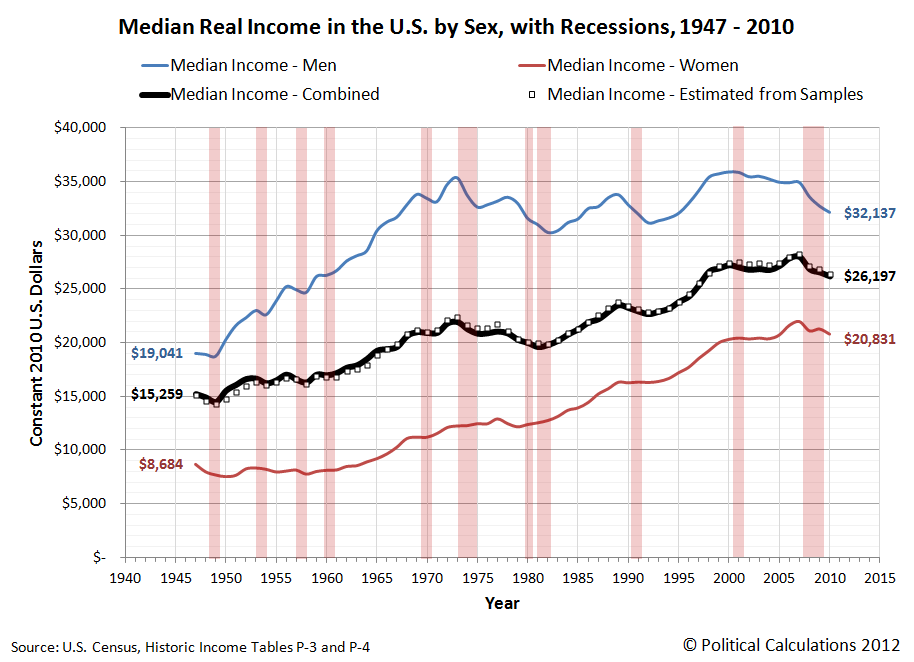
As you can see, our calculated results in creating a weighted median from the subsets of median income data for men and women are very close to the actual real median income numbers for all individuals. Here, because per capita income has been demonstrated to follow a log-normal distribution, we are able to use this math to either combine or extract subsets of data that have never been officially presented.
As an aside, we achieved the results above by treating the reported median income data the way we might calculate a weighted average. The beauty of the log-normal distribution math is that we can do this with medians, which we ordinarily could not do otherwise.
In the chart above, you can see the effect of the changing composition of the U.S. workforce, as the relative share of women earning incomes in the United States has increased since 1947. In 1947, the median income for individuals is much closer to the median income for men than it is for women. By 2010 however, we see that the median income for individuals is about halfway in between the median incomes for men and for women, reflecting that nearly equal share that both sexes now have among all individual income earners in the U.S.
Extracting The Unseen
The U.S. Census Bureau provides the median income data for individuals (or persons), men and women. It also reports median income data for both male and female wage or salary earners [Excel spreadsheet], whom we’ll simply describe as Working Men and Working Women.
Using the math we demonstrated above with this data, we can extract the median incomes for two categories of people for whom the U.S. Census has never reported median incomes: men and women with incomes who do not earn wages or salaries, or as we’ll describe them from now on, Non-Working Men and Non-Working Women! Today, we’re putting what we found for all U.S. individual income earners together for the first time:

Constructing Households
Now, let’s combine our median income earners into two-person households, pairing working men and women, working men and non-working women, non-working men and working women and finally non-working men and non-working women. We’ve shown our results below, along with the U.S. Census’ official median income for U.S. households:

Well, look at that! The households formed by our single-wage and salary income earning couples from 1947 through 2010 closely parallels the actual real median income for U.S. households with a working man and non-working woman over that time (except for the years 1974 through 1977, where there seems to be an anomaly in the Census’ data for working men – and here, the actual median splits the difference!) Also keeping in mind that the actual median household income might include the income contributions of additional people (say individuals between the ages of 16 and 24 who might be working part time at minimum wage jobs while also attending school and living at home with their parents), which likely accounts for the difference between the two, we’ve pretty much just demonstrated that we can successfully model basic U.S. households using just the data that applies for U.S. individuals.
But wait! What about single person households? Our next chart throws them into the mix as well!
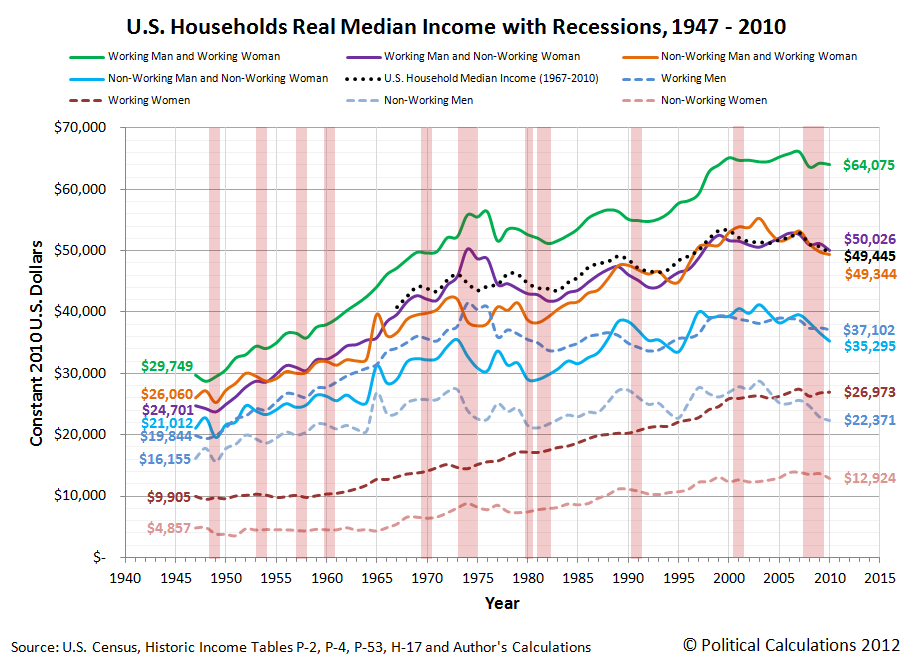
Using the figures for 2010, we approximated the income percentiles for each of our single and two-person median income earning households. The table below reveals our results (our model should put each approximated percentile within 0.2 of the actual percentile!):
| Household Type | 2010 Median Income | Approximate Income Percentile |
|---|---|---|
| Working Men and Working Women | $64,075 | 61.4 |
| Working Men and Non-Working Women | $50,026 | 50.7 |
| Working Women and Non-Working Men | $49,344 | 50.1 |
| Non-Working Men and Women | $35,295 | 36.7 |
| Working Men Only | $37,102 | 38.6 |
| Working Women Only | $26,973 | 27.7 |
| Non-Working Men Only | $22,371 | 22.4 |
| Non-Working Women Only | $12,924 | 11.5 |
It occurs to us that all we would need to increase the income inequality among households in the United States is to increase the nation’s percentage of single person households among all households. That would work by increasing the number of households at the lower end of the income spectrum, even though it would have absolutely no effect upon the measured income inequality for individuals. The U.S. Census Bureau shows the change in the number of single person households since 1960:

Here’s the U.S. Census Bureau’s Gini index measure of the amount of income equality among U.S. households for the years from 1947 through 2010:

And here is the Gini index measure of the amount of income equality among U.S. individuals for the years from 1947 through 2005 (the data since 2005 is presented here – it’s similar to all that recorded since 1960 in the chart below):

The relevant data in the chart above is the Gini measure indicated with the hollow circles, which is based on the “fine”, or more detailed, income bins reported by the U.S. Census in its annual Current Population Survey. The other data in the chart, indicated by solid diamonds, represents income distribution data reported by the U.S. Census in larger, or more “coarse” income bins, which are less detailed and are therefore a much less accurate measure of the nation’s level of income inequality in any given year.
Intersections and Connections
Looking at where all the data in these three charts intersect and overlap, What we find is that since 1960, the level of income inequality for U.S. individuals as measured by the “fine” Gini index is nearly constant, but has increased significantly for U.S. households. What has changed over that time is the composition of U.S. households, with a steady increase in the percentage of single person households.
Without a corresponding increase in the measured income inequality for U.S. individuals, the increase in the measured income inequality for U.S. households has been almost entirely driven by the increase in the number of single person households over time.
So income inequality among U.S. households isn’t increasing because the rich are getting richer. That means that policies intended to right this situation by going after the rich in the name of “fairness” are guaranteed to fail, because the real cause of the increase in income inequality among U.S. households over time is something that cannot be fixed by such actions.
If only the people pushing such policies could see that….
Share this:

Self Help Healthcare
I checked in with KevinMD for this piece of helpful information. The free market will produce a better product than the government will ever be able to handle. Capitalism always provides competition which drives DOWN prices and drives UP services.
f you cannot measure it, you cannot improve it.
-Lord Kelvin
Asking science to explain life and vital matters is equivalent to asking a grammarian to explain poetry.
-Nassim Nicholas Taleb
Of course the quantified self movement with its self-tracking, body hacking, and data-driven life started in San Francisco when Gary Wolf started the Quantified Self blog in 2007. By 2012, there were regular meetings in 50 cities and a European and American conference. Most of us do not keep track of our moods, our blood pressure, how many drinks we have, or our sleep patterns every day. Most of us probably prefer the Taleb to the Lord Kelvin quotation when it comes to living our daily lives. And yet there are an increasing number of early adopters who are dedicated members of the quantified self movement.
They are an eclectic mix of early adopters, fitness freaks, technology evangelists, personal-development junkies, hackers, and patients suffering from a wide variety of health problems. What they share is a belief that gathering and analysing data about their everyday activities can help them improve their lives.
According to Wolf four technologic advances made the quantified self movement possible:
First, electronic sensors got smaller and better. Second, people started carrying powerful computing devices, typically disguised as mobile phones. Third, social media made it seem normal to share everything. And fourth, we began to get an inkling of the rise of a global superintelligence known as the cloud.
An investment banker who had trouble falling asleep worried that his concentration level at work was suffering. Using a headband manufactured by Zeo, he monitored his sleep quantity and quality, and he also recorded data about his diet, supplements, exercise, and alcohol consumption. By adjusting his alcohol intake and taking magnesium supplements, he has increased his sleeping by an hour and a half from the start of the experiment.
A California teacher used CureTogether, an online health website, to study her insomnia and found that tryptophan improved both her sleep and concentration. As an experiment, she stopped the tryptophan and continued to sleep well, but her ability to concentrate suffered. The teacher discovered a way to increase her concentration while curing her insomnia. Her experience illustrates a phenomenon that Wolf has noticed: “For many self-trackers, the goal is unknown … they believe their numbers hold secrets that they can’t afford to ignore, including answers to questions they have not yet thought to ask.”
Employers are becoming interested in this approach in connection with their company sponsored wellness programs. Suggested experiments include using the Jawbone UP wristband to see if different amounts of sleep affect work performance such as sales or using the HeartMath emWave2 to monitor pulse rates for determining what parts of the workday are most stressful.
Stephen Wolfram recently wrote a blog illustrating just how extensive these personal analytics experiments in self-awareness could become when coupled with sophisticated technologies. Wolfram shares graphs of his “third of a million emails I’ve sent since 1989” and his more than 100 million keystrokes he has typed.
Anyone interested in understanding just how far reaching this approach may become in the future should examine the 23 pages of projects being conducted by the MIT Media Center. My favorites from this fascinating list include automatic stress recognition in real-life settings where call center employees were monitored for one week of their regular work; an emotional-social intelligence toolkit to help autism patients learn about nonverbal communication in a natural, social context by wearing affective technologies; and mobile health interventions for drug addiction and PTSD where wearable, wireless biosensors detect specific physiological states and then perform automatic interventions in the form of text/images plus sound files and social networking elements.
It is easy to get caught up in the excitement of all this new technology and to start crafting sentences about how the quantified self movement will “transform” and “revolutionize” health care and spawn wildly successful new technology companies.
Jackie Fenn’s “hype cycle” concept has identified the common pattern of enthusiasm for a new technology that leads to the Peak of Inflated Expectations, disappointment that results in the Trough of Disillusionment and gradual success over time that concludes in the Slope of Enlightenment and the Plateau of Productivity. Fenn’s book, Mastering the Hype Cycle: How to Choose the Right Innovation at the Right Time can help all of us realize that not all new technologies becomes killer applications.
Jay Parkinson, MD has also written a blog that made me pause before rushing out to invest in quantified self companies or predict the widespread adoption of this approach by all patients. Parkinson divides patients into three groups. The first group is the young, active person who defines health as “not having to think about it until they get sick or hurt themselves.” The second group is the newly diagnosed patient with a chronic illness that will affect the rest of their lives. After a six month period of time coming to terms with their illness, Parkinson believes this group moves closer and closer to group one who do not have to think about their disease. The third group are the chronically ill who have to think about their disability every day. Parkinson concludes that “it’s almost impossible to build a viable social media business that focuses on health. It’s the wrong tool for the problem at hand.”
The quantified self movement should be closely monitored by all interested in the future of the American health care delivery system. The potential to improve the life of patients with chronic diseases is clearly apparent; whether most people will use the increasingly sophisticated tools being developed is open to debate.
Share this:

Court Weighs Heavy on Health Costs
From the Raleigh WRAL sometimes news.
WASHINGTON — Death, taxes and now health insurance? Having a medical plan or else paying a fine is about to become another certainty of American life, unless the Supreme Court says no.
People are split over the wisdom of President Barack Obama’s health care overhaul, but they are nearly united against its requirement that everybody have insurance. The mandate is intensely unpopular even though more than 8 in 10 people in the United States already are covered by workplace plans or government programs such as Medicare. When the insurance obligation kicks in, not even two years from now, most people won’t need to worry or buy anything new.
Nonetheless, Americans don’t like being told how to spend their money, not even if it would help solve the problem of the nation’s more than 50 million uninsured.
Can the government really tell us what to buy?
Federal judges have come down on both sides of the question, leaving it to the Supreme Court to sort out. The justices are allotting an unusually long period, six hours over three days, in sessions that started Monday, to hear arguments challenging the law’s constitutionality.
Their ruling, expected in June, is shaping up as a historic moment in the century-long quest by reformers to provide affordable health care for all.
Many critics and supporters alike see the insurance requirement as the linchpin of Obama’s health care law: Take away the mandate and the wheels fall off.
Politically it was a wobbly construction from the start. It seems half of Washington has flip-flopped over mandating insurance.
One critic dismissed the idea this way: “If things were that easy, I could mandate everybody to buy a house and that would solve the problem of homelessness.” That was Obama as a presidential candidate, who was against health insurance mandates before he was for them.
Once elected, Obama decided a mandate could work as part of a plan that helps keep premiums down and assists those who can’t afford them.
To hear Republicans rail against this attack on personal freedom, you’d never know the idea came from them.
Its model was a Massachusetts law signed
Share this:

Creative HouseHold Self Help Tips

Share this:

Neurological Self Test (If You Fear Alzheimers)
1- Find the C below.
OOOOOOOOOOOOOOOOOOOOOOOOOOOOOOO
OOOOOOOOOOOOOOOOOOOOOOOOOOOOOOO
OOOOOOOOOOOOOOOOOOOOOOOOOOOOOOO
OOOOOOOOOOOOOOOOOOOOOOOOOOOOOOO
OOOOOOOOOOOOOOOOOOOOOOOOOOOOOOO
OOOOOOOOOOOOOOOOOOOOOOOOOOOOOOO
OOOOOOOOOOOOOOOOOOOCOOOOOOOOOOO
OOOOOOOOOOOOOOOOOOOOOOOOOOOOOOO
OOOOOOOOOOOOOOOOOOOOOOOOOOOOOOO
OOOOOOOOOOOOOOOOOOOOOOOOOOOOOOO
OOOOOOOOOOOOOOOOOOOOOOOOOOOOOOO
2- If you already found the C, now find the 6 below.
99999999999999999999999999999999999999999999999
99999999999999999999999999999999999999999999999
99999999999999999999999999999999999999999999999
69999999999999999999999999999999999999999999999
99999999999999999999999999999999999999999999999
99999999999999999999999999999999999999999999999
3 – Now find the N below. It’s a little more difficult.
MMMMMMMMMMMMMMMMMMMMMMMMMMMMNMM
MMMMMMMMMMMMMMMMMMMMMMMMMMMMMMM
MMMMMMMMMMMMMMMMMMMMMMMMMMMMMMM
MMMMMMMMMMMMMMMMMMMMMMMMMMMMMMM
MMMMMMMMMMMMMMMMMMMMMMMMMMMMMMM
This is NOT a joke. If you were able to pass these 3 tests, you can cancel your annual visit to your neurologist. Your brain is great and you’re far from having a close relationship with Alzheimer.
Share this:

Are you a Geek or a Nerd?

From: MastersInIt.org
Share this:

Was IBM’s Watson a Breakthrough or Very Cheap and Creative Advertising?

The worst news in the above link is that companies like Google can do the the same for far less and that Watson doesn’t even work with other IBM technology.
Update: Watson is in the next publicity stunt with Wall Street as sales seem to be lagging.
As we all know, Watson appeared and won on Jeopardy last year. It was the culmination of years of work and manpower to build a machine that could react faster and be programmed to win a game show. It was brilliant, but more for promotion than technology sales (as evidenced so far). There is little doubt that the promotional value was priceless to the IT industry and an easy calculation by IBM to one up the competition.
The two humans were limited to their capacity, whereas Watson was a massive computer with incredible storage and processing capability. It was programmed specifically for the game, so while not a slam dunk, inevitability wasn’t in much doubt.
I don’t know about you, but as I get older, I forget things and computers don’t. You can add memory, processors and build it big enough to recall more than any amount of humans. Jeopardy had two champions, so it wasn’t really a fair fight. You ultimately can overpower any certain situation with billions in technology (which is what it cost to win), but throw something like emotion or nuance into a situation and computers are lost.
It was the perfect set up. Everyone loves to root for the underdog even though the humans really fit that role. It was accomplished by putting the biggest two winners ever on Jeopardy up against poor Watson. The truth was that it never was going to be close given the confines of the rules of the game. In real life, with unforeseen issues, the humans would have a fair chance. That was never the point of Watson though.
IBM got to promote a research facility, executives, technology and almost a free ticket for three days. Jeopardy also was a winner with dominant ratings.
I don’t want to debate the possibilities of Watson’s future contribution to technology other than stating that it is another step (and possibly direction) in data analytics, and it increases the perception of IBM’s lead in this area (thanks to a lot of M&A and some folks that worked without getting enough credit). It hasn’t been the breakthrough that companies have jumped on like an iPhone, yet billions of dollars have been spent on the same hardware used to build Watson since Jeopardy for traditional IT. Time will tell.
ADVERTISING
For now, the real victory was exposure. How much would it cost to purchase 1.5 hours of prime time advertising for a 3 day period where you basically get to change the rules of advertising to where you don’t even have to pretend that an ad agency was involved (also saving millions). Here is the breakdown of advertising to program, but in reality the big IBM Watson Avatar is a commercial by itself every time Alex said the word Watson.
From a Mad Men point of view (advertising show for those who don’t know) this was a stroke of creative genius that began with winning a chess match against Gary Kasparov, then moving to prime time TV when new exposure was needed. I saw people glued to their seats and talking about it the next day at a conference. Nevertheless, it still has all the appearances of a publicity stunt. Unfortunately, it saddled IBM with a 2015 earnings projection claim that Palmisano left Gini Rometty to figure out. With this economy, it has Sham’s chance of beating Secretariat in the Belmont Stakes to make it.
There will be claims that further technology is Watson legacy and success, but it is not what was intended by the efforts which related to making sure it beat the humans on Jeopardy. That is supposed to come later.
CURING THE COMMON COLD
It has been suggested that Watson technology is being used to cure cancer. I like others wish for this as I lost my mother to that disease. Along with AIDS and the common cold, I have my doubts that we’ll really see this in our lifetime. By then, trillions will be spent. Like Global Warming, we could do more by helping to feed the starving and providing help and aid to millions. This is not what Watson is about though last spring, it was the advertising win of 2010.
So the jury is out on whether it will succeed in medical or some other breakthrough. For now, it was the promotional prime time win last year.
Share this:

RIM – RIP
Update: Morgan Stanley on 6/25/12 confirms my premise that RIM is Essentially Broken:
Update: Yahoo shuns Blackberry from Fun Smartphones for all employees:
In a bold move reportedly instigated by new CEO Marissa Mayer, aging web giant Yahoo plans to outfit every one of its US employees with a new iOS, Android, or Windows Phone 8 device. According to an internal memo published by Business Insider on Saturday, the company is offering workers a choice between Apple’s iPhone 5, the Samsung Galaxy S III, the HTC One X, the HTC Evo 4G LTE, and Nokia’s Lumia 920, with all bills taken care of. Yahoo is also discontinuing IT support for BlackBerry devices, seeking to move away from RIM’s enterprise-focused platform.
“We believe the only way RIM remains a viable entity is at a fraction of its current size, a transformation that erases much of its earnings power,” the analysts wrote. “The next 9 months likely see rapidly deteriorating fundamentals on the one hand offset by stories of potential strategic options on the other.”
Indeed, there was more unconfirmed deal speculation just this weekend, as The Sunday Times reported the BlackBerry maker was considering selling its handset-making unit or a stake in the company.
What I don’t get is why the Government just made it the standard handset. Are they that out of touch?
Update: RIM at a new low, sort of proving the following is on track. Executives are now bailing.
Now they are laying off people. I’ll be quoting them along with Palm, OS/2, Token Ring and other technologies that used to be.
Original story starts here.
Rarely do I write about the technology that I replaced because I’m usually so excited about the replacement. In this case I’ll make an exception. I already wrote about my new phone, but as much as I wanted the new phone, getting rid of my blackberry was more important. Rob Enderle reminded me of this in his tech trends blog.
At a Lotusphere show not too long ago, we did an announcement with RIM and Notes (it was an announcement of a product we were going to release at a later date). Not only was I underwhelmed by the product, the hardware and software technology from RIM was as cool as mud huts compared to new construction. On top of this, when I offered to help the RIM executives for gratis on very obvious marketing oversights, they had an attitude that belied the fact that they already had iPhone daggers fatally in their hearts and didn’t even know it. It now looks like it’s going to cost them their jobs. I was treated as if I was dust (I’m being nice to them) by their executives. Notes was almost impossible to use on a blackberry at first. It was a D- at best.
Update: Now I know he should have listened to me instead of being so arrogant. I could have helped them….and I’m not trying to be conceited, but I knew what was going on much more than the leader of RIM.
I knew then that not only was RIM in trouble as a company, I disliked the blackberry as a piece of technology almost more than any I’ve had in 30 years (I’ve had more than most in the last 30 years). I saw the crackberry addiction it caused in some folks which I didn’t like. I also saw that if you had a blackberry (before iPhone days), you just signed up for a 24/7 availability.
The first one I got for free, and promptly got rid of in a month as it was more trouble than it was worth. The last one I’ll ever have is because my then company had me get one when I wanted a real phone/data device instead.
My problem is solved. Too bad about RIM…their once leadership position is now only a memory with recent market share decline.
It looks like I’m not the only one who believes they are in trouble. Their Board is not helping out either.
Sales figures show the same decline. It was not even nice knowing you.
So throw the Blackberry on the technology rubbish pile along with the Palm, OS/2, Token Ring, Newton and a host of others. There, now they are on the way to being a good product back when Britney Spears was hot.
Share this:

Why I Bought an iPhone Vs. Any Google Device
 It took me this long to finally buy an iPhone. I waited until the right carrier had it (AT&T is a diversity nightmare), then my current provider didn’t have international covered because of CDMA. So when that all came online, I then had to wait for an upgrade time so that I wouldn’t pay an arm/leg/firstborn. It wasn’t a feature to feature comparison, 3G or 4G or any other techie issue that caused it. It was because I know Google, have worked with Eric Schmidt and believe they are evil about their intentions with our data, public or private.
Before any hate mail comes in that Apple does it too, I turn off location services when I leave the house and can confuse them enough that tracking me doesn’t me do them any good….not that anyone would/should care. I’m a statistic to them and so be it.

Disclaimer: I’ve had an iPod since 1994 (rotary wheel version) and have an iPad and iPod before I bought the phone, but I worked with/against Google and have met Eric Schmidt at a partner conference. I don’t trust Google nor do I trust Schmidt as I heard what they are up to. Basically the same thing as Pinky and the Brain are after, take over the world.
I and I believe they are sincere. Apple developers are trying to build an ad base to compete against the world/Google, but I can turn them off…..Google follows me, my house, what I buy and everything else…..then are all too happy to share it with those I don’t want them knowing I exist.
In the quest for data analytics, companies have sold their soul. Google and IBM are at the top of this data list, closely followed by Oracle, only closely in this case as they are hampered by a leader who holds them back from becoming a great (or modern) company.
OPEN SOURCE VS. PROPRIETARY.
Most analyst’s I talk to have Android so that they can practice what they preach, it’s an open world. Well open source doesn’t work as well and smooth as IOS, so I don’t give a rat’s rump about this. I just want it to work and for me not to have to fix or code one more device. Most open systems require tinkering far too often. So I’m calling BS on that argument. I’m a consumer with too much going on to have a device that doesn’t work every time and easily.
SECURITY
It appears that Smartphones are now being attacked by malware and theft. I know of 2 so far on IOS, but Android seems to be up 90%, so it looks like Apps on this OS are easier to break into. This was not my initial decision point, but has skyrocketed to my list of concerns within a short period of time.
MY PREVIOUS SMARTPHONE
I had one of the newest Blackberry’s and in one word of advice for those who are considering buying it….don’t. The interface is archaic compared to IOS and I got it because of a corporate policy that stuck me with a device that was hard to use. I had to take it the phone store to set up the special things I wanted (I have about 7 email addresses and many special things related to what I do, and BTW I set them up myself on the iPhone) and have set up phones and computers for 31 years….before things were easy so I know how to reverse engineer without instructions
One thing I liked about Google was that 3 executives owned 8 corporate jets. God Bless Capitalism. I think IBM has a whole fleet of jets for the executives also so they “don’t” have to fly commercial. Too inconvenient I guess. It’s the same for most corporations.
Anyway I bought the iPhone.
BTW, I’ll never buy another Windows/Microsoft product again now that I work for myself. They can only treat me this poorly (since Windows was released) for so long before I vote with my own money like I did here….
It looks like I’m not the only one. ZDNet wrote this a few days after I wrote about my travails.
Share this:

Is the PC Dead Or Is It Marketing Hype and Spin?

Update: Apple is more nails in the PC coffin with the new announcement of Post PC devices.
- 362 Apple stores
- 315 million iOS devices sold through last year, including 62 million in the last quarter
- 585,000 apps created
- 25 billion app downloads
- 1080p movies and TV shows for iCloud and the new Apple TV
- 15.4 million iPads sold in the fourth quarter of 2011
- 200,000+ iPad apps
- 2048 by 1536 pixels displayed on the new iPad, with 264 pixels per inch
- 44 percent greater color saturation than the old iPad
- 5 megapixel sensor on the new iPad camera
- A maximum of 73 mbps downlink with 4G LTE on new iPad
- New iPad specs: 10 hours of battery life, nine hours with 4G; 9.4 millimeters thick, 1.4 pounds
- Same pricing as last iPad: Wi-Fi models are $499 for 16 gigabytes, $599 for 32GB, $699 for 64GB; $629, $729 and $829, if you want 4G
- Old iPad now starts at $399 and $529
The Real Meaning in Marketing Speak
In the mid 2000’s, Sam Palmisano of IBM declared the era of the PC is over. This was somewhat of a marketing move since IBM had just sold the PC Division to Lenovo. What he really meant was that IBM is getting out of consumer products. IBM also sold other consumer divisions that were not the margin kings that Software and Services were. Disclaimer, after working either for/with/against/partnering with IBM for 31 years, I can say that a lot of what they do is incredible spin on pretty good technology. I had better knowledge of what was going on than what was told to the outside.
PC’s are Toasters Now
This is a bit of a history lesson. There was a time that PC’s were special and had value. They still can be found on almost every desk or backpack at an airport, but in reality they are now (and have been for a while) a consumer product. There gets to a point in time in every product’s life cycle that economies of scale and parts availability drive this value (and therefore the price) down when you can’t differntiate. It is compounded by newer technologies (tablet computers and mobile devices) to where you can get them at any consumer store that sells toasters, video games and TV’s. Any improvement is just a little bit better (except Windows which usually is worse), not an era better which was the case when they were new.
PC’s have done this to themselves over the years. Remember when all you could get was a bulky desktop? Technology moved on to the luggable computer to the laptop. Now you can get a wafer thin Macbook Air (for a premium price), but the technology curve will drive cost down here when every manufacturer offers it. Margins are razor thin and there is minimal hardware differentiation on the Wintel platform.
The Effect of iPad and Mobile Phones
Ultimately, the world is driving your communications and computing device to be in your hand. The end game of input is not a keyboard, but voice. This addresses the need for instantaneous that we have required as we’ve shifted from email to IM and texting, and from blogging to tweeting. I envision a vision screen that is projected by your small handheld that lets you see what a huge monitor is required for now in the near future. For more on this, see Project Blade Runner as an example of what the future could look like.
PC’s are already under fire from Tablet computing and smartphones. While at some point you still need a PC for complicated input/output such as the dreaded Powerpoint and the more mundane payroll/HR applications, they soon will be adapted to tablets as we easily morphed from immobile desktops to laptops.
Many analysts have shown that more phones and tablets are sold than PC’s. More texts are sent than emails and we certainly have more tweets than blogs.
The Cloud
Powering a lot of this of course is the overhyped Cloud model. While conceptually it has been around for a long time (we have called it client/server and other names), it is a software delivery model that will make the end device irrelevant. Perhaps you could get your email on your toaster or refrigerator. You could make phone calls by dialing in the air at some point. The issue is that we are driving the connecting device smaller, cheaper and more powerful (and less relevant) so that we can get what we want, when we want it and wherever we want it.
Lenovo and HP
Companies are jumping out of this market as evidenced by IBM and HP willing to sell their PC businesses worth billions in revenue, mostly because of low single digit profit margin. They realize that there isn’t much money to be made anymore, again putting them in the toaster category. Similar components by most, similar operating systems, market driving memory and storage costs and overhead to sell. HP is now particularly vulnerable as companies negotiating long term contracts will throw HP out as a viable vendor not knowing what their future will be either in terms of ownership or viability. HP has completely lost their way starting with the purchase of Compaq years ago, then dumping their tablet, announcing the sale of their PC division and switching CEO’s like underwear.
The Apple Factor
Everyone eventually builds a better mousetrap. The Mac has been around for a long time, but the entry way to the door to Apple changed with the iPad/iPhone. A new processor, operating system visibility, technology paradigm, profit potential and the coolness factor make Apple a different model than the PC. Prior to that, Mac’s were a niche player in the creative, advertising and education world. This has changed partly because the OS is better, Windows is not a great platform and Mac’s are headed in the direction of iPads.
So Is the PC Dead?
Ultimately yes, but not this year or in the near future. I’ve seen models of computers called bricks the size of your phone that you can drop in a kiosk and work anywhere. You can even use them like an iPhone if needed, but until the voice input issue is resolved, keyboard input is an inhibitor.
No one thought we’d ever see the end of typewriters, faxing or even the 360, but technology advances at an increasing rate economically speaking. What will be interesting is which social mores we’ll break like talking to ourselves (on a cellphone) in public (or worse in a bathroom or driving).
Is the iPad the next endgame? Likely also not. Companies are trying to out do themselves and we’ll wind up like the Jetson’s one day.
Share this:

June 14, Flag Day, Fathers Day, Thoughts and Curves
Here is another blog that WordPress lost in my transition. This one is from 6/14/2008.
First things first, it is my parents Anniversary. They would have been married 55 years today. It is the first June 14th that has passed that both of them are gone.
Today is also Flag Day. Unlike the bitter half of one of our candidates, I’ve always been proud of my country.
And of course, the greatest moment in Flag Saving History, Rick Monday Saves a Flag from being burned.
Birth of the Army – In 1775, this was the birth of the Army, thank you George Washington. The only thing the government has done consistently right is to defend our country. I hope the next president keeps that in mind
Fathers day – Tomorrow is Father’s Day. My Dad isn’t around any more. If yours is, appreciate the time you have left. In honor of him, I drove his car, on the curvyest road I could find. His car was meant for the turns.

Today was also the start of the 24 Hours of LeMans. I used to go to races with my Dad, in the car pictured here. So I’m melancholy today. In honor of our memories, I bought a grille badge on eBay.
So I thought about my parents, the country…and while I was exceeding the speed limit, enjoying the curves.
Share this:

Update on Grocery Shopping
I originally wrote about my shopping adventures from as much as 30 years ago mentioning dressing for the store, meeting someone at work, bikini’s, girls in the frozen isle….and other observations. Instead of just being out of college which was the perspective of the original blog, I’m now buying groceries for a college student.
I also wrote about the old people and their habits. It dawned on me today I’m almost one of them now. I go on BOGO (buy one get one free) day. My day is complete when I can get BOGO with a coupon for double savings. When did I get this old? Actually I’m just smarter with our money now and know there are deals to be had.
I’m even getting balloons for my dog to play with as they float and it gives her great pleasure to bark at them. If I could just get her to breath in the helium and bark, I’d be the one howling with laughter.
Just think, one more year and I can get another 5% off for senior discount on Thursdays!
Share this:

Duh, Science Confirms the Obvious
Another post that got lost which I liked.
I get the part about cigarettes cost you money, combining drugs and alcohol are bad for you…but get number 3 meeting heads!
3. Too Many Meetings Make You Grumpy
The Study: “The relationship between meeting load and . . . well-being of employees,” Group Dynamics, March 2005
The Findings: Ever get the feeling that you’d get more work done if you weren’t constantly attending meetings to discuss all the work to be done? Two social scientists from the universities of Minnesota and North Carolina hypothesized that meetings are analogous to “hassles,” defined in stress-research literature as “annoying episodes in which daily tasks become more difficult or demanding than anticipated.” The psychologists analyzed diary entries from 37 meeting-prone midlevel university workers over one week. They found that days chock-full of meetings left employees feeling stressed, exhausted and burned out.
Why Bother? Employers take heed: Since beleaguered workers may perform poorly, be tardy, or quit, the authors suggest that “organizations be sensitive to the number of meetings employees are required to attend.” Managers could create “formal guidelines” for meeting necessity (presumably not drafted at a meeting).
Here’s another Mr. Obvious, dudes prefer good looking women? Who’d have guessed it?
Share this:

When You See a Deer You See Bambi, And I see Antlers Up On the Wall

This originally appeared 12/3/2007, but was lost during a transition to WordPress (fail there). I’m re-posting it as it was my son’s first deer. Since then he has harvested more food for us, and hat racks for the wall.
Here is the Post:
With all kudos to Brad Paisley, I took my son hunting… and here is his first deer, a nice 8 pointer. To you vegetarians, sorry, but I’m an outdoorsman and I believe in being able to take care of yourself which is growing and harvesting your food…..both meat and vegetables. After all, I love vegetarians….most of what I eat are vegetarians anyway.
It’s also because of hunting and fishing that I get to connect with my offspring. I see many parents fighting with their kids, but we’re getting to spend hours together away from the computer, video games and other distractions that are potentially harmful to teenagers. We put the deer stand together, painted it camo, grew the food plots and reaped the rewards.
We also fed a herd of 50+ animals and worked the land from scrub to ecologically very fruitful and crop producing.
As Brad says, “but what can I say at the end of the day, honey I’m still a guy” .
Share this:

Finances and Bible Verses
Money is one of the most quoted subjects in the Bible. Many people are suffering right now because of countries governments mis-managing spending debt and other people’s money.-
I’ve always lived by the Larry Burkett and Dave Ramsey debt free living, and giving back to G-d first. For you non-believers, at least learn the lesson of a debt free lifestyle.
Out of nowhere on the same day come two blogs that mention this. Christian Personal Finance and Faith and Finance with scriptures about money.
You should click on either (CPF has 250 verses and F&F has 101) to know what to do with your money in these tough times.
Share this:

The Original Press Release for the IBM PC in 1981
At 4 pages (typed on a typewriter), here is the original Press Release for the IBM PC from 1981. Judge for yourself the writing style.
At $4500, you could get a fully configured 64k PC with 2 360k floppy disk drives and a small dot matrix printer. Such a deal. I’m pretty sure that there are wristwatch es with more computing power available now.

Share this:

Count of Monte Cristo – A Book Review
 Of course you could just go to Wikipedia and get someone’s version of it, but I read the book and found it to be fascinating. I read quite a bit and have 3-4 books going at all times. Through this, I’ve learned to read fast and retain a good deal of information. I’m constantly trying to figure out the plot before it ends, but I confess I didn’t succeed this time.
Originally, my son was assigned this book in school. Being a typical high schooler, he didn’t work hard and complained a lot. What got my attention was that he liked this book. There are times (few) that I find him astute, but I recognize the potential in him and knew I was going to read it.
GOOD VS BAD
Written by Alexandre Dumas, père in 1844, the book has hero’s that are trampled upon (Edward Dantes, the protagonist) and villains who sent him to prison for a trumped up charges (Villefort, Fernand, Mercedes and random others ). Good vs. evil always tugs at the heart strings to pull for the good guys.
After 14 years in prison, he ingeniously escapes after making friends with the Abbé Faria who was deemed mad for claiming to have millions. Upon his dying bed, he bequeathed it all to Dantes who was unceremoniously tossed off the cliff while posing as the dead Abbe. Fortunately he had a knife and set himself free.
Upon reaching the island of Monte Cristo, he discovered the massive fortune that did exist and changed his life. From then on he lived like he wanted to, exploring where he wished, eating on the best and setting up the rest of the book for what is basically a revenge plot. Dantes, who now has many aliases becomes for the most part the Count of Monte Cristo.
After learning the secrets of the above stated villans, he schemes to take them down for ruining his life, starving his father and losing his love, Mercedes (who later married Fernand the snake).
He gets his way and the villains are vanquished (or the Count helps them vanquish themselves) and revenge is exacted.
What is not fully explained is how he became so learned from a sailor and prisoner to a chemist, man of the world and just how he knows so much about who he is going make pay for his suffering. It does describe a long period of time (appx. 24 years) to do it and how he developed his learning skills from the Abbe in prison, but it would have helped to understand some of the chemicals he used in his actions. I do note that this doesn’t take away from the book, I just wanted more.
THE WARPED EUROPEANS
The book does expose the pontificous nature and pomp of the Europeans in that time period (not that they haven’t been for most of history). Fortunately, it also exposes the fallible nature of this culture. The class system is quite evident and appearance versus substance apparent. I remind the critics of current times as they denigrate or try to convert the USA to their lifestyle and government that this is just what we wished to escaped from. It is through this exposure to those times that history is revealed and relished.
OVERALL
The writing is excellent and builds as the book builds as it progresses, my favorite style of writing. At the end I could hardly put it down. I highly recommend it and it’s use of words not normally in our vocabulary anymore is brilliant. If we could only go back to that language rather than the obnoxious rappers like a self deluded Kanye West – (especially when drunk in front of Taylor Swift and the rest of the world) and others of his league, we would be bringing up better and more learned children. Fortunately, I listened to my son and benefited from it. I’m grateful to have sent him to a school that teaches the classics such as this.
I don’t have a star rating, but I would give it one less than the best. All should read it to better themselves and improve/understand good vocabulary, a good story and the struggles of man in good vs. evil.
Share this:

Interviewing, What Not to Say
As I face the end of this phase of my corporate career, I recall back on the many interviews I’ve had. Some went well as I’ve had jobs, and certainly many did not as I didn’t get others.
 The strangest question I was ever asked was if you could choose whether to be on a planet where you worked all the time or one that you could rest and play all the time, which would you choose? Fortunately, I answered I’d go to the planet to work all the time so that I could get to the other one to enjoy the fruits of my labor. Somehow that worked and I got the job.
After I wrote this, one of my friends from work sent me this worthy entry. Thanks Arline.
After spending 30 minutes interviewing a young man for a position
he asked if I would elaborate a little more on my own position, I
kindly agreed, He then said he had decided he wanted my Job and
not the on he was interviewing for.
After hearing the mention of what people say, I decided to include these answers from Rachel Farrell, Careerbuilder.com, to whom I give full credit.
You can always depend on young children to tell you exactly what they think, or precisely how they feel on any given topic. Want to know if your breath smells bad, if you should wear a different tie or if you really look fat in that outfit? Find a 5-year-old. He will give you an uncensored, honest answer.
Needless to say, we expect more from adults. Especially adults who are interviewing for a job.
For the second year in a row, we asked hiring managers everywhere to tell us the craziest thing they’ve ever heard in an interview. Keep reading for 37 hilarious (and true) statements from the job candidates:
1. “I interviewed a gentleman who looked great on paper but said two things during the interview that made me think, ‘Really?’ When starting the interview, I asked him what his hobbies were, to lighten the mood. He replied, ‘I sometimes walk up to perfect strangers just to say hello. I also like to pick up trash if I see some when I’m walking around.’ After I asked him how the position would contribute to his professional goals and future plans, he replied, ‘My main goal is to be a rock star; this is more of a backup plan.'” — Jessica Harrington, marketing associate, Eastern Michigan University
2. “I remember interviewing a secretary some years ago and asking her, ‘What is important to you in a job?’ Her answer was: ‘I want to work close to Bloomingdales.'” — Bettina Seidman, career management coach, Seidbet Associates
3. “‘When your workload is heavy and you are overwhelmed, how do you handle the stress?’ ‘I run in the bathroom and cry.’” — Jessica Simko, Career Branding Guide
4. “We performed mock interviews where our clients were put in an interview session using their real backgrounds, interests, etc. When asked why the client left her last job, which was in a family buffet-style restaurant, her response was, ‘I was hungry and didn’t know it would be a problem so I had pizza delivered to the restaurant while was on the clock.'” — Jacqueline Lisenby, chief visionary officer and president, StatusJ Entertainment Group
5. “I interviewed a senior engineer for one of our open positions. He demanded coffee and proceeded to spill coffee in his lap. Then he pointed to his groin area, laughed and said, ‘It looks like I wet myself!’ Needless to say, he didn’t get the job.” — Lisa Hall, human resources trainer and author of “Taking Charge of Your Own Health”
6. “I recently had the craziest interviewee ever come into our offices for a copywriter position. I wanted enthusiastic, but this guy was so over the top, I almost laughed in the middle of the interview. He high-fived someone on my team after hearing that my team member just got engaged. He talked about how terrible his boss was for a good 20 minutes. He said he felt like he was already working with us. And then he left something behind so that he could come back and get it. He called wondering when he could come back, and we [saw] him prepping in the parking lot.” — Amanda Halm, senior copywriter, editor, Bridezilla.com
7. “Without a doubt, the craziest thing I ever heard came from a candidate for an entry-level management position. He looked perfect on paper, so we scheduled a phone interview for 3 p.m. He answered the phone and when I introduced myself he said, ‘Hold on, I’m at a bar. Let me finish this shot and go outside.’ Amidst the noise of an active game of pool and a rowdy bar crowd, he slipped outside and told me, ‘You know what? I’m a little drunker than I thought. Can we reschedule?’ Needless to say, we did not.” — Heather Lytle, senior partner, H&L Media Partners
8. “While I am not the interviewer for a corporation, having been in many interviews for opportunities, I have actually heard a number of interesting, crazy, less-tactful things said from the interviewer side. The worst was, I drove two hours to do an in-person, one-hour interview and the interviewer was 30-40 minutes late to the interview, even though she walked by me in the lobby six or seven times with a bag of chips talking about her personal life to the receptionist. When she finally came out to get me, she didn’t even act shocked or sorry for the delay, and just said, ‘I was munching on a bag of chips and time flies when you’re eating chips.’ Let’s just say I knew then it wouldn’t be a good fit.” — Chris Perry, founder of Career Rocketeer
9. “We recently asked a job candidate, ‘What do you know about us?’ He leaned back in his chair and replied, ‘Not much. Why don’t you fill me in?’ He wasn’t hired.” — John Kramb, Adams County Winery
10. “We always include a casual lunch or dinner portion during an interview to continue our discussions in a more informal manner. This candidate let their guard down, falling out of their ‘interview mode,’ during the friendly and casual meal-time discussions. They went so far as to share that they installed an illegal second network in their office with co-workers and would spend their afternoons gaming on the clock. They then went on to further share how regularly in the mornings and afternoons they would sleep at their desk during working hours. Bragging that they had never once been caught in either of these acts. Needless to say, this candidate was not hired. Prior to this meal-time, more casual discussion, they were likely to be made an offer. The lesson learned and to be shared is that you are on the interview from before you arrive at a location until you have returned home. I was truly surprised that such a smart individual would make such a stupid mistake by sharing such obviously unacceptable work practices with a potential new employer.” — Zachary Z. Zguris, chief technology officer, Lime Design Inc.
11. “The interview was for a highly visible administrative assistant position. Clearly, I was looking for someone who would exercise tact with top-caliber people who would come into our office. I opened the interview with a fairly standard question:
‘What is it that attracts you to this job the most?’ Without hesitation, she replied, ‘My mother thinks this will be the right job for me.'” — Bill Lampton, president, Championship Communication
12. “We have the standard lists of questions you’d expect to hear, but at any given moment, I’ll interject with, ‘If you were an animal, what animal would you be and why?’ The most shocking response was, ‘I’d be a cat so I can lay around all day and not have to do anything.'” — Efrain Ayala, account executive, Walt Denny Inc., The Home Products Agency
13. “The man’s phone kept ringing. Finally, he answered it and he said, ‘Hello. No. I’m fine. OK.’ Of course, it was rude and uncalled for in my opinion, but I gave him the benefit of the doubt and asked if everything was OK. He basically said nothing was wrong but that his wife was checking in. He had not flown in for the interview. He was local.” — T. Murray, author of “Stuck on Stupid: A Guide for Today’s Professional Stuck in a Rut”
14. “The most bizarre experience I ever had was regarding a candidate who was offered a position with my client. Because she had disclosed that she had a college degree, she was required to produce proof in the form of transcripts, diploma, etc. She told us that she was unable to produce the required documentation because her identity had been changed and that the information the firm was seeking was in her previous name. Due to safety reasons, she was unable to produce proof (in any name she had or was using).” — Cathleen Faerber, managing director, The Wellesley Group Inc.
15. “I was interviewing an older woman for a position in my company. I thought she had a great personality and was considering hiring her. Then at the end of the interview she asked if I would be able to give her a ride to work and then back home again everyday! Umm, no.” — Janice Celeste, president and CEO, Celeste Studios Film & Video
16. “I had a woman come in and tell me that she ran a business around the corner and that she would be working this job, as well as managing her business during business hours. I wanted to be sure that I understood her correctly — that she would be taking time away from the position with me to ‘check in’ on her store periodically. But when I asked her a few questions to clarify, she became upset with me and ended up storming out of my office.” — Shay Olivarria, speaker and author of “Bigger Than Your Block”
17. “One job candidate arrived late for the interview, in a not-so-gracious mood. ‘The commute is terrible,’ she said. ‘I’m so glad I don’t have to do this every day.'” — Sammie Samuella Becker, CEO, TigressPR
18. “I had a candidate in the final interview stages. He pretty much had the job. He was invited to interview with a couple of people who would become peers as last step in the process. One would-be peer asked my candidate to demonstrate to them his work ethic and drive, to which he replied, ‘You can just strap a saddle on my a** and ride me!’ Apparently, he was hoping to show what a workhorse he is. As you might imagine, he did not get the job.” — Jenny Foss, recruiting agency owner, recruiter and job search consultant
19. “I interviewed a candidate over the phone for a sales position. Less than five minutes into the call, I began to hear water swishing and realized that the candidate was taking a bath during the phone interview.” — Jessica Miller-Merrell, owner, Xceptional HR
20. “I had a candidate come into my office with her child and proceed to breastfeed her baby boy during the interview. There was no acknowledgment or mention from the woman I was interviewing about the baby or him eating.” — Miller-Merrell
21. “While interviewing a young lady who was wearing a revealing top, at the end of the interview, she leaned forward and said in a sultry voice, ‘I’ll do anything to get this job.’ She got people’s attention, but eliminated herself from getting hired.” — Ronald Kaufman consultant and author of “Anatomy of Success”
22. “One [candidate] came in dressed very professionally and really looked like she had made an effort to look the part. Some people assume because we are laid back and bring our pets to work, that we are extremely casual and will show up for an interview dressed in jeans, so this was a nice change. Toward the end of the interview, I complimented her on how professional she looked. She got this huge smile and looked down at her clothes and said, ‘I know. I think I look like Mary Tyler Moore; that’s why I wore this!’ We ended up hiring her and she was such a quirky, fun, enthusiastic employee with a style all her own.” — Cindy Lukacevic, owner/vice president of marketing, Dinovite Inc.
23. “While wrapping up a seemingly decent interview with a young lady for an administrative assistant position, I asked her if she had any questions. She asked one or two default questions about the company then — drum roll — she says, ‘I used my last bit of change to put gas in my car to make it here. Is there any way that you could help me out?’ Needless to say, I was floored and the candidate did not get the job.” — Clorissa Wright, senior publicist, WrightWay Marketing and Consulting
24. “‘I like to date the young ones, is that bad?’ and ‘I love older women, do you really only have women working in your organization?’ Those are the two I will never forget.” — Greg Palomino, CRE8AD8
25. “I was working for a private investigator and interviewing applicants for a decoy position, in which they could possibly be confronted with various situations while investigating everyone from potentially cheating wives to drug dealers. I asked a guy in his early 20s, ‘What would you do if you were working undercover and someone you were investigating starting using drugs?’ He laughed, ‘Oh, it wouldn’t bother me. I mean, I have a medical marijuana card and all. You know, anxiety and stuff.’ ‘Oh, really?’ I noticed his eyes were slightly glassy. ‘Yep.’ He grinned. ‘So, are you high now?’ I asked. A chuckle. ‘Just a little!’ ‘Oh, just a little?’ I replied. ‘When did you last smoke?’ ‘Oh, before I left my place to come here.’ He didn’t get the job.” –Lauren Gard, Infinite Public Relations
26. “Over a nice dinner, the president of a company conducted a final interview with a vice president of sales candidate. At the end of the interview, the job was going to be offered to the candidate. The waiter brought the bill and the candidate, who was employed at the time, took it, pulled out his company credit card and said, ‘Don’t worry about this, I’ll put it on my company’s expense account.’ The president later said he didn’t know which shocked him more, the lack of ethics or the candidate’s stupidity. Obviously the job offer was never extended.” — Brian Marchant-Calsyn, Health Career Agents
27. “An executive search recruiter was explaining the qualities needed for the job: multitasking, hard-working, time management skills, attention to detail, etc. The candidate responded with, ‘I can’t do that. I’m not a robot.'” –Andrea Friedman, public relations coordinator, The LaSalle Network, a Chicago professional staffing and recruiting company
28. “A recruiter was in the midst of an interview, when the candidate asked, ‘Do you mind if I use your kitchen to eat my turkey sandwich?'” — Friedman
29. “An executive search recruiter asked the candidate, who was previously an accounting manager, what their ideal job would be. The candidate responded with, ‘A Playboy photographer.'” — Friedman
30. “I had to interview for a position that required organization, time management and attention to detail. My candidate was young, in his early 20s, and wore all black to the interview. We were a very casual office, so I thought nothing of it. But when I asked him to describe for me an instance when he had managed his time effectively, he cited managing his time in dungeon raids in the online game ‘World of Warcraft.’ When I said I knew the game and had even played it a bit, he took that as his cue to answer all my questions with ‘World of Warcraft’ examples. The word ‘necromancer’ came up far too many times. Needless to say, I was looking for real-world examples and he didn’t get the position.” — Jennifer Escalona
31. “One of the funniest things an applicant said to me was in response to my question, ‘What do you like in an office environment?’ The applicant said, ‘I like 42nd and Broadway.’ Needless to say, that wasn’t what I was asking, and that wasn’t anywhere near our office location.” — Sharon Armstrong, author of “The Essential Performance Review Handbook”
32. “‘I have a hunch that someone in your office is dating an ex-boyfriend/acquaintance of mine and I feel that’s too awkward of a conflict of interest. I will not accept any job based on this kind of pork-chop recommendation.’ Especially amusing because no one in our office at the time was dating any men. We still have no idea where the candidate came up with this theory, or what exactly she means by ‘pork-chop recommendation,’ for that matter.” — Anne Howard, Lynn Hazan & Associates
33. “In an interview, the oddest thing has to be a candidate asking if we had any
food that she could have.” — Howard
34. “When I interview candidates, I always ask the following questions in this order: What are you most proud of? What do you enjoy doing? Why did you leave your previous jobs? Here are the answers I received from one candidate: ‘I am most proud of my wife and children.’ ‘The thing I enjoy most is spending time with my family.’ ‘I decided to quit. I had an affair with a co-worker and when we broke up there was too much tension in the office.’ And he said it without batting an eye.” — Bruce, executive recruiter and career counselor, Hurwitz Strategic Staffing Ltd.
35. “One time during an interview, a candidate removed his flip-flops and literally stuck his foot in my face. Another time, I was interviewing a candidate who asked me out on a date three times in five minutes. I had to remind him that he was on an interview — not speed dating.” — Heather Araneo, branch manager, Snelling Staffing – The Wyckoff Group
36. “Interviewer (president of a mid-sized company): Do you plan on having children?
Answer (me/candidate): Yes, at some point.
Interviewer: Do you intend to continue working then?
A: Yes.
Interviewer: What are you going to do, be like a cow and drop it in the middle of a field?” — Janice Warren, director, OneReport, SRI World Group
37. “One day, I met with a candidate who, on his résumé, had good experience and education. I was going through the normal interview questions with him when I asked him which accounting system he had implemented. His response was immediate: ‘PEACHTREE!’ But then he started shaking his head and saying, “No, no, no’ and then he slapped himself across the face and said ‘NO! QUICKBOOKS!'” — Meghan Norman, corporate recruiter
Share this:

Happy Birthday Mom
Most will celebrate the birth of our nation, as will I. Some are more proud of it than others, they usually are red stater’s.
For me, my Mom was born and died on July 4th, so it has a different meaning to me. Much of what I am, why I believe in God and many other things in my life are attributed to her.
She would have been 88 tomorrow, an age I may or may not see. What I do wish to see is her in my life still. For now, I’ll wait for the afterlife (read Revelation 21 on)..
Here is one of the last pictures I have of her. For now, I’ll just have to live with the day lily named after her.


Share this:

Microsoft, Being Chipped Away by Google, Apple, Everyone
Every time a company comes up with a good idea, another company finds a way to one up it. Patents, trademarks, copy-writes or any other legal means don’t stand in the way of a better idea.
This also works when you don’t have a better idea, but your product still dominates the market, mostly due to better marketing. Yes, there is a good percentage of people don’t think Windows is a good product. Most have experienced the Blue screen of death. Booting takes forever, drivers, compatibility, price and any number of factors make it a product that is only doing well because of marketing and the force of Microsoft.
Apple OS, Linux and even OS/2 were or are better operating systems. Now the Chromebook is out. I won’t pontificate as to whether it is better or not, but it will take share away from Windoze as the OS of choice. There are many Google lovers or users out there and for the price of a Chromebook, you could only get Windows 7 from Microsoft.
I’ve often said that Microsoft will have to pull an IBM by re-inventing itself, but their phone OS, gaming, MP3 players and Office haven’t really done the trick. They are are the quintessential one trick pony.
Time will tell what will happen, but the introduction of the Chromebook is just another layer of the onion being peeled away. Good thing they have a lot of cash in the bank, because they will need it to buy a better product. They sure haven’t invented one……ever.
Share this:

Green Jobs – Teaching my Offspring about Capitalism

Times are tough for teenagers to get a job. I’ve heard that unemployment is more that 20 +% for teenagers. My son has struck out getting a job, although he has put more effort into video games than looking for a job, so we started an eBay business.
It’s name is NeonDeal, Click on the name and see what he is selling, vintage fishing lures. The one in the picture is worth a few hundred dollars. Of course, I know something about it, but he built the blog and the Twitter account which you should follow and see what he is selling. He sold and shipped his first lures last week and made more money in one night than he would in a month at McDonald’s. He’s learned a valuable lesson, work for yourself and it’s good to be the boss. Michael Dell started a company called PC’s Limited out of his dorm room….It’s now call Dell Computers. Hope my son gets that kind of taste for the real green. So he’s self employed for the summer and is understanding inventory, shipping, logistics, marketing, sales, blogging and if you don’t work…you don’t get paid.
Now, when I said green jobs in the title, I mean in terms of Money. If you thought I meant Green jobs in terms of saving the planet, they are tough to come by in real life. One thing I learned is that if they really were a better solution, they would have succeeded on their own already. That is the way business works.
h

Share this:

D-Day 2011, Remembering 67 years Ago
First, let’s start with President Reagan’s speech about D-Day on the 40th Anniversary
For the most graphic description of what took place, read BlackFive
Next, let’s look at the view of the beach that was taken

Here is the visual provided by the Army
It was one of the bloodiest days of WWII with the Germans cutting down our soldiers from pill boxes as they hit the beach, many seasick. The sea was red with blood and it took days to clean up the beaches, but this was the beginning of the march to Berlin. It was the “surge” that won the war.
As I’ve commented before, you do not negotiate the end of a war, nor the exit strategy. You win and gain surrender, then negotiate the terms of surrender. Pulling out just lets the enemy know how long they have to wait, then where to re-group. Today’s enemy’s, terrorist Muslims hate the US and the West mostly because of the liberal values that are against their beliefs. I especially blame Hollywood, MTV, College professors and the hippies of the 60’s for this.
D-Day was one of our greatest and most terrible moments in history. I salute those who showed bravery and fought for the freedom we have today.
Share this:

Memorial Day 2011

My fath er saw Europe tear itself apart in the 40’s, a continent that has been at each others throats for hundreds of years. My uncle saw the atrocities of the Pacific Theater as a B-29 bomber Captain. We now face attack from radical terrorist Muslims from the outside and socialism attacking Capitalism or those who invent faux issues like Anthropogenic Global Warming from the inside. Now, other religions are trying to take our holiday from us.
We must stand on the principles that made this country great, honor the memory of those who gave their lives to make us free and stand up to those who wish to defeat us now, or tear us down because we are not like them or are able, willing and ready to defend ourselves and our freedoms This is unlike the pacifistic and appeasers and even some of our current deleterious leaders who didn’t understand what Patton, MacArthur, Nimitz, Bradley and others knew. You fight to win, then you negotiate the terms of surrender and how business will be conducted. Even on my blog, there are some that just have no clue as to what we are about as demonstrated in the absurd comments of this entry.
Others feel this way also like Ricky Gilleland, quoting from this article:
Quiet, soft-spoken 17- year-old Ricky Gilleland spends most weekends surrounded by tombstones, as he walks through Arlington National Cemetery just outside Washington, D.C. looking for the burial sites of those individuals who have died in the line of duty since September 11, 2001. Gilleland has taken on the job that the historic cemetery has not been able to do itself.
Through his website, preserveandhonor.com, Gilleland has cataloged the thousands who are laid to rest in Section 60 of Arlington Cemetery. With a camera in hand, Gilleland shoots a photo of both the front and back of the headstone, “to provide a virtual place for loved ones and friends to both locate the graves of the fallen and reflect on the memory of their sacrifice.”
Read more: http://politics.blogs.foxnews.com/2011/05/30/teen-mission-preserve-and-honor-fallen#ixzz1NsEWLm3u
Or these great American’s who realize why we have Memorial Day:
GM’s Place The Last Battle


So I don’t wish a happy Memorial Day, although I hope you enjoy the hot dogs and family celebration. Rather, remember those who fought so that you could live free
Share this:

Dealing with Email
The 300 Baud Modem Days
I remember back in the 80’s when I had exclusive access to some very important reporters as only about 50 of us were on MCI Mail and it was sort of a club that we had. We didn’t say it, but we didn’t share our secret as they got pounds of press releases by snail mail daily. If they got an email over a 300 baud modem, they knew it meant something. We only contacted each other when it was important, so no one abused it.
Remember, this was the days of the office memo that got typed on a typewriter and sent around. CC’s were made with carbon paper so it was to tough to abuse it due to the trouble
The Evolution, Email is the new Snail Mail, and Spam King

Later, Outlook, Lotus Notes, Pegasus and a ton of other email clients have come and gone. Email could now even be regarded as the new snail mail, and certainly it’s the king of Spam. Being CC’d or BCC’d on thousands of notes fills up inboxes globally. Many have gone to multiple email addresses to divert off the spam for personal use, but if you work for a company, you’re stuck with that address that is all to easy to find.
So what are the up’s and down’s to email? It can be the only way to reach someone (in a company, a text message or tweet DM is likely faster) if they are in a different timezone or are miles up the corporate ladder for you. So that is good.
Slogging through endless emails that have little impact are a time suck now and you must fight the urge to respond, stopping the chain. There are other downsides which I’ll discuss below.
Email Road Rage
Ranting behind the false curtain of email rather than face to face or calling the person directly. I dubbed this tactic Email Road Rage. All have been the recipient of it or have seen someone go off the deep end, many times later to regret it. Bosses seem to think they have immunity on this, but it inhibits employee behavior and openness via email exchange.
The best executive I’ve worked directly for, Buell Duncan once told me to answer these kind of emails once, and then let it roll off your back like water off a duck. Don’t spend nights letting it keep you up. Deal with it and be done.
While it may be tempting to get into the fray, especially when one is feisty is to defend your position, attack back or go behind the offender’s back describing in unflattering terms what kind of a person would send these emails, the best answer is…..
Don’t Respond Unless Required.
Most email stops when you stop the chain. I get you have to answer the boss, but not joining the fray is the best medicine. I have found this hard to do, but being a Ph.D. in the School of hard knocks, I’ve learned to not answer when at all possible. Don’t explain or defend yourself, just use the del key, the appropriate response. This is true for tweets. I’ve gotten into endless tweetbacks that I wish had never happened. Now I just ignore and I’ve forgotten the next day or someone else is naive enough to get caught into the trap.
Along with don’t answer is don’t send. You can avoid a lot of useless email if you don’t feel the obligation to fire off emails at every whim. I’m learning that lesson also. My inbox thanks me.
The most important time to start going dark is….
Before Vacation
I purposely don’t start anything that could bite me while I’m trying to not work. IBM is the poster child for people working on vacation, something I try hard not to do. I got emails from bosses on anniversary vacations, which I’m sure made their spouses happy. The way I see it, the doors to the company will stay open while I’m away. Americans are notorious for not being good vacationers. Not me. I put on that I won’t be checking email until I return.
The key to this is to start slowing down a few days before you leave. This slows the wheels of motion and gets the anonymity going.
Conclusion
While email can be helpful and it certainly is still our main method of communicating, it follows Sturgeon’s law. Life has enough of that anyway, so why add to it?
Share this:

A Great Relief

Share this:

World’s Shortest Books (Satire)
For those easily offended, move along, nothing to see here. For those with a sense of irony, humor and perhaps sarcasm, enjoy.
The World’s Shortest Books:
THINGS I LOVE ABOUT MY COUNTRY
by Jane Fonda & Cindy Sheehan.
Illustrated by Michael Moore
________________________________________MY CHRISTIAN ACCOMPLISHMENTS &
HOW I HELPED AFTER KATRINA
by Rev Jesse Jackson & Rev Al Sharpton
_______________________________________
THINGS I LOVE ABOUT BILL
by Hillary Clinton
________________________________
Sequel:
THINGS I LOVE ABOUT HILLARYBy Bill Clinton
___________________________________MY LITTLE BOOK OF PERSONAL HYGIENE
by Osama Bin Laden
___________________________________THINGS I CANNOT AFFORD
by Bill Gates
____________________________________THINGS I WOULD NOT DO FOR MONEY
by Dennis Rodman
_________________________________THINGS I KNOW TO BE TRUE
by Al Gore & John Kerry
_____________________________________
AMELIA EARHART’S GUIDE TO THE PACIFIC___________________________________
A COLLECTION of MOTIVATIONAL SPEECHES
by Dr. J.. Kevorkian
__________________________________
ALL THE MEN I HAVE LOVED BEFOREby Ellen de Generes & Rosie O’Donnel
____________________________________
GUIDE TO DATING ETIQUETTEby Mike Tyson
__________________________________
THE AMISH PHONE DIRECTORY
_______________________________________
MY PLAN TO FIND THE REAL KILLERSby O. J. Simpson
_________________________________________HOW TO DRINK & DRIVE OVER BRIDGES
by Ted Kennedy
___________________________________MY BOOK OF MORALS
by Bill Clinton with introduction
by the Rev. Jesse Jackson
*******************************************************
AND, JUST ADDED:Complete Knowledge of Military Strategy!
By Nancy Pelosi
**************************************************************************************************************************
My Real-World Work Experience
by Barack Obama


