Great Sayings – Aristotle on Anger

“Anybody can become angry — that is easy, but to be angry with the right person, and to the right degree, and at the right time, and for the right purpose, and in the right way — that is not within everybody’s power and is not easy.” — Aristotle


It’s hard to figure out who is angry and who is an opportunist with what is going on right now.

Some people can go from zero to life in prison in 2 seconds.  Others seem to be able to take more than most.  As I grow older and with more wisdom, I realize that a lot of things really aren’t worth getting upset over.  I realized this when I was younger, but usually after I got angry and did something I regretted.

Oh, this works for other situations also, like relationships and work situations also.

Great Sayings – For High IQ People, or Anybody In a Group

If you are the smartest person in your group, you need a new group.


You are not going to grow if you don’t stretch yourself.  There is no standing still.  You either are advancing or falling behind.

Don’t fall behind.

Great Sayings – Jimmy Buffet on Past Relationships and Introverts

If the phone doesn’t ring, it’s me.


Good songwriters are clever with words.  This song is really about how you can’t re-live the past, but it’s also about introverts.

First, if the past was so good, why did you break up?  You can never go back because it won’t be the same.  Just try to remember the good times.  You’ll have others in the future, just different.

Next, there are many times I don’t call, text or start a conversation.  It’s not because I don’t want to or don’t have something to say, I just don’t want to get stuck in a small talk situation that is meaningless.  It doesn’t devalue my feelings on our relationship/friendship/acquaintanceship that we have, I just would rather talk if we really have something to say.  It is the life of introverts.

People don’t realize it, but introverts tell better stories.  There is way less going off the path and including unnecessary details and the timing of the punch line or the moral of the story is far more effective.

I doubt anyone thinks about me or other introverts not calling, but if the phone doesn’t ring, it’s me.

I always changed the saying at the bottom of my work email.  Some of them are ones that I have posted recently.  This was the last one I had when I retired from IBM.


Great Sayings – How To Handle Failure

Failure is but a paragraph in the book of each human life. It is the pages that follow that ultimately define us.


I don’t know who said this, but will give attribution if someone knows.

Some give up, some use it as motivation to try harder and some invent failure for extra motivation (Michael Jordan on rivals).

We are all going to go through it.  When you do, you should already be thinking about how you are going to deal with the aftermath.

Great Sayings – The Hunt For Happiness

What disturbs and depresses young people is the hunt for happiness on the firm assumption that it must be met with in life. From this arises constantly deluded hope and so also dissatisfaction. Deceptive images of a vague happiness hover before us in our dreams, and we search in vain for their original. Much would have been gained if, through timely advice and instruction, young people could have had eradicated from their minds the erroneous notion that the world has a great deal to offer them.

Arthur Schopenhauer
A recent poll of young people revealed that they wanted fame more than anything else, even money.  In other words, they wanted what someone else has that they think would make them happy.  They also have FOMO, always worrying what others have or are doing instead of doing what you want to without worrying what others think.
It is tough to hunt for happiness, but it is easy when it happens to you.  Schopenhauer mentions that entitlement is an erroneous notion.  Working hard for something and achieving it limits your time for wanting what others have and gives you greater satisfaction when you achieve it.

Great Sayings – On Intellect and Sociability

A high degree of intellect tends to make a man unsocial.

-Arthur Schopenhauer
I knew there was a reason I want to talk less and less.  My tolerance for small talk decreases everyday.  I thought it was just a function of being an introvert.
Now that I ponder the intellect of those I interact with, this clears up a lot of things.
I am not trying to be anti-social, but my ability to put up with doing stuff I don’t want to do is a cost/benefit ratio.  The costs often outweigh the benefits so I find that keeping to myself has made my life a lot better.

Great Sayings – Right vs. Wrong by William Penn

We are constantly being herded like sheep by the media, politicians, celebtards, sports stars, corporations and social media to the pen of group think.  Do what we say, not what we do.  Buy this and your life will be better.  Vote for me and I’ll do anything for you (until I get elected, then my goal is to get re-elected…not help you).  It goes on depending on their agenda.

We are born with a conscience.  Even Cain knew it was wrong to kill Abel before any law was handed down about murder.

So no matter whether or not you choose follow along like a sheeple, right vs. wrong still exist regardless of what we do to convince ourselves otherwise.

Critical thinking and being strong enough to stand up for what is right is hard when you are pressured to go along to get along.  Be strong and don’t be afraid to be right.  In the long run it is best.  You will also be able to live with yourself instead of second guessing what you should have done.

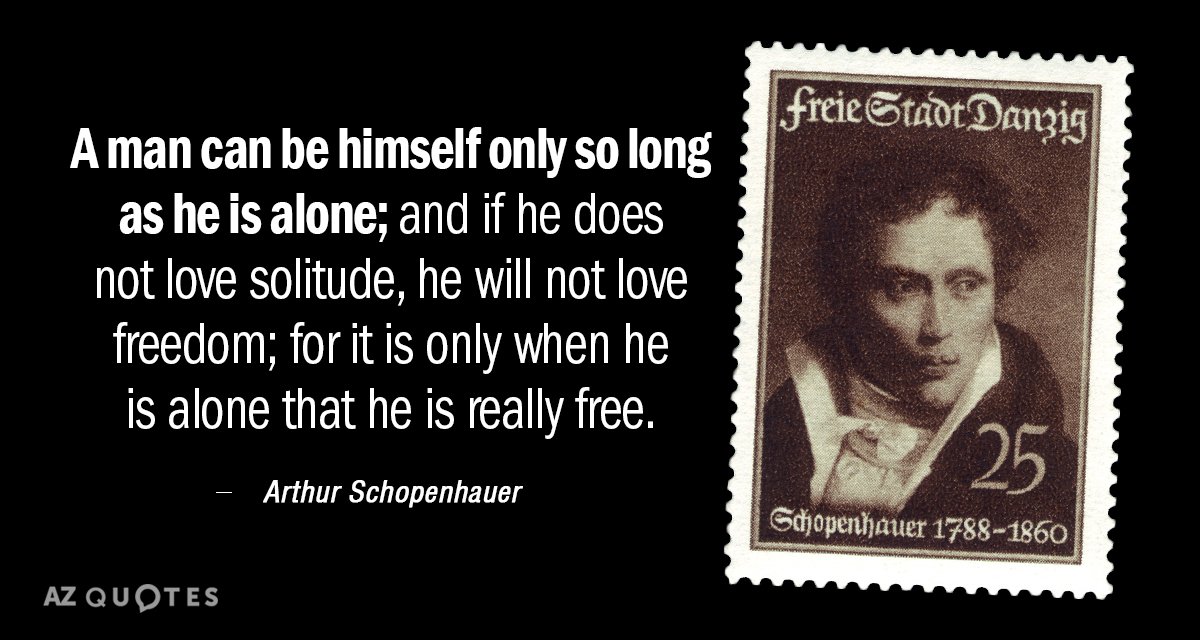
Great Sayings – Arthur Schopenhauer on Being Alone (Covid-19)

We have been in quarantine for a while now.  Most are dying to get back to their life of being busy.  I’ve observed that those who want to get out the most are the ones who are trying to escape from themselves.  It is a time of introspection.  If it weren’t an election year, it probably would have been lifted in a lot of places by now.

The extroverts have to talk to others.  The introverts don’t mind being alone, but are bothered when they are quarantined with an extrovert that makes their life miserable thinking that they have to talk all the time.  They can’t wait for it to be lifted so that they can be home alone again.

Those of us who are truly comfortable with ourselves can enjoy the solitude without distress.  The needy are those who have to have others as a salve for their issues.  It is a good time to learn to deal with your issues.  That is when you are finally free.


Things You May Not Know, Or Haven’t Considered Yet About Life (6 People Look Exactly Like You)

1. Your shoes are the first things people subconsciously notice about you. Wear nice shoes.
2. If you sit for more than 11 hours a day, there’s a 50% chance you’ll die within the next 3 years.
3. There are at least 6 people in the world who look exactly like you. There’s a 9% chance that you’ll meet one of them in your lifetime.
4. Sleeping without a pillow reduces back pain and keeps your spine stronger.
5. A person’s height is determined by their father, and their mother determines their weight.
6. If a part of your body “falls asleep”, you can almost always “wake it up” by shaking your head.
7. There are three things the human brain cannot resist noticing – food, attractive people and danger.
8. Right-handed people tend to chew food on their right side.
9. Putting dry tea bags in gym bags or smelly shoes will absorb the unpleasant odor.
10. According to Albert Einstein, if honeybees were to disappear from earth, humans would be dead within 4 years.
11. There are so many kinds of apples, that if you ate a new one every day, it would take over 20 years to try them all.
12. You can survive without eating for weeks, but you will only live 11 days without sleeping.
13. People who laugh a lot are healthier than those who don’t.
14. Laziness and inactivity kill just as many people as smoking.
15. A human brain has a capacity to store 5 times as much information as Wikipedia.
16. Our brain uses the same amount of power as a 10-watt light bulb!!
17. Our body gives enough heat in 30 minutes to boil 1.5 liters of water!!
18. The Ovum egg is the largest cell and the sperm is the smallest cell!!
19. Stomach acid (conc. HCl) is strong enough to dissolve razor blades!!
20. Take a 10-30 minute walk every day & while you walk, SMILE. It is the ultimate antidepressant.
21. Sit in silence for at least 10 minutes each day.
22. When you wake up in the morning, pray to ask God’s guidance for your purpose, today.
23. Eat more foods that grow on trees and plants and eat less food that is manufactured in plants.
24. Drink green tea and plenty of water. Eat blueberries, broccoli, and almonds.
25. Try to make at least three people smile each day.
26. Don’t waste your precious energy on gossip, energy vampires, issues of the past, negative thoughts and things you cannot control. Instead invest your energy in the positive present moment.
27. Eat breakfast like a king, lunch like a prince and dinner like a college kid with a maxed out charge card.
28. Life isn’t fair, but it’s still good.
29. Life is too short to waste time hating anyone. Forgive them for everything.
30. Don’t take yourself so seriously. No one else does.
31. You don’t have to win every argument. Agree to disagree.
32. Make peace with your past so it won’t spoil the present.
33. Don’t compare your life to others. You have no idea what their journey is all about.
34. No one is in charge of your happiness except you.
35. Frame every so-called disaster with these words: ‘In five years, will this matter?’
36. Help the needy, be generous! Be a ‘Giver’ not a ‘Taker’
37. What other people think of you is none of your business.
38. Time heals everything.
39. However good or bad a situation is, it will change.
40. Your job won’t take care of you when you are sick. Your friends will. Stay in touch.
41. Envy is a waste of time. You already have all you need.
42. Each night before you go to bed, pray to God and be thankful for what you accomplished, today. What if you woke up this morning and only had what you thanked God for yesterday? DON’T FORGET TO THANK GOD FOR EVERYTHING.
43. Remember that you are too blessed to be stressed.

Great Sayings – Daniel Patrick Moynihan on Opinion vs. Facts

Everyone has both.  Some choose one over the other.  Most mesh the two together.

The difficulty in this day of being barraged by social media and a 24/7/365 news hype cycle is that you can choose to go with your bias and only see one side of any story.  This is dangerous regardless of which side you view it from.

Don’t believe the scare tactics of the money hustlers who rush people into a position like sheep herders trying to corral the flock into group think.  The tactic is shame for not subjugating yourself to the PC position of the day.

It takes courage to step out and stand for what is right, especially in the start of a crisis or an event in time. This requires critical thinking as to discovery of the real facts and applying the necessary logic to come to the right conclusion.  It also can take time.  The media and politicians will try to rush us into judgement based on opinion.

As they said in Watergate, follow the money and you’ll usually see through those who are self-serving.

Most of all, don’t be a sheep.  Think for yourselves and don’t take anything you read online as gospel, except for the Gospel.

Sooner or later, time exposes the truth.  Whether you want to believe it or not is now up to you.

Great Sayings – William Penn on Right vs. Wrong

No doubt about it, we know this deep down despite what the media and the power hungry part of the Government tries to cram down our throats.

It’s tough to be on an island when everyone is shooting at you because of what you believe.  In the long run, staying the course with what is right is better.  You’ll also have fewer regrets, and probably fewer people in your life that you may have thought were friends.  Be grateful that they revealed their nature to you.

These are difficult times, but deep down we all know right vs. wrong.  Pick right and life may not be easier, but you’ll have fewer regrets.

Great Sayings – Johann Wolfgang von Geothe

“To think is easy. To act is hard. But the hardest thing in the world is to act in accordance with your thinking.”

Peer pressure and fear cause most people to go with the crowd instead of their values.  In these days of political correctness and social justice warriors, there is always someone to criticize you no matter what you do.  It’s best to ignore them and do what you know is right.  We have a conscience and know instinctively right vs. wrong.  You’ll feel better in the long run about yourself and they choices you’ve made.

Great Sayings – Blaise Pascal On What We Choose To Believe

“We are generally the better persuaded by the reasons we discover ourselves than by those given to us by others.”


Besides having a programming language named after him and a famous theorem, he points out the obvious.

You can’t tell most people anything.  They have to learn it themselves and usually the hard way.  Today’s toxic political environment is a perfect example, no matter which side you take.

It’s just how many times do you have to bang your head against the wall until you realize that it hurts?

Great Sayings – Dale Carnegie (Covid-19)

“Inaction breeds doubt and fear. Action breeds confidence and courage. If you want to conquer fear, do not sit home and think about it. Go out and get busy.”
– Dale Carnegie


And that time is upon us.  We are about to emerge from the Wuhan virus cocoon that we were forced into.  We need to kick start life in the butt.

Great Sayings – Henry David Thoreau

“In the long run men hit only what they aim at.”
— Henry David Thoreau


You also miss 100% of the shots you don’t take.  Some wander aimlessly through life and wind up lost.  Some are too focused on their goal and miss out life.  Find the balance, but have a target.

Great Sayings In Times of Peril (like Covid-19) – Lucretius

“So it is more useful to watch a man in times of peril, and in adversity to discern what kind of man he is; for then at last words of truth are drawn from the depths of his heart, and the mask is torn off, reality remains.” — Lucretius


Anybody can be good when times are good.  You see what someone is made of in the bad times.  How do they act?  How do they deal with the trouble, pain, hurt and adversity.  When the going gets tough, the tough get going as they say.  People are most honest when they are at their end and all the layers of the onion are pealed away.

Great Sayings – Solving Problems by M. Scott Peck

“It is in the whole process of meeting and solving problems that life has meaning. Problems are the cutting edge that distinguishes between success and failure. Problems call forth our courage and our wisdom; indeed, they create our courage and our wisdom. It is only because of problems that we grow mentally and spiritually. It is through the pain of confronting and resolving problems that we learn.” — M. Scott Peck


We all have problems.  Ignoring them won’t make them go away.  One must face them and solve them.  Every problem solved increases your arsenal of weapons to take on the next problem. Those who won’t face the issues or deal with them not only don’t grow, they go backwards in life.  Oh, and you will have problems to solve until the day you die, deal with it.


Great Sayings – When the Storm is Over, Haruki Murakami

“And once the storm is over, you won’t remember how you made it through, how you managed to survive. You won’t even be sure, whether the storm is really over. But one thing is certain. When you come out of the storm, you won’t be the same person who walked in. That’s what this storm’s all about.” — Haruki Murakami


We will be different when the China/Wuhan/Covid-19/whatever virus has run its’ course.  Some will act differently like washing their hands more or social distancing.  Some may travel less. The smartest of these will stay off cruise ships.  The wisest will decide who and what they believe in to as the rock to anchor their life on.

Great Sayings – Fearlessness and Readiness by Friedrich Neitzsche

“The higher man is distinguished from the lower by his fearlessness and his readiness to challenge misfortune.” — Friedrich Nietzsche


This is not a rating system based on grief, rather how one acts in the face of things not going their way.  Everyone has ups and downs despite what they post on social media.  We all have the choice to give up, or pulling up our trousers and moving ahead.  Note: it doesn’t say we won’t grieve or suffer, rather how we persevere.

Great Sayings – Thomas Paine On Overcoming

“The harder the conflict, the more glorious the triumph. What we obtain too cheap, we esteem too lightly; it is dearness only that gives everything its value. I love the man that can smile in trouble, that can gather strength from distress and grow.” — Thomas Paine


When I studied Martial Arts, my Sensei told me that the ones who quit are the ones that it comes easy too.  The ones who have to struggle or try harder persevere longer and achieve more.

Training for anything is necessary.  Enjoying the journey is how to best enjoy the process of overcoming.  That is the key to the above saying because life, happiness, freedom and other things we cherish are a journey, not an event.

Another Covid-19 Related Saying That is Relevant – Life

“Learning to endure times of disappointment, suffering, and sorrow is part of our on-the-job training. These experiences, while often difficult to bear at the time, are precisely the kinds of experiences that stretch our understanding, build our character, and increase our compassion for others.” — Joseph B. Wirthlin

Great Sayings – Jordan Peterson

“A harmless man is not a good man. A good man is a very dangerous man who has that under voluntary control.” — Jordan Peterson


Self control is a good trait.  The baddest man in the room never has to prove it, but should be able to defend himself and the weak when necessary.  This is not just a bare knuckles statement.  Being intellectually strong as well as spiritually sound are also strengths one needs.

None of these come for free.  You must work on them, and work on them constantly.  The world doesn’t stop and neither does evil.  Now go out and be dangerous to evil.

Great Sayings – George Patton

“I don’t fear failure. I only fear the slowing up of the engine inside of me which is saying, ‘Keep going, someone must be on top, why not you?’” — George S. Patton Jr.


Love him or hate him, he got things done and was feared by the enemy, so much so that they had a respect for his command.  In these times of the Covid-19 virus, we need to keep going and not give up.  Stay on top and don’t give up.

Great Sayings – Abraham Maslow

“If I were dropped out of a plane into the ocean and told the nearest land was a thousand miles away, I’d still swim. And I’d despise the one who gave up.” — Abraham Maslow


I’ve been in some dark places before either in life or just competition.  They say in the Marines that there is always an end to whatever pain you are going through so don’t give up.  You’d be amazed at what you can accomplish.

They train Seals until exhaustion, but it’s said that they are only at their 60% level and have a reserve.  How do I know?  If someone pointed a rifle at them, they could still run some more.  It’s said if you get to your end and someone offered you $100 to go 30 seconds more, almost everyone can and will do it.


Great Sayings – Vince Lombardi

I’ve heard him being quoted with different versions of this one, so I’ll put in the ones that I’ve heard.


“Winning isn’t everything, but wanting to win is.” — Vince Lombardi

If winning isn’t important, why do they keep score?

Winning isn’t everything, it’s the only thing.

It’s not whether you win or lose, it’s whether you win.

What It’s Like To Have An Extremely High IQ?

Editors note:  Since I published this, the comments have been coming in and are now far better than the blog post.  I encourage you to read about the lives and struggles of those who have high IQ.  Their stories are quite revealing.-> It’s in the comments, hint, hint, hint.

Authors disclosure: I won’t disclose where I am on the IQ chart, but I do have some in my family with very high IQ.  My father had a gigantic IQ.   Here are the stories of those with high IQ and their travails. See if you identify with any of them.

The blog post actually starts here.  It is a compilation of individuals with their names mostly redacted who have written about the travails of a high IQ:

Johann Wolfgang von Goethe – “The intelligent man finds almost everything ridiculous, the sensible man hardly anything.”


Update: 10/3/16 from Alison Craig

It sounds like you are in the beginning stages of an existentialist crisis. http://plato.stanford.edu/entrie…  I know the word “crisis” looks alarming, but it shouldn’t. In this case it just means you are examining the point of your own existence. Will I always be alone? Why am I here? Eventually you may even question all existence and come to the seemingly frightening conclusion that we’re all born alone and die alone and nothing in life has purpose.

“Well, that’s horrible! You’re depressing, why would you say such things?”

Again, I repeat- it is nothing to be alarmed about. Those things are true – to a degree. We are born alone and die alone, but we work to make connections with people who can support us, and that we can support in return. Intelligent or not, there will always be like minded people in the world somewhere and they are never easy to find for anyone. To me, making those connections is why I am here and is a large part of my purpose.

No matter how intelligent, wealthy or attractive a person is – it can always be difficult to find true connections so that all of the sharing and giving is not a one way street. Intelligent people may have stricter standards for making friends (in fashion or other), but so might a wealthy person, or a very attractive one. All people fear being used and some are just more cautious than others. An intelligent person can read books on understanding human nature ( Ten Keys to Handling Unreasonable & Difficult People), body language Psychology Today and other psychology tools to assist them in making life long connections with other people.

===============================================

From Shah Rukh Qasim on hiding your intelligence:

If you could generalize, the most common would be:

  1. You keep talking to a person, telling him something you think he doesn’t know. He keeps listening. Then he shares his insight which makes you think he has already known everything you told him. Smart people at often silent and active listeners.

Other signs will include:

  1. Good problem solvers. Not just mathematics problem. But even daily life problems. They’ll quickly find what’s wrong and take the best course of action to solve the problem.
  2. They’ll be different in views. And their views will always come with reason. A quote goes around: Small minds discuss people. Average mind discuss events. Great minds discuss ideas.
  3. A fool thinks himself to be wise, but a wise man knows himself to be a fool.” – William Shakespeare
  4. They often look for reasons. It goes in four levels (worst to best):
    1. What?
    2. How?

=========================================

It sucked when I was younger, but these days it’s just awesome.

There is a very common pattern among highly gifted people, namely:

  • When you’re young it’s very isolating, and it feels like everyone else is just stupid
  • As you grow older, you realize your gift. You also realize that raw intelligence isn’t everything, and that things like social skills matter a lot. Plus, you meet others like you.
  • Your social life improves as you get older and learn to connect on things other than intelligence or go to elite institutions where you can meet other highly gifted people.

Honestly, at this point in my life I feel like there are literally no downsides to having a high IQ. It’s like being born good looking or with great physical health: it’s not a silver bullet to a happy life, but it makes a lot of things much easier.

I only found out I had a high IQ (161) because my professional life was such a mess I had to see a psychologist.

If I had to sum it up in a few sentences, I would say that the most aggravating thing about being very intelligent is that you quickly see and understand things at a level of depth that most people don’t (or can’t), and it is very frustrating.  You want to move on, you want to be pushed, you don’t want to spend time explaining the details of things you have already grasped, but no one else is caught up yet, so you have to pause.  It is particularly painful when dealing with complex topics where the mental models involve feedback loops and non-linearities.

But that said, I’ve learned there is much more to life than intelligence, and being successful is more about hard work and good communication skills than anything else.

====================================================

“One of the indictments of civilizations is that happiness and intelligence are so rarely found in the same person.”

Working successfully in society and business is limited by some really important social choke points.  One of them is that other people, even if they are intellectually slower, must be treated with respect.  Another is that even if you are correct you will have difficulty getting people to act on your insights until they understand why you are correct.  A third thing is that most important activities are done as a team and so taking action requires breaking down your insights into something that your slower peers and employees can understand.  If you try to blow past these choke points you will destroy relationships and even if you are right, your career will languish.  I try to remind myself that being successful is not well correlated to being right.

My career is going pretty well now that I’ve understood these constraints.  It is possible to turn intelligence to practical life-advantage but our educational system doesn’t really give a blueprint for this.  I left school thinking that it mattered that I understood things 5 minutes or 5 years before my classmates did.  It doesn’t.  Most people’s functioning adult lives are not spent solving tough problems.  They are spent going through well established rituals and patterns of relating to each other punctuated by an occasional tough problem.  In most cases, people can even skip the tough problems and still do okay in life.  So how do you convert a parlor trick (like knowing the ending of a movie after 5 minutes) into something that will make you happier?  Mostly, you don’t.  Use it when it’s valuable and relax a little when it’s not.

There’s a great Dilbert where someone invites him to join the company’s Mensa chapter and Dilbert asks why people who are so smart continue to work at the company.  The president of the Mensa chapter answers, “Intelligence has much less practical application than you’d think.”

==========================================

In a word, I find it alienating.

Extremely so, in fact.

And I think this is not only because of what makes me “smart”, but also because of what my brain has to sacrifice to be “smart” in that way.  (More on that in a sec.)

For the record, my IQ was measured (years ago) at 178. [ETA: Just looked up the percentile, and that’s about 1 in 2 million, for some perspective.]  I have 3 advanced degrees and a solid career.  But I’m still single and spend very little time around other people.

It took me some time as a young kid to figure out that the people around me weren’t interested in the same things I was.  And that, often, to talk about the things I found interesting turned people away.

So I hid that.

When they announced that I was valedictorian of my high school, I was in 1st period art class, and one of my classmates refused to believe that they’d said my name.

But I never felt like I belonged anywhere, and I still don’t.

I don’t have kids, TV doesn’t interest me, I don’t follow celebrities or watch sports.  My time is spent with my work, and researching the things that are important to me — astrophysics, particle physics, consciousness research, and although this might seem strange to some people, Biblical scholarship (tho I’m not a believer).

As a result, chit-chat is impossible for me, or else it’s so boring that it becomes impossible.

But like I said, the problem isn’t only that my brain is interested in things that most other brains aren’t.  It’s also what my brain can’t do.

There’s only a certain amount of space in the brain, and if one area is eating up the real estate with more neural power, some other part of the brain is likely losing out.

For me, it’s some of the automatic social functioning which tells you, for example, what emotion another person is feeling based on their facial expression, or whether someone’s being sarcastic or not.  (Sarcasm is a minefield for me, and meeting another person in a hallway is a nightmare — I cannot interpret when to look, or not, what to say, or not, etc.)

That said, I have an enormously rich life, and I’ve adjusted to it.  When I stopped trying to fit in, things got better.

=============================================

HOWEVER…..STUPID IS AS STUPID DOES

The smart can do stupid things such as:

  • Ignoring the importance of design and style – When the iPod originally came out, technical people complained about its lack of features and perceived high price (“ooh, who cares about another MP3 player, I can go buy one at Best Buy for $50” http://forums.macrumors.com/show…).  In the meantime, it was so cool and easy to use that normal people went out in droves to buy it.
  • Using terrible tools, and taking pride in their awfulness – Especially common with programmers, who take pride in using programming languages and text editors that have been designed by programmers, not updated since the 1970s, and never touched by anyone with a modicum of design sense. They believe that mastering arcane, overcomplicated commands and processes are a mark of pride, rather than a waste of time.  I will refrain from singling out specific programming languages and tools here, because smart people also like to get caught up in pointless flame wars about this sort of thing.
  • Following the pack – Many smart people often seem to be followers, probably because they grow up spending so much time pleasing others via academic and extracurricular achievement that they never figure out what they really like to work on or try anything unique.  Smart people from top schools tend to flock into the same few elite fields, as they try to keep on achieving what other people think they should achieve, rather than figuring out whatever it is they intrinsically want to do.
  • Failing to develop social skills – Some smart people focus exclusively on their narrow area of interest and never realize that everything important in life is accomplished through other people.  They never try to improve their social skills, learn to network, or self promote, and often denigrate people who excel in these areas. If you are already a good engineer you are going to get 10x the return on time spent improving how you relate to other people compared to learning the next cool tool.
  • Focusing on being right above all else – Many smart people act as if being right trumps all else, and go around bluntly letting people know when they are wrong, as if this will somehow endear others to them.  They also believe that they can change other people’s minds through argument and facts, ignoring how emotional and irrational people actually are when it comes to making decisions or adopting beliefs.
  • Letting success in one area lead to overconfidence in others – Smart people sometimes think that just because they are expert in their field, they are automatically qualified in areas about which they know nothing.  For instance, doctors have a reputation as being bad investors: http://medicaleconomics.modernme….
  • Underrating effort and practice – For smart people, many things come easily without much effort.  They’re constantly praised for “being smart” whenever they do anything well.  The danger is that they become so reliant on feeling smart and having people praise them, that they avoid doing anything that they’re not immediately great at.  They start to believe that if you’re not good at something from the beginning, you’re destined to always be terrible at it, and the thing isn’t worth doing.  These smart people fail to further develop their natural talents and eventually fall behind others who, while less initially talented, weren’t as invested in “being smart” and instead spent more time practicing.  http://nymag.com/news/features/2…
  • Engaging in zero sum competitions with other smart people – Many smart people tend to flock to fields which are already saturated with other smart people.  Only a limited number of people can become a top investment banker, law partner, Fortune 500 CEO, humanities professor, or Jeopardy champion.  Yet smart people let themselves be funneled into these fields and relentlessly compete with each other for limited slots.  They all but ignore other areas where they could be successful, and that are less overrun by super-smart people.   Instead of thinking outside the box, smart people often think well within a box, a very competitive box that has been set up by other people and institutions to further someone else’s interests at the expense of the smart person.
  • Excessively focusing on comparing their achievements with others – Smart people who have been raised in a typical achievement-focused family or school can get anxious about achievement to the point of ridiculousness.  This leads to people earnestly asking questions like: Success: If I haven’t succeeded in my mid 20s, could I be successful in the rest of my life? and Are you a failure if you are not a billionaire by age 30? What about 40?
  • Ignoring diminishing returns on information – Smart people are often voracious readers and can absorb huge quantities of information on any subject.  They get caught up in reading every last bit of information on subjects that interest them, like investing, lifehacking, or tech specs of products they’re planning on buying.   While some information is useful in making a decision, poring through the vast amount of information available online can be a waste of time.  They end up spending a lot of time gathering information without taking action.
  • Elitism – Smart people often use smartness as measure of the entire worth of a person.  They fail to see the value in or even relate with people who are different.  This is illustrated by the Yale professor who doesn’t have the slightest idea what to say to his plumber: http://www.theamericanscholar.or….  And questions like Am I an elitist to think that most people are stupid?


What Are The Top 10 Things You Should Be Informed Of In Life

Again, these are not my answers, but are an interesting read on people.  It will offend some, but God is number one for me.  The rest of the lists below should offend someone or many.

1. Human psychology. It’s a young field, and no one has all the answers yet. But you can get a better understanding of why other people do what they do — and how to thread your way through life’s complexities — by studying at least a little of this field.

2. The basics of accounting. This will greatly reduce your chances of being swindled in life. It also will make it much easier for you to do some systematic planning, while keeping track of how you’re doing vis a vis your plans.

3. Music. It will calm you. It will inspire you. It will build bridges to a more interesting set of friends.

4. Your own family’s story. Where did your parents grow up, and how did that shape who they are? What are the formal or informal communities that help define your identity? (“We are athletes … we are Irish … we are restless spirits who move from city to city.”) Having an enduring sense of identity that goes beyond the ups and downs of your own life will be a source of comfort and motivation all your life.

5. The way your government really works. Find out why some laws are tightly enforced and others aren’t. Learn the best ways of influencing your government — whether it’s on matters of national significance or something as personal as winning a zoning variance for the cafe you run. Finally, gain some non-bitter insights about why society doesn’t always work the way you’d like.

6. Good nutrition and how to incorporate it into your life. Mike Leary is right.  In a poor society, this is the difference between life and death. In a rich society, it’s — surprise! — the difference between a long, robust future and chronic illness that can turn deadly far too soon.

7. Different cultural values. If you’re going to be effective outside a small cluster of people like you, you’ll need to understand and appreciate how other tribes work, too.

8. How to communicate your ideas to the wider world. Justin Freeman is right. Learn how to speak clearly and persuasively. Or to write well. Or to create useful and appealing computer code, video, music, etc. Pick the medium that works best for you, and make sure you don’t go through life being mute.

9. Effective parenting. Just because your parents didn’t quite get it right (no one ever does!) doesn’t mean that you can’t do better. Find your own style, stick with what works … but keep refining your approach as you learn from others. You owe it to the species.

10. Quora. It’s one-stop shopping for biased crap! Be aware of what’s on Quora, and you’ll know what not to believe.

Here’s another:

  1. Realize that nobody cares, and if they do, you shouldn’t care that they care. Got a new car? Nobody cares. You’ll get some gawkers for a couple of weeks—they don’t care. They’re curious. Three weeks in it’ll be just another shiny blob among all the thousands of others crawling down the freeway and sitting in garages and driveways up and down your street. People will care about your car just as much as you care about all of those. Got a new gewgaw? New wardrobe? Went to a swanky restaurant? Exotic vacation? Nobody cares. Don’t base your happiness on people caring, because they won’t. And if they do, they either want your stuff or hate you for it.
  2. Some rule breakers will break rule number one. Occasionally, people in your life will defy the odds and actually care about you. Still not your stuff, sorry. But if they value you, they’ll value that you value it, and they’ll listen. When you talk about all of those things that nobody else cares about, they will look into your eyes and consume your words, and in that moment you will know that every part of them is there with you.
  3. Spend your life with rule breakers. Marry them. Befriend them. Work with them. Spend weekends with them. No matter how much power you become possessed of, you’ll never be able to make someone care—so gather close the caring.
  4. Money is cheap. I mean, there’s a lot of it—about forty thousand billion dollars floating around the world, largely made up of cash whose value is made up and ascribed to it, anyway. Don’t engineer your life around getting a slightly less tiny portion of this pile, and make your spirit of generosity reflect this principle. I knew a man who became driven by the desire to amass six figures in savings, so he worked and scrimped and sacrificed to get there. And he did… right before he died of cancer. I’m sure his wife’s new husband appreciated his diligence.
  5. Money is expensive. I mean, it’s difficult to get your hands on sometimes—and you never know when someone’s going to pull the floorboards out from under you—so don’t be stupid with it. Avoid debt on depreciating assets, and never incur debt in order to assuage your vanity (see rule number one). Debt has become normative, but don’t blithely accept it as a rite of passage into adulthood—debt represents imbalance and, in some sense, often a resignation of control. Student loan debt isn’t always unavoidable, but it isn’t a given—my wife and I completed a combined ten years of college with zero debt between us. If you can’t avoid it, though, make sure that your degree is an investment rather than a liability—I mourn a bit for all of the people going tens of thousands of dollars in debt in pursuit of vague liberal arts degrees with no idea of what they want out of life. If you’re just dropping tuition dollars for lack of a better idea at the moment, just withdraw and go wander around Europe for a few weeks—I guarantee you’ll spend less and learn more in the process.
  6. Learn the ancient art of rhetoric. The elements of rhetoric, in all of their forms, are what make the world go around—because they are what prompt the decisions people make. If you develop an understanding of how they work, while everyone else is frightened by flames and booming voices, you will be able to see behind veils of communication and see what levers little men are pulling. Not only will you develop immunity from all manner of commercials, marketing, hucksters and salesmen, to the beautiful speeches of liars and thieves, you’ll also find yourself able to craft your speech in ways that influence people. When you know how to speak in order to change someone’s mind, to instill confidence in someone, to quiet the fears of a child, then you will know this power firsthand. However, bear in mind as you use it that your opponent in any debate is not the other person, but ignorance.
  7. You are responsible to everyone, but you’re responsible for yourself. I believe we’re responsible to everyone for something, even if it’s something as basic as an affirmation of their humanity. However, it should most often go far beyond that and manifest itself in service to others, to being a voice for the voiceless. If you’re reading this, there are those around you who toil under burdens larger than yours, who stand in need of touch and respect and chances. Conversely, though, you’re responsible for yourself. Nobody else is going to find success for you, and nobody else is going to instill happiness into you from the outside. That’s on you.
  8. Learn to see reality in terms of systems. When you understand the world around you as a massive web of interconnected, largely interdependent systems, things get much less mystifying—and the less we either ascribe to magic or allow to exist behind a fog, the less susceptible we’ll be to all manner of being taken advantage of. However:
  9. Account for the threat of black swan events. Sometimes chaos consumes the most meticulous of plans, and if you live life with no margins in a financial, emotional, or any other sense, you will be subject to its whims. Take risks, but backstop them with something—I strongly suspect these people who say having a Plan B is a sign of weak commitment aren’t living hand to mouth. Do what you need to in order to keep your footing.
  10. You both need and don’t need other people. You need others in a sense that you need to be part of a community—there’s a reason we reflexively pity hermits. Regardless of your theory of anthropogenesis, it’s hard to deny that we are built for community, and that ‘we’ is always more than ‘me.’ However, you don’t need another person in order for your life to have meaning—this idea that Disney has shoved through our eyeballs, that there’s someone out there for all of us if we’ll just believe hard enough and never stop searching, is hokum… because of arithmetic, if nothing else. Establish your own life—then, if there’s a particular person that you can’t help but integrate, believe me, you’ll know.
  11. Always give more than is required of you.

Go to the link above, there is more.

Add more in comments if you have a better suggestion than these.

How Do High IQ People Read Books

Note: intelligent people generally read a lot.  There are many ways to read a book.  Authors read for story arc’s, character profile and emotional connection.

Many people learn from textbooks, but for general reading, here is a good list I found on how high IQ people read:

1) Find a personal angle: You need to relate to what you’re reading

2) Get a bird’s eye view: Get the basic outline of the book by skimming through the table of contents (and the rest of the book); try finding a central theme

3) Drum up curiosity: Draft a few “curiosity questions” based on the theme; consider these questions as you read the book

4) Create your own structure: Identify key points in the book and leave space for you to take in-depth notes

5) Record key insights: Take in-depth notes based on the elements you mentioned in Step 4; think about what the “Takeaway Message” is.

6) Review your notes: Now that you have a summary you have created in your own words, it’s now time to review; try to remember the details related to the messages you recorded 10 minutes, 2 days, 1 week after finishing the book.

7) Repeat with another book.

Here is the link to this list.

Reflections On Growing Older

I’ll bet if you ask most people of a certain age, they are going to realize that this is true.  I remember asking my father for life advice on his 75th birthday.  He answered, “where did it all go so fast?”  You’ll find that one below also.

Read and learn if you are young, commiserate if you agree.

    #1  –  I talk to myself because there are times I need expert advice.

    #2  –  I consider “In Style” to be the clothes that still fit.

    #3  –  I don’t need anger management.  I need people to stop pissing me off.

    #4  –  My people skills are just fine. It’s my tolerance for idiots that needs work.

    #5  –  The biggest lie I tell myself is, “I don’t need to write that down.  I’ll remember it.”

    #6  –  I have days when my life is just a tent away from a circus.

    #7  –  These days, “on time” is when I get there.

    #8  –  Even duct tape can’t fix stupid – but it sure does muffle the sound.

    #9  –  Wouldn’t it be wonderful if we could put ourselves in the dryer for ten minutes, then come out wrinkle-free and three sizes smaller?

    #10  –  Lately, I’ve noticed people my age are so much older than me.

    #11  –  “Getting lucky” means walking into a room and remembering why I’m there.

    #12  –  When I was a child, I thought nap time was punishment.  Now it feels like a mini-vacation.

    #13  –  Some days I have no idea what I’m doing out of bed.

    #14  –  I thought growing old would take longer.

    #15  –  Aging sure has slowed me down, but it hasn’t shut me up.

    #16  –  I still haven’t learned to act my age and doubt I’ll live that long.


Unfortunately, these are all sadly true!

Actual Maps of Where The #Shitholes Are – An A-Polititical Post On Where They Exist

First, I am not going to weigh in on what a world leader has said.  Every time I have ever tried it, nothing is gained as everyone has their own opinion and trying to sway it is not what I care about.  Enjoy your center, left, right or whatever political position you wish.

I was looking for whether this actually exists.  Here is what I’ve found.

UPDATE: Portland is the newest shit hole. Click on the link: Portland: American epicenter of degeneracy, depression, and ANTIFA.

Here is a link and a screenshot of a map from the Rice Institute based showing countries with the most open defecation.

Forbes published a list of the world’s dirtiest cities.  Without passing judgement, they seem to line up with the shitholes in the map so the facts seem to be in order.

Next, is it possible that the United States has places where there is open defecation?  I found that map also.

Below is the link and screenshot also, but in case you don’t recognize it, this is San Francisco.

Now, after reading this, one can add it to their travel plans to go and help, or avoid for sanitary purposes, you choose.  If you go to San Francisco, zoom in and you can see where to not step in a pile of poop.  As I type that, I realize that it is sad for what is supposed to be one of the leading cities of the US, and one so close to silicon valley.

It also gives everyone equal political fodder to take shots at whomever.  In these days of political partisanship, nothing or nobody is safe by the 3rd or 4th comment, so I expect the same.

I just got curious and I wondered if what was said was true or not. Apparently it is.

Here is the link to the recent study of sanitation including feces, used syringes and other disease carrying trash in the heart of San Francisco.  It’s a shame since it is in the heart of the restaurant and hotel area.  You’d think that the tourism officials would do something about this, but looking at the graph indicates the problem escalating.

UPDATE: San Francisco is getting over 80 calls a day to report human feces for clean up.  In the same report were almost as many instances of needles despite the fact that there are safe injection spaces for shooting up an illegal drug that destroys lives.


UPDATE: It turns out that Denver is now officially classified as a shithole also.  They passed an act that you can drop trou and pinch a loaf right on the street.  Here is the story and the reason why they passed the law.

UPDATE: It looks like Hawaii isn’t as pristine as one thinks of it.  The cesspools and the water around the islands are contaminated enough to make it a shithole also.  There is a link within this link that goes to the WSJ.

Video Update: A large portion of Orange county is now a 3rd world shithole also.

After all is said and done, I thought that having to have a map to not step in a pile of human feces makes a city the biggest shithole.  It turns out that I was wrong.

According to the Government services including the EPA, ACS and the Census bureau comes this little gem:

The City that Never Sleeps ranked the highest in three out of five categories, placing it as shittest-city-in-the-nation of 427.9 on Busy Bee’s “dirtiness index.” The next closest competitor for all the wrong reasons is Los Angeles, which has a dirtiness index of 317.8. To complete the top five list, the remaining dirtiest cities are Chicago, Philadelphia, and San Francisco.

So not only do you have to pay way more more to live in these places, they have worse air, bigger rats and more cockroaches, they turn out to be the shitholes that we all thought they were.  Why anyone would choose to live there knowing there?

8 Basic Truths Even the Smartest People Forget

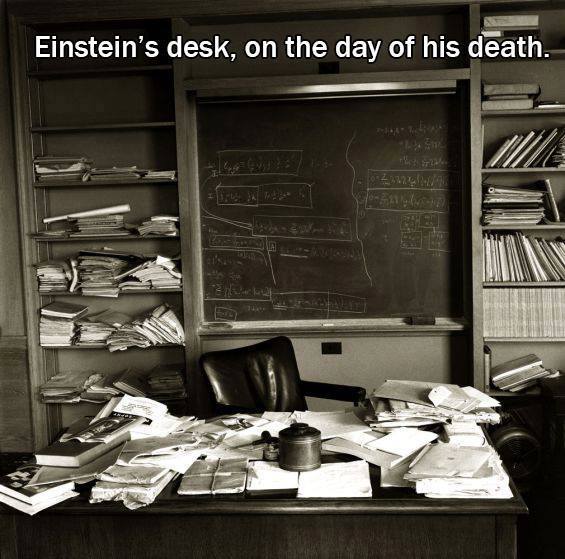
This is the Background for my Facebook page, the reason I thought this article was so interesting.  Perhaps you will also.  Even the person some regard as the smartest surely forgot some things, especially on his desk.

10982462_10153638113558797_8847922298755759730_n


Even the smartest people out there sometimes forget some of those obvious concepts:

1. Not feeling ready can be a good thing

Opportunities rarely come when we are 100% ready to seize them. They are more likely to knock on your door when you feel insecure with your preparation, knowledge and skills. But that doesn’t mean you should be ignoring them until you feel ready. Most of our lifetime opportunities force us to grow both emotionally and intellectually. They push us to give the best of ourselves, even if that means getting out of our comfort zones. But sacrificing our comfort can give us the chance for personal growth. If you want to change your life for the better, you should open yourself to the opportunities that arise, even if you don’t feel 100% ready.

2. Success and failure go hand in hand

Often times people tend to misinterpret the meaning of the word “failure”. Why are we so afraid of failure? It is just as natural as succeeding. Failure doesn’t mean not succeeding. It is actually a part of the circle of success. And success itself shouldn’t be measured by the achievement of a particular goal. Success is a state of being and therefore everyone can feel successful.

3. Action is the key for all success

We often hear that knowledge is power. But it only is power if you use it. Knowing how to do something and actually doing it are two completely different things. It doesn’t matter if ,for example, you read books and articles on fighting procrastination, and take no particular action to overcome that problem. Knowledge and intelligence are useless without action.

4. Even mistakes mean progress

If you look back in your life, maybe you will realize that the mistakes you have done in the past have taught you valuable lessons. So why should we be scared of making mistakes, if they help us grow stronger and wiser? Every mistake you make on the way to a particular goal brings you one step closer to achieving it. It is highly possible that the mistake you will regret the most in your life is not taking action because of the fear of making mistakes. This way you will always be wondering what could have happened, if you hadn’t been so scared. And most importantly- you wouldn’t have made any progress. So don’t be afraid of feeling uncertain about something- give it a try and see what happens.

5. Making decisions is impeded when there are too many options

We live in times when there are so many opportunities for us to choose from when it comes to determining our career and life paths. But when we have so many choices before us, we can often times get confused and indecisive. Business and marketing studies prove that when a consumer has more product choices, he’s predisposed to buy less. If you think about it, choosing one product out of three product choices feels much easier than choosing one out of three hundred. Most people will give up easily, if the buying decision process is tough.

6. Success doesn’t necessarily mean happiness

Many people believe that they can only be happy if they accomplish a particular goal. In my opinion, we can choose to be happy every day, no matter where on the path to our goals we are at the moment. “The monk who sold his Ferrari” by Robin Sharma is one of the most inspiring books I have ever read. One of the main ideas shared by the author is that you don’t have to wait to accomplish your dreams to be happy. The main character was one of the most successful layers in the country but even though he had everything he ever wanted, he wasn’t a happy person. The most important thing is to cherish every moment of every day and to be thankful for who you are and what you have now.

7. You can be the best at something even if you don’t like doing it

Some people say that in order to be good at doing something, you should love doing this thing. In my opinion, this isn’t necessarily true. If a person devotes their time and effort to learn a particular skill, they can become excellent at it. How they feel about the activity doesn’t determine their success in it.

8. What we see in others exists in us

When we have a problem with someone, this can actually help us learn more about ourselves. It can help us learn why we see that problem in the other person, and the reason can be that we hold it inside of us, too, and seeing it exposed before us can be frustrating. But acknowledging that what we see in others is a reflection of ourselves, can help us overcome our unsolved issues.

Hat tip to Intelligence.com

University of Texas at Austin 2014 Commencement Address – Admiral William H. McRaven

This is not only very inspiring, it is some of the best advice on the Interweb. For those in a good way, it will make you better, for those in a bad way it will show you how to begin to pick yourself up.  If you are young, it is a good lesson in how to live your life.

Navy SEAL Admiral Bill McRaven University Texas Austin Commencement Hook 'Em

AP Photo/The University of Texas at Austin, Marsha Miller

UT alum Adm. William H. McRaven gives students the “hook ’em horns” at the university’s commencement last week.


U.S. Navy admiral and University of Texas, Austin, alumnus William H. McRaven returned to his alma mater last week to give seniors 10 lessons from basic SEAL training when he spoke at the school’s commencement. 

McRaven, the commander of the U.S. Special Operations Command who organized the raid that killed Osama bin Laden, stressed the importance of making your bed every morning, taking on obstacles headfirst, and realizing that it’s OK to be a “sugar cookie.”

All of his lessons were supported by personal stories from McRaven’s many years as a Navy SEAL.

“While these lessons were learned during my time in the military, I can assure you that it matters not whether you ever served a day in uniform,” McRaven told students. “It matters not your gender, your ethnic or religious background, your orientation, or your social status.”


How #Gun #Control Is Made Simple and Explained Without Words

good-guys-gunsUPDATE: Gun ownership (as of 6/16) is at an all time high, but homicide rate is at an all time low.

Let’s explain this to Bloomberg, Holder, Rahm Emmanuel, Feinstein, the Prez.

It’s about enforcing existing laws, controlling the bad guys with guns and not banning self-defense against oppressiveness like the government and the UN.

Added bonus!  Here are the 8 myths by the gun control grabbers debunked like women who carry, more gun control stops violence, the USA should adopt the Australian model of gun control, the AR-15 is a Military grade assault rifle, anyone can buy a gun and other tripe.

I dedicate this one to idiots like Thomas Woosley (tjawoolsey@gmail.com) from the UK who needs more education but would rather use mendacious ad-hominem attacks on me instead of facts.  He clearly doesn’t understand the USA and guns and must live under a rock to make false assumptions about gun control the wanker.  He also doesn’t understand the north vs the south when trying to call people names.  At least educate yourself before putting out to the world how stupid you are.

Bonus Bonus!  Below are the myths of gun control including the gun show loophole, that there are more murders than suicides (not by a long shot) and others for idiots like Tom :

17 Things Alka Seltzer Is Good For, It Even Catches Fish

1. Safely Unclog A Drain
A great natural solution for unclogging the drain! Just drop four Alka-Seltzer tablets down the drain, followed by a cup of white vinegar and allow to stand for about ten minutes. Flush with a pot of boiling water. Doing this on a regular basis can help keep that drain clear. This also works to deodorize the drain.

2. Clean a Toilet In A Hurry
Drop two tablets in the toilet, wait 20 minutes for the citric acid to loosen the grime, scrub and flush. The bowl will be clean, shiny, and deodorized. Handy for a quick clean in case of uninvited, unannounced, surprise guests.

3. An All-Purpose Cleaner
Alka Seltzer can also be a good all around cleaner. Plop three tablets into 8 ounces of warm water. Once the fizzing stops, dip a sponge in the water (or you could fill a spray bottle) and wipe down counters, tiles and tubs. You can even place some in your sink and use as mop water. Just add five tablets to one half gallon of water.

4. Soothe Insect Bites
Drop two tablets in warm water, then soak a cotton ball in the solution. Place on the bite for 30 minutes for relief from the insect bites.

5. Catch a Fish
Fish love bubbles. Break a tablet in half and throw it out near your fishing line, or put a tablet inside your tube jig and cast off. The fish won’t be able to resist the stream of bubbles.

6. Remove Burnt On Food From Bakeware
Drop 5 tablets into a sink full of hot water and let your cookware soak for an hour or so. The burnt food will come off with ease.

7. Whiten and Brighten Your Laundry
To get rid of dingy yellow color on white cotton, soak your whites in a solution of a gallon of warm water and two Alka Seltzer tablets. Then hang your whites in the sun to dry to get rid of any lingering stains.

8. Deodorize the Fridge
For a clean, fresh smelling refrigerator, drop an Alka-Seltzer tablet in a cup of water and leave it in the refrigerator for a half hour. If there is still a smell in the refrigerator, then wash down the inside of the refrigerator with another Alka-Seltzer tablet in water.

9. Clean a Glass Jar, Flower Vase or Thermos
For those difficult to clean vessels with narrow-necks, and hard to reach places, drop two Alka-Seltzer tablets in, add hot water and swish it around until the tablets are dissolved and let it sit for an hour. Rinse, and the glass jar, vase or Thermos will be as clean as new.

10. Restore Stained Plastic Containers
Got spaghetti sauce stains on your plastic containers? Simply fill your container with warm to hot water and depending on the size drop 1-2 tablets into the water. Let sit for 30 minutes and the stains will disappear before your eyes.

11. Polish Your Jewelry
Drop two tablets in a bowl of warm water. Let your jewelry soak for about 20 minutes. It will look new again! (Note: This is not safe for pearls or opals.)

12. Build Rockets For Kids
Entertain little ones by heading outside with an empty film canister, filled halfway with warm water. Drop in half a tablet, snap on the lid and place the canister upside down on the sidewalk or driveway. Take a step back and watch your rocket blast off!

13. Clean Your Coffeemaker
Fill the water chamber of the coffeemaker and then drop in three tablets. When the Alka-Seltzer has dissolved, put the coffeemaker through a brew cycle. This will clean out all the internal components. Run through another plain water cycle before using the machine again for coffee.

14. Help For Nicotine Addiction
If you’re trying to quit smoking Alka-Seltzer can help. Take two tablets three times a day to relieve nicotine withdrawal symptoms and curb cravings.

15. Cure Urinary Tract Infections
Showing signs of a urinary infection? Take two tablets in a glass of water as soon as you notice symptoms. Results are almost immediate. Keep in mind that Aspirin is a main ingredient in Alka-Seltzer so those with Aspirin allergies shouldn’t use it.

16. Clean and Deodorize A Cooler
After an outing or trip, add about 1 inch of water to the bottom of your cooler, drop 4 tablets in, and let sit for an hour. After an hour, rinse and dry. All smells will be gone and it will be clean and ready for its next use.

17. Clean Dentures
Drop an Alka-Seltzer tablet into a glass of warm water, and then drop your dentures into the glass for about ten minutes. The citric acid and carbonation will remove the toughest stains from your dentures and other prosthetic dental work. This is an excellent substitute for more expensive denture cleanser products.

Senior Moments or What happens in my brain when I can’t recall something I know?

An interesting subject, sometimes called a brain fart.  These are not my answers, but I thought it would be interesting until you can’t recall it.

While it is not known for sure what is happening, this is how current models of memory recall would explain it:

Memory recall in the brain is not like retrieving a file from disk on a computer. In the brain, memories are reconstructed rather than retrieved. The brain is constantly augmenting what is in “working memory” with related information from the past. This is why stream of consciousness and memory recall often work by free association: The information association process is already there and we just make use of it.

When attempting to recall something specific, like a name, we “trick” the name into appearing in working memory by thinking about concepts related to it: the person’s identity, when we saw them last, what they look like. Normally this process automatically brings the information into working memory as a side-effect of filling in related facts.

When a word is missing but you “think you know it,” what is probably happening is that a lot of information about that word has been reconstructed in working memory, but not enough to trigger the production of the word itself. The presence of related information signals that you’ve “almost recalled it,” but the failure to produce the word shows that the recall is incomplete.

Often when people can’t recall a word, someone else can fill it in for them. But sometimes the “tip of the tongue” word does not actually exist. Related words may come to mind and it may seem like there “should be a word” for whatever it is. Thus the tip of the tongue feeling is not infallible.

Or: you can use this one….

A Neural Network (computer software) is just a simple model of the brain – not sure if the brain has something to do with it, but NN is composed of interconnected neurons with synapses (software model artifacts.)

Each neuron is an adder with a threshold, and each synapse has a weight. Both the threshold and the weight holds a small unit of information (could be digital or analog.) The entire NN has a certain information capacity, and used wisely (as in VOT (voice to text) or OCR (optical character recognition)) they do quite a job!

However, NN theory (and practice) shows (if I recall well) that when this capacity has been used/filled more than 11% (or something like that) while ‘learning‘,  the network starts ‘ forgetting!’

I want to stress again that I’m not aware of any evidence that the real brain works like a computer neural network – even more a computer NN would be to a brain like a dog house to New York city – but here there is something to think about…

For more information, go here.

Great Sayings With Meaning, and Some Trivia Also

“Not everything that counts can be counted, and not everything that can be counted counts.” (Sign hanging in Einstein’s office at Princeton)

“Inaction breeds doubt and fear. Action breeds confidence and courage. If you want to conquer fear, do not sit home and think about it. Go out and get busy.” – Dale Carnegie

Robert Frost – “In three words I can sum up everything I’ve learned about life: it goes on.”

arrêtez de ramer, tu attaques la falaise. (You can stop rowing now, you’re on the beach)

It is easy to lose one’s perspective in a mass of details. – Bible Study Fellowship

Failure is but a paragraph in the book of each human life. It is the pages that follow that ultimately define us

Laurence J. Peter – “An economist is an expert who will know tomorrow why the things he predicted yesterday didn’t happen today.”

“Racing is Life.  Everything before and after is just waiting.” Steve McQueen from the movie LeMans

Albert Einstein open original article “Only two things are infinite, the universe and human stupidity, and I’m not sure about the former

Joseph Heller -“The enemy is anybody who’s going to get you killed, no matter which side he’s on.”

Sidney J. Harris – “A cynic is not merely one who reads bitter lessons from the past, he is one who is prematurely disappointed in the future.”

Abba Eban-“History teaches us that men and nations behave wisely once they have exhausted all other alternatives.”

When you win, say nothing, when you lose, say less. -Paul Brown

You have to expect things of yourself before you can do them. -Michael Jordan

Every game is an opportunity to measure yourself against your own potential. -Bud Wilkinson

Excellence is not a singular act but a habit. You are what you do repeatedly. -Shaquille O’Neal

“Socialism is a philosophy of failure, the creed of ignorance, and the gospel of envy, its inherent virtue is the equal sharing of misery.” Winston Churchill, as quoted in The New American Newspeak Dictionary (2005) by Adrian Krieg, p. 96

 Rudeness is a weak person’s imitation of strength

Oscar Wilde

“What is a cynic? A man who knows the price of everything and the value of nothing.”

Losers quit when they’re tired. Winners quit when they’ve won

370H-SSV-0773H  – read upside down

I returned, and saw under the sun, that the race [is] not to the swift, nor the battle to the strong, neither yet bread to the wise, nor yet riches to men of understanding, nor yet favour to men of skill; but time and chance happeneth to them all.

For man also knoweth not his time: as the fishes that are taken in an evil net, and as the birds that are caught in the snare; so [are] the sons of men snared in an evil time, when it falleth suddenly upon them.– Ecclesiastes 9:11,12 —

“Meetings are indispensable when you don’t want to do anything.”  – John Kenneth Galbraith

If guns kill people, then pens misspell words, cars make people drive drunk, forks make you fat, and TVs make you watch porn.

Listen to people.  If they are worth talking to, they are worth listening to first.

You can’t change what happens to you in life.  All you can change is how you deal with it.

I think I’m emotionally constipated because I haven’t given a Rats Rump in days.

Liberalism: Moochers electing looters to steal from producers

Political Correctness –  A term used by whiny wussies that need stuff sugar coated

“The difference between stupidity and genius is that genius has its limits.” -Albert Einstein

“I like to see a man proud of the place in which he lives. I like to see a man live so that his place will be proud of him.” Abraham Lincoln

  • “This nation will remain the land of the free only so long as it is the home of the brave.” Elmer Davis
  • “Let every nation know, whether it wishes us well or ill, that we shall pay any price, bear any burden, meet any hardship, support any friend, oppose any foe, to assure the survival and success of liberty.”  John F. Kennedy
  • “Sure I wave the American flag. Do you know a better flag to wave? Sure I love my country with all her faults. I’m not ashamed of that, never have been, never will be.”  John Wayne
  • “We must always remember that America is a great nation today not because of what government did for people but because of what people did for themselves and for one another.” Richard Nixon
  • “There is no limit to the greatness of America!” George W. Bush
  • “Liberals become indignant when you question their patriotism, but simultaneously work overtime to give terrorists a cushion for the next attack and laugh at dumb Americans who love their country and hate the enemy.” Ann Coulter
  • “I only regret that I have but one life to lose for my country.” Nathan Hale
  • “Patriotism is not short, frenzied outbursts of emotion, but the tranquil and steady dedication of a lifetime.” Adlai E. Stevenson
  • “One, if you attack my integrity, I will defend myself. If you attack my patriotism, I will defend myself. If you come after my family, I will counter-attack viciously, I will destroy you.” Scott Ritter
  • “The American patriots of today continue the tradition of the long line of patriots before them, by helping to promote liberty and freedom around the world.” John Linder
  • “Patriotism is easy to understand in America. It means looking out for yourself by looking out for your country.” Calvin Coolidge
  • “This country will not be a good place for any of us to live in unless we make it a good place for all of us to live in.” Theodore Roosevelt
  • “You cannot spill a drop of American blood without spilling the blood of the whole world…. We are not a nation, so much as a world.” Herman Melville

A great civilization is not conquered from without until it has destroyed itself from within – Ariel Durant

“Blessed is the man who, having nothing to say, abstains from giving wordy evidence of the fact.”  – George Eliot

But isn’t it always that way with liberals? The only time they seem to make any sense at all is when they’re drunk or you are.

-Burt Prelutsky

Ya gotta be tough if your gonna be stupid.

“Political correctness is a doctrine, fostered by a delusional, illogical minority, and rapidly promoted by mainstream media, which holds forth the proposition that it is entirely possible to pick up a piece of crap by the clean end.”


Laurence J. Peteropen

“Against logic there is no armor like ignorance.”

“Never judge a book by its movie.”

“Liberals are very broadminded: they are always willing to give careful consideration to both sides of the same side.”

The fear of the Lord is the beginning of Wisdom
If the phone doesn’t ring, it’s me – Jimmy Buffett
The strongest reason for the people to retain the right to keep and bear arms is, as a last resort, to protect themselves against tyranny in government.” – Thomas Jefferson
Pain is only temporary, victory is forever -Jeremy H. WinningLaurence J. Peter – “Competence, like truth, beauty and contact lenses, is in the eye of the beholder.”

Ronald Reagan – “The government’s view of the economy could be summed up in a few short phrases: If it moves, tax it. If it keeps moving, regulate it. And if it stops moving, subsidize it.”

Douglas Adams – “Human beings, who are almost unique in having the ability to learn from the experience of others, are also remarkable for their apparent disinclination to do so.”

Ronald Reagan – “The nine most terrifying words in the English language are, ‘I’m from the government and I’m here to help.'”

Mark Twain – “Suppose you were an idiot and suppose you were a member of Congress. But I repeat myself.”

Frank Zappa – “Communism doesn’t work because people like to own stuff.”

Peter Drucker – “So much of what we call management consists in making it difficult for people to work.”

Michael Crichton – “Whenever you hear the consensus of scientists agrees on something or other, reach for your wallet, because you’re being had.”

Thomas Sowell – “Much of the social history of the Western world over the past three decades has involved replacing what worked with what sounded good.”

Vince Lombardi – “If winning isn’t everything, why do they keep score?”

Ronald Reagan – “Politics is supposed to be the second oldest profession. I have come to realize that it bears a very close resemblance to the first.”

“Thanking Obama for killing Osama bin Laden is like going into McDonald’s and thanking Clown Ronald McDonald for the hamburger. The person cooking the burger should get the credit, not the Clown. It was the intelligence gained by the previous administration that found him.”

And you sir are weak! Unwilling and unable to look evil in the eye and deal with it!  – Jack Bauer

“If one does not fail at times, then one has not challenged himself.” -Ferdinand Porsche

Homeschooling, The Antidote For Notoriously Inadequate Public School Systems

Our public school system has been decaying for decades.  My parent’s education was actually better than mine for fundamentals.  I only benefited from more current knowledge and information…..and considerable hard work.  When it’s easy to cruise through school as it is now fundamentally flawed (and the US ranks very low compared to the world in math and vocabulary scores), the facts are indicating that the kids learn less.  It has come out that 80% of high school kids in NYC can’t read.

Some have taken a step to leave this indoctrination and are Home Schooling their kids.  If you’ve followed the spelling bee championships, home schooled kids regularly win.  It’s a parent’s duty to do the best for their kids, whatever it takes.

Here is an article from the USA Today describing the dynamics and results of going down this path:

“What about home schooling? You know, it’s not just for scary religious people any more.” That’s a line from Buffy The Vampire Slayer, and it should strike fear into the hearts, not of vampires, but of public-school administrators everywhere.

The fact is, Americans across the country — but especially in large, urban school systems — are voting with their feet and abandoning traditional public schools, to the point that teachers are facing layoffs. Some are going to charter schools, which are still public but are run more flexibly. Some are leaving for private schools. But many others are going another step beyond traditional education, and switching to online school or even pure home schooling.

And, as Buffy so accurately noted, it’s not just “scary religious people.” In fact, rather than scary, those religious people are looking more like trendsetters. A recent piece in The Atlantic told of purely secular parents’ decision to take their kids out of New York public schools and home school instead:

Click on the link above for the full story

Update: California public schools are poisoning the minds of youth now also.

Update: Georgia cheats on SAT’s costing careers of students and educators

Fiscal Cliff Put Into Perspective of a Household Income

Lesson #1:
U.S. Tax revenue: $2,170,000,000,000
* Fed budget: $3,820,000,000,000
* New debt: $ 1,650,000,000,000
* National debt: $14,271,000,000,000
* Recent budget cuts: $ 38,500,000,000
Let’s now remove 8 zeros and pretend it’s a household budget using the
Same numbers:
* Annual family income: $21,700
* Money the family spent: $38,200
* New debt on the credit card: $16,500
* Outstanding balance on the credit card: $142,710
* Total budget cuts so far: $385.00
Easier to understand ??…….OK now,
Lesson #2:
Here’s another way to look at the Debt Ceiling:
Let’s say, You come home from work and find
There has been a sewer backup in your neighborhood….
And your home has sewage all the way up to your ceilings.
What do you think you should do ……
Raise the ceilings, or remove the sewage?

Citizens With Guns and Concealed Carry Statistics

  • Mass shootings rose between the 1960s and the 1990s, and dropped in the 2000s. Mass killings actually reached their peak in 1929. (According to Grant Duwe, criminologist with the MinnesotaDepartment of Corrections.)

  • “States that allow law-abiding citizens to carry concealed handguns enjoy a 60 percent decrease in multiple-victim public shootings and a 78 percent decrease in victims per attack.” John Lott, Jr. and Bill Landes, “More Guns, Less Crime.”

  • “With just one single exception, the attack on congresswoman Gabrielle Giffords in Tucson in 2011, every public shooting since at least 1950 in the U.S. in which more than three people have been killed has taken place where citizens are not allowed to carry guns.”– John Lott, Jr. Co-author with Bill Landes of “More Guns, Less Crime.”

  • “Until the Newtown horror, the three worst K–12 school shootings ever had taken place in either Britain or Germany.” [John Fund, NRO. “The Facts About Mass Shootings.”]

  • Total violent crime from 1973 to 2009 decreased 65%, or is about one-third as high. (Bureau of Justice Statistics)

  • The U.S. murder rate decreased 8.1% between 2008 and 2009, and has fallen every year since 2006. (Bureau of Justice Statistics, based on FBI data).

  • The United States ranks 24th in the world in terms of its murder rate. It also has the most highly armed civilian population.

  • “International evidence and comparisons have long been offered as proof of the mantra that more guns mean more deaths and that fewer guns, therefore, mean fewer deaths. There is a compound assertion that (a) guns are uniquely available in the United States compared with other modern developed nations, which is why (b) the United States has by far the highest murder rate. Though these assertions have been endlessly repeated, statement (b) is, in fact, false and statement (a) is substantially so.” (Kates & Mauser, Harvard Journal of Law & Public Policy, Vol. 30, No. 2)

  • “The political causation is that nations which have violence problems tend to adopt severe gun controls, but these do not reduce violence, which is determined by basic sociocultural and economic factors.” [Then why does Luxemburg have nine times the murder rate of Germany?] (Kates & Mauser,Harvard Journal of Law & Public Policy, Vol. 30, No. 2)

  • “The Middle Ages were a time of notoriously brutal and endemic warfare. They also experienced rates of ordinary murder almost double the highest recorded U.S. murder rate. But Middle Age homicide “cannot be explained in terms of the availability of firearms, which had not yet been invented.” (Kates & Mauser, Harvard Journal of Law & Public Policy, Vol. 30, No. 2)

  • The odds of being in a victim of a mass shooting are far less than that of being struck by lightning.

Should You Pay Off Your Mortgage?

This goes with my series of “How and average Joe can become a Millionaire”.

I am not the author, but this is one of the most important financial decisions you’ll make (the other is tithing) The whole article can be found here:

One of my good friends, “Judge Rob,” is a local, elected judge who also owns a small family business. Judge Rob paraphrased Warren Buffett when we were discussing mortgages over a recent breakfast, saying, “If I knew where I was going to live for the next decade or so, I would buy a house with a long-term mortgage.” The idea is that a mortgage is a good hedge against inflation because you pay it off with much cheaper dollars down the road.

Today, many pundits point to low interest rates and encourage people to borrow as much as they can while interest rates are low. While they do have a good point, deciding when to pay off my own mortgage caused a great deal of conflict between the logical and emotional parts of my brain.

In the early days of black-and-white television, much of the programming was old, silent movies. Who can forget the little old widow, confronted by the evil, rich banker, who licked his chops at the opportunity to throw her out as her mortgage payment came due? As the deadline got closer, the piano would bang louder and faster, and somehow Widow Nell would make her payment in the nick of time. Was I programmed by my generation’s version of Sesame Street?

There’s Something to Being “Old School”

I spent a good bit of my breakfast with Judge Rob in “Yes, but!” mode. Here’s why.

When I was contemplating paying off my mortgage, I spoke with a CPA who also happened to be a financial advisor recommended by a good friend. I explained that I was self-employed, so my income fluctuated, and my mortgage was my largest monthly bill. I suggested that there could be some emotional benefit to paying it off. Less stress perhaps?

He insisted that I could invest and out-earn the cost of my first mortgage. He pooh-poohed the idea of paying it off to calm my nerves, and kept repeating that I could easily invest my money and earn more after taxes than the cost of the first mortgage.

When I asked if his mortgage was paid off, he responded with, “Oh, hell yes!” I was flabbergasted. How could he advise me to do one thing when he’d done the exact opposite? He explained that his wife was from Germany – the old school where you pay your bills, don’t borrow money, and stay out of debt.

Then I asked him, “Once you paid off your mortgage, did you sleep better at night?” He pondered a bit and said, “Yeah, I guess I did. I no longer worried about it. No matter how bad things got, we would still have a roof over our heads.”

When I asked Vedran Vuk, our senior research analyst, about when to pay off a first mortgage, he made some excellent points. First, you should no longer view your house as an investment that’s going to rapidly appreciate as it did in the past. A house is a home, and you should look at it that way. Second, right now a mortgage can make sense from an investment perspective. If you can borrow money at 3.5%, invest it, and earn a guaranteed higher return on it, you’ll come out ahead.

The real question becomes: where can you find a guaranteed greater return, even with the low mortgage rates available today? The government is committed to keeping interest rates artificially low for the foreseeable future. Yields on CDs and high-quality bonds are pathetic.

I just checked my brokerage account, and the longest CD they have available is a five-year CD paying 1.15%. A 30-year Treasury bond will pay 2.8%. Neither holds any appeal for me, particularly if I were investing with borrowed money.

If you’ve found an investment that’s a lead-pipe cinch – one that’s absolutely, positively going to pay off – and a low mortgage rate, you may want to roll the dice. However, I want to add one more note of caution.

The upcoming issue of Money Forever‘s premium subscription, which we’re releasing on December 18, takes an in-depth look at reverse mortgages, one of the most controversial ways to help fund your retirement. Our team will explain reverse mortgages in easily understood terms, highlight pitfalls to avoid, and explain how a reverse mortgage is a good way for some (but not all) folks to fund their retirement and maintain their lifestyle.

Before obtaining a reverse mortgage you must go through HUD counseling. While researching our upcoming report, I came across a study of over 20,000 people who had been through HUD counseling between September 2010 and November 2010. A few statistics really jumped off the page!

In 2000, the average age of people receiving reverse mortgages was 73 years old. By November 2010, the average age had dropped to 71.5, and it’s continuing to decline. In other words, retirees are tapping into their home equity at an increasingly younger age, many because they have no other choice.

It was also interesting to learn why these folks wanted a reverse mortgage. In the 70-and-older group, 38% still had mortgage debt. Seventy-one percent owed 25% or more on the current value of their home, and 33% had a mortgage in excess of 50% of the value of their home. Many wanted a reverse mortgage because they could not service their existing debt. A reverse mortgage is based on the net equity in your home. If their homes were paid for, meaning no huge house payment, perhaps they could have put off the reverse mortgage for a few more years. The older the applicant, the higher monthly payment they receive.

I wonder how many of these folks lost money betting on their lead-pipe cinch investment because they had been nudged along by their CPA.

My point is simple. For most baby boomers and retirees, their home is their largest asset. You don’t want to live like the little old widow in a black-and-white film, worrying about getting thrown out of your home, particularly if you’re no longer working.

Nevertheless, if you had a mortgage with a 3.5% interest rate and we were still living in a world where a top-quality bond or CD would pay you 5% or more, it could make sense to take advantage of it. But that’s not the world of today.

Ideally, you would pay off your mortgage and then use the money you’d been setting aside for payments to build a nice portfolio. For many folks, home equity is like a security blanket – and a potential source of income for when they may really need it.

The Judge’s Word Isn’t Always Law

As I left our breakfast meeting, I shared a few parting comments with Judge Rob. The mortgage conundrum has both financial and emotional factors. Paying off your mortgage is a milestone; it really does change your life. I certainly sleep better, and my blood pressure probably dropped ten points. It was the point when my wife and I actually started accumulating true wealth.

Once I paid off my mortgage, I never looked back.

Economy Signs in the USA and EU that WE ARE IN DECLINE, PROTECT YOURSELVES

Two disturbing articles came my way.  I watch the economy and look for trends.  I found two that are similar because of political policies, yet would be so easy to fix if the respective governments would stop spending, handing out money to those who don’t deserve it, stop handing to themselves and stop the regulations.

We are headed into a depression and it appears that is what the governments want.  History shows they can control a distressed population more easily than a productive, self-reliant successful one…so the preponderance of evidence shows it is intentional.

You’ve been warned, get out of debt, get a strong cash position, stock up on supplies (they are much cheaper now before inflation) and do everything you can to be self reliant rather than convenient.  This is against all the pundits who want you to buy into this is just a phase, just like right about 1926.

Here they are.

THE USA

Link to the full article here:

#1 According to the World Bank, U.S. GDP accounted for 31.8 percent of all global economic activity in 2001.  That number dropped to 21.6 percent in 2011.  That is not just a decline – that is a freefall.  Just check out the chart in this article.

#2 According to The Economist, the United States was the best place in the world to be born into back in 1988.  Today, the United States is only tied for 16th place.

#3 The United States has fallen in the global economic competitiveness rankings compiled by the World Economic Forum for four years in a row.

#4 According to the Wall Street Journal, of the 40 biggest publicly traded corporate spenders, half of them plan to reduce capital expenditures in coming months.

#5 More than three times as many new homes were sold in the United States in 2005 as will be sold in 2012.

#6 America once had the greatest manufacturing cities on the face of the earth.  Now many of our formerly great manufacturing cities have degenerated into festering hellholes.  For example, the city of Detroit is on the verge of financial collapse, and one state lawmaker is now saying that “dissolving Detroit” should be looked at as an option.

#7 In 2007, the unemployment rate for the 20 to 29 age bracket was about 6.5 percent.  Today, the unemployment rate for that same age group is about 13 percent.

#8 Back in 1950, more than 80 percent of all men in the United States had jobs.  Today, less than 65 percent of all men in the United States have jobs.

#9 If you can believe it, approximately one out of every four American workers makes 10 dollars an hour or less.

#10 Sadly, 60 percent of the jobs lost during the last recession were mid-wage jobs, but 58 percent of the jobs created since then have been low wage jobs.

#11 Median household income in America has fallen for four consecutive years.  Overall, it has declined by over $4000 during that time span.

#12 The U.S. trade deficit with China during 2011 was 28 times larger than it was back in 1990.

#13 Incredibly, more than 56,000 manufacturing facilities in the United States have been shut down since 2001.  During 2010, manufacturing facilities were shutting down at the rate of 23 per day.  How can anyone say that “things are getting better” when our economic infrastructure is being absolutely gutted?

#14 Back in early 2005, the average price of a gallon of gasoline was less than 2 dollars a gallon.  During 2012, the average price of a gallon of gasoline has been $3.63.

#15 In 1999, 64.1 percent of all Americans were covered by employment-based health insurance.  Today, only 55.1 percent are covered by employment-based health insurance.

#16 As I have written about previously, 61 percent of all Americans were “middle income” back in 1971 according to the Pew Research Center.  Today, only 51 percent of all Americans are “middle income”.

#17 There are now 20.2 million Americans that spend more than half of their incomes on housing.  That represents a 46 percent increase from 2001.

#18 According to the U.S. Census Bureau, the poverty rate for children living in the United States is about 22 percent.

#19 Back in 1983, the bottom 95 percent of all income earners in the United States had 62 cents of debt for every dollar that they earned.  By 2007, that figure had soared to $1.48.

#20 Total home mortgage debt in the United States is now about 5 times larger than it was just 20 years ago.

#21 Total credit card debt in the United States is now more than 8 times larger than it was just 30 years ago.

#22 The value of the U.S. dollar has declined by more than 96 percent since the Federal Reserve was first created.

#23 According to one survey, 29 percent of all Americans in the 25 to 34 year old age bracket are still living with their parents.

#24 Back in 1950, 78 percent of all households in the United States contained a married couple.  Today, that number has declined to 48 percent.

#25 According to the U.S. Census Bureau, 49 percent of all Americans live in a home that receives direct monetary benefits from the federal government.  Back in 1983, less than a third of all Americans lived in a home that received direct monetary benefits from the federal government.

#26 In 1980, government transfer payments accounted for just 11.7 percent of all income.  Today, government transfer payments account for more than 18 percent of all income.

#27 In November 2008, 30.8 million Americans were on food stamps.  Today, 47.1 million Americans are on food stamps.

#28 Right now, one out of every four American children is on food stamps.

#29 As I wrote about the other day, according to one calculation the number of Americans on food stamps now exceeds the combined populations of “Alaska, Arkansas, Connecticut, Delaware, District of Columbia, Hawaii, Idaho, Iowa, Kansas, Maine, Mississippi, Montana, Nebraska, Nevada, New Hampshire, New Mexico, North Dakota, Oklahoma, Oregon, Rhode Island, South Dakota, Utah, Vermont, West Virginia, and Wyoming.”

#30 Back in 1965, only one out of every 50 Americans was on Medicaid.  Today, one out of every 6 Americans is on Medicaid, and things are about to get a whole lot worse.  It is being projected that Obamacare will add 16 million more Americans to the Medicaid rolls.

#31 In 2001, the U.S. national debt was less than 6 trillion dollars.  Today, it is over 16 trillion dollars and it is increasing by more than 100 million dollars every single hour.

#32 The U.S. national debt is now more than 23 times larger than it was when Jimmy Carter became president.

#33 According to a PBS report from earlier this year, U.S. households that make $13,000 or less per year spend 9 percent of their incomes on lottery tickets.  Could that possibly be accurate?  Are people really that foolish?

#34 As the U.S. economy has declined, the American people have been downing more antidepressants and other prescription drugs than ever before.  In fact, the American people spent 60 billion dollars more on prescription drugs in 2010 than they did in 2005.

THE EUROPEAN UNION

Link to the full article here:

The following are 11 facts that show that Europe is heading into an economic depression…

1. The economies of 17 out of the 27 countries in the EU have contracted for at least two consecutive quarters.

2. Unemployment in the eurozone has hit a brand new all-time record high of 11.7 percent.

3. The unemployment rate in Portugal is now up to 16.3 percent.  A year ago it was just 13.7 percent.

4. The unemployment rate in Greece is now up to 25.4 percent.  A year ago it was just 18.4 percent.

5. The unemployment rate in Spain has hit a brand new all-time record high of 26.2 percent.  How much higher can it possibly go?  This is already higher than the unemployment rate in the United States ever reached during the Great Depression of the 1930s.

6. Youth unemployment levels in both Greece and Spain are rapidly approaching the 60 percent level.

7. Earlier this month, Moody’s stripped France of its AAA credit rating, and wealthy individuals are leaving France in droves as the socialists implement plans to raise taxes to very high levels on the rich.

8. Industrial production is collapsing all over Europe.  Just check out these numbers…

You don’t have to be an economic genius to understand that the perpetual uncertainty over the Eurozone’s future has led to a widespread freeze on industrial investment and development. Industrial production is collapsing at an accelerating rate, falling 7% year-on-year in Spain and Greece, 4.8% in Italy, and 2.1% in France.

9. There are even trouble signs in the “stable” economies in Europe.  In Germany, factory orders in September were down 3.3 percent from the month before, and retail sales in October declined 2.8 percent from the previous month.

10. The debt of the Greek government is now projected to hit 189 percent of GDP by the end of this year.

11. The Greek economy has shrunk by more than 7 percent this year, and it is being projected that the Greek economy will contract by another 4.5 percent in 2013.

But sometimes you can’t really get a feel for how bad things really are over there just from the raw economic numbers.

Many people that are living through these depression-like conditions are totally giving in to despair.  Just check out the following example from an RT article from earlier this year…

A 61-year-old Greek pensioner has hung himself from a tree in a public park after succumbing to the pressure of crushing debt. A note in his pocket indicates he is merely the latest in a rash of economic crisis-induced suicides.

The pensioner’s lifeless body was found dangling by an attendant in a public park not far from his home in the suburb of Nikaia, Athens. The attendant also found a suicide note in the man’s pocket, The Athens news reports.

The man, identifying himself as Alexandros, said he was a man of few vices who “worked all day.”  However, he blamed himself from committing one “horrendous crime”: becoming a professional at the age of 40 and plunging himself into debt. He referred to himself as a 61-year-old idiot who had to pay, hoping his grandchildren would not be born in Greece, as the country’s prospects were so bleak.

Best Zig Ziglar Quotes

I heard him speak once, and it was inspiring.  He was late in life but still had much youth in his presentation.  I wish I could come up with such inspiring messages:

  • Money won’t make you happy… but everybody wants to find out for themselves.
  • People often say motivation doesn’t last. Neither does bathing—that’s why we recommend it daily.
  • Money isn’t the most important thing in life, but it’s reasonably close to oxygen on the “gotta have it” scale.
  • Money will buy you a bed, but not a good night’s sleep, a house but not a home, a companion but not a friend.
  • People don’t buy for logical reasons. They buy for emotional reasons.
  • If you can dream it, you can achieve it.
  • Building a better you is the first step to building a better America.
  • Your attitude, not your aptitude, will determine your altitude.
  • Little men with little minds and little imaginations go through life in little ruts, smugly resisting all changes which would jar their little worlds.
  • Sometimes adversity is what you need to face in order to become successful.
  • Every choice you make has an end result.
  • Every obnoxious act is a cry for help.
  • Expect the best. Prepare for the worst. Capitalize on what comes.
  • Failure is a detour, not a dead-end street.
  • I believe that being successful means having a balance of success stories across the many areas of your life. You can’t truly be considered successful in your business life if your home life is in shambles.
  • If God would have wanted us to live in a permissive society He would have given us Ten Suggestions and not Ten Commandments.
  • If you can dream it, then you can achieve it. You will get all you want in life if you help enough other people get what they want.
  • If you don’t see yourself as a winner, then you cannot perform as a winner.
  • If you go looking for a friend, you’re going to find they’re very scarce. If you go out to be a friend, you’ll find them everywhere.
  • If you learn from defeat, you haven’t really lost.
  • If you treat your wife like a thoroughbred, you’ll never end up with a nag.
  • If you want to reach a goal, you must “see the reaching” in your own mind before you actually arrive at your goal.
  • It was character that got us out of bed, commitment that moved us into action, and discipline that enabled us to follow through.
  • It’s not what you’ve got, it’s what you use that makes a difference.
  • Many marriages would be better if the husband and the wife clearly understood that they are on the same side.
  • If you treat your wife like a thoroughbred, you’ll never end up with a nag.
  • People often say that motivation doesn’t last. Well, neither does bathing – that’s why we recommend it daily.
  • Statistics suggest that when customers complain, business owners and managers ought to get excited about it. The complaining customer represents a huge opportunity for more business.
  • Success is dependent upon the glands – sweat glands.
  • The foundation stones for a balanced success are honesty, character, integrity, faith, love and loyalty.
  • The way you see people is the way you treat them.
  • When you are tough on yourself, life is going to be infinitely easier on you.
  • You cannot perform in a manner inconsistent with the way you see yourself.
  • People who have good relationships at home are more effective in the marketplace.
  • You cannot climb the ladder of success dressed in the costume of failure.
  • Positive thinking will let you do everything better than negative thinking will.
  • Success is the maximum utilization of the ability that you have.
  • Remember that failure is an event, not a person. You cannot tailor-make the situations in life but you can tailor-make the attitudes to fit those situations.
  • You do not pay the price of success, you enjoy the price of success.
  • You were born to win, but to be a winner, you must plan to win, prepare to win, and expect to win.
  • Remember that failure is an event, not a person.
  • You will get all you want in life, if you help enough other people get what they want.
  • There has never been a statue erected to honor a critic.
  • Expect the best. Prepare for the worst. Capitalize on what comes.
  • If you go looking for a friend, you’re going to find they’re scarce. If you go out to be a friend, you’ll find them everywhere.

Doug Casey on American Socialism

I was hoping this was not true, but it is his Doug’s point of view.

(Interviewed by Louis James, Editor, International Speculator)

[Skype rings. It’s Doug, as expected.]

L: Hi, Doug. I got the Alan Colmes article you sent. I can see why it got your goat – guess you’ve got a good rant in mind?

Doug: I don’t approve of rants. It’s true that I have strong opinions, and I’m not afraid to express them – but a considered and defensible opinion, even if it’s delivered with conviction, is essentially different from an emotional outburst.

L: Okay, sorry. No rants. But if the other side starts name-calling, we can be forgiven for a little emotion on our side – how does one answer a snarky dismissal of anyone who doesn’t agree with so-called progressives, labeling them “regressives”?

Doug: I’m certainly not above delivering an appropriate and well-deserved insult. An insult is really all that the lame attempts of progressives to shame people into voting for Obama deserve. From a long-term perspective, it certainly doesn’t much matter who wins the coming election; Romney would be just as great a disaster for what’s left of America as Obama, just in slightly different ways, with different rhetoric.

It’s interesting how certain breeds of statist are now re-labeling themselves as “progressives.” I guess they like the sound of the root word – progress – even though they only want progress towards collectivism. They used to call themselves “liberals,” a word which in America used to stand for free minds and free markets. But they appropriated it and degraded it – classical liberals had to rechristen themselves “libertarians.” World-improvers, political hacks, and busybodies in general are excellent at disguising bad ideas with good words, ruining them in the process.

It’s said that “Sticks and stones may break my bones, but words can never hurt me.” But that’s actually untrue; propaganda is a very effective weapon. As Orwell pointed out, if you control the language, you control people’s thinking; and if you control people’s thinking, you control their actions. So I despise the way these types manipulate words.

As for the case at hand, one of the things that annoys me most about Colmes’ vapid article is his dishonest and misleading, albeit conventional, defense of the New Deal – America’s first great lurch towards socialism. He defends all the harm it’s done as a wonderful thing. He repeats the fiction that the New Deal rescued the economy from the last depression. It actually made the Depression deeper, and made it last longer.

L: Do tell.

Doug: Well, to start with, Colmes, a self-appointed whitewasher of American socialism, begins by resting his case on the claim that it is American socialism that has made America exceptional. It’s quite a bold assertion, since socialism as well as fascism are antithetical to everything that was good about America. He really is a cheeky bastard.

L: He calls his socialism “liberalism.”

Doug: Yes, but that too is an Orwellian perversion. As always, we should start with a definition. Around the world, you ask people what a liberal is, and they say something that at least relates to the word’s original meaning: liberals favor liberty. And that’s not just the civil liberties defended by the ACLU, but also economic liberty – meaning freedom to engage in free trade with others. The free market.

But back in the 1930s, socialists like Norman Thomas started to realize that they were never going to persuade the majority of Americans to accept socialism outright, so they changed the name and embarked on a deliberate campaign to implement their agenda, one piece at a time, calling it liberalism. And who could be against that?

L: I’ve read that most of Thomas’ 1932 platform has now become law in the US.

Doug: I believe that’s true. Take a look at this Word document [it will download automatically]. Actually, the same is true of Marx’s Communist Manifesto. But back to today, Colmes’ claim is absolutely ridiculous. Social Security, Medicare, and progressive income taxes have not made America exceptional, but just the opposite; they’ve made it like all the other socialist and fascist countries that cover the face of the globe like a skin disease. They are burdens that have slowed the economy and distorted people’s incentives and ideas.

These programs have, perversely, hurt the poor – the very people they’re supposed to help – the most. They’ve acted to corrupt them and cement them to the bottom of society. They’ve destroyed huge amounts of capital, which would otherwise have raised the general standard of living, redirecting it from production toward consumption. These coercive ideas all originated and were first implemented in Europe before so-called liberals foisted them on Americans, in the name of freedom. It’s quite Orwellian, the way they’ve twisted concepts to mean the opposite of what they once did.

L: Some people would argue that things like Social Security liberate them – free them from fear of poverty in old age.

Doug: That claim shouldn’t be worth answering – but it must be answered, because Boobus americanus believes it. It’s a classic “big lie.” Say it often enough, and people think it’s true. In fact, Social Security acts to impoverish the country, by destroying the incentive to save.

L: How so?

Doug: By taking almost 15% of a person’s wages right off the top, Social Security makes it much harder for a poor person to save money. Worse yet, it makes people think they don’t need to save for themselves; it gives them a false sense of security. Even worse is that the money never really belongs to the presumed recipient; it’s simply another unsecured obligation of a bankrupt government.

Social Security payments should at least be set aside as discrete accounts in each person’s name, and become assets for them. If that money were placed in an individually owned pension plan, with just average management, the results would be many times what people now hope to get. And the plan wouldn’t be a burden to future taxpayers. Social Security is, in fact, just a gigantic Ponzi scheme, where the next generation of young people is forced to support the last generation of old people.

Worst of all, the program causes people to be irresponsible. This is a disaster, because a free society can only exist when everyone takes personal responsibility seriously. It’s a swindle, and it corrupts everyone. No wonder parents can no longer rely on their own children to support them in old age. Maybe the Chinese will lend the US government the money it needs to pay its Social Security obligations…

But the numerous practical failures of a program like Social Security are not the main problem.

The primary problem with a scheme like Social Security is that it’s not voluntary; it’s coercive, which makes it unethical. You can’t force people to do what you think is right and then claim to be liberating them. Alleged freedom from fear of poverty in old age in exchange for theft of wages in the present – and the correct word for taking people’s money without their consent is “theft” – is not liberal in any defensible meaning of the world. It’s brute, “might-makes-right” power clothed in noble-sounding words.

L: Colmes says that Social Security keeps 40% of seniors above the poverty line today, and “helps families with disabilities and those who have lost loved ones.” That’s a bad thing?

Doug: No one seriously thinks they’ll be able to have a decent quality of life on Social Security retirement income alone. Why do you think so many senior citizens are working at Walmart or the like? Colmes is committing the same error Bastiat pointed out 200 years ago; choosing to value immediate, direct, and visible benefits, but ignoring the delayed and indirect costs, which only become obvious later.

The long-term costs of Social Security, Medicare/Medicaid, food stamps, and so forth include bankrupting the country, among other economic consequences. But even more disturbing and damaging is the degradation of once self-reliant people to subservience and dependence, which is what happens when government assumes responsibilities that adult individuals should bear themselves.

For example, Social Security disability benefits are being used as an alternate income source by the unemployed. As of August, 2012, there were about 10.8 million people collecting disability income – that’s a larger number than the entire population of most US states, and up from 8.1 million in 2007, when the Greater Depression began. It can be a great scam, claiming PTSD, unprovable back pain, or a mood disorder. There’s a whole class of ambulance-chasing lawyers that takes these cases on contingency.

L: What about the individuals who try and can’t bear the responsibilities of adulthood?

Doug: The programs exist and have not prevented that from happening; there are plenty of homeless people today. I would argue that most of them are in that position because they’ve developed bad habits. There would be a lot fewer of them if they didn’t get taught from childhood that assuring their own lives and well-being is really the state’s responsibility, not their own. The system is failing these people, but again, that’s beside the point; two wrongs don’t make a right. The whole idea of a government “safety net” is wrong, in principle and practice.

Ideas have consequences in the physical world, and lies, twisted words, and self-contradictory, impossible claims can be extremely damaging. You can’t liberate people by putting them in financial chains.

L: I understand the principles, but many people don’t – or just don’t care. People like Colmes see the parks built by the Civilian Conservation Corps and the infrastructure built by the Works Progress Administration as unmitigated goods, the work given to all the millions employed by the government as life-saving, and the idea of helping those in need to be a moral imperative they don’t question.

Doug: The average person has been handed this party line throughout his life, from teachers in government schools to talking heads on TV. He’s been discouraged from thinking critically or independently. We have two widely shared myths – that Roosevelt’s New Deal cured the Depression and Johnson’s Great Society cured poverty – although both beliefs are counterfactual. It’s pretty much as Will Rogers liked to say: “It isn’t what we don’t know that gives us trouble; it’s what we know that just ain’t so.”

Now a new myth is being hatched, that Obama and Bernanke’s quantitative easing saved the economy. But that will never catch on; it will be totally debunked over the next few years as they destroy both the dollar and the economy.

Colmes seems completely unaware that government programs have costs. The money used to pay the Civilian Conservation Corps and Works Progress Administration workers had to come from somewhere – where? It’s either forcibly taken from current taxpayers, who then can neither enjoy it nor invest it as they prefer – or it comes from taking on debt, which means future taxpayers, who are thereby turned into indentured servants. That money was redirected from whatever uses those who earned it had for it, and put to uses government employees deemed best.

The political process, of course, has a perverse tendency to result in “pork” spending on the most useless, wasteful, and idiotic programs imaginable. It goes for things that are politically productive for the people who control the state, not necessarily economically productive for either society or the taxpayers. But again, this is all secondary to the ethics of the matter; that is vastly more important.

Parks are nice, but should the money to build them have been taken from entrepreneurs struggling to build businesses in the 1930s? Or single mothers in, say, Harlem, struggling to feed their families? It’s the little people who can’t afford the lawyers and accountants needed to cut tax bills who suffer the most.

Coercing people to do what politicians decide is simply unethical.

L: What about the argument that it’s not coercion if the people voted for the politicians who passed the laws that created these programs?

Doug: Essentially another big lie. In the first place, people vote for politicians – who rarely keep promises – not for laws at the federal level. None of these laws were enacted by the people. Second, unless you could get unanimous consent of every person affected, it would still be coercive to people who have committed no crime and want no part of it, and thus unethical.

If 51% of the people vote to enslave 49% of the people, that doesn’t make that slavery right. If 99% vote to enslave 1% – something many of the ignorant, torch-wielding masses seem to be clamoring for these days – it’s still wrong. Ethics is not a matter of popularity contests.

Anything that society wants or needs can, should, and will be provided by entrepreneurs working for a profit.

L: Can you elaborate on that? It’s all fine to criticize stupid ideas, but unless you offer a constructive alternative, what’s the point?

Doug: Indeed. We’re talking about products and services that people regard as necessary or beneficial for society as a whole, but which they say private enterprise wouldn’t provide adequately. Roads, schools, and post offices are frequently cited examples.

Government post offices were a bad idea to begin with – even back in the 1800s when most people thought they were vitally important, a man named Lysander Spooner set up a private company to deliver mail – and do so for less than the government charged. This superior service upset the apple cart, and was outlawed and shut down. Today, everyone knows that UPS and FedEx do a better job than the post office; no sensible person trusts the government when it absolutely, positively has to get there. Between that and email, the post office should have been shut down, rather than propped up, long ago. It now costs taxpayers on t he order of $12 billion a year.

Similarly, there’s a history of private roads going back to previous centuries. The fist transcontinental highway, the old Route 66, was paved with private money. There are private roads in the US and around the world today. It’s simply not true that you need a government to build things that people actually need. You need government roads about as much as you need government cars.

We’ve covered schools and education. The schools are absolutely the last thing the state should do…

L: What about things like the military, police, and courts?

Doug: Well, I would argue that even those should be handled by the private sector, but I understand that many people can’t get away from the idea that these services are core government functions that should not be privatized. That’s because they fear they would not be fair and impartial – though it’s a cruel joke to think that government courts today are fair and impartial. At any rate, I could live with it if government were limited to these core functions; but police and courts are only a tiny fraction of what government does today.

There’s great danger in having the government do anything, quite frankly. But it could be better if more people like Ron Paul or my friend Marc Victor were in office. Check out Victor; he has the potential to be the next Ron Paul – on steroids.

L: Understood: if no one can make a buck providing some good or service, how vital can it be? Anything people actually want will be provided by entrepreneurs, making a profit. And like you, I too like to start by asking what is right, before I ask how much it costs. But most people just don’t seem to think this way. That’s why I keep coming back to the practical arguments. It seems that, regardless of one’s politics, it should matter that the state’s coffers are empty.

Colmes argues that by 2022 Obama’s Affordable Care Act “will provide coverage to 33 million Americans who would otherwise be uninsured.” He doesn’t mention that mandated government spending and interest payments have already taken over the entire federal budget. Even now, with a $1.5 trillion deficit, most of the $700 billion for the military, the $227 billion for interest on the national debt and the $646 billion for regular government services is borrowed every year. The whole thing is an impossible pipe dream that absolutely ensures the bankruptcy of not just the US government, but American society itself.

Doug: It seems insane – people wouldn’t believe us if we’d written this into a story some years ago.

But you can see the scary truth in the news every day; people in Europe’s totally broke and failing economies protest violently in the streets for their governments to spend more money those governments don’t have and won’t be able to borrow. Colmes exhibits this same breathtaking unwillingness to face the facts. He talks about one in seven people being on food stamps, as though it were a good thing. He talks about how politicians voted to extend unemployment benefits with money they don’t have as though that’s an unquestionably good thing to do.

L: So is Colmes an evil manipulator or a misguided dupe?

Doug: I don’t see how any intellectually honest person can write a long article praising a whole alphabet soup of government agencies without ever once admitting their failure, asking how much they cost, or examining the ethical basis for their existence. So I suspect he’s both a knave and a fool.

Colmes’ article encapsulates wrong-headedness and willful ignorance in exactly the same way that Paul Krugman and Thomas Friedman invariably do. They’re all very destructive people. Since they don’t appear to be stupid – in the sense of having low IQs – I’m forced to assume they’re ill-intentioned.

L: So… What’s in it for him to circulate such obviously biased and misleading opinions?

Doug: Perhaps he’s simply a sociopath who gets pleasure from destruction. Or perhaps he’s just motivated by fame and money and has found a profitable gig. Despite being an apologist for socialism, the man hosts a talk show and writes books which make him money; he doesn’t do it pro bono. He has identified a market and is making money, pursuing his own self-interest, deliberately or unwittingly to the detriment of society.

L: Just like a politician.

Doug: He sees the government as the solution to every problem. But since government is pure coercion by its very nature, you can count on it to do the wrong thing – and often even the exact opposite of the right thing.

L: It’s perverse.

Doug: [Laughs] Took the words out of my mouth.

L: Investment implications?

Doug: Nothing specifically related to Colmes. He’s just another sign of the degradation of America, yet another data point supporting my view that the US is probably past the point of no return. The place that was once America is going through the wringer, and so is the rest of the world. And the way to deal with that is what we’ve been saying for some time now: rig for stormy weather.

L: Liquidate, consolidate, speculate, create – and internationalize.

Why Doesn’t Honey Spoil?


Compliments of Jonus Luster:

For something to spoil there has to be something to spoil it. Honey is almost unique among organic compounds in that it constitutes a “perfect storm” or attributes against spoilage:

Most honey is a supersaturated, the rest is a saturated solution of sugar. Sugar acts hygroscopic, that means it attracts water. Bacteria and some other microorganisms that come in contact with this solution are being desiccated (water is drawn from them into the solution) and explode (ok, ok, they kind of just shrivel, but I like the idea of them blowing up) and die.

This supersaturation of sugar also inhibits the growth of yeast and other fungal spores.

Its pH is 3.26 to 4.48, a killing field for bacteria. Combined with the above-mentioned supersaturation you have both a pH that weakens bacterial walls and a hygroscopic environment. Them bacters don’t stand no chance.

And if all that isn’t enough, bees process honey by means of an enzyme called glucose oxydase which modifies sugar into gluconic acid ( D-glucono-δ-lactone, a contributor to the above-mentioned pH) and hydrogen peroxide. You might know glucose oxidase from something else: it used to be called “Penicillin A” and is now known as Notatin. Poor bacteria, eh?

This is, by the way, why you should never leave a jar of honey standing open. The supersaturated sugar solution will absorb moisture from the air and gradually become weaker, losing its anti-bacterial properties.

One last warning: honey is, as we discover above, rather safe. It does, however, sometimes contain inactive spores of Clostridium botulinum, the bacterium responsible for botulism. Healthy humans don’t get sick from that but infants whose intestinal tract dilutes the honey without digesting it quickly can get sick from it. There is honey that has been radiated with gamma rays to kill those spores dead for good that can be purchased for lots of money. Just wait until the kid is a year old or so and you’ll be safe.

What Are The Biggest Time Wasters of Your Life

I found this from Anuj Agarwal, Founder Feedspot.com. but I wish I’d known about it earlier in life as I could have been more productive.
Common things:

  • Anger
  • Worry
  • Regret
  • Procrastination
  • Watching TV
  • Dwelling on the past
  • Not learning from past mistakes
  • Trying to change things outside of your control
  • Seeking revenge
  • Quarreling
  • The Internet/Social Media
  • Thinking too much about the future
  • Working hard and nothing is coming out of it.
  • Facebook
  • Facebook (2)
  1. The fear of missing out. – If you feel anxious because you constantly feel like you’re missing out on something happening somewhere else, you’re not alone.  We all feel this way sometimes.  But let me assure you,you could run around trying to do everything, and travel around the world, and always stay connected, and work and party all night long without sleep, but you could never do it all.  You will always be missing something.  So let it go, and realize you have everything right now.  The best in life isn’t somewhere else; it’s right where you are, at this moment.  Celebrate the perhaps not altogether insignificant fact that you are alive right now.  This moment, and who you are, is absolutely perfect.  Take a deep breath, smile, and notice how lovely it is.
  2. Avoiding pain and defeat. – Not to spoil the ending for you, but everything is going to be OK – you just need to learn a lesson or two first.  Don’t run from the realities of the present moment.  The pain and defeat contained within is necessary to your long-term growth.  Remember, there is a difference between encountering defeats and being defeated.  Nothing ever goes away until it teaches you what you need to know, so you can move on to the next step.
  3. Holding on to what’s no longer there. – Some of us spend the vast majority of our lives recounting past memories, and letting them steer the course of the present.  Don’t waste your time trying to live in another time and place.  Let the past, go.  You must accept the end of something in order to begin to build something new.  So close some old doors today.  Not because of pride, inability or egotism, but simply because you’ve entered each one of them in the past and realize that they lead to nowhere.
  4. Retelling a self-defeating story. – If we continue to repeat a story in our head, we eventually believe that story and embrace it – whether it empowers us or not.  So the question is: Does your story empower you?  Don’t place your mistakes on your mind, their weight may crush your current potential.  Instead, place them under your feet and use them as a platform to view the horizon.  Remember, all things are difficult before they are easy.  What matters the most is what you start doing now.
  5. Attempting to fit in by becoming someone else. – The hardest battle you’re ever going to fight is the battle to be you, just the way you are in this moment.  We cannot find ourselves if we are always searching for, or morphing into, someone else.  In this crazy world that’s trying to make you like everyone else, find the courage to keep being your awesome self.  Be your own kind of beautiful right now, in the way only you know how.
  6. The picture in your head of how it’s supposed to be. – What often screws us up the most in life is the picture in our head of how it’s supposed to be.  Although every good thing has an end, in life every ending is just a new beginning.  Life goes on – not always the way we had envisioned it would be, but always the way it’s supposed to be.  Remember, we usually can’t choose the music life plays for us, but we can choose how we dance to it.
  7. Berating yourself for not being perfect. – Don’t be too hard on yourself.  There are plenty of people willing to do that for you.  Do your best and surrender the rest.  Tell yourself, “I am doing the best I can with what I have in this moment.  And that is all I can expect of anyone, including me.”  Love yourself and be proud of everything that you do, even your mistakes.  Because even mistakes mean you’re trying.
  8. Waiting, and then waiting some more. – Stop waiting for tomorrow; you will never get today back.  It doesn’t matter what you’ve done in the past.  It doesn’t matter how low or unworthy you feel right now.  The simple fact that you’re alive makes you worthy.  Life is too short for excuses.  Stop settling.  Stop procrastinating.  Start today by taking one courageous step forward.  If you are not sure exactly which way to go, it is always wise to follow your heart.

Rod Stewart – Stay With Me

Whenever I need a pick me up when working out or just riding in the car, this is the song that does it for me. I even blew a speaker to this song when I turned it up too loud. I’m still proud of that.

So if you need a pick me up that is as good as a 5 hour energy, take a listen.

9 Things Successful People Do Differently

Some people are better than others for certain reasons.   Some are more political, better trained, work harder and so forth.  I read this and it is a good summary of how to be more successful.

Via the Havard Business Review:

1. Get specific. When you set yourself a goal, try to be as specific as possible. “Lose 5 pounds” is a better goal than “lose some weight,” because it gives you a clear idea of what success looks like. Knowing exactly what you want to achieve keeps you motivated until you get there. Also, think about the specific actions that need to be taken to reach your goal. Just promising you’ll “eat less” or “sleep more” is too vague — be clear and precise. “I’ll be in bed by 10pm on weeknights” leaves no room for doubt about what you need to do, and whether or not you’ve actually done it.

2. Seize the moment to act on your goals.
Given how busy most of us are, and how many goals we are juggling at once, it’s not surprising that we routinely miss opportunities to act on a goal because we simply fail to notice them. Did you really have no time to work out today? No chance at any point to return that phone call? Achieving your goal means grabbing hold of these opportunities before they slip through your fingers.

To seize the moment, decide when and where you will take each action you want to take, in advance. Again, be as specific as possible (e.g., “If it’s Monday, Wednesday, or Friday, I’ll work out for 30 minutes before work.”) Studies show that this kind of planning will help your brain to detect and seize the opportunity when it arises, increasing your chances of success by roughly 300%.

3. Know exactly how far you have left to go. Achieving any goal also requires honest and regular monitoring of your progress — if not by others, then by you yourself. If you don’t know how well you are doing, you can’t adjust your behavior or your strategies accordingly. Check your progress frequently — weekly, or even daily, depending on the goal.

4. Be a realistic optimist.
When you are setting a goal, by all means engage in lots of positive thinking about how likely you are to achieve it. Believing in your ability to succeed is enormously helpful for creating and sustaining your motivation. But whatever you do, don’t underestimate how difficult it will be to reach your goal. Most goals worth achieving require time, planning, effort, and persistence. Studies show that thinking things will come to you easily and effortlessly leaves you ill-prepared for the journey ahead, and significantly increases the odds of failure.

5. Focus on getting better, rather than being good.
Believing you have the ability to reach your goals is important, but so is believing you can get the ability. Many of us believe that our intelligence, our personality, and our physical aptitudes are fixed — that no matter what we do, we won’t improve. As a result, we focus on goals that are all about proving ourselves, rather than developing and acquiring new skills.

Fortunately, decades of research suggest that the belief in fixed ability is completely wrong — abilities of all kinds are profoundly malleable. Embracing the fact that you can change will allow you to make better choices, and reach your fullest potential. People whose goals are about getting better, rather than being good, take difficulty in stride, and appreciate the journey as much as the destination.

6. Have grit.
Grit is a willingness to commit to long-term goals, and to persist in the face of difficulty. Studies show that gritty people obtain more education in their lifetime, and earn higher college GPAs. Grit predicts which cadets will stick out their first grueling year at West Point. In fact, grit even predicts which round contestants will make it to at the Scripps National Spelling Bee.

The good news is, if you aren’t particularly gritty now, there is something you can do about it. People who lack grit more often than not believe that they just don’t have the innate abilities successful people have. If that describes your own thinking …. well, there’s no way to put this nicely: you are wrong. As I mentioned earlier, effort, planning, persistence, and good strategies are what it really takes to succeed. Embracing this knowledge will not only help you see yourself and your goals more accurately, but also do wonders for your grit.

7. Build your willpower muscle. Your self-control “muscle” is just like the other muscles in your body — when it doesn’t get much exercise, it becomes weaker over time. But when you give it regular workouts by putting it to good use, it will grow stronger and stronger, and better able to help you successfully reach your goals.

To build willpower, take on a challenge that requires you to do something you’d honestly rather not do. Give up high-fat snacks, do 100 sit-ups a day, stand up straight when you catch yourself slouching, try to learn a new skill. When you find yourself wanting to give in, give up, or just not bother — don’t. Start with just one activity, and make a plan for how you will deal with troubles when they occur (“If I have a craving for a snack, I will eat one piece of fresh or three pieces of dried fruit.”) It will be hard in the beginning, but it will get easier, and that’s the whole point. As your strength grows, you can take on more challenges and step-up your self-control workout.

8. Don’t tempt fate. No matter how strong your willpower muscle becomes, it’s important to always respect the fact that it is limited, and if you overtax it you will temporarily run out of steam. Don’t try to take on two challenging tasks at once, if you can help it (like quitting smoking and dieting at the same time). And don’t put yourself in harm’s way — many people are overly confident in their ability to resist temptation, and as a result they put themselves in situations where temptations abound. Successful people know not to make reaching a goal harder than it already is.

9. Focus on what you will do, not what you won’t do. Do you want to successfully lose weight, quit smoking, or put a lid on your bad temper? Then plan how you will replace bad habits with good ones, rather than focusing only on the bad habits themselves. Research on thought suppression (e.g., “Don’t think about white bears!”) has shown that trying to avoid a thought makes it even more active in your mind. The same holds true when it comes to behavior — by trying not to engage in a bad habit, our habits get strengthened rather than broken.

If you want to change your ways, ask yourself, What will I do instead? For example, if you are trying to gain control of your temper and stop flying off the handle, you might make a plan like “If I am starting to feel angry, then I will take three deep breaths to calm down.” By using deep breathing as a replacement for giving in to your anger, your bad habit will get worn away over time until it disappears completely.

It is my hope that, after reading about the nine things successful people do differently, you have gained some insight into all the things you have been doing right all along. Even more important, I hope are able to identify the mistakes that have derailed you, and use that knowledge to your advantage from now on. Remember, you don’t need to become a different person to become a more successful one. It’s never what you are, but what you do.

Heidi Grant Halvorson, Ph.D. is a motivational psychologist, and author of the new book Succeed: How We Can Reach Our Goals (Hudson Street Press, 2011). She is also an expert blogger on motivation and leadership for Fast Company and Psychology Today. Her personal blog, The Science of Success, can be found at www.heidigranthalvorson.com. Follow her on Twitter @hghalvorson

Heidi Grant Halvorson

Heidi Grant Halvorson

Heidi Grant Halvorson, Ph.D. is a motivational psychologist and author of the HBR Single Nine Things Successful People Do Differently and the book Succeed: How We Can Reach Our Goals (Hudson Street Press, 2011). Her personal blog, The Science of Success, can be found at www.heidigranthalvorson.com. Dr. Halvorson is available for speaking and training. Follow her on Twitter @hghalvorson.

Keys To Being Excellent At What You Do

Exceprts from: Tony Schwartz: 

We’ve found, in our work with executives at dozens of organizations, that it’s possible to build any given skill or capacity in the same systematic way we do a muscle: push past your comfort zone, and then rest. Aristotle Will Durant*, commenting on Aristotle, pointed out that the philosopher had it exactly right 2000 years ago: “We are what we repeatedly do.” By relying on highly specific practices, we’ve seen our clients dramatically improve skills ranging from empathy, to focus, to creativity, to summoning positive emotions, to deeply relaxing.

Like everyone who studies performance, I’m indebted to the extraordinary Anders Ericsson, arguably the world’s leading researcher into high performance. For more than two decades, Ericsson has been making the case that it’s not inherited talent which determines how good we become at something, but rather how hard we’re willing to work — something he calls “deliberate practice.” Numerous researchers now agree that 10,000 hours of such practice is the minimum necessary to achieve expertise in any complex domain.

That notion is wonderfully empowering. It suggests we have remarkable capacity to influence our own outcomes. But that’s also daunting. One of Ericsson’s central findings is that practice is not only the most important ingredient in achieving excellence, but also the most difficult and the least intrinsically enjoyable.

If you want to be really good at something, it’s going to involve relentlessly pushing past your comfort zone, as well as frustration, struggle, setbacks and failures. That’s true as long as you want to continue to improve, or even maintain a high level of excellence. The reward is that being really good at something you’ve earned through your own hard work can be immensely satisfying.

Here, then, are the six keys to achieving excellence we’ve found are most effective for our clients:

  1. Pursue what you love. Passion is an incredible motivator. It fuels focus, resilience, and perseverance.
  2. Do the hardest work first. We all move instinctively toward pleasure and away from pain. Most great performers, Ericsson and others have found, delay gratification and take on the difficult work of practice in the mornings, before they do anything else. That’s when most of us have the most energy and the fewest distractions.
  3. Practice intensely, without interruption for short periods of no longer than 90 minutes and then take a break. Ninety minutes appears to be the maximum amount of time that we can bring the highest level of focus to any given activity. The evidence is equally strong that great performers practice no more than 4 ½ hours a day.
  4. Seek expert feedback, in intermittent doses. The simpler and more precise the feedback, the more equipped you are to make adjustments. Too much feedback, too continuously can create cognitive overload, increase anxiety, and interfere with learning.
  5. Take regular renewal breaks. Relaxing after intense effort not only provides an opportunity to rejuvenate, but also to metabolize and embed learning. It’s also during rest that the right hemisphere becomes more dominant, which can lead to creative breakthroughs.
  6. Ritualize practice. Will and discipline are wildly overrated. As the researcher Roy Baumeister has found, none of us have very much of it. The best way to insure you’ll take on difficult tasks is to build rituals — specific, inviolable times at which you do them, so that over time you do them without having to squander energy thinking about them.

And now a note from me, work harder than the next guy but do it smarter.  The above will help guide you but I’ve found that if you can figure out your passion, the resolve to do the rest falls easier into place.  Concentrate and focus on what you and your competition are doing, that way you know what the playing field is.  Learn the un-written rules of the game as well as any politics that will serve you better than your competition.

Self Help Healthcare

I checked in with KevinMD for this piece of helpful information.  The free market will produce a better product than the government will ever be able to handle.  Capitalism always provides competition which drives DOWN prices and drives UP services.

f you cannot measure it, you cannot improve it.
-Lord Kelvin

Asking science to explain life and vital matters is equivalent to asking a grammarian to explain poetry.
-Nassim Nicholas Taleb

Of course the quantified self movement with its self-tracking, body hacking, and data-driven life started in San Francisco when Gary Wolf started the Quantified Self blog in 2007. By 2012, there were regular meetings in 50 cities and a European and American conference. Most of us do not keep track of our moods, our blood pressure, how many drinks we have, or our sleep patterns every day. Most of us probably prefer the Taleb to the Lord Kelvin quotation when it comes to living our daily lives. And yet there are an increasing number of early adopters who are dedicated members of the quantified self movement.


They are an eclectic mix of early adopters, fitness freaks, technology evangelists, personal-development junkies, hackers, and patients suffering from a wide variety of health problems. What they share is a belief that gathering and analysing data about their everyday activities can help them improve their lives.

According to Wolf four technologic advances made the quantified self movement possible:

First, electronic sensors got smaller and better. Second, people started carrying powerful computing devices, typically disguised as mobile phones. Third, social media made it seem normal to share everything. And fourth, we began to get an inkling of the rise of a global superintelligence known as the cloud.

An investment banker who had trouble falling asleep worried that his concentration level at work was suffering. Using a headband manufactured by Zeo, he monitored his sleep quantity and quality, and he also recorded data about his diet, supplements, exercise, and alcohol consumption. By adjusting his alcohol intake and taking magnesium supplements, he has increased his sleeping by an hour and a half from the start of the experiment.

A California teacher used CureTogether, an online health website, to study her insomnia and found that tryptophan improved both her sleep and concentration. As an experiment, she stopped the tryptophan and continued to sleep well, but her ability to concentrate suffered. The teacher discovered a way to increase her concentration while curing her insomnia. Her experience illustrates a phenomenon that Wolf has noticed: “For many self-trackers, the goal is unknown … they believe their numbers hold secrets that they can’t afford to ignore, including answers to questions they have not yet thought to ask.”

Employers are becoming interested in this approach in connection with their company sponsored wellness programs. Suggested experiments include using the Jawbone UP wristband to see if different amounts of sleep affect work performance such as sales or using the HeartMath emWave2 to monitor pulse rates for determining what parts of the workday are most stressful.

Stephen Wolfram recently wrote a blog illustrating just how extensive these personal analytics experiments in self-awareness could become when coupled with sophisticated technologies. Wolfram shares graphs of his “third of a million emails I’ve sent since 1989” and his more than 100 million keystrokes he has typed.

Anyone interested in understanding just how far reaching this approach may become in the future should examine the 23 pages of projects being conducted by the MIT Media Center. My favorites from this fascinating list include automatic stress recognition in real-life settings where call center employees were monitored for one week of their regular work; an emotional-social intelligence toolkit to help autism patients learn about nonverbal communication in a natural, social context by wearing affective technologies; and mobile health interventions for drug addiction and PTSD where wearable, wireless biosensors detect specific physiological states and then perform automatic interventions in the form of text/images plus sound files and social networking elements.

It is easy to get caught up in the excitement of all this new technology and to start crafting sentences about how the quantified self movement will “transform” and “revolutionize” health care and spawn wildly successful new technology companies.

Jackie Fenn’s “hype cycle” concept has identified the common pattern of enthusiasm for a new technology that leads to the Peak of Inflated Expectations, disappointment that results in the Trough of Disillusionment and gradual success over time that concludes in the Slope of Enlightenment and the Plateau of Productivity. Fenn’s book, Mastering the Hype Cycle: How to Choose the Right Innovation at the Right Time can help all of us realize that not all new technologies becomes killer applications.

Jay Parkinson, MD has also written a blog that made me pause before rushing out to invest in quantified self companies or predict the widespread adoption of this approach by all patients. Parkinson divides patients into three groups. The first group is the young, active person who defines health as “not having to think about it until they get sick or hurt themselves.” The second group is the newly diagnosed patient with a chronic illness that will affect the rest of their lives. After a six month period of time coming to terms with their illness, Parkinson believes this group moves closer and closer to group one who do not have to think about their disease. The third group are the chronically ill who have to think about their disability every day. Parkinson concludes that “it’s almost impossible to build a viable social media business that focuses on health. It’s the wrong tool for the problem at hand.”

The quantified self movement should be closely monitored by all interested in the future of the American health care delivery system. The potential to improve the life of patients with chronic diseases is clearly apparent; whether most people will use the increasingly sophisticated tools being developed is open to debate.