Wednesday Saying – Is The USA Dying?

It's interesting sometimes to read about the last days of past civilizations. It's hard not to notice during these readings that those last days were filled with completely irrational ideas and behaviors that could not be explained in any way outside of a mass collapse of reason. - David Horowitz

I’ve heard it said that governments based on a republic have an average life span of about 200 years throughout history. That means America is in overtime.

Other nations have been unable to unseat the USA as the de-facto world leader by force, so they are using the 5th column instead. Here is the definition of the 5th column -> Link to 5th column.

I have chosen to not be political, rather than observe patterns and history on this one.

Tuesday Saying – The Two Most Important Days Of Your Life

This is his, not mine. I have some other days that deal with eternity, but will be another day and another saying.

Enjoy what Twain says and I hope it helps you discover yourself. Hint: If you concentrate more on improving you instead of others, you’ll probably be ahead in life and others will be able to stand you easier.

Tuesday Saying – Peter Drucker

“In all recorded history there has not been one economist who has had to worry about where the next meal would come from.”

I suppose that being an economist is like being a weather forecaster. You are more likely to be wrong about your guess, but people still tune in the next day in case you might be right.

Monday Saying – The Secret Of Life

“The whole secret of life is to be interested in one thing profoundly and in a thousand things well.” – Horace Walpole

I just finished a conversation with a successfully retired executive. He told me the secret to retirement is to keep your life uncomplicated. These two are related.

If you do something really well are paid for it, you hit the lottery. If it is one of your 1000 things, you still are ok. If you are hating your job and don’t something you do well you might be a dumbass.

Life is too short to not enjoy what you are doing. Sure, we have to do things we don’t want to, but not all the time.

If you do this, your life will be a lot easier than swimming upstream doing something you don’t like and aren’t good at. There is nothing wrong with tenacity, as long as it is combined with intelligence.

The moral of the story is don’t be a dumbass.

Monday Saying – When To Shut Up

I have noticed that nothing I never said ever did me any harm. – Calvin Coolidge

I heard another version that went never miss a good opportunity to shut up.

I liked how Coolidge spoke after he thought. That way, he didn’t have to say that much and got right to the point. Others knew he wasn’t going to waste their time with BS so when he talked, they listened.

Still, most of you, cut the crap and the small talk. It’s a waste of time and is annoying.

Wednesday Saying – Mark Twain On What The World Owes You

Don’t go around saying the world owes you a living. The world owes you nothing. It was here first. – Mark Twain


I wasn’t sure if this should have been a sarcasm post instead of a saying.  Why?  Everyone, especially sports stars, rioters, news makers and celebrities seem to think that they are owed something.  They are like the rest of us, the world owes you nothing.

You are what you make of yourself and the sum of your choices that got you where you are.  That means the responsibility for life is yours to either buck up or suffer for not pulling your share.  The responsibility is yours and no one else’s.  Except for some circumstances that are random or uncommon, ou can take either the credit or blame for where you are in life.

My advice is to do good, stop blaming anyone else and make good choices.

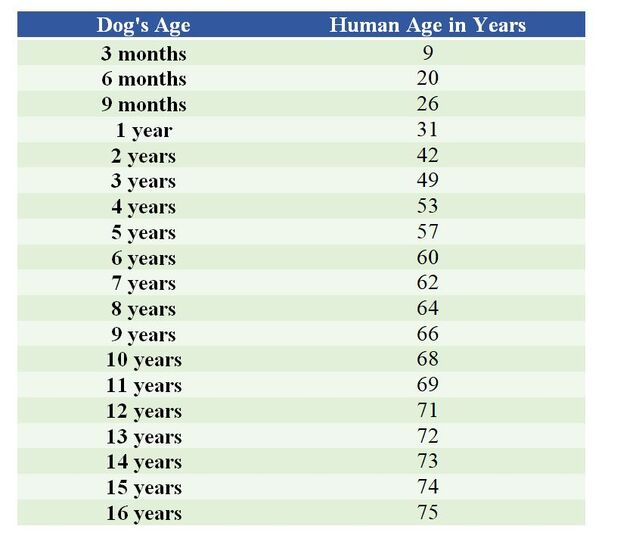
How Fast Do Dogs Age? Hint, The 7 Years Per Human May Not Be Right, And Other Dog Stuff

What I do know is that dogs don’t live long enough for how much they love you.

I found this story and here are the highlights as well as the link to the study, but it’s not how we were told they age and it explains why.

  • Three recent discoveries have changed scientists’ understanding of the nature of dogs.
  • One study found that young puppies age much faster than young humans do, so the common rule of thumb that one “dog year” is equivalent to seven “human years” is wrong.

Dogs live an average of 12 years. Human life expectancy, by contrast, is at least five times that, which is why many people go by the common rule of thumb that one “dog year” is equivalent to seven “human years.”

But that one-to-seven ratio is wrong, researchers found — it’s a misunderstanding of how dogs’ aging processes compare to those of humans. Instead, according to a July study, genetic evidence suggests that Labrador puppies and other young dogs age faster than their older counterparts.

“What’s surprising is exactly how old a 1-year-old dog is — it’s like a 30-year-old human,” Trey Ideker, a co-author of that study, said in a press release.

Ultimately, in order to calculate your dog’s human-age equivalent, you’ll need a calculator. The researchers’ formula is: A dog’s human age = 16 ln * your dog’s age + 31. (The ln refers to the natural log of a number.)

For the full story, here is the link.

Monday Sayings – Since It’s Election Season, This Is How Politicians Do It

If you can’t convince them, confuse them. – Harry S. Truman

Big words seldom accompany good deeds. – Charlotte Whitton


I put two quotes today because they represent the BS that comes from most politicians, from either party.

In reality, most of them are lawyers so they are smart enough to pass both law school and the Bar.  That means they know they are full of it and know that they are saying exactly nothing most of the time.

As with most things, actions speak louder than words.  Some politicians just talk.  A few of them actually make and keep promises.  That should help you judge who to support, regardless of your position on right or left, D or R.

As always, use your mind and make good decisions.  Don’t listen to others or the MSM/News/Social Media to tell you what to believe or how to act.

Great Sayings – On Why Being Prepared Affects Your Luck

The winds and the waves are always on the side of the ablest navigators. – Edward Gibbon


I’ve heard a version of this that goes, “The harder I work and prepare, the luckier I am”.

Sure every pig finds an acorn once in a while, but nothing beats being prepared for most outcomes, situations and other events.  Yes, the more you do something, the more experience you have to call upon to guide you.  The only gotcha is human emotion and interaction.  That is never predictable in the outcome.

Fortunately, you can at least anticipate that this is going to happen and how you will react.

There you go.  It was 3 sayings in one for today, enjoy.

Friday Saying – Einstein On Success and Perserverance

I think and think for months and years. Ninety-nine times, the conclusion is false. The hundredth time I am right.


Many have heard this as if at first you don’t succeed try, try again.  While this is true, it assumes that you can just force success.

As we know, Einstein could see things through his thinking that few could fathom.  This was finesse rather than force.  Nevertheless, this does show that he never gave up and continued despite setbacks.

That is the lesson, don’t give up just because you didn’t get it right the first time.  Will you come up with the Theory of Relativity?  It’s doubtful, but you just might find meaning in your life.

Thursday Quote – Nietzsche On Social Media and Peer Pressure

The surest way to corrupt a youth is to tell them to hold in higher esteem those who think alike than those who think differently.

Nietzsche hated “the Herd”. He was often writing against the ideas and ways of the masses in favor of the free thinker who has risen above them. This statement is a clear example of this worldview.

Who are the herd?  They are social media telling you what to think, say, speak and what your values should be.  They are the MSM, celebtards and sports stars who want to force their values on you because of an outdated construct that equates fame with power.

Think for yourself and don’t be afraid to say it.  Don’t be a dumb ass though and say it when you are surrounded by Antifa or the rioters.  There is no reasoning with them right now and even agreeing with them can get you an ass whooping.

Don’t take your views from the media.  Almost no entity is more biased at this point.  Don’t succumb to pressure from social media.  That is just the new high school for the in crowd.  Be your own person instead and think for yourself.

Nietzsche is not wrong about the herd.  You’ll never respect yourself if you think like the herd just to be one of them. It isn’t worth it.

It is a smart person who avoids trouble, but chooses wisely when and where to take a stand for his values.

Wednesday Saying – Nietzsche on Suffering

What does not kill me, makes me stronger.

For Nietzsche, psychological growth is one of the most important things there is. Experiences do not have to be pleasurable to be good for us. Often it is suffering which gives meaning to our lives. By gaining experiences, good or bad, we grow as people, so long as we survive them, of course.

This quote is usually said as a quip, rather than to understand it’s true meaning.  Navy Seals fully understand this and what it takes to not give up even when you want to and it is the easy path to take.

File this under the school of hard knocks, of which I have a Ph.D.

Thursday Saying – How To Win

You will never win if you never begin.

Helen Rowland


Wayne Gretzky said you miss 100% of the shots you never take.

Sometimes things hold us back from trying.  It could be fear of failure, embarrassment, procrastination or just timidness.

Learn from the lessons in life.  It’s OK to try and fail, because that is the start to the road to success.

Start now and don’t regret never having done whatever it is.

Friday’s Saying – Henri Fredrick Amiel

“The man who insists on seeing with perfect clearness before he decides, never decides.”


A more common version of this is he who hesitates, hesitates.

No one knows the outcome of any decision.  We only have a few scientific theorems that are somewhat certain, for now.  They could be proven incorrect (Einstein’s Theory of Relativity) if we use scientific methods.

The same can be said for our everyday lives.  We usually think we are right, but we don’t know how it will turn out.  Many times our decisions help or harm others in ways we never intended them to.

Nevertheless, most of the time, making a decision is better than not making one, or procrastinating.  I’m in favor of getting the best intel you can to make a good decision, but in the heat of the battle you have to make one.

This is why some are better leaders than others.  They have the right instincts or have been through enough to have history and experience on their side to make a better decision.

There have been good young leaders, it’s just that most don’t have the wisdom of a life lived to not know when to shut up.

We’ll never have perfect clearness because we can’t see the future.  If we did, life wouldn’t be worth living.

Great Sayings – Marcus Aurelius on Celebtards, Sports Stars and Politicians Today

“The opinion of 10,000 men is of no value if none of them know anything about the subject.”

Marcus Aurelius


Celebrities pretend to be someone else.  They are trained liars.  Sports stars are the best of the best at playing kids games.  Politicians for the most part live to be re-elected and like celebtards, are trained liars (many are lawyers who are masters at not telling the truth).  The MSM are the worst.  They are news readers that have a bias one way or the other.  None of them really know about what they are telling us to do.  It is almost always do as I say, not as I do.

Why the hell would we listen to these people’s opinions?  For the idiots who trust social media, it’s because they live a false life on social media.  Kids (I include millennial’s to teenagers here) haven’t had enough hard knocks in life.  Sometimes it is the parents fault for trying to not have them go through what made them learn about life.  That’s why everyone got participation trophies and time out.

Older people who buy into what others are saying instead of finding out and deciding for themselves have no excuse.  Life causes us to learn whether we want to or not.  It’s called making mistakes and learning from it.  They just didn’t learn from it.

The net is don’t change your values because you went with the crowd.  That didn’t work in high school and it won’t work now.  Learn to think for yourself and do what you know is the right thing to do.

Seek out those who know what they are talking about, not those described in paragraph one above

No going back, how Covid has changed us

Covid has changed our lives for good, and possibly/probably not for the better. Let’s take it by activity.

Travel

Here is some history. Flying used to be fun, economical and had good service. We used to like going on an airplane until some jag-off decided to try and light his shoe bomb on a plane.  Then another tried to blow up his underwear. We now have to queue in a long line  and I’m not all that sure that it’s stopped anyone other than the average Joe traveler. It hasn’t stopped the TSA from copping a feel on strangers.  The food sucks now and isn’t free anymore. Flying is more like the line for enlistment (including your prostate exam by the TSA) than to get on a plane.

With Covid, we can now add a temperature check, face masks and the the fear of catching anything from being in a tube for hours with little to no service.  The airports are petri dishes for bacteria.

Given the losses on travel companies and equipment manufacturers, it doesn’t bode well for the travel industry or the travelers.

Going to the office to work.

The requirement to be in person at work not as necessary as thought.

Before remote working, we had to be in the office or no one could be fully sure that you were earning your pay. Travel and working remotely eased that but there still are some bosses who didn’t trust their employees.   I had one piss-ant manager named R. Gorman when I worked at Thinkpad who didn’t trust anyone. He  sent a memo called rules of the road where you had to be in the office. All that got him was no trust or loyalty from the team. We were technologically equipped to work from anywhere and always did on business travel, but there still was some requirement to be in the office otherwise.

Employees want to be empowered to succeed. When that happens, they find ways to be creative and accomplish their goals. Conversely, when you treat them like school children, many will act that way. Just like with Ray, our productivity went down and the Ray jokes went up.

Now, no one can go in to work while we are socially distancing, and most jobs (non-manufacturing) are still getting done. It’s easy to reach anyone at anytime (too easy and too intrusive) but the oversight of said taskmasters is not needed. In a way, the people are now empowered and they still get the work done.  This one could be a benefit of Covid.

The downside is that a lot of empty buildings will lose their real estate value as there is no need to be in the office with the exception of essential workers.

How it affects the home

For us introverts, I thought it would be a time that we could cancel and/or avoid engagements until Zoom invaded our lives. Now even virtual happy hours are like a meeting. I’ve noticed that it’s hard to get privacy when kids and dogs are in the room or yelling in the background. Spouses or parents have been caught parading nude in front of the camera by accident.

When you meet in person, it’s easier to read body language and have someones attention. I tend to drift during Zoom meetings and have multiple devices that I often look at. I’ve noticed that I’m not alone.

Trouble for Introverts

Normally, we would be in pig heaven not to have to go to the office. In addition to the invasiveness of Zoom/Skype, we are stuck in the house with extroverts who won’t leave us alone. It’s like being trapped in hell. You want the quiet and the peace you got when the extrovert was in the office, instead your personal space is invaded and you can’t escape the dreaded small talk.  The place that used to be your refuge has been invaded and there is no escape.  It’s a fucking nightmare.  It’s the people in your house that you can’t get away from.

How are you supposed to recharge your social battery when an extrovert is constantly draining it all day?  Please, leave me alone and talk to your girlfriends.

Schools

The school model is now exposed, especially at college level. No more extortion for dorms when you can do 90% online. College professors are no longer as essential. Recorded classes, especially at the 100 and 200 level are adequate. Online testing and submitting required homework is routinely done online even well before this virus.

It turns out that colleges are a Breathtakingly overpriced product.

https://www.thegatewaypundit.com/2020/05/breathtakingly-overpriced-product-mike-rowe-says-covid-19-revealed-college-really/

According to Mike Rowe: “They’re gonna’ find big thinkers with easily accessible ideas who are exponentially more interesting than professors, and soon, I hope, our obscene love affair with credentialing is going to stop, and we’re going to pause in every imaginable way, and look at what is essential – not just in workers or in work, but in education, in food, in fun. Everything is going to be forced through a different filter,” he said.

Colleges will also be exposed on their sports programs. Sports are a bank fund that pays for a lot of other school expenses and is a recruiting tool for enrollment. The schools will now have to rely on actual academics as a draw for students instead of March Madness or Bowl season. Maybe the students will now get an education instead of an indoctrination to Marxism.

Conversely, this is a big positive as the cost of education has the opportunity to go down (but so far the colleges are still extorting the same ransom from parents). Room and board are a large part of the cost of an education. Combine that with the lack of a requirement for many classrooms and there is the road to cutting costs.

It is not in the best interest of the Major institutions to charge less, but the cat is out of the bag that you can get almost as much done online. I hope that the masses will overcome and help this opportunity for cost cutting.

For elementary, middle and high school, I think it will hurt our youth.  There is a need for hands on in basic learning and kids have the attention span of gnats.  Sometimes you need to snatch their asses back to attention when it’s learning time.

New paradigm for getting essential needs like groceries.

Essential services like cancer, emergency rooms are same, but will change. Non-essential Dr. visits are now handled over the phone or via video. Dr.’s can now dedicate more of their time to real emergencies or necessary in-person visits. A person using the Emergency Room for healthcare because they don’t have insurance is going to go way down.

There is no downtime for paperwork and other overhead that comes with any job, but that got handled off-line mostly anyway.

Rely on technology more, but the risk is that you can take down a society like the virus did. Beware of hackers though, where there is opportunity, there will be bad guys looking to make your day worse.

Shopping

Groceries have taken a turn for the better/worse/something different. Now that we went through the great toilet paper shortage and people have enough to wipe their asses for the next 5 years.   They can realize that a little planning can condense 5 shopping trips into one, or one delivery or pickup.

A lot converts have been made for grocery delivery. There are a few kinks that need to be worked out though. I’ve gotten stuff I didn’t order, but mostly I rarely get everything I wanted, even if I put in what the substitute would be product. There is no shopping for the store brand that is a whole lot cheaper.

We have gotten used to queuing a lot more now. It used to be the end of the world for some people who had to wait for more than one person to checkout. Now, we’re standing on X’s taped to the floor like kindergartners waiting to go potty.

As is the trend, online shopping has picked up and the downside is retail stores are less needed.  Again, this is a loss in real estate value and will leave a lot of square footage available.

So all in all, some of this is good, but a lot of it was unnecessary. If it wasn’t an election year or if there were different political leaders, a whole lot of people wouldn’t be losing there freaking minds over every little thing that they look for to be offended by.  HCQ would be over the counter like it is in a lot of countries and we wouldn’t be held hostage for masks as no one really seems to know whether it truly helps or hurts us yet.

I’ll remain optimistic that society will adapt.  I’m pessimistic that this is a political power opportunity to control the masses and we should beware.

Surprise! A Dogs Age Is Not 7 Times A Human’s – Here Is the Real Chart

If you want to do the math, here is how:

The most precise method involves the empirical equation that the researchers discovered, which is 16 x ln(dog’s age) +31 = human age, (that is the natural logarithm of the dog’s real age, multiplied by 16, with 31 added to the total.)

You can compute this using any calculator which has the ln function. Simply type your dog’s age. Press ln. Press x and type in 16. Press + and type in 31. Hit the equals sign and there you have it.

Hat tip to Psychology Todayhttps://www.psychologytoday.com/intl/blog/canine-corner/202007/genetics-shows-how-convert-dogs-age-human-years

Great Sayings – The Bias That People Have

People only see what they are prepared to see.  – Ralph Waldo Emerson


I’m not going to get political here because I think people should make up their own minds.  Most already have.  The problem with the MSM and Social Media is that you can confirm you bias, no matter what it is by going to what sources you feel comfortable to read.  That is your filter.

What I do think is that the actual smart people will have an open mind to both sides of any situation and look at the facts and ask questions.  We should challenge what is out there every time there is a “major issue” to see what the real answers are.

It takes time and you will have to have an open mind, but coming to the right conclusion instead of viewing a situation through the filter of what someone else says is the way to truth.

This is not easy.  What is easy is to fall back to your usual sources and just believe and regurgitate what is being said.

Take off the filter and evaluate like a detective.  Come to the right conclusion based on facts, not feelings or especially on what someone else said.

To Tim O’Reilly, On Global Warming And Rising Tides When He Told Me We Were Doomed And Will Drown.

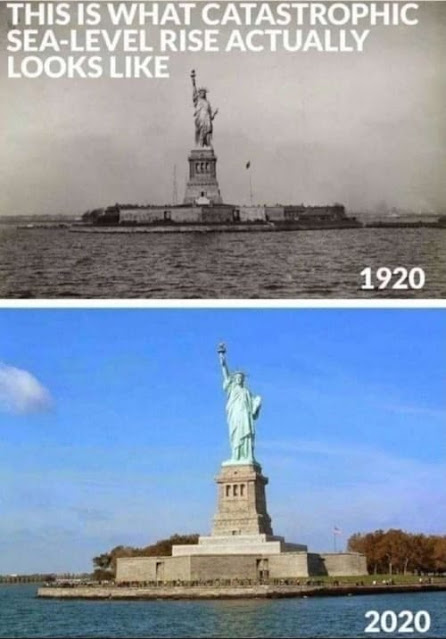
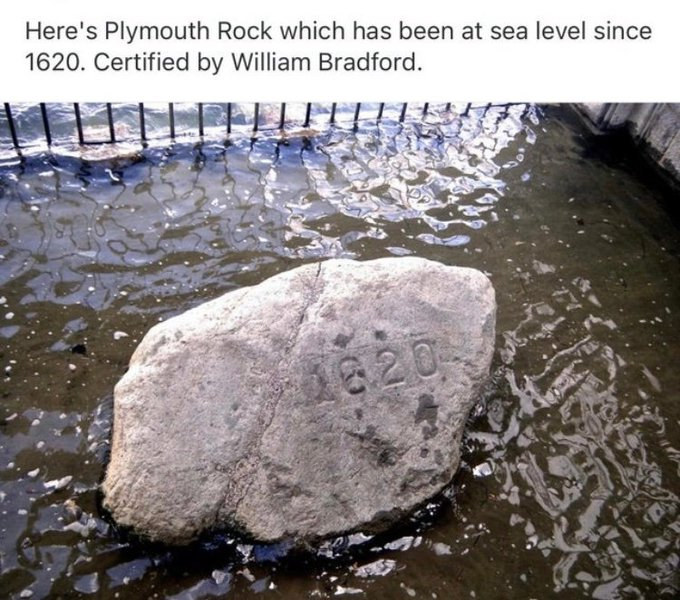
After reading a post that claimed rising tides threatened the world a while back, I suggested to him that the tides fluctuate. Science plus history prove the Statue of Liberty isn’t drowning, or Florida sinking like his hero Al Gore promised. I was pointing out the obvious to no avail. I’ve rarely encountered such an elitist, who was so wrong on a subject (except Al Gore).

check it out Tim, The tides aren’t rising in 500 years. Global warming science isn’t hard if you lie. I figured it out and so did you. I’m just the one pointing out the truth you don’t want to believe.
One of Al Gore’s Houses
Which came true Tim O, or James G or Tom R? You guys were nuts and wrong every time.

His argument was that climate science is hard. (It is when you only try to scare others with fake predictions and not facts to back up your position and then the scare never happens). It’s hard to defend when none of those descriptions of doom ever come true, hot or cold. The tweet below shows the Grand Tetons the same as they were 100 years ago

What is funny to me is that instead of decent discussion which I offered, I instead got an ad hominem attack on my character. It was an ill advised use of a bully pulpit as without any personal knowlege of me, I was told I was a typical Fox News watcher (I refuse to watch any news channel, especially FOX l as they all are biased in some way, read my blog and you’ll see). This is typical leftist behavior when they don’t get their way. Start saying they are racists, supremacists, Hitler, deplorable’s and so forth.

There were the other usual liberal attacks on me personally about beliefs I was accused of but don’t have, typical of when you run out of facts. I was this or that, because I wouldn’t worship Gaia and no mention of my knowledge of science and history, and especially facts. So he lied about the tides and about me. Good job there boy.

I also know that Carbon Dioxide is a nutrient for plants. That is the settled science. These idiots call it poison and wanted to tax it. Did anyone go to biology class?

The offer to talk is now rescinded because I don’t have time for Internet trolls like Tim or people who won’t get educated about what they spew. They aren’t going to believe facts and have adjusted it to fit their pre-determined outcome.

Evidence That Climate Change Is A Hoax Perpetuated By The Rich, your hero’s.

proof the rich don’t believe it either

So the Greenland Ice is growing and Florida is still there. The water around the statue is at the same level it’s been for 100 years and Tim is a troll it appears and is wrong. I’ve added at hastag for TIm, a social media terrorist.

THE PAUSE IN TEMPERATURE

I offer a few facts, something Tim didn’t have when castigating others on social media.

The New Pause paused last month because I was ill. Many apologies for the interruption. Now, however, it resumes – and it has lengthened from 7 years 7 months to the end of April 2022. To the end of June 2022, the New Pause is now 7 years 10 months in length:

This Pause, like its predecessor, which was an impressive 18 years 8 months (UAH), or 18 years 9 months (HadCRUT4), is, as always, not cherry-picked. It is derived from the UAH monthly global mean lower-troposphere temperature anomalies as the period from the earliest month starting with which the least-squares linear-regression trend to the most recent month for which data are available does not exceed zero. Whatever the data show, I show. Or, in the immortal words of Dr Roy Spencer, speaking of his dataset, “It is what it is”. In that splendid dictum speaks all true science.

The least-squares trend, which Professor Jones at the University of East Anglia used to recommend as the simplest and most robust method of deriving global-temperature trends, takes due account of all monthly values, not merely of the starting and ending values.

It sucks when you are wrong. But the point of climate change isn’t carbon reduction (Trump reduced it more than any president), it’s controlling others and grifting money.

I feel sorry for people like him. It must suck to go through life choosing to be purposely ignorant about science. It must suck to be wrong and to not change, but when you are in that deep, there is no getting out. You’ve bought the lie hook, line and sinker.

The European Union’s parliament has decided that nuclear power and gas power from plants now qualify as “green energy.” The proposal passes the EU parliament as Russia is threatening to cut off all natural gas transit to Europe in light of the ongoing war in Ukraine.

The news was reported by Disclose TV on Wednesday morning.

JUST IN – EU Parliament declares nuclear power and gas as “green” energy.

— Disclose.tv (@disclosetv) July 6, 2022

“EU Parliament declares nuclear power and gas as ‘green’ energy,” the news account tweeted.

It was also reported by the Associated Press in a piece that reads more like an outraged editorial.

“European Union lawmakers voted Wednesday to include natural gas and nuclear in the bloc’s list of sustainable activities, backing a proposal from the EU’s executive arm that has been drawing fierce criticism from environment groups and will likely trigger legal challenges,” the AP noted.

Great Sayings – How To Play the Game Of Life

You can only win in the game of life if you play. Those who stand and watch others don’t get to play or live life.


Some sit on the sidelines and watch.  Some want to play but are too afraid.  Others jump in and never worry what happens and some can fall into a mud puddle and come up wearing a dry cleaned tuxedo.

Most of us do all of these things, but not trying is the worst sin of the above.  There is no shame in trying and failing if you learn and try again.  Use what you learn and apply it to the next situation.

Great Sayings – How To Deal With Change (Covid 19 edition)

For the timid, change is frightening; for the comfortable, change is threatening; but for the confident, change is opportunity. –

Nido Qubein

What goes with this saying is that change is the only thing that stays the same.  It’s going to happen so how you deal with it is how it’s going to affect you.

Being frightened isn’t bad.  It heightens your awareness (fight or flight) to notice it’s happening and allows you to deal with it.  Those who embrace it and see the upside will be better off.  Running away from it isn’t going to stop it.  Life goes on and so must you.

As we get older, we get more used to it or get more used to running from it.  It’s your choice.

Look around you right now.  It’s happening with Covid 19, the riots and political back biting.  Stay above it and don’t believe what is being written (actually don’t read the news or social media, neither of which are likely to tell the truth).  Decide for yourself.

Great Sayings – What The Heck is Aristotle Really Saying?

“In the case of all things which have several parts and in which the totality is not, as it were, a mere heap, but the whole is something besides the parts, there is a cause; for even in bodies contact is the cause of unity in some cases, and in others viscosity or some other such quality.”

I got this from Mark Manson.  The original quote we think we know goes like this; the sum of the parts is greater than the whole.  Mark points out that almost nothing Aristotle says is all that understandable so I thought I’d give an example above.

Usually I have something pithy today, but I thought I’d throw in an example of something we think we know and really don’t, along with how little we pay attention to history.

Great Sayings on Discernment – Spurgeon

Discernment is not knowing the difference between right and wrong, it is the difference between right and almost right.

Times are weird right now.  What once was considered wrong is now right, just because.  The reverse is also true.

Don’t let what is going on tear you from your principles or the ability to know what is right.  It is difficult and it is also hard to know if you are correct in your discernment.

History is a good teacher.  It is important to have principles and stick to them.  It’s just hard to do when the world is upside down.


Mask Follies – When Covid Kids Go Back To School (Humor)

Local school board is deciding whether or not to make kids wear masks at school. Here is what will happen.

Here’s how I think requiring masks might work in elementary.

Please don’t snap Billy’s mask in his face.

Your mask is not a necklace, bracelet, or any other form of jewelry.

You should not be using your mask as a slingshot. Please put it back on your face.

Please do not chew on your mask.

Your mask should be on your face, not on the back of your head

I’m sorry your mask is wet, but that’s what happens when you lick the inside of it.

I’m sorry you sneezed. Here’s a tissue. Wipe out the snot as well as you can.

No, you may not blow your nose in your mask.

Why is your mask soaking wet? You just came back from the bathroom?

And you put it back on your face after you dropped it?

I’m sorry you broke the elastic on your mask by seeing how far the band would stretch. Now you’ll have to hold the mask on your face … or use this duct tape.

Please take the mask off your eyes and watch where you’re walking. I don’t care if you have X-ray vision.

Please take the mask off of your pencil and stop twirling it.

I know the mask fits over your pants like a knee pad, but please take it off of your leg and put it on your face.

What do you mean you tried to eat your lunch through your mask?

Please don’t share your mask or trade masks. I don’t care if you like Ingrid’s mask better than yours.

I’m sorry, but your mask is not school appropriate.

We’re not comparing our masks to other kids’ masks… everyone’s mask is unique and special.

No, you may not decorate your mask instead of doing your work. I don’t care if you have a Sharpie.

You’re not a pirate, please take your mask off your eye.

Try to get the gum off as much as you can.

Please don’t use your mask to pick your nose.

I’m sorry you tripped, but that’s what happens when you put your feet inside the elastic of your mask.

No, your mask doesn’t make it hard to get your work done.

Your Mom will need to get you a new mask since you chewed a hole in that one.

Why is there a shoe print on your mask?

No, you cannot eat the snow through your mask.

I don’t care if you were in art class and being creative; we do not decorate our masks.

We do not beam other kids in the face with balls. No, their masks don’t make it not hurt.

Please don’t plug your nose holes with your mask.

Who’s making that noise?

I’m sorry your ponytail is stuck, that’s what happens when you see how many times you can wrap it around your mask.

I’m sorry to tell you, but your child thought her mask made her a superhero. She tried to fly off the jungle gym at recess …

I’m sorry your breath stinks in your mask, maybe we should all try to brush better.

Please take those cookies out of your mask. No, you are not a chipmunk.

Great Sayings – For High IQ People, or Anybody In a Group

If you are the smartest person in your group, you need a new group.


You are not going to grow if you don’t stretch yourself.  There is no standing still.  You either are advancing or falling behind.

Don’t fall behind.

Great Sayings – On Intellect and Sociability

A high degree of intellect tends to make a man unsocial.

-Arthur Schopenhauer
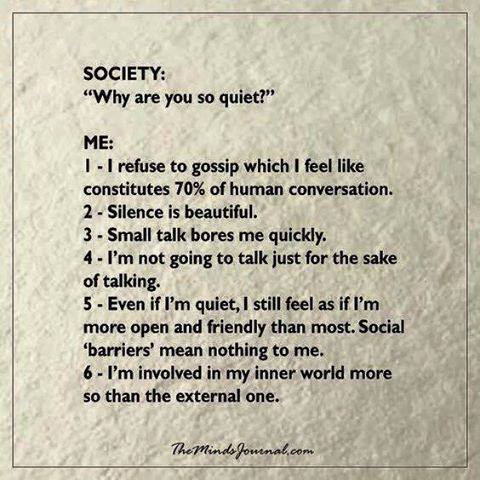
I knew there was a reason I want to talk less and less.  My tolerance for small talk decreases everyday.  I thought it was just a function of being an introvert.
Now that I ponder the intellect of those I interact with, this clears up a lot of things.
I am not trying to be anti-social, but my ability to put up with doing stuff I don’t want to do is a cost/benefit ratio.  The costs often outweigh the benefits so I find that keeping to myself has made my life a lot better.

The Ten Commandments Of Logic

  1. Thou shalt not attack the person’s character, but the argument. (Ad hominem)
  2. Thou shalt not misrepresent or exaggerate a person’s argument in order to make them easier to attack. (Straw man fallacy)
  3. Thou shalt not use small numbers to represent the whole.(Hasty generalizations)
  4. Thou shalt not argue thy position by assuming one of its premises is true. (Begging the question)
  5. Thou shalt not claim that because something occurred before, it must be the cause. (Post hoc/False cause)
  6. Thou shalt not reduce the argument down to two possibilities.(False dichotomy)
  7. Thou shalt not argue that because of our ignorance, claim must be true or false. (Ad ignorantum)
  8. Thou shalt not lay the burden of proof onto him that is questioning the claim. (Burden of proof reversal)
  9. Thou shalt not assume “this” follows “that” when it has no logical connection. (Non sequitir)
  10. Thou shalt not argue that because a premise is popular, therefore it must be true. (Bandwagon fallacy)

Try telling this to the Press, celebtards, sports stars who try to cram their opinion on those because they are good a games or career politicians.  They are the worst offenders.

Things You May Not Know, Or Haven’t Considered Yet About Life (6 People Look Exactly Like You)

1. Your shoes are the first things people subconsciously notice about you. Wear nice shoes.
2. If you sit for more than 11 hours a day, there’s a 50% chance you’ll die within the next 3 years.
3. There are at least 6 people in the world who look exactly like you. There’s a 9% chance that you’ll meet one of them in your lifetime.
4. Sleeping without a pillow reduces back pain and keeps your spine stronger.
5. A person’s height is determined by their father, and their mother determines their weight.
6. If a part of your body “falls asleep”, you can almost always “wake it up” by shaking your head.
7. There are three things the human brain cannot resist noticing – food, attractive people and danger.
8. Right-handed people tend to chew food on their right side.
9. Putting dry tea bags in gym bags or smelly shoes will absorb the unpleasant odor.
10. According to Albert Einstein, if honeybees were to disappear from earth, humans would be dead within 4 years.
11. There are so many kinds of apples, that if you ate a new one every day, it would take over 20 years to try them all.
12. You can survive without eating for weeks, but you will only live 11 days without sleeping.
13. People who laugh a lot are healthier than those who don’t.
14. Laziness and inactivity kill just as many people as smoking.
15. A human brain has a capacity to store 5 times as much information as Wikipedia.
16. Our brain uses the same amount of power as a 10-watt light bulb!!
17. Our body gives enough heat in 30 minutes to boil 1.5 liters of water!!
18. The Ovum egg is the largest cell and the sperm is the smallest cell!!
19. Stomach acid (conc. HCl) is strong enough to dissolve razor blades!!
20. Take a 10-30 minute walk every day & while you walk, SMILE. It is the ultimate antidepressant.
21. Sit in silence for at least 10 minutes each day.
22. When you wake up in the morning, pray to ask God’s guidance for your purpose, today.
23. Eat more foods that grow on trees and plants and eat less food that is manufactured in plants.
24. Drink green tea and plenty of water. Eat blueberries, broccoli, and almonds.
25. Try to make at least three people smile each day.
26. Don’t waste your precious energy on gossip, energy vampires, issues of the past, negative thoughts and things you cannot control. Instead invest your energy in the positive present moment.
27. Eat breakfast like a king, lunch like a prince and dinner like a college kid with a maxed out charge card.
28. Life isn’t fair, but it’s still good.
29. Life is too short to waste time hating anyone. Forgive them for everything.
30. Don’t take yourself so seriously. No one else does.
31. You don’t have to win every argument. Agree to disagree.
32. Make peace with your past so it won’t spoil the present.
33. Don’t compare your life to others. You have no idea what their journey is all about.
34. No one is in charge of your happiness except you.
35. Frame every so-called disaster with these words: ‘In five years, will this matter?’
36. Help the needy, be generous! Be a ‘Giver’ not a ‘Taker’
37. What other people think of you is none of your business.
38. Time heals everything.
39. However good or bad a situation is, it will change.
40. Your job won’t take care of you when you are sick. Your friends will. Stay in touch.
41. Envy is a waste of time. You already have all you need.
42. Each night before you go to bed, pray to God and be thankful for what you accomplished, today. What if you woke up this morning and only had what you thanked God for yesterday? DON’T FORGET TO THANK GOD FOR EVERYTHING.
43. Remember that you are too blessed to be stressed.

Great Sayings – Daniel Patrick Moynihan on Opinion vs. Facts

Everyone has both.  Some choose one over the other.  Most mesh the two together.

The difficulty in this day of being barraged by social media and a 24/7/365 news hype cycle is that you can choose to go with your bias and only see one side of any story.  This is dangerous regardless of which side you view it from.

Don’t believe the scare tactics of the money hustlers who rush people into a position like sheep herders trying to corral the flock into group think.  The tactic is shame for not subjugating yourself to the PC position of the day.

It takes courage to step out and stand for what is right, especially in the start of a crisis or an event in time. This requires critical thinking as to discovery of the real facts and applying the necessary logic to come to the right conclusion.  It also can take time.  The media and politicians will try to rush us into judgement based on opinion.

As they said in Watergate, follow the money and you’ll usually see through those who are self-serving.

Most of all, don’t be a sheep.  Think for yourselves and don’t take anything you read online as gospel, except for the Gospel.

Sooner or later, time exposes the truth.  Whether you want to believe it or not is now up to you.

Great Sayings – Blaise Pascal On What We Choose To Believe

“We are generally the better persuaded by the reasons we discover ourselves than by those given to us by others.”


Besides having a programming language named after him and a famous theorem, he points out the obvious.

You can’t tell most people anything.  They have to learn it themselves and usually the hard way.  Today’s toxic political environment is a perfect example, no matter which side you take.

It’s just how many times do you have to bang your head against the wall until you realize that it hurts?

Another Covid-19 Related Saying That is Relevant – Life

“Learning to endure times of disappointment, suffering, and sorrow is part of our on-the-job training. These experiences, while often difficult to bear at the time, are precisely the kinds of experiences that stretch our understanding, build our character, and increase our compassion for others.” — Joseph B. Wirthlin

The 10 Cannot’s – Inserting Reality Into Today’s Politics (And Woke Culture)

Some sanity and reasonableness should be considered when putting yourself out into the social media universe. Everyone seems to think that it is now their responsibility to tell us how to think, speak and act.

Here are 10 logical statements that are not new, but should have been taught to those who think they should tell us what to do, especially by politicians, the media and celebtards.  I wish George Orwell were alive today to see how right he was when he wrote 1984.

PC culture is ruining our society and frankly is taking the fun out of life for those of us who don’t get offended easily.

It’s time for a lot of people to grow up and act like adults.  Personally, I blame the educational system.  It has a considerable lack of diversity in terms of being able to view all sides of an issue before opening there mouths or post on Twitter, which I now call Hater.  Other platforms are becoming just as bad, but the hate usually starts there.

Rep. Stephen M. Young inserted into the Congressional Record, in 1950, an article from Harper’s magazine, written by a Lincoln scholar, Albert A. Wolman, listing most of the ”Ten Cannots” and other material falsely attributed to Lincoln.

The 10 Cannots:

1) You cannot bring about prosperity by discouraging thrift.

2) You cannot help small men by tearing down big men.

3) You cannot strengthen the weak by weakening the strong.

4) You cannot lift the wage earner by pulling down the wage payer.

5) You cannot help the poor man by destroying the rich.

6) You cannot keep out of trouble by spending more than your income.

7) You cannot further the brotherhood of man by inciting class hatred.

8) You cannot establish security on borrowed money.

9) You cannot build character and courage by taking away men’s initiative and independence.

10) You cannot help men permanently by doing for them what they could and should do for themselves.

How Racism and White Supremacy Are The New Godwin’s Law

Authors Note: I have a tendency to notice patterns in both a macro and micro universes. I’ve been watching this one brew for a while now.

FIRST, WHAT IS GODWIN’S LAW?

Reformulated in the Net.Legends FAQs “Usenet Rule #4”:

“Any off-topic mention of Hitler or Nazis will cause the thread it is mentioned in to come to an irrelevant and off-topic end very soon; every thread on Usenet has a constantly-increasing probability to contain such a mention.”

It is generally accepted that whoever is the first to play the “Hitler card” has lost the argument as well as any trace of respect, as having to resort to comparing your adversary to the most infamous mass-murdering dictator in history generally means you’ve run out of better arguments. Thus, once such a comparison is made, the thread is finished and whoever mentioned the Nazis has automatically lost whatever debate was in progress. This principle is itself frequently referred to as Godwin’s law.

Disclaimer: This blog post does not take a position on racism, it’s prevalence, who is or isn’t or might be racist and my position on this subject. Aristotle noted that the mark of an educated mind is to entertain a thought without accepting it.  Therefore I am observing a speech and behavioral pattern of the public.  In other words it’s on them, not me.

It is also noted that a trait of people with a higher IQ is that you can argue from multiple perspectives (unfortunately so can lawyers and politicians who may or may not be of higher intelligence – especially politicians and especially millennial politicians).

The original Godwin’s Law has lost its’ sting since everyone is now Hitler, so the new talking point is racism or white supremacy. Rather than argue on the merits of the position of the person (political candidates mostly since they dominate the news) the go to is now calling the other person one of these two pejorative names.  This constant overuse has devalued the meaning of the words and rendered them ineffective at worst and boring at best.

Here is a quick search that shows views from multiple points doing just this:

https://www.google.com/search?source=hp&ei=IXpRXZrPHOqH_Qa9hbr4AQ&q=examples+of+politicians+being+called+racist&oq=examples+of+politicians+being+called+racist&gs_l=psy-ab.3…2240.2240..3652…0.0..0.186.324.0j2……0….2j1..gws-wiz.aEnMfNpKcHc&ved=0ahUKEwja48Tux_3jAhXqQ98KHb2CDh8Q4dUDCAc&uact=5

This is in direct conflict with Martin Luther King’s evocative phrase: “I look to a day when people will not be judged by the color of their skin, but by the content of their character.”  Now, it is common to hear you are a racist or white supremacist because you don’t agree with me.  It greatly devalues MLK’s position.

A General Definition of racism

1a belief that race is the primary determinant of human traits and capacities and that racial differences produce an inherent superiority of a particular race, racial prejudice or discrimination.

While I could list any or all of the comments that have been made in public themselves could be racist in tone, one could make the case for or against whether the accused are really racist. Calling someone a racist is easy but proving most of these ad hominem attacks is harder.

One would need to know what is inside the person making the statements to know if it were really true or just talking points. I won’t and am not even sure if I can make that value judgement. These attacks are easy enough to find (see the media below).

This is not the point of this post. I am not here to call someone a racist or White supremacist (or Hitler), rather to point out a trend.

In the department of redundancy department, this discussion is that the replacement for Godwin’s Law is that you are not Hitler, instead you are racist for whatever reason or whatever you say.

Why is this the case? The overuse of Godwin’s Law has made it impotent in political circles, the media and on social media platforms. Hitler stands with few others in history, perhaps Mao, Stalin or Pol Pot as true villains. Nobody really believes that the other person is like Hitler, they are just trying to make the worst case as they flush their argument down the toilet due to lack of substance.

HOW TO WIN YOUR POLITICAL RACE OR PUT YOUR OPPONENT ON THE DEFENSIVE WITHOUT TAKING A POSITION

What most of the accusers are doing is described in Saul Alinsky’s Rules for Radicals numbers 7-13 as follows:

  • “Keep the pressure on.”
  • “The threat is usually more terrifying than the thing itself.”
  • “The major premise for tactics is the development of operations that will maintain a constant pressure upon the opposition.”
  • “If you push a negative hard and deep enough it will break through into its counterside.”
  • “The price of a successful attack is a constructive alternative.”

Rather than argue on a platform, beliefs and issues, it is far easier to make your opponent defend themselves, and put them off their talking points.

Example: Candidate 1) If elected, I’ll lower taxes if elected (insert any issue here because it’s about to be destroyed).

Candidate 2) my opponent is Hitler and molests collies.

Press coverage: Candidate 1 is a well known collie molester. How long has this person been molesting Collies? The first question in the next debate; Candidate 1, are you still molesting Collies?

Now insert the word racist or white supremacist for molesting collies and you get the point of why this is effective.

  • “Pick the target, freeze it, personalize it, and polarize it.”

HOW THE PRESS BECOMES AN ENABLER

A common adage is that sex sells, as do murders, rapes, political embarrassments and anything not good news. Guess what they will print (hint: collie molester)?

A not so recent trend is that there is a common thread where a preponderance of reporters has similar talking points concurrently. There is a groupthink that causes the media to focus on a particular phrase, word or subject. Like piranha on carcass, they hammer it home. https://www.google.com/search?q=why+do+news+anchors+say+the+same+thing&sa=X&ved=2ahUKEwim9dyQxv3jAhWFB80KHeyQAE0Q1QIoAHoECAsQAQ&biw=1440&bih=825

Since the new go to in Godwin’s Law is you are a racist and/or white supremacist, it makes for headlines that sell advertising. I can also be taken as ideological.  This is the de-facto statement now to the point that it has lost effectiveness.

Having spent decades working with (and against) all forms of media, they have a tendency to take the position of them being right, even if proven wrong. A correction is meaningless as once a statement is printed, it is still in the minds of the reader. Almost no one reads the corrections.

Most are journalists who write about a topic because it is assigned to them.  In the case of social media everyone thinks they have the moral high ground.

SOCIAL MEDIA

I’m not going to spend much time here, because most people have gotten into an Internet argument. Nobody wins unless the motive of one of the combatants is to piss off the other. It won’t matter how factual your argument is because it is just Internet road rage.

If you go to the above link, you see the outcome and great advice on how to handle this.

So the net result of overusing this theme is the same thing that happens with all overuse. Godwin’s Law is becoming meaningless. The definition of what racism really is and when the word should be used to protect the oppressed has been damaged. Even Alinsky’s Rules for Radicals suffers from overuse and tediousness.

The political landscape is a train wreck of who can sling the most mud. Watch the ratings nosedive for upcoming debates.

Stay out of it on Social Media except to observe who isn’t smart enough to stay out of this pool. With each use of the attack, the meaning becomes less valid and meaningful.

I thought about calling someone a racist instead of Hitler the Simonds Law, since I haven’t found this discussion fully hashed out, but I’d rather be associated with something more positive.

Everyone is a loser who engages in this behavior. My advice is grow up or be better educated to discuss your position better than: you are Hitler/racist/white supremacist and whatever the next insult is.

It used to be that to call someone Hitler was the ultimate insult, albeit the indication that the argument is lost.  Has calling them a racist and/or a white supremacist suffered the same fate?

How To Talk To Generation Z Using Their Dictionary

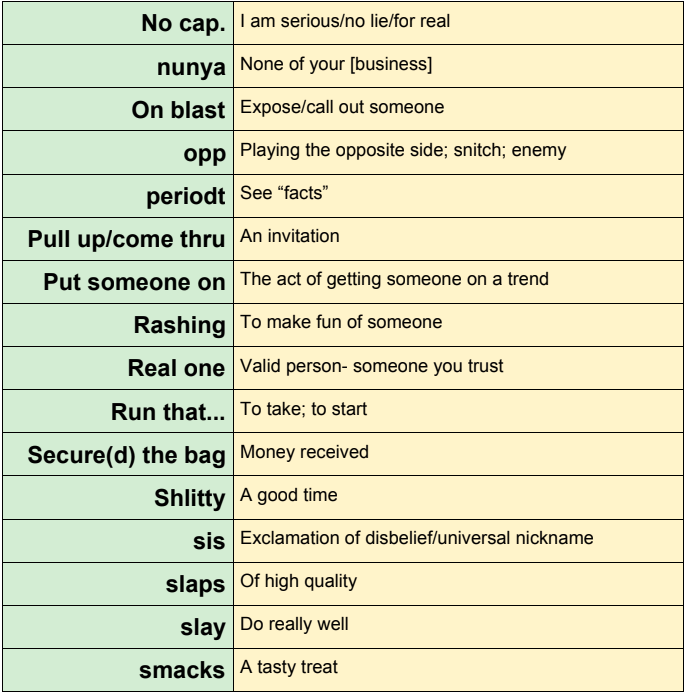
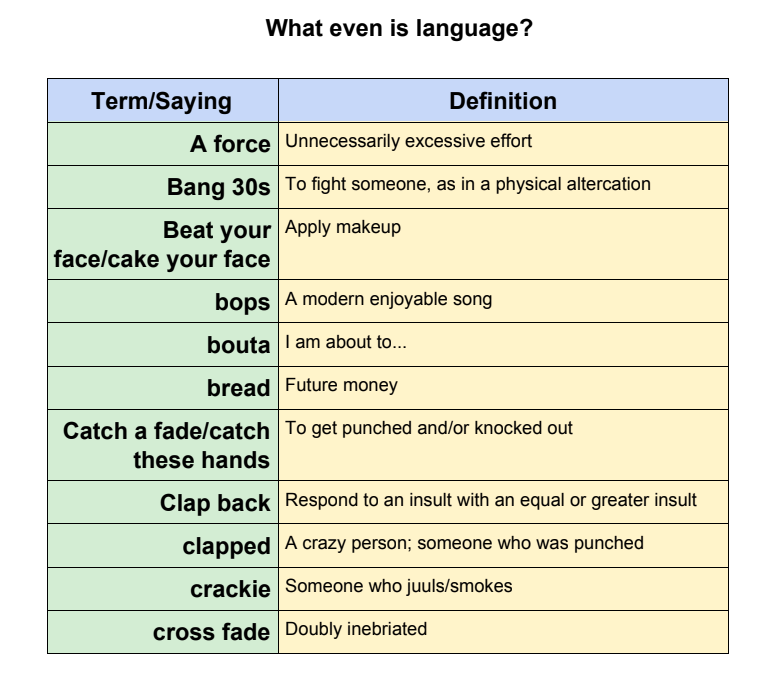
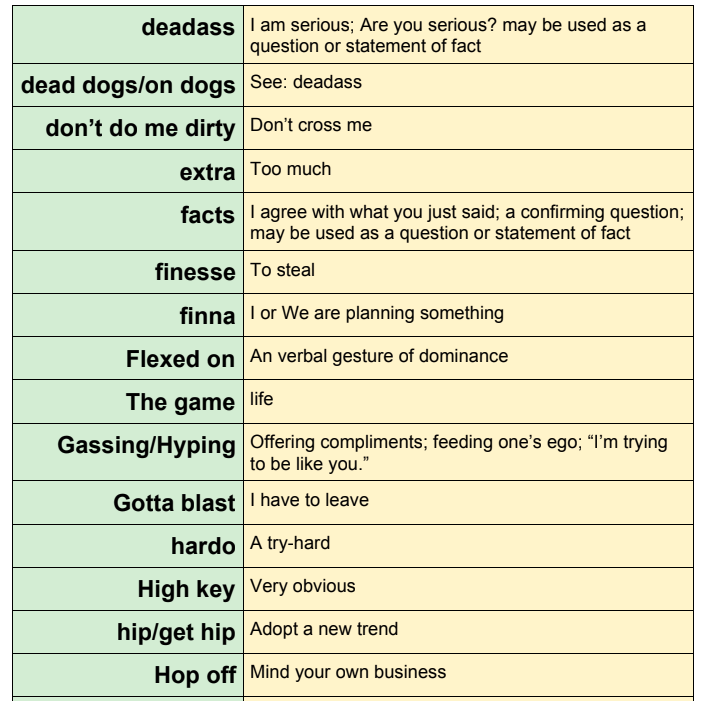
Have you ever wondered what the f&*% the kids are talking about lately?  Do you parents want to decode your kids texts?

Below is the Generation Z dictionary distributed by a Mr. Callahan so I point to him if any Gen Z’ers have a problem with it.


When thinking about this, I’m sure every generation trashes the previous by describing them as not as learned and their improper use of grammar.  I’m also pretty confident that Shakespeare is rolling in his grave as he probably has done for each generation after him.

I’ve put some screenshots below and full link to the dictionary in PDF form to download.

What I fear is these people will be making decisions about my generation in a few years.

To fully honor this generation, I purposely didn’t put it in alphabetical order just to mess with them.

Generation Z Dictionary Link

Common Core Education, Failing our Kids


THE SETUP FOR THE DISCUSSION

I suppose every generation considers the learning of the next generation as inferior to theirs.  If we didn’t, why do millennials eat tide pods?  Why do parents talk about how better their education was and how soft they are on kids today?   There are many reasons for this including prejudice, standards, government intrusion into the learning system and deviation from what made our education system the one that led to more progress, inventions and breakthroughs than any in the history of man.

We’ve now potentially gone backwards and have therefore failed the following generations.

In working with public school kids, I observe that there are many reasons.  People are not equal and some are smarter and learn better than others.  Those with two parent families or with a single parent who is highly integrated in the student’s learning consistently outperform those who don’t.  The system has gone backwards due to interference from do-gooders, government (over)regulation and unions.  Note: that is my observation only.  I see kids rise above the system to achieve, but they have to swim upstream.  Most can coast their way through.

Conversely, children who learn under Classical Education have an advantage in learning as it is taught to a standard the kids must keep up with as opposed to teaching to the lowest common denominator so no one is left behind, penalizing those who could achieve more.

Further, Classical Christian education is an approach to learning which emphasizes biblical teachings and incorporates a teaching model known as the Trivium, which consists of the three stages of grammar, logic, and rhetoric.

Classical education complements a child’s natural development stages. Young children can memorize information easily. So, in the early years, learning is enhanced by songs, body movement, recitation, and exploration. This sets them up for success in their next stage of learning, critical thinking.

The critical thinkers are what companies want to hire.  They look at problems differently and come to the table with better skills for success.

They also have a distinct advantage over the public school system and the below discussion of how we are destroying learning.

WHERE EDUCATION HAS FAILED OUR KIDS

The biggest failure I’ve observed is the Common Core learning system.  It threw away the standards of learning that has proved to produce educated kids by introducing a system that borders on the ridiculous.

It was implemented by those we thought were helping us, yet it may have set us back for years.

Behind a lot of this is none other than Bill Gates, a man I’ve met and have mixed thoughts about.  Microsoft is far more successful than his support of Common Core.

From the American Thinker, I read this snippet:

But Bill Gates should have felt some uneasiness.  Common Core was untested, unproven, and micromanaged by David Coleman, a man with limited credentials but reliably far to the left.  Nobody in the business world launches a big new product without years of research and refinement.  Instead, Common Core was wrapped in $1 billion’s worth of propaganda and dumped on the country as a fait accompli.

The late, great Siegfried Engelmann, a real educator, was asked what he thought of this approach: “A perfect example of technical nonsense.  A sensible organization would rely heavily on data about procedures used to achieve outstanding results; and they would certainly field test the results to assure that the standards resulted in fair, achievable goals.  How many of these things did they do?  None.”

Did Gates realize that Common Core, supposedly a new and higher instruction, incorporates all the dubious ideas from decades prior?  New Math and Reform Math were the basis for Common Core Math.  Similarly, Whole Language and Balanced Literacy were rolled into Common Core’s English Language Arts (jargon for reading).  Constructivism, which prevented teacher from teaching, has been undermining American schools for decades.  Nothing new and higher about these clunkers.

An earlier generation of Gates’s business partners had created so much illiteracy that Rudolf Flesch had to write a book to answer every American’s favorite question: “why can’t Johnny read?”

I don’t hold Gates responsible except for his funding and use of his status to push this, but I hold those who pushed this system on the generation suffering from this learning standard.

The Thinker sums it up like this:

We have to wonder if Bill Gates performed due diligence, that being the care that a reasonable person exercises to avoid harm to other persons or property.  In other words, before putting your business funds to work on anything, you should make yourself an expert.  That’s what we need in this country: everybody becomes an expert.  For sure, nobody should trust the official experts.  If Bill Gates had observed that simple rule, he would still have a billion or two he doesn’t have now.  And the country would have tens of millions of better educated students it doesn’t have now. 

We need to stop this disservice to our kids and have them learn properly, and to learn to think critically.

Here is a video that shows just how far we’ve deviated from the learning system that invented computers, vaccines, technology that has helped mankind and sent men to the moon.  Go to 1:24 under Decompose to see how far we’ve digressed.

CONCLUSION

It would seem the dumping common core and putting real learning would be best for the kids.  The world is getting tougher and we need to give them every advantage possible.


What It’s Like To Have An Extremely High IQ?

Editors note:  Since I published this, the comments have been coming in and are now far better than the blog post.  I encourage you to read about the lives and struggles of those who have high IQ.  Their stories are quite revealing.-> It’s in the comments, hint, hint, hint.

Authors disclosure: I won’t disclose where I am on the IQ chart, but I do have some in my family with very high IQ.  My father had a gigantic IQ.   Here are the stories of those with high IQ and their travails. See if you identify with any of them.

The blog post actually starts here.  It is a compilation of individuals with their names mostly redacted who have written about the travails of a high IQ:

Johann Wolfgang von Goethe – “The intelligent man finds almost everything ridiculous, the sensible man hardly anything.”


Update: 10/3/16 from Alison Craig

It sounds like you are in the beginning stages of an existentialist crisis. http://plato.stanford.edu/entrie…  I know the word “crisis” looks alarming, but it shouldn’t. In this case it just means you are examining the point of your own existence. Will I always be alone? Why am I here? Eventually you may even question all existence and come to the seemingly frightening conclusion that we’re all born alone and die alone and nothing in life has purpose.

“Well, that’s horrible! You’re depressing, why would you say such things?”

Again, I repeat- it is nothing to be alarmed about. Those things are true – to a degree. We are born alone and die alone, but we work to make connections with people who can support us, and that we can support in return. Intelligent or not, there will always be like minded people in the world somewhere and they are never easy to find for anyone. To me, making those connections is why I am here and is a large part of my purpose.

No matter how intelligent, wealthy or attractive a person is – it can always be difficult to find true connections so that all of the sharing and giving is not a one way street. Intelligent people may have stricter standards for making friends (in fashion or other), but so might a wealthy person, or a very attractive one. All people fear being used and some are just more cautious than others. An intelligent person can read books on understanding human nature ( Ten Keys to Handling Unreasonable & Difficult People), body language Psychology Today and other psychology tools to assist them in making life long connections with other people.

===============================================

From Shah Rukh Qasim on hiding your intelligence:

If you could generalize, the most common would be:

  1. You keep talking to a person, telling him something you think he doesn’t know. He keeps listening. Then he shares his insight which makes you think he has already known everything you told him. Smart people at often silent and active listeners.

Other signs will include:

  1. Good problem solvers. Not just mathematics problem. But even daily life problems. They’ll quickly find what’s wrong and take the best course of action to solve the problem.
  2. They’ll be different in views. And their views will always come with reason. A quote goes around: Small minds discuss people. Average mind discuss events. Great minds discuss ideas.
  3. A fool thinks himself to be wise, but a wise man knows himself to be a fool.” – William Shakespeare
  4. They often look for reasons. It goes in four levels (worst to best):
    1. What?
    2. How?

=========================================

It sucked when I was younger, but these days it’s just awesome.

There is a very common pattern among highly gifted people, namely:

  • When you’re young it’s very isolating, and it feels like everyone else is just stupid
  • As you grow older, you realize your gift. You also realize that raw intelligence isn’t everything, and that things like social skills matter a lot. Plus, you meet others like you.
  • Your social life improves as you get older and learn to connect on things other than intelligence or go to elite institutions where you can meet other highly gifted people.

Honestly, at this point in my life I feel like there are literally no downsides to having a high IQ. It’s like being born good looking or with great physical health: it’s not a silver bullet to a happy life, but it makes a lot of things much easier.

I only found out I had a high IQ (161) because my professional life was such a mess I had to see a psychologist.

If I had to sum it up in a few sentences, I would say that the most aggravating thing about being very intelligent is that you quickly see and understand things at a level of depth that most people don’t (or can’t), and it is very frustrating.  You want to move on, you want to be pushed, you don’t want to spend time explaining the details of things you have already grasped, but no one else is caught up yet, so you have to pause.  It is particularly painful when dealing with complex topics where the mental models involve feedback loops and non-linearities.

But that said, I’ve learned there is much more to life than intelligence, and being successful is more about hard work and good communication skills than anything else.

====================================================

“One of the indictments of civilizations is that happiness and intelligence are so rarely found in the same person.”

Working successfully in society and business is limited by some really important social choke points.  One of them is that other people, even if they are intellectually slower, must be treated with respect.  Another is that even if you are correct you will have difficulty getting people to act on your insights until they understand why you are correct.  A third thing is that most important activities are done as a team and so taking action requires breaking down your insights into something that your slower peers and employees can understand.  If you try to blow past these choke points you will destroy relationships and even if you are right, your career will languish.  I try to remind myself that being successful is not well correlated to being right.

My career is going pretty well now that I’ve understood these constraints.  It is possible to turn intelligence to practical life-advantage but our educational system doesn’t really give a blueprint for this.  I left school thinking that it mattered that I understood things 5 minutes or 5 years before my classmates did.  It doesn’t.  Most people’s functioning adult lives are not spent solving tough problems.  They are spent going through well established rituals and patterns of relating to each other punctuated by an occasional tough problem.  In most cases, people can even skip the tough problems and still do okay in life.  So how do you convert a parlor trick (like knowing the ending of a movie after 5 minutes) into something that will make you happier?  Mostly, you don’t.  Use it when it’s valuable and relax a little when it’s not.

There’s a great Dilbert where someone invites him to join the company’s Mensa chapter and Dilbert asks why people who are so smart continue to work at the company.  The president of the Mensa chapter answers, “Intelligence has much less practical application than you’d think.”

==========================================

In a word, I find it alienating.

Extremely so, in fact.

And I think this is not only because of what makes me “smart”, but also because of what my brain has to sacrifice to be “smart” in that way.  (More on that in a sec.)

For the record, my IQ was measured (years ago) at 178. [ETA: Just looked up the percentile, and that’s about 1 in 2 million, for some perspective.]  I have 3 advanced degrees and a solid career.  But I’m still single and spend very little time around other people.

It took me some time as a young kid to figure out that the people around me weren’t interested in the same things I was.  And that, often, to talk about the things I found interesting turned people away.

So I hid that.

When they announced that I was valedictorian of my high school, I was in 1st period art class, and one of my classmates refused to believe that they’d said my name.

But I never felt like I belonged anywhere, and I still don’t.

I don’t have kids, TV doesn’t interest me, I don’t follow celebrities or watch sports.  My time is spent with my work, and researching the things that are important to me — astrophysics, particle physics, consciousness research, and although this might seem strange to some people, Biblical scholarship (tho I’m not a believer).

As a result, chit-chat is impossible for me, or else it’s so boring that it becomes impossible.

But like I said, the problem isn’t only that my brain is interested in things that most other brains aren’t.  It’s also what my brain can’t do.

There’s only a certain amount of space in the brain, and if one area is eating up the real estate with more neural power, some other part of the brain is likely losing out.

For me, it’s some of the automatic social functioning which tells you, for example, what emotion another person is feeling based on their facial expression, or whether someone’s being sarcastic or not.  (Sarcasm is a minefield for me, and meeting another person in a hallway is a nightmare — I cannot interpret when to look, or not, what to say, or not, etc.)

That said, I have an enormously rich life, and I’ve adjusted to it.  When I stopped trying to fit in, things got better.

=============================================

HOWEVER…..STUPID IS AS STUPID DOES

The smart can do stupid things such as:

  • Ignoring the importance of design and style – When the iPod originally came out, technical people complained about its lack of features and perceived high price (“ooh, who cares about another MP3 player, I can go buy one at Best Buy for $50” http://forums.macrumors.com/show…).  In the meantime, it was so cool and easy to use that normal people went out in droves to buy it.
  • Using terrible tools, and taking pride in their awfulness – Especially common with programmers, who take pride in using programming languages and text editors that have been designed by programmers, not updated since the 1970s, and never touched by anyone with a modicum of design sense. They believe that mastering arcane, overcomplicated commands and processes are a mark of pride, rather than a waste of time.  I will refrain from singling out specific programming languages and tools here, because smart people also like to get caught up in pointless flame wars about this sort of thing.
  • Following the pack – Many smart people often seem to be followers, probably because they grow up spending so much time pleasing others via academic and extracurricular achievement that they never figure out what they really like to work on or try anything unique.  Smart people from top schools tend to flock into the same few elite fields, as they try to keep on achieving what other people think they should achieve, rather than figuring out whatever it is they intrinsically want to do.
  • Failing to develop social skills – Some smart people focus exclusively on their narrow area of interest and never realize that everything important in life is accomplished through other people.  They never try to improve their social skills, learn to network, or self promote, and often denigrate people who excel in these areas. If you are already a good engineer you are going to get 10x the return on time spent improving how you relate to other people compared to learning the next cool tool.
  • Focusing on being right above all else – Many smart people act as if being right trumps all else, and go around bluntly letting people know when they are wrong, as if this will somehow endear others to them.  They also believe that they can change other people’s minds through argument and facts, ignoring how emotional and irrational people actually are when it comes to making decisions or adopting beliefs.
  • Letting success in one area lead to overconfidence in others – Smart people sometimes think that just because they are expert in their field, they are automatically qualified in areas about which they know nothing.  For instance, doctors have a reputation as being bad investors: http://medicaleconomics.modernme….
  • Underrating effort and practice – For smart people, many things come easily without much effort.  They’re constantly praised for “being smart” whenever they do anything well.  The danger is that they become so reliant on feeling smart and having people praise them, that they avoid doing anything that they’re not immediately great at.  They start to believe that if you’re not good at something from the beginning, you’re destined to always be terrible at it, and the thing isn’t worth doing.  These smart people fail to further develop their natural talents and eventually fall behind others who, while less initially talented, weren’t as invested in “being smart” and instead spent more time practicing.  http://nymag.com/news/features/2…
  • Engaging in zero sum competitions with other smart people – Many smart people tend to flock to fields which are already saturated with other smart people.  Only a limited number of people can become a top investment banker, law partner, Fortune 500 CEO, humanities professor, or Jeopardy champion.  Yet smart people let themselves be funneled into these fields and relentlessly compete with each other for limited slots.  They all but ignore other areas where they could be successful, and that are less overrun by super-smart people.   Instead of thinking outside the box, smart people often think well within a box, a very competitive box that has been set up by other people and institutions to further someone else’s interests at the expense of the smart person.
  • Excessively focusing on comparing their achievements with others – Smart people who have been raised in a typical achievement-focused family or school can get anxious about achievement to the point of ridiculousness.  This leads to people earnestly asking questions like: Success: If I haven’t succeeded in my mid 20s, could I be successful in the rest of my life? and Are you a failure if you are not a billionaire by age 30? What about 40?
  • Ignoring diminishing returns on information – Smart people are often voracious readers and can absorb huge quantities of information on any subject.  They get caught up in reading every last bit of information on subjects that interest them, like investing, lifehacking, or tech specs of products they’re planning on buying.   While some information is useful in making a decision, poring through the vast amount of information available online can be a waste of time.  They end up spending a lot of time gathering information without taking action.
  • Elitism – Smart people often use smartness as measure of the entire worth of a person.  They fail to see the value in or even relate with people who are different.  This is illustrated by the Yale professor who doesn’t have the slightest idea what to say to his plumber: http://www.theamericanscholar.or….  And questions like Am I an elitist to think that most people are stupid?


What Are The Top 10 Things You Should Be Informed Of In Life

Again, these are not my answers, but are an interesting read on people.  It will offend some, but God is number one for me.  The rest of the lists below should offend someone or many.

1. Human psychology. It’s a young field, and no one has all the answers yet. But you can get a better understanding of why other people do what they do — and how to thread your way through life’s complexities — by studying at least a little of this field.

2. The basics of accounting. This will greatly reduce your chances of being swindled in life. It also will make it much easier for you to do some systematic planning, while keeping track of how you’re doing vis a vis your plans.

3. Music. It will calm you. It will inspire you. It will build bridges to a more interesting set of friends.

4. Your own family’s story. Where did your parents grow up, and how did that shape who they are? What are the formal or informal communities that help define your identity? (“We are athletes … we are Irish … we are restless spirits who move from city to city.”) Having an enduring sense of identity that goes beyond the ups and downs of your own life will be a source of comfort and motivation all your life.

5. The way your government really works. Find out why some laws are tightly enforced and others aren’t. Learn the best ways of influencing your government — whether it’s on matters of national significance or something as personal as winning a zoning variance for the cafe you run. Finally, gain some non-bitter insights about why society doesn’t always work the way you’d like.

6. Good nutrition and how to incorporate it into your life. Mike Leary is right.  In a poor society, this is the difference between life and death. In a rich society, it’s — surprise! — the difference between a long, robust future and chronic illness that can turn deadly far too soon.

7. Different cultural values. If you’re going to be effective outside a small cluster of people like you, you’ll need to understand and appreciate how other tribes work, too.

8. How to communicate your ideas to the wider world. Justin Freeman is right. Learn how to speak clearly and persuasively. Or to write well. Or to create useful and appealing computer code, video, music, etc. Pick the medium that works best for you, and make sure you don’t go through life being mute.

9. Effective parenting. Just because your parents didn’t quite get it right (no one ever does!) doesn’t mean that you can’t do better. Find your own style, stick with what works … but keep refining your approach as you learn from others. You owe it to the species.

10. Quora. It’s one-stop shopping for biased crap! Be aware of what’s on Quora, and you’ll know what not to believe.

Here’s another:

  1. Realize that nobody cares, and if they do, you shouldn’t care that they care. Got a new car? Nobody cares. You’ll get some gawkers for a couple of weeks—they don’t care. They’re curious. Three weeks in it’ll be just another shiny blob among all the thousands of others crawling down the freeway and sitting in garages and driveways up and down your street. People will care about your car just as much as you care about all of those. Got a new gewgaw? New wardrobe? Went to a swanky restaurant? Exotic vacation? Nobody cares. Don’t base your happiness on people caring, because they won’t. And if they do, they either want your stuff or hate you for it.
  2. Some rule breakers will break rule number one. Occasionally, people in your life will defy the odds and actually care about you. Still not your stuff, sorry. But if they value you, they’ll value that you value it, and they’ll listen. When you talk about all of those things that nobody else cares about, they will look into your eyes and consume your words, and in that moment you will know that every part of them is there with you.
  3. Spend your life with rule breakers. Marry them. Befriend them. Work with them. Spend weekends with them. No matter how much power you become possessed of, you’ll never be able to make someone care—so gather close the caring.
  4. Money is cheap. I mean, there’s a lot of it—about forty thousand billion dollars floating around the world, largely made up of cash whose value is made up and ascribed to it, anyway. Don’t engineer your life around getting a slightly less tiny portion of this pile, and make your spirit of generosity reflect this principle. I knew a man who became driven by the desire to amass six figures in savings, so he worked and scrimped and sacrificed to get there. And he did… right before he died of cancer. I’m sure his wife’s new husband appreciated his diligence.
  5. Money is expensive. I mean, it’s difficult to get your hands on sometimes—and you never know when someone’s going to pull the floorboards out from under you—so don’t be stupid with it. Avoid debt on depreciating assets, and never incur debt in order to assuage your vanity (see rule number one). Debt has become normative, but don’t blithely accept it as a rite of passage into adulthood—debt represents imbalance and, in some sense, often a resignation of control. Student loan debt isn’t always unavoidable, but it isn’t a given—my wife and I completed a combined ten years of college with zero debt between us. If you can’t avoid it, though, make sure that your degree is an investment rather than a liability—I mourn a bit for all of the people going tens of thousands of dollars in debt in pursuit of vague liberal arts degrees with no idea of what they want out of life. If you’re just dropping tuition dollars for lack of a better idea at the moment, just withdraw and go wander around Europe for a few weeks—I guarantee you’ll spend less and learn more in the process.
  6. Learn the ancient art of rhetoric. The elements of rhetoric, in all of their forms, are what make the world go around—because they are what prompt the decisions people make. If you develop an understanding of how they work, while everyone else is frightened by flames and booming voices, you will be able to see behind veils of communication and see what levers little men are pulling. Not only will you develop immunity from all manner of commercials, marketing, hucksters and salesmen, to the beautiful speeches of liars and thieves, you’ll also find yourself able to craft your speech in ways that influence people. When you know how to speak in order to change someone’s mind, to instill confidence in someone, to quiet the fears of a child, then you will know this power firsthand. However, bear in mind as you use it that your opponent in any debate is not the other person, but ignorance.
  7. You are responsible to everyone, but you’re responsible for yourself. I believe we’re responsible to everyone for something, even if it’s something as basic as an affirmation of their humanity. However, it should most often go far beyond that and manifest itself in service to others, to being a voice for the voiceless. If you’re reading this, there are those around you who toil under burdens larger than yours, who stand in need of touch and respect and chances. Conversely, though, you’re responsible for yourself. Nobody else is going to find success for you, and nobody else is going to instill happiness into you from the outside. That’s on you.
  8. Learn to see reality in terms of systems. When you understand the world around you as a massive web of interconnected, largely interdependent systems, things get much less mystifying—and the less we either ascribe to magic or allow to exist behind a fog, the less susceptible we’ll be to all manner of being taken advantage of. However:
  9. Account for the threat of black swan events. Sometimes chaos consumes the most meticulous of plans, and if you live life with no margins in a financial, emotional, or any other sense, you will be subject to its whims. Take risks, but backstop them with something—I strongly suspect these people who say having a Plan B is a sign of weak commitment aren’t living hand to mouth. Do what you need to in order to keep your footing.
  10. You both need and don’t need other people. You need others in a sense that you need to be part of a community—there’s a reason we reflexively pity hermits. Regardless of your theory of anthropogenesis, it’s hard to deny that we are built for community, and that ‘we’ is always more than ‘me.’ However, you don’t need another person in order for your life to have meaning—this idea that Disney has shoved through our eyeballs, that there’s someone out there for all of us if we’ll just believe hard enough and never stop searching, is hokum… because of arithmetic, if nothing else. Establish your own life—then, if there’s a particular person that you can’t help but integrate, believe me, you’ll know.
  11. Always give more than is required of you.

Go to the link above, there is more.

Add more in comments if you have a better suggestion than these.

Are High IQ People Better Off With Fewer Friends?

So says an article published by the Washington Post.

Having discussed high IQ people including those with a perceived higher intelligence a number of times (this one with the highest Google ranking), I like to ponder on these things.

The first in this article tends to reference dwelling among all people as it relates to happiness:

They use what they call “the savanna theory of happiness” to explain two main findings from an analysis of a large national survey (15,000 respondents) of adults aged 18 to 28.

First, they find that people who live in more densely populated areas tend to report less satisfaction with their life overall. “The higher the population density of the immediate environment, the less happy” the survey respondents said they were. Second, they find that the more social interactions with close friends a person has, the greater their self-reported happiness.

Why would high population density cause a person to be less happy? There’s a whole body of sociological research addressing this question. But for the most visceral demonstration of the effect, simply take a 45-minute ride on a crowded rush-hour Red Line train and tell me how you feel afterward.

One would tend to think that if you weren’t in such a densely populated area, that it might lead to greater happiness.  No wonder New York, Chicago and other highly populated cities have such low rankings in this category.

THE NEED TO BE ALONE

I can’t prove it, but there is a tendency for “Smart People” to be either introverted or have a need to spend time alone to gather their thoughts when making contributions to inventions, theorem’s, calculations and other notable achievements. (Note: the link above describes things introverts won’t tell you, but you should know).

Being an author, I know that I prefer quiet to gather my thoughts and increase the powers of concentration on what I am trying to write.  It’s hard to clear your mind when there is a bombardment of distractions either from people, social media or other causes.

The article does state the obvious, long commutes, traffic, waiting in line and crowds are tedious, monotonous, and can grate on anyone over time. The infrastructure is usually older (see the lead in the water in Flint, Mich.)  I’ve often wondered why anyone would want to live in a place like that if they really had a choice.  Maybe that is why there is such a large population outflow to Florida upon retirement.

Kanazawa and Li’s second finding is a little more interesting. It’s no surprise that friend and family connections are generally seen as a foundational component of happiness and well-being. But why would this relationship get turned on its head for really smart people?

I posed this question to Carol Graham, a Brookings Institution researcher who studies the economics of happiness. “The findings in here suggest (and it is no surprise) that those with more intelligence and the capacity to use it … are less likely to spend so much time socializing because they are focused on some other longer term objective,” she said.

Think of the really smart people you know. They may include a doctor trying to cure cancer or a writer working on the great American novel or a human rights lawyer working to protect the most vulnerable people in society. To the extent that frequent social interaction detracts from the pursuit of these goals, it may negatively affect their overall satisfaction with life.

The article and researchers discuss a “Savannah theory of happiness” which is a bit of a reach since there weren’t iPhones for cavemen, although an ability to deal with new challenges seems obvious.

FEAR OF MISSING OUT OF SOMETHING FOR SOME, LOATHING PEOPLE FOR OTHERS

There is a need for many in the general population to gain happiness from their social interactions.  I have relatives who suffer from FoMo syndrome, generally indicating that they derive their happiness and/or satisfaction from others or the perception of others.

When drilling down and specifically targeting high IQ people, there is a distinct difference from the last sentence in the above quote:

Second, they find that the more social interactions with close friends a person has, the greater their self-reported happiness.

But there was one big exception. For more intelligent people, these correlations were diminished or even reversed.

“The effect of population density on life satisfaction was therefore more than twice as large for low-IQ individuals than for high-IQ individuals,” they found. And “more intelligent individuals were actually less satisfied with life if they socialized with their friends more frequently.”

Let me repeat that last one: When smart people spend more time with their friends, it makes them less happy.

Again, an observation from the high IQ group and personal introspection, there seems to be less of a need to find your happiness in others or what others think of you in this space.  It might be in the above stated pursuit of goals:

Hell might actually be other people — at least if you’re really smart.

That’s the implication of fascinating new research published last month in the British Journal of Psychology. Evolutionary psychologists Satoshi Kanazawa of the London School of Economics and Norman Li of Singapore Management University dig in to the question of what makes a life well-lived. While traditionally the domain of priests, philosophers and novelists, in recent years survey researchers, economists, biologists and scientists have been tackling that question.

There’s a twist, though, at least as Kanazawa and Li see it. Smarter people may be better equipped to deal with the new (at least from an evolutionary perspective) challenges present-day life throws at us. “More intelligent individuals, who possess higher levels of general intelligence and thus greater ability to solve evolutionarily novel problems, may face less difficulty in comprehending and dealing with evolutionarily novel entities and situations,” they write.

It appears that the high IQ might actually have another less socially accepted skill that is less politically correct as defined by the masses.  They may just have thought out that they are able to be happier or more satisfied while being alone rather than by having to try and satisfy others definition of their happiness.

Conversely, they might find being around other people annoying, especially the chatty or needy.

Once you are able to happy alone, the ability to be happy with others is icing on the cake, but shouldn’t be the definition of the cake.


How Do High IQ People Read Books

Note: intelligent people generally read a lot.  There are many ways to read a book.  Authors read for story arc’s, character profile and emotional connection.

Many people learn from textbooks, but for general reading, here is a good list I found on how high IQ people read:

1) Find a personal angle: You need to relate to what you’re reading

2) Get a bird’s eye view: Get the basic outline of the book by skimming through the table of contents (and the rest of the book); try finding a central theme

3) Drum up curiosity: Draft a few “curiosity questions” based on the theme; consider these questions as you read the book

4) Create your own structure: Identify key points in the book and leave space for you to take in-depth notes

5) Record key insights: Take in-depth notes based on the elements you mentioned in Step 4; think about what the “Takeaway Message” is.

6) Review your notes: Now that you have a summary you have created in your own words, it’s now time to review; try to remember the details related to the messages you recorded 10 minutes, 2 days, 1 week after finishing the book.

7) Repeat with another book.

Here is the link to this list.

Fun Facts Like Betty White IS older than Sliced Bread, A Break from The News, Fake News and Shitholes

With all the crap that is in the news today, I’m taking a break of levity with some interesting facts.  Since I got this from someone else, some of it could be disputed, like peas on pizza, but it’s a hell of a lot closer to the truth than you’ll read in the news.
1. A strawberry isn’t a berry but a banana is.
2. Avocados and watermelon are berries, too.
3. Cashews grow on trees like this:
4. And Brussels sprouts grow in long stalks like this:
Flickr / Creative Commons / Katy Stoddard / Via Flickr: 68067047@N00
5. Chocolate milk was invented in Ireland.
6. Ketchup used to be sold as medicine.
7. Carrots were originally purple.
8. McDonald’s sells 75 hamburgers every second of every day.
9. Yams and sweet potatoes are not the same thing
10. Ripe cranberries will bounce like rubber balls.
11. An average ear of corn has an even number of rows, usually 16.
12. Betty White is actually older than sliced bread.
Alberto E. Rodriguez / Getty Images for TV Land
13. Humans share 50% of their DNA with bananas.
14. Honey never spoils. You can eat 32,000-year-old honey.
15. Peanuts are not nuts. They grow in the ground like this, so they are legumes.
16. Vending machines are twice as likely to kill you than a shark is.
17. Coconuts kill more people than sharks every year. So do cows.
18. Pound cake got its name from its original recipe, which called for a pound each of butter, eggs, sugar, and flour.
19. The probability of you drinking a glass of water that contains a molecule of water that also passed through a dinosaur is almost 100%.
20. Honey is made from nectar and bee vomit.
21. Pineapples grow like this:
22. Quinoa is the seeds of this plant:
23. Kiwis grow on vines:
Bignai / Getty Images
24. Ginger is the root of a plant:
25. And cinnamon is just the inner part of this tree:
Flickr / Creative Commons / Abby Flat-coat / / Via Flickr: 22912005@N06
26. And artichokes are flowers that are eaten as buds. This is what they look like when flowered:
Flickr / Creative Commons / Wayne Marshall
27. “Spam” is short for spiced ham.
28. Popsicles were invented by an 11-year-old in 1905.
29. Apples, like pears and plums, belong to the rose family.
30. The official state vegetable of Oklahoma is the watermelon. 
31. Peas are one the most popular pizza toppings in Brazil:
32. There are over 7,500 varieties of apples throughout the world, and it would take you 20 years to try them all if you had one each day.
33. The twists in pretzels are made to look like arms crossed in prayer.
34. Canola oil was originally called rapeseed oil, but renamed by the Canadian oil industry in 1978 to avoid negative connotations. “Canola” is short for “Canadian oil.”
35. And no matter what color Froot Loop you eat, they all taste the same.

The Real Nature Of Freedom, Economic and Political and the Interrelationship Between The Two

In these days of divisiveness, there are some facts based on economics that are hard to refute, even if you don’t want to admit it.  I enjoy discussion by people of high IQ and of great wisdom, something the world of Political Correctness is sadly overlooking.

What You Had To Know In 1910 To Pass The 8th Grade Test

For my fellow High IQ readers, see how you would do on this test.  It’s not are you as smart as a 5th grader.  No, it’s much tougher.  No wonder that our public school system is turning out under educated students.  It appears that not only did our ancestors have to walk to school in the snow, they had to actually learn more than google on a smart phone.

Perhaps if they could pass this test, they wouldn’t have as much time to spend on Facebook, Instagram and Snapchat.

Press on.

Indicator That Harvard Might Not Be A Good Place To Study For Intellectuals

This post was supposed to fall in the intellectual category for people to decide if Harvard has the qualities that high IQ people still desire (such as being able to see/argue multiple sides of an issue).  They have managed to ruin any hope of defending both sides of an issue given the updates as you read them below.  I’ll leave it for those who may be on the fence, and wish them the best in their decision.

Original Post Begins Here

If you look at the previous post, you will see some of the traits you might have indicating a high intellect.

One of them is the ability to see and argue from multiple perspectives.  To have this trait, you have to shut out ideological thinking or persuasiveness of others before developing a hypothesis.  Many have preconceived thoughts on a subject, political stance or values influenced by others rather than examining all aspects of a subject.  In other words, they read one side of a subject on the Internet and believe what they want to.  Everyone has a bias, but one needs to come to problems with an open mind and use facts and history to evaluate the solution otherwise you run at least a 50% chance of being wrong.

Harvard has released their list of Fake News sites.  This is a popular subject given the 2016 Presidential election.  If you look at the coverage and predictions of the various news sites, you can come to a conclusion which ones were actually wrong (based on forecasts, coverage and predictions) and if their coverage was biased or indeed “Fake News”.  You have to make up your own mind where you stand on this.  I am not saying their position is necessarily wrong, rather questioning their intelligence.

The list is decidedly one-sided, showing a bias.  This is unfortunate.  Again, readers have to decide if this is correct or not.  No one or news institution is right or wrong 100% of the time.

In fair disclosure, one trait may indicate nothing, or it may be the bread crumb down the trail of truth if they are the institution they claim to be.  Once more, each must reach his or her own conclusion.  I show later in the post how I came to my decision about the title based more on empirical evidence.

Given the perceived prestige that comes with a Harvard degree (note: I did not say education), one would hope that the inflated price for such would be well spent money.  It would appear that their logic in such a one-sided position on what is “Fake News” doesn’t indicate that they show this intellectual trait.  You take a chance where to get an education or where you send your kids.  One just hopes that it is the right decision.  Since almost every decision is a cost/benefit analysis in your mind, one now must question if it is worth it.  Maybe your kid isn’t really an intellectual so the point might be moot.

I realize that you can develop relationships with power people at college that can advance a successful career.  It is not the point of this discussion.  I am merely observing a perceived status and whether it is justified or not.

Worst Update: Harvard is one of the top 10 suppressors of free speech, a further indicator that they are pushing away one of the attributes of intellectuals

Update: Harvard now supports segregation.  MLK would not have wanted this.

Update: Harvard Grad students have organized themselves to start a resistance school.

Update: Students don’t understand the danger of ISIS.

Update: You can now submit a rap album as a senior thesis instead of actual academic work.

Update: Harvard discriminates, avoids meritocracy and endorses legacy of the privileged

Update 2: Apparently, they have now abandoned diversity and have become racist, albeit not in the traditional way.

The grad students, who consider themselves a progressive version of “Dumbledore’s Army,” have enlisted former Obama staffers to teach the class sessions. The syllabus includes readings on “Black-Palestinian Queer Reciprocal Solidarity.”

They have decidedly taken a position of only viewing issues from one side.  One should greatly question the concept of critical thinking ability being taught there.  For those of us who can balance multiple views of the same subject, it is clear that these snowflakes will be under-educated and might be damaged goods in the marketplace of talent.

I formed my own opinion having worked for decades with Ivy League educated employees, albeit somewhat weighted towards Harvard and Columbia.  It was made exceedingly clear by a PR flak who after having worked with a number of Harvard MBA’s stated that they had obviously wasted their money on their education.  We were working for a prestigious company that attracts genius level talent.  She showed remarkable intuition that caused me to further observe the Ivy’s. The majority didn’t last as they had a piece of paper saying that they should be smart, but lacked an education in people or the understanding that life is a series of challenges and hurdles.

Some of the most successful executives and workers I’ve encountered didn’t rely on their degree in school, rather what they learned in life and how they applied it to the next problem.

While history reveals that many leaders and intelligent people came from Harvard, the direction they are heading and the principles that they now uphold should add some cost to the side of the cost/benefit decision making process.  I hope it’s worth it if you choose it as your place for an education.  You will apparently get an institution that has a bias.

Are You Intelligent, Or Just Think You Are? – The 5 Indicators That You Can’t Fake

Most people think the are smarter than they are but usually are wrong.  This has nothing to do with whether they have a high IQ or have trained extensively in an area (discussed throughout). These are indicators of whether you possess intelligence, but does not discuss whether you use it.

You can go anywhere on the Internet and find any research you want, but here are 5 indicators that show that you have potential for intelligence.

  1. You learn from mistakes
  2. You read for fun
  3. You can argue from multiple perspectives
  4. You think before you speak
  5. You don’t care what others think

I saw this at My Domaine which show 3 of them you can’t fake.

You Learn From Your Mistakes

Intelligent people are able to accept their own failures and re-purpose them into lessons for future success. In fact, a study on decision-making skills reports that critical feedback from a mistake results in better performance the second time around. So while errors and setbacks can be frustrating, highly intelligent people are able to perceive them as growth opportunities.

It could of course be argued that humans are not that intelligent to begin with as we’ve continued to make the same mistakes throughout history.

I would argue that you learn more from a mistake than success.  In giving one of my prodigy advice for life, I told him I didn’t remember every success because I expected it.  I remembered every failure as it hurt and I vowed never to do it again.  Some however never learn. They reveal narcissistic behavior which prevents them from admitting they were wrong.

You’re an Avid Reader

If someone doesn’t cite their sources but insists upon an opinion regardless of evidence, they’re likely exaggerating expertise. A simple way to check is by asking them what they do for fun. Beyond being a good way to gain knowledge about history or experiences that are different from your own, research shows that reading increases memory function, communication skills, and focus.

I am intrigued to talk with people with good vocabularies.  To a person, they are readers of books, not social media.

One of the most intelligent fellows I’ve met was an avid reader, but couldn’t put life together due to lack of common sense.  That is another subject altogether.  He was obviously intelligent, but he couldn’t make good life decisions.

I see people in the gym taking selfies (or at the party, or anywhere) to garner likes on their Instagram or Fake Book (ok Facebook, but it is edited and acts a lot like a high school reunion).  Those who are contemplating intelligent thoughts aren’t as concerned about likes or emoji’s.  They are enjoying a book.

You See Both Sides of an Issue

When someone can articulately and convincingly argue every angle of an argument, they’re genuinely smart. Travis Bradberry, author of Emotional Intelligence 2.0, reveals the issues with assumptions; if someone is thoughtful and well-informed, they’re probably not faking their intelligence to get ahead. So while they’re really passionate and well-versed on a topic from their own perspective, if they haven’t evaluated all sides of an issue, they don’t understand it (or how to respond to it effectively).

This to me is one of the biggest indicators. The less intelligent can become so fixated on being right that they fail to observe the whole issue.  You can intrinsically know what is correct by understanding which part of the subject being discussed is not correct or what part is flawed.  The logic presents itself when you view it in its entirety.

I exempt lawyers here.  Some of them may actually be intelligent, but they are trained to argue any side of an issue.  Training is not an indicator that you are intelligent other than that you can learn.

You think before you speak

Truly intelligent people have a brain that is quicker than their mouth.

If you take your time to answer people’s questions and think them through to provide a genuine answer that you’ve thought about, you’re one step ahead. 

It is also related with being overly concerned with what others think of you and the idea that you must be right.  Many times, it is best to hear everything that is to be said before you respond.  This point helps clarify celebrity behavior.  They more often than not speak before they think or hear what is being said and then not thinking out the entirety of a subject.  Combined with living in a bubble, the few that are intelligent are overshadowed by the celebtards who have to be heard.  They expose themselves by opening their mouths, most often without their brain in gear.

You don’t care what others think 

Seriously intelligent people don’t consider other people when making decisions.

They don’t think about how others will feel as a result of their own actions and do things regardless of other people’s judgement.

The net of it is look at yourself or your behavior.  If you have these traits, you are likely more intelligent.

There are lists that say more intelligent people are messy and swear more, but I’d rather look for good qualities in people.

Women Now Swear More Than Men

flashing-updateA unique survey of the swearing habits of men and women over the past 20 years has revealed that not only is the English language constantly discovering new ways to be rude, but women are using the f-word more often than men.

According to the Times from this link, women (mostly British in this study, but listen to YouTube to realize the U.K.  doesn’t have the patent on this) have potty mouths now worse than men, except for maybe James Governor.  The study, conducted by researchers from Lancaster University and Cambridge University Press, also found that women were ten times more likely to say s–t than men.

But it wasn’t always this way. According to studies from the early 1990s, men used ‘f–k’ 1,000 times out of every million words they said; while women said it 167 times.  They should get a better vocabulary I guess.

I’ll speculate that men have been told to watch their mouths and women think that it makes them empowered.  In reality, unless you are very creative with your speech patterns, it’s not very linguistic to speak like this.  It’s not like everyone hasn’t thought it or said it, but to legitimize it on this scale is disturbing.  It also brings down a population segment.

I also find women with higher IQ’s use considerably less foul language than wannabee’s.  Conversely, celebrities and entertainers seem to be trying to legitimize this type of speaking.  It seems that the female politicians have taken to this trend also.

Maybe that’s why there is an attraction to intelligence?

You all should be ashamed of yourselves. 😉


How The Income Inequality Jihad Will Likely Hurt the Poor

The brilliant John Hawkins presents the facts about this subject.  It is to be the 2014 top priority from our executive branch.  Readers should evaluate the facts and judge for yourself if this is good for the country or not.  Park your ideology at the door (regardless of its source) and think through the argument.  Your beliefs are yours, just make sure to check with history to see what information it supports

The truth is that income inequality is of minimal importance in a nation like America, where so many people already move between classes, where the poor are doing so much better than they used to, and where our poor already do so well compared to the rest of the world. “Among children from families in the bottom fifth of the income distribution, 84 percent of those who go on to get a college degree will escape the bottom fifth, and 19 percent will make it all the way to the top fifth.” During the Great Depression, more than 60% of Americans were living below the poverty line. Over the last 50 years, that number has generally ranged between 12%-15% — and even that dramatically overstates the number of poor Americans because it doesn’t take into account government assistance that’s being paid out. On top of all that, liberals get so angry when people point out that more than 80% of poor Americans have cell phones, televisions and refrigerators while “most Americans living below the official poverty line also own a motor vehicle and have more living space than the average European.” Yet, they don’t take into account the fact that almost half of the world’s population still lives on less than $2.50 a day. In other words, if you are poor, you can live better and have more opportunity to advance in America than you will anywhere else. That’s why immigrants all across the world still want to come to this country.

1) The higher the government mandated minimum wage/living wage, the more people it prices out of jobs: When you force businesses to pay people more than they can return in value with their work, companies tend to respond either by hiring better quality people, replacing the jobs with automation, moving the posts overseas or by looking for opportunities to get rid of the positions entirely. The higher the wages and benefits the government insists on, the more stagnant it makes the labor market for the people who need to build their skills the most. If your goal were to deliberately put as many young, unskilled single mothers out of work as possible, the best politically feasible way to do it would be to jack the minimum wage up into the stratosphere.

2) It emphasizes making people more comfortable, not helping them succeed: There is no shame in taking any honest job, but you’re not supposed to make a living pressing the button that drops the fries into the grease at McDonald’s. If you work long enough at an entry-level job to worry about raising the minimum wage, you’re failing your family, your society and yourself. Instead of encouraging minimum skill workers to demand that the government force businesses to give them more money than they’re currently worth, we should be encouraging people to build their skills and move up, move on or start their own business. Want poor people to be eligible for more education or training? Want to give them micro-loans? Want to make it easier for them to create small businesses? Those are policies that make poor Americans more valuable. That’s good for them and the country. On the other hand, trying to redistribute income ultimately brings everyone down, especially the poor Americans who lose their drive after becoming dependent on it.

3) The more government becomes involved, the more it stagnates the economy: As John F. Kennedy said, “A rising tide lifts all boats.” The stronger the economy is, the more jobs it creates and the more everyone — poor, middle-class, or rich — benefits. How do you make the economy stronger? You keep the government small, taxes low, and regulations light. That’s a proven formula that has worked time and time again. On the other hand, if you want to constipate the economy, you make the government bigger, increase taxes and pour on the regulations. How did that latter set of “solutions” work out for Detroit?

4) The more the government focuses on income inequality, the harder it is to get ahead: As Thomas Sowell likes to say, “There are no solutions; there are only trade-offs.” You can see this very clearly with Obamacare, where a few people are getting subsidized care, while tens of millions more are losing their health care and paying considerably more to make up for it. It works the same way with income inequality. Want to make Wal-Mart pay all its employees twice as much? Then that means all the poor Americans who shop at Wal-Mart will have to spend more of their limited incomes to pay for it. Want to give more tax dollars to the poor? Then the rich and middle class will have to pay more in taxes. So, the moment that poor American is making enough money to get into the middle class, he’s hit with a bigger tax bill that makes it harder for him to ever get ahead. In other words, the more resources we put into “helping” the poor, the harder we ultimately make it for those very same people to ever permanently escape poverty and live the American Dream.

5) It ignores the real causes of poverty: The real causes of lasting poverty in America are not greed, the rich, racism, America being “unfair,” or any of the other excuses that you hear so often. Instead, the harsh truth that so many people don’t want to hear is that if you stay poor in America, it’s usually because you made bad life choices. Via Walter Williams, here’s what you have to do in order to avoid poverty in America.

“Complete high school; get a job, any kind of a job; get married before having children; and be a law-abiding citizen. Among both black and white Americans so described, the poverty rate is in the single digits.”

Instead of lying to destitute Americans and telling them that the rich became wealthy by stealing the money that the poor never had in the first place, why not tell people the truth? Yes, it might make some poor Americans feel bad, but do you think welfare, food stamps, and living in a housing project do wonders for people’s moods?

What Alexis de Tocqueville Said About America, The USA

It is interesting to think of what he observed in the mid 1800’s vs. the country we have in 2014.  Here are his comments based on a visit:

Upon my arrival in the United States, the religious aspect of the country was the first thing that stuck my attention; and the longer I stayed there, the more I perceived the great political consequences resulting from this new state of things.

In France I had almost always seen the spirit of religion and the spirit of Freedom marching in opposite directions. But in America I found they were intimately united and that they reigned in common over the same country.

Religion in America…must be regarded as the foremost of the political institutions of that country; for if it does not impart a taste for freedom; it facilitates the use of it. Indeed, it is in this same point -of -view that the inhabitants of the United States themselves look upon religious belief.

I do not know whether all Americans have a sincere faith in their religion—for who can search the human heart?  But I am certain that they hold it to be indispensable to the maintenance of republican institutions. This opinion is not peculiar to a class of cities or a party, but it belongs to the whole nation and to every rank of society.

The sects that exist in the United States are innumerable. They all differ in respect to the worship which is due to the Creator; but they all agree in respect to the duties which are due from man to man.

Each sect adores the Deity in its own peculiar manner, but all sects preach the same moral law in the name of God.

Moreover, all sects of the United States are comprised within the great unity of Christianity and Christian morality is everywhere the same.

In the United States the sovereign authority is religions…there is no country in the world where the Christian religion retains a greater influence over the souls of men than in America, and there can be no greater proof of its utility and its conformity to human nature than that its influence is powerfully felt over the most enlightened and free nation of the earth.

In the United States, if a political character attacks a sect [denomination], this may not prevent even the partisans of that very sect, from supporting him; but if he attacks all the sects together [Christianity], everyone abandons him and remains alone.

I do not question that the great austerity of manners that is observable in the United States arises, in the first instance, from religious faith…its influence over the mind of woman is supreme, and women are the protectors of morals. There is certainly no country in the world where the tie of marriage is more respected than in America or where conjugal happiness is more highly or worthily appreciated.

In the United States, the influence of religion is not confined to the manners, but it extends to the intelligence of the people…

Christianity, therefore, reigns without obstacle, by universal consent; the consequence is, as I have before observed, that every principle of the moral world is fixed and determinate…

I sought for the key of greatness and genius of America in her harbors…; in her fertile fields and boundless forests; in her rich mines and vast world commerce; in her public school system and the institutions of learning. I sought for it in her democratic Congress and in her matchless Constitution.

Not until I went into the chutes of America and heard her pulpits flame with righteousness did I understand the secret of her genius and power.

America is great because America is good, and if America ever ceases to be good, America will cease to be great.

The safeguard of morality is religion, and morality is the best security of law as well as the surest pledge of freedom.

The Americans combine the notions of Christianity and of liberty so intimately in their minds that it is impossible to make them conceive the one without the other.

Christianity is the companion of liberty in all of its conflicts–the cradle of its infancy, and the divine source of its claims.

They brought with them…a form of Christianity, which I cannot better describe than by styling it in a democratic and republican religion…From the earliest settlement of the emigrants, politics and religion contracted an alliance which has never been dissolved.

The Christian nations of our age seem to me to present a most alarming spectacle; the impulse which is bearing them along is so strong that it cannot be stopped, but is not yet so rapid that it cannot be guided; their fate is in their hands; yet a little while and it may be no longer.

Read the rest of this PolitiChicks.tv article here: http://politichicks.tv/column/2014-alexis-de-tocqueville-esque-year-restoration/#5ulfUJKsDb9hcb3G.99

The Next Financial Crisis Worse than 2008? Which Politician Will Expose it?

I have always been warned of the great wealth transfer from the middle and lower class to the wealthiest.  I first thought it would be through the devaluation, then revaluation of gold, but I didn’t realize that it was engineered through Washington programs, financial crisis, stock compensation and accounting tricks.

I have been reading and found this.  Attribution is below and comments should consider this if you get upset, especially if you lose your shirt.  Here are some excerpts:

Corporate earnings reports for the fourth quarter are pretty much in the books. The deception, falsification, accounting manipulation, and propaganda utilized by mega-corporations and their compliant corporate media mouthpieces has been outrageously blatant. It reeks of desperation as the Wall Street shysters attempt to extract the last dollar from their muppet clients before this house of cards collapses.”

“The previous all-time high in stock buybacks occurred in 2008 at the previous peak. That brilliant strategy led to 50% shareholder losses in a matter of months. No Board of Directors fired any CEO for these disastrous strategic blunders. These cowardly ego maniacs didn’t buy back any stock in 2009 and 2010 when they could have made a killing with valuations at decade lows. After the stock market recovered by 100%, these stooges then began borrowing and buying. It has now reached another all-time high crescendo.

Dividends and stock buybacks in 2015 topped $1 trillion for the first time according to S&P Capital IQ Global Markets Intelligence. As CEOs have borrowed billions to buyback their inflated overvalued stock, they have put the long-term sustainability of their firms at extreme risk.”

The 2008 Wall Street created financial crisis will look like a walk in the park compared to what’s coming down the pike now. We now have a bond bubble, stock bubble, housing bubble, commercial real estate bubble and central banker confidence bubble all poised to pop simultaneously. The negative interest rate and banning of cash schemes will be dead on arrival, driving a stake into the heart of the Fed vampire.”

Even the billionaire oligarch crony capitalist Warren Buffett addressed this despicably flagrant flaunting of basic accounting principles to mislead shareholders in his annual letter last week:

It has become common for managers to tell their owners to ignore certain expense items that are all too real. “Stock-based compensation” is the most egregious example. The very name says it all: “compensation.” If compensation isn’t an expense, what is it? And, if real and recurring expenses don’t belong in the calculation of earnings, where in the world do they belong?

Wall Street analysts often play their part in this charade, too, parroting the phony, compensation-ignoring “earnings” figures fed them by managements. Maybe the offending analysts don’t know any better. Or maybe they fear losing “access” to management. Or maybe they are cynical, telling themselves that since everyone else is playing the game, why shouldn’t they go along with it. Whatever their reasoning, these analysts are guilty of propagating misleading numbers that can deceive investors…. When CEOs or investment bankers tout pre-depreciation figures such as EBITDA as a valuation guide, watch their noses lengthen while they speak.

Buffett’s words are borne out in the chart below. Based on fake reported earnings per share, the profits of the S&P 500 mega-corporations were essentially flat between 2014 and 2015. Using real GAAP results, earnings per share plunged by 12.7%, the largest decline since the memorable year of 2008. Despite persistent inquiry it is virtually impossible for a Wall Street outsider to gain access to the actual GAAP net income numbers for all S&P 500 companies. With almost $500 billion of shares bought back in 2015, the true decline in earnings is closer to 15%.”

I do not support any politician in my blog.  I’m generally not happy with any of the current crop.  One is called out in the following paragraph that causes problems with Wall Street….

The establishment is aghast that Donald Trump is storming towards the presidency. They are blind to the fact their unconcealed felonious actions rise to the level of treason in the eyes of average hard working Americans. The fabric of this country is being torn asunder by a contemptible class of corporate fascists, ego maniacal bankers, shadowy billionaires, and media titans. They have reaped billions of profits since 2009 as the Fed and politicians in D.C. rolled out “solutions” designed to enrich them. They are confident their failures will be shifted to the American people again. The American people may have a different opinion this time. Pitchforks and torches are being readied.”

I found this article from The Burning Platform which was entitled the Great Corporate Earnings Fraud.

8 Basic Truths Even the Smartest People Forget

This is the Background for my Facebook page, the reason I thought this article was so interesting.  Perhaps you will also.  Even the person some regard as the smartest surely forgot some things, especially on his desk.

10982462_10153638113558797_8847922298755759730_n


Even the smartest people out there sometimes forget some of those obvious concepts:

1. Not feeling ready can be a good thing

Opportunities rarely come when we are 100% ready to seize them. They are more likely to knock on your door when you feel insecure with your preparation, knowledge and skills. But that doesn’t mean you should be ignoring them until you feel ready. Most of our lifetime opportunities force us to grow both emotionally and intellectually. They push us to give the best of ourselves, even if that means getting out of our comfort zones. But sacrificing our comfort can give us the chance for personal growth. If you want to change your life for the better, you should open yourself to the opportunities that arise, even if you don’t feel 100% ready.

2. Success and failure go hand in hand

Often times people tend to misinterpret the meaning of the word “failure”. Why are we so afraid of failure? It is just as natural as succeeding. Failure doesn’t mean not succeeding. It is actually a part of the circle of success. And success itself shouldn’t be measured by the achievement of a particular goal. Success is a state of being and therefore everyone can feel successful.

3. Action is the key for all success

We often hear that knowledge is power. But it only is power if you use it. Knowing how to do something and actually doing it are two completely different things. It doesn’t matter if ,for example, you read books and articles on fighting procrastination, and take no particular action to overcome that problem. Knowledge and intelligence are useless without action.

4. Even mistakes mean progress

If you look back in your life, maybe you will realize that the mistakes you have done in the past have taught you valuable lessons. So why should we be scared of making mistakes, if they help us grow stronger and wiser? Every mistake you make on the way to a particular goal brings you one step closer to achieving it. It is highly possible that the mistake you will regret the most in your life is not taking action because of the fear of making mistakes. This way you will always be wondering what could have happened, if you hadn’t been so scared. And most importantly- you wouldn’t have made any progress. So don’t be afraid of feeling uncertain about something- give it a try and see what happens.

5. Making decisions is impeded when there are too many options

We live in times when there are so many opportunities for us to choose from when it comes to determining our career and life paths. But when we have so many choices before us, we can often times get confused and indecisive. Business and marketing studies prove that when a consumer has more product choices, he’s predisposed to buy less. If you think about it, choosing one product out of three product choices feels much easier than choosing one out of three hundred. Most people will give up easily, if the buying decision process is tough.

6. Success doesn’t necessarily mean happiness

Many people believe that they can only be happy if they accomplish a particular goal. In my opinion, we can choose to be happy every day, no matter where on the path to our goals we are at the moment. “The monk who sold his Ferrari” by Robin Sharma is one of the most inspiring books I have ever read. One of the main ideas shared by the author is that you don’t have to wait to accomplish your dreams to be happy. The main character was one of the most successful layers in the country but even though he had everything he ever wanted, he wasn’t a happy person. The most important thing is to cherish every moment of every day and to be thankful for who you are and what you have now.

7. You can be the best at something even if you don’t like doing it

Some people say that in order to be good at doing something, you should love doing this thing. In my opinion, this isn’t necessarily true. If a person devotes their time and effort to learn a particular skill, they can become excellent at it. How they feel about the activity doesn’t determine their success in it.

8. What we see in others exists in us

When we have a problem with someone, this can actually help us learn more about ourselves. It can help us learn why we see that problem in the other person, and the reason can be that we hold it inside of us, too, and seeing it exposed before us can be frustrating. But acknowledging that what we see in others is a reflection of ourselves, can help us overcome our unsolved issues.

Hat tip to Intelligence.com

Public Speaking #Words One Shouldn’t Use or Say #PublicSpeaking

Note to readers:  Please add to this list, either words I’ve left out or those that bother you or piss you off.  I’d like to get a collection of things not to say. I listen to people speak all the time.  I’ve done it myself.  Almost everyone is guilty of not speaking properly unless they are reading a teleprompter.  The less practiced you are, the more likely you are to say them. I’ve been keeping a collection of them and have perused the internet to get some others.  They are filler words and take up time and space, don’t use them. Here goes:

Um – women more than men

Uh – men more than women

Here is the record for Um’s and Uh’s that I’ve every heard from a public speaker. This is truly awful.

Huh

Okay

Right

Totally

Oh by the way – I particularly hate this one

You know what I mean? You know what I’m sayin’?

You know

Shape, form or fashion

Finger quotes in the air

There and there abouts

To be honest/If I’m hones with you – (what, are you lying to me otherwise?)

Any expletives – James Governor, this is for you

It’s all good – my current pet peeve

Ah

Like, so like, so I’m like – mostly used by younger people, especially teenage girls

Er

Quite honestly, (were you lying up until now?)

Cracking – as of this date, the current most annoying UK adjective.  It is overused by the announcers at Radio LeMans as an example.  Everything used to be brilliant, but now it’s cracking.

True story

Advanced filler words: just, very, really, mostly An apparently meaningless word, phrase, or sound that marks a pause or hesitation in speech. Also known as a pause filler or hesitation form.

Here is a list I got from the Blacksheeponline. 10.) “Ya know?”: If you have to end your thought by asking the person if they “know” what it is you’re saying, then it’s either painfully obvious or totally obscure. Either way you’re not making it any clearer, ya know?   9.) “Really”: “Really” is the least descriptive adjective in the English language. “How bitchy was she?” “Really bitchy.” Okay now we got it. We can’t all be Poet Laureate, but words are awesome! They’re like how we can communicate really well and stuff.   8.) “Literally”: This word should be erased from everyone’s vocabulary. Anything that is not a figurative statement is a literal statement. “It’s literally like a million degrees out.” Even if we lived on the sun you still wouldn’t be right.   7.) “I guess”: “Houston are we clear for takeoff?” “Yeah, I guess.” We can’t be afraid to show a little conviction. We’re in college now. It’s time to stop guessing and start knowing.   6.) “Or whatever”: Yeah we know it’s cool to not give a shit, but saying “whatever” at the end of every sentence makes everyone else give less of a shit. It’s the ultimate badge of apathy and kills the whole point of making conversation. But, whatever… ya know?   5.) “I mean”: If you’re talking then people can only assume that you mean to say something. People shouldn’t have to try to understand what you’re saying. If you mean what you say, you shouldn’t have to say what you mean.   4.) “Idonknow” (phonetic: I-dunno): There’s nothing wrong with not knowing something, but you should never follow up an “Idonknow” with an explanation. “Why are you tired? Idonknow, I guess I stayed up too late,” Okay, so you do know.   3.) “So…”: Sorry, we couldn’t tell if you were finished. Using a coordinating conjunction at the end of the sentence without a follow-up clause is like writing a perpetual cliffhanger, and cliffhangers may be all right, but we’re all here for the climax anyway.   2.) “Um/Uh”: “Um” and “Uh” have become a means of kick starting our sentences. Even when asked the simplest questions we can’t help but let out an “Um.” “What did you say your name was?” “Um… S**t!”   1.) “Like”: The granddaddy of them all. “He was like… And then I was like…” When did “like” become a substitute for “said?” Instead of saying how everything is like something else, simply say what it actually is. Why do we even use it so much? When you listen to your parents talk, they’ll rarely use the word, and definitely not to the extent to which we use it. It’s the most normal way to talk these days, and it feels so natural to use it. If you can talk for five minute without saying the word “like” once, you are the prodigal leader, like, the one mankind has been waiting for.

Why The English Language Is So Hard To Learn

1) The bandage was wound around the wound.

2) The farm was used to produce produce.

3) The dump was so full that it had to refuse more refuse.

4) We must polish the Polish furniture.

5) He could lead if he would get the lead out.

6) The soldier decided to desert his dessert in the desert.

7) Since there is no time like the present, he thought it was time to present the present.

8) A bass was painted on the head of the bass drum.

9) When shot at, the dove dove into the bushes.

10) I did not object to the object.

11) The insurance was invalid for the invalid.

12) There was a row among the oarsmen about how to row.

13) They were too close to the door to close it.

14) The buck does funny things when the does are present.

15) A seamstress and a sewer fell down into a sewer line.

16) To help with planting, the farmer taught his sow to sow.

17) The wind was too strong to wind the sail.

18) After a number of injections my jaw got number.

19) Upon seeing the tear in the painting I shed a tear.

20) I had to subject the subject to a series of tests.

21) How can I intimate this to my most intimate friend?


There is no egg in eggplant nor ham in hamburger; neither apple nor pine in pineapple. English muffins weren’t invented in England or french fries in France. Sweetmeats are candies while sweetbreads, which aren’t sweet, are meat.

We take English for granted. But if we explore its paradoxes, we find that quicksand can work slowly, boxing rings are square, and a guinea pig is neither from Guinea nor is it a pig. And why is it that writers write but fingers don’t fing, grocers don’t groce, and hammers don’t ham? If the plural of tooth is teeth, why isn’t the plural of booth beeth? One goose,2 geese. So one moose, 2 meese? One index, 2 indices?

Doesn’t it seem crazy that you can make amends but not one amend.   If you have a bunch of odds and ends and get rid of all but one of them, what do you call it?

If teachers taught, why didn’t preachers praught? If a vegetarian eats vegetables, what does a humanitarian eat?

Sometimes I think all the English speakers should be committed to an asylum for the verbally insane. In what language do people recite at a play and play at a recital? Ship by truck and send cargo by ship? Have noses that run and feet that smell? How can a slim chance and a fat chance be the same, while a wise man and a wise guy are opposites?

You have to marvel at the unique lunacy of a language in which your house can burn up as it burns down, in which you fill in a form by filling it out, and in which an alarm goes off by going on.

English was invented by people, not computers, and it reflects the creativity of the human race, which, of course, is not a race at all.

That is why, when the stars are out, they are visible, but when the lights are out, they are invisible.

6th Grade History Provides Insight Into The Mind of 6th Graders

The following were answers provided by 6th graders during a history test. Watch the spelling! Some of the best humor is in the misspelling.


Ancient Egypt was inhabited by mummies and they all wrote in hydraulics. They lived in the Sarah Dessert. The climate of the Sarah is such that all the inhabitants have to live elsewhere.


Moses led the Hebrew slaves to the Red Sea where they made unleavened bread, which is bread made without any ingredients. Moses went up on Mount Cyanide to get the Ten Commandments. He died before he ever reached Canada.


Solomon had three hundred wives and seven hundred porcupines.


The Greeks were a highly sculptured people, and without them we wouldn’t have history. The Greeks also had myths. A myth is a female moth.


Socrates was a famous Greek teacher who went around giving people advice. They killed him. Socrates died from an overdose of wedlock. After his death, his career suffered a dramatic decline.


In the Olympic games, Greeks ran races, jumped, hurled biscuits, and threw the java.


Julius Caesar extinguished himself on the battlefields of Gaul. The Ides of March murdered him because they thought he was going to be made king. Dying, he gasped out: “Tee hee, Brutus.”


Joan of Arc was burnt to a steak and was canonized by Bernard Shaw.


Queen Elizabeth was the “Virgin Queen.” As a queen she was a success. When she exposed herself before her troops they all shouted “hurrah.”

It was an age of great inventions and discoveries. Gutenberg invented removable type and the Bible. Another important invention was the circulation of blood. Sir Walter Raleigh is a historical figure because he invented cigarettes and started smoking.


Sir Francis Drake circumcised the world with a 100-foot clipper.


The greatest writer of the Renaissance was William Shakespeare. He was born in the year 1564, supposedly on his birthday. He never made much money and is famous only because of his plays. He wrote tragedies, comedies, and hysterectomies, all in Islamic pentameter. Romeo and Juliet are an example of a heroic couple. Romeo’s last wish was to be laid by Juliet.


Writing at the same time as Shakespeare was Miguel Cervantes. He wrote Donkey Hote. The next great author was John Milton. Milton wrote paradise Lost. Then his wife died and he wrote Paradise Regained.


Delegates from the original 13 states formed the Contented Congress. Thomas Jefferson, a Virgin, and Benjamin Franklin were two singers of the Declaration of Independence. Franklin discovered electricity by rubbing two cats backward and declared, “A horse divided against itself cannot stand.” Franklin died in 1790 and is still dead.


Abraham Lincoln became America’s greatest Precedent. Lincoln’s mother died in infancy, and he was born in a log cabin which he built with his own hands. Abraham Lincoln freed the slaves by signing the Emasculation Proclamation. On the night of April 14, 1865, Lincoln went to the theater and got shot in his seat by one of the actors in a moving picture show. They believe the assinator was John Wilkes Booth, a supposingly insane actor. This ruined Booth’s career.


Johann Bach wrote a great many musical compositions and had a large number of children. In between he practiced on an old spinster which he kept up in his attic. Bach died from 1750 to the present. Bach was the most famous composer in the world and so was Handel. Handel was half German, half Italian, and half English. He was very large.


Beethoven wrote music even though he was deaf. He was so deaf he wrote loud music. He took long walks in the forest even when everyone was calling for him. Beethoven expired in 1827 and later died for this.


The nineteenth century was a time of a great many thoughts and inventions. People stopped reproducing by hand and started reproducing by machine. The invention of the steamboat caused a network of rivers to spring up. Cyrus McCormick invented the McCormick raper, which did the work of a hundred men. Louis Pasteur discovered a cure for rabbits. Charles Darwin was a naturalist who wrote the Organ of the Species. Madman Curie discovered the radio. Karl Marx became one of the Marx Brothers.

University of Texas at Austin 2014 Commencement Address – Admiral William H. McRaven

This is not only very inspiring, it is some of the best advice on the Interweb. For those in a good way, it will make you better, for those in a bad way it will show you how to begin to pick yourself up.  If you are young, it is a good lesson in how to live your life.

Navy SEAL Admiral Bill McRaven University Texas Austin Commencement Hook 'Em

AP Photo/The University of Texas at Austin, Marsha Miller

UT alum Adm. William H. McRaven gives students the “hook ’em horns” at the university’s commencement last week.


U.S. Navy admiral and University of Texas, Austin, alumnus William H. McRaven returned to his alma mater last week to give seniors 10 lessons from basic SEAL training when he spoke at the school’s commencement. 

McRaven, the commander of the U.S. Special Operations Command who organized the raid that killed Osama bin Laden, stressed the importance of making your bed every morning, taking on obstacles headfirst, and realizing that it’s OK to be a “sugar cookie.”

All of his lessons were supported by personal stories from McRaven’s many years as a Navy SEAL.

“While these lessons were learned during my time in the military, I can assure you that it matters not whether you ever served a day in uniform,” McRaven told students. “It matters not your gender, your ethnic or religious background, your orientation, or your social status.”


Stupid Things Smart People Do

Once again, here is a smattering of what the internet says.  I observed some of this behavior at the IT companies I worked for.  Many of them were brilliant on the IQ scale, but couldn’t find their way out of the social (real not web) wet paper bag.
I found most of this on the internet.  If you don’t agree, try arguing with the internet.  BTW, that is one of the stupid things smart people do.
Enjoy.
free nobel peace prize
Stupid Stuff smart people do:
Fail to recognize their own cognitive bias
Fail to recognize the cognitive bias in those whom they care about.
Underestimate theal gore Horses-Ass-Awardir own stupidity.
Overestimate the stupidity of others.
Fail to understand Psychological projection

Getting into an argument on the internet.
Believe in global warming.
Believe what’s written on Quora.
Believe that socialism works.
Get frustrated and give up too easily when something doesn’t come naturally to them.

Related to this perhaps is not learning to lose gracefully.

And care more about being perceived as smart rather than doubling down and becoming smarter through failure.

They value intelligence over kindness.

Assuming other people think the same way about things as themselves. Also, assuming people act according to rational cost/benefit analysis of outcomes instead of according to their “gut”, habits or emotions.Also, conflating education (college degrees) for intelligence. This can lead them to pay too much attention to people with the right Ivy League credentials and not realize that it is often people who are “working in the trenches” who know more about what is going on.

They don’t spend enough time wondering “what are some smart things that stupid people do?”Underestimating people is a dangerous habit.
  1. Not reading the instructions.
  2. Never learning the value of practice.
  3. Underestimating the value of experience.
  4. Not learning how to study — really study — so they are unprepared when study is the only thing that will save them.
  5. Procrastinate

A study of successful con-men will show that they choose smart people to con.This is because smart people think they are smart in all things as against just their area of expertise.Smart people are commonly successful from a young age so do not have to experience the problems of  surviving on a daily basis. They are not forced to work for people they don’t like or do jobs they hate.They do not have to live without hope, or accept insults and attitudes of others who denigrate them.In all, they become divorced from the realities of life. They mix with others of their kind, and this reinforces their belief that they are smarter than those of lower social rank.They indulge in conspicuous consumption to keep up with their peers. They develop a lifestyle that assumes they will always have the means to live that way.They are easily conned because con-men flatter them on how  smart they are.

The smart people who end up in jail are rarely short of money, they do what they do because they think they can outsmart others.

How we love to see pride come before a fall.

They are the fodder of movie makers and writers.

Wow, there are so many.  Here are but a few of my favorite stupid things smart people tend to do:

  • Ignoring the importance of design and style – When the iPod originally came out, technical people complained about its lack of features and perceived high price (“ooh, who cares about another MP3 player, I can go buy one at Best Buy for $50” http://forums.macrumors.com/show…).  In the meantime, it was so cool and easy to use that normal people went out in droves to buy it.
  • Using terrible tools, and taking pride in their awfulness – Especially common with programmers, who take pride in using programming languages and text editors that have been designed by programmers, not updated since the 1970s, and never touched by anyone with a modicum of design sense. They believe that mastering arcane, overcomplicated commands and processes are a mark of pride, rather than a waste of time.  I will refrain from singling out specific programming languages and tools here, because smart people also like to get caught up in pointless flame wars about this sort of thing.
  • Following the pack – Many smart people often seem to be followers, probably because they grow up spending so much time pleasing others via academic and extracurricular achievement that they never figure out what they really like to work on or try anything unique.  Smart people from top schools tend to flock into the same few elite fields, as they try to keep on achieving what other people think they should achieve, rather than figuring out whatever it is they intrinsically want to do.
  • Failing to develop social skills – Some smart people focus exclusively on their narrow area of interest and never realize that everything important in life is accomplished through other people.  They never try to improve their social skills, learn to network, or self promote, and often denigrate people who excel in these areas. If you are already a good engineer you are going to get 10x the return on time spent improving how you relate to other people compared to learning the next cool tool.
  • Focusing on being right above all else – Many smart people act as if being right trumps all else, and go around bluntly letting people know when they are wrong, as if this will somehow endear others to them.  They also believe that they can change other people’s minds through argument and facts, ignoring how emotional and irrational people actually are when it comes to making decisions or adopting beliefs.
  • Letting success in one area lead to overconfidence in others – Smart people sometimes think that just because they are expert in their field, they are automatically qualified in areas about which they know nothing.  For instance, doctors have a reputation as being bad investors: http://medicaleconomics.modernme….
  • Underrating effort and practice – For smart people, many things come easily without much effort.  They’re constantly praised for “being smart” whenever they do anything well.  The danger is that they become so reliant on feeling smart and having people praise them, that they avoid doing anything that they’re not immediately great at.  They start to believe that if you’re not good at something from the beginning, you’re destined to always be terrible at it, and the thing isn’t worth doing.  These smart people fail to further develop their natural talents and eventually fall behind others who, while less initially talented, weren’t as invested in “being smart” and instead spent more time practicing.  http://nymag.com/news/features/2…
  • Engaging in zero sum competitions with other smart people – Many smart people tend to flock to fields which are already saturated with other smart people.  Only a limited number of people can become a top investment banker, law partner, Fortune 500 CEO, humanities professor, or Jeopardy champion.  Yet smart people let themselves be funneled into these fields and relentlessly compete with each other for limited slots.  They all but ignore other areas where they could be successful, and that are less overrun by super-smart people.   Instead of thinking outside the box, smart people often think well within a box, a very competitive box that has been set up by other people and institutions to further someone else’s interests at the expense of the smart person.
  • Excessively focusing on comparing their achievements with others – Smart people who have been raised in a typical achievement-focused family or school can get anxious about achievement to the point of ridiculousness.  This leads to people earnestly asking questions like: Success: If I haven’t succeeded in my mid 20s, could I be successful in the rest of my life? and Are you a failure if you are not a billionaire by age 30? What about 40?
  • Ignoring diminishing returns on information – Smart people are often voracious readers and can absorb huge quantities of information on any subject.  They get caught up in reading every last bit of information on subjects that interest them, like investing, lifehacking, or tech specs of products they’re planning on buying.   While some information is useful in making a decision, poring through the vast amount of information available online can be a waste of time.  They end up spending a lot of time gathering information without taking action.
  • Elitism – Smart people often use smartness as measure of the entire worth of a person.  They fail to see the value in or even relate with people who are different.  This is illustrated by the Yale professor who doesn’t have the slightest idea what to say to his plumber: http://www.theamericanscholar.or….  And questions like Am I an elitist to think that most people are stupid?
  • Try to click on the red links above
They become arrogant. They forget they aren’t really the smartest person in the world and flaunt their intelligence to others to the point where it’s annoying and it loses them friends and can hurt a lot of people.On the flip-side smart people can also sacrifice their smarts to fit in by trying to appear dumber than they really are to please others, talking about low-intellect topics which require no thought.Others over-estimate how clever they really are and use what they think is an almighty amount of smarts to pick on others, leaving themselves open to huge critiquing and losing a lot of potential friends.Some even think they’re smarter than they really are when it comes down doing certain tasks which would be much simpler had they taken the time to develop a proper approach to whatever they are doing.
Focusing on thinking to the detriment of doing.Smart people love to think.  It comes naturally to them, and they’re good at it.  But thinking only takes you so far, especially when you’re trying to make an impact on the world.  At some point, you have to do.Because thinking comes so easily to smart people, doing becomes relatively* harder. Research and planning are great in moderation, but can offer the dangerous illusion of progress. In the end, the only way to make a difference is to do something.  Start now.* Note that I say relatively–doing is generally easier for smart people than stupid people.  But thinking is so much easier that smart people tend to fall back on where they have the greatest comparative advantage.

Here is the opening ofSlavojZizek’s magnum opus, Less than Nothing. He is a self-described idiot, imbecile, and neurotic. Others call him the most important philosopher alive:

There are two opposed types of stupidity. The first is the (occasionally) hyper-intelligent subject who just doesn’t “get it,” who understands a situation logically, but simply misses its hidden contextual rules. For example, when I first visited New York, a waiter at a café asked me: “How was your day?” Mistaking the phrase for a genuine question, I answered him truthfully (“ I am dead tired, jet-lagged, stressed out …”), and he looked at me as if I were a complete idiot … and he was right: this kind of stupidity is precisely that of an idiot. Alan Turing was an exemplary idiot: a man of extraordinary intelligence, but a proto-psychotic unable to process implicit contextual rules. In literature, one cannot avoid recalling Jaroslav Hašek’s good soldier Švejk, who, when he saw soldiers shooting from their trenches at the enemy soldiers, ran into no-man’s land and started to shout: “Stop shooting, there are people on the other side!” The arch-model of this idiocy is, however, the naïve child from Andersen’s tale who publicly exclaims that the emperor is naked— thereby missing the point that, as Alphonse Allais put it, we are all naked beneath our clothes.

What is it Like to Have a Photographic Memory?

Below are the discussions of people who have a photographic memory including both pros and cons.  I’ve met some (none below) in my life. They were great at taking tests and can be valuable in some situations, like people with a high IQ they have weaknesses in other situations (when they rely on the memory only and it requires input from multiple sources to navigate a situation (many times social) successfully.  Common sense is underrated sometimes as is street smarts.  Nevertheless, it is a unique gift that is quite handy.  Attribution is at the end.
Well if you’re anything like me you won’t be aware that you have it until others repeatedly point it out and you have an aha moment that it maybe true. Up until a psychiatrist recently documented it on paper I thought it was just a personality quirk. LolI’ve spent the majority of my life trying to both unconsciously and consciously block this ability so I’m not certain how far it extends for me today. However from my experience I can still remember when my parents got remarried in a roman style basilica looking church to the last detail. I can recall its stain glassed windows and the figures etched across them, the echo that bounced off its wall, the color and style of my mother’s long flowing dress, and the types of flowers she put in my hair when I sat on her lap. I was 4 years old at the time.

I can put a face to every teacher, friend, bf, acquaintance, and stranger Ive met along the way in every country and every city beginning the age of 5. I can also still recall names, dates, and lifelong back stories if I was paying attention and often times even when I wasn’t.

I never forget something people tell me directly including the words you use and the order by which they use them. If you use a different word to relate to the same meaning I’ll note the disparity in my head.

I can remember all major highways, streets, and directions in any given country and any given city for an extension of I would say of about 65 miles within a week if I was the one driving. If I go back there 10 years later I can still recall it. E.V.E.R.Y.  L.A.S.T  D.E.T.A.I.L

I can remember anything by touch, sound, taste, smell and feel better than I can if you tell me something more specific like your name. But I’ll remember the name by a trigger of one of the other senses. The senses thing will trigger any memory at any given time for me – a scent of a perfume, a sound of an airplane, the touch of a material.

If I read a textbook or do something for work or if I look at the actual page which I try not to most of the time I’ll remember enough that when I go to sleep at night I’ll dream of the page and read it in my sleep and even turn the pages as I’m dreaming… Which is a little creepy. I’m not going to lie. Lol

I’ve never studied. Partially because I’m ADD and partially because I knew I never had to.

But for all the reasons this can sound exciting and useful at times it is as much of a burden, responsibility, and even tormenting if you don’t train yourself to block out as much of it as you can. I can recall every bad thing I’ve ever done, every moment someone has hurt me, every memory I’ve hurt someone else. You’re burdened with the responsibility that not only do people realize you remember these things but more importantly that you also understand them. It’s the understanding that will drive you up a wall. I can connect things where most others can’t and can experience things others never will forcing you into a reality few can live by and most will never see.

Painful. I remember every detail of every second of every day perfectly. I can tell you the license plate number, make, and model of every car I have ever driven behind.
There are some pretty amazing benefits, I store an amazing amount of information, I can remember every book I have ever read, and I have read thousands.
I remember every person I have ever seen, I walk through a crowded mall, and remember people that I have only glimpsed once before. I remember every conversation I have ever had. When I say in perfect detail, I do not exaggerate. I do not remember, I relive. To me memories are as real as current time, it’s hard to differentiate real life from memories. This is because I remember every feeling, smell, taste, sound, everything I see, every thought I have. Time really has no meaning I can never really tell what is real unless I experience something really truly new, something I don’t have a memory for.
I don’t have to study, never have. I read a textbook, and I never forget it. I spend my time instead constantly searching for new information, new experiences. I almost hunger for knowledge.But what people don’t understand Is that unlike their memories, my memory doesn’t put any more weight on one memory than another. Most people only remember what their brain deems is important. I remember everything. Driving to school everyday is considered as important as my most treasured memories. My brain doesn’t stress anything. To find a memory, I have to look through a lifetime of memories. Memories that include reliving memories. I remember remembering. Needless to say this makes thinking confusing.
Another thing is I don’t dream. I’m incapable of dreaming, instead all night I replay my memories from the previous day. It should go without saying that I’m an insomniac.
I’ve never met anyone else who shares my memory type, and frankly it’s lonely. I feel like I am nothing like those who surround me and even in a crowded room I feel painfully alone. I am trapped in a world of memory, alone, and questioning what is real.
Sure there are some great benefits, but living with it has been a constant battle.


Juliette Creech, Currently writing my thesis to complete my MA in Counseling Psychology

I have a semi-photographic memory in that I can remember the content of most anything I’ve read and sometimes visually remember where the information is on the page or how far into the book/article it is.  I don’t generally remember the names of the author or possibly the article/book but can usually find it with the specific information I do remember.  I have almost no autobiographical/experiential memory ability and that usually feels like an unfair price to pay :-)What is it like?  It’s complicated.

There are certainly positive ramifications:

  • In college; I’ve never had to study as long as I took notes during lectures and I didn’t have to buy textbooks unless they were going to be used for independent reading and/or were interesting enough for me to want to buy them. I usually get 100% or thereabout on any test and if I miss any questions its usually because I missed a class or got lazy and didn’t take notes one day. I don’t experience any test anxiety because I know I will get an A. I can answer most people’s questions with some degree of certainty and back up my response with a reference to the research or source of my answer. I can write research papers more quickly than most people because I have the info in my head and know which references I need to collect in order to cite/back up my ideas. Professors tend to enjoy me as a student because I am knowledgeable about the topics and can participate in well-informed and interesting conversations about their work/research. I easily generate original ideas for projects and papers because I can remember and connect information from different fields and studies related to the topic.
  • In regular life; I don’t get lost (photographic navigational memory). I can provide accurate information to friends and family about topics ranging from legal problems, medical problems, psychological problems, investments, business, parenting, nutrition, politics, fashion, etiquette, art, crafts, and anything else I’ve been interested enough to research (I research for fun and relaxation). I know how to fix things. I’m useful to have around and this helps me socially. I can generally come up with a relevant and amusing quote or anecdote from history or current events to amuse people with, I rock at karaoke, and no one can beat me at word games (except my brother whose strategy skills blow me out of the water during scrabble).

It’s not all good though, on a personal and emotional level its quite costly.

  • In college; I feel guilty about getting As on tests I didn’t study for when really hard workers struggle to pass. I feel guilty about ruining the curve in classes that have one (and sometimes negotiate with the teacher to be removed from the curve equation, even if it might lower my scores). I hate working in groups because I end up doing more work when I have to not only carry more of the burden but also figure out how to make sure everyone looks like they’ve done an equal amount of work on the project. I hate working in groups because it takes me more time to complete projects when I generally have to spend a fair amount of time providing my group-mates with the information I have that they don’t. I am popular as a group member (particularly with average and below average peers) because working with me pretty much guarantees an A on the project– this is a disadvantage to me because I’d rather work alone but am afraid of hurting others’ feelings if I refuse to work with them.  I am unpopular as a group member with better students (usually those who actually work hard to earn their grades) because I choose unconventional projects and make them very anxious with my disorganization and procrastination.I have TERRIBLE study skills because I’ve never had to develop them and I fear it will one day bite me in the ass. I am a crazy perfectionist because I know what I am capable of and will punish myself severely for failing to get an A on a test or project. I find it hard to make friends because many people dislike me since I have an “unfair” advantage and don’t have to work to get the grades they struggle to approach. I find it hard to make friends because many people who like me in spite of my “unfair” advantage find it difficult to relate to me on a personal level and seem to feel like I have super-powers or am otherwise alien. I find it hard to make friends because I don’t fit in with most other people and they find it hard to comprehend that I research for fun and would rather spend a Friday night intensely discussing potential solutions to unsolvable problems than going out to drink and socialize with random people.

    Some professors dislike me because I ask questions that they don’t have the answers to or related to research on the topic that they haven’t yet read. Some professors dislike me because they feel like I am “too big for my britches,” and I often feel guilty for asking questions during class (so many questions) that are related to the topic but beyond the scope of what is being presented and often beyond the ability of others to understand when they haven’t accumulated as much information as I have about the subject.

  • At work:  I get bored easily because I have an insatiable drive for new information and most jobs are repetitive. I piss off my managers because they often feel like I’m making them “look dumb” and I don’t know how to keep my mouth shut if I have pertinent information. I piss off my managers because my coworkers often come to me for information and assistance instead of them. I have trouble working in groups because I usually have too much more information and I can easily dominate the discussion or make people feel like I’m being pushy. I have trouble working with other people because I often have more knowledge about any given topic we’re working on and its not actually a good thing to “always be right” about things because you can’t not remember what you remember.  I have trouble making friends at work because many peers find me odd, difficult to understand, and/or feel like I threaten their chances of advancing as much as they’d like.I have a lot of trouble even deciding on a career path because I am “really good at” (and really educated about) too many subjects and in order to choose one path I would have to give up my dreams and passion for the other paths I’m not taking. At 38 I haven’t yet been able to establish a track record or formal evidence of expertise in any particular field because my memory (and number of topics I’m passionate about) makes me have high aptitude for too many things and prevents me from being able to focus on one thing long enough to make tangible progress.  Worst of all, I have difficulty following through on projects because my memory is such that thinking through the problem (and figuring it out) seems like having done it completely and I then find it hard to muster motivation to take the time to finish it in real life.
  • The personal costs are what I hate the most: I have trouble in relationships because I’m “always right” when it comes to facts & information that I’ve accumulated knowledge about (non experiential) and have not yet figured out how to let other people “be right” without compromising my intellectual principles and/or unfairly hoarding information I could have shared. I have trouble finding people who connect with me intellectually because while many people are as or more informed than me in their particular domain of interest it seems impossible to find others who are equally informed in a wide range of domains of knowledge. I have trouble connecting with others because I often end up feeling guilty or becoming aware of the frightening potential of manipulating or unduly influencing others when they unquestioningly accept my input as fact due to my wealth of information about everything that I am compelled to learn about– It’s frightening to feel responsible for being infallible when you know you actually are not.I am disorganized because everything I experience internally or externally triggers a memory and demands that I contemplate the connection /relationship and I am rendered effectively incapable of reliably noticing the organization/cleanliness of my home or office. I lose track of time and days because I am distracted by associative memories triggered by anything; I forget to pay my bills & cannot properly manage money because I am usually stuck in my head and lose track of time or lose the bills in the clutter I’m failing to notice. Other problems associated with being constantly reminded of something that is potentially related to whatever: I can’t keep a schedule, I forget to eat, I forget to shower (or that I forgot to eat or shower), I forget important dates like birthdays and anniversaries,  I often have insomnia, I lose everything (If I were a man I’d be very grateful not to have a detachable penis), and I am always anxious that I’ve forgotten some important deadline or other task I usually forget.

    I can’t remember experiences like my 21st birthday, special times with my daughter (I think its a trade off for my other kind of memory ability), my first kiss or the first time I had sex, friends and lovers I have fallen out of contact with (I somehow completely forget many people which makes me sad), or most any personal accomplishment that would probably look really good on my resume.

    I feel really guilty about not being grateful for my “gifts.”  I feel really guilty for not using my ability as much as I could or should have.  From childhood, people have told me that I am responsible for using my gifts to improve the world, I don’t feel I have honored that responsibility and so feel guilty for letting “the world” down (irrational, I know).  I fear I am arrogant; I fear that others think I’m arrogant.  I struggle to achieve greater humility but have little success on that count.  I sometimes worry that I’m a “bad person” because I have failed to use my abilities or live up to the potential this memory gives me.

    The single worst thing for me, though, is that I feel like I’m not quite human.  I don’t have many experiences others have, have not developed skills that others have developed because they require repetition or other tools to remember information, and I have many experiences that others do not have due to the differences in how my brain works. If I could feel like I “belong” somewhere or that I am really “connected” to another human being then I might feel like all the other negatives are worth it for the benefits I experience.

I don’t know if this actually answers “what it is like” to have this type of memory because it seems more like I’m simply listing the effects it has on my life.  However, I don’t know what its like to NOT have this memory of mine and since this type of question requires a comparison between the two experiences… I think the question could only REALLY be answered by someone who has both had and not had this type of memory ability.


On the one hand :

I can remember nearly everything I’ve ever read, sometimes even how it is layed out on the page. Many of my answers are straight from my head as I remember my studies especially well. With my obsessive topics of interest (yay autism) I can remember EVERYTHING.

I can remember many conversations (except over the phone) verbatim for years, movies and song lyrics also stick.

If I hear a song on the radio I can recall the day of the week, the weather, and the location of where I was when it last played. I can “replay” or visualize past occurrences…
I can visualize maps in my head.

On the other hand:

I have face blindness. If I see a person out of context (like my sons speech therapist at the grocery store) I do not recognize them.

Under stress I cannot recall simple familiar information- like my address, pin number, children’s birth dates, and aquaintances/people I do not see every day names – I’m very bad at names

I cannot memorize formulas, dates, or anything with numbers.

Even though music sticks, I cannot attend to audio books or remember things read to me.

downsides:
Like a previous answerer, I to have felt sad to have a cherished memory no one else recalls

Having ptsd I can be visualizing a traumatic situation in mere seconds of a trigger.

Allan Nielsen, Omnischolar

I do not think I fall into the “eidetic memory” category, although I have a superb photographic and auditory memory.There are of course several pros, but there are also quite a few cons.

Let me just clarify what kind of memory I actually have.

I can vividly recall sight and sounds, into the tiniest detail. Without even concentrating, I can visualize people I have seen for as little as 5 minutes.
I can recall such small details as jewelry, hairstyle, make-up, etc.
Out of the approximately 80 persons I meet regularly (at least once a week), I can recall eye-colour, maybe around 5 different sets of clothing each have worn, including for example jewelry and tattoos.

I can picture people, myself, and even whole scenes in fine detail, walk through them, look at them from bird-perspective. I am even able to visualize the schoolyard from 1st grade, which is a 14 year old memory.

For me, the best thing is that I can remember what people have said to me, even years after. Almost every conversation I’ve had is stored in my memory, not matter how trivial they are.

Sounds great, right?

Well, the downsides are as many as the upsides.

Sometimes I can’t control when I visualize memories. The first notes of a song with which I have attached a memory, can trigger a full memorization.

I sometimes tend to visualize the equations and formulas my math teacher present in class, in real time. That can easily make me want to visualize the equations with various different combinations, and therefore render me much less active in lessons.

I can remember a lot of joyful experiences with my family that they can’t remember. It hurt me quite a bit the first time I mentioned a memory that they did not recall.

Only a few of my friends know that I have this kind of memory, and they all ask me the classic: Why aren’t you getting A grades all the time, in everything?
The simple answer is, that the “photographs” in my memory are so fragmented, and so cluttered that it consumes a whole lot of my energy just to memorize one thing in detail.

Edited Friday 3rd of January 2014.

Mike Sellers, Entrepreneur, game designer, AI researcher, dad

I don’t have “superior autobiographical memory” by a long shot, but I do have some degree of eidetic memory. I’m afraid it’s faded from when I was a teenager, when it seems to have been strongest, but it’s still there.I remember things visually very clearly. I used to be able to take a quote from a page I had read by “re-reading” it in my mind; occasionally I can still do that (it was great for studying in high school and college!). More often now it’s more of “the quote I’m looking for is on the left-hand page in the first column, about an inch below the diagram on that page.” That sort of thing. I remember images, artwork, visual events in my life very clearly (but I don’t think I remember many more of these events than is typical). I’ve been able to draw scenes or images long after having seen them with good to excellent correspondence (and sometimes, perfect correspondence in what might seem like odd details, but which my brain for some reason latched onto).

Oddly, while I can’t do this with sounds or music (anymore than is typical, again; people seem to have strong memory for music and lyrics anyway), I have a great sense and memory for smells and flavors. I think it verges into a bit of synesthesia, as I tend to think of and remember flavors and smells as colored shapes. Sounds strange I know. (Emotions also have color to me, but I’ve been doing work on using color to represent emotions for years now, so I’m not sure if that’s just part of me or a result of my research. 🙂 )

Andy Manoske, Observer on PlayHaven and BandPage BoD

I have an exceptional memory. I have the ability to recall things like patterns (patterns of numbers, words, etc.), images, and experiences with pretty strong detail.I’ve used it in things like memorizing speeches, quiz bowl, acting as a GPS for my friends and family in places I’ve driven, and spelling bees: as long as I’ve read or heard that word before on somewhere like Wikipedia or an encyclopedia I can usually just read you the letters from memory.

I also might have tried charming girls in college at parties by tipsily recalling to them Latin poetry from books I read in high school from memory. Unsurprisingly, this was rarely successful.

Just because I have a strong memory doesn’t mean that I have an eidetic memory. True photographic and eidetic memory is extremely uncommon. There’s absolutely an exceptional few who have an eidetic memory in the strictest degree in that they literally can recall vivid details about any random day or moment in their life, but this minority is extremely small. Most people sit somewhere in the middle of being Dustin Hoffman’s character in Rain Man and being Guy Pierce’s characer in Momento.

With regards to my experiences and creating a hopefully entertaining Quora read, I want to note a few things that you don’t get from having an exceptional memory.

  • Memory != Intelligence. Just because I have a strong memory doesn’t mean I’m a super genius. I’m a pretty decently smart guy and being able to read you passages from science books in my head might be a cool parlor trick. But that doesn’t mean that I understand everything I recall.For me, the combination of letters and words is really just a pattern that I interpret to be text, speech, a math problem, etc. I can remember phrases in a language by recalling the feeling it makes to contort my mouth into saying that phrase or equations from some math textbook because they “feel” like a certain pattern. But my ability to recall them doesn’t mean that I speak that language or understand what that equation means.

    Learning is about both memory and comprehension. I’ve got to do a lot of grunt work in learning the semantics and architecture behind what I’m saying, and that’s I feel like that process is independent of my ability to remember things.

  • Memory is an unjournaled, non-optimized file system. This is one of the reasons why I don’t have an eidetic memory. Even though I can probably tell you a lot about what went on a certain day with pretty strong detail (particularly if there was anything significant that happened then), I still need to take time to figure out what a day or period of time was – how it correlates to my sensory information of the event.E.g.: if you were to ask me what I did on on September 12th of this year I’d have to realize that it was a week ago, work back through my memory of the last 7 days, and then I could probably tell you what happened then.

    The level of detail I can muster for an day or event really depends on how important it was to me. I can still muster a decently vivid description of what I did random days, but given that I don’t have an eidetic-grade memory I wonder how much of it is pure memory and how much of it is curve-fitting that my brain is doing to “fill in the blanks.”

    This is one of the reasons why it’s easier for me to remember things like passages from books and numbers. Usually these are associated with some kind of emotional or physical anchor that help me quickly “source” said passage or number. I can quote from the Things They Carried because I was touched by the book. I can pretty easily recall Aeneid I in Latin because I first read it in full right before I asked out a girl to prom.

    In fact, whenever I start going off on my “Arma virumque cano…” that memory usually comes with a little bit of anxiousness and the feel and smell of warm, recently photocopied paper. I was reading/hiding behind my sheaf of copied Virgil right until I mustered the courage to vomit out a “willyougotopromwithme”.

  • You are still human. This is one I learned about in college. I may have a pretty good memory, but I’ll still forget details on what goes on during a night of heavy drinking and partying. Alcohol inhibits aspects of the hippocampal function of the brain that govern short term and long term memory. I’ll still be asking “what went on last night” alongside everyone else if there was an aggressive consumption of Tequila involved. Also, if I’m really fatigued I find it difficult to capture a lot of the fine details of a scene in memory or to recall vividly events in general.
Barbara Buckley, Animal lover, Constant seeker of knowledge

I have a semi-eidectic visual memory. I can visualize my written notes on any subject, long after I have written them. This has been advantageous when taking tests in school or remembering geographic or historic data and visual details. I also believe and have been told that I can remember details of my life and of those I have come in contact with as far back as when I was 2 years of age.I have read thousands of books and have a visual memory of the covers and pages. I began reading the newspaper at 4 years of age. I am now 51, and seem to have an intact visual memory. I do not have the same ability with numbers, engineering, architectural drawing, or artistic ability. I am a competent and interesting writer (so I have been told and have been published.)

What does this mean? I have a lot of useless material clogging up my brain so I have an immediate need to discover a good storage or filing system for it!

I don’t have a photographic memory, but I do have the ability to remember most conversations. I can remember, word for word, conversations that happened as long as fifteen gets ago.Some say this is a gift, but it is more like a curse. When you remember every word, you realize quickly that almost everybody lies. Their stories change from week to week or even day to day.

When I first realized I had this “gift”, I would often call people out when I noticed a discrepancy in something they’ve said in the past and what they are saying at the time. Them I realized that this was not the way to win friends. It’s hard to know somebody is lying and nog say anything.

Fred Landis, Investigative Reporter

The only good thing to come out of the 60 Min show which focused on Marilou Henner is that the people were normal and successful, rather than like the movie Rainman. But the focus is still on a particular kind of eidetic memory which focuses on dates.
Christopher Hitchens, despite the drinking, could produce exact quotes in the heat of live debate.
For 10 years I hosted a live debate at the U of Ill at Urbana, in the Student Union, that lasted over 10 hours, once a month. At any given time there were 200-300 participants. At that time I could not only give exact quotes, I could see the page. I could see the book and locate where on the page the quote was from.I did not view this as peculiar until one person declared this an unfair advantage.This still worked as late as 15 years ago when I took a cruise on Celebrity Cruises and there was a quiz show where I not only knew the answer but could see the page.
I have almost 3000 answers here 99% off the top of my head, but was very much put off by an error concerning a Herblock Cartoon of Barry Goldwater during the 1964 campaign. I had him coming out of  a Goldwater Dept Store and insulting a poor mother and child on the stairs, someone found the original and it was of him walking in front of their home in a poor neighborhood. Frankly my version is more credible. What would Barry Goldwater be doing walking alone in the slums?
My memory is of images, not words and certainly not numbers.
The first time I saw Lawrence of Arabia I remembered the whole thing. I knew something unusual was going on here and told the head of the psychology department.
Update: In Ridley Scott’s latest film, Promethius, he has an android who is obsessive about the movie Lawrence of Arabia.
I believe there is some relation among eidetic memory, Aspergers, synesthesia, and savant syndrome.I have every confidence that in the immediate future brain research will prove this.
The first day of the first grade I wore a red blazer, grey shorts,and carried a leather backpack. It was part of an obligatory uniform that could not be purchased, it had to be hand-made from required materials.

Sashwat Mishra, Analyzing people since 1991.

Well, here’s my contribution to this. I have a very strong photographic memory, and maybe an eidetic memory just a bit over most others. Eidetic memory includes recollection of experiences involving other senses as well. To me this has been a boon, the only bane being that I get irritated when I cannot recollect something trivial.I will approach this from two sides: Academics and Life.

Academics:
There are some subjects like History, Geography, and maybe even Biology that I just couldn’t understand completely in school. For most of these subjects, I have used a combination of my photographic memory and some random brain mapping to score high in exams. I remember the words by actually looking at an image of the page and the column the text was on. I am going to take a random example here to illustrate this:
Question: Define crevasses.
Processing: I recollect that this word was in bold on the left page of the first chapter on Glaciers in my Geography book. It was in a paragraph containing 4 lines. Now, I use my memory to recollect what those four to five lines were, and put them in my answer. The word crevasse might not always be clearly visible in the photo inside my brain, but I can recollect its location because, the length of the word and the characters match the blurred image in my brain. This has not worked flawlessly, but it is the major reason I have scored high even in subjects mentioned above. There have been times in Engineering, as well when I have used this processing to score high in subjects like Manufacturing and Technology, machining and Metrology, Advanced Physical Metallurgy from my undergraduate education. There have been times in a few subjects when I have felt awkward about the fact that I have scored perfectly on theoretical questions in an exam as compared to numerical ones.

Life:
This is the part where it gets awesome. I feel very much in control of my life because, I recollect perfectly even incidents from when I was 3 irrespective of their importance, and my memory here has failed me only few times.

  1. Roads and Streets in cities I visit.
  2. Bus routes once taken are never forgotten.
  3. Train and most Bus Schedules, even the local passenger trains. Helps me plan out trips perfectly.
  4. Faces. And most names associated with faces.(As long as I don’t have difficulty pronouncing the name. :P)
  5. Once I set up my calendar, I actually don’t need it anymore. I remember even non-recurring events once I have made an entry into the calendar. the events remain in my mind with the exact color coding as in my calendar.
  6. Searching through my mailbox or history is easy.
  7. I am a foodie. So I have to mention this. I recollect the prices of almost all items at food chains that I frequently go to.
  8. I catch people lying about incidents in the past(Well sometimes, they just forget). I usually can recall the entire context visually.

I usually surprise people with the ability to remember random incidents precisely. I wish my eidetic memory was stronger and as good as my photographic memory, but I guess the only other sense that is as well remembered as my Sight is Smell. So far, I haven’t found any use of having a good eidetic memory for smells.

I’ve been able to clearly recall several days (to the date) of every week of my life since I was roughly twelve or thirteen, although this baseline age increases with time. It hasn’t really helped me with much, or impacted me at all, other than propagate my compulsion to order everything in my life chronologically and feel mental stress when I cannot correctly connect a cause-and-effect situation. It also makes a good party trick. People often throw dates at me (“January 26, 2008!”) and I am able to say with certainty which day of the week it was, what I did (or anything eventful that happened that week, as sometimes nothing happens at all in high school—although I remember all my class schedules), what I was wearing, sometimes even specific conversations I’ve had with people.Sometimes I play games in which I try to recall what I was doing, on this current date, one year ago, two years ago, three years ago. I guess this helps refresh my memory reserves but I draw a lot more enjoyment out of this sort of thing than other people when I try to involve them.

Ross Cohen, just a guy with lots of interests

I have a very good memory. I wish it was eidetic but sadly it’s not. However, I can tell you a little about having an above average memory.Here are a few points that come to mind…

I can remember things from every year of school. I can picture each of my teachers, my classrooms, some of my classmates and where they sat, things we argued about, games we played, stories we were read, strange beliefs we had, specific lessons from the teacher,assignments we had,  tests we took, wrong answers I gave, etc. I don’t remember every single one of them, but certainly far more than you’d expect. I can probably tell you dozens of stories and details from every year of grade school. I didn’t always understand that everyone couldn’t do this and only recently discovered that my friends can’t remember anything from some of these years.

I once made an offhand reference to a silly game I used to play with one of my best friends growing up and he looked at me like I had six heads. He really had no clue what I was talking about. I was shocked. Shocked! It seems so clear to me.

I can remember lyrics to songs I wrote for the fake band I had with my neighbor at 7 years old. I know some of the lyrics and melodies I had to learn for our school chorus for 3rd grade, 5th grade, 7th grade, even some with foreign languages I don’t speak. Not just popular songs either, but songs I haven’t heard since. I can tell you the phone numbers of friends and family growing up, even the elementary school’s number. I recall the name of the character I played in a 4th grade Halloween play and it wasn’t an important part; I literally had one line. I remember the unit number of the patrol car a police officer showed us in 2nd grade.

I remember getting lost following my dog out an open door when I was 2; sticking my hand into the pretty blue blow torch flame when I was 4; and marching in my nursery school graduation (among other details, like playing in their kid sized kitchen and learning to sing “Frère Jacques”). I can picture the workbooks I used to learn the alphabet in kindergarten, the area of the room where we had show and tell and story time, playing post office, substitute teachers, on and on.

In first grade on the first day of school I went to the wrong room and was there until the principal came and got me. I remember projects we had, quirks about the teacher, even another kid throwing up all over our reading workbooks. I really can add another page of details from just that year. And the next. And the next.

I haven’t been to Disney World since I was 6 years old but I can recount many details from the trip…and not just the exciting stuff but stupid things like carrying around a belly bag and putting crispy chinese noodles in it. I went to the Statue of Liberty once when I was 8 or 9 and yet I still remember what the tour guide said about its height (22 stories). I have no other reason to know that but I just Googled it to confirm.

I have an obscenely encyclopedic knowledge of movie and tv quotes and the ability to call them up instantly. Everything reminds me of something I’ve seen on TV. It’s hard to know which things someone will get and so I alternate between being that weird guy that makes random references that need to be explained and being that awesome guy that’s always quick with the perfect reference.

In many high school classes I would rarely take notes. Sometimes it caused problems. Not problems with grades, problems with teachers and other students. I went virtually the entire year getting A’s in 8th grade math without taking a single note before the teacher one day noticed my empty desk and asked why I wasn’t taking notes today, as if I ever had. I don’t think anyone had ever called me out before and I didn’t know what to say, so I said “Oh!” and just acted like I totally forgot. I felt like the entire class was laughing at me and I think one girl said “what an idiot” or something like that. This situation repeated itself many times in other classes over the years and I tried many different tacts depending on the teacher and how bold I was feeling. Sometimes I would just fake it when I was actually doodling. Usually I was sitting there with a blank page the entire time, but angled so they couldn’t see. Other times I was more blatant about it and invited the confrontation. To one teacher, I was kind of a jerk and said outright, “I will if you want me to but it would just be for you.” She was actually really cool about it and said I didn’t have to, but then several of my classmates hated me (not truly, just friendly envy) and always tried to see how I did on the tests. I was not a consistently straight A student (mostly because I skipped a lot of homework) but happened to be in that class, except I would lie to the girls I sat next to and tell them I got Bs so they wouldn’t feel bad. No fewer than 3 of them wrote about it in my yearbook.

Not every teacher was as understanding. My biology teacher demanded that I take notes, despite my insistence that I learn better if I can fully think about what’s being said and not worry about writing it down. She was so adamant that I can’t possibly learn better that way that she vindictively changed the grading system for the entire class and began regularly collecting and grading everyone’s notes to spite me. I was super popular in that class too.

In college my friend joked that I had a “universal notebook” because I carried the same one to every class. I did jot down some notes depending on the class, but the same one would usually last me the entire semester with room to spare. I’m not talking about one of those thick “5 subject” notebooks but a fairly thin legal pad, except letter sized.

Having a really strong memory can also make you socially awkward at times. I don’t mean that in the conventional sense, I socialize just fine, but you have to tone down how sure you are about things that you remember perfectly. It’s a little like the way I learned to consciously dumb down my vocabulary, but that’s for another question.

Another negative is that I can vividly recall every time I said or did something stupid. Believe me, there have been many, many times over the years and I feel a strong sense of regret with all of them. You’d be surprised how inconsequential these things are. I remember sitting on line waiting to leave gym class in fifth grade and our teacher wasn’t there yet so the gym teacher had to kill time by quizzing us on current events in sports. It was 1994 and the winter olympics were going on that year so she asked who won an event the night before. I knew the answer was Australia but had recently heard of Austria for the first time and thought it was just a cool way of saying Australia, so I wanted to be cool and say it the shorter way. I raised my hand and got it wrong. Big deal, right? Well, I felt stupid and so it goes in the memory bank. I have no earthly reason to remember that but I obviously do, along with 600 other totally insignificant “regrets” on that level.

So what do you think? Do you want my memory? I don’t feel like it’s that special but it seems to be pretty unusual relative to others.

With all this said, my memory is so far from eidetic it’s not worth thinking about. Despite remembering the lyrics from songs I learned more than 20 years ago, I’m actually not good at learning the lyrics to songs I hear all the time. I have just as much trouble as anyone else memorizing lists, scripts, poetry, directions, quotes from books, etc. I’m terrible with names of people I just met and am no better than anyone else at remembering faces. I’m not especially good with numbers and can’t keep too many in my head at once– but I can tell you George Washington’s birthday because I did a report on him in third grade and Abe Lincoln’s birthday because they said it in Bill & Ted’s Excellent Adventure. You’d want me on your pub trivia team, but it’s not good for much else.

Anonymous

It’s great, but it can also be awkward when flirting with people who don’t have that level of mental capacity. Especially when they say they don’t remember some time you spent with them recently. Having an eidetic memory can be especially awkward when trying to relate to people who are obviously highly intelligent but clearly do not have an eidetic memory. They tend to think you’re crazy for your recollections and give you this look like you’re nuts or even creepy for allegedly remembering everything you’ve ever seen. Heaven forbid. This level of being a somewhat visual person can be taken for granted and misunderstood.Also, I have ADD, and it took years before I realized that I had an eidetic memory and that this eidetic memory was apparently not something that everybody has. I always thought having a photographic memory meant being able to memorize what I saw on paper instantaneously, but quite frankly, having an eidetic memory means recalling in vast detail what I’ve experienced and seen and what I know. My mind filters through what I don’t understand, although with time, my memory and its accuracy improves (probably because the vastly detailed memory of what I’ve seen becomes more clear with added understanding of that memory, which can only be achieved with time). This has all been confirmed by a neuropsychiatrist by the way, although that really doesn’t matter now, does it?

Bruce Feldman, Amateur speculator.

There are supposedly 6 people in the US (that are known) who can recite what happened on ANY day of their life (some have a limit back to age 11 or so) if you just give them a date. Marilou Henner (Taxi show) is one of these people. They have immediate access to their SCM file cabinet to recall events from morning to night of any day chosen at random.They did tests with these people..well…you can watch it at http://www.cbsnews.com/8301-5048…. It opens the door to further awareness of how the SCM organizes data and functions in memory. Plus, other studies of SCM. This is fascinating.

Neto Sosa, I have a heavy interest in personality disorders and have done a lot of layman reading

I’ve read all the answers and I’m really happy that I did. I don’t have eidetic memory, but my memory, like a few posters is above average. I have very vivid memories that date back to before I could talk. I believe my oldest one is getting vaccinated. I always believed this must have been six months but now that I’m a parent, I know it could have possibly been 3, 6, or 9 months. I remember my father walking me into a clinic. I remember sitting in his lap in a white room, I remember the white tile speckled with gold, the layout of the chairs, and on on my left there was a doorway. I remember parents taking in their children and coming out sometime later. I very specifically remember at one point, a child completely freaking out beyond that doorway(it must have been a hallway) and a staff member walking out and smiling at the parents before shutting the door. At the time I was just observing but when I was older, I realized she was jokingly smiling at the parents before shutting the door because the screaming kid was bound to make the other kids uneasy. I recall her face so vividly. It’s a surreal memory because her communication to me was delayed by several years. Like she was “speaking” in a code that I would know how to decipher later. It was just body language. I don’t remember the walk into the room where I was vaccinated but I know the next memory was the same day, because I was the same size, and my father was wearing the same blue checkered shirt. My clothes were removed and I remember my father holding me down. The nurse and my father said a few words I don’t remember but then the lady pricked me. THE FREAKING LADY PRICKED ME!!!! OMG I remember feeling like WTF and I stared at this lady confused, with burrowed eyebrows and raging eyes. I remember the feeling, the glare, and the grunt. I can still make it even today. I did not cry. She immediately smiled the biggest smile and said “oohh, what a brave little boy.” I did not know what she was saying at the time. I grew up speaking spanish, but sometime in first or second grade I recalled the memory(I had recalled it a number of times up until then), and there was a moment where I finally realized what she had said. She had called me a brave little boy. Again, the sounds, the syllables, the cadence of her voice, was a code that I wouldn’t break for many years.  She was honestly happy when I didn’t cry and my mistrust faded a little. I know I received more shots but I don’t remember if I cried or not. It was the clinic, the initial first shot, and her voice and words that were so vivid. I recalled this memory often when i was young, but now it’s just a memory of a memory.I also remember dreams I had from this period. Possibly around 1-2. I remember my parents were naked in a car driving and my mother had this donut shaped ring around her waist, like a giant fruit loop. The loop belonged to my father, and my mother’s wearing of it implied some kind of ownership by my father. My mother was happy and smiling to be wearing it. I remember in the dream my parents took my fathers orange car to a car wash but they did’t wash the car(my father never had an orange convertible but he did in this dream). I know that the car belonged to my father and not my parents. It was one of those do it yourself car washes. They got out happy and then they were under the carwash in suds…laughing. Despite the laughing the dream implied ownership and dominance, and submission on my mothers part, and spoke of male and female sexuality. I know I was still in diapers when I had this dream and I couldn’t talk. There was no talking in the dream, just feelings.

I remember walking in on my parents having sex around this time too. My father had yelled at me to get out. “get out. Get out!” he had been very angry. I was clearly upset at his yelling and my mother seeing my face quickly rebuttaled
him saying “oh leave him be, he’s just a baby” (in spanish). Also  a code I would understand later. I remember when I was eight telling my mother and my aunt that I knew what sex was because I had seen my parents have it. They both laughed at me and said I was ridiculous. My mother had probably forgot that one incident(there might have been others). But then I told them about the memory and described what I had seen. My mother was flabbergasted and embarrased.

“I would have never let you in my room while I was with your father!”

“No, mom. It’s because I was still very little. My dad tried to kick me out but you even said “Oh leave him be. He’s just a baby.”

Another memory I have from that time period was the first time I got spanked, sometime between the age of 2 and 3. I had woken up early at my aunts house and my cousins had just finished a bowl of cereal. She sat me down in a chair and poured me a bowl and also poured second bowls for my cousins. I ate my cereal and then requested seconds. My aunt poured me a little more cereal but then ALSO POURED THIRDS FOR MY COUSINS!! I was immediately upset. NO, NOT THEM> THEY ALREADY HAD TWO BOWLS! I pointed upset at their bowls saying NO. NO. and whining. Eventually my parents had also come to the kitchen table. My father must have done some scolding because I remember eating my bowl and seeing my cousins eat their third bowl. After finishing I requested my fairly due third bowl. This time I must have been a little demanding. The adults had a discussion about what to do and at some point my father requested my aunt serve me, but then also serve my cousins. None of the adults understood that I was upset because the count was off, they just saw a bratty selfish toddler wanting to be the only one with cereal at the table. When I realized my aunt was also pouring cereal for my cousins I threw a fit. NO, NO. I was no longer backing down. I pushed my cereal away and started pointing and whining and saying NO. My father pushed the cereal bowl back in front of me and demanded I eat. I back handed that bowl with all my might and it went flying off the table, milk, cheerios, and spoon all over my aunts floor and possibly all over my father. I can see that moment in slow motion. FUCK THAT. Keep your charity cereal this is about JUSTICE!!! The adults all gasped, my cousins stared at me open mouthed and wide eyed, after a slight pause my father pulled me from one arm out of the chair and apparently I got spanked. I don’t remember that part. But sometime when I was a teenager my mom, again with my aunts, were reminiscing while I was with them. They were laughing about something, and then my mom turned to me and said. “Do you remember that? that was the first time your father spanked you. Wanting cereal all to yourself god you were throwing a tantrum. Do you remember? You threw the cereal on the floor and your fathe;r wooo he spanked you!!! And he made your aunt pour you another and stood there making sure you ate that one.” By this time my mother was somewhat aware of my memory, which is why she thought it appropriate to ask me if I remember something from when I was two or three. I replied. “I wasn’t trying to be the only one with cereal. My aunt had already fed art and christy. They were one bowl ahead of me. I was just trying to get it to be fair.” Statements like these always made my mother feel very uncomfortable. What are you suppose to feel when you realize your teenage son remembers you having sex in detail; that the first time you let his father spank him he had been completely right to be upset?

I have many other memories from childhood. Often they are tied to pretty strong emotions; regret, triumph, loss, love, beauty. I also have the trait of not having to study for tests that involve memory. I don’t have to take notes. Hearing it once, or reading it once is enough. For a lot of exams, I would even wait till 20 minutes before a test and skim through a friends notes that they had been laboring and studying with for days. I would go into the exam and come out with a perfect score while my friend would get a B.

My memory usually deals with facts that I’m passionate about and want to remember or it is tied to strong emotions. I’m awful with names. I’m awful with little things like my keys or my phone or my wallet. I forget something important like that daily. I don’t know what I ate yesterday morning. I don’t know what I wore two days ago. I don’t remember casual conversations. This last one is a big one with girlfriends who often feel I’m ignoring them. “I told you that LAST WEEK!!”  The girlfriend thing is tough. My last girlfriend,( well every girlfriend I’ve had)…I remember the very first time I saw her…what she wore, where she sat, what she said to the skinny indian guy next to her, what he said. I remember the very first time I spoke with her, the way she looked, how she was so eager to show me the way to the exam room. I remember her excusing herself to use the restroom and coyly turning as she walked through the door to smile back at me. Those memories are vivid and clear and I have tons of them. During our relationship it was difficult to bring some of these happy memories up and realize she had no clue what i was talking about. It’s like the opposite of dating someone with Alzheimer’s. It’s not that they’re forgetting these beautiful moments, but your just remembering too many of them! or at least too many details. We broke up 3 months ago. Try getting over an ex with a memory like that. I can close my eyes and relive an amazing experience I had with her like it was just yesterday, except I haven’t talked to her in months. :/

Adisa Nicholson, lone ranger

I do not remember everything in my life, and I don’t have direct access to the things I remember. So if you asked me what Keyshia Cole looks like, I couldn’t give you answer, although I’ve seen her over 5 years ago on some R&B music video. I also can’t tell you the 6 halogens in the Periodic Table are, if you asked me what they were.So in that sense, my memory is just like yours.

However, I see a blurry image in my mind for the things that I do remember. This only helps me in 2 rare aspects of my life.

  • Every time I tell you a piece of information, I can tell you what medium I read it from, and what it was called. So I could mention something I read from a newspaper in conversation, and tell you what newspaper I read it from. This has got me nicknamed encyclopedia at times
  • In exams when I’m answering questions, if I have revised for the exam beforehand using an old exam paper, I will see a blurry image with some of the words, including the words I wrote on the page, to help me answer the question.

This comes with disadvantages.
It is hard for me to take in lots of information at once.

  • When revising for 2 exams at once, everyone revised 75-100% of the old exam paper. I could only revise a third of it. I failed both exams and now have to resit those modules. I am absolutely rubbish at exams, and I have to revise 2 months in advance to have a chance of passing them. I couldn’t meet the 40% pass mark, getting 1 or 2 marks off, a maximum of 15 questions. I don’t know how I’m going to pass university.
  • I am rubbish at remembering numbers. Yet I remember important phone numbers and my pin code because they’re important.
  • When talking to me with lots of words about new stuff, you might notice that there’s a part of your message that I obliviously skipped. Some of the sentences I know you’ve said, don’t actually compute in my brain. It takes me a while to realise that I’ve overlooked something, so I have to think back to remember what I’ve overlooked.
  • I am not observant in any way. I walked out the Fish and Chip shop and dropped my change on the grey concrete. It was right in front in my face right next to the copper coin I picked up. I couldn’t find the silver 20p coin, no matter how hard I looked. I’m rubbish at noticing changes in things. Another time some Muslim girl in my class had a newly acquired headscarf on, to dedicate herself to her religion. Her and some other girl asked me to spot what was different about her. I couldn’t get it no matter how many guesses I did. The irony is that I had trouble recognising her when she said hello to me earlier, because her face was covered. My brain just skips that sort of stuff.

So I would like to say, that there are no advantages or disadvantages to having my type of memory. It takes with one hand, and gives with the other. It’s really good at certain things, but it makes up for it in other ways.

PS. If you’ve ever had a comment thread with me on this website or anything, I haven’t forgotten what you’ve said to me, because I have made an active effort not to forget any of your words to me. That’s how good my memory is. I just don’t have direct access to it now. I hope Gary Rutz doesn’t reply to this answer and talk about Gringotts.

It can be an advantage and a disadvantage, depending on how it’s used.
I have a photographic memory, but I don’t always have film in the camera, to paraphrase Steven Wright.  Some days I don’t use the flash or forget to take the lens cap off.I can remember as a baby–less than a year old–being bathed in the kitchen sink after dinner. I recall the sounds (but not the meaning) of the conversation, the details of the room and how I comprehended certain features that seemed to make no sense as a child of that age but would be completely sensible to someone older.

For example, the kitchen sink had two large windows (large from the perspective of a very small child) in front of them.  The windows were like two glossy black monoliths. My baths would take place in the early evening, when the sun had gone down, but the blinds had not yet been drawn–this was mid-winter. So it was pitch black outside and the windows reflected back to me only the light and contents of the room–including the movement of people. I thought that there were two versions of my family members: those that I could see in the kitchen itself and those who appeared in the monoliths’ reflections–I didn’t understand the idea of a reflection, but I can still see them as clearly as the screen on which I’m typing.

My family members don’t believe that I can remember these details, given my age at the time, even when I describe in detail the event that they remember as children and teenagers.  It’s a completely accurate retelling of events that happened frequently during the first winter of my life, but for them there’s no way I could have known about them then or remember them now.

The fact that you can provide an accurate first-hand account of an event that you witnessed and have others disbelieve you is one of the challenges you face everyday in different ways–some times trivially and sometimes tragically.

When you remember something that others don’t remember the same way or that suggests that their sense of the world is being challenged or is at risk of being rewritten, typically you don’t find a sympathetic listener.
At an important level, by challenging what others remember you’re challenging their identity, the way they understand the world, and the ways they seek, construct and find meaning.

When you remember every single moment like other people remember what they were doing when Kennedy was shot, or the Challenger exploded, or towers were attacked, you can unsettle people, to say the least. You become acutely aware of the depth and breadth of cognitive dissonance that people employ (and not necessarily on purpose either).  If you should accidentally or on purpose reflect back to people that they exhibit forms of cognitive dissonance, they get frustrated and angry. You become the trouble maker, a source of disruption, arrogant, and argumentative. On the one hand, its a really interesting area to understand about your family, friends, and co-workers–where the deeper you go to explore this the more you can learn about a person.  At the same time, it’s incredibly dangerous and potentially deadly when it comes to building strong, lasting relationships.

One positive exception–there was a girl I used to see in a class I took that I never talked to during the entire term. She was attractive and smart and funny, and yet I never talked to her even though I wanted to because I was introverted and shy. When she walked out of the final exam, I thought that would be the last time I ever saw her. But it wasn’t. A few years later I ran into her, quite by chance. I asked her if she was in a certain class with a certain professor and of course she remembered that, yes, in fact she was.  For whatever reason, with the distance between the two events I was able to tell her what I had thought of her younger self and that I had so wished I had had the courage/ sense to tell her back then. Not surprisingly, she was very taken by my recollection and the genuine emotion that I shared. She was always thirty seconds late, always flustered coming in, always had a large coffee from Incredible Edibles, always had a paisley scarf that was in the process of coming off, and always sat in the back, towards the aisle in a crowded room. You can dwell in detail and emotional states from the past with the full intensity of that moment, while at the same time having something of the self-reflective distancing that time passing provides.

It’s a form of emotional time travel: everything you felt and thought comes back to you but you’ve got everything you’ve felt and learned since then to help better deal with or process a past that you may have wanted to change or redress. Most of the time, there’s no opportunity to change that past.  This time there was.  In 24 hours we were dating.

You also realize how much people repeat themselves, how they tell the same stories and anecdotes again and again, regardless of whether or not you’ve heard them before. Initially I thought that some older people I knew were simply forgetful, but I find it’s the case with people of all ages, just more common as you get older and there are more narratives that tend to get calcified in their recounting. I used to be bothered by this and have even told the teller that they’d already shared the tale.  I don’t do this anymore, realizing that people aren’t telling you a story singularly for your benefit, but for their benefit as well–or even most importantly.  The story of “the time I got that scar” shows that the teller had a life of adventure, that they’re funny and perhaps wistful, and that they’re fated to be who they are. My letting them know that this is the seventh time they’ve told me that story in the history of our relationship (and, worse, the context of the earlier six tellings) doesn’t help them.  You can’t even easily talk about the fact that people repeat themselves a lot without family and friends getting defensive about what they share with you.  People over 35 typically have about 10-12 stories, 5-6 theories, and 3-4 things that they really hate/ love that they keep coming back to, circling around regarding their own lives.
Depending on their age and experience, they may extend their set of stories about themselves to stories of their parents, their co-workers, their partner, their kids.  But even those stories are almost always about them processing their own 10-12 stories.

On a trivial level–literally speaking–when the board game Trivial Pursuit came out my friends and family loved playing the game, at least for their first turn. And then, at some point, I got my turn. I  answered question after question to the point that in some games my first turn would be the last turn of the game. In no time, I couldn’t find anyone who wanted to play the game.  I was the jerk, the cheater, or the fanatic who must have spent days memorizing the answers just to show off. I was the person who wrecked the game for everyone else.
There’s a bar room version of the game, the TNT network. Some jerk winning every game in a bar is not a happy outcome for the other folks in the bar.

Part of my studies included a course on Milton and his epic poem, Paradise Lost. The poem is over 10,000 lines long. One test in the course was simply to identify lines from the poem–including the speaker, the Book, line, and dramatic context. Milton was a blind poet who had memorized his primary texts: The Bible,and the Classics, etc. before going blind and in part, the test was a lesson in humility: Milton was great. We were not Milton and never would be.  No one was expected to get every answer right. The test was 80 minutes long. I finished in 20 minutes. It was like asking someone to list the numbers from 1-50 and then the letters of the alphabet in alphabetical order.

One strange wrinkle is that I can remember details in dreams very clearly as well.  Once I dreamed I was on stage with The Cult playing their song, She Sells Sanctuary.  I’m not a big fan of the band and while I had heard the song on the radio and in clubs, I had never tried playing it. But there I was–in a dream–playing it with the band. The next morning I got up, went to work and arrived home nine hours later.  That evening, as I was heading out the door with a friend, I mentioned my dream and picked up my guitar to see if what I played in the dream was anything like the song (having remembered the fingering and fretting).  To our surprise, I was playing the song from memory, note for note, but without every having attempted to play the song before.
In another dream just days before a PhD exam (Renaissance Drama) I dreamed that I was taking the exam and the exam demanded that I perform the role of Hamlet. So I did. From memory.  I told a friend about the dream and his response was . . . but you didn’t actually play the role, you just dreamed that you did.  I responded by performing Hamlet’s opening scene.

Liza Saha, inquisitively curious…

I don’t have an eidetic memory. What I have is a ‘better than average’ memory, which I had promptly overlooked until many of my friends and relatives pointed it out to me! Let me explain how my memory map works. I can recount early childhood memories as far as when I was one and a half years old and my aunt had bought me some expensive chocolates, which I absolutely hated. I can also recall the events of the first day of my pre-school as fresh as yesterday, including what i was wearing down to the last detail. I can also remember a lot of other ordinary stuff that happened in school. This is not a very exciting thing as most of my friends forget what happened that long ago, and give me blank stares when i ask them if they remember such and such event from the 2nd standard etc. and this frustrates me to no end.I have always been a voracious reader, especially fiction and whenever i read a book or watch a movie or anything else on tv, i can remember the names of all the characters and their story arc. However, recently I do struggle once or twice to remember a name and i really feel like tearing my hair over this.

One of the few cool things that I CAN do is that whenever I lose something, I can play out the events leading to it (like, where it was last kept before losing it, why it was taken from that place etc) in my mind and 98% of the time, I usually find it. I can also remember tastes and smells, in a large range and I usually associate them with a lot of memories.

During my early school days, I could remember the entire text from a chapter along with the diagrams and charts and stuff and had no problem replicating it with a few or no alterations just by reading it once or twice. But now I can only remember the gist of  a certain text along with the diagrams, but I can tell, on which part of the book you can find the answer (yeah, not much helpful this way :P)

Also, I can always,always remember a face long time after I have seen it but a few times, I have trouble associating a name with the face and that few times drives me mad!

The fact is, having a ‘better than average’  memory has its perks but the need to connect certain things (such as a place with a memory, a name with a face, an event  etc) can be really overwhelming and it sometimes (all the times) drives me to obsession. I keep thinking about the unconnected things even in my dreams and during important events, like exams, even if I dont want to!! Also, it’s very painful to visit old places (like our first home, my first classroom etc) and finding out that they are no longer similar to what they are in my vivid memory and  it really bugs me several days on end. There are also a LOT of useless information lying around my head which I wish I could erase somehow. All in all, having this kind of memory is in no way, considered by me to be ‘ a gift’. I would rather have a normal memory, that allows me to carry out all my duties  without driving me to unnecessary brooding and obsession every other day


Anonymous

cons:1.  People constantly tell me that normal people can’t remember things like that.  This makes it hard for me to gauge how much background explanation to provide and I have to learn through trial and error.
2.  I can’t forget things — passage of time has very little effect.  Memories are always fresh in my mind.   I have to use rules of thumb, e.g., one year is a long time for most people, etc.

 
I don’t technically have photographic memory, but everything I listen to, I can always recall nearly all the details. Until very recently I thought it was very normal. My teacher pointed out that I remembered a lot more historical events and scientific theories than everyone in the class added together. Even though in daily life it might make you look very smart, there are many disadvantages.Positive side:

In school, just because I can give many examples to support my arguments in essays and in exams. in one debate speech I used more than 20 examples to justify my stance. In science subjects, I can memorise and recall every formula I have learnt since 1st grade. I don’t really need to study for maths or sciences. When my classmates have a problem, they come to me for the answer and that makes you look really smart. I also remember every phone number I ever dialled.

From another person’s point of view it looks really good, but there are several problems:

1. Every time I see something disgusting or horrifying, I remember it forever. Since the age of 6, I have been collected these scary moments. Sometimes on the street I recall one of them and it sends chills down my spine. I still remember being scared in a circus when I was 8. Only until very recently have I manage to overcome the fear.

2. I have very serious ear worms. I listen to half a song in the car and the song is stuck inside my head, until I replace it with another song. The problem is, because I only know half the song, my head constantly replays the last line of the music before I got off the car. It disturbs me allot.

3. Visual memories pop up at the wrong time. During my exams I suddenly recall a full scene from movies. I remember the entire scene, the way it was edited, the dialogue. Only last Monday when I was in my history exam my brain replayed the entire Siege of Gondor from Lord of the Rings, which lasted around 30 minutes. I could not concentrate and ended up writing much less than I usually do.

4. I can never go to bed. Once my head hits the pillow I start replay recent events. Since I am very fond of audiobooks, I replay them in my head when I try to sleep. I go to bed at eleven, but in the past two weeks I have been constantly reciting the process of German Unification and Bismarck’s diplomatic victories. That is not particularly helpful when there is a maths exam the next day.

So I hope you don’t get too excited about photographic memory. It does make you look cool when you manage to recite a phone number or a random scientific theory; but when you are alone the bad memory starts to freak you out. By the way, sometimes I look at the picture and a skimmed over it briefly and I didn’t study the entire thing, the fragmented pictures consumes a lot of my energy to fill in the missing bits.


It means that the way you remember things are visual.
When it comes to learning a new language, I prefer to learn reading and writing first, because then when I learn new words, new phrases, in my mind I ‘spell’ it. (Ex: Instead of seeing an apple, when learning a new word for an apple, I instead in my mind see how it’s spelled A-P-P-L-E)It means that if I want to consciously remember dates and facts, I easily can. It’s stored somewhere in my brain, and when years later, a date, or a fact is presented again, if it was extremely vague, I feel like I know it, and if it’s something I thought was unique/interesting, then I recall it.

I remember everyone‘s faces I come into contact with. EVERYONE. If you tell me your name, most likely I’ll remember it too. In Vegas, I ran into an old classmate I haven’t seen for six years, I instantly recognized him, as a small example. It also means I get easily annoyed because I remember everyone’s faces, and I get irritated when I can’t remember everyone’s names.

Believe it or not, although I’m the queen of typos on the Internet, it means I’m a good speller and very nitpicky about spelling(in real life). It led me to the fact that before I knew perfect English, I already did  well in spelling bee, because spelling to me, in terms of  words, feels “right”.

If  I paid attention to something, I will remember these specific details. My friends say I remember the most random non obvious details–but that’s only if I made some kind of a note of it. I can remember years later.

I wasn’t too good in math, but not surprisingly, I did well in geometry and enjoyed geometry.

History and poli sci classes were not too difficult in terms of dates, facts, and remembering what happened, I absolutely loved it and grasped that quickly  ^ ^

I’m not super human or posses super special abilities, but I do have to some degree a photographic memory.


Margaret Weiss, will try anything once

i believe i have photographic memory: not sure how the average is defined.. but mine serves me rather well :)studying – school and college – was a breeze; like Mike Sellers mentioned, all that’s needed is reading the material and then “calling it back” when needed..

HEY!
it is the original Google Glass!.. lol..

some examples: during exams, all i had to do was to reproduce the answers/pages of the book from memory.. VERY handy if you ask me..

but i would say that’s even more useful now, in my adult life:
– at work: reading contract and legal briefs, making notes on legislative changes, etc..
– at home: it is invaluable.. as any other parent/spouse would confirm, many times the house appears to turn into the Bermuda triangle and things go missing.. so all that’s needed is just retrace steps and recall mental pictures of the environment, and voila! – i think i am the walking-and-talking “Lost and Found” department.. haha


Anonymous

I didn’t mind it at school or work. I took a very analytic path so I couldn’t rely on my memory too much (I do quant/problem solving all day). However, it gets awkward when I meet people I have met before. I can recall all details about them. For instance, if I met you in nursery school, I’ll recall your house, your parents occupations and random other tidbits. It can make people uncomfortable.


Shantnu Mathuria, An amateur amateur

I have a photographic memory and there are lots of advantages of it –

  • I remember books in the form of pictures and hence it’s pretty easy for me to retrieve the important parts which I prefer to keep in my mind. I can remember the location of a line in a page of a book (basically which side of the page does it lie) apart from its color, size and vertical position in the page.
  • Sometimes it gets weird for others to understand. Ex – while searching for a place I would start giving directions just because I had seen that electric pole or a particular house, or a hoarding the last time we came here on that route. These easily passable things get fed into my mind even though I never try to absorb them.
  • I never forget faces, I’ll tell you a funny instance about it. When I got hooked to FB, I started looking for all my long lost friends, one of whom I had last met 12 years ago. Luckily she was there on FB, I sent her a message furnishing details about us like  our school’s name, class and teacher’s name. She first refused to acknowledge these details as a proof that I was her genuine classmate. After that I had to tell her the color of hairband, the types of shoes she used to wear and our common friend. She was a bit puzzled knowing all these fine details but she accepted my request. We still talk to each other and she still does not know who I am.
  • Similarly, I caught hold of one my friends who had lost contact with me many years ago. We were travelling in a bus and I could not shake away the feeling of seeing that face before and bam it struck me! Unlike the case above, he got easily convinced.
  • This also helps in improving my sports abilities. ex – I would keep playing a particular shot, swing in my memory until I feel that it has become perfect and it could be executed as it is. It is quite exhausting but benefits are worth reaping.
  • Things are also painful for me. I have to run a cycle of pictures on my bed before I go sleep. If I wake up in the middle of the night, the same process has to be repeated. Unlike Christian McConnell, I dream every night and can retain very specific dreams for a very long time. I often wake up quite exhausted in the morning since I feel that dreaming too involves mind  engagement.


Paul Ferris, web developer, graphic designer and games developer. Too young for industry employment 😦

Interesting. It feels like a bit of a superpower sometimes, and other times you don’t really notice. These are the things I can do atm:- Instantly memorise spellings (When someone says a word I instantly “see” it in my mind [as white on a black background], and I can go backwards and check the spelling, as well as change how that “copy” of the word is spelt for use in usernames, etc)

– Go backwards through memories as if I’m reading a book (I need to stare straight ahead and sort of “fade out” of conscious reality for this to work, but it let’s me “tab” through each memory until I find what I want. I’d call it a memory palace, but it isn’t quite detailed enough for that)

– Rewind memories (Same as above, but in video form. I simply focus on a specific point in time and play around with it. Around about last year I managed to go through the very recent past [~1-5 minutes ago], and I can now do that somewhat reliably. Clips of memory can be viewed in third person, but they normally take the form of ~1080p unless I’m in a very, very peaceful environment)

– Navigate regularly-visited environments as if I’m viewing them through a camera w/ perfect (aka human-eye level) display (This needs to be somewhere I visit more than once or twice a week, but I can see literally anything I’ve looked at i that area. I proved having an eidetic/photographic memory to a friend by reciting features of a school art room from memory)

– See myself in third person (requires TOTAL AND ABSOLUTE CALM or extreme boredom. Otherwise, I just hit a lot of mental fog and don’t really get anywhere. Doing it intentionally in realtime is f*cking terrifying, so I generally avoid that)

– SUPER OMG EXTREME lucid dreams, including one where I was a fish. Every single human sense except sight experienced the dream (this happened when I was in the bath, and it’s actually the only one of these I’ve ever had. I’m sure I could trigger one again though, if I took the right steps.)

– Lucid dreaming (Been possible for a long time, possibly since I was born)

Tradeoffs

– Repeated night terrors in the form of visual hallucinations + paranoia. They might contain sound, smell and hearing one day, but they haven’t yet.

– Almost useless memory for names and a possibly poorer than average one for words.

– I’ll sometimes spend entire days “out”, unable to really participate in any maths despite being very strong creatively. This is going away now and becomes less common alongside stress + lack of sleep, so it might just be normal tiredness.

Unrelated to topic (aka random bragging because why not):

– Manipulating pain/perceived temperature

– Deep (aka non-thinking) meditation (only experienced so far during cold baths in Winter [I live in Melbourne, don’t worry], so this could have been temporary hypothermia).


I think the benefits outweigh the downside for my semi-eidetic memory.  Remembering information learned from books and lectures allows greater associational exploration between disciplines.  As an alpine ski racer from age 5 through twenties, all winter long I’d be having to memorize slalom courses.  We would climb the course in reverse and memorize by sequence.  With good memory, I could “run” the course many times mentally and clock my finish time to within a second. “Knowing” the course is critical when you then ski it in real time at high speed.  This helped me become VT junior champion as a teen.
As described by others here, I can remember where a topic is covered and the figures for math and physics textbooks from 30 years ago.  I traveled to Europe with my mother and brother at age 11, and I can remember everything we saw, from the Munich science museum to the catacombs under Rome.
Growing up in the woods, I learned to remember orientational changes, grade changes, etc.  I never get lost and can remember long sequences of changes in compass direction.  I prefer a quick glance at target location with Google maps versus GPS, because the whole map sticks in my head.
One benefit is rarely losing anything.  My office is total clutter, but I know where everything was last thrown, underneath which pile.  I know where I last saw something, or last used something.  I often find things by running the day in reverse to determine the possible places an item could have been deposited.  Calculatus eliminatus!
Some downside: Problems in relationships owing to my partners not remembering life correctly.  They change reality and it drives me buggy.  My wife forgets that she’s told me things before, but I remember all the details, so I have to hear things over and over.  I don’t like watching movies or TV shows a second time, because I remember everything that happened and it’s not as enjoyable.  Because so many shows are formulaic, my associative skills give me a very strong ability to predict a plot twist.  It’s fun, but movies are then less surprising.
The ADHD thing others mentioned is a problem for me, too.  The thirst for NEW information is voracious, as is my ability to relate new information to the many subjects I’ve studied.  So I’m eminently distractable and very easily bored by tasks that don’t involve exploratory learning.
For all those similarly afflicted, and others interested, I’ve found a community of “different minds” at the Polymathic Institute and Polymathica group on Facebook (go to “…com/groups/Polymathica/). There are over 2000 people conversing there.  Brain research and memory are often popular topics.


I don’t have eidetic memory but I do have a very good memory that I started to train as soon as I realized that I had a kind of “rare” skill.I can recall a huge amount of information without even trying to.

For example, I don’t have the best orientation and I can guarantee that I’m not the guy to guide you through an unknown location. However, having a good memory helps a lot by recalling the exact path and locations to actually draw a map in my mind without any effort, and being a motorcycle rider I can say that on the streets I rely a lot on my memory.
This skill also helps me a lot in my work as well. Being a software developer it’s really a huge time saver to recall the little things everyone has forgotten.

One of the disadvantages I often see is that for example everyone in the classroom or in a work meeting has their little notebooks to type information or write down ToDo’s and stuff like that. Of course, you, having a good memory, are just sitting there without writing down anything and this may cause bad impressions of people who doesn’t know about you and your memory. The first impression is that you might be uninterested in your education or your work.

Some boss I had once tested my memory because of this. He didn’t buy the idea of me remembering the details of the meeting, so we record the next meeting and we did some tests. I repeated the entire dialog while he was hearing the recording with one headphone. He didn’t bother me again.
But still, for me was a problem, so I bought a little notebook to “write down important things” (that I’d never read again, I didn’t want to spoil my memory :))

Another important disadvantage is the amount of information since anything could fire a lot of different visualizations, sounds, images, etc. It’s a problem that you might not notice while you’re a kid but it tends to annoy you when you have a lot of worries in your mind. Meditation helps with this issue, sometimes it feels like a “reset” of your brain.

Everyone would want to forget the bad things you lived through, however this it’s impossible for people who has a good memory, and it can really annoy you. When you have bad experiences, you would probably remember them, and it can be sad and annoying. But, when you can remember them in detail, then things feels wrong.
The opposite it’s also true, you can recall great experiences in detail, even when people already forgot them, and despite this being a good thing, sometimes it feels a little sad…

And last but not least, one of the major disadvantage is that when people know about your skill, they think you can remember anything at will and it really doesn’t work that way. You just have the skill there, like a receptor storing memories and a good index to get them back, but you can’t just say “I want to recall the entire cities in the world right now”, at least not with my brain.

For that I started to use some memory techniques like http://en.wikipedia.org/wiki/Met…  that can really improve your memory even you have a really bad one. With these techniques I learned to control it a little bit, by knowing how my memory works. Despite that there’s a lot of things science doesn’t know about the brain and the memory process, you tend to do the recall process consciously when you have to, and it feels fantastic.

I would have to change many things in my life if one day I loose my memory. Of course, eventually I will, but let’s hope that I’ll be old enough to care!


It sucks… it really does.I spend more time trying to forget things that I have seen or heard than I care to admit. Having worked in computer support, meant me having to remind people to never tell me their passwords.. sadly some people refuse to listen.

I have become a book of secrets with the only advantage of being able to provide facts if needed.

There are many many memories that I would love to have erased from my brain.. yeah.. it sucks a lot.


Wen Shi Di, Perpetual Explorer

\
Memory comes in many shades, a bit like sexuality.  I think that there are many different levels and variations depending upon upbringing, environment etc.
I myself am very lucky to possess a very good spatial memory that is almost photographic.  I can recall locations that I have been through and do walkthroughs in my mind and hardly ever get lost, even in big complicated cities.  I understand that Australian Aboriginals have similarly advanced skills although they are seen as backward in other respects.
I tend to think that my own skill comes mainly from practice.  As a travel writer, I am exploring all the time and very rarely stay in one place for long.  I would not be surprised if my skills disappeared if I were to lead a more sedentary lifestyle.
Overall, I hope someone puts together a wiki on these answers as it is raising some very important points about the multi faceted nature of intelligences.


Bradley Mattice, Armchair commenter.

It has it’s definite pros and cons, many of which have been mentioned here.Some cons for me:
Basically I have to really enjoy a film in order to watch it more than once. A positive aspect of this is that the first time I watch a film, I make an effort to really enjoy it. I’ll usually watch it again shortly afterward just to freshen my perspective, and then that’s it. Oftentimes I may think I want to watch a film, only to turn it off after a few minutes because there is nothing new for me to see, and I’m almost immediately bored with it. It will be years before I feel ready to review it, but it’ll only be to verify that I haven’t misplaced a detail, in essence.

Same problem applies to books. I typically read it twice, then it will rarely be read again. If it wasn’t that great or was rather simple, I’ll read it once and it will go back on the shelf. Ask me to recall the plot line and I’ll give you a summary of the entire story, and can expound on points throughout.

Then there’s things I’d rather not remember. Unfortunately, forgetting for me is not an easy thing, so I consider it a miracle when I can finally avoid dredging up a memory I would rather never recall again. Not to mention that often the slightest thing can essentially bring up the entire file cabinet related to that item, so to speak. It can be handy when someone needs information, or it can be a royal pain.

But it has it’s pros: I can count on one hand the times I’ve actually studied for an exam, at least longer than a simple 10 minute review. That’s not always a good thing, I suppose, but I really haven’t needed it.

If someone has a question on anything, I’m usually the one they turn to.

I also find it useful and nice to be able to simply picture a memory, and review it as if my mind were a DVR with no storage limit.

I can also recall conversations with ease.

That being said, it all requires a good deal of tact, and learning when to correct and when to let it pass. It’s something I’m still working on, as my personality type (INTJ) tends toward being poor at recognizing emotions, as well as being forthright.

I manage.

Wouldn’t trade the memory ability, though. Very glad to have it.


I don’t have much of a superb memory but one thing i noticed about myself was that i associated every memory with a scent or smell, I still remember the scent of the biscuit i used to eat when i was around 5 years old, i remember the scent of the road back at my home town, i remember the scent of my room when i first moved in with my uncle, and all these scents trigger memories. some good, some bad.


My memory isn’t eidetic to the degree some have described here, but is sufficiently retentive and flexible to allow me to recall events from age three or four with full visual, auditory, and sometimes olfactory components. For instance, my earliest memory is of being disappointed that my afternoon cartoons weren’t on TV at their usual time, and of my mother explaining it was because President Kennedy had been shot (while describing this I’m visualizing the room, furniture, images on TV, and so forth in full technicolor detail). I was just under three years old at the time.I recall teaching myself how to read, at age four, by associating the letters of a word my brother had spelled out to me the week before (“comet”) with a similar word in a different book (both were on space travel). From that point onward I could read at a very high level, and was consuming books on history and economics, as well as Mark Twain and other authors, in first grade. I can’t see the pages visually, but remember concepts from most of them and often the cover or “feel” of the book.

In school, I barely had to study since I took highly structured notes and, while reviewing them for a test, could envision and recall everything the instructor said during that discussion. I’ve also studied a wide range of topics, from history to computer science, and have a strong ability to recall and synthesize information from all these disciplines. The only learning issue I’ve ever had involved higher math (surprisingly) because my talent seems more focused on the written and spoken word than on numbers. That said, I can recall phone and other numbers along with the people and addresses with which they’re associated. Many of these date from high school or earlier and are just as fresh in my memory as the day I learned them.

I also can recall details of maps and locations, which is very handy when traveling. If I look at a map of a major city for maybe half an hour, I then no longer need it and can visualize the structure with a high degree of accuracy.

Likewise, I can recall details of mechanical devices I’ve worked on. If I disassemble something (I restore old radios as a hobby) my brain automatically maps the steps, so I don’t need a diagram in order to re-assemble it correctly even if dis-assembly happened months or years earlier.

One good thing is that, unlike some who simply cannot sort through memory by relevance, my own storage is prioritized and context driven. I’m not constantly re-living memories unless they’re relevant to a given situation, and can then recall what’s needed. The bad part of it is that, if reminded of anything “bad” I’ve ever done (from early childhood onward) I immediately re-experience the event and the attached negative emotion as if it’s in real time.

From a personal perspective, people find this ability both fascinating and somewhat intimidating or uncanny. People who know me well are used to my recall abilities, but new acquaintances often find them creepy or off-putting. When my mother passed away, family members were sorting through her things when one found a small shell ornament she owned. This person mused “where did she ever get this?” because my mother never traveled. I reminded her that SHE had bought the ornament as a gift for my mother, adding the year and in what context. She looked at me like I’d just sprouted a second head.

My ability to recall nearly accurate quotes is very handy in debate, but I have to consciously control its use in social contexts so as not to offend people.


Anonymous

Memory is multi-faceted. In addition to the typical photographic memory I also have a perfect memory for color. I can look at a color and match it exactly months or years later. I sing with perfect pitch because I remember musical sounds exactly. I can replay entire symphonies in my head, or replay scenes from my favorite movies, so I rarely get bored. In my earlier life I soaked up everything indiscriminately. As I got older I learned to turn it off and on. Unfortunately, I can’t remember faces and sometimes embarrass myself by introducing myself to people I already know well. I once had a rather lengthy conversation with a woman I believed was my grandmother, but who was actually my next-door neighbor. (I had known the neighbor for years and my grandmother all my life.) Yes, I also have Aspergers.
So you take the good with the bad…

Reading your apparent honest answer to the question makes me feel a tiny bit better.  The reason is that I am just the opposite—I have a terrible memory. I have always found it easy to understand things and then a few days later cannot remember how to say, do, or perform them.  My work has always been aviation related.  Joined the airforce when 18 years old during world war two and then an airline after it was over.  I always did my job fairly well but really had to work at it. For example, I had one job instructing pilots how all the aircraft’s systems worked but usually had to study the night before in order to explain them. When I was navigating or pilot, where repetitive procedures were required, I could perform quite well and happy while doing so.
I have always envied those persons with a great memory and never realized the down side until I read some of the remarks re this subject.
I am now 89 years old, always liked my job, happily married, have great children and 31 years of retirement.
Phil

 
I can remember books I read as a young child, word perfect.  Along with characters and colour backgrounds.  This of course lead to longer and longer stories – The Lord of the Rings at age 12.  Becoming a bit of a teachers pet simply by retaining and regurgitating what was in the book.  The same thing with movies – dialogue, scenes, costumes.  Friends have commented that this isn’t normal behaviour.These skills completely fail me when it comes to social queues and meeting people.  I can remember the text of a conversation but not the tone.  I have difficulty remembering the faces of people I have met, often more than once, especially if there has been some time between meetings.  Some people get locked in, and others don’t.  Walking into a party and introducing myself to someone who says ‘I remember you’ is a frequent occurence

For roughly the last five years I’ve been on medication for depression, and have definately noticed an effect on my memory.  Many things that would previously have been laser-etched in my memory are now vague and fuzzy.  I think its mainly effecting newer memories than old.  I’m still unable to reread a book without mouthing words or mentally preparing for the updoming scene tho.

I will say that being on the meds is better than being off them, as a subjective judement call.  Even if they are changing me, me on them is better than me off them.


I don’t have an eidietic memory per se, not as strong as some people who have commented but I have what I call as “halfway there”. I don’t recall every single number plate as Christian does but I am very good at reliving past events, being able to play what I have seen previously through my head like inserting a DVD. It just flows. I have no problems with it and find it thoroughly advantageous in many aspects of my life (work, hobbies, uni etc).
The only downside of it is that I am often quite surprised to see how most people I know don’t have this ability to recall loads of information at the drop of a hat and remember dates and times and whatever occurrences etc and I express that and then I come across as a bit egotistical- but that’s something I can work on.


Jon Rodriguez, EpiphanyEyewear.com

I tend to vividly remember the spatial layout of the room or scene where most of the scenes in my memory took place. I have lots and lots of memories stretching back to my childhood where I don’t remember what was said, and I don’t really remember visual colors or textures, but I do remember where everyone was and what actions everyone was doing. I can also often replay the walk/drive that took me from one of these memories to another.For remembering the “photographic” details of scenes in my life (details beyond just the spatial layout), I’ve started wearing Epiphany Eyewear smart glasses that record my experiences from my perspective! For example, here is my memory of an intense fast/upside-down theme park ride from the LA County Fair:


Andrew Rump, Software Engineer

I recognize people if they have made an impression on me some time in my life – any kind of impression like when I walked down a road in Copenhagen and recognized a young woman who was walking towards me. I greated her before I realized that I actually didn’t know her and when she stopped – waiting for an apologi for my lame attempt to talk to her I realized that I had seen her the day before on another street in the city with a beautiful scarf. When I described the scarf to her I was immediately pardoned! 🙂
I have also several times in my life recognized people I haven’t seen for 15-30 years. I don’t always remember where I have seen them before but I know right away that I know them and we just have to figure out by going back in time until we find were our paths have crossed in the past.


Horia Tudosie, Nexialist when not programming

I can recognize a movie I’ve seen before (long before) seeing just 2-5 seconds (assuming I have seen those 2-5 seconds of it the first time and most of the movie itself.) I may not remember its title, but I surely remember the subject and the outcome!
It does not affect my life in any way… I still like to re-watch a good movie many times, I hate when scenes are missing from more recent versions.


Anonymous

When I was 5 I had seen a couple in my neighbourhood have sex. I remember it vividly. Even the color of their clothes lying on the blue carpet.
When I was 7, I joined school. Being home schooled until then it was weird when they asked me learn a poem in 30 minutes. My mom used to let me glance at it once. I kept yawning for 30 minutes.
When I was 13, I went to watch my first movie in theater. The guy seated across me had a feather tattoo on his shoulder and a dragon fly earring on. I found him more intriguing than the movie.
When I was fifteen my first crush wrote me a letter. I don’t have it anymore but I remember all the words. He tucked it in my bag while blushing profusely. His t shirt matched his eye color that day. He walked away hanging the blue fast track bag on his back.
When I was 18 , The lecturer refused to give me extra marks on the chemistry theory paper. I had written exact words as given in the notes. He pointed his index finger, which had a plain gold ring on, onto my answer and asked me explain the equation. I couldn’t. Always hated chemistry. He took out his blue Reynolds pen and entered 60 in the yellow covered register. Asshole.
When I was 20 I was out shopping like always. I stood in front of the reception at pantaloons and asked them why did they shift their computers near the manequins. They were amused that I noticed. A thin lady wearing blue eye shadow explained how they were blocking the voltas ac.
I’m 22 now. I’m a programmer. Everybody who works with me loves me because I remember the line number of the code they were supposed to correct, among a lot many other things.


Ayan Lim, Quorean

The answer to this question can be found in Jorge Luis Borges’s short story, ‘Funes the Memorious.’ I recommend this if you want to know what would be like to have a “perfect” memory.Edit: There is also an interesting article in Scientific American on Borges’s work and the “first properly documented case of extraordinary memory,” which “is that of Solomon Shereshevskii, studied by the celebrated Russian psychologist Alexander Luria starting in the 1920s”.

http://www.scientificamerican.co…

Wikipedia article on Funes the Memorious: http://en.m.wikipedia.org/wiki/F…

Anonymous
It is a boon and a bane. Sometimes, I feel like I am cursed with it. Sometimes I feel blessed.I have an unreal photographic memory. I can remember events from the time I was 2 years old. I’m 23 now; and have insane amount of memories in my head.

The happy memories are fun. I love thinking of my 4th birthday, watching black and white tv shows, singing and taking care of my baby sister when mom took a quick shower, climbing trees with my cousin brothers, the wrinkles on my granma’s face when she smiles warmly, the french fries I shared with my uncle, my sister being born and me sleeping with my mom’s blanket while she was in the hospital, watching cartoons, eating cake and chips watching Captain Planet. I smile, as I fondly think of these and type out my answer. Having a photographic memory is so good, right? Not always.

The bad memories are the worst. I sometimes hate that I cannot forget some terrible events, even though I really want to. What’s worse is that, every time I think of it, it still brings back same amount of anger, hatred and pain. Not to mention tears. It’s strange. I’ve come to terms with it. Trying to forgive the people who caused you pain isn’t all that easy (especially when you can remember words, actions, thoughts through your head, your crying and sadness so very clearly, as if it just happened 5 minutes ago). But life is good. At least, I try to think of it that way.

Also, sometimes it’s sad when you remember important events and others.. well.. don’t. But it’s all cool. I love these people anyway. 🙂

I am thankful for my “gift”. Wouldn’t have it any other way.


I see patterns.  For example, I can look down at a huge patch of clover in the grass, and the four-leaders stick out to me.  It’s disconcerting.
Having a photographic memory can be a life saver. Being blessed with this talent has help me with everything from passing a class to getting home. I can go some where one time and remember everything vividly. However my memory isn’t the best, so if something was a while ago I won’t remember.


Elena van der Meer, art of life
If you know how to use it , your life change. It is up to you how much information you will take and process and how you use them in future. Sometimes you just have to switch it off and delete. It sound impossible but with every up and then upgrate you archive only the part of the memory you want to keep and the other one might be temporary forgoten. The tricky think about it is, your brain work 24/7 and we all design to sleep well to rest and get energy for the following day..with photographic memory you might get some trouble sleeping and that’s the negative point of it.


Michael Ioffe, Student
I remember almost every song I’ve listened to, and can recall tiny details such as the fact that the intro to “The Man” by Aloe Blacc is the same as part of the riff in Wonderwall by Oasis (“Yeah I can tell nobody feels the way I do” versus “And you can tell everybody, I’m the man”). I visually remember most books and scenes in movies, as well as the most random things. I remember events back to age three and some to age two, although some memories I can’t recall at all. I remember people who often don’t remember me, and remember events and make connects that nobody remembers or believes. Which can be kinda annoying sometime. That being said, I’m not necessarily photographic in my memory. It’s an interesting feeling 🙂
Anonymous

While we wait for 1st person perspective, I’ll share a story from an old classmate of mine.As a kid, he was given a book with random pictures and words and random associations between them.  He can still remember the contents of those pages and the associations.
However, he had some disability that allowed him to take extra time on tests and standardized tests.

His life didn’t seem that different but maybe he just hadn’t learned to take full advantage at the time.


Well I can tell you what its like to have a poor memory, and how that leads to being taken advantage of every single day. I can’t keep a mobile phone,I can and have lost the item within one day, the same thing with my wallet, and keys for my car. This means I no longer carry a phone, and carry only  a small amount of cash and no wallet on me. I lose my bank card at least 3 times in past year. The amount of planning it takes to overcome this. Multiple bank cards, cash stashed for emergency use, several duplicates of every key I use and I communicate only by e-mail so there are written records. Also finding places while driving is very hard, so anywhere new I always use google maps.Right now I was lend a work laptop, which I cannot find will have to replace out of my own pocket.
Life is very hard. I do not remember my childhood, other than some fleeting images here and there. I wish I had 10% the capability of a eidetic memory.

I’m 30 something.  Now I do have the ability to read large amounts of information and scan it for keywords, it is if my brain is very selective on what it stores, like a filter.


Anonymous

What is it…how is it called the ability …….once you see a new face you recall another person you have meet in your life or seen in TV with similar features…..let’s say the same eyes, same laughter, identical lips or whatever they have in common. It comes to me like two photos in the same page of the book….computer desk. Friends and family say kept saying until I run into your discussion.

I too have an eidetic memory. I remember the normal and day to day events in my life very clearly. I can still picturize my childhood days. For me its a blessing.
I cant remember anything unless I am prompted, then it comes back into my knowledge. It is like I am a blank until I remember it. I have forgotten lots of my life because I have not been prompted to remeber it. I know this. I think this is how I hold so much. Disclaimer: Any online notes or journals are strictly for the peruse of my SO. They are not meant to be shared unless he deems them so. In addition, unnecessary knowledge which may lead to harm will be censored rather than recorded. Thank you.
The full discussion can be found at quora here.

When Knowledge is Greater Than Power

A few years ago in a small town, robbers entered a bank and one of them shouted: “Don’t move! The money belongs to the bank. Your lives belong to you.  Immediately all the people in the bank laid on the floor quietly and without panic.
This is an example of how the correct wording of a sentence can make everyone change their world view.  

  • One woman lay on the floor in a provocative manner. The robber approached her saying, ” Ma’am, this is a robbery not a rape. Please behave accordingly.”

This is an example of how to behave professionally, and focus on the goal.

  • While running from the bank the young robber (who had a college degree) said to the older robber (who barely finished elementary school): “Hey, maybe we should count how much we stole.” The older man replied: “Don’t be stupid. It’s a lot of money so let’s wait for the news to be told how much money was taken from the bank.”

This is an example of how life experience is more important than a degree.  

  • After the robbery, the manager of the bank said to his accountant: “Let’s call the cops.” The accountant said: “Wait, before we do that let’s add the $800,000 to the robbery of that we took to ourselves a few months ago and just say that it was stolen.”

This is an example of taking advantage of an opportunity.

  • The following day it was reported in the news that the bank was robbed of $ 3 million. The robbers counted the money, but they found only $1 million so they started to grumble. “We risked our lives for $1 million, while the bank’s management robbed two million dollars without blinking? Maybe its better to learn how to work the system, instead of being a simple robber.”

This is an example of how knowledge can be more useful than power.  


Moral :Give a person a gun, and he can rob a bank . Give a person a bank, and he can rob everyone.


via R.W. Forsythe

How #Gun #Control Is Made Simple and Explained Without Words

good-guys-gunsUPDATE: Gun ownership (as of 6/16) is at an all time high, but homicide rate is at an all time low.

Let’s explain this to Bloomberg, Holder, Rahm Emmanuel, Feinstein, the Prez.

It’s about enforcing existing laws, controlling the bad guys with guns and not banning self-defense against oppressiveness like the government and the UN.

Added bonus!  Here are the 8 myths by the gun control grabbers debunked like women who carry, more gun control stops violence, the USA should adopt the Australian model of gun control, the AR-15 is a Military grade assault rifle, anyone can buy a gun and other tripe.

I dedicate this one to idiots like Thomas Woosley (tjawoolsey@gmail.com) from the UK who needs more education but would rather use mendacious ad-hominem attacks on me instead of facts.  He clearly doesn’t understand the USA and guns and must live under a rock to make false assumptions about gun control the wanker.  He also doesn’t understand the north vs the south when trying to call people names.  At least educate yourself before putting out to the world how stupid you are.

Bonus Bonus!  Below are the myths of gun control including the gun show loophole, that there are more murders than suicides (not by a long shot) and others for idiots like Tom :

17 Things Alka Seltzer Is Good For, It Even Catches Fish

1. Safely Unclog A Drain
A great natural solution for unclogging the drain! Just drop four Alka-Seltzer tablets down the drain, followed by a cup of white vinegar and allow to stand for about ten minutes. Flush with a pot of boiling water. Doing this on a regular basis can help keep that drain clear. This also works to deodorize the drain.

2. Clean a Toilet In A Hurry
Drop two tablets in the toilet, wait 20 minutes for the citric acid to loosen the grime, scrub and flush. The bowl will be clean, shiny, and deodorized. Handy for a quick clean in case of uninvited, unannounced, surprise guests.

3. An All-Purpose Cleaner
Alka Seltzer can also be a good all around cleaner. Plop three tablets into 8 ounces of warm water. Once the fizzing stops, dip a sponge in the water (or you could fill a spray bottle) and wipe down counters, tiles and tubs. You can even place some in your sink and use as mop water. Just add five tablets to one half gallon of water.

4. Soothe Insect Bites
Drop two tablets in warm water, then soak a cotton ball in the solution. Place on the bite for 30 minutes for relief from the insect bites.

5. Catch a Fish
Fish love bubbles. Break a tablet in half and throw it out near your fishing line, or put a tablet inside your tube jig and cast off. The fish won’t be able to resist the stream of bubbles.

6. Remove Burnt On Food From Bakeware
Drop 5 tablets into a sink full of hot water and let your cookware soak for an hour or so. The burnt food will come off with ease.

7. Whiten and Brighten Your Laundry
To get rid of dingy yellow color on white cotton, soak your whites in a solution of a gallon of warm water and two Alka Seltzer tablets. Then hang your whites in the sun to dry to get rid of any lingering stains.

8. Deodorize the Fridge
For a clean, fresh smelling refrigerator, drop an Alka-Seltzer tablet in a cup of water and leave it in the refrigerator for a half hour. If there is still a smell in the refrigerator, then wash down the inside of the refrigerator with another Alka-Seltzer tablet in water.

9. Clean a Glass Jar, Flower Vase or Thermos
For those difficult to clean vessels with narrow-necks, and hard to reach places, drop two Alka-Seltzer tablets in, add hot water and swish it around until the tablets are dissolved and let it sit for an hour. Rinse, and the glass jar, vase or Thermos will be as clean as new.

10. Restore Stained Plastic Containers
Got spaghetti sauce stains on your plastic containers? Simply fill your container with warm to hot water and depending on the size drop 1-2 tablets into the water. Let sit for 30 minutes and the stains will disappear before your eyes.

11. Polish Your Jewelry
Drop two tablets in a bowl of warm water. Let your jewelry soak for about 20 minutes. It will look new again! (Note: This is not safe for pearls or opals.)

12. Build Rockets For Kids
Entertain little ones by heading outside with an empty film canister, filled halfway with warm water. Drop in half a tablet, snap on the lid and place the canister upside down on the sidewalk or driveway. Take a step back and watch your rocket blast off!

13. Clean Your Coffeemaker
Fill the water chamber of the coffeemaker and then drop in three tablets. When the Alka-Seltzer has dissolved, put the coffeemaker through a brew cycle. This will clean out all the internal components. Run through another plain water cycle before using the machine again for coffee.

14. Help For Nicotine Addiction
If you’re trying to quit smoking Alka-Seltzer can help. Take two tablets three times a day to relieve nicotine withdrawal symptoms and curb cravings.

15. Cure Urinary Tract Infections
Showing signs of a urinary infection? Take two tablets in a glass of water as soon as you notice symptoms. Results are almost immediate. Keep in mind that Aspirin is a main ingredient in Alka-Seltzer so those with Aspirin allergies shouldn’t use it.

16. Clean and Deodorize A Cooler
After an outing or trip, add about 1 inch of water to the bottom of your cooler, drop 4 tablets in, and let sit for an hour. After an hour, rinse and dry. All smells will be gone and it will be clean and ready for its next use.

17. Clean Dentures
Drop an Alka-Seltzer tablet into a glass of warm water, and then drop your dentures into the glass for about ten minutes. The citric acid and carbonation will remove the toughest stains from your dentures and other prosthetic dental work. This is an excellent substitute for more expensive denture cleanser products.

Don’t Quit

When things go wrong, as they sometimes will,
When the road you’re trudging seems all up hill,
When the funds are low and the debts are high,
And you want to smile, but you have to sigh,
When care is pressing you down a bit,
Rest, if you must—but don’t you quit.
 Life is queer with its twists and turns,
As every one of us sometimes learns,
And many a failure turns about
When he might have won had he stuck it out;
Don’t give up, though the pace seems slow—
You might succeed with another blow.

Often the goal is nearer than
It seems to a faint and faltering man,
Often the struggler has given up
When he might have captured the victor’s cup,
And he learned too late, when the night slipped down,
How close he was to the golden crown.

Success is failure turned inside out—
The silver tint of the clouds of doubt,
And you never can tell how close you are,
It may be near when it seems afar;
So stick to the fight when you’re hardest hit—
It’s when things seem worst that you mustn’t quit.


I got this from Adam Ginsberg

What Does the Internet Say Are Great Pieces of Advice for Life?

Not all of these are my idea, rather they were gathered from a collection of many, many others as I’ve run across them.  Nevertheless, they are interesting to ponder.  I’m sure there a thousands more, but they are here for you to share:

Don’t stop learning: If you start coasting through life, you’re gonna lose. Always stretch your intellect.
Don’t always try to be original: Just tell the story or paint the canvas or whatever.
Focusing on “fairness” will lead to stagnation.
If you’re not failing, you’re doing it wrong. (It’s OK to make mistakes.)
Don’t try to reason with mindless, irrational people.
Don’t stress yourself out with news and “staying informed” too much.
Do something that’s not for money.
The key to happiness is BUILDING stuff, not GETTING stuff.
Time passes by a lot faster than you’d think. This effect accelerates with age.
Wealth is relatively unimportant.
Some things can’t be learned; they can only be experienced.
Figure out who you are, then ACCEPT that person, and then BE that person.
Don’t wait for permission. Give yourself the okay.
Don’t lie to yourself.
Forgive as much as possible. Grudges achieve little.
Be humble (especially to the “little” people).
You and you alone control how happy you allow yourself to be.
Find a mentor and BE a mentor.
Find what you like and let it kill you.
You don’t have to eat everything that’s on your plate.
You don’t have to pick up a phone that’s ringing.
Always take action on things. People regret inaction more than action.
The past is something you learn from.  It is not something you live in.
Wealth is measured by your happiness and not by your financial statement.
Your mind decides what is hopeless.  Your circumstances do not.
More things will happen to you that you have absolutely no control over than things you do have control over. You ALWAYS Have the power to choose how you will react.
Remember that their is a God and don’t stop seeking him.
Do one thing at a time. All that huzzah about multi-tasking? BS
Don’t compare yourself with others. It’s an inaccurate measuring stick. It is more accurate to compare from within. Compare yourself with yourself. How much progress have you made? How have you changed? What negative behavior have you stopped engaging in? That’s what matters.

Don’t believe what you think. Never make up stories in your head about what other people are thinking or why they do certain things. Your made-up stories are making you miserable. You’re often wrong about other people are thinking anyway (I cannot count the number of times I’ve overhead “I think x hates me.”) Quit it. Remember, people are by nature benevolent). The criticism you hear about you is only ever one person’s opinion about you. If it becomes a pattern, then you can re-evaluate course and improve. More power to you.

Learn to handle criticism. Don’t take it personally. Criticism of an idea or project is not criticism of the creator as a person. Everything can always be improved; criticism is the vehicle to allow you to improve. Only apply remedial measures if the criticism has value. ”Criticism is something we can avoid easily by saying nothing, doing nothing, and being nothing.” – Aristotle

Quit idealizing authority. Don’t try to impress people. If you feel a need to you’re implicitly de-valuing yourself and asserting “I don’t think you’ll like me for who I am, so I will try to “impress” you instead.” You’re not allowing yourself to fully connect with someone when you put them on a pedestal.
Don’t take anything personally. It’s easy to get offended and internalize what others say. Recognize that when you ask someone for advice, responses can be all over the place. Understand that others opinions’ are a reflection of their own world and a product of their own reality. It has nothing to do with you.
Never get into a victim mentality. If you focus on what’s right and wrong, you’ll stagnate. Instead, accept things the way they are. Once you do this you can to start to change things and have the power to redirect the future the way you want to.
Value the people in your life. Everyone wants to feel like they’re important. Look at everyone as if they had a star on their forehead that said, “make me feel special.” People hunger for sympathy. Give it to them, and they will love you. Stop wasting time and energy thinking about how people should be different.
Be happy for other people who are happy. Train your mind to be sincerely happy for happiness and catch your resentments and jealousies before they run off too far. It’s easy to resent people for being happy.
Embrace vulnerability. Embrace discomfort. Doing this will increase your luck surface. Allow yourself to be hurt. When you trust yourself, you’ll be confident enough that you will rise up again when you fall.
Just because you don’t feel like doing something doesn’t mean that you shouldn’t do it.
You never have anything to lose. You could lose all your money, and become homeless for a while, but you can’t lose who you are, your essence. Be okay with getting your hands dirty and screwing things up – in believing that you have nothing to lose, you will have the power to move through your own life and create change.

Senior Moments or What happens in my brain when I can’t recall something I know?

An interesting subject, sometimes called a brain fart.  These are not my answers, but I thought it would be interesting until you can’t recall it.

While it is not known for sure what is happening, this is how current models of memory recall would explain it:

Memory recall in the brain is not like retrieving a file from disk on a computer. In the brain, memories are reconstructed rather than retrieved. The brain is constantly augmenting what is in “working memory” with related information from the past. This is why stream of consciousness and memory recall often work by free association: The information association process is already there and we just make use of it.

When attempting to recall something specific, like a name, we “trick” the name into appearing in working memory by thinking about concepts related to it: the person’s identity, when we saw them last, what they look like. Normally this process automatically brings the information into working memory as a side-effect of filling in related facts.

When a word is missing but you “think you know it,” what is probably happening is that a lot of information about that word has been reconstructed in working memory, but not enough to trigger the production of the word itself. The presence of related information signals that you’ve “almost recalled it,” but the failure to produce the word shows that the recall is incomplete.

Often when people can’t recall a word, someone else can fill it in for them. But sometimes the “tip of the tongue” word does not actually exist. Related words may come to mind and it may seem like there “should be a word” for whatever it is. Thus the tip of the tongue feeling is not infallible.

Or: you can use this one….

A Neural Network (computer software) is just a simple model of the brain – not sure if the brain has something to do with it, but NN is composed of interconnected neurons with synapses (software model artifacts.)

Each neuron is an adder with a threshold, and each synapse has a weight. Both the threshold and the weight holds a small unit of information (could be digital or analog.) The entire NN has a certain information capacity, and used wisely (as in VOT (voice to text) or OCR (optical character recognition)) they do quite a job!

However, NN theory (and practice) shows (if I recall well) that when this capacity has been used/filled more than 11% (or something like that) while ‘learning‘,  the network starts ‘ forgetting!’

I want to stress again that I’m not aware of any evidence that the real brain works like a computer neural network – even more a computer NN would be to a brain like a dog house to New York city – but here there is something to think about…

For more information, go here.

Great Sayings With Meaning, and Some Trivia Also

“Not everything that counts can be counted, and not everything that can be counted counts.” (Sign hanging in Einstein’s office at Princeton)

“Inaction breeds doubt and fear. Action breeds confidence and courage. If you want to conquer fear, do not sit home and think about it. Go out and get busy.” – Dale Carnegie

Robert Frost – “In three words I can sum up everything I’ve learned about life: it goes on.”

arrêtez de ramer, tu attaques la falaise. (You can stop rowing now, you’re on the beach)

It is easy to lose one’s perspective in a mass of details. – Bible Study Fellowship

Failure is but a paragraph in the book of each human life. It is the pages that follow that ultimately define us

Laurence J. Peter – “An economist is an expert who will know tomorrow why the things he predicted yesterday didn’t happen today.”

“Racing is Life.  Everything before and after is just waiting.” Steve McQueen from the movie LeMans

Albert Einstein open original article “Only two things are infinite, the universe and human stupidity, and I’m not sure about the former

Joseph Heller -“The enemy is anybody who’s going to get you killed, no matter which side he’s on.”

Sidney J. Harris – “A cynic is not merely one who reads bitter lessons from the past, he is one who is prematurely disappointed in the future.”

Abba Eban-“History teaches us that men and nations behave wisely once they have exhausted all other alternatives.”

When you win, say nothing, when you lose, say less. -Paul Brown

You have to expect things of yourself before you can do them. -Michael Jordan

Every game is an opportunity to measure yourself against your own potential. -Bud Wilkinson

Excellence is not a singular act but a habit. You are what you do repeatedly. -Shaquille O’Neal

“Socialism is a philosophy of failure, the creed of ignorance, and the gospel of envy, its inherent virtue is the equal sharing of misery.” Winston Churchill, as quoted in The New American Newspeak Dictionary (2005) by Adrian Krieg, p. 96

 Rudeness is a weak person’s imitation of strength

Oscar Wilde

“What is a cynic? A man who knows the price of everything and the value of nothing.”

Losers quit when they’re tired. Winners quit when they’ve won

370H-SSV-0773H  – read upside down

I returned, and saw under the sun, that the race [is] not to the swift, nor the battle to the strong, neither yet bread to the wise, nor yet riches to men of understanding, nor yet favour to men of skill; but time and chance happeneth to them all.

For man also knoweth not his time: as the fishes that are taken in an evil net, and as the birds that are caught in the snare; so [are] the sons of men snared in an evil time, when it falleth suddenly upon them.– Ecclesiastes 9:11,12 —

“Meetings are indispensable when you don’t want to do anything.”  – John Kenneth Galbraith

If guns kill people, then pens misspell words, cars make people drive drunk, forks make you fat, and TVs make you watch porn.

Listen to people.  If they are worth talking to, they are worth listening to first.

You can’t change what happens to you in life.  All you can change is how you deal with it.

I think I’m emotionally constipated because I haven’t given a Rats Rump in days.

Liberalism: Moochers electing looters to steal from producers

Political Correctness –  A term used by whiny wussies that need stuff sugar coated

“The difference between stupidity and genius is that genius has its limits.” -Albert Einstein

“I like to see a man proud of the place in which he lives. I like to see a man live so that his place will be proud of him.” Abraham Lincoln

  • “This nation will remain the land of the free only so long as it is the home of the brave.” Elmer Davis
  • “Let every nation know, whether it wishes us well or ill, that we shall pay any price, bear any burden, meet any hardship, support any friend, oppose any foe, to assure the survival and success of liberty.”  John F. Kennedy
  • “Sure I wave the American flag. Do you know a better flag to wave? Sure I love my country with all her faults. I’m not ashamed of that, never have been, never will be.”  John Wayne
  • “We must always remember that America is a great nation today not because of what government did for people but because of what people did for themselves and for one another.” Richard Nixon
  • “There is no limit to the greatness of America!” George W. Bush
  • “Liberals become indignant when you question their patriotism, but simultaneously work overtime to give terrorists a cushion for the next attack and laugh at dumb Americans who love their country and hate the enemy.” Ann Coulter
  • “I only regret that I have but one life to lose for my country.” Nathan Hale
  • “Patriotism is not short, frenzied outbursts of emotion, but the tranquil and steady dedication of a lifetime.” Adlai E. Stevenson
  • “One, if you attack my integrity, I will defend myself. If you attack my patriotism, I will defend myself. If you come after my family, I will counter-attack viciously, I will destroy you.” Scott Ritter
  • “The American patriots of today continue the tradition of the long line of patriots before them, by helping to promote liberty and freedom around the world.” John Linder
  • “Patriotism is easy to understand in America. It means looking out for yourself by looking out for your country.” Calvin Coolidge
  • “This country will not be a good place for any of us to live in unless we make it a good place for all of us to live in.” Theodore Roosevelt
  • “You cannot spill a drop of American blood without spilling the blood of the whole world…. We are not a nation, so much as a world.” Herman Melville

A great civilization is not conquered from without until it has destroyed itself from within – Ariel Durant

“Blessed is the man who, having nothing to say, abstains from giving wordy evidence of the fact.”  – George Eliot

But isn’t it always that way with liberals? The only time they seem to make any sense at all is when they’re drunk or you are.

-Burt Prelutsky

Ya gotta be tough if your gonna be stupid.

“Political correctness is a doctrine, fostered by a delusional, illogical minority, and rapidly promoted by mainstream media, which holds forth the proposition that it is entirely possible to pick up a piece of crap by the clean end.”


Laurence J. Peteropen

“Against logic there is no armor like ignorance.”

“Never judge a book by its movie.”

“Liberals are very broadminded: they are always willing to give careful consideration to both sides of the same side.”

The fear of the Lord is the beginning of Wisdom
If the phone doesn’t ring, it’s me – Jimmy Buffett
The strongest reason for the people to retain the right to keep and bear arms is, as a last resort, to protect themselves against tyranny in government.” – Thomas Jefferson
Pain is only temporary, victory is forever -Jeremy H. WinningLaurence J. Peter – “Competence, like truth, beauty and contact lenses, is in the eye of the beholder.”

Ronald Reagan – “The government’s view of the economy could be summed up in a few short phrases: If it moves, tax it. If it keeps moving, regulate it. And if it stops moving, subsidize it.”

Douglas Adams – “Human beings, who are almost unique in having the ability to learn from the experience of others, are also remarkable for their apparent disinclination to do so.”

Ronald Reagan – “The nine most terrifying words in the English language are, ‘I’m from the government and I’m here to help.'”

Mark Twain – “Suppose you were an idiot and suppose you were a member of Congress. But I repeat myself.”

Frank Zappa – “Communism doesn’t work because people like to own stuff.”

Peter Drucker – “So much of what we call management consists in making it difficult for people to work.”

Michael Crichton – “Whenever you hear the consensus of scientists agrees on something or other, reach for your wallet, because you’re being had.”

Thomas Sowell – “Much of the social history of the Western world over the past three decades has involved replacing what worked with what sounded good.”

Vince Lombardi – “If winning isn’t everything, why do they keep score?”

Ronald Reagan – “Politics is supposed to be the second oldest profession. I have come to realize that it bears a very close resemblance to the first.”

“Thanking Obama for killing Osama bin Laden is like going into McDonald’s and thanking Clown Ronald McDonald for the hamburger. The person cooking the burger should get the credit, not the Clown. It was the intelligence gained by the previous administration that found him.”

And you sir are weak! Unwilling and unable to look evil in the eye and deal with it!  – Jack Bauer

“If one does not fail at times, then one has not challenged himself.” -Ferdinand Porsche

Homeschooling, The Antidote For Notoriously Inadequate Public School Systems

Our public school system has been decaying for decades.  My parent’s education was actually better than mine for fundamentals.  I only benefited from more current knowledge and information…..and considerable hard work.  When it’s easy to cruise through school as it is now fundamentally flawed (and the US ranks very low compared to the world in math and vocabulary scores), the facts are indicating that the kids learn less.  It has come out that 80% of high school kids in NYC can’t read.

Some have taken a step to leave this indoctrination and are Home Schooling their kids.  If you’ve followed the spelling bee championships, home schooled kids regularly win.  It’s a parent’s duty to do the best for their kids, whatever it takes.

Here is an article from the USA Today describing the dynamics and results of going down this path:

“What about home schooling? You know, it’s not just for scary religious people any more.” That’s a line from Buffy The Vampire Slayer, and it should strike fear into the hearts, not of vampires, but of public-school administrators everywhere.

The fact is, Americans across the country — but especially in large, urban school systems — are voting with their feet and abandoning traditional public schools, to the point that teachers are facing layoffs. Some are going to charter schools, which are still public but are run more flexibly. Some are leaving for private schools. But many others are going another step beyond traditional education, and switching to online school or even pure home schooling.

And, as Buffy so accurately noted, it’s not just “scary religious people.” In fact, rather than scary, those religious people are looking more like trendsetters. A recent piece in The Atlantic told of purely secular parents’ decision to take their kids out of New York public schools and home school instead:

Click on the link above for the full story

Update: California public schools are poisoning the minds of youth now also.

Update: Georgia cheats on SAT’s costing careers of students and educators

The Back Channel, My Most Important A/R Tool

Getting to the person you want to meet with or communicate with when you want to is vital.

Relationships ultimately are very important, but I find that an A/R best practice is knowing the Back Channel.

My First Back Channel

I’m skipping the phone in this discussion.  Most people screen calls.

Backing up a few years when I was in PR, I remember when public email first started.  We were using MCI Mail on DOS and  300 baud modems back in the mid 80’s to reach influential people in the industry like John Dvorak, Paul Sommerson, Bill Machrone and others.  I think there were about 10 of us using it.  I was beating the big PR agencies and they couldn’t figure out why, as I was working for a small company that shouldn’t have had the presence we had.  We were the inside club.

Email then of course became mainstream so we lost that advantage.

The Next Tool –  IM

It’s hard to believe that as much as we use instant messaging now,  that at the beginning of the technology not many were using it and again it was the way to reach those who were using it.  At this point, Email immunity was beginning to take hold and if you weren’t important, you fell quickly out of the realm of first responders.  I read a tweet from an analyst recently who noted his inbox was so far gone that he was about to delete everything and just start over.

IM also fell to everyone abusing it and we moved on.

Twitter:

Skip forward a few years and you have  Twitter.  This worked until the recent explosion of everyone being on the platform and it again became commonplace.  It still is somewhat effective if you are high on the other parties list.

The Point of this Post:

I was meeting with an very influential analyst a few nights ago and to be honest, I’m not that high on his list.  I decided to ask him, what is his back channel when I really need to reach him.   The condition was that I wouldn’t abuse it so that when I really was using it, I had something of value to speak about.   He was up front and gave me a personal address that he said he will look at.  Bingo.

It occurred to me that this is the best practice.  First, be high on the relationship, you will get through that way.  Next, find out how the analyst wants to be communicated with as a preference and DON”T abuse it.

When you use that method, you get to them and they answer.  Sure they will answer you anyway out of courtesy, but at some point, you have an I need it now, or you are on the road and don’t have your usual access.  In a way, it’s part of managing the relationship properly anyway.