After 2020, I have some trust issues with the CDC also.

After 2020, I have some trust issues with the CDC also.
I trust that the vaccine’s being distributed and will help stop the China/Wuhan/Corona/Covid/Whatever virus and stop the deaths. I like old people, they are full of wisdom. We need that right now.
The other good news is that deaths from global warming are also down. As I say later, I think the climate is changing. Not wanting to play God, I don’t know how and it’s not for me to decide, but i believe that there are a lot of things who contribute to it together.
I’m just happy for good news.
On the plus side:
at the end of 2020 shows that climate related deaths are now approaching zero. The data spans 100 years of “global warming” back to 1920 and shows “climate related” deaths are now approaching zero.
Below is an update of the graph in the 2020 peer-reviewed article by Bjørn Lomborg: Welfare in the 21st century: Increasing development, reducing inequality, the impact of climate change, and the cost of climate policies

“Back in the 1920s, the death count from climate-related disasters was 485,000 on average every year. In the last full decade, 2010-2019, the average was 18,357 dead per year or 96% lower. In the first year of the new decade, 2020, the preliminary number of dead was even lower at 8,086 — 98% lower than the 1920s average.
But because the world’s population also quadrupled at the same time, the climate-related *death risk* has dropped even faster. The death risk is the probability of you dying in any one year. In the 1920s, it was 243 out of a million people that would die from climate-related disasters.
In the 2010s, the risk was just 2.5 per million people — a drop of 99%. Now, in 2020, the preliminary number is 1 per million — 99.6% lower.”
This is clearly the opposite of what climate alarmists have been screaming about, but that is because we’re been exposed to a constant stream of “disaster TV” on cable news and Internet news outlets telling us daily about yet another new disaster, which invariably gets blamed on “climate change”.
There’s an important distinction that must be made: increased reports does not equal increased death risk.
HOW ACCURATE WERE THE CLIMATE CHANGE RISKS?
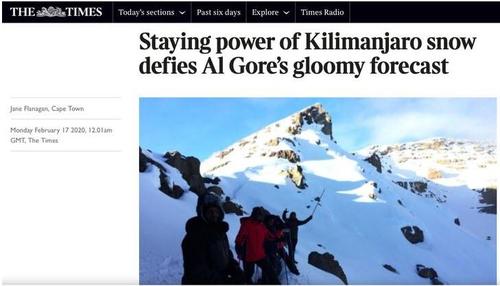
Here is documentation of 10 climate predictions and their outcome/result, like no snow on Mt. Kilimanjaro:

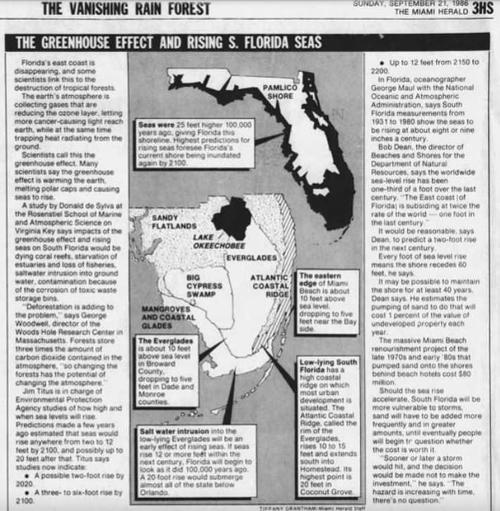
The disappearance of South Florida:

I don’t have anything against climate change and as I said, I think it is happening. I also think that the climate alarmists used it to get rich off of an unfounded scare, documented here and here.
I’m just glad for a Vaccine and that climate deaths are not killing off the Senior Citizens. So whether they get rich off of scare tactics or not is not important to me.
Social Media, the place where you can make yourself look better to feel good about yourself when someone likes the tripe you post. Aside from being little more than a digital high school, a cesspool of hate (Twitter) and one of the biggest time wasters invented, it appears to causes depression.
In recent years, a number of studies have linked heavy social media use to an increased risk of depression.
“But then you have to ask the chicken-and-egg question,” said study author Dr. Brian Primack, a professor of public health at the University of Arkansas, in Fayetteville.
On one hand, he said, excessive time on Twitter or Facebook might fuel depression symptoms. On the other, people with depression might withdraw from face-to-face interactions and spend more time online.
So Primack and his colleagues decided to see whether social media use made a difference in young adults’ risk of future depression.
It did, according to their report, which was published online Dec. 10 in the American Journal of Preventive Medicine.
The study included nearly 1,000 adults aged 18 to 30 who were depression-free at the outset, based on a standard questionnaire. All reported on their usual social media time and were assessed for depression again six months later.
By that time, nearly 10% fit the criteria for depression.
Overall, depression risk rose in tandem with time spent on social media.
Why can’t the US get it right vs. other countries? It is explained below. Most of all, our politicians have gotten in the way of actual healthcare. We need to get rid of them first, although that is not the nature of this article, but the crux of how we got where we are.
Check out the one where other countries deal with their population that smokes way more than the US does….need I say more?
The Bipartisan Policy Report titled “What is Driving US Health Care Spending? America’s Unsustainable Health Care Cost Growth” issued in September lists seven factors increasing American health care costs. The “fiscal cliff” debates include many of these arguments.
While these factors do indeed play roles in American health care, almost all are at work in other industrialized countries, all of whom provide better care to more people for half what we spend. Good intentions aside, the report overlooks critical (and dysfunctional) characteristics of American health care and instead distracts itself with factors never mastered by any country (including ours).
The report was prepared under the direction of former Senate majority leaders Tom Daschle (D-S.D.) and Bill Frist (R-Tenn.), former Senator Pete Domenici (R-N.M.) and former Congressional Budget Office Director Dr. Alice Rivlin. With such participants, the report certainly qualifies as bipartisan, but unfortunately the final product does not qualify as accurate.
Here are the seven factors. They are largely irrelevant in our quest for better care at less cost.
1. Many industrialized countries pay providers on a fee-for-service basis, seemingly rewarding more care rather than better care. Yet their costs are lower and their citizens are healthier.
2. Other countries face aging populations with higher smoking rates and more chronic illnesses than we have. Yet their costs are lower and their citizens are healthier.
3. Other countries face patient demands for the latest therapies. Yet their costs are lower and their citizens are healthier.
4. Other countries do not financially penalize patients seeking care. Yet their costs are lower and their citizens are healthier.
5. Other countries provide patients with no more information about complex health decisions than we do. Yet their costs are lower and their health results are better.
6. Many hospital systems in other countries dominate their markets. Yet their costs are lower and their citizens are healthier.
7. The one exception making us unique is our malpractice costs. Yet defensive medicine costs $55 billion annually, just 0.2% of our $2.6 trillion health care spending.
Thus we face the same challenges every country faces. But American costs are increasing faster and are already twice as high. What are these other countries doing differently? They apply three characteristics missing from American health care:
No country, including ours, has ever resolved the Bipartisan Policy Report factors. Yet our health care costs are the world’s highest. Although the report is bipartisan, it misses the critical factors driving up American health care costs. And unfortunately so does the Affordable Care Act, another valiant but futile effort at addressing our health care crisis. If the US wants a health care system that provides better care to more people for less money, we should take our lessons from countries already doing so, not from think tanks speculating on economic theories never applied successfully anywhere.
Successful systems around the world can teach us proven methods of containing costs while providing better care, but if only we choose to learn from them. These policy makers chose to ignore these lessons. The rest of us should not.
I went to a hospital today to have a procedure done. When the nurse apologized for the quantity of paperwork, I casually mentioned that things might become more complicated with Obamacare.
I was not ready for the answer. Actually, being in a very socially liberal city and healthcare system, I thought I was going to hear support for the program. I instead was told how government has corrupted the system, made it worse for both Doctors and patients and other horror stories. I replied that the government has not helped healthcare in a long time to which the nurse responded that the decline of morals in our culture was the beginning of the problem. How correct this nurse was.
Next, I met with the Doctor to go over what the procedure was going to entail. I again mentioned whether the healthcare system was affecting his job. Again I received a surprise answer.
The doctor told me of his passion for his practice all of his life. He then told me that what is being done to us by Washington has him considering getting out. He was honorable enough to not practice if he couldn’t do his best. It was a John Galt conversation. There are others like this doctor. I’ve found that if you are contemplating your retirement in your mind, you are already in the process of retiring.
To a person, the hospital staff admitted that Washington and the damage they have done and are doing to our healthcare system makes it worse for patients and providers. This is not a partisan statement for the record.
Let me point out that this was a highly successful practice with state of the art equipment and professional personnel making these perspicacious comments to me.
It was clear that they wanted to help people and do their job, but our own government is in the way. It seems obvious that they have overstepped their role in making sure that medicine is safe and lawful.
If I hadn’t heard it from the horse’s mouth, I wouldn’t have known. I did go in looking for a cure, but I left with a dose of information. It is easy to conclude that we need to fix or excise Washington from the healthcare system and put it back in the hands of the doctors.
After 18 years in private practice, many good, some not, I am making a very big change. I am leaving my practice.
No, this isn’t my ironic way of saying that I am going to change the way I see my practice; I am really quitting my job. The stresses and pressures of our current health care system become heavier, and heavier, making it increasingly difficult to practice medicine in a way that I feel my patients deserve. The rebellious innovator (who adopted EMR 16 years ago) in me looked for “outside the box” solutions to my problem, and found one that I think is worth the risk. I will be starting a solo practice that does not file insurance, instead taking a monthly “subscription” fee, which gives patients access to me.
I must confess that there are still a lot of details I need to work out, and plan on sharing the process of working these details with colleagues, consultants, and most importantly, my future patients.
Here are my main frustrations with the health care system that drove me to this big change:
Here are some things that are not reasons for my big change:
What will my practice look like? Here are the cornerstones on which I hope to build a new kind of practice.
This is the first of a whole bunch of posts on this subject. My hope is that the dialog started by my big change (and those of other doctors) will have bigger effects on the whole health care scene. Even if it doesn’t, however, I plan on having a practice where I can take better care of my patients while not getting burned out in the process.
Is this scary? Heck yeah, it’s terrifying in many ways. But the relief to be changing from being a nail, constantly pounded by an unreasonable system, to a hammer is enormous.
I checked in with KevinMD for this piece of helpful information. The free market will produce a better product than the government will ever be able to handle. Capitalism always provides competition which drives DOWN prices and drives UP services.
f you cannot measure it, you cannot improve it.
-Lord Kelvin
Asking science to explain life and vital matters is equivalent to asking a grammarian to explain poetry.
-Nassim Nicholas Taleb
Of course the quantified self movement with its self-tracking, body hacking, and data-driven life started in San Francisco when Gary Wolf started the Quantified Self blog in 2007. By 2012, there were regular meetings in 50 cities and a European and American conference. Most of us do not keep track of our moods, our blood pressure, how many drinks we have, or our sleep patterns every day. Most of us probably prefer the Taleb to the Lord Kelvin quotation when it comes to living our daily lives. And yet there are an increasing number of early adopters who are dedicated members of the quantified self movement.
They are an eclectic mix of early adopters, fitness freaks, technology evangelists, personal-development junkies, hackers, and patients suffering from a wide variety of health problems. What they share is a belief that gathering and analysing data about their everyday activities can help them improve their lives.
According to Wolf four technologic advances made the quantified self movement possible:
First, electronic sensors got smaller and better. Second, people started carrying powerful computing devices, typically disguised as mobile phones. Third, social media made it seem normal to share everything. And fourth, we began to get an inkling of the rise of a global superintelligence known as the cloud.
An investment banker who had trouble falling asleep worried that his concentration level at work was suffering. Using a headband manufactured by Zeo, he monitored his sleep quantity and quality, and he also recorded data about his diet, supplements, exercise, and alcohol consumption. By adjusting his alcohol intake and taking magnesium supplements, he has increased his sleeping by an hour and a half from the start of the experiment.
A California teacher used CureTogether, an online health website, to study her insomnia and found that tryptophan improved both her sleep and concentration. As an experiment, she stopped the tryptophan and continued to sleep well, but her ability to concentrate suffered. The teacher discovered a way to increase her concentration while curing her insomnia. Her experience illustrates a phenomenon that Wolf has noticed: “For many self-trackers, the goal is unknown … they believe their numbers hold secrets that they can’t afford to ignore, including answers to questions they have not yet thought to ask.”
Employers are becoming interested in this approach in connection with their company sponsored wellness programs. Suggested experiments include using the Jawbone UP wristband to see if different amounts of sleep affect work performance such as sales or using the HeartMath emWave2 to monitor pulse rates for determining what parts of the workday are most stressful.
Stephen Wolfram recently wrote a blog illustrating just how extensive these personal analytics experiments in self-awareness could become when coupled with sophisticated technologies. Wolfram shares graphs of his “third of a million emails I’ve sent since 1989” and his more than 100 million keystrokes he has typed.
Anyone interested in understanding just how far reaching this approach may become in the future should examine the 23 pages of projects being conducted by the MIT Media Center. My favorites from this fascinating list include automatic stress recognition in real-life settings where call center employees were monitored for one week of their regular work; an emotional-social intelligence toolkit to help autism patients learn about nonverbal communication in a natural, social context by wearing affective technologies; and mobile health interventions for drug addiction and PTSD where wearable, wireless biosensors detect specific physiological states and then perform automatic interventions in the form of text/images plus sound files and social networking elements.
It is easy to get caught up in the excitement of all this new technology and to start crafting sentences about how the quantified self movement will “transform” and “revolutionize” health care and spawn wildly successful new technology companies.
Jackie Fenn’s “hype cycle” concept has identified the common pattern of enthusiasm for a new technology that leads to the Peak of Inflated Expectations, disappointment that results in the Trough of Disillusionment and gradual success over time that concludes in the Slope of Enlightenment and the Plateau of Productivity. Fenn’s book, Mastering the Hype Cycle: How to Choose the Right Innovation at the Right Time can help all of us realize that not all new technologies becomes killer applications.
Jay Parkinson, MD has also written a blog that made me pause before rushing out to invest in quantified self companies or predict the widespread adoption of this approach by all patients. Parkinson divides patients into three groups. The first group is the young, active person who defines health as “not having to think about it until they get sick or hurt themselves.” The second group is the newly diagnosed patient with a chronic illness that will affect the rest of their lives. After a six month period of time coming to terms with their illness, Parkinson believes this group moves closer and closer to group one who do not have to think about their disease. The third group are the chronically ill who have to think about their disability every day. Parkinson concludes that “it’s almost impossible to build a viable social media business that focuses on health. It’s the wrong tool for the problem at hand.”
The quantified self movement should be closely monitored by all interested in the future of the American health care delivery system. The potential to improve the life of patients with chronic diseases is clearly apparent; whether most people will use the increasingly sophisticated tools being developed is open to debate.
From the Raleigh WRAL sometimes news.
WASHINGTON — Death, taxes and now health insurance? Having a medical plan or else paying a fine is about to become another certainty of American life, unless the Supreme Court says no.
People are split over the wisdom of President Barack Obama’s health care overhaul, but they are nearly united against its requirement that everybody have insurance. The mandate is intensely unpopular even though more than 8 in 10 people in the United States already are covered by workplace plans or government programs such as Medicare. When the insurance obligation kicks in, not even two years from now, most people won’t need to worry or buy anything new.
Nonetheless, Americans don’t like being told how to spend their money, not even if it would help solve the problem of the nation’s more than 50 million uninsured.
Can the government really tell us what to buy?
Federal judges have come down on both sides of the question, leaving it to the Supreme Court to sort out. The justices are allotting an unusually long period, six hours over three days, in sessions that started Monday, to hear arguments challenging the law’s constitutionality.
Their ruling, expected in June, is shaping up as a historic moment in the century-long quest by reformers to provide affordable health care for all.
Many critics and supporters alike see the insurance requirement as the linchpin of Obama’s health care law: Take away the mandate and the wheels fall off.
Politically it was a wobbly construction from the start. It seems half of Washington has flip-flopped over mandating insurance.
One critic dismissed the idea this way: “If things were that easy, I could mandate everybody to buy a house and that would solve the problem of homelessness.” That was Obama as a presidential candidate, who was against health insurance mandates before he was for them.
Once elected, Obama decided a mandate could work as part of a plan that helps keep premiums down and assists those who can’t afford them.
To hear Republicans rail against this attack on personal freedom, you’d never know the idea came from them.
Its model was a Massachusetts law signed
1- Find the C below.
OOOOOOOOOOOOOOOOOOOOOOOOOOOOOOO
OOOOOOOOOOOOOOOOOOOCOOOOOOOOOOO
OOOOOOOOOOOOOOOOOOOOOOOOOOOOOOO
2- If you already found the C, now find the 6 below.
99999999999999999999999999999999999999999999999
99999999999999999999999999999999999999999999999
99999999999999999999999999999999999999999999999
69999999999999999999999999999999999999999999999
99999999999999999999999999999999999999999999999
99999999999999999999999999999999999999999999999
3 – Now find the N below. It’s a little more difficult.
MMMMMMMMMMMMMMMMMMMMMMMMMMMMNMM
MMMMMMMMMMMMMMMMMMMMMMMMMMMMMMM
This is NOT a joke. If you were able to pass these 3 tests, you can cancel your annual visit to your neurologist. Your brain is great and you’re far from having a close relationship with Alzheimer.