
Walking away, it is the best way to preserve your sanity. It is also the best self-defense in a fight. When you know you don’t have to fight, and if you did you would still win, you already have.
Walking away, it is the best way to preserve your sanity. It is also the best self-defense in a fight. When you know you don’t have to fight, and if you did you would still win, you already have.
Social Media, the place where you can make yourself look better to feel good about yourself when someone likes the tripe you post. Aside from being little more than a digital high school, a cesspool of hate (Twitter) and one of the biggest time wasters invented, it appears to causes depression.
In recent years, a number of studies have linked heavy social media use to an increased risk of depression.
“But then you have to ask the chicken-and-egg question,” said study author Dr. Brian Primack, a professor of public health at the University of Arkansas, in Fayetteville.
On one hand, he said, excessive time on Twitter or Facebook might fuel depression symptoms. On the other, people with depression might withdraw from face-to-face interactions and spend more time online.
So Primack and his colleagues decided to see whether social media use made a difference in young adults’ risk of future depression.
It did, according to their report, which was published online Dec. 10 in the American Journal of Preventive Medicine.
The study included nearly 1,000 adults aged 18 to 30 who were depression-free at the outset, based on a standard questionnaire. All reported on their usual social media time and were assessed for depression again six months later.
By that time, nearly 10% fit the criteria for depression.
Overall, depression risk rose in tandem with time spent on social media.


I agree that looks fade away. You have to peel back the layers and find the jewel inside.
There are many beautiful women who are kind and loving, but many also that just trade on their looks. Too many have paid price of the Siren’s Song.
Time is fair to everyone. Sooner or later we all get old and all that is left is what is inside.

“A psychiatrist is a person who asks you a lot of expensive questions your wife asks for nothing.” – Joey Adams
Editor: Try to find the humor in this one and be offended elsewhere


I just finished a conversation with a successfully retired executive. He told me the secret to retirement is to keep your life uncomplicated. These two are related.
If you do something really well are paid for it, you hit the lottery. If it is one of your 1000 things, you still are ok. If you are hating your job and don’t something you do well you might be a dumbass.
Life is too short to not enjoy what you are doing. Sure, we have to do things we don’t want to, but not all the time.
If you do this, your life will be a lot easier than swimming upstream doing something you don’t like and aren’t good at. There is nothing wrong with tenacity, as long as it is combined with intelligence.
The moral of the story is don’t be a dumbass.
Maybe you have to know the darkness before you can appreciate the light. – Madelline L’Engel
Some have to reach their rock bottom to recover from disease, broken heart, addiction or whatever the poison is. Everyone has a story.
Going through it, recovering or learning how to live with the darkness is when you grow. Admitting what is bothering you is a good first step, but we move on and deal with things our own way.
You sure appreciate how much you have when you think how little time you have to enjoy it. Choose light and not darkness.
“No man remains quite what he was when he recognizes himself.” – Thomas Mann
Once you take your guard down and truly admit who you are, you get to see the person that is you. It’s doubtful that you’ll ever show this person to others except on a deathbed, but once you see yourself as you view and judge others.
We think we are invincible and nearly immortal when we are young, but the scars of life take it’s toll as do the decisions we make or avoid and we aren’t who we think we are.
As we age, inside we still see ourselves as the younger version until things start breaking down, but Zoom meetings will show you that age is taking it’s toll. Maybe that is why some hide their looks with makeup.

Covid has changed our lives for good, and possibly/probably not for the better. Let’s take it by activity.
Travel
Here is some history. Flying used to be fun, economical and had good service. We used to like going on an airplane until some jag-off decided to try and light his shoe bomb on a plane. Then another tried to blow up his underwear. We now have to queue in a long line and I’m not all that sure that it’s stopped anyone other than the average Joe traveler. It hasn’t stopped the TSA from copping a feel on strangers. The food sucks now and isn’t free anymore. Flying is more like the line for enlistment (including your prostate exam by the TSA) than to get on a plane.
With Covid, we can now add a temperature check, face masks and the the fear of catching anything from being in a tube for hours with little to no service. The airports are petri dishes for bacteria.
Given the losses on travel companies and equipment manufacturers, it doesn’t bode well for the travel industry or the travelers.
Going to the office to work.
The requirement to be in person at work not as necessary as thought.
Before remote working, we had to be in the office or no one could be fully sure that you were earning your pay. Travel and working remotely eased that but there still are some bosses who didn’t trust their employees. I had one piss-ant manager named R. Gorman when I worked at Thinkpad who didn’t trust anyone. He sent a memo called rules of the road where you had to be in the office. All that got him was no trust or loyalty from the team. We were technologically equipped to work from anywhere and always did on business travel, but there still was some requirement to be in the office otherwise.
Employees want to be empowered to succeed. When that happens, they find ways to be creative and accomplish their goals. Conversely, when you treat them like school children, many will act that way. Just like with Ray, our productivity went down and the Ray jokes went up.
Now, no one can go in to work while we are socially distancing, and most jobs (non-manufacturing) are still getting done. It’s easy to reach anyone at anytime (too easy and too intrusive) but the oversight of said taskmasters is not needed. In a way, the people are now empowered and they still get the work done. This one could be a benefit of Covid.
The downside is that a lot of empty buildings will lose their real estate value as there is no need to be in the office with the exception of essential workers.
How it affects the home
For us introverts, I thought it would be a time that we could cancel and/or avoid engagements until Zoom invaded our lives. Now even virtual happy hours are like a meeting. I’ve noticed that it’s hard to get privacy when kids and dogs are in the room or yelling in the background. Spouses or parents have been caught parading nude in front of the camera by accident.
When you meet in person, it’s easier to read body language and have someones attention. I tend to drift during Zoom meetings and have multiple devices that I often look at. I’ve noticed that I’m not alone.
Trouble for Introverts
Normally, we would be in pig heaven not to have to go to the office. In addition to the invasiveness of Zoom/Skype, we are stuck in the house with extroverts who won’t leave us alone. It’s like being trapped in hell. You want the quiet and the peace you got when the extrovert was in the office, instead your personal space is invaded and you can’t escape the dreaded small talk. The place that used to be your refuge has been invaded and there is no escape. It’s a fucking nightmare. It’s the people in your house that you can’t get away from.
How are you supposed to recharge your social battery when an extrovert is constantly draining it all day? Please, leave me alone and talk to your girlfriends.
Schools
The school model is now exposed, especially at college level. No more extortion for dorms when you can do 90% online. College professors are no longer as essential. Recorded classes, especially at the 100 and 200 level are adequate. Online testing and submitting required homework is routinely done online even well before this virus.
It turns out that colleges are a Breathtakingly overpriced product.
According to Mike Rowe: “They’re gonna’ find big thinkers with easily accessible ideas who are exponentially more interesting than professors, and soon, I hope, our obscene love affair with credentialing is going to stop, and we’re going to pause in every imaginable way, and look at what is essential – not just in workers or in work, but in education, in food, in fun. Everything is going to be forced through a different filter,” he said.
Colleges will also be exposed on their sports programs. Sports are a bank fund that pays for a lot of other school expenses and is a recruiting tool for enrollment. The schools will now have to rely on actual academics as a draw for students instead of March Madness or Bowl season. Maybe the students will now get an education instead of an indoctrination to Marxism.
Conversely, this is a big positive as the cost of education has the opportunity to go down (but so far the colleges are still extorting the same ransom from parents). Room and board are a large part of the cost of an education. Combine that with the lack of a requirement for many classrooms and there is the road to cutting costs.
It is not in the best interest of the Major institutions to charge less, but the cat is out of the bag that you can get almost as much done online. I hope that the masses will overcome and help this opportunity for cost cutting.
For elementary, middle and high school, I think it will hurt our youth. There is a need for hands on in basic learning and kids have the attention span of gnats. Sometimes you need to snatch their asses back to attention when it’s learning time.
New paradigm for getting essential needs like groceries.
Essential services like cancer, emergency rooms are same, but will change. Non-essential Dr. visits are now handled over the phone or via video. Dr.’s can now dedicate more of their time to real emergencies or necessary in-person visits. A person using the Emergency Room for healthcare because they don’t have insurance is going to go way down.
There is no downtime for paperwork and other overhead that comes with any job, but that got handled off-line mostly anyway.
Rely on technology more, but the risk is that you can take down a society like the virus did. Beware of hackers though, where there is opportunity, there will be bad guys looking to make your day worse.
Shopping
Groceries have taken a turn for the better/worse/something different. Now that we went through the great toilet paper shortage and people have enough to wipe their asses for the next 5 years. They can realize that a little planning can condense 5 shopping trips into one, or one delivery or pickup.
A lot converts have been made for grocery delivery. There are a few kinks that need to be worked out though. I’ve gotten stuff I didn’t order, but mostly I rarely get everything I wanted, even if I put in what the substitute would be product. There is no shopping for the store brand that is a whole lot cheaper.
We have gotten used to queuing a lot more now. It used to be the end of the world for some people who had to wait for more than one person to checkout. Now, we’re standing on X’s taped to the floor like kindergartners waiting to go potty.
As is the trend, online shopping has picked up and the downside is retail stores are less needed. Again, this is a loss in real estate value and will leave a lot of square footage available.
So all in all, some of this is good, but a lot of it was unnecessary. If it wasn’t an election year or if there were different political leaders, a whole lot of people wouldn’t be losing there freaking minds over every little thing that they look for to be offended by. HCQ would be over the counter like it is in a lot of countries and we wouldn’t be held hostage for masks as no one really seems to know whether it truly helps or hurts us yet.
I’ll remain optimistic that society will adapt. I’m pessimistic that this is a political power opportunity to control the masses and we should beware.

People breakup in relationships. They get laid off from work. Those close to us die. It happens to everyone sooner or later.
You will always keep that memory whether or not you want to, but moving on is part of life. Yes, it takes time, more for some than others. Some never move on as a loss is hurtful.
The best thing I can offer is that every experience can help you grow. Try to look for the positives. Try to remember those things or people that you lost for their positive influence on you. Sometimes if you can’t move on, at least move along until the pain is less.
The other situation I often see is that you don’t get the dream job you thought would change your life. There is always a next job if you keep seeking and no one thing is the panacea of life that will cause it to stop if it doesn’t go your way.
“You can discover what your enemy fears most by observing the means he uses to frighten you.”
Eric Hoffer
Sun Zhu said something similar about noticing your opponents weakness and you will win the fight because they can no longer hurt you.Much of the strife we go through is fear based recently. It caused us to leave life and self-quarantine, until it was ok to go out and riot. It’s been going on for a week now an there will be plenty of data shortly as to whether we really need to social distance anymore, because they sure aren’t doing it in the riot cities.
Remember Greta Thunberg? She’s not even a blip on the map, nor is global warming. The scare mongers have moved on to the next issue. I haven’t been afraid of these things because the truth is that we live in the greatest times of mankind ever. Yes we have problems, but that is life.
There is no need to be afraid and have unnecessary fears. The glass is really half full. These can be the greatest years of our lives if we stop buying into the crap that the media and social media tries to feed us.
“Sphenopalatine ganglioneuralgia”
There you have it. If you place your tongue on the roof of your mouth, it will go away.
Don’t eat your ice cream as fast works also.
“The universe is a big place, perhaps the biggest.” – Kilgore Trout
I didn’t label this as great. It is however, a break from the anarchy going on right now.
About the only positive I can take from the rioting is that we’re going to see real quickly if social distancing is necessary anymore. It’s surely not happening in a lot of places at once.
It seems like history is repeating itself. There were protests in the 60’s at the same time we sent men to the moon. Space-X just had a successful launch on Saturday.
No one would wish what happened to us with the China/Wuhan/Covid-19/Kung flu/Corona virus this year. I wonder if there is any silver lining?
WE’VE LEARNED THAT YOU DON’T HAVE TO BE IN PERSON AT WORK
First, the essential workers should be commended. Those putting their life at risk for the rest of us or to keep us able to stay away but help keep the economy going do need to be there. They don’t get thanked enough and deserve more accolades than they are getting. I can’t list them all, but you know who you are as do we, especially when we go out or are in need and you are there.
There are a group of desk jockeys that can work from anywhere, including home, the coffee shop or anywhere that has WIFI. Many companies are still getting along just fine without everyone in their cubicles or open office space being babysat by next level of ladder climbers and wannabees.
Yes, some of them are goofing off, but they goof off at the office also. They self-sort themselves out of their jobs after a while anyway. The other workers know who is carrying their load and who is carrying a load of bullshit without them being there.
We have been forced into a higher level of trust to get the job done. I’ve worked for some who didn’t trust their employees if they weren’t at their desk. If you treat people like grownups they will be. If you treat them poorly or like monkeys, like managers I’ve had they will eat bananas.
Now, those who want to work at home or remotely had the chance to prove that they could get the job done and don’t have to go into an office to do the same thing.
For introverts, this is a blessing. They don’t have to be sentenced to the jail of in person meetings or having to have their day ruined by HR regimented nonsense that can be done in non-critical hours.
PRODUCTIVITY
This is a unique time to get more work done, or to refine our work habits. See above about goofing off in the office and you have now eliminated water cooler BS sessions, meaningless meetings that can be done on email or chat and time to actually concentrate.
I know those in sales have to talk, but if they concentrate more on selling, they too will be more productive. A lot of them are too chatty anyway.
The USA works more than other countries and it appears that we like to work. You can tell by how much we’ve achieved, but also the lack of vacation we take vs. other countries. Hey, but how many countries have landed a man on the moon?
We have the opportunity to open up (re-open up) and unleash the greatest economy and workforce that has ever existed. There are people dying to get back to work that may be furloughed. I only hope the politicians haven’t put onerous rules in place that hurts the economy and the ability for small businesses to thrive.
TRAVEL
You can now go anywhere you need to if you want. I imagine that travel will be light at first, although some with pent up demand or anxiety will leave as soon as it is allowed. The downside will be the TSA security check lines if we have to stay 6 feet apart. The line will be out of the building and into long term parking.
I read that the bookings for Cruise ships are in high demand, something I just don’t understand. Cruise ships are petri dishes for viruses and have been for a long time. Why you would want to be in basically a jail cell that travels with limited escape time to buy a T-shirt doesn’t seem desirable, but I have friends who love it. They mostly like to eat though and say it’s a cheap way to travel. At least they won’t be on planes for those of us who want to get where we are going and then actually see the country/place we are visiting.
You won’t have to worry about getting stuck in the middle seat for a while on an airplane. That is the designated social distancing seat, like it’s going to matter when you are in a tube for hours and well within the reach of a cough or a sneeze. I love this one as the airlines have made travel less enjoyable year over year. The armrest fight for position will be solved for now.
I imagine there will be a lot of deals at first. Travel costs should be down as well as tourist traps will have good prices to make up for the time we’ve spent in our quarantine jail. Get ’em while you can. There will be less tourists everywhere you go and businesses dying to offer deals to make up for the faux shut down.
BE POSITIVE
One can look at the downside and think that the world is going to end and that we might die from Covid-19. The statistics say that it is mostly in a few concentrated places (NE corridor and elderly care facilities) and affects those with a co-morbidity. The odds are in our favor that we won’t get it or that it won’t be as bad as the media is trying to shove down our throats.
When this passes (hint: watch how soon it passes after the November election is over regardless of who wins) the opportunities to better your life and enjoy some things in the work/life balance that have been either ruined or complicated for us.
1. Your shoes are the first things people subconsciously notice about you. Wear nice shoes.
2. If you sit for more than 11 hours a day, there’s a 50% chance you’ll die within the next 3 years.
3. There are at least 6 people in the world who look exactly like you. There’s a 9% chance that you’ll meet one of them in your lifetime.
4. Sleeping without a pillow reduces back pain and keeps your spine stronger.
5. A person’s height is determined by their father, and their mother determines their weight.
6. If a part of your body “falls asleep”, you can almost always “wake it up” by shaking your head.
7. There are three things the human brain cannot resist noticing – food, attractive people and danger.
8. Right-handed people tend to chew food on their right side.
9. Putting dry tea bags in gym bags or smelly shoes will absorb the unpleasant odor.
10. According to Albert Einstein, if honeybees were to disappear from earth, humans would be dead within 4 years.
11. There are so many kinds of apples, that if you ate a new one every day, it would take over 20 years to try them all.
12. You can survive without eating for weeks, but you will only live 11 days without sleeping.
13. People who laugh a lot are healthier than those who don’t.
14. Laziness and inactivity kill just as many people as smoking.
15. A human brain has a capacity to store 5 times as much information as Wikipedia.
16. Our brain uses the same amount of power as a 10-watt light bulb!!
17. Our body gives enough heat in 30 minutes to boil 1.5 liters of water!!
18. The Ovum egg is the largest cell and the sperm is the smallest cell!!
19. Stomach acid (conc. HCl) is strong enough to dissolve razor blades!!
20. Take a 10-30 minute walk every day & while you walk, SMILE. It is the ultimate antidepressant.
21. Sit in silence for at least 10 minutes each day.
22. When you wake up in the morning, pray to ask God’s guidance for your purpose, today.
23. Eat more foods that grow on trees and plants and eat less food that is manufactured in plants.
24. Drink green tea and plenty of water. Eat blueberries, broccoli, and almonds.
25. Try to make at least three people smile each day.
26. Don’t waste your precious energy on gossip, energy vampires, issues of the past, negative thoughts and things you cannot control. Instead invest your energy in the positive present moment.
27. Eat breakfast like a king, lunch like a prince and dinner like a college kid with a maxed out charge card.
28. Life isn’t fair, but it’s still good.
29. Life is too short to waste time hating anyone. Forgive them for everything.
30. Don’t take yourself so seriously. No one else does.
31. You don’t have to win every argument. Agree to disagree.
32. Make peace with your past so it won’t spoil the present.
33. Don’t compare your life to others. You have no idea what their journey is all about.
34. No one is in charge of your happiness except you.
35. Frame every so-called disaster with these words: ‘In five years, will this matter?’
36. Help the needy, be generous! Be a ‘Giver’ not a ‘Taker’
37. What other people think of you is none of your business.
38. Time heals everything.
39. However good or bad a situation is, it will change.
40. Your job won’t take care of you when you are sick. Your friends will. Stay in touch.
41. Envy is a waste of time. You already have all you need.
42. Each night before you go to bed, pray to God and be thankful for what you accomplished, today. What if you woke up this morning and only had what you thanked God for yesterday? DON’T FORGET TO THANK GOD FOR EVERYTHING.
43. Remember that you are too blessed to be stressed.
“Facts are stubborn things, but statistics are more pliable.”
Doctors Fauci and Birx predicted gloom, doom and death with the China/Wuhan/Corona/Covid/Whatever virus. They were off not by a little, but by millions. History will show whether they saved a lot of lives or screwed the World’s economy. Let that be the judge and not the media.
I have railed against the media because all of them now have stopped reporting the news and now make stuff up based on their position. They mostly miss the mark on everything also.
The last time I recall missing the target this badly was the 2016 election where at 8 am Nate Silver at 538 had Hillary winning with a 95% probability.
I could go on and on with examples, but I’ll spare everyone because we all read the internet and judge it for ourselves (for those smart enough to have our own opinion and not believe what we read).
Wise up and don’t be a sheeple. Twain is right so go with the facts.
“When you think of the long and gloomy history of man, you will find more hideous crimes have been committed in the name of obedience than have ever been committed in the name of rebellion.”
We have some power grabbing governors vs. some who are trying to re-start their states. Who knows which model will be correct. Forcing people to close businesses and not being able to feed their families seems overbearing though. It happened only a few miles from me to an honest fellow and it seemed unfair.
Who we trust in positions of authority right now and their limits of authority are certainly of interest. Being a student of history doesn’t give me a real sense of hope or belief that many of them have our best interests in mind ahead of their sense of power. My .02.
“Inaction breeds doubt and fear. Action breeds confidence and courage. If you want to conquer fear, do not sit home and think about it. Go out and get busy.”
– Dale Carnegie
And that time is upon us. We are about to emerge from the Wuhan virus cocoon that we were forced into. We need to kick start life in the butt.
“And once the storm is over, you won’t remember how you made it through, how you managed to survive. You won’t even be sure, whether the storm is really over. But one thing is certain. When you come out of the storm, you won’t be the same person who walked in. That’s what this storm’s all about.” — Haruki Murakami
We will be different when the China/Wuhan/Covid-19/whatever virus has run its’ course. Some will act differently like washing their hands more or social distancing. Some may travel less. The smartest of these will stay off cruise ships. The wisest will decide who and what they believe in to as the rock to anchor their life on.

When I first started liking Star Wars, I never realized how useful the dark side was going to be. See more of Vader here
in social distancing and here in the Circle Game.
“The harder the conflict, the more glorious the triumph. What we obtain too cheap, we esteem too lightly; it is dearness only that gives everything its value. I love the man that can smile in trouble, that can gather strength from distress and grow.” — Thomas Paine
When I studied Martial Arts, my Sensei told me that the ones who quit are the ones that it comes easy too. The ones who have to struggle or try harder persevere longer and achieve more.
Training for anything is necessary. Enjoying the journey is how to best enjoy the process of overcoming. That is the key to the above saying because life, happiness, freedom and other things we cherish are a journey, not an event.
Douglas Adams – “Human beings, who are almost unique in having the ability to learn from the experience of others, are also remarkable for their apparent disinclination to do so.”
I guess not. I wonder what lessons we will have from the Corona/Covid/China/Wuhan/Whatever virus? Probably not to trust the media and to carefully evaluate if Congress is working for us or themselves.
“Learning to endure times of disappointment, suffering, and sorrow is part of our on-the-job training. These experiences, while often difficult to bear at the time, are precisely the kinds of experiences that stretch our understanding, build our character, and increase our compassion for others.” — Joseph B. Wirthlin
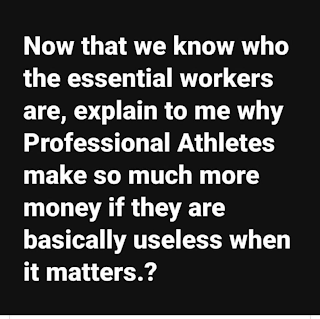
I love sports as much as any other red blooded American male. I love both playing them and watching the best compete against each other. I just wish they’d realize that with a very few exceptions, athletics is all they are qualified to pontificate on. I’m tired of being lectured about their position on anything other than their sport. I’m willing to bet that I’m not alone and in the majority.
I’ve already posted here that actors (celebtards) are the same.
Even though the meme points to their salary, I don’t have a problem that they make a lot of money. It doesn’t make them smart or qualified to tell the people with essential jobs how we should think though. I’m glad that they worked their way to the top based on their skill and God given talent that they worked hard to perfect. They should be grateful that they were born in a time and a place that allows them to succeed. When anyone succeeds, the tide rises for all boats so good for them.
They are getting a lesson that while we enjoy being distracted watching them, we don’t miss their soapbox spoutings and are managing to survive just fine without them.
I hope they don’t forget that it’s the fans who pay them. They work for the fans, not the other way around.
Update: On April 5th, the Surgeon General compared the Corona Virus to Pearl Harbor.
There are events in history that cause a divided nation to come together.
Some have been pandemics and others have been wars, but there are times defined by history that people put their selfishness aside and gather to do what is best.
As an example, I could pick the Spanish Flu, SARS, MERS, H1N1, Y2K, the Swine Flu, the Space Race to the Moon or any number of events, but I’m going to use Pearl Harbor.
I wasn’t there, but our nation was divided as to whether we should enter another World War or isolate ourselves and hope the problem would go away or others would solve it. This all changed on December 7, 1941 when our country was forced into the events of the world.
We could have cowered to the attack and ask them not to do it again. Neville Chamberlin tried to appease Hitler this way and it didn’t work out so well.
THE MIGHT OF THE USA
Admiral Yamamoto, the architect of Pearl Harbor knew that a surprise attack to take out our Navy was the only real chance for Japan to stop the USA so they they could expand their reach in the Pacific Rim. After all, he had studied and lived in the USA and knew that our forces were depleted after WWI. He also knew that he couldn’t attack us on our own soil.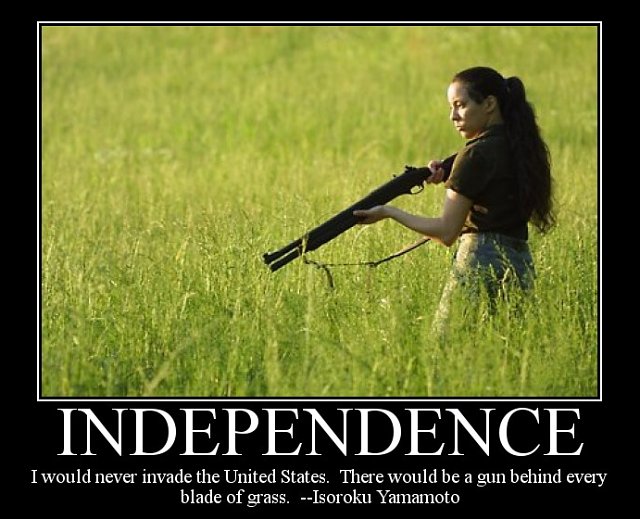
What also turned out to be true was that if the attack didn’t work, that he would awaken the might of the greatest industrialized nation in the world and unite our country to defeat evil.
On December 8th 1941, men young and old were lined up to enlist to fight for our survival. They knew that they would be leaving loved ones behind and there was a distinct possibility that they wouldn’t return alive. They put their fears aside and were willing to fight for our survival and the future that we enjoy today.
Not long after, women went to work in the factories. We had to ration rubber and metal for war supplies, but everyone did their part.
Companies changed their direction. Auto makers went from making cars to building bombers. Scientists invented new weapons to win, not to just survive and suffer. Our nation came together as one because we had a cause to fight for.
After the war, the greatest achievements in technology, medicine and space exploration happened at a speed heretofore never accomplished.
WE’VE BEEN COMPLACENT AND DIVIDED
All of that progress created wealth, comfort and abundance and we lost our focus. It’s no secret that we’ve been a divided country. I’m not here to point fingers because there is enough of that going on through the tradional news and social media. All of it has a bias one way or the other and it has been pulling us apart.
We haven’t had a common enemy to rally against since the downfall of the Soviet Union. Instead, we’ve been feeding on ourselves instead of pulling together. There is a strain of hatred for what we have been that defies the achievements that built our country. I have read celebtards and sports figures that say we have never been great. This just proves that they have no appreciation for the sacrifice and achievements that gave them the fame and fortune to preach from their soapboxes. It also denies our ability to do it again.
We as humans need a cause to believe in and to fight for, whether we are handed or invent it ourselves. Conversely, politicians have been poisoning us with their desire for power and control. They have been playing a game of capture the flag on their own islands and haven’t put the good of the country and the people first. They have been building their power base by taking away our freedom through regulation.
Our government was set up with a system of checks and balances to ensure that no one had the power like the monarchy who we defeated to become what we are. We now potentially suffer from what the history of the world has suffered from since the beginning of time. That is the selfishness, greed and desire for power that has aflicted man since the expulsion from the Garden of Eden.
There also has been a faction for globalization that has tried to deplete our greatness by moving manufacturing offshore to the point that we could be held hostage for medical supplies. Our spirit of nationalization has been tested by the border fight and ideology fueled by hate of the President. It has ratcheted up these last few years in a power struggle because there was no enemy other than from within.
We have been eating ourselves instead of fighting together.
THE CORONA/COVID-19/CHINA/WUHAN/WHATEVER VIRUS
We now have a new Pearl Harbor. We have been attacked by a new enemy who ambushed us again. It is time for us to realize that we have a fight on our hands Opportunity for success or failure knocks at the door of the fate of our country.
To do that, we need to go back to the spirit of 1941. It was the people who came together in both the public and private sector, not the control of the Government that helped us save ourselves.
We can go back to being the humans that have struggle to fight against, rally together and overcome (both the virus and the overbearance of the governement regulations).
THE SILVER LINING
There is a great opportunity if we do the same as our forefathers. Manufacturing in America again can help us right ourselves to help reunite our country and help other countries as we’ve done before.
We are beginning to see the automakers making ventilators, factories starting to make facemasks and other birth pains of our possible re-emergance to self-sustainment. It can be done.
Before you manufacture in the USA instead of cheap labor offshore, there needs to be a construction boom to prepare production facilities. After that, the job creation of made in in America is limitless, profitable and will help us help ourselves and others if they want it.
We already have become energy independent by producing enough oil so as to not be dependent on countries who hate us.
Our pharmacuticals are all made offshore by countries that have threatened to cut us off. We need to do the same in the drug industry to continue our trend of independence and strength. Through this can we help the rest of the world and save our nation from being held hostage for needed medical supplies and energy.
Most of all, we need fix our goverment and make them serve us instead of us serving them. Companies and individuals need to be let loose to invent, design and create to defeat this latest Pearl Harbor instead of being told when and what we can or can’t do. It’s time to limit their power and continue the greatness that history proves is inside of us.
I tend to notice trends early. I quit Twitter 4 years ago as soon as work didn’t (unofficially) require it. Almost every time I used it, the conversation degraded by the 3rd or 4th tweet into something political, followed by unsubstantiated name calling. You have to have a thick skin and a terse personality to want to survive out there.
A few years later I tried helping a friend get on Facebook and we both decided that it was like a high school reunion, or being in high school where you make up stuff to seem like your life is better than others. He finally told me to stop and to not put him on. At that point it dawned on me that most of social media falls under Sturgeon’s Law:
There might be a corollary that 99% of social media is crap.
The trend I noticed besides people acting false was that I never felt better after being on twitter and I loathe Facebook for the same reason. This was 5-8 years ago and now the studies are coming out proving what I noticed.
A recent article in the USA today talked about another high schoolish trend, mob mentality.
Social media also has polluted our more general life, with the ability to form online mobs increasing, as Prof. Glenn Reynolds aka Instapundit recently wrote in USA Today:
People enjoy forming mobs. Mobs allow people to do things they’d be afraid to do on their own, to steal, to hurt and kill, to burn and destroy — and also to feel set free from the bonds of civil society, to experience a kind of atavistic catharsis, a feeling of power and a solidarity with their fellow rioters, in a way that’s otherwise difficult to achieve, especially without suffering serious consequences….
But now there’s a new kind of mob, an online mob. And judging by the events of the past week, this new mob is becoming a more frequent problem. Part of that is because it’s easier (and safer) to be part of an online mob than one in the real world.
Joining a real mob requires you to leave your house, go somewhere else, and experience risks and discomforts. Joining an online mob can be done from an easy chair at home.
There are times that I post something and bizarre comments come it, so much so that I have to moderate them according to the policy on the sidebar. Some just violate the policy too much. It’s like twitter, if it can get political it usually does. Since I’ve posted a lot about the military and patriotism, I caught a lot of crap.
I read a blog post by Legal Insurrection that noted the increase in suicides and the link that may exist between the two.
A New, More Rigorous Study Confirms: The More You Use Facebook, the Worse You Feel
Social Media and Teen Depression: The Two Go Hand-In-Hand
Rise in teen suicide connected to social media popularity: study
Suicide rate’s increase can be tied to social media, technology: Dr. Marc Siegel
Using Many Social Media Platforms Linked With Depression, Anxiety Risk
Why don’t people just put it down? It looks to be like the new next cigarette, just as addictive and equally as bad for you.
As for me, I can go about my day enjoying not getting into useless tweet storms and having my head glued to my phone. Hell, I won’t even put Facebook on because I don’t want them in my life.
I’d like to say the higher IQ people would be immune to this, but it’s not true. They are just as susceptible to this and it goes under things they shouldn’t do.
WHAT FACEBOOK KNOWS AND IT ISN’T TELLING YOU
It preys on Women’s emotions and other mind altering and interfering techniques and the company KNOWS THAT IT IS DOING IT.
Even former Facebook President Sean Parker realizes the pitfalls of Facebook:
The former Facebook President discussed the company’s initial aim, which was mainly centered around drawing in and building their audience:
The thought process that went into building these applications, Facebook being the first of them, … was all about: ‘How do we consume as much of your time and conscious attention as possible?’ And that means that we need to sort of give you a little dopamine hit every once in a while, because someone liked or commented on a photo or a post or whatever. And that’s going to get you to contribute more content, and that’s going to get you … more likes and comments.
Parker described Facebook’s appeal as a “social-validation feedback loop” which exploits human psychology to keep users coming back to the app:
It’s a social-validation feedback loop … exactly the kind of thing that a hacker like myself would come up with, because you’re exploiting a vulnerability in human psychology. The inventors, creators — it’s me, it’s Mark [Zuckerberg], it’s Kevin Systrom on Instagram, it’s all of these people — understood this consciously. And we did it anyway.
Comments such as this from Facebook former President, combined with Facebook’s mishandling of user data, has led to a greater level of distrust around the company. What was previously seen as just a website by many users was becoming better known as a data collection company.
It turns out that platforms like Facebook are the “Junk Food For the Soul”. In other words crap that isn’t good for you.
THE CESSPOOL OF HATE AND DISCRIMINATION BY TWITTER
Just say something, anything and pretty soon it can turn into a hate storm if you offend someone or anyone. I saw someone post here’s a picture of a rock, let the arguing begin just to prove it and it did.
When I check I often find that a user who has blocked me is someone I have never interacted with. So why the block? Often, it’s due to being on a block list created by a liberal activist group. Twitter supports block lists and makes it easy for users to mass-block entire universes of people they don’t even know.
But Twitter now uses factors such as the number of people who have blocked an account to determine whether to classify it as “low quality” content. The company also uses the number of complaints or reports on the account. If the number of these exceeds certain thresholds, an account can be deemed low quality and access to tweets from that user are severely diminished.
I couldn’t wait to leave that platform of time-wasting and hate and my life is better because of it.
Something to laugh at, especially if you are a many over 40 and go through this yearly. I choose women doctors because they have smaller hands and fingers and are more compassionate.
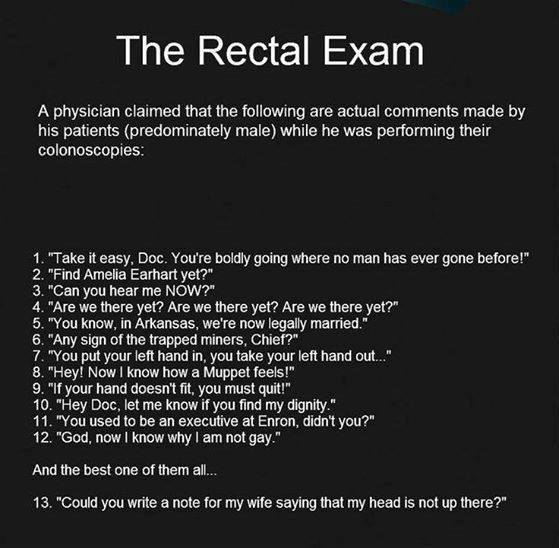
I’ll bet if you ask most people of a certain age, they are going to realize that this is true. I remember asking my father for life advice on his 75th birthday. He answered, “where did it all go so fast?” You’ll find that one below also.
Read and learn if you are young, commiserate if you agree.
#1 – I talk to myself because there are times I need expert advice.
#2 – I consider “In Style” to be the clothes that still fit.
#3 – I don’t need anger management. I need people to stop pissing me off.
#4 – My people skills are just fine. It’s my tolerance for idiots that needs work.
#5 – The biggest lie I tell myself is, “I don’t need to write that down. I’ll remember it.”
#6 – I have days when my life is just a tent away from a circus.
#7 – These days, “on time” is when I get there.
#8 – Even duct tape can’t fix stupid – but it sure does muffle the sound.
#9 – Wouldn’t it be wonderful if we could put ourselves in the dryer for ten minutes, then come out wrinkle-free and three sizes smaller?
#10 – Lately, I’ve noticed people my age are so much older than me.
#11 – “Getting lucky” means walking into a room and remembering why I’m there.
#12 – When I was a child, I thought nap time was punishment. Now it feels like a mini-vacation.
#13 – Some days I have no idea what I’m doing out of bed.
#14 – I thought growing old would take longer.
#15 – Aging sure has slowed me down, but it hasn’t shut me up.
#16 – I still haven’t learned to act my age and doubt I’ll live that long.
Unfortunately, these are all sadly true!
First, I am not going to weigh in on what a world leader has said. Every time I have ever tried it, nothing is gained as everyone has their own opinion and trying to sway it is not what I care about. Enjoy your center, left, right or whatever political position you wish.
I was looking for whether this actually exists. Here is what I’ve found.
UPDATE: Portland is the newest shit hole. Click on the link: Portland: American epicenter of degeneracy, depression, and ANTIFA.
Here is a link and a screenshot of a map from the Rice Institute based showing countries with the most open defecation.
Forbes published a list of the world’s dirtiest cities. Without passing judgement, they seem to line up with the shitholes in the map so the facts seem to be in order.
 Next, is it possible that the United States has places where there is open defecation? I found that map also.
Below is the link and screenshot also, but in case you don’t recognize it, this is San Francisco.
Now, after reading this, one can add it to their travel plans to go and help, or avoid for sanitary purposes, you choose. If you go to San Francisco, zoom in and you can see where to not step in a pile of poop. As I type that, I realize that it is sad for what is supposed to be one of the leading cities of the US, and one so close to silicon valley.
It also gives everyone equal political fodder to take shots at whomever. In these days of political partisanship, nothing or nobody is safe by the 3rd or 4th comment, so I expect the same.
I just got curious and I wondered if what was said was true or not. Apparently it is.
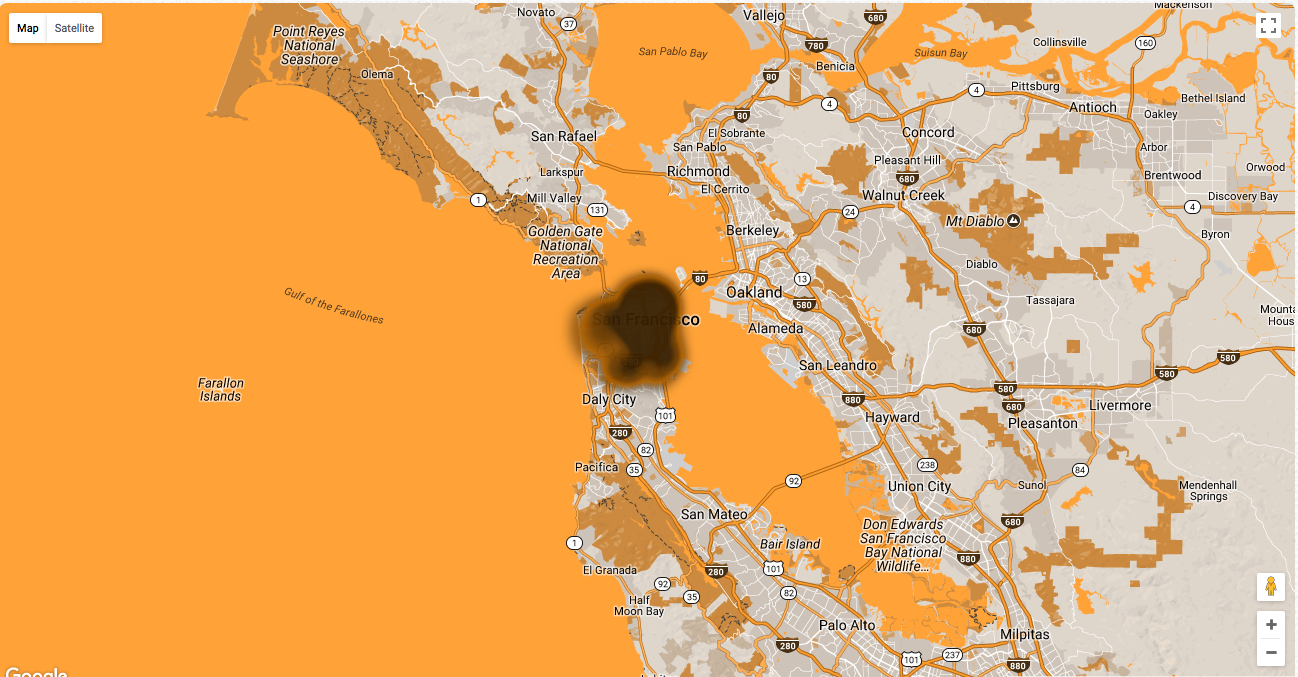
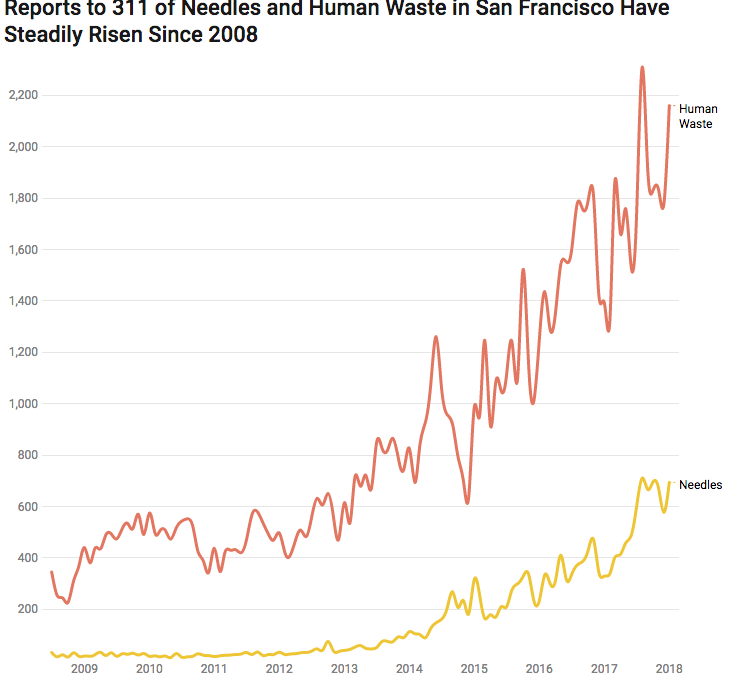 Here is the link to the recent study of sanitation including feces, used syringes and other disease carrying trash in the heart of San Francisco. It’s a shame since it is in the heart of the restaurant and hotel area. You’d think that the tourism officials would do something about this, but looking at the graph indicates the problem escalating.
UPDATE: San Francisco is getting over 80 calls a day to report human feces for clean up. In the same report were almost as many instances of needles despite the fact that there are safe injection spaces for shooting up an illegal drug that destroys lives.
UPDATE: It turns out that Denver is now officially classified as a shithole also. They passed an act that you can drop trou and pinch a loaf right on the street. Here is the story and the reason why they passed the law.
UPDATE: It looks like Hawaii isn’t as pristine as one thinks of it. The cesspools and the water around the islands are contaminated enough to make it a shithole also. There is a link within this link that goes to the WSJ.
Video Update: A large portion of Orange county is now a 3rd world shithole also.
After all is said and done, I thought that having to have a map to not step in a pile of human feces makes a city the biggest shithole. It turns out that I was wrong.
According to the Government services including the EPA, ACS and the Census bureau comes this little gem:
The City that Never Sleeps ranked the highest in three out of five categories, placing it as shittest-city-in-the-nation of 427.9 on Busy Bee’s “dirtiness index.” The next closest competitor for all the wrong reasons is Los Angeles, which has a dirtiness index of 317.8. To complete the top five list, the remaining dirtiest cities are Chicago, Philadelphia, and San Francisco.
So not only do you have to pay way more more to live in these places, they have worse air, bigger rats and more cockroaches, they turn out to be the shitholes that we all thought they were. Why anyone would choose to live there knowing there?
UPDATE: The 7 Reasons Farting is Good For You
Dropping a deuce, pinching a loaf, laying pipe, reading the sports page, seeing a man about a horse, all are names for the same thing.
But how much does it weigh? Can you lose weight by taking laxatives or giving birth to a legend size turn monster? How much does a fart weigh? Do women fart as much as men? Let’s look into it.
According to thrill list health:
To find out how much our stool adds to the scale, researchers (serious poop
researchers do exist, folks) collected samples from people living in 12
different countries to get a comprehensive overview.
They discovered that poop weighs between 2.5oz and 1lb, on average.
To find out how much our stool adds to the scale, researchers (serious poop
researchers do exist, folks) collected samples from people living in 12
different countries to get a comprehensive overview.
Have you ever weighed yourself before and then after taking a dump?
Of course you have! Who hasn’t? The best part is seeing the scale budge
in your favor after dropping the kids off at the pool.
So it stands to reason that if you could poop more, you’d lose weight, right?
Same for farting — gas has mass, after all. Could pooping and farting
be legit weight-loss secrets, or is it all just a lot of hot air?
Unsurprisingly, Westernized populations have the lowest poop weights,
thanks to a severe lack of fiber that comes with a fast-food diet. Western
samples only averaged between 3-4oz, which isn’t nearly enough to
make a difference in your skinny jeans.
Very, very carefully. Gastroenterologists in England tried to determine
a fart’s weight by giving study participants 200g of baked beans in
addition to their normal diet. Even scientists know beans are a magical
fruit. To measure the toots these beans are known for, they used rectal
catheters over the course of 24 hours, which raises serious concerns
about the mental stability of the participants.
Despite the method, the data collected may surprise you more.
Scientists learned that the farts weighed between 16-50oz per day.
That’s right: You’re holding as much gas in your system as a small
Sweetums soda. And in case you’re wondering (you’re obviously
wondering), “Women and men expelled equivalent amounts,”
according to science. That’s right. Your sweet little cupcake is
cutting the cheese and stinking up the room just as much as you are.
Of course, there are those out there who see “poop can weigh a pound”
and will try to up their poop game by taking laxatives. Bad idea.
Robert Herbst, an 18-time world-champion powerlifter and one of
the drug-testing supervisors at the Rio Olympics, says laxative-driven
weight loss happens even at the highest levels of sport, and it isn’t pretty.
Herbst confirms that dropping a deuce will in fact budge the number
on the scale, though it won’t alter your body composition or muscle
percentage, saying, “One pound in does not guarantee one [pound] out,”
because food is metabolized differently. Certain foods are absorbed
more efficiently, while others pass right through (looking at you, corn).
So while a pound of lettuce may work its way out to the porcelain
water slide, a pound of pie will most likely stick to your thighs.
Pooping isn’t a total elimination of all the calories you eat, since that
wouldn’t make any sense. Your body needs energy, so it’s not going
to shit it all out.
On top of that, Herbst’s experience monitoring weigh-ins taught
him that no one’s going to see Biggest Loser-type results. He says
you may see a 5lb drop (if that), depending on how much you currently
weigh. If you’re a big dude, you’re going to expel more in weight and
volume because you’re already eating more.
The majority of people will only be able to look forward to a mere
1-2lb difference (at most) if you’re an active person. Those losses
aren’t worth canceling your gym membership, and in extreme
cases, excessive laxative use can lead to all sorts of nasty medical complications.
What About Competitive Eaters?
I watch the July 4th Nathans Hot Dog Eating Contest yearly. Joey Chestnut
knocked down 70 dogs in 10 minutes. I’m not sure how much that
weighs, but given the average Joe spits out almost 2 pounds after a
few dogs at most, does that mean that Joey is somewhere between a
Saint Bernard and an elephant the day after the contest?
I found this gem THE 8 TYPES OF POOP YOU SHOULD NEVER
IGNORE because it means you have a problem
What Does Your Poop Say About You?
I found this gem at did you know your facts?

And finally, go to this link to evaluate your poop and pooping habits because you should examine your deuce to see if you are unhealthy or have a problem.
An interesting subject, sometimes called a brain fart. These are not my answers, but I thought it would be interesting until you can’t recall it.
While it is not known for sure what is happening, this is how current models of memory recall would explain it:
Memory recall in the brain is not like retrieving a file from disk on a computer. In the brain, memories are reconstructed rather than retrieved. The brain is constantly augmenting what is in “working memory” with related information from the past. This is why stream of consciousness and memory recall often work by free association: The information association process is already there and we just make use of it.
When attempting to recall something specific, like a name, we “trick” the name into appearing in working memory by thinking about concepts related to it: the person’s identity, when we saw them last, what they look like. Normally this process automatically brings the information into working memory as a side-effect of filling in related facts.
When a word is missing but you “think you know it,” what is probably happening is that a lot of information about that word has been reconstructed in working memory, but not enough to trigger the production of the word itself. The presence of related information signals that you’ve “almost recalled it,” but the failure to produce the word shows that the recall is incomplete.
Often when people can’t recall a word, someone else can fill it in for them. But sometimes the “tip of the tongue” word does not actually exist. Related words may come to mind and it may seem like there “should be a word” for whatever it is. Thus the tip of the tongue feeling is not infallible.
Or: you can use this one….
A Neural Network (computer software) is just a simple model of the brain – not sure if the brain has something to do with it, but NN is composed of interconnected neurons with synapses (software model artifacts.)
Each neuron is an adder with a threshold, and each synapse has a weight. Both the threshold and the weight holds a small unit of information (could be digital or analog.) The entire NN has a certain information capacity, and used wisely (as in VOT (voice to text) or OCR (optical character recognition)) they do quite a job!
However, NN theory (and practice) shows (if I recall well) that when this capacity has been used/filled more than 11% (or something like that) while ‘learning‘, the network starts ‘ forgetting!’
I want to stress again that I’m not aware of any evidence that the real brain works like a computer neural network – even more a computer NN would be to a brain like a dog house to New York city – but here there is something to think about…
For more information, go here.
Probably because the parents let them be that way. Fighting the good fight to be a responsible parent means that you are not trying to be their friend, rather you are trying to prepare them for life.
Part of this preparation is to be able to eat whatever is put in front of them. You never know when they will be in a new situation, new country or perhaps in survivalist mode.
Nevertheless, here are the top reasons as given by a MD:
1. Parents are afraid to say no. It’s not just that they don’t want to create an ice cream binger. It’s also that feeding our children is a way to nurture them and show our love. It is so tempting to give them treats like French toast or chocolate chip cookies just to see their joyful faces, especially if that was one of the ways our own parents showed their love. The question is, can we break this cycle and express our love with healthy foods?
2. Parents think it’s okay for kids to eat junk food in moderation. Even though parents themselves might not indulge, we are told kids can eat it “in moderation.” But what exactly is “moderation”? Once a week? Once a day? What would be a moderate amount of a chemical like artificial color, which some studies have linked to hyperactivity? Perhaps we are lulled into thinking kids have years to go before they have to worry about calories or fat. But the truth is that even babies have been found to have the early stages of plaque in their arteries, childhood obesity is considered an epidemic, and type 2 diabetes, once only an adult disease, is now all too common in children.
3. Doctors recommend it and schools provide it. Many of our pediatricians tell us we are supposed to feed our kids Cheerios® starting at 10 months old so they can work on their pincer grasp, never mind that the cereal is highly processed and full of simple carbohydrates which quickly turn into sugar in the body. Besides, anyone with kids knows they fine tune their pincer grasp by picking up the tiniest specks of dirt off the floor and skillfully putting them in their mouths. In addition to the doctor’s office, the other surprising place kids get exposed to unhealthy foods is school. It begins with the Mommy and Me groups, where children are handed Goldfish crackers to snack on, despite that they are high in sodium and simple carbohydrates; or, worse, Graham Crackers, which are nothing more than cookies hiding out in a box labeled “crackers,” along side apple juice, another hefty serving of sugar. By preschool my kids were served cookies or cupcakes, often with bright pink or blue frosting, at least once a week to celebrate a birthday or holiday.
4. It is appealingly easy to make a ready made meal we know our kids will eat. “Nuking” chicken nuggets that have been scientifically formulated to please the little ones or boiling up pasta takes a lot less energy than standing in the kitchen for an hour or two to make a meal. Understandably, after working all day inside the home or out, that may not be so enticing, especially in our over-scheduled, highly intense culture, where spending hours in the kitchen is no longer considered time well spent.
Whatever the cause, the question is, what to do now? Whether you have a clean slate with an infant or are trying to change directions with an older child, here are some suggestions.
1. Make sure your children are really hungry for dinner (or whatever meal you are serving). So, for example, don’t allow them to have any sweets or too much bread after school. If it is two or three hours before meal time, provide only fruits and vegetables if they are hungry.
2. Only keep food in your home that you want them to eat. “Sorry, we don’t have any Oreos” is so much easier than “Sorry, you can’t have any Oreos.”
3. Let them be involved with some aspect of food prep. My son once found some kid-friendly recipes online and became totally enthused about making and eating ants-on-a-log (nut butter and raisins on celery). Or, with your careful oversight, let them cut up or peel some veggies, or even just turn on the blender. It only takes me twice as long when my kids help me make a recipe, but it’s worth it (usually!) because they are so much more interested in tasting what they made.
4. If you can sit down to eat together, do it. Kids are so affected by what they see their parents and each other eat. Mind you, I haven’t had a relaxing dinner in the three years since we started eating with our kids, but I remain optimistic that one day soon it will happen.
5. Don’t push kids to eat something if they really don’t want to. When my daughter, the pickiest eater in the family, was younger and would balk at the lentils and brown rice I’d cooked for dinner, I would have easy, healthy back-up options available that I knew she liked, such as a handful of pistachios or whole grain crackers and hummus. Eventually, whether it was that she was bored of the back-up foods or inspired by seeing everyone else eat the lentils and rice, she started eating it, too.
6. Your child may need to try a new food 10-15 times before he is willing to eat it. That’s how it was with my daughter and vegetarian chili. Now she eats it, more or less happily, as long as I pick out the carrots and onions before I serve it to her!
7. Feed your children the same food you eat. This is particularly helpful if your children are fairly new to eating solids. As long as your children can chew the food, there is no reason their menu at home and restaurants should look any different than yours. That way they will have the opportunity to experience the textures and colors of ‘real’ food and not become partial to the soft, white food kids are usually offered.
8.Your children are smart! Talk to them. Explain why you are making the changes you are making — that you love them and are concerned about their teeth and their bodies. You want them to grow up to be healthy and feel well. They may not like the changes, but understanding them should help.
9. Don’t underestimate your kids. My oldest just had his 8th birthday with 14 friends, most of whom eat standard American fare. Although he convinced me to serve regular pizza (I had resisted for many birthdays), I put out piles of grapes, sliced apples and cucumbers all along the table instead of chips. By the end of the party, almost all were gone. I considered the victory to be mine!
Why can’t the US get it right vs. other countries? It is explained below. Most of all, our politicians have gotten in the way of actual healthcare. We need to get rid of them first, although that is not the nature of this article, but the crux of how we got where we are.
Check out the one where other countries deal with their population that smokes way more than the US does….need I say more?
The Bipartisan Policy Report titled “What is Driving US Health Care Spending? America’s Unsustainable Health Care Cost Growth” issued in September lists seven factors increasing American health care costs. The “fiscal cliff” debates include many of these arguments.
While these factors do indeed play roles in American health care, almost all are at work in other industrialized countries, all of whom provide better care to more people for half what we spend. Good intentions aside, the report overlooks critical (and dysfunctional) characteristics of American health care and instead distracts itself with factors never mastered by any country (including ours).
The report was prepared under the direction of former Senate majority leaders Tom Daschle (D-S.D.) and Bill Frist (R-Tenn.), former Senator Pete Domenici (R-N.M.) and former Congressional Budget Office Director Dr. Alice Rivlin. With such participants, the report certainly qualifies as bipartisan, but unfortunately the final product does not qualify as accurate.
Here are the seven factors. They are largely irrelevant in our quest for better care at less cost.
1. Many industrialized countries pay providers on a fee-for-service basis, seemingly rewarding more care rather than better care. Yet their costs are lower and their citizens are healthier.
2. Other countries face aging populations with higher smoking rates and more chronic illnesses than we have. Yet their costs are lower and their citizens are healthier.
3. Other countries face patient demands for the latest therapies. Yet their costs are lower and their citizens are healthier.
4. Other countries do not financially penalize patients seeking care. Yet their costs are lower and their citizens are healthier.
5. Other countries provide patients with no more information about complex health decisions than we do. Yet their costs are lower and their health results are better.
6. Many hospital systems in other countries dominate their markets. Yet their costs are lower and their citizens are healthier.
7. The one exception making us unique is our malpractice costs. Yet defensive medicine costs $55 billion annually, just 0.2% of our $2.6 trillion health care spending.
Thus we face the same challenges every country faces. But American costs are increasing faster and are already twice as high. What are these other countries doing differently? They apply three characteristics missing from American health care:
No country, including ours, has ever resolved the Bipartisan Policy Report factors. Yet our health care costs are the world’s highest. Although the report is bipartisan, it misses the critical factors driving up American health care costs. And unfortunately so does the Affordable Care Act, another valiant but futile effort at addressing our health care crisis. If the US wants a health care system that provides better care to more people for less money, we should take our lessons from countries already doing so, not from think tanks speculating on economic theories never applied successfully anywhere.
Successful systems around the world can teach us proven methods of containing costs while providing better care, but if only we choose to learn from them. These policy makers chose to ignore these lessons. The rest of us should not.
I went to a hospital today to have a procedure done. When the nurse apologized for the quantity of paperwork, I casually mentioned that things might become more complicated with Obamacare.
I was not ready for the answer. Actually, being in a very socially liberal city and healthcare system, I thought I was going to hear support for the program. I instead was told how government has corrupted the system, made it worse for both Doctors and patients and other horror stories. I replied that the government has not helped healthcare in a long time to which the nurse responded that the decline of morals in our culture was the beginning of the problem. How correct this nurse was.
Next, I met with the Doctor to go over what the procedure was going to entail. I again mentioned whether the healthcare system was affecting his job. Again I received a surprise answer.
The doctor told me of his passion for his practice all of his life. He then told me that what is being done to us by Washington has him considering getting out. He was honorable enough to not practice if he couldn’t do his best. It was a John Galt conversation. There are others like this doctor. I’ve found that if you are contemplating your retirement in your mind, you are already in the process of retiring.
To a person, the hospital staff admitted that Washington and the damage they have done and are doing to our healthcare system makes it worse for patients and providers. This is not a partisan statement for the record.
Let me point out that this was a highly successful practice with state of the art equipment and professional personnel making these perspicacious comments to me.
It was clear that they wanted to help people and do their job, but our own government is in the way. It seems obvious that they have overstepped their role in making sure that medicine is safe and lawful.
If I hadn’t heard it from the horse’s mouth, I wouldn’t have known. I did go in looking for a cure, but I left with a dose of information. It is easy to conclude that we need to fix or excise Washington from the healthcare system and put it back in the hands of the doctors.
After 18 years in private practice, many good, some not, I am making a very big change. I am leaving my practice.
No, this isn’t my ironic way of saying that I am going to change the way I see my practice; I am really quitting my job. The stresses and pressures of our current health care system become heavier, and heavier, making it increasingly difficult to practice medicine in a way that I feel my patients deserve. The rebellious innovator (who adopted EMR 16 years ago) in me looked for “outside the box” solutions to my problem, and found one that I think is worth the risk. I will be starting a solo practice that does not file insurance, instead taking a monthly “subscription” fee, which gives patients access to me.
I must confess that there are still a lot of details I need to work out, and plan on sharing the process of working these details with colleagues, consultants, and most importantly, my future patients.
Here are my main frustrations with the health care system that drove me to this big change:
Here are some things that are not reasons for my big change:
What will my practice look like? Here are the cornerstones on which I hope to build a new kind of practice.
This is the first of a whole bunch of posts on this subject. My hope is that the dialog started by my big change (and those of other doctors) will have bigger effects on the whole health care scene. Even if it doesn’t, however, I plan on having a practice where I can take better care of my patients while not getting burned out in the process.
Is this scary? Heck yeah, it’s terrifying in many ways. But the relief to be changing from being a nail, constantly pounded by an unreasonable system, to a hammer is enormous.
For something to spoil there has to be something to spoil it. Honey is almost unique among organic compounds in that it constitutes a “perfect storm” or attributes against spoilage:
Most honey is a supersaturated, the rest is a saturated solution of sugar. Sugar acts hygroscopic, that means it attracts water. Bacteria and some other microorganisms that come in contact with this solution are being desiccated (water is drawn from them into the solution) and explode (ok, ok, they kind of just shrivel, but I like the idea of them blowing up) and die.
This supersaturation of sugar also inhibits the growth of yeast and other fungal spores.
Its pH is 3.26 to 4.48, a killing field for bacteria. Combined with the above-mentioned supersaturation you have both a pH that weakens bacterial walls and a hygroscopic environment. Them bacters don’t stand no chance.
And if all that isn’t enough, bees process honey by means of an enzyme called glucose oxydase which modifies sugar into gluconic acid ( D-glucono-δ-lactone, a contributor to the above-mentioned pH) and hydrogen peroxide. You might know glucose oxidase from something else: it used to be called “Penicillin A” and is now known as Notatin. Poor bacteria, eh?
This is, by the way, why you should never leave a jar of honey standing open. The supersaturated sugar solution will absorb moisture from the air and gradually become weaker, losing its anti-bacterial properties.
One last warning: honey is, as we discover above, rather safe. It does, however, sometimes contain inactive spores of Clostridium botulinum, the bacterium responsible for botulism. Healthy humans don’t get sick from that but infants whose intestinal tract dilutes the honey without digesting it quickly can get sick from it. There is honey that has been radiated with gamma rays to kill those spores dead for good that can be purchased for lots of money. Just wait until the kid is a year old or so and you’ll be safe.
I wrote this as humor years ago. I thought it was a joke, but due to tracked digital footprint and Big Data, it turns out to be true.
From Kevin MD:
Three out of four dentists recommend this tooth brightening toothpaste — make your smile sparkle like never before! Six out of seven plumbers recommend this drain opening de-clogger — make your bathtub drain like never before! Nine out of ten doctors recommend improving the medical system in the United States — make your health care system heal like never before!
But how do we do that?
Do doctors think the Affordable Care Act is the soothing balm for the festering wound that is the economics of the American medical system—paying too much while delivering too little population health? What do our health care experts think about health care reform? Do we think it is a step in the right direction? A step towards doom and damnation? A small step for insurance companies, a huge leap for mankind?
It goes on to say that they need to read the bill to see what is in it.
However, here is what is in the bill click on it to find out what is in the bill and what rights we the people lose like financial control over our own assets and our own doctors. We do lose that despite what congress and the POTUS say to the contrary.
I checked in with KevinMD for this piece of helpful information. The free market will produce a better product than the government will ever be able to handle. Capitalism always provides competition which drives DOWN prices and drives UP services.
f you cannot measure it, you cannot improve it.
-Lord Kelvin
Asking science to explain life and vital matters is equivalent to asking a grammarian to explain poetry.
-Nassim Nicholas Taleb
Of course the quantified self movement with its self-tracking, body hacking, and data-driven life started in San Francisco when Gary Wolf started the Quantified Self blog in 2007. By 2012, there were regular meetings in 50 cities and a European and American conference. Most of us do not keep track of our moods, our blood pressure, how many drinks we have, or our sleep patterns every day. Most of us probably prefer the Taleb to the Lord Kelvin quotation when it comes to living our daily lives. And yet there are an increasing number of early adopters who are dedicated members of the quantified self movement.
They are an eclectic mix of early adopters, fitness freaks, technology evangelists, personal-development junkies, hackers, and patients suffering from a wide variety of health problems. What they share is a belief that gathering and analysing data about their everyday activities can help them improve their lives.
According to Wolf four technologic advances made the quantified self movement possible:
First, electronic sensors got smaller and better. Second, people started carrying powerful computing devices, typically disguised as mobile phones. Third, social media made it seem normal to share everything. And fourth, we began to get an inkling of the rise of a global superintelligence known as the cloud.
An investment banker who had trouble falling asleep worried that his concentration level at work was suffering. Using a headband manufactured by Zeo, he monitored his sleep quantity and quality, and he also recorded data about his diet, supplements, exercise, and alcohol consumption. By adjusting his alcohol intake and taking magnesium supplements, he has increased his sleeping by an hour and a half from the start of the experiment.
A California teacher used CureTogether, an online health website, to study her insomnia and found that tryptophan improved both her sleep and concentration. As an experiment, she stopped the tryptophan and continued to sleep well, but her ability to concentrate suffered. The teacher discovered a way to increase her concentration while curing her insomnia. Her experience illustrates a phenomenon that Wolf has noticed: “For many self-trackers, the goal is unknown … they believe their numbers hold secrets that they can’t afford to ignore, including answers to questions they have not yet thought to ask.”
Employers are becoming interested in this approach in connection with their company sponsored wellness programs. Suggested experiments include using the Jawbone UP wristband to see if different amounts of sleep affect work performance such as sales or using the HeartMath emWave2 to monitor pulse rates for determining what parts of the workday are most stressful.
Stephen Wolfram recently wrote a blog illustrating just how extensive these personal analytics experiments in self-awareness could become when coupled with sophisticated technologies. Wolfram shares graphs of his “third of a million emails I’ve sent since 1989” and his more than 100 million keystrokes he has typed.
Anyone interested in understanding just how far reaching this approach may become in the future should examine the 23 pages of projects being conducted by the MIT Media Center. My favorites from this fascinating list include automatic stress recognition in real-life settings where call center employees were monitored for one week of their regular work; an emotional-social intelligence toolkit to help autism patients learn about nonverbal communication in a natural, social context by wearing affective technologies; and mobile health interventions for drug addiction and PTSD where wearable, wireless biosensors detect specific physiological states and then perform automatic interventions in the form of text/images plus sound files and social networking elements.
It is easy to get caught up in the excitement of all this new technology and to start crafting sentences about how the quantified self movement will “transform” and “revolutionize” health care and spawn wildly successful new technology companies.
Jackie Fenn’s “hype cycle” concept has identified the common pattern of enthusiasm for a new technology that leads to the Peak of Inflated Expectations, disappointment that results in the Trough of Disillusionment and gradual success over time that concludes in the Slope of Enlightenment and the Plateau of Productivity. Fenn’s book, Mastering the Hype Cycle: How to Choose the Right Innovation at the Right Time can help all of us realize that not all new technologies becomes killer applications.
Jay Parkinson, MD has also written a blog that made me pause before rushing out to invest in quantified self companies or predict the widespread adoption of this approach by all patients. Parkinson divides patients into three groups. The first group is the young, active person who defines health as “not having to think about it until they get sick or hurt themselves.” The second group is the newly diagnosed patient with a chronic illness that will affect the rest of their lives. After a six month period of time coming to terms with their illness, Parkinson believes this group moves closer and closer to group one who do not have to think about their disease. The third group are the chronically ill who have to think about their disability every day. Parkinson concludes that “it’s almost impossible to build a viable social media business that focuses on health. It’s the wrong tool for the problem at hand.”
The quantified self movement should be closely monitored by all interested in the future of the American health care delivery system. The potential to improve the life of patients with chronic diseases is clearly apparent; whether most people will use the increasingly sophisticated tools being developed is open to debate.
From the Raleigh WRAL sometimes news.
WASHINGTON — Death, taxes and now health insurance? Having a medical plan or else paying a fine is about to become another certainty of American life, unless the Supreme Court says no.
People are split over the wisdom of President Barack Obama’s health care overhaul, but they are nearly united against its requirement that everybody have insurance. The mandate is intensely unpopular even though more than 8 in 10 people in the United States already are covered by workplace plans or government programs such as Medicare. When the insurance obligation kicks in, not even two years from now, most people won’t need to worry or buy anything new.
Nonetheless, Americans don’t like being told how to spend their money, not even if it would help solve the problem of the nation’s more than 50 million uninsured.
Can the government really tell us what to buy?
Federal judges have come down on both sides of the question, leaving it to the Supreme Court to sort out. The justices are allotting an unusually long period, six hours over three days, in sessions that started Monday, to hear arguments challenging the law’s constitutionality.
Their ruling, expected in June, is shaping up as a historic moment in the century-long quest by reformers to provide affordable health care for all.
Many critics and supporters alike see the insurance requirement as the linchpin of Obama’s health care law: Take away the mandate and the wheels fall off.
Politically it was a wobbly construction from the start. It seems half of Washington has flip-flopped over mandating insurance.
One critic dismissed the idea this way: “If things were that easy, I could mandate everybody to buy a house and that would solve the problem of homelessness.” That was Obama as a presidential candidate, who was against health insurance mandates before he was for them.
Once elected, Obama decided a mandate could work as part of a plan that helps keep premiums down and assists those who can’t afford them.
To hear Republicans rail against this attack on personal freedom, you’d never know the idea came from them.
Its model was a Massachusetts law signed
1- Find the C below.
OOOOOOOOOOOOOOOOOOOOOOOOOOOOOOO
OOOOOOOOOOOOOOOOOOOOOOOOOOOOOOO
OOOOOOOOOOOOOOOOOOOOOOOOOOOOOOO
OOOOOOOOOOOOOOOOOOOOOOOOOOOOOOO
OOOOOOOOOOOOOOOOOOOOOOOOOOOOOOO
OOOOOOOOOOOOOOOOOOOOOOOOOOOOOOO
OOOOOOOOOOOOOOOOOOOCOOOOOOOOOOO
OOOOOOOOOOOOOOOOOOOOOOOOOOOOOOO
OOOOOOOOOOOOOOOOOOOOOOOOOOOOOOO
OOOOOOOOOOOOOOOOOOOOOOOOOOOOOOO
OOOOOOOOOOOOOOOOOOOOOOOOOOOOOOO
2- If you already found the C, now find the 6 below.
99999999999999999999999999999999999999999999999
99999999999999999999999999999999999999999999999
99999999999999999999999999999999999999999999999
69999999999999999999999999999999999999999999999
99999999999999999999999999999999999999999999999
99999999999999999999999999999999999999999999999
3 – Now find the N below. It’s a little more difficult.
MMMMMMMMMMMMMMMMMMMMMMMMMMMMNMM
MMMMMMMMMMMMMMMMMMMMMMMMMMMMMMM
MMMMMMMMMMMMMMMMMMMMMMMMMMMMMMM
MMMMMMMMMMMMMMMMMMMMMMMMMMMMMMM
MMMMMMMMMMMMMMMMMMMMMMMMMMMMMMM
This is NOT a joke. If you were able to pass these 3 tests, you can cancel your annual visit to your neurologist. Your brain is great and you’re far from having a close relationship with Alzheimer.





 Delusions of Adequacy