
Category: Freedom

Great Sayings With Meaning, and Some Trivia Also
“Not everything that counts can be counted, and not everything that can be counted counts.” (Sign hanging in Einstein’s office at Princeton)
“Inaction breeds doubt and fear. Action breeds confidence and courage. If you want to conquer fear, do not sit home and think about it. Go out and get busy.” – Dale Carnegie
Robert Frost – “In three words I can sum up everything I’ve learned about life: it goes on.”
arrêtez de ramer, tu attaques la falaise. (You can stop rowing now, you’re on the beach)
It is easy to lose one’s perspective in a mass of details. – Bible Study Fellowship
Failure is but a paragraph in the book of each human life. It is the pages that follow that ultimately define us
Laurence J. Peter – “An economist is an expert who will know tomorrow why the things he predicted yesterday didn’t happen today.”
“Racing is Life. Everything before and after is just waiting.” Steve McQueen from the movie LeMans
Albert Einstein open original article “Only two things are infinite, the universe and human stupidity, and I’m not sure about the former
Joseph Heller -“The enemy is anybody who’s going to get you killed, no matter which side he’s on.”
Sidney J. Harris – “A cynic is not merely one who reads bitter lessons from the past, he is one who is prematurely disappointed in the future.”
Abba Eban-“History teaches us that men and nations behave wisely once they have exhausted all other alternatives.”
When you win, say nothing, when you lose, say less. -Paul Brown
You have to expect things of yourself before you can do them. -Michael Jordan
Every game is an opportunity to measure yourself against your own potential. -Bud Wilkinson
Excellence is not a singular act but a habit. You are what you do repeatedly. -Shaquille O’Neal
“Socialism is a philosophy of failure, the creed of ignorance, and the gospel of envy, its inherent virtue is the equal sharing of misery.” Winston Churchill, as quoted in The New American Newspeak Dictionary (2005) by Adrian Krieg, p. 96
Rudeness is a weak person’s imitation of strength
Oscar Wilde
“What is a cynic? A man who knows the price of everything and the value of nothing.”
Losers quit when they’re tired. Winners quit when they’ve won
370H-SSV-0773H – read upside down
I returned, and saw under the sun, that the race [is] not to the swift, nor the battle to the strong, neither yet bread to the wise, nor yet riches to men of understanding, nor yet favour to men of skill; but time and chance happeneth to them all.
For man also knoweth not his time: as the fishes that are taken in an evil net, and as the birds that are caught in the snare; so [are] the sons of men snared in an evil time, when it falleth suddenly upon them.– Ecclesiastes 9:11,12 —
“Meetings are indispensable when you don’t want to do anything.” – John Kenneth Galbraith
If guns kill people, then pens misspell words, cars make people drive drunk, forks make you fat, and TVs make you watch porn.
Listen to people. If they are worth talking to, they are worth listening to first.
You can’t change what happens to you in life. All you can change is how you deal with it.
I think I’m emotionally constipated because I haven’t given a Rats Rump in days.
Liberalism: Moochers electing looters to steal from producers
Political Correctness – A term used by whiny wussies that need stuff sugar coated
“The difference between stupidity and genius is that genius has its limits.” -Albert Einstein
“I like to see a man proud of the place in which he lives. I like to see a man live so that his place will be proud of him.” Abraham Lincoln
- “This nation will remain the land of the free only so long as it is the home of the brave.” Elmer Davis
- “Let every nation know, whether it wishes us well or ill, that we shall pay any price, bear any burden, meet any hardship, support any friend, oppose any foe, to assure the survival and success of liberty.” John F. Kennedy
- “Sure I wave the American flag. Do you know a better flag to wave? Sure I love my country with all her faults. I’m not ashamed of that, never have been, never will be.” John Wayne
- “We must always remember that America is a great nation today not because of what government did for people but because of what people did for themselves and for one another.” Richard Nixon
- “There is no limit to the greatness of America!” George W. Bush
- “Liberals become indignant when you question their patriotism, but simultaneously work overtime to give terrorists a cushion for the next attack and laugh at dumb Americans who love their country and hate the enemy.” Ann Coulter
- “I only regret that I have but one life to lose for my country.” Nathan Hale
- “Patriotism is not short, frenzied outbursts of emotion, but the tranquil and steady dedication of a lifetime.” Adlai E. Stevenson
- “One, if you attack my integrity, I will defend myself. If you attack my patriotism, I will defend myself. If you come after my family, I will counter-attack viciously, I will destroy you.” Scott Ritter
- “The American patriots of today continue the tradition of the long line of patriots before them, by helping to promote liberty and freedom around the world.” John Linder
- “Patriotism is easy to understand in America. It means looking out for yourself by looking out for your country.” Calvin Coolidge
- “This country will not be a good place for any of us to live in unless we make it a good place for all of us to live in.” Theodore Roosevelt
- “You cannot spill a drop of American blood without spilling the blood of the whole world…. We are not a nation, so much as a world.” Herman Melville
A great civilization is not conquered from without until it has destroyed itself from within – Ariel Durant
“Blessed is the man who, having nothing to say, abstains from giving wordy evidence of the fact.” – George Eliot
But isn’t it always that way with liberals? The only time they seem to make any sense at all is when they’re drunk or you are.
-Burt Prelutsky
Ya gotta be tough if your gonna be stupid.
“Political correctness is a doctrine, fostered by a delusional, illogical minority, and rapidly promoted by mainstream media, which holds forth the proposition that it is entirely possible to pick up a piece of crap by the clean end.”
Laurence J. Peteropen
“Against logic there is no armor like ignorance.”
“Never judge a book by its movie.”
“Liberals are very broadminded: they are always willing to give careful consideration to both sides of the same side.”
The fear of the Lord is the beginning of Wisdom
If the phone doesn’t ring, it’s me – Jimmy Buffett
The strongest reason for the people to retain the right to keep and bear arms is, as a last resort, to protect themselves against tyranny in government.” – Thomas Jefferson
Pain is only temporary, victory is forever -Jeremy H. WinningLaurence J. Peter – “Competence, like truth, beauty and contact lenses, is in the eye of the beholder.”
Ronald Reagan – “The government’s view of the economy could be summed up in a few short phrases: If it moves, tax it. If it keeps moving, regulate it. And if it stops moving, subsidize it.”
Douglas Adams – “Human beings, who are almost unique in having the ability to learn from the experience of others, are also remarkable for their apparent disinclination to do so.”
Ronald Reagan – “The nine most terrifying words in the English language are, ‘I’m from the government and I’m here to help.'”
Mark Twain – “Suppose you were an idiot and suppose you were a member of Congress. But I repeat myself.”
Frank Zappa – “Communism doesn’t work because people like to own stuff.”
Peter Drucker – “So much of what we call management consists in making it difficult for people to work.”
Michael Crichton – “Whenever you hear the consensus of scientists agrees on something or other, reach for your wallet, because you’re being had.”
Thomas Sowell – “Much of the social history of the Western world over the past three decades has involved replacing what worked with what sounded good.”
Vince Lombardi – “If winning isn’t everything, why do they keep score?”
Ronald Reagan – “Politics is supposed to be the second oldest profession. I have come to realize that it bears a very close resemblance to the first.”
“Thanking Obama for killing Osama bin Laden is like going into McDonald’s and thanking Clown Ronald McDonald for the hamburger. The person cooking the burger should get the credit, not the Clown. It was the intelligence gained by the previous administration that found him.”
And you sir are weak! Unwilling and unable to look evil in the eye and deal with it! – Jack Bauer
“If one does not fail at times, then one has not challenged himself.” -Ferdinand Porsche
Share this:

A Romanian’s View of America
Why are Americans so united? They would not resemble one another even if you painted them all one color! They speak all the languages of the world and form an astonishing mixture of civilizations and religious beliefs.
On 9/ll, the American tragedy turned three hundred million people into a hand put on the heart. Nobody rushed to accuse the White House, the Army, or the Secret Service that they are only a bunch of losers. Nobody rushed to empty their bank accounts. Nobody rushed out onto the streets nearby to gape about.
Instead the Americans volunteered to donate blood and to give a helping hand.
After the first moments of panic, they raised their flag over the smoking ruins, putting on T-shirts, caps and ties in the colors of the national flag. They placed flags on buildings and cars as if in every place and on every car a government official or the president was passing. On every occasion, they started singing: ‘God Bless America !’
I watched the live broadcast and rerun after rerun for hours listening to the story of the guy who went down one hundred floors with a woman in a wheelchair without knowing who she was, or of the Californian hockey player, who gave his life fighting with the terrorists and prevented the plane from hitting a target that could have killed other hundreds or thousands of people.
How on earth were they able to respond united as one human being? Imperceptibly, with every word and musical note, the memory of some turned into a modern myth of tragic heroes. And with every phone call, millions and millions of dollars were put into collection aimed at rewarding not a man or a family, but a spirit, which no money can buy. What on earth unites the Americans in such a way? Their land? Their history? Their economic Power? Money? I tried for hours to find an answer, humming songs and murmuring phrases with the risk of sounding commonplace, I thought things over, I reached but only one conclusion… Only freedom can work such miracles.
Cornel Nistorescu
Share this:

How Much Income Tax Warren Buffet Pays
Despite his request to pay more taxes and that the rich do not do their fair share, it appears that Mr. Buffet has reduced his tax burden. While you read the story below, consider if there is a double standard.
Warren Buffett is the best of the best at transforming income into wealth. How did he do it? Wise investing, you say. Combine this with his reputation for having enormous integrity and his well publicized frugal lifestyle. When it comes to consumption he seems to possess traditional midwestern values. In spite of his substantial wealth he lives in a relatively modest home and drives American makes of cars. Ah , but there is something else. As I stated in The Millionaire Next Door,
Millionaires know that the more they spend, the more income they must realize. The more they realize, the more they must allocate for income taxes. So . . . adhere to an important rule: To build wealth, minimize your realized (taxable) income and maximize your unrealized income (wealth/capital appreciation without a cash flow).
You may recall from an earlier blog that the typical millionaire next door has a realized income that is equivalent to only 8.2% of his wealth [median]. But Mr. Buffett is much better at miniziming his income as a function of net worth. According to the 2012 Forbes 400 list, Mr. Buffett has a net worth of $46 billion. CNN Money reported that “his taxable income was $39,814,784” in 2010. That is the equivalent of only 0.087% of his net worth! Translated, the typical millionaire next door’s percentage of realized income to his net worth (8.2%) is nearly 95 times higher than Mr. Buffett’s (8.2%/0.087%).
Also consider something else in this equation: income tax as a function of net worth. The typical millionaire next door pays the equivalent of approximately 2% (median) of his net worth in income tax annually. But here again Mr. Buffett is far, far better in minimizing his income tax. According to Reuter’s, “[Warren Buffett] paid only $6.9 million in federal income taxes in 2010.”
In a nominal sense, $6.9 million in income tax might appear to be a significant amount of money. But look at Mr. Buffett’s tax bill as a function of his net worth, that is $6.9 million as a percentage of his $46 billion in wealth. At this rate he is paying the equivalent of only 0.015% of his net worth. Compare this with the 2% paid by the millionaire next door. This rate is more than 133 times greater than Mr. Buffett’s. In fact, if Mr. Buffett was taxed at the same rate (2%) he would owe the Treasury Department $920,000,000 or nearly $1 billion. You might say that it is unAmerican not to pay your fair share. But Mr. Buffett gets special dispensation regarding this topic. Why? He has pledged to leave the vast majority of his estate to noble causes. And according to Forbes, he has already demonstrated considerable generosity. “He gave $1.5 billion to the Gates Foundation in July, bringing his total giving to $17.5 billion. . . in August he pledged $3 billion of stock to his children’s foundations.
Who is more likely to do an efficient job distributing money from your estate, the government or enlightened eleemosynary organizations? You know the answer and apparently so does Mr. Buffett.
Share this:

Homeschooling, The Antidote For Notoriously Inadequate Public School Systems
Our public school system has been decaying for decades. My parent’s education was actually better than mine for fundamentals. I only benefited from more current knowledge and information…..and considerable hard work. When it’s easy to cruise through school as it is now fundamentally flawed (and the US ranks very low compared to the world in math and vocabulary scores), the facts are indicating that the kids learn less. It has come out that 80% of high school kids in NYC can’t read.
Some have taken a step to leave this indoctrination and are Home Schooling their kids. If you’ve followed the spelling bee championships, home schooled kids regularly win. It’s a parent’s duty to do the best for their kids, whatever it takes.
Here is an article from the USA Today describing the dynamics and results of going down this path:
“What about home schooling? You know, it’s not just for scary religious people any more.” That’s a line from Buffy The Vampire Slayer, and it should strike fear into the hearts, not of vampires, but of public-school administrators everywhere.
The fact is, Americans across the country — but especially in large, urban school systems — are voting with their feet and abandoning traditional public schools, to the point that teachers are facing layoffs. Some are going to charter schools, which are still public but are run more flexibly. Some are leaving for private schools. But many others are going another step beyond traditional education, and switching to online school or even pure home schooling.
And, as Buffy so accurately noted, it’s not just “scary religious people.” In fact, rather than scary, those religious people are looking more like trendsetters. A recent piece in The Atlantic told of purely secular parents’ decision to take their kids out of New York public schools and home school instead:
Click on the link above for the full story
Update: California public schools are poisoning the minds of youth now also.
Update: Georgia cheats on SAT’s costing careers of students and educators
Share this:

Open Thread on the MSM
 The MSM takes us for idiots. We need to wake up and say no to them.
Share this:

Pravda Warns Americans About Gun Control and How Soviet Communism Began
Do not be fooled by a belief that progressives, leftists hate guns. Oh, no, they do not. What they hate is guns in the hands of those who are not marching in lock step of their ideology.
Pravda warns Americans to protect their rights
Americans never give up your guns
These days, there are few few things to admire about the socialist, bankrupt and culturally degenerating USA, but at least so far, one thing remains: the right to bare arms and use deadly force to defend one’s self and possessions.
This will probably come as a total shock to most of my Western readers, but at one point, Russia was one of the most heavily armed societies on earth. This was, of course, when we were free under the Tsar. Weapons, from swords and spears to pistols, rifles and shotguns were everywhere, common items. People carried them concealed, they carried them holstered. Fighting knives were a prominent part of many traditional attires and those little tubes criss crossing on the costumes of Cossacks and various Caucasian peoples? Well those are bullet holders for rifles.
Various armies, such as the Poles, during the Смута (Times of Troubles), or Napoleon, or the Germans even as the Tsarist state collapsed under the weight of WW1 and Wall Street monies, found that holding Russian lands was much much harder than taking them and taking was no easy walk in the park but a blood bath all its own. In holding, one faced an extremely well armed and aggressive population Hell bent on exterminating or driving out the aggressor.
This well armed population was what allowed the various White factions to rise up, no matter how disorganized politically and militarily they were in 1918 and wage a savage civil war against the Reds. It should be noted that many of these armies were armed peasants, villagers, farmers and merchants, protecting their own. If it had not been for Washington’s clandestine support of and for the Reds, history would have gone quite differently.
Moscow fell, for example, not from a lack of weapons to defend it, but from the lieing guile of the Reds. Ten thousand Reds took Moscow and were opposed only by some few hundreds of officer cadets and their instructors. Even then the battle was fierce and losses high. However, in the city alone, at that time, lived over 30,000 military officers (both active and retired), all with their own issued weapons and ammunition, plus tens of thousands of other citizens who were armed. The Soviets promised to leave them all alone if they did not intervene. They did not and for that were asked afterwards to come register themselves and their weapons: where they were promptly shot.
Share this:

France Rejects 75% Tax on Millionaires (Socialism fails again)
Once again, the rich like their money. Once again, Socialism doesn’t work because growing an economy is the way out of a deficit rather than taxing your way out. So Hollande’s premise during his campaign, like in the US is a facade.
As Frank Zappa said: Communism doesn’t work because people like to own stuff.
Margaret Thatcher noted that socialism doesn’t work because sooner or later you run out of other people’s money.
France’s Constitutional Council on Saturday rejected a 75 percent upper income tax rate to be introduced in 2013 in a setback to Socialist President Francois Hollande’s push to make the rich contribute more to cutting the public deficit.
The Council ruled that the planned 75 percent tax on annual income above 1 million euros ($1.32 million) – a flagship measure of Hollande’s election campaign – was unfair in the way it would be applied to different households.
Prime Minister Jean-Marc Ayrault said the government would redraft the upper tax rate proposal to answer the Council’s concerns and resubmit it in a new budget law, meaning Saturday’s decision could only amount to a temporary political blow.
While the tax plan was largely symbolic and would only have affected a few thousand people, it has infuriated high earners in France, prompting some such as actor Gerard Depardieu to flee abroad. The message it sent also shocked entrepreneurs and foreign investors, who accuse Hollande of being anti-business.
Share this:

Fiscal Cliff Put Into Perspective of a Household Income
Lesson #1:
U.S. Tax revenue: $2,170,000,000,000
* Fed budget: $3,820,000,000,000
* New debt: $ 1,650,000,000,000
* National debt: $14,271,000,000,000
* Recent budget cuts: $ 38,500,000,000
Let’s now remove 8 zeros and pretend it’s a household budget using the
Same numbers:
* Annual family income: $21,700
* Money the family spent: $38,200
* New debt on the credit card: $16,500
* Outstanding balance on the credit card: $142,710
* Total budget cuts so far: $385.00
Easier to understand ??…….OK now,
Lesson #2:
Here’s another way to look at the Debt Ceiling:
Let’s say, You come home from work and find
There has been a sewer backup in your neighborhood….
And your home has sewage all the way up to your ceilings.
What do you think you should do ……
Raise the ceilings, or remove the sewage?
Share this:

The Meaning Of Christmas
Politically Un (In) Correct these days, but God is bigger than PC-ness.
Linus explains Christmas
Share this:

Why Crime is So Low In Switzerland
Share this:

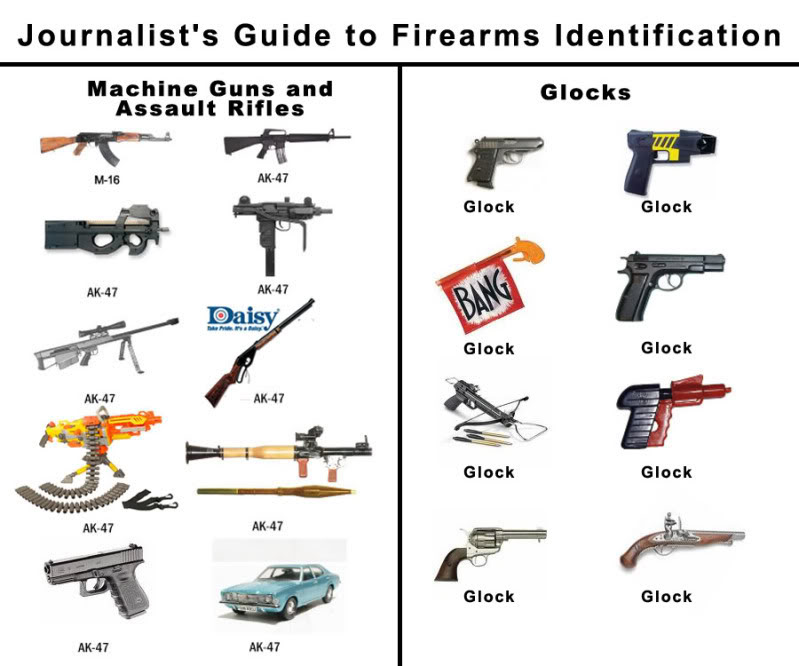
Journalists, Unqualified To Discuss Gun Control, Here’s Why


Citizens With Guns and Concealed Carry Statistics
-
Mass shootings rose between the 1960s and the 1990s, and dropped in the 2000s. Mass killings actually reached their peak in 1929. (According to Grant Duwe, criminologist with the MinnesotaDepartment of Corrections.)
-
“States that allow law-abiding citizens to carry concealed handguns enjoy a 60 percent decrease in multiple-victim public shootings and a 78 percent decrease in victims per attack.” John Lott, Jr. and Bill Landes, “More Guns, Less Crime.”
-
“With just one single exception, the attack on congresswoman Gabrielle Giffords in Tucson in 2011, every public shooting since at least 1950 in the U.S. in which more than three people have been killed has taken place where citizens are not allowed to carry guns.”– John Lott, Jr. Co-author with Bill Landes of “More Guns, Less Crime.”
-
“Until the Newtown horror, the three worst K–12 school shootings ever had taken place in either Britain or Germany.” [John Fund, NRO. “The Facts About Mass Shootings.”]
-
Total violent crime from 1973 to 2009 decreased 65%, or is about one-third as high. (Bureau of Justice Statistics)
-
The U.S. murder rate decreased 8.1% between 2008 and 2009, and has fallen every year since 2006. (Bureau of Justice Statistics, based on FBI data).
-
The United States ranks 24th in the world in terms of its murder rate. It also has the most highly armed civilian population.
-
“International evidence and comparisons have long been offered as proof of the mantra that more guns mean more deaths and that fewer guns, therefore, mean fewer deaths. There is a compound assertion that (a) guns are uniquely available in the United States compared with other modern developed nations, which is why (b) the United States has by far the highest murder rate. Though these assertions have been endlessly repeated, statement (b) is, in fact, false and statement (a) is substantially so.” (Kates & Mauser, Harvard Journal of Law & Public Policy, Vol. 30, No. 2)
-
“The political causation is that nations which have violence problems tend to adopt severe gun controls, but these do not reduce violence, which is determined by basic sociocultural and economic factors.” [Then why does Luxemburg have nine times the murder rate of Germany?] (Kates & Mauser,Harvard Journal of Law & Public Policy, Vol. 30, No. 2)
-
“The Middle Ages were a time of notoriously brutal and endemic warfare. They also experienced rates of ordinary murder almost double the highest recorded U.S. murder rate. But Middle Age homicide “cannot be explained in terms of the availability of firearms, which had not yet been invented.” (Kates & Mauser, Harvard Journal of Law & Public Policy, Vol. 30, No. 2)
-
The odds of being in a victim of a mass shooting are far less than that of being struck by lightning.
Share this:

History and Egypt
Here’s how you know a country has been around for a while. When BBC.com’s “Timeline” starts with “Settlement of Nile Valley.”
• For the next 9,000 years, it’s mostly downhill from there:
— 669 BC – Assyrians from Mesopotamia conquer and rule Egypt.
— 525 BC – Persian conquest.
— 332 BC – Alexander the Great conquers Egypt.
— 31 BC – Egypt comes under Roman rule.
— 642 AD – Arab conquest of Egypt.
— 1517 – Egypt absorbed into the Turkish Ottoman empire.
—1798 – Napoleon Bonaparte’s forces invade but are repelled by the British and the Turks in 1801.
— 1882 – British troops take control of Egypt.
— 1922 – Fuad I becomes King of Egypt and Egypt gains its independence.
— 1953 – [Military] Coup leader Muhammad Najib becomes president as Egypt is declared a republic.
— 1956 July – Gamal Abdul Nasser nationalizes the Suez Canal.
— 1956 October – Tripartite Invasion of Egypt by Britain, France and Israel due to the nationalization of the Suez Canal.
— 1967 June – Six-Day War in which Israel defeats forces of Egypt, Jordan and Syria. Israel takes control of Sinai, the Golan Heights, the Gaza Strip, East Jerusalem and the West Bank.
— 1973 October – Egypt and Syria go to war with Israel during Israel’s celebration of Yom Kippur to reclaim the land they lost in 1967.
— 1978 September – Camp David Accords for peace with Israel are signed.
— 2011 February – President Mubarak steps down and hands power to the army council.
• And, like that.
• Egypt’s major mistake was being located along the Nile (which flows north to the Mediterranean, but you knew that) and the Red Sea. If it weren’t for that no one would have ever bothered with it.
• Except, maybe for that whole Cleopatra-Julius Caesar-Marc Antony thing.
• More recently Egypt has been the focal point of the “Arab Spring” that began two years ago on December 18, 2010 in Tunisia. Since that time there has been unrest ranging from demonstrations, to riots, to revolutions to at least one civil war in (according to Wikipedia’s count):
Tunisia, Egypt, Libya, Yemen, Bahrain, Algeria, Iraq, Jordan, Kuwait Morocco, Sudan, Lebanon, Mauritania, Oman, Saudi Arabia, Djibouti, Western Sahara and, of course Syria.
• We know from recent events how stable Libya is and, according to the Washington Post, some 64,700 Syrians have died since the demonstrations began in November 2011.
Share this:

Yamamoto’s Master Plan for Pearl Harbor Attack
Yamamoto was educated in the US and knew us well. He also knew that we were a sleeping industrial giant. He was well aware of the 2nd Amendment and how much we believed in it (We still do for the Islamic Jihad Terrorists). He also knew he couldn’t attack the US, but a surprise attack would and could cripple us for a while until the industrial might of a sleeping giant was woken up. Luck was not on his side that day as the US Carriers were out at sea and the Battleships (an aging, but vital weapon) was all that was harbored in Pearl Harbor.
Here is the take by the Pacific War.com

JAPANESE PREPARATIONS FOR THE ATTACK ON PEARL HARBOR


Admiral Yamamoto plans the Destruction of the United States Pacific Fleet

These aircraft are superb reproductions of the Nakajima Type 97 carrier torpedo bombers (Allied code-name “Kate”) that attacked the United States Pacific Fleet at Pearl Harbor. They were used in the gripping and historically accurate 20th Century Fox film Tora, Tora, Tora! (1970).
In conformity with this traditional approach to naval warfare, the Japanese Naval General Staff intended to limit naval operations in support of Japan’s military thrust into South-East Asia to offensive actions against local American, British and Dutch naval forces defending their country’s colonial possessions in South-East Asia. To the conservative admirals of the Naval General Staff, a direct confrontation in the central Pacific Ocean between their navy and the United States Navy was unthinkable.
In early 1941, Vice Admiral Isoroku Yamamoto was appointed Commander-in-Chief of Japan’s Combined Fleet, and he immediately took issue with the cautious policy of the Japanese Naval General Staff. Yamamoto did not believe that the United States Pacific Fleet would remain idle at Pearl Harbor while Japan attacked and seized America’s Philippines, and British and Dutch colonial possessions in South-East Asia. He believed that Japan must cripple the United States Pacific Fleet at the same time as it launched its attacks on countries of South-East Asia.
With this firm conviction, Admiral Yamamoto began to consider a surprise carrier-launched air attack on the United States Pacific Fleet at its Pearl Harbor base timed to coincide with Japan’s military aggression in South-East Asia. Yamamoto instructed Rear Admiral Takijiro Onishi, Chief of Staff of the 11th Air Fleet, to assess the feasibility of an attack on Pearl Harbor by carrier-launched aircraft. Onishi enlisted the assistance of Commander Minoru Genda, a brilliant staff officer and tactician serving with Japan’s 1st Air Fleet. Genda studied the problem and came to the conclusion that an attack on Pearl Harbor could succeed if (a) the attack took the Americans completely by surprise, (b) the attack occurred early on a Sunday morning when American defence preparedness would be at a low level, (c) all six of Japan’s best aircraft carriers were used, and (d) highly skilled aircrews were used in the attack. To ensure complete surprise, Genda’s plan precluded alerting the Americans to their danger by a prior declaration of war.
Admiral Yamamoto’s plan for a surprise peacetime attack on the United States Pacific Fleet at Hawaii would involve a strike force which included Japan’s six largest and most powerful aircraft carriers. His task was made much easier by President Roosevelt’s decision to relocate the United States Pacific Fleet from California to Hawaii. As Yamamoto saw it, the destruction of the American Pacific Fleet would give Japan time to seize the Philippines, Malaya, British Borneo, Burma and the Netherlands East Indies (now Indonesia), and gain access to the oil, minerals, rubber and other resources that Japan needed to sustain its aggressive war machine. He was hopeful that, with its Pacific Fleet destroyed or crippled, the Americans would be willing to accept a peace settlement that allowed Japan to keep its new conquests in South-East Asia.
The Japanese Naval General Staff initially rejected Admiral Yamamoto’s plan for an attack on Pearl Harbor as being too great a gamble. They doubted that surprise could be achieved when the strike force would be at sea for two weeks before the attack. Japan had eleven aircraft carriers, and the admirals felt that Yamamoto’s plan could put at risk their six best carriers. They also felt that diverting Japan’s six most powerful aircraft carriers to Hawaii would leave the southern attacks on the Philippines and British Malaya dangerously unprotected. In the end, Yamamoto only overcame their opposition by threatening to resign.
Although the admirals of the Naval General Staff were reluctantly persuaded by Yamamoto to abandon the policy of defensive naval war in favour of attack, the years of night warfare training and the highly accurate, long range torpedoes associated with the defensive policy would give the Japanese Imperial Navy a significant edge over Allied navies in night actions during the Pacific War.
Training for the Pearl Harbor Attack
Early in 1941, despite the fact that the Chief of the Naval General Staff, Admiral Osami Nagano, had not yet approved a surprise attack on Pearl Harbor, Admiral Yamamoto directed that intensive planning and training for such an attack was to be undertaken.
Japanese naval aircrews had already honed their war skills flying sorties against the poorly equipped and trained Chinese air force and army. However, Pearl Harbor offered special challenges to an enemy force proposing to use air-launched torpedoes. The harbor was comparatively shallow and a large area in the centre of the harbor was occupied by Ford Island. The American battleships were moored on the eastern side of Ford Island. The water area between the battleships and the eastern shore of the harbor was narrow. Japanese torpedoes would have to be redesigned for use in shallow harbor waters, and torpedo aircrews would have to learn to drop their torpedoes with great precision so that they would land in the narrow stretch of water between the eastern shore of the harbor and the battleships. The Japanese aircrews went about this training with great enthusiasm and dedication. By November 1941, they were ready for the attack.
On 3 November 1941, the Chief of the Japanese Naval General Staff finally gave his approval to Admiral Yamamoto’s plan to attack the United States Pacific Fleet at its Pearl Harbor base.
The Japanese Carrier Strike Force departs for Hawaii
To distract the American government while it secretly positioned a powerful aircraft carrier strike force for the “sneak attack” on Pearl Harbor, the Japanese government had ordered its envoys in Washington to engage the American government in intensive diplomatic negotiations.AdmiralYamamoto’s aircraft carrier strike force, under the command of Vice-Admiral Chuichi Nagumo, left Japan on 26 November 1941.

The fast and powerful aircraft carrier Akagi was regarded as the “Queen” of the Japanese Imperial Navy. It is shown here in 1941. It was the flagship of Vice Admiral Chuichi Nagumo for the attack on Pearl Harbor.
Preserving strict radio silence, Nagumo’s carriers steered well clear of normal shipping lanes and headed for a stand-by point about 1,000 miles (1,600km) north of Hawaii. The carrier strike force comprised Japan’s six largest fleet aircraft carriers, Akagi, Kaga, Soryu, Hiryu, Shokaku, and Zuikaku. Each of these aircraft carriers would later play a role in the major sea battles closely related to Australia’s survival in 1942. The last two would take part in the crucial Battle of the Coral Sea. The first four would take part in the pivotal Battle of Midway. The carriers were supported by battleships, cruisers, destroyers and submarines.
Japan’s Prime Minister Tojo threatens Britain and America with War
In the last week of November 1941, at a time when Admiral Nagumo’s aircraft carriers were sailing towards Pearl Harbor with hostile intent, Japan’s militarist Prime Minister, General Hideki Tojo, issued a blunt warning to Britain and the United States that Japan would “purge East Asia of US -British power with a vengeance”. General Tojo’s threat appeared on the front page of the New York Herald Tribune on Sunday, 30 November 1941, exactly seven days before the Japanese attack on America’s Pacific Fleet at Pearl Harbor.
Despite the clear threat of war contained in Tojo’s warning, and despite having no knowledge of the whereabouts of Japan’s six largest fleet aircraft carriers, no steps were taken at Hawaii to bring the United States Pacific Fleet or the United States Army Air Corps to a state of war alert.
The Americans had broken the Japanese diplomatic code in September 1941, and were able to read coded messages from Tokyo to Japan’s embassies in Berlin and Washington. The United States government knew that Japan had warned its diplomats in Washington that certain unspecified events would occur after 29 November 1941. However, the Americans believed that the warning fore-shadowed possible aggressive moves by Japan against the Philippines or British or Dutch colonial possessions in South-East Asia. Although they did not believe that an attack on Pearl Harbor was planned by the Japanese, the American commanders in Hawaii took steps to guard against possible hostile action by Japanese submarines and sabotage to military aircraft or installations on the main island of Oahu. To guard against sabotage, Major General Short lined up his aircraft on the runways as if for an inspection. They would prove easy targets for Japanese aircraft when the attack came.
The Order to attack the United States Pacific Fleet
When the Japanese aircraft carrier strike force reached its stand-by point north of Hawaii, it waited to receive either final confirmation to proceed with the attack on Pearl Harbor or an order to return to Japan. On 1 December 1941, the Japanese government reached a firm decision to make war on the United States. On 2 December 1941, a radio signal containing the code words “climb Mount Niitaka” was received by Vice Admiral Nagumo aboard his flagship Akagi. The code message was an order to attack Pearl Harbor on Sunday, 7 December 1941. The Japanese were well aware that most Americans at this time observed Sunday as a holy day, and they had carefully timed the surprise attack to occur when many Americans in Hawaii would be preparing for or attending church services.
Surprise was considered vital to the success of the attack on the American fleet. There would be no prior declaration of war to alert the Americans to their danger.
Admiral Nagumo’s carrier strike force refuelled at sea on 5 and 6 December. Its approach to Hawaii was screened from American reconnaissance aircraft by low, dense cloud cover.
Japanese intelligence informed Nagumo on 6 December that the American battleships and a large number of smaller warships were in Pearl Harbor. However, Nagumo’s primary targets were the American aircraft carriers, and they were all absent from the harbor. The Japanese believed that the American aircraft carriers Lexington, Saratoga, Enterprise and Yorktown were all based at Pearl Harbor at this time. Their intelligence was faulty. Having undergone routine dry-docking, Saratoga was at San Diego on the American west coast. Yorktown was stationed with the newly commissioned Hornet in the Atlantic at this time. Only Lexington and Enterprise were actually based at Pearl Harbor on 6 December 1941, and fortunately for the United States and Australia, both carriers were at sea when the Japanese attack took place. Despite this setback, Nagumo was under orders to proceed with the attack.
On 6 December 1941, President Franklin D. Roosevelt intervened personally in the cause of peace by sending a direct appeal to the Emperor of Japan. It fell on deaf ears in Tokyo. The Japanese government was determined on war and had no intention of recalling the Japanese carrier force.
 Review of 20th Century Fox Pearl Harbor attack film “Tora! Tora! Tora! (1970)
Share this:

World’s Most Emotional Countries and Why
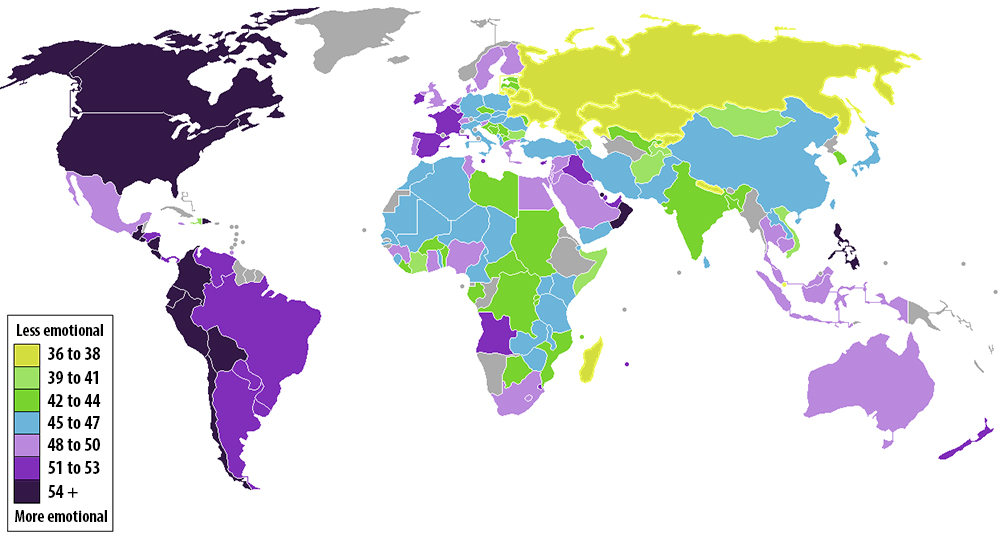 This is not my data, rather a Bloomberg study. What I can’t figure out is how the US is so emotional except for the political discord recently (the article below says they are happy). I much more expected it from the Latin countries.
According to Bloomberg, the source of this map, here are the real reasons:
Singapore is the least emotional country in the world. ”Singaporeans recognize they have a problem,” Bloomberg Businessweek writes of the country’s “emotional deficit,” citing a culture in which schools “discourage students from thinking of themselves as individuals.” They also point to low work satisfaction, competitiveness, and the urban experience: “Staying emotionally neutral could be a way of coping with the stress of urban life in a place where 82 percent of the population lives in government-built housing.”
The Philippines is the world’s most emotional country. It’s not even close; the heavily Catholic, Southeast Asian nation, a former colony of Spain and the U.S., scores well above second-ranked El Salvador.
Post-Soviet countries are consistently among the most stoic. Other than Singapore (and, for some reason, Madagascar and Nepal), the least emotional countries in the world are all former members of the Soviet Union. They are also the greatest consumers of cigarettes and alcohol. This could be what you call and chicken-or-egg problem: if the two trends are related, which one came first? Europe appears almost like a gradient here, with emotions increasing as you move West. (their emotions are sedated)
People in the Americas are just exuberant. Every nation on the North and South American continents ranked highly on the survey. Americans and Canadians are both among the 15 most emotional countries in the world, as well as ten Latin countries. The only non-American countries in the top 15, other than the Philippines, are the Arab nations of Oman and Bahrain, both of which rank very highly. (they have it good there)
English- and Spanish-speaking societies tend to be highly emotional and happy. Though the Anglophone nations of the world retain deep cultural links, it’s not clear if Spain’s emotional depth has anything to do with Latin America’s. According to Gallup, “Latin America leads the world when it comes to positive emotions, with Panama, Paraguay, and Venezuela at the top of that list.” Yes, even Hugo Chavez’s Venezuela is apparently filled with happy people. (they have to say that or be imprisoned)
Africans are generally stoic, with some significant exceptions. The continent is among the world’s least emotional, though there is wide variation, which serves as a non-definitive but interesting reminder of Africa’s cultural diversity. Each could be its own captivating case study. It’s possible that South Africa’s high rating has to do with its cultural ties to Western Europe, for example, and Nigeria’s may have to do with the recent protest movement in the south and sectarian violence in the north. (life is tough for them, they cope)
The Middle East is not happy. Gallup notes, “Negative emotions are highest in the Middle East and North Africa, with Iraq, Bahrain, and the Palestinian Territories leading the world in negative daily experiences.” Still, that doesn’t quite fully explain the high emotions in the Levant and on the Arabian peninsula, compared to the lower emotions in Libya, Algeria, and Morocco. Perhaps this hints at how people in these countries are being affected by the still-ongoing political turmoil of the Arab Spring. (they are rife with terrorists who brim with hate)
What am I missing? Every color-coded national boundary here tells a story. Why is Haiti so bereft of emotion compared to its neighbors? Why is Angola so heavy with feeling? Leave your thoughts in the comments or reach me on social media. (Haiti was founded on voodoo so they believe in the devil).
Share this:

Should You Pay Off Your Mortgage?
This goes with my series of “How and average Joe can become a Millionaire”.
I am not the author, but this is one of the most important financial decisions you’ll make (the other is tithing) The whole article can be found here:
One of my good friends, “Judge Rob,” is a local, elected judge who also owns a small family business. Judge Rob paraphrased Warren Buffett when we were discussing mortgages over a recent breakfast, saying, “If I knew where I was going to live for the next decade or so, I would buy a house with a long-term mortgage.” The idea is that a mortgage is a good hedge against inflation because you pay it off with much cheaper dollars down the road.
Today, many pundits point to low interest rates and encourage people to borrow as much as they can while interest rates are low. While they do have a good point, deciding when to pay off my own mortgage caused a great deal of conflict between the logical and emotional parts of my brain.
In the early days of black-and-white television, much of the programming was old, silent movies. Who can forget the little old widow, confronted by the evil, rich banker, who licked his chops at the opportunity to throw her out as her mortgage payment came due? As the deadline got closer, the piano would bang louder and faster, and somehow Widow Nell would make her payment in the nick of time. Was I programmed by my generation’s version of Sesame Street?
There’s Something to Being “Old School”
I spent a good bit of my breakfast with Judge Rob in “Yes, but!” mode. Here’s why.
When I was contemplating paying off my mortgage, I spoke with a CPA who also happened to be a financial advisor recommended by a good friend. I explained that I was self-employed, so my income fluctuated, and my mortgage was my largest monthly bill. I suggested that there could be some emotional benefit to paying it off. Less stress perhaps?
He insisted that I could invest and out-earn the cost of my first mortgage. He pooh-poohed the idea of paying it off to calm my nerves, and kept repeating that I could easily invest my money and earn more after taxes than the cost of the first mortgage.
When I asked if his mortgage was paid off, he responded with, “Oh, hell yes!” I was flabbergasted. How could he advise me to do one thing when he’d done the exact opposite? He explained that his wife was from Germany – the old school where you pay your bills, don’t borrow money, and stay out of debt.
Then I asked him, “Once you paid off your mortgage, did you sleep better at night?” He pondered a bit and said, “Yeah, I guess I did. I no longer worried about it. No matter how bad things got, we would still have a roof over our heads.”
When I asked Vedran Vuk, our senior research analyst, about when to pay off a first mortgage, he made some excellent points. First, you should no longer view your house as an investment that’s going to rapidly appreciate as it did in the past. A house is a home, and you should look at it that way. Second, right now a mortgage can make sense from an investment perspective. If you can borrow money at 3.5%, invest it, and earn a guaranteed higher return on it, you’ll come out ahead.
The real question becomes: where can you find a guaranteed greater return, even with the low mortgage rates available today? The government is committed to keeping interest rates artificially low for the foreseeable future. Yields on CDs and high-quality bonds are pathetic.
I just checked my brokerage account, and the longest CD they have available is a five-year CD paying 1.15%. A 30-year Treasury bond will pay 2.8%. Neither holds any appeal for me, particularly if I were investing with borrowed money.
If you’ve found an investment that’s a lead-pipe cinch – one that’s absolutely, positively going to pay off – and a low mortgage rate, you may want to roll the dice. However, I want to add one more note of caution.
The upcoming issue of Money Forever‘s premium subscription, which we’re releasing on December 18, takes an in-depth look at reverse mortgages, one of the most controversial ways to help fund your retirement. Our team will explain reverse mortgages in easily understood terms, highlight pitfalls to avoid, and explain how a reverse mortgage is a good way for some (but not all) folks to fund their retirement and maintain their lifestyle.
Before obtaining a reverse mortgage you must go through HUD counseling. While researching our upcoming report, I came across a study of over 20,000 people who had been through HUD counseling between September 2010 and November 2010. A few statistics really jumped off the page!
In 2000, the average age of people receiving reverse mortgages was 73 years old. By November 2010, the average age had dropped to 71.5, and it’s continuing to decline. In other words, retirees are tapping into their home equity at an increasingly younger age, many because they have no other choice.
It was also interesting to learn why these folks wanted a reverse mortgage. In the 70-and-older group, 38% still had mortgage debt. Seventy-one percent owed 25% or more on the current value of their home, and 33% had a mortgage in excess of 50% of the value of their home. Many wanted a reverse mortgage because they could not service their existing debt. A reverse mortgage is based on the net equity in your home. If their homes were paid for, meaning no huge house payment, perhaps they could have put off the reverse mortgage for a few more years. The older the applicant, the higher monthly payment they receive.
I wonder how many of these folks lost money betting on their lead-pipe cinch investment because they had been nudged along by their CPA.
My point is simple. For most baby boomers and retirees, their home is their largest asset. You don’t want to live like the little old widow in a black-and-white film, worrying about getting thrown out of your home, particularly if you’re no longer working.
Nevertheless, if you had a mortgage with a 3.5% interest rate and we were still living in a world where a top-quality bond or CD would pay you 5% or more, it could make sense to take advantage of it. But that’s not the world of today.
Ideally, you would pay off your mortgage and then use the money you’d been setting aside for payments to build a nice portfolio. For many folks, home equity is like a security blanket – and a potential source of income for when they may really need it.
The Judge’s Word Isn’t Always Law
As I left our breakfast meeting, I shared a few parting comments with Judge Rob. The mortgage conundrum has both financial and emotional factors. Paying off your mortgage is a milestone; it really does change your life. I certainly sleep better, and my blood pressure probably dropped ten points. It was the point when my wife and I actually started accumulating true wealth.
Once I paid off my mortgage, I never looked back.
Share this:

Economy Signs in the USA and EU that WE ARE IN DECLINE, PROTECT YOURSELVES
Two disturbing articles came my way. I watch the economy and look for trends. I found two that are similar because of political policies, yet would be so easy to fix if the respective governments would stop spending, handing out money to those who don’t deserve it, stop handing to themselves and stop the regulations.
We are headed into a depression and it appears that is what the governments want. History shows they can control a distressed population more easily than a productive, self-reliant successful one…so the preponderance of evidence shows it is intentional.
You’ve been warned, get out of debt, get a strong cash position, stock up on supplies (they are much cheaper now before inflation) and do everything you can to be self reliant rather than convenient. This is against all the pundits who want you to buy into this is just a phase, just like right about 1926.
Here they are.
THE USA
Link to the full article here:
#1 According to the World Bank, U.S. GDP accounted for 31.8 percent of all global economic activity in 2001. That number dropped to 21.6 percent in 2011. That is not just a decline – that is a freefall. Just check out the chart in this article.
#2 According to The Economist, the United States was the best place in the world to be born into back in 1988. Today, the United States is only tied for 16th place.
#3 The United States has fallen in the global economic competitiveness rankings compiled by the World Economic Forum for four years in a row.
#4 According to the Wall Street Journal, of the 40 biggest publicly traded corporate spenders, half of them plan to reduce capital expenditures in coming months.
#5 More than three times as many new homes were sold in the United States in 2005 as will be sold in 2012.
#6 America once had the greatest manufacturing cities on the face of the earth. Now many of our formerly great manufacturing cities have degenerated into festering hellholes. For example, the city of Detroit is on the verge of financial collapse, and one state lawmaker is now saying that “dissolving Detroit” should be looked at as an option.
#7 In 2007, the unemployment rate for the 20 to 29 age bracket was about 6.5 percent. Today, the unemployment rate for that same age group is about 13 percent.
#8 Back in 1950, more than 80 percent of all men in the United States had jobs. Today, less than 65 percent of all men in the United States have jobs.
#9 If you can believe it, approximately one out of every four American workers makes 10 dollars an hour or less.
#10 Sadly, 60 percent of the jobs lost during the last recession were mid-wage jobs, but 58 percent of the jobs created since then have been low wage jobs.
#11 Median household income in America has fallen for four consecutive years. Overall, it has declined by over $4000 during that time span.
#12 The U.S. trade deficit with China during 2011 was 28 times larger than it was back in 1990.
#13 Incredibly, more than 56,000 manufacturing facilities in the United States have been shut down since 2001. During 2010, manufacturing facilities were shutting down at the rate of 23 per day. How can anyone say that “things are getting better” when our economic infrastructure is being absolutely gutted?
#14 Back in early 2005, the average price of a gallon of gasoline was less than 2 dollars a gallon. During 2012, the average price of a gallon of gasoline has been $3.63.
#15 In 1999, 64.1 percent of all Americans were covered by employment-based health insurance. Today, only 55.1 percent are covered by employment-based health insurance.
#16 As I have written about previously, 61 percent of all Americans were “middle income” back in 1971 according to the Pew Research Center. Today, only 51 percent of all Americans are “middle income”.
#17 There are now 20.2 million Americans that spend more than half of their incomes on housing. That represents a 46 percent increase from 2001.
#18 According to the U.S. Census Bureau, the poverty rate for children living in the United States is about 22 percent.
#19 Back in 1983, the bottom 95 percent of all income earners in the United States had 62 cents of debt for every dollar that they earned. By 2007, that figure had soared to $1.48.
#20 Total home mortgage debt in the United States is now about 5 times larger than it was just 20 years ago.
#21 Total credit card debt in the United States is now more than 8 times larger than it was just 30 years ago.
#22 The value of the U.S. dollar has declined by more than 96 percent since the Federal Reserve was first created.
#23 According to one survey, 29 percent of all Americans in the 25 to 34 year old age bracket are still living with their parents.
#24 Back in 1950, 78 percent of all households in the United States contained a married couple. Today, that number has declined to 48 percent.
#25 According to the U.S. Census Bureau, 49 percent of all Americans live in a home that receives direct monetary benefits from the federal government. Back in 1983, less than a third of all Americans lived in a home that received direct monetary benefits from the federal government.
#26 In 1980, government transfer payments accounted for just 11.7 percent of all income. Today, government transfer payments account for more than 18 percent of all income.
#27 In November 2008, 30.8 million Americans were on food stamps. Today, 47.1 million Americans are on food stamps.
#28 Right now, one out of every four American children is on food stamps.
#29 As I wrote about the other day, according to one calculation the number of Americans on food stamps now exceeds the combined populations of “Alaska, Arkansas, Connecticut, Delaware, District of Columbia, Hawaii, Idaho, Iowa, Kansas, Maine, Mississippi, Montana, Nebraska, Nevada, New Hampshire, New Mexico, North Dakota, Oklahoma, Oregon, Rhode Island, South Dakota, Utah, Vermont, West Virginia, and Wyoming.”
#30 Back in 1965, only one out of every 50 Americans was on Medicaid. Today, one out of every 6 Americans is on Medicaid, and things are about to get a whole lot worse. It is being projected that Obamacare will add 16 million more Americans to the Medicaid rolls.
#31 In 2001, the U.S. national debt was less than 6 trillion dollars. Today, it is over 16 trillion dollars and it is increasing by more than 100 million dollars every single hour.
#32 The U.S. national debt is now more than 23 times larger than it was when Jimmy Carter became president.
#33 According to a PBS report from earlier this year, U.S. households that make $13,000 or less per year spend 9 percent of their incomes on lottery tickets. Could that possibly be accurate? Are people really that foolish?
#34 As the U.S. economy has declined, the American people have been downing more antidepressants and other prescription drugs than ever before. In fact, the American people spent 60 billion dollars more on prescription drugs in 2010 than they did in 2005.
THE EUROPEAN UNION
Link to the full article here:
The following are 11 facts that show that Europe is heading into an economic depression…
1. The economies of 17 out of the 27 countries in the EU have contracted for at least two consecutive quarters.
2. Unemployment in the eurozone has hit a brand new all-time record high of 11.7 percent.
3. The unemployment rate in Portugal is now up to 16.3 percent. A year ago it was just 13.7 percent.
4. The unemployment rate in Greece is now up to 25.4 percent. A year ago it was just 18.4 percent.
5. The unemployment rate in Spain has hit a brand new all-time record high of 26.2 percent. How much higher can it possibly go? This is already higher than the unemployment rate in the United States ever reached during the Great Depression of the 1930s.
6. Youth unemployment levels in both Greece and Spain are rapidly approaching the 60 percent level.
7. Earlier this month, Moody’s stripped France of its AAA credit rating, and wealthy individuals are leaving France in droves as the socialists implement plans to raise taxes to very high levels on the rich.
8. Industrial production is collapsing all over Europe. Just check out these numbers…
You don’t have to be an economic genius to understand that the perpetual uncertainty over the Eurozone’s future has led to a widespread freeze on industrial investment and development. Industrial production is collapsing at an accelerating rate, falling 7% year-on-year in Spain and Greece, 4.8% in Italy, and 2.1% in France.
9. There are even trouble signs in the “stable” economies in Europe. In Germany, factory orders in September were down 3.3 percent from the month before, and retail sales in October declined 2.8 percent from the previous month.
10. The debt of the Greek government is now projected to hit 189 percent of GDP by the end of this year.
11. The Greek economy has shrunk by more than 7 percent this year, and it is being projected that the Greek economy will contract by another 4.5 percent in 2013.
But sometimes you can’t really get a feel for how bad things really are over there just from the raw economic numbers.
Many people that are living through these depression-like conditions are totally giving in to despair. Just check out the following example from an RT article from earlier this year…
A 61-year-old Greek pensioner has hung himself from a tree in a public park after succumbing to the pressure of crushing debt. A note in his pocket indicates he is merely the latest in a rash of economic crisis-induced suicides.
The pensioner’s lifeless body was found dangling by an attendant in a public park not far from his home in the suburb of Nikaia, Athens. The attendant also found a suicide note in the man’s pocket, The Athens news reports.
The man, identifying himself as Alexandros, said he was a man of few vices who “worked all day.” However, he blamed himself from committing one “horrendous crime”: becoming a professional at the age of 40 and plunging himself into debt. He referred to himself as a 61-year-old idiot who had to pay, hoping his grandchildren would not be born in Greece, as the country’s prospects were so bleak.
Share this:

Benghazi Issues and Facts That Are Being Put Together Like a Jigsaw Puzzle
Back in the 70’s, we had Watergate. Some people broke into an office of the opposing party and it was scandalous. People went to jail, a president resigned and we had morals.
Benghazi has happened and 4 people died despite prior attacks and cries for more protection before and during the attacks. It will probably be swept under the rug except for the sex scandal. Although people may go to jail it is unlikely. The president will be protected by the biased media and this will slide off of him like Teflon.
The attorney general who appears to be complicit in this and other scandals will also likely be untouched. The Secretary of State to whom the embassy reported to will also escape justice as she has in the other times she has broken the law (Whitewater, travelgate……)
For now, here is a collection of where we stand. Hopefully history will document the injustice that was done.
Don’t ever use Gmail if you want privacy
Patraeus could be prosecuted for Adultery, he might sing like a bird if offered a deal.
Hillary was informed about the Benghazi debacle on 8/16
To no one’s surprise, Eric Holder knew about Benghazi reports for months
Classified documents found on Broadwell’s computer
FBI suppressed Beghazi scandal to protect Obama 10/10/12
The veteran agent related to me that FBI agents assigned to the case were outraged by what were they were told by senior officials: The FBI was going to hold in limbo their findings until after the election.
“The decision was made to delay the resignation apparently to avoid potential embarrassment to the president before the election,” an FBI source told me. “To leave him in such a sensitive position where he was vulnerable to potential blackmail for months compromised our security and is inexcusable.”
Petraeus might have leaked secret prison information to Paula Broadwell
On Saturday, The New York Times reported that House Majority Leader Eric Cantor spoke to an FBI whistle-blower two weeks ago who accused Petraeus of not only having an extramarital affair but potentially jeopardizing the security of classified information.
During the same university speech, Braodwell may have also divulged information that Petraeus knew “within 24 hours” of CIA annex’s request for reinforcements, reported Israel National News.
“The challenging thing for Gen. Petraeus,”she stated, “is that in his new position, he’s not allowed to communicate with the press. So he’s known all of this – they had correspondence with the CIA station chief in Libya, within 24 hours they kind of knew what was happening.”
Earlier she had said the military could have sent reinforcements.
“They were requesting the – it’s called the C-in-C’s In Extremis Force – a group of Delta Force operators, our very, most talented guys we have in the military. They could have come and reinforced the consulate and the CIA annex.”
Patraeus successor Allen caught up in scandal
Guys, keep your zipper shut!
Senator Feinstein wants to get to the bottom of this.
“It’s been like peeling an onion,” she said.
Petraeus’ resignation follows an FBI investigation that, as Mitchell said, “morphed into an investigation about the possibility of national security secrets” as Petraeus’ alleged extramarital affair with biographer Paula Broadwell was revealed.
According to NBC News:
Officials tell NBC News that the affair was revealed because Broadwell sent anonymous, threatening emails to Jill Kelley, 37, described as a close friend of the Petraeus family. Kelley, who lives in the Tampa, Fla. area, was a volunteer social liaison to MacDill Air Force Base in Tampa.
Investigating who sent the emails to Kelley, the FBI discovered the connection between Petraeus and Broadwell, officials say.
As Mitchell summarized NBC News’ reporting on the relationship between Broadwell, Kelley, and Petraeus, Feinstein interrupted: ”Well, this is all news to me. We were not told this. This is the first time I’ve learned of this. This makes me think, ‘Well, how many other things are there, too?’”
NBC News also reports:
According to reporting by NBC’s chief justice correspondent Pete Williams, a senior law enforcement official said a call to a congressional staffer came from an agent who was initially involved in the investigation but who was later removed from the case because he knew an associate of one of the people being investigated. The agent knew someone on the Hill and called that person, a Republican staffer, according to the official. But that phone call had no effect on either the course of the investigation, the involvement of Mueller — who was following it closely long before Cantor called him — or the decision to notify Clapper, the official says.
Share this:

November 10, 2012; The 237th Anniversary of the Marines
First to Fight, the Marines are one of the 5 Military Branches that protect and serve our country. They have protected our freedom and the countless lives of many around the world. I am a big supporter of the military and celebrate each branch for what they offer.
BACKGROUND
Marine Corps History
 On November 10, 1775, the Continental Congress passed a resolution stating that “two battalions of Marines be raised” for service as landing forces with the fleet. This established the Continental Marines and marked the birth of the United States Marine Corps. Serving on land and at sea, early Marines distinguished themselves in a number of important operations, including their first amphibious raid on foreign soil in the Bahamas in March 1776, under the command of the Corps’ first commandant, Capt. Samuel Nicholas. The 1783 Treaty of Paris ended the Revolutionary War and as the last of the Navy’s ships were sold, the Continental Navy and Marines disbanded.
Following the formal re-establishment of the Marine Corps on July 11, 1798, Marines fought in conflicts with France, landed in Santo Domingo and conducted operations against the Barbary pirates along the “Shores of Tripoli.”
Marines participated in numerous operations during the War of 1812, including the defense of Washington at Bladensburg, Md. They also fought alongside Andrew Jackson in the defeat of the British at New Orleans. Following the War of 1812, Marines protected American interests around the world in areas like the Caribbean, the Falkland Islands, Sumatra and off the coast of West Africa, and close to home in operations against the Seminole Indians in Florida.
During the Mexican War, Marines seized enemy seaports on both the Gulf and Pacific coasts. While landing parties of Marines and Sailors were seizing enemy ports, a battalion of Marines joined General Winfield Scott’s army at Pueblo and marched and fought all the way to the “Halls of Montezuma,” Mexico City.
Although most Marine Corps service during the Civil War was with the Navy, a battalion fought at Bull Run, and other units saw action with blockading squadrons at Cape Hatteras, New Orleans, Charleston and Fort Fisher. During the last third of the 19th century, Marines made numerous landings around the world, especially in the orient and the Caribbean.
Following the Spanish-American War in 1898, Marines fought during the Philippine Insurrection, the Boxer Rebellion in China, in Nicaragua, Panama, The Dominican Republic, Cuba, Mexico and Haiti.
In World War I, Marines distinguished themselves on the battlefields of France, as the 4th Marine Brigade earned the title of “Devil Dogs” for actions at Belleau Wood, Soissons, St. Michiel, Blanc Mont and the final Muesse-Argonne offensive. Marine aviation, which began in 1912, was used for the first time in a close-air support role during WWI. More than 309,000 Marines served in France and more than a third were killed or wounded in six months of intense fighting.
During the two decades before World War II, the Marine Corps began to more completely develop its doctrine and organization for amphibious warfare. The success of this effort was proven at Guadalcanal, Bougainville, Tarawa, New Britain, Kwajalein, Eniwetok, Saipan, Guam, Tinian, Peleliu, Iwo Jima and Okinawa. By the war’s end in 1945, the Corps had grown to include six divisions, five air wings and supporting troops, about 485,000 Marines. Nearly 87,000 Marines were killed or wounded during WWII and 82 earned the Medal of Honor.
As the Marine Corps attempted to modify the Fleet Marine Force (FMF) for operations in the nuclear age, the Corps began a decade long struggle to save the FMF and, in affect, its own existence. The Marine Corps had peaked in strength in 1945 at nearly half a million men in six divisions and five aircraft wings. The postwar Corps shrank to fit federal budgets rather than adjust realistically to fit the contingency needs of the Cold War era. Available manpower fell to 83,000 men in 1948 and dropped to just over 74,000 by the spring of 1950. About 50,000 men were assigned to the operating forces, but the FMF had only about 30,000 men in the two skeltal divisions and aircraft wings. Fewer than 12,000 Marines comprised FMFPac which included the 1st Division at Camp Pendleton and the 1st Marine Aircraft Wing (MAW) at El Toro, California. On the East Coast, the 2d Division at Camp Lejeune and the 2d MAW at Cherry Point, making up FMFLant, numbered just under 16,000 Marines. At the outbreak of the Korean War, no Marine unit of any size was based or deployed in the Far East.
The Corps’ supporting establishment was so small and its tasks for maintaining Marine Corps bases so extensive that many FMF troops spent more time housekeeping than training. The Marine Corps share of the federal budget was simply not enough to buy adequate manpower, training, or new equipment. The main threat to the nation was seen in inflation and unbalanced budgets rather than in the Soviet armed forces. On the eve of the Korean War, the FMF seemed doomed to fall to six battalion landing teams and twelve squadrons in 1950.
While Marine units were taking part in the post-war occupation of Japan and North China, studies at Quantico, Va., concentrated on attaining a “vertical envelopment” capability for the Corps through the use of helicopters. Landing at Inchon, Korea, in September 1950, Marines proved that the doctrine of amphibious assault was still viable and necessary. After the recapture of Seoul, the Marines advanced to the Chosin Reservoir only to see the Chinese Communists enter the war. In March, 1955, after five years of hard fighting, the last Marine ground forces were withdrawn. More than 25,000 Marines were killed or wounded during the Korean War.
The realities of the Korean War brought major changes in the basing and deployment of Marine Corps forces. The Corps strength ballooned to 192,000 men in June 1951, to 232,000 a year later and nearly 250,000 by June 1953. More than half the troops actually served in the operating forces, and the 1st Marine Division and 1st MAW, operationally employed in Korea, were kept up to strength. In the meantime, the 2d Marine Division and 2d MAW reached full strength for their European contingencies. In June 1951 Headquarters activated the 3d Marine Brigade, built around the 3d Marines at Camp Pendleton. In 1952 the brigade expanded to become the 3d Marine Division, and the same year the 3d MAW formed and occupied a new base in Miami. In another important reorganization, Headquarters in 1951 formed an organization known as Force Troops in order to provide the heavy artillery and other combat support and combat service support units necessary to sustain a Marine division in a land war.
The three-division/three-wing force structure decreed by the June 1952 passage of the Douglas-Mansfield Act, gave legislative support to the stated roles and missions of the Corps. The defense assumptions and programs of the Eisenhower Administration, however, left the Marine Corps role, and the corresponding basing and deployment strategy, less clearly defined. The emphasis on strategic forces over conventional forces, coupled with domestic economic implications of high defense costs and unbalanced federal budgets, challenged Marine Corps leaders of this period.
During the years 1953 to 1955, significant changes in the basing and deployment of Marine forces were realized. The 3d Marine Division deployed from Camp Pendleton to the Far East in the summer of 1953. Based in Japan, the Division followed regimental landings in Japan and Okinawa with a full-dress division landing exercise on Iwo Jima in March 1954. Significantly, the division began redeploying from Japan to Okinawa in 1955 and by February 1956 the Headquarters of the 3d Marine Division was moved to Okinawa where its remains today. Teamed with the 3d Division, the bulk of the 1st Marine Aircraft Wing, in Japan with headquarters at Atsugi, provided the air portion of a ready U.S. expeditionary force in the Far East.
The 1st Marine Division, meanwhile, which had been in Korea since the summer of 1950, was returned to Camp Pendleton in 1955. The 3d MAW during the same period moved from the East to the West Coast to support Pacific deployments.
In 1954, the 1st Provisional Marine Air-Ground Task Force, built around a reinforced infantry regiment and a reinforced air group, was established at Hawaii in response to strategic requirements in the Pacific Theater. One reinforced regiment of the 3d Marine Division, together with elements of the 1st Marine Aircraft Wing were shifted from the Far East to Oahu to build the task force, later called the 1st Marine Brigade, to desired strength.
On the other side of the world, the commitment of a Marine battalion landing team to the Sixth Fleet in the Mediterranean, which began in 1948, continued except for brief periods in 1950-51 and 1955. During the Korean War, this practice was briefly interrupted due to wartime needs and during 1955 a reduction in amphibious shipping forced the termination of the rotating assignment for nearly a year. The deployment to the Sixth Fleet was designed to give the fleet commander a ready landing force in an area left unstable in the aftermath of World War II.
Events in the Far East from 1955 on likewise pointed out the need for a ready battalion of Marines afloat with the fleet, and from 1960 on, the 3d Marine Division maintained such a floating battalion under Commander Seventh Fleet.
In July 1958, a brigade-size force landed in Lebanon to restore order. During the Cuban Missile Crisis in October 1962, a large amphibious force was assembled, but not landed. In April 1965, a brigade of Marines landed in the Dominican Republic to protect Americans and evacuate those who wished to leave.
The period from 1956-1960 witnessed the Corps’ continuing development of a permanent base structure to support its force in readiness mission as well as the procurement of supplies and equipment for a wide range of contingencies. Bases were developed stateside for cold-weather training at Pickel Meadows, and for desert warfare and supporting arms training at Twentynine Palms, both in California. Budget cuts and resulting reduced end strengths, however, became formidable obstacles to meeting desired manning levels for FMF units. The reductions resulted in all three divisions being placed on reduced manning levels in 1957 and total Marine Corps strength fell below 200,000. Commandant of the Marine Corps Annual Reports for the years 1957 through 1960 reflect the reduced manning levels throughout the FMF, stating of the Divisions and Wings, “their capability for sustained combat has been seriously diminished.” Reserve training also suffered during this period due to lack of funding.
By 1960, Marine Corps strength had fallen to 170,000 – down 30,000 in just three years. Over the same period the Marine Corps “green dollar” budget dropped from an already austere $942 million in FY1958 to $902 million in FY1961. Certain elements of the FMF had to be placed in cadre status. Perhaps just as damaging to the Corps’ readiness posture was the low priority given in the “blue dollar” budget to the construction of amphibious shipping and particularly helicopter-carrying ships, which threatened the development of the vertical assault mission.
To improve readiness in the Pacific, a system was implemented to rotate infantry battalions between the 3d and 1st Divisions. Beginning in 1959, the “transplacement” program had battalions forming and training in the 1st Division, then deploying to Okinawa for fifteen months’ service as a cohesive unit. The 2d Division began a similar program in 1960 which aided personnel stability and continuity, but as in the Pacific, it meant that several battalions could not be easily deployed in a crisis.
Nevertheless, in 1960 the Marine Corps began a five-year surge in its readiness that brought it to its highest level of peacetime effectiveness by the eve of the Vietnam War. The results of the Presidential election of 1960, coupled with internal redirection in the Corps, combined to form the highly favorable conditions for the Marine Corps to consolidate its amphibious force in readiness mission. The “Flexible Response” strategy of the new administration was ideally suited to the Marine Corps — stressing conventional force improvements in manpower, equipment modernization, and strategic mobility. Marine Corps budgets grew, as did the strength ceilings, and just as significantly, improvements were realized in obtaining amphibious shipping. During this period, as well, Headquarters enhanced the readiness of the Reserve with the formation of the 4th Marine Division and 4th Marine Aircraft Wing in the Marine Corps Organized Reserve.
The combination of increased amphibious exercises and contingency deployments kept the tactical units of the FMF busy during the early 1960s. The size of the possible Marine role in Europe grew as Headquarters aimed at a larger role in NATO. In 1964 II MEF conducted Operation Steel Pike I, an amphibious exercise in Spanish waters that exceeded all earlier exercises in both the size of the Marine force deployed and the distance covered. An amphibious force of 60 ships carried 22,000 Marines and over 5,000 vehicles to the amphibious objective area.
While FMF Atlantic forces were being exercized in Europe, the Caribbean, and Africa, FMF Pacific units trained throughout the Far East, Hawaii, and California. In 1964 there were 45 landing exercises worldwide, and by the beginning of the major U.S. involvement in Vietnam, in 1965, the FMF, both regular and Reserve, was as effective a force as the Corps had ever fielded in peacetime.
The landing of the 9th Marine Expeditionary Brigade at Da Nang in 1965 marked the beginning of a large-scale Marine involvement in Vietnam. By the summer of 1968, after the enemy’s Tet Offensive, Marine Corps strength in Vietnam rose to about 85,000. The Marine withdrawal began in 1969 as the South Vietnamese began to assume a larger role in the fighting. The last ground forces left Vietnam by June 1971. The Vietnam War, the longest in the history of the Marine Corps, exacted a high cost, with more than 13,000 Marines killed and 88,000 wounded.
The Vietnam War proved to be the ultimate test of the Corps’ basing and deployment decisions of the 1950s and early 1960s. From the March 1965 landing of Marine ground troops as Da Nang until the departure of the last large Marine units in June 1971, the war impacted drastically on all Marine forces within and outside the III Marine Amphibious Force. Peak Marine strength in Vietnam was reached in 1968 when more than 85,000 Marines were in Vietnam out of a Marine Corps numbering just over 300,000.
By 1972 the Marine Corps was once again down to 200,000 men and post-Vietnam redeployments had returned the Corps to the same basing and deployment patterns that had been in effect from 1960 to 1965. The 3d Marine Division was back on Okinawa and the 1st Marine Brigade had been reconstituted in Hawaii. The 1st Marine Division was back in Camp Pendleton and the 3d MAW remained at El Toro. On the East Coast, the 2d Marine Division and 2d MAW remained in North Carolina.
In July 1974, Marines evacuated U.S. citizens and foreign nationals during the unrest in Cyprus.
During the 1970s, the Marine Corps assumed an increasingly significant role in defending NATO’s northern flank as amphibious units of the 2nd Marine Division participated in exercises throughout northern Europe.
As it moved into the 1970s, the Marine Corps once again faced close scrutiny of its missions, force structure, and personnel policies. The Marine Corps continued to emphasize global strategic flexibility and reemphasized the Corps’ amphibious mission, developing the concept of “sea-basing,” which aimed at greatly increasing sea-borne logistic support. At the same time, FMF Atlantic launched its first time NATO exercise outside the Mediterranean when a Marine Amphibious Unit (MAU) conducted maneuvers in Norway and northern Germany in 1975. These exercises, which became annual and expanded to brigade size, and their underlying mission of preparing to assist in the defense of NATO’s Northern flank, represented the Marine Corps single most significant change in deployment patterns until the end of the decade.
The revolution in Iran, the seizure of the U.S. Embassy and hostages there, and the Soviet intervention in Afghanistan in 1979 gave impetus to a Department of Defense plan to improve U.S. non-NATO military capability. The Rapid Deployment Force was created in response to the realization of the range of contingencies short of general war that faced the United States. In particular, the CONUS-based joint task force, with designated forces from all four services, was created with responsibility for operational planning, training, and exercises for designated rapid deployment forces worldwide with the initial focus on Southwest Asia and the Indian Ocean. The new force widened the FMF’s force in readiness role without compromising its amphibious mission.
The Corps played a key role in the development of the Rapid Deployment Force, a multi-service organization created to ensure a flexible, timely military response around the world. The Maritime Pre-Positioning Ships (MPS) Program was instituted in late 1979 with the goal of providing three Marine amphibious brigades ready for airlift to potential crisis areas where they would unite previously positioned ships carrying their equipment and supplies. The MPS concept gave the Marine Corps and the U.S. a significant new dimension in mobility, sustainability, and the global response.
An increasing number of terrorist attacks on U.S. embassies around the world took place in the 1980s. In August 1982, Marines landed at Beirut, Lebanon, as part of a multinational peacekeeping force. For the next 19 months these units faced the hazards of their mission with courage and professionalism. In October 1983, Marines took part in the highly successful, short-notice intervention in Grenada.
In December 1989, Marines responded to instability in Central America during Operation Just Cause in Panama to protect American lives and restore democracy.
The Iraqi invasion of Kuwait in August 1990 led to the largest movement of Marine forces since World War II. Between August 1990 and January 1991, 24 infantry battalions, 40 squadrons (more than 92,000 Marines) deployed to the Persian Gulf as part of Operation Desert Shield. The air campaign of Operation Desert Storm began Jan. 16, 1991, followed by the main overland attack Feb. 24 when the 1st and 2nd Marine Divisions breached the Iraqi defense lines and stormed into occupied Kuwait. Meanwhile, the threat from the sea in the form of Marine Expeditionary Brigades held 50,000 Iraqis in check along the Kuwait coast. By the morning of Feb. 28, 100 hours after the ground war began, the Iraqi army was no longer a threat.
In December 1992, Marines landed in Somalia marking the beginning of a two-year humanitarian relief operation there. In another part of the world, land-and carrier-based Marine Corps fighter-attack squadrons and electronic warfare aircraft supported Operation Deny Flight in the no-fly zone over Bosnia-Herzegovina. During April 1994, Marines once again demonstrated their ability to protect American citizens in remote parts of the world when a Marine task force evacuated 142 U.S. citizens from Rwanda in response to civil unrest in that country.
Closer to home, Marines went ashore in September 1994 at Cape Haitian, Haiti, as part of the U.S. force participating in the restoration of democracy in that country. At the same time, Marines were actively engaged in providing assistance to America’s counter-drug effort, battling wildfires in the western United States, and aiding in flood and hurricane relief operations.
WORLD WAR II
Not to diminish any other time in their history, but to call out a particular time of sacrifice before technology and exemplifying hand to hand combat to save the world from oppression, I found this:
World War II

Photograph of the USMC War Memorial, which depicts the flag-raising on Iwo Jima. The memorial is modeled on Joe Rosenthal’s famous Raising the Flag on Iwo Jima.
In World War II, the Marines played a central role in the Pacific War. The battles of Guadalcanal, Bougainville, Tarawa, Guam, Tinian, Cape Gloucester, Saipan, Peleliu, Iwo Jima, and Okinawa saw fierce fighting between Marines and the Imperial Japanese Army.
Philip Johnston proposed the use of Navajo as a code language to the Corps. The idea was accepted, and the Navajo code was formally developed and modeled on the Joint Army/Navy Phonetic Alphabet.
During the battle of Iwo Jima, photographer Joe Rosenthal took the famous photograph Raising the Flag on Iwo Jima of five Marines and one Navy Corpsman raising the American flag on Mt. Suribachi. Secretary of the Navy James Forrestal, having come ashore earlier that day, said of the flag-raising, “…the raising of that flag on Suribachi means a Marine Corps for the next five hundred years.” The acts of the Marines during the war added to their already significant popular reputation. By the end of the war, the Corps expanded from two brigades to six divisions, five air wings, and supporting troops, totaling about 485,000 Marines. In addition, 20 defense battalions and a parachute battalion were set raised.[43] Nearly 87,000 Marines were casualties during World War II (including nearly 20,000 killed), and 82 were awarded the Medal of Honor.[44]
Despite Secretary Forrestal’s prediction, the Corps faced an immediate institutional crisis following the war due to the low budget. Army generals pushing for a strengthened and reorganized defense establishment attempted to fold the Marine mission and assets into the Navy and Army. Drawing on hastily assembled Congressional support, and with the assistance of the so-called “Revolt of the Admirals,”the Marine Corps rebuffed such efforts to dismantle the Corps, resulting in statutory protection of the Marine Corps in the National Security Act of 1947.[45] Shortly afterward, in 1952 the Douglas-Mansfield Bill afforded the Commandant an equal voice with the Joint Chiefs of Staff on matters relating to the Marines and established the structure of three active divisions and air wings that remain today.
Finally, what makes the title Marine so valuable? Click to find out!
SEMPER FI
Share this:

The State of Healthcare Firsthand, From the Doctor
I went to a hospital today to have a procedure done. When the nurse apologized for the quantity of paperwork, I casually mentioned that things might become more complicated with Obamacare.
I was not ready for the answer. Actually, being in a very socially liberal city and healthcare system, I thought I was going to hear support for the program. I instead was told how government has corrupted the system, made it worse for both Doctors and patients and other horror stories. I replied that the government has not helped healthcare in a long time to which the nurse responded that the decline of morals in our culture was the beginning of the problem. How correct this nurse was.
Next, I met with the Doctor to go over what the procedure was going to entail. I again mentioned whether the healthcare system was affecting his job. Again I received a surprise answer.
The doctor told me of his passion for his practice all of his life. He then told me that what is being done to us by Washington has him considering getting out. He was honorable enough to not practice if he couldn’t do his best. It was a John Galt conversation. There are others like this doctor. I’ve found that if you are contemplating your retirement in your mind, you are already in the process of retiring.
To a person, the hospital staff admitted that Washington and the damage they have done and are doing to our healthcare system makes it worse for patients and providers. This is not a partisan statement for the record.
Let me point out that this was a highly successful practice with state of the art equipment and professional personnel making these perspicacious comments to me.
It was clear that they wanted to help people and do their job, but our own government is in the way. It seems obvious that they have overstepped their role in making sure that medicine is safe and lawful.
If I hadn’t heard it from the horse’s mouth, I wouldn’t have known. I did go in looking for a cure, but I left with a dose of information. It is easy to conclude that we need to fix or excise Washington from the healthcare system and put it back in the hands of the doctors.
After 18 years in private practice, many good, some not, I am making a very big change. I am leaving my practice.
No, this isn’t my ironic way of saying that I am going to change the way I see my practice; I am really quitting my job. The stresses and pressures of our current health care system become heavier, and heavier, making it increasingly difficult to practice medicine in a way that I feel my patients deserve. The rebellious innovator (who adopted EMR 16 years ago) in me looked for “outside the box” solutions to my problem, and found one that I think is worth the risk. I will be starting a solo practice that does not file insurance, instead taking a monthly “subscription” fee, which gives patients access to me.
I must confess that there are still a lot of details I need to work out, and plan on sharing the process of working these details with colleagues, consultants, and most importantly, my future patients.
Here are my main frustrations with the health care system that drove me to this big change:
- I don’t feel like I can offer the level of care I want for my patients. I am far too busy during the day to slow down and give people the time they deserve. I have over 3000 patients in my practice, and most of them only come to me when there are problems, which bothers me because I’d rather work with them to prevent the problems in the first place.
- There’s a disconnect between my business and my mission. I want to be a good doctor, but I also want to pay for my kids’ college tuition (and maybe get the windshield on the car fixed). But the only way to make enough money is to see more patients in my office, making it hard to spend time with people in the office, or to handle problems on the phone. I have done my best to walk the line between good care and good business, but I’ve grown weary under the burden of having to make this choice patient after patient. Why is it that I would make more money if I was a bad doctor? Why am I penalized for caring?
- The increased burden of non-patient issues added to the already difficult situation. I have to comply with E/M coding for all of my notes. I have to comply with “Meaningful Use” criteria for my EMR. I have to practice defensive medicine to avoid lawsuits. I have more and more paperwork, more drug formulary problems, more patients frustrated with consultants, and less time to do it all. My previous post about burnout was a prelude to this one; it was time to do something about my burn out: to drop out.
Here are some things that are not reasons for my big change:
- I am not angry with my partners. I have been frustrated that they didn’t see things as I did, but I realize that they are not restless for change like I am. They do believe in me (and are doing their best to help me on this new venture), but they don’t want to ride shotgun while I drive to a location yet undisclosed.
- I am not upset about the ACA (Obamacare). In truth, the changes primary care has seen have been more positive than negative. The ACA also favors the type of practice I am planning on building, allowing businesses to contract directly with direct care practices along with a high-deductible insurance to meet the requirement to provide insurance. Now, if I did think the government could fix healthcare I would probably not be making the changes I am. But it’s the overall dysfunctional nature of Washington that quenches my hope for significant change, not the ACA.
What will my practice look like? Here are the cornerstones on which I hope to build a new kind of practice.
- I want the cost to be reasonable. Direct Care practices generally charge between $50 and $100 per patient per month for full access. I don’t want to limit my care to the wealthy. I want my practice to be part of a solution that will be able to expand around the country (as it has been doing).
- I want to keep my patient volume manageable. I will limit the number of patients I have (1000 being the maximum, at the present time). I want to go home each day feeling that I’ve done what I can to help all of my patients to be healthy.
- I want to keep people away from health care. As strange as this may sound, the goal of most people is to spend less time dealing with their health, not more. I don’t want to make people wait in my office, I don’t want them to go to the ER when they don’t need to. I also don’t want them going to specialists who don’t know why they were sent, getting duplicate tests they don’t need, being put on medications that don’t help, or getting sick from illnesses they were afraid to address. I will use phones, online forms, text messages, house calls, or whatever other means I can use to keep people as people, not health care consumers.
- People need access to me. I want them to be able to call me, text me, or send an email when they have questions, not afraid that I will withhold an answer and force them to come in to see me. If someone is thinking about going to the ER, they should be able to see what I think. Preventing a single ER visit will save thousands of dollars, and many unnecessary tests.
- Patients should own their medical records. It is ridiculous (and horrible) how we treat patient records as the property of doctors and hospitals. It’s like a bank saying they own your money, and will give you access to it for a fee. I should be asking my patients for access to their records, not the reverse! This means that patients will be maintaining these records, and I am working on a way to give incentive to do so. Why should I always have to ask for people information to update my records, when I could just look at theirs?
- I want this to be a project built as a cooperative between me and my patients. Do they have better ideas on how to do things? They should tell me what works and what does not. Perhaps I can meet my diabetics at a grocery store and have a dietician talk about buying food. Perhaps I can bring a child psychologist in to talk about parenting. I don’t know, and I don’t want to answer those questions until I hear from my patients.
This is the first of a whole bunch of posts on this subject. My hope is that the dialog started by my big change (and those of other doctors) will have bigger effects on the whole health care scene. Even if it doesn’t, however, I plan on having a practice where I can take better care of my patients while not getting burned out in the process.
Is this scary? Heck yeah, it’s terrifying in many ways. But the relief to be changing from being a nail, constantly pounded by an unreasonable system, to a hammer is enormous.
Share this:

France’s Rich Jumping Ship To Switzerland. The Effect of Raising Taxes
THE CAUSE – VIA USA TODAY
THE RESULT
“In the north, we are hearing that more and more people are preparing to leave the country,” said Sebastien Huyghe, a conservative UMP lawmaker. “This autumn, a number of people may make their arrangements.
“The 75% tax will not fill the country’s coffers; instead, it sends a strong signal that will both scare away those who have the means to create jobs, and prevent others from coming and investing in France,” he said.
Economists and analysts say the super-tax is more symbolic than effective, saying it would affect only 2,000 to 3,000 French households while adding little to state revenue.
“From a strictly budgetary and economic point of view, the impact will be marginal, but the Socialists expect a political effect, and they are right,” said Thierry Pech, editor-in-chief of Alternative Économiques monthly magazine. “There is a deep resentment (by the public) against the ultra-rich, one that could feed populism.”
Many French say these super-rich must contribute more, and those seeking tax exile betray the very country that gave them the savoir-faire that led to their international success, a sort of French version of the “You didn’t build that” claim that President Obama leveled against successful businesspeople in America.
“Has (Arnault) thought about all the help he has received from French investors and from the French state itself to make it where he is now?” asks French taxpayer Olivier Weber in Paris.
Last year, 16 business tycoons and other holders of French fortunes wrote an open letter in the French weekly magazine Le Nouvel Observateur with the title “Tax us!”, saying that after benefiting from the “French model,” they were willing to pay more in times of crisis. But that was before a super-tax.
Many of them have changed their minds, such as Jean-Paul Agon, the chief executive of L’Oréal, the biggest cosmetics company in the world.
“If there is such a new tax rule, it’s going to be very, very difficult to attract talent to work in France, almost impossible at a certain level,” he told The Financial Times.
Even Stéphane Richard, CEO of telecom company Orange , who is close to the Socialist party, is worried about the “accumulation” of taxes and the impact on the French economy.
“I’m worried that we start by taxing the rich, and that’s it,” he told French daily Le Monde. “It’s one thing to call on economic patriotism, it’s another to organize a looting (of the rich) that will turn on the tax exile machine.”
Some French shrug their shoulders with typical Gallic distaste
“It’s normal to pay your taxes — it’s important — it means you belong to a community,” said Christine Templier, 38.
IS THE USA GOING DOWN THIS PATH?
Share the wealth has been the mantra of the current government. Current policies emulate France, Greece and the PIIGS. Based on our tax system, we certainly seem to be headed in the direction of not having enough taxpayers to pay for the entitlements.
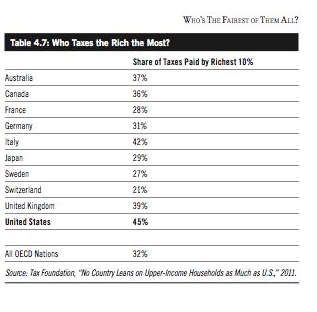
It is said that the 1% need to pay more. In fact, if you confiscated 100% of their wealth, it wouldn’t make a dent in the deficit. It causes division and class warfare. It clearly defies the history of success where “a rising tide raises all boats”.
SO WHAT IS THE ANSWER?
Besides the obvious of spending less, which congress does not have the ability on either side to do, grow the base of taxpayers and more revenue will come in. JFK and Reagan (and other Presidents) proved this so we have history to support this. In fact, the largest year of tax revenue ever by the government was 2007. There are far more complex economic theories, but increase a tax base who are not afraid to spend more, and tax revenue will rise.
CONCLUSION
I don’t think Zuckerberg, Gates and Buffet will leave America if they raise taxes, but many are leaving California (at 2000 per week). If you look at history, we can do more by having an economy that is growing for everyone. By not singling out a specific group, we get the rising tide and an economy shift with more jobs and more tax revenue.
As for the rich French, many are now in Switzerland.
Maybe there will be a lesson in here for them and they can get their tax base back.
Share this:

Doug Casey on American Socialism
I was hoping this was not true, but it is his Doug’s point of view.
(Interviewed by Louis James, Editor, International Speculator)
[Skype rings. It’s Doug, as expected.]
L: Hi, Doug. I got the Alan Colmes article you sent. I can see why it got your goat – guess you’ve got a good rant in mind?
Doug: I don’t approve of rants. It’s true that I have strong opinions, and I’m not afraid to express them – but a considered and defensible opinion, even if it’s delivered with conviction, is essentially different from an emotional outburst.
L: Okay, sorry. No rants. But if the other side starts name-calling, we can be forgiven for a little emotion on our side – how does one answer a snarky dismissal of anyone who doesn’t agree with so-called progressives, labeling them “regressives”?
Doug: I’m certainly not above delivering an appropriate and well-deserved insult. An insult is really all that the lame attempts of progressives to shame people into voting for Obama deserve. From a long-term perspective, it certainly doesn’t much matter who wins the coming election; Romney would be just as great a disaster for what’s left of America as Obama, just in slightly different ways, with different rhetoric.
It’s interesting how certain breeds of statist are now re-labeling themselves as “progressives.” I guess they like the sound of the root word – progress – even though they only want progress towards collectivism. They used to call themselves “liberals,” a word which in America used to stand for free minds and free markets. But they appropriated it and degraded it – classical liberals had to rechristen themselves “libertarians.” World-improvers, political hacks, and busybodies in general are excellent at disguising bad ideas with good words, ruining them in the process.
It’s said that “Sticks and stones may break my bones, but words can never hurt me.” But that’s actually untrue; propaganda is a very effective weapon. As Orwell pointed out, if you control the language, you control people’s thinking; and if you control people’s thinking, you control their actions. So I despise the way these types manipulate words.
As for the case at hand, one of the things that annoys me most about Colmes’ vapid article is his dishonest and misleading, albeit conventional, defense of the New Deal – America’s first great lurch towards socialism. He defends all the harm it’s done as a wonderful thing. He repeats the fiction that the New Deal rescued the economy from the last depression. It actually made the Depression deeper, and made it last longer.
L: Do tell.
Doug: Well, to start with, Colmes, a self-appointed whitewasher of American socialism, begins by resting his case on the claim that it is American socialism that has made America exceptional. It’s quite a bold assertion, since socialism as well as fascism are antithetical to everything that was good about America. He really is a cheeky bastard.
L: He calls his socialism “liberalism.”
Doug: Yes, but that too is an Orwellian perversion. As always, we should start with a definition. Around the world, you ask people what a liberal is, and they say something that at least relates to the word’s original meaning: liberals favor liberty. And that’s not just the civil liberties defended by the ACLU, but also economic liberty – meaning freedom to engage in free trade with others. The free market.
But back in the 1930s, socialists like Norman Thomas started to realize that they were never going to persuade the majority of Americans to accept socialism outright, so they changed the name and embarked on a deliberate campaign to implement their agenda, one piece at a time, calling it liberalism. And who could be against that?
L: I’ve read that most of Thomas’ 1932 platform has now become law in the US.
Doug: I believe that’s true. Take a look at this Word document [it will download automatically]. Actually, the same is true of Marx’s Communist Manifesto. But back to today, Colmes’ claim is absolutely ridiculous. Social Security, Medicare, and progressive income taxes have not made America exceptional, but just the opposite; they’ve made it like all the other socialist and fascist countries that cover the face of the globe like a skin disease. They are burdens that have slowed the economy and distorted people’s incentives and ideas.
These programs have, perversely, hurt the poor – the very people they’re supposed to help – the most. They’ve acted to corrupt them and cement them to the bottom of society. They’ve destroyed huge amounts of capital, which would otherwise have raised the general standard of living, redirecting it from production toward consumption. These coercive ideas all originated and were first implemented in Europe before so-called liberals foisted them on Americans, in the name of freedom. It’s quite Orwellian, the way they’ve twisted concepts to mean the opposite of what they once did.
L: Some people would argue that things like Social Security liberate them – free them from fear of poverty in old age.
Doug: That claim shouldn’t be worth answering – but it must be answered, because Boobus americanus believes it. It’s a classic “big lie.” Say it often enough, and people think it’s true. In fact, Social Security acts to impoverish the country, by destroying the incentive to save.
L: How so?
Doug: By taking almost 15% of a person’s wages right off the top, Social Security makes it much harder for a poor person to save money. Worse yet, it makes people think they don’t need to save for themselves; it gives them a false sense of security. Even worse is that the money never really belongs to the presumed recipient; it’s simply another unsecured obligation of a bankrupt government.
Social Security payments should at least be set aside as discrete accounts in each person’s name, and become assets for them. If that money were placed in an individually owned pension plan, with just average management, the results would be many times what people now hope to get. And the plan wouldn’t be a burden to future taxpayers. Social Security is, in fact, just a gigantic Ponzi scheme, where the next generation of young people is forced to support the last generation of old people.
Worst of all, the program causes people to be irresponsible. This is a disaster, because a free society can only exist when everyone takes personal responsibility seriously. It’s a swindle, and it corrupts everyone. No wonder parents can no longer rely on their own children to support them in old age. Maybe the Chinese will lend the US government the money it needs to pay its Social Security obligations…
But the numerous practical failures of a program like Social Security are not the main problem.
The primary problem with a scheme like Social Security is that it’s not voluntary; it’s coercive, which makes it unethical. You can’t force people to do what you think is right and then claim to be liberating them. Alleged freedom from fear of poverty in old age in exchange for theft of wages in the present – and the correct word for taking people’s money without their consent is “theft” – is not liberal in any defensible meaning of the world. It’s brute, “might-makes-right” power clothed in noble-sounding words.
L: Colmes says that Social Security keeps 40% of seniors above the poverty line today, and “helps families with disabilities and those who have lost loved ones.” That’s a bad thing?
Doug: No one seriously thinks they’ll be able to have a decent quality of life on Social Security retirement income alone. Why do you think so many senior citizens are working at Walmart or the like? Colmes is committing the same error Bastiat pointed out 200 years ago; choosing to value immediate, direct, and visible benefits, but ignoring the delayed and indirect costs, which only become obvious later.
The long-term costs of Social Security, Medicare/Medicaid, food stamps, and so forth include bankrupting the country, among other economic consequences. But even more disturbing and damaging is the degradation of once self-reliant people to subservience and dependence, which is what happens when government assumes responsibilities that adult individuals should bear themselves.
For example, Social Security disability benefits are being used as an alternate income source by the unemployed. As of August, 2012, there were about 10.8 million people collecting disability income – that’s a larger number than the entire population of most US states, and up from 8.1 million in 2007, when the Greater Depression began. It can be a great scam, claiming PTSD, unprovable back pain, or a mood disorder. There’s a whole class of ambulance-chasing lawyers that takes these cases on contingency.
L: What about the individuals who try and can’t bear the responsibilities of adulthood?
Doug: The programs exist and have not prevented that from happening; there are plenty of homeless people today. I would argue that most of them are in that position because they’ve developed bad habits. There would be a lot fewer of them if they didn’t get taught from childhood that assuring their own lives and well-being is really the state’s responsibility, not their own. The system is failing these people, but again, that’s beside the point; two wrongs don’t make a right. The whole idea of a government “safety net” is wrong, in principle and practice.
Ideas have consequences in the physical world, and lies, twisted words, and self-contradictory, impossible claims can be extremely damaging. You can’t liberate people by putting them in financial chains.
L: I understand the principles, but many people don’t – or just don’t care. People like Colmes see the parks built by the Civilian Conservation Corps and the infrastructure built by the Works Progress Administration as unmitigated goods, the work given to all the millions employed by the government as life-saving, and the idea of helping those in need to be a moral imperative they don’t question.
Doug: The average person has been handed this party line throughout his life, from teachers in government schools to talking heads on TV. He’s been discouraged from thinking critically or independently. We have two widely shared myths – that Roosevelt’s New Deal cured the Depression and Johnson’s Great Society cured poverty – although both beliefs are counterfactual. It’s pretty much as Will Rogers liked to say: “It isn’t what we don’t know that gives us trouble; it’s what we know that just ain’t so.”
Now a new myth is being hatched, that Obama and Bernanke’s quantitative easing saved the economy. But that will never catch on; it will be totally debunked over the next few years as they destroy both the dollar and the economy.
Colmes seems completely unaware that government programs have costs. The money used to pay the Civilian Conservation Corps and Works Progress Administration workers had to come from somewhere – where? It’s either forcibly taken from current taxpayers, who then can neither enjoy it nor invest it as they prefer – or it comes from taking on debt, which means future taxpayers, who are thereby turned into indentured servants. That money was redirected from whatever uses those who earned it had for it, and put to uses government employees deemed best.
The political process, of course, has a perverse tendency to result in “pork” spending on the most useless, wasteful, and idiotic programs imaginable. It goes for things that are politically productive for the people who control the state, not necessarily economically productive for either society or the taxpayers. But again, this is all secondary to the ethics of the matter; that is vastly more important.
Parks are nice, but should the money to build them have been taken from entrepreneurs struggling to build businesses in the 1930s? Or single mothers in, say, Harlem, struggling to feed their families? It’s the little people who can’t afford the lawyers and accountants needed to cut tax bills who suffer the most.
Coercing people to do what politicians decide is simply unethical.
L: What about the argument that it’s not coercion if the people voted for the politicians who passed the laws that created these programs?
Doug: Essentially another big lie. In the first place, people vote for politicians – who rarely keep promises – not for laws at the federal level. None of these laws were enacted by the people. Second, unless you could get unanimous consent of every person affected, it would still be coercive to people who have committed no crime and want no part of it, and thus unethical.
If 51% of the people vote to enslave 49% of the people, that doesn’t make that slavery right. If 99% vote to enslave 1% – something many of the ignorant, torch-wielding masses seem to be clamoring for these days – it’s still wrong. Ethics is not a matter of popularity contests.
Anything that society wants or needs can, should, and will be provided by entrepreneurs working for a profit.
L: Can you elaborate on that? It’s all fine to criticize stupid ideas, but unless you offer a constructive alternative, what’s the point?
Doug: Indeed. We’re talking about products and services that people regard as necessary or beneficial for society as a whole, but which they say private enterprise wouldn’t provide adequately. Roads, schools, and post offices are frequently cited examples.
Government post offices were a bad idea to begin with – even back in the 1800s when most people thought they were vitally important, a man named Lysander Spooner set up a private company to deliver mail – and do so for less than the government charged. This superior service upset the apple cart, and was outlawed and shut down. Today, everyone knows that UPS and FedEx do a better job than the post office; no sensible person trusts the government when it absolutely, positively has to get there. Between that and email, the post office should have been shut down, rather than propped up, long ago. It now costs taxpayers on t he order of $12 billion a year.
Similarly, there’s a history of private roads going back to previous centuries. The fist transcontinental highway, the old Route 66, was paved with private money. There are private roads in the US and around the world today. It’s simply not true that you need a government to build things that people actually need. You need government roads about as much as you need government cars.
We’ve covered schools and education. The schools are absolutely the last thing the state should do…
L: What about things like the military, police, and courts?
Doug: Well, I would argue that even those should be handled by the private sector, but I understand that many people can’t get away from the idea that these services are core government functions that should not be privatized. That’s because they fear they would not be fair and impartial – though it’s a cruel joke to think that government courts today are fair and impartial. At any rate, I could live with it if government were limited to these core functions; but police and courts are only a tiny fraction of what government does today.
There’s great danger in having the government do anything, quite frankly. But it could be better if more people like Ron Paul or my friend Marc Victor were in office. Check out Victor; he has the potential to be the next Ron Paul – on steroids.
L: Understood: if no one can make a buck providing some good or service, how vital can it be? Anything people actually want will be provided by entrepreneurs, making a profit. And like you, I too like to start by asking what is right, before I ask how much it costs. But most people just don’t seem to think this way. That’s why I keep coming back to the practical arguments. It seems that, regardless of one’s politics, it should matter that the state’s coffers are empty.
Colmes argues that by 2022 Obama’s Affordable Care Act “will provide coverage to 33 million Americans who would otherwise be uninsured.” He doesn’t mention that mandated government spending and interest payments have already taken over the entire federal budget. Even now, with a $1.5 trillion deficit, most of the $700 billion for the military, the $227 billion for interest on the national debt and the $646 billion for regular government services is borrowed every year. The whole thing is an impossible pipe dream that absolutely ensures the bankruptcy of not just the US government, but American society itself.
Doug: It seems insane – people wouldn’t believe us if we’d written this into a story some years ago.
But you can see the scary truth in the news every day; people in Europe’s totally broke and failing economies protest violently in the streets for their governments to spend more money those governments don’t have and won’t be able to borrow. Colmes exhibits this same breathtaking unwillingness to face the facts. He talks about one in seven people being on food stamps, as though it were a good thing. He talks about how politicians voted to extend unemployment benefits with money they don’t have as though that’s an unquestionably good thing to do.
L: So is Colmes an evil manipulator or a misguided dupe?
Doug: I don’t see how any intellectually honest person can write a long article praising a whole alphabet soup of government agencies without ever once admitting their failure, asking how much they cost, or examining the ethical basis for their existence. So I suspect he’s both a knave and a fool.
Colmes’ article encapsulates wrong-headedness and willful ignorance in exactly the same way that Paul Krugman and Thomas Friedman invariably do. They’re all very destructive people. Since they don’t appear to be stupid – in the sense of having low IQs – I’m forced to assume they’re ill-intentioned.
L: So… What’s in it for him to circulate such obviously biased and misleading opinions?
Doug: Perhaps he’s simply a sociopath who gets pleasure from destruction. Or perhaps he’s just motivated by fame and money and has found a profitable gig. Despite being an apologist for socialism, the man hosts a talk show and writes books which make him money; he doesn’t do it pro bono. He has identified a market and is making money, pursuing his own self-interest, deliberately or unwittingly to the detriment of society.
L: Just like a politician.
Doug: He sees the government as the solution to every problem. But since government is pure coercion by its very nature, you can count on it to do the wrong thing – and often even the exact opposite of the right thing.
L: It’s perverse.
Doug: [Laughs] Took the words out of my mouth.
L: Investment implications?
Doug: Nothing specifically related to Colmes. He’s just another sign of the degradation of America, yet another data point supporting my view that the US is probably past the point of no return. The place that was once America is going through the wringer, and so is the rest of the world. And the way to deal with that is what we’ve been saying for some time now: rig for stormy weather.
L: Liquidate, consolidate, speculate, create – and internationalize.
Share this:

2nd Amendment, Who Are the Militia by Allen West
I saw this question by analyst James Governor in an obviously sarcastic tweet a while back during a twitter debate on the 2nd Amendment. I did not want to engage in a useless waste of time in a twitter-fest.
We are protecting ourselves against the government, whether it be in 1776 against the British or today against the socialists trying to ruin the USA. It’s what keeps us from getting arrested for dank memes by the government.
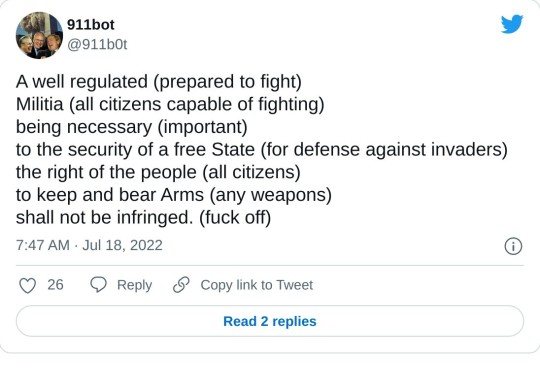
I also did not have as eloquent answer as Allen West, Representative from Florida. An African-American tells how even whites would be held in slavery were it not for the 2nd Amendment as well a lesson in history as to who are the militia and why it exists. Lessons that real Americans know. Commies want to take away guns to control the population, right James?
Allen is a true American hero and forgetting the 2nd Amendment issue, is the standard for which politicians should be held to for integrity.
Here, he defines the enemy:
Also, he notes there are never any anti-gun protesters or appeasers at NRA events. At least they are smart enough for that.
I also note that the cities with the highest crime have the most limited concealed carry laws.
It is about preserving order.
An armed man is a citizen, an disarmed man is a subject.
George Washington: “Firearms are second only to the Constitution in importance; they are the peoples’ liberty’s teeth.”
For those that have questions about why we have guns or that we should ban them, please answer these questions first.
1. How will you get all the guns?
2. How will you stop the bad guys like the Taliban and Al Qaeda from using other weapons?
3. When in history was man not covetous enough to use force to take his neighbor’s property?
4. Prisoners are able to make weapons in prison without gunsmith ability, how will you stop criminals from making guns?
5. The best protection from terror and attack are the best defense or the greater ability for offense. You have now taken that away. What is your protection?
6. When in the history of man have we not been at war somewhere in the world?
So here is the answer. Send your complaints to Allen, but be prepared for a beat down like you’ve never experienced.
Below, Yamamoto was the Commander of the Japanese Forces and architect of the Pearl Harbor attack. He was educated and lived in the US.

Share this:

How Warren Buffet Ends The Deficit in 5 Minutes
Warren Buffett, in a recent interview with CNBC, offers one of the best quotes about the debt ceiling …
“I could end the deficit in 5 minutes,” he told CNBC. “You just pass a law that says that any time there is a deficit of more than 3% of GDP, all sitting members of Congress are ineligible for re-election.”
The 26th amendment (granting the right to vote for 18 year-olds) took only 3 months and 8 days to be ratified! Why?
Simple! The people demanded it.
That was in 1971 – before computers, e-mail, cell phones, etc.
Of the 27 amendments to the Constitution, seven (7) took one (1) year or less to become the law of the land – all because of public pressure. Warren Buffet is asking each addressee to forward this email to a minimum of twenty people on their address list; in turn ask each of those to do likewise. In three days, most people in The United States of America
will have this message.
1. No Tenure/No Pension
A Congressman/woman collects a salary while in office and receives no pay when they’re out of office.
2. Congress (past, present & future) participates in Social Security.
All funds in the Congressional retirement fund move to the Social Security system immediately. All future funds flow into the Social Security system, and Congress participates with the American people. It may not be used for any other purpose.
3. Congress can purchase their own retirement plan, just as all other Americans do.
4. Congress will no longer vote themselves a pay raise.
Congressional pay will rise by the lower of CPI or 3%.
5. Congress loses their current health care system and participates in the same health care system as the American people.
6. Congress must equally abide by all laws they impose on the American people.
7. All contracts with past and present Congressmen/women are void effective 12/1/12.
The American people did not make this contract with Congressmen/women.
Congress made all these contracts for themselves.
Serving in Congress is an honor, not a career.
The Founding Fathers envisioned citizen legislators, so ours should serve their term(s), then go home and back to work.
If each person contacts a minimum of twenty people then it will only take three days
for most people (in the U.S.) to receive the message.
Don’t you think it’s time?
Share this:

Talk Like A Pirate Day
 The pirate speaks,”Today be Talk Like a Pirate day. I haven’t blogged about it in a while, but it be very important t’ enjoy somethin’ this distractin’ from your work. Go t’ talklikeapirateday.com and learn about this important, yet unappreciated day. Celebrate hero’s like Blackbeard instead o’ worryin’ about cowards like the yellow belly in ye old Whitehouse. True Pirates would attack t’ muslims and defeat them like true men. We’d use our cutlass and six pounders t’ defeat them and free t’ world.”

Share this:

9/11, 11 Years Later…A Roundup of Posts



Today we remember the 11th anniversary of the worst attack against America on our home soil. This year, it is mildly different as the perpetrator, Osama Bin Laden is now dead due to the bravery of Seal Team 6 (video of the actual operation here).
I congratulate the president on executing the mission to attack him, although it would have been better if we had been able to waterboard him for more information. I believe that except for the most rabid of pacifists, most Americans would have been happy to give the same order.
Likewise, we should give credit to the Bush administration for setting up the intelligence network and the extracting and the correlation of the intelligence that lead to his demise. So a great number of people who contributed should share in the credit and be praised for a job well done.
Here is a round up of coverage during the day regarding this anniversary. I’ll gladly include any other coverage that is respectful and accurate.
We could have captured Osama before 9/11 but let him get away
Fortunately, we didn’t close Guantanamo Bay
Enhance interrogation on KSM helped find OBL
How and why we failed to coordinate the evidence about 9/11
The makings of the next attack which could be nuclear
Rudy Guilinani: The Pain Stays, the Fight Goes On
American’s prepare to mark the anniversary of 9/11
United Airlines Flight 175 South Tower 9:03 a.m.
American Airlines Flight 11 North Tower 8:46 a.m.
5 words and 2 numbers – the note from the 84th floor
9/11: Remembrance, Resolve, Action
9/11: Americans remember attacks on 11th Anniversary (Photos)
Allen West’s statement on the 9/11 Attacks
I post this to remind those like Junaidah Dahlan, who got offended because I blogged that Islam produced the terrorists, but the facts show that it is true. Almost every terrorist attack is Muslim Junaidah. Go be offended somewhere else and for a real reason.
Share this:

Milton Friedman Would have been 100, Still One Of The Best Economists Ever
Economists have either followed Friedman or Keynes for Economic Theory over the last century. Keynes is being used currently and you can judge the results for yourself. For me, it does not seem to work, nor has history shown it to have worked for any of the presidents who have based their administration on Keynesian theory anywhere in the world.
I quote one of the best authors of our generation on economics for this article.
If Milton Friedman were alive today — and there was never a time when he was more needed — he would be one hundred years old. He was born on July 31, 1912. But Professor Friedman’s death at age 94 deprived the nation of one of those rare thinkers who had both genius and common sense.
Most people would not be able to understand the complex economic analysis that won him a Nobel Prize, but people with no knowledge of economics had no trouble understanding his popular books like “Free to Choose” or the TV series of the same name.
In being able to express himself at both the highest level of his profession and also at a level that the average person could readily understand, Milton Friedman was like the economist whose theories and persona were most different from his own — John Maynard Keynes.
Like many, if not most, people who became prominent as opponents of the left, Professor Friedman began on the left. Decades later, looking back at a statement of his own from his early years, he said: “The most striking feature of this statement is how thoroughly Keynesian it is.” No one converted Milton Friedman, either in economics or in his views on social policy. His own research, analysis and experience converted him.
As a professor, he did not attempt to convert students to his political views. I made no secret of the fact that I was a Marxist when I was a student in Professor Friedman’s course, but he made no effort to change my views. He once said that anybody who was easily converted was not worth converting.
I was still a Marxist after taking Professor Friedman’s class. Working as an economist in the government converted me.
What Milton Friedman is best known for as an economist was his opposition to Keynesian economics, which had largely swept the economics profession on both sides of the Atlantic, with the notable exception of the University of Chicago, where Friedman was both trained as a student and later taught.
In the heyday of Keynesian economics, many economists believed that inflationary government policies could reduce unemployment, and early empirical data seemed to support that view. The inference was that the government could make careful trade-offs between inflation and unemployment, and thus “fine tune” the economy.
Milton Friedman challenged this view with both facts and analysis. He showed that the relationship between inflation and unemployment held only in the short run, when the inflation was unexpected. But, after everyone got used to inflation, unemployment could be just as high with high inflation as it had been with low inflation.
When both unemployment and inflation rose at the same time in the 1970s — “stagflation,” as it was called — the idea of the government “fine tuning” the economy faded away. There are still some die-hard Keynesians today who keep insisting that the government’s “stimulus” spending would have worked, if only it was bigger and lasted longer.
This is one of those heads-I-win-and-tails-you-lose arguments. Even if the government spends itself into bankruptcy and the economy still does not recover, Keynesians can always say that it would have worked if only the government had spent more.
Although Milton Friedman became someone regarded as a conservative icon, he considered himself a liberal in the original sense of the word — someone who believes in the liberty of the individual, free of government intrusions. Far from trying to conserve things as they are, he wrote a book titled “Tyranny of the Status Quo.”
Milton Friedman proposed radical changes in policies and institution ranging from the public schools to the Federal Reserve. It is liberals who want to conserve and expand the welfare state.
As a student of Professor Friedman back in 1960, I was struck by two things — his tough grading standards and the fact that he had a black secretary. This was years before affirmative action. People on the left exhibit blacks as mascots. But I never heard Milton Friedman say that he had a black secretary, though she was with him for decades. Both his grading standards and his refusal to try to be politically correct increased my respect for him.
Thomas Sowell is a senior fellow at the Hoover Institution, Stanford University, Stanford, CA 94305. His website is www.tsowell.com.
He also wrote this:
When both unemployment and inflation rose at the same time in the 1970s —”stagflation,” as it was called — the idea of the government “fine tuning” the economy faded away. There are still some die-hard Keynesians today who keep insisting that the government’s “stimulus” spending would have worked, if only it was bigger and lasted longer.
This is one of those heads-I-win-and-tails-you-lose arguments. Even if the government spends itself into bankruptcy and the economy still does not recover, Keynesians can always say that it would have worked if only the government had spent more.
Although Milton Friedman became someone regarded as a conservative icon, he considered himself a liberal in the original sense of the word — someone who believes in the liberty of the individual, free of government intrusions. Far from trying to conserve things as they are, he wrote a book titled “Tyranny of the Status Quo.”
Milton Friedman proposed radical changes in policies and institutions ranging from the public schools to the Federal Reserve. It is liberals who want to conserve and expand the welfare state.
As a student of Professor Friedman back in 1960, I was struck by two things — his tough grading standards and the fact that he had a black secretary. This was years before affirmative action. People on the left exhibit blacks as mascots. But I never heard Milton Friedman say that he had a black secretary, though she was with him for decades. Both his grading standards and his refusal to try to be politically correct increased my respect for him.
Share this:

Will Rogers Gets It Right on Our Government Spending
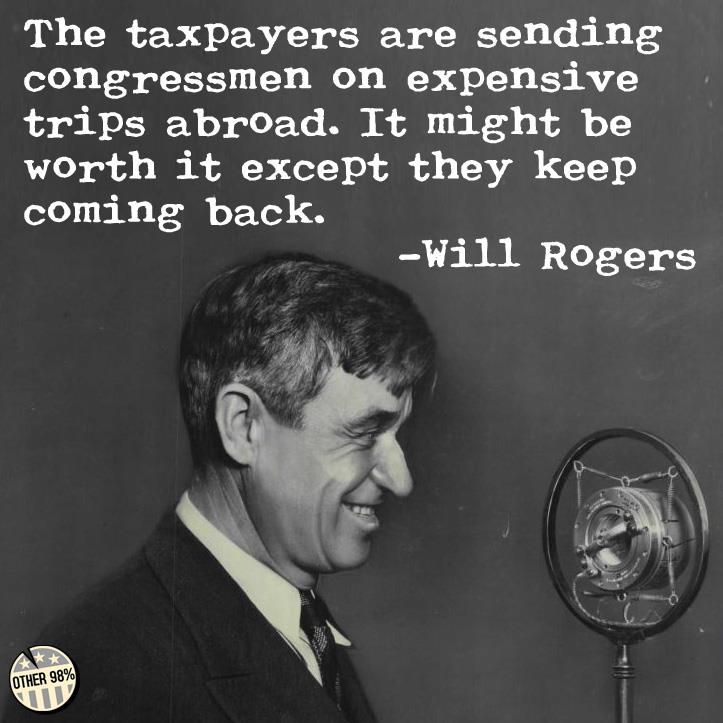
Share this:

Dan Cathy Of Chick-fil-A, A Genuine Person
A true leader who built a business by standing for what he believed in. Now he is being discriminated against by those against discrimination. Hated by those who say they are against hate.
Mr. Cathy goes about the success of Chick-Fil-A and serves, hires and buys from those who say they hate what he believes in. Who is the hypocrite?
UPDATE: Cathy sticks to his guns.
As you can see, he is not picking on any group, rather is giving to what he believes in. Just because you aren’t a politically correct lemming doesn’t make you against something, it is your right to have an opinion. He can run his company the way he so desires. Those who believe otherwise to make a statement by starting their own business and supporting their desired group, rather than trying to change everyone else.
For many months now, Chick-‐fil-‐A’s corporate giving has been mischaracterized. And while our sincere intent has been to remain out of this political and social debate, events from Chicago this week have once again resulted in questions around our giving. For that reason, we want to provide some context and clarity around who we are, what we believe and our priorities in relation to corporate giving.
A part of our corporate commitment is to be responsible stewards of all that God has entrusted to us. Because of this commitment, Chick-‐fil-‐A’s giving heritage is focused on programs that educate youth, strengthen families and enrich marriages, and support communities. We will continue to focus our giving in those areas. Our intent is not to support political or social agendas.
As we have stated, the Chick-‐fil-‐A culture and service tradition in our restaurants is to treat every person with honor, dignity and respect – regardless of their belief, race, creed, sexual orientation or gender. We will continue this tradition in the over 1,600 restaurants run by independent Owner/Operators.

Political correctness has made us a nation tolerant only of “one-legged opinions,” a friend of mine recently observed. We take a stand on a hot issue, but only on one leg at a time, shifting when necessary so as not to offend the beliefs of others—but never standing solidly on two feet.
Like a modern day parable, the story of a lone, courageous businessman has taught us what it means to be guided by truth, rather than political fad.
Dan Cathy is the Chief Operating Officer of Chick-fil-A, a privately owned chain of quick service restaurants with annual sales of $4 billion. The company is ranked the 10th fastest growing retailer in the country, although Chick-fil-A restaurants close their doors every Sunday, the best sales day of the week for those in this business sector.
Cathy recently expressed his belief that marriage is the union of a man and…
View original post 876 more words
Share this:

July 4th 2012, Top Posts Round-up

 First of all if you read the dates on the gravestone, Happy Birthday Mom.
So it’s Independence Day, declared in 1776 from the rest of the World. The USA has in its short life (compared with other countries) given more to others in benevolence, freed and saved more people, helped former enemies to recover, sacrificed more than others and established a new way of running a country other than a Monarchy. Unlike the Monarchy’s around the world, the land wasn’t taken from others in a border dispute war or outright takeover like those we declared freedom from….. and has contributed more development, medicine and technology than most other countries combined. So why are our leaders trying to run it in a way that has failed?
Ronald Reagan said, “The American dream is not that every man must be level with every other man. The American dream is that every man must be free to become whatever God intends he should become.”
Most of this is a blessing from our Creator, mentioned in all the documents of the Founding Fathers, yet the government of today is trying to leave that model and get back to the type of behavior we declared independence from. Why?
First, let’s start off with the Star Spangled Banner.
Here is a round-up of the best posts for today.
Michelle Malkin – Happy 236th Birthday
John Ransom – Washington’s First Fourth
America joining the One World Crappola from the Daily Kos instead of celebrating why we are different (see our Judeo-Christian history) I tried finding something patriotic just for fairness, but it’s just a different world view I guess
America Haters from the Usual sources, Hollywierd
The other America Haters – The Media
Paul Greenberg – The American Idea
Rasmussen poll – Liberty and Justice for all
Speaker Boehner’s Independence Day Tribute: “Here’s to the Spirit of ‘76”
Joshpundit – America’s Birthday Edition (lots of links here)
Robert Samuelson – Love of Country 2012
Fleming: What Life Was Like in 1776
For levity, The Hot Dog eating contest where an American is the favorite
Finally, here is the Declaration of Independence, from tyranny and taxes. Have we come full circle?
IN CONGRESS, July 4, 1776.
The unanimous Declaration of the thirteen united States of America,
When in the Course of human events, it becomes necessary for one people to dissolve the political bands which have connected them with another, and to assume among the powers of the earth, the separate and equal station to which the Laws of Nature and of Nature’s God entitle them, a decent respect to the opinions of mankind requires that they should declare the causes which impel them to the separation.
We hold these truths to be self-evident, that all men are created equal, that they are endowed by their Creator with certain unalienable Rights, that among these are Life, Liberty and the pursuit of Happiness.–That to secure these rights, Governments are instituted among Men, deriving their just powers from the consent of the governed, –That whenever any Form of Government becomes destructive of these ends, it is the Right of the People to alter or to abolish it, and to institute new Government, laying its foundation on such principles and organizing its powers in such form, as to them shall seem most likely to effect their Safety and Happiness. Prudence, indeed, will dictate that Governments long-established should not be changed for light and transient causes; and accordingly all experience hath shewn, that mankind are more disposed to suffer, while evils are sufferable, than to right themselves by abolishing the forms to which they are accustomed. But when a long train of abuses and usurpations, pursuing invariably the same Object evinces a design to reduce them under absolute Despotism, it is their right, it is their duty, to throw off such Government, and to provide new Guards for their future security.–Such has been the patient sufferance of these Colonies; and such is now the necessity which constrains them to alter their former Systems of Government. The history of the present King of Great Britain is a history of repeated injuries and usurpations, all having in direct object the establishment of an absolute Tyranny over these States. To prove this, let Facts be submitted to a candid world.
He has refused his Assent to Laws, the most wholesome and necessary for the public good.
He has forbidden his Governors to pass Laws of immediate and pressing importance, unless suspended in their operation till his Assent should be obtained; and when so suspended, he has utterly neglected to attend to them.
He has refused to pass other Laws for the accommodation of large districts of people, unless those people would relinquish the right of Representation in the Legislature, a right inestimable to them and formidable to tyrants only.
He has called together legislative bodies at places unusual, uncomfortable, and distant from the depository of their public Records, for the sole purpose of fatiguing them into compliance with his measures.
He has dissolved Representative Houses repeatedly, for opposing with manly firmness his invasions on the rights of the people.
He has refused for a long time, after such dissolutions, to cause others to be elected; whereby the Legislative powers, incapable of Annihilation, have returned to the People at large for their exercise; the State remaining in the mean time exposed to all the dangers of invasion from without, and convulsions within.
He has endeavoured to prevent the population of these States; for that purpose obstructing the Laws for Naturalization of Foreigners; refusing to pass others to encourage their migrations hither, and raising the conditions of new Appropriations of Lands.
He has obstructed the Administration of Justice, by refusing his Assent to Laws for establishing Judiciary powers.
He has made Judges dependent on his Will alone, for the tenure of their offices, and the amount and payment of their salaries.
He has erected a multitude of New Offices, and sent hither swarms of Officers to harass our people, and eat out their substance.
He has kept among us, in times of peace, Standing Armies without the Consent of our legislatures.
He has affected to render the Military independent of and superior to the Civil power.
He has combined with others to subject us to a jurisdiction foreign to our constitution, and unacknowledged by our laws; giving his Assent to their Acts of pretended Legislation:
For Quartering large bodies of armed troops among us:
For protecting them, by a mock Trial, from punishment for any Murders which they should commit on the Inhabitants of these States:
For cutting off our Trade with all parts of the world:
For imposing Taxes on us without our Consent:
For depriving us in many cases, of the benefits of Trial by Jury:
For transporting us beyond Seas to be tried for pretended offences
For abolishing the free System of English Laws in a neighbouring Province, establishing therein an Arbitrary government, and enlarging its Boundaries so as to render it at once an example and fit instrument for introducing the same absolute rule into these Colonies:
For taking away our Charters, abolishing our most valuable Laws, and altering fundamentally the Forms of our Governments:
For suspending our own Legislatures, and declaring themselves invested with power to legislate for us in all cases whatsoever.
He has abdicated Government here, by declaring us out of his Protection and waging War against us.
He has plundered our seas, ravaged our Coasts, burnt our towns, and destroyed the lives of our people.
He is at this time transporting large Armies of foreign Mercenaries to compleat the works of death, desolation and tyranny, already begun with circumstances of Cruelty & perfidy scarcely paralleled in the most barbarous ages, and totally unworthy the Head of a civilized nation.
He has constrained our fellow Citizens taken Captive on the high Seas to bear Arms against their Country, to become the executioners of their friends and Brethren, or to fall themselves by their Hands.
He has excited domestic insurrections amongst us, and has endeavoured to bring on the inhabitants of our frontiers, the merciless Indian Savages, whose known rule of warfare, is an undistinguished destruction of all ages, sexes and conditions.
In every stage of these Oppressions We have Petitioned for Redress in the most humble terms: Our repeated Petitions have been answered only by repeated injury. A Prince whose character is thus marked by every act which may define a Tyrant, is unfit to be the ruler of a free people.
Nor have We been wanting in attentions to our British brethren. We have warned them from time to time of attempts by their legislature to extend an unwarrantable jurisdiction over us. We have reminded them of the circumstances of our emigration and settlement here. We have appealed to their native justice and magnanimity, and we have conjured them by the ties of our common kindred to disavow these usurpations, which, would inevitably interrupt our connections and correspondence. They too have been deaf to the voice of justice and of consanguinity. We must, therefore, acquiesce in the necessity, which denounces our Separation, and hold them, as we hold the rest of mankind, Enemies in War, in Peace Friends.
We, therefore, the Representatives of the united States of America, in General Congress, Assembled, appealing to the Supreme Judge of the world for the rectitude of our intentions, do, in the Name, and by Authority of the good People of these Colonies, solemnly publish and declare, That these United Colonies are, and of Right ought to be Free and Independent States; that they are Absolved from all Allegiance to the British Crown, and that all political connection between them and the State of Great Britain, is and ought to be totally dissolved; and that as Free and Independent States, they have full Power to levy War, conclude Peace, contract Alliances, establish Commerce, and to do all other Acts and Things which Independent States may of right do. And for the support of this Declaration, with a firm reliance on the protection of divine Providence, we mutually pledge to each other our Lives, our Fortunes and our sacred Honor.
The 56 signatures on the Declaration appear in the positions indicated:
Column 1
Georgia:
Button Gwinnett
Lyman Hall
George Walton
Column 2
North Carolina:
William Hooper
Joseph Hewes
John Penn
South Carolina:
Edward Rutledge
Thomas Heyward, Jr.
Thomas Lynch, Jr.
Arthur Middleton
Column 3
Massachusetts:
John Hancock
Maryland:
Samuel Chase
William Paca
Thomas Stone
Charles Carroll of Carrollton
Virginia:
George Wythe
Richard Henry Lee
Thomas Jefferson
Benjamin Harrison
Thomas Nelson, Jr.
Francis Lightfoot Lee
Carter Braxton
Column 4
Pennsylvania:
Robert Morris
Benjamin Rush
Benjamin Franklin
John Morton
George Clymer
James Smith
George Taylor
James Wilson
George Ross
Delaware:
Caesar Rodney
George Read
Thomas McKean
Column 5
New York:
William Floyd
Philip Livingston
Francis Lewis
Lewis Morris
New Jersey:
Richard Stockton
John Witherspoon
Francis Hopkinson
John Hart
Abraham Clark
Column 6
New Hampshire:
Josiah Bartlett
William Whipple
Massachusetts:
Samuel Adams
John Adams
Robert Treat Paine
Elbridge Gerry
Rhode Island:
Stephen Hopkins
William Ellery
Connecticut:
Roger Sherman
Samuel Huntington
William Williams
Oliver Wolcott
New Hampshire:
Matthew Thornton
Share this:

Memorial Day 2012 Round Up of the Best Posts
Memorial Day, when we remember that many sacrificed for our freedom, many made the ultimate sacrifice.
It pains me to see those who protest against those who serve and served, when their ability to make mendacious and hateful comments against our military are protected by those who defended that right to free speech. Except for Jane Fonda who was over in Viet Nam and conspired with the enemy, John Murtha and John Kerry who served and later demeaned our soldiers, most of these protesters haven’t been there and have no idea of the hell these people go through.

The solemn act of honoring those who have fallen in battle is a custom that seems to have faded in importance to our nation over time.
Nowadays, many Americans have forgotten the meaning and traditions of Memorial Day. At cemeteries across the country, the graves of the fallen are sadly ignored, and worse, neglected.
While there are towns and cities still planning Memorial Day parades, many have not held a parade in decades. Some think the day is for honoring anyone who has died, not just those fallen in service to our country.
Perhaps they do not know how deeply our nation once appreciated those who sacrificed their lives in defense of the principles we hold most dear. Perhaps those very principles of individual sovereignty, freedom and liberty are no longer so important.
It was not always so.
In 1868, on May 5th, Memorial Day, originally called “Decoration Day,” was officially proclaimed by General John Logan, national commander of the Grand Army of the Republic, in his General Order No. 11.
General Logan asked that we cherish “tenderly the memory of our heroic dead, who made their breasts a barricade between our country and its foes. Their soldier lives were the reveille of freedom to a race in chains, and their deaths the tattoo of rebellious tyranny in arms. We should guard their graves with sacred vigilance. All that the consecrated wealth and taste of the nation can add to their adornment and security is but a fitting tribute to the memory of her slain defenders.”
Freedom is never free.
Here is a round-up of coverage.
The importance of Memorial Day
If you leave the blog here, watch this short video narrated by John Wayne on taps:
Memorial Day by Blackfive, a MilBlogger
Times Free Press, note it has the casualties from each war.
US Department of Veterans Affairs listing of Events
Share this:

Sunday, December 7th, 1941, a Date that will live in Infamy
A question that has interested historians and researchers for decades is: why? Why did Japan launch an attack that, in hindsight at least, they clearly had no chance of winning? The obvious answer is that they thought they could, but military and naval strategists know the answer is not so simple.
Precisely because its resources were so depleted by the war with China, it is accepted wisdom that Japan was hoping to expand its territories in the Pacific. If these areas belonged to Japan, they would, almost by default, become customers for Japan’s industrial and resource sectors.
But the Japanese underestimated America’s resolve to defend itself, for however long, and by whatever means necessary. If Japan hoped that America might take a “c’est la vie” attitude to the prospect of losing a battle in the Philippines, it was sorely mistaken. Nor was America still weary from the First World War.
Japan also underestimated the extent of Americans’ outrage at the bombing in 1941. It fueled the nation’s desire to win at almost any cost. No democratic government on earth can move forward without the will of the people, and after Pearl Harbor, the American people’s will was ferocious.

Here is the text and a link to the speech that FDR made after the attack at Pearl Harbor.

I read the Biography of Admiral Yamamoto, the architect of the attack. He believed that the only way to defeat the United States of America was a surprise attack that would disable our military in the Pacific. He clearly stated that he feared that if the attack was not completely successful, it would awaken a sleeping giant that the Empire of Japan could not defeat in standard battle. It must haunt his legacy.
Tactically, the mistake was not destroying the aircraft carriers which were out at sea that day or his plan may have succeeded.
As it turned out, he was shot down only a few years later in a surprise attack by a squadron of P-38’s heading to an inspection in the Pacific.
Here is the Youtube speech by FDR
I find ironic the words of the second half of the speech, if applied to 9/11, would be appropriate. Also ironic is that Japan was extending its reach for economic resources.
The United States was at peace with that nation and, at the solicitation of Japan, was still in conversation with its Government and its Emperor looking toward the maintenance of peace in the Pacific. Indeed, one hour after Japanese air squadrons had commenced bombing in Oahu, the Japanese Ambassador to the United States and his colleague delivered to the Secretary of State a formal reply to a recent American message. While this reply stated that it seemed useless to continue the existing diplomatic negotiations, it contained no threat or hint of war or armed attack.
It will be recorded that the distance of Hawaii from Japan makes it obvious that the attack was deliberately planned many days or even weeks ago. During the intervening time, the Japanese Government had deliberately sought to deceive the United States by false statements and expressions of hope for continued peace.
The attack yesterday on the Hawaiian Islands has caused severe damage to American naval and military forces. I regret to tell you, very many American lives were lost. In addition, American ships have been reported torpedoed on the high seas between San Francisco and Honolulu.
Yesterday the Japanese Government also launched an attack against Malaya.
Last night Japanese forces attacked Hong Kong.
Last night Japanese forces attacked Guam.
Last night Japanese forces attacked the Philippine Islands.
Last night Japanese forces attacked Wake Island.
This morning the Japanese attacked Midway Island.
Japan has, therefore, undertaken a surprise offensive extending throughout the Pacific area. The facts of yesterday and today speak for themselves. The people of the United States have already formed their opinions and well understand the implications to the very life and safety of our nation.
As Commander in Chief of the Army and Navy, I have directed that all measures be taken for our defense.
But always will our whole nation remember the character of the onslaught against us.
No matter how long it may take us to overcome this premeditated invasion, the American people in their righteous might will win through to absolute victory.
I believe I interpret the will of the Congress and of the people when I assert that we will not only defend ourselves to the uttermost but will make very certain that this form of treachery shall never endanger us again.
Hostilities exist. There is no blinking at the fact that our people, our territory, and our interests are in grave danger.
With confidence in our armed forces-with the unbounded determination of our people-we will gain the inevitable triumph–so help us God.
I ask that the Congress declare that since the unprovoked and dastardly attack by Japan on Sunday, 7 December 1941, a state of war has existed between the United States and the Japanese Empire.
Here is the only color film of the event. Listen to how excited the Japanese are and their commitment to give everything, including lives to this war:


