
1
2
3
3
4
5

5

6

7

8

9
10

11

12

13

14
15

16
17
Liberal Women
The Radicalization of Young Liberal Women: A Minnesota Lesson – this is who is ruining the country from within
Pets
Doberman Pinscher Runs Away With 150th Westminster Dog Show Accolade – good-looking dog
Twunt
Midwest Woman Goes On Date To The Cheesecake Factory, Orders A Well-Done Steak. Then She Puts Him On Blast For Ordering Chicken Tenders And Wanting To Split The Bill – This is why guys don’t want to go out with these women
Golf
The 14 Golfers With The Most PGA Tour Wins In A Year – familiar names, but didn’t expect who won the most
The Worst Place In The World To Build a House
Nor’Easter In North Carolina Causes 4 Houses To Collapse Into The Frozen Ocean (Videos) – I was betting some would collapse. It’s a dumbass place to have a house
Fishing
The 50 Best Bass Fishermen In The World Will Compete For $3M In New Nashville Fishing Tournament – A lot of money for a fish that doesn’t fight very much. I’ve caught hundreds of them, but not for 3 million
Almost a Darwin Award
High School Student Protesting ICE Runs in Front of Car With Trump Flag, Gets Hit – instead, he’s just a dumbass
Bio-Warfare
Congress Targets Sales of Possibly Risky Synthetic DNA – like this is going to stop China or Russia
Health
One-Third of Cancer Cases Preventable, Massive Study Finds
UN
United Nations Warns That It’s Going Broke Without US Financial Support – let it die. They have been anti-USA for a long enough time.
UN Looking For A Global Tax On Fossil Fuels Companies – they are against the population having freedom
Cars
EV Bloodbath: Carmakers Suffer Face-Melting Losses As Buyers Flee, Credits End – That’s right, people only bought them when they got money for doing it. No one really wants one other than enviroweenies.
Education
Shocking Number of Elite College’s Students Claim “Disability” to Avoid Roommates – I thought they were going to say they were serial masterbators. Give them a hand though for thinking this up.
Federal Reserve
Why the Titanic Sinking Was the Final Step to Create the Federal Reserve [VIDEO] – It makes you wonder if the Titanic was really an accident.
Fantasy Football Punishments
NFL Players Reveal the WORST Fantasy Football Punishments Ever (Video)
Why Traveling Sucks
Man Says Passengers ‘Begged’ American Airlines To Cancel The Flight At Miami Airport. Were They Valid? – They find new ways to make it worse
Rare Earth Minerals
Arkansas’ Lithium Jackpot: New Tech Turns Ancient Saltwater Into ‘White Gold’
EU Hates God
Quoting Scripture Now a Hate Crime? EU Targets Bible, Free Speech, and X…I wouldn’t want to be anywhere near them for doing this
Miss Kentucky is first former foster child to win the title
The ‘Gold Standard’ of Jobs Data Is Broken—And America Is Paying the Price
Homeless Camps Are Morphing Into Larger Homeless ‘Cities’ In LA
The Hottest Summer Days in D.C. Have Not Gotten Hotter in Last 40 Years
New York Police Conceal a Hit-And-Run Crash
These Are The Largest Immigrant Groups In America
Europe
Europe On “High Alert” As Polish Moms Train For War Against Russia
‘Green’ Europe’s Industrial Masochism
Germany’s “Skills Shortage” Scam: Open Borders, Job Losses, And Economic Collapse
Britain’s Car Industry: From World Leader To Net Zero Casualty
World
DEA Seizes 7500Kg Of Coke, Arrests 617 Members Of Sinaloa Cartel In Global Operation
Oh for Pete’s sake, can’t you just leave us alone? These people couldn’t pour water out of a boot if there were instructions on the sole.
A team of researchers in California drew notoriety last year with an aborted experiment on a retired aircraft carrier that sought to test a machine for creating clouds.
But behind the scenes, they were planning a much larger and potentially riskier study of salt-water-spraying equipment that could eventually be used to dim the sun’s rays — a multimillion-dollar project aimed at producing clouds over a stretch of ocean larger than Puerto Rico.
The details outlined in funding requests, emails, texts and other records obtained by POLITICO’s E&E News raise new questions about a secretive billionaire-backed initiative that oversaw last year’s brief solar geoengineering experiment on the San Francisco Bay.
They also offer a rare glimpse into the vast scope of research aimed at finding ways to counter the Earth’s warming, work that has often occurred outside public view. Such research is drawing increased interest at a time when efforts to address the root cause of climate change — burning fossil fuels — are facing setbacks in the U.S. and Europe. But the notion of human tinkering with the weather and climate has drawn a political backlash and generated conspiracy theories, adding to the challenges of mounting even small-scale tests.
One of the things that makes the heat so dangerous here in Florida is the humidity. The dew point temperature is the temperature at which the air can no longer hold all of its water vapor, and some of the water vapor must condense into liquid water. At 100% relative humidity, the dew point temperature and the air temperature are the same, and clouds or fog can begin to form. While relative humidity is a relative measure of how humid it is, the dew point temperature is an absolute measure of how much water vapor is in the air (how humid it is). In very warm, humid conditions, the dew point temperature can reach 75 to 77 degrees F, but rarely exceeds 80 degrees.
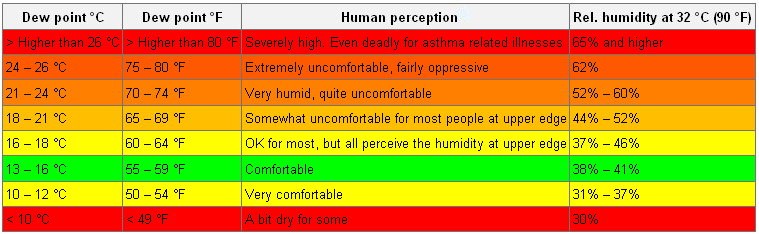
The dewpoint for the afternoon that caused my heatstroke was between 71f and 74f. The temperature for that 4 hour period was between 91f and 94f. That results in a heat index of between 100f and 103f.
High dewpoints are dangerous because it is a limit on how well your sweat can evaporate and cool your body. Heat can build up to dangerous levels.
Combined with that, it was a bright, sunny day with almost no wind. The Navy actually has tables for permissible heat exposure. Under those conditions, Navy regulations say that acclimatized personnel shouldn’t perform heavy work for more than 15 minutes per hour. I far exceeded that for more than 4 continuous hours.
I hated going outside. they say to understand, take a shower and don’t dry off. Get dressed and now you know what it’s like to live there.
I got out of there after 39 years and never looked back. I talk to friends there and the heat is unbearable. It’s why a beach vacation or a theme park is over for me in life.
Combine that with the shitty drivers and it’s not that great of a place once you grasp the length and depth of the constant heat.
Even now, many states away I park in the shade. I spend as much time high in the mountains as I can where it is cool in the summer.
Americans from Florida to North Carolina continue to deal with the devastating consequences of Hurricane Helene, now the deadliest hurricane to hit the US since Katrina. The stories emerging from the region are heart breaking. The economic damage to property and the infrastructure will take years to recover from. Large parts of the area will never return to what they were.
Many Americans may be unaware of the extent of the damage. Unlike Hurricane Katrina, which received non-stop coverage on cable news for weeks, with primetime anchors like Anderson Cooper visiting on location covering stories of human tragedy and government incompetence, Helene’s aftermath has received far less coverage. It is on social media platforms like X where folks will find horrifying stories of the stench of death still strong in difficult to reach areas, the lack of government assistance for those in need, and the courage of private efforts serving the area.

Some of this is explained by the time period we are living in. Escalation in the Middle East. A national election is on the horizon. A court decision releasing documents allows the salivating press to re-litigate the events of January 6th, 2020 yet again. What cannot be ignored, however, is the extent to which the open hostility the nation’s most powerful institutions have had to the sorts of people that are overwhelmingly impacted by this storm, predominantly white, working class, and politically conservative.
This horrific natural disaster is a reminder of the extent to which the regime hates the people who live there.
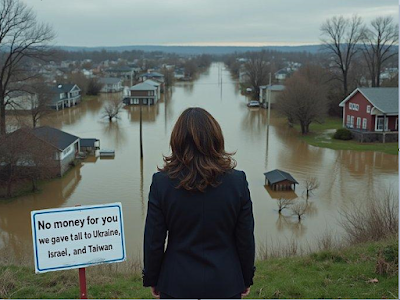
This was true prior to Helene, where Washington policies have impoverished these areas with policies ranging from the national impact of inflation and financialization to more specific regional impacts stemming from regulatory policy with specific impacts on the region impacted. The immediate aftermath, however, demonstrates the extent to which state reaction to a disaster impedes voluntary efforts to quickly mobilize and assist those in need.
A combination of heavy-handed federal and state action has attempted to undercut recovery efforts, from grounding private helicopters seeking to rescue stranded victims, to the demands of Transportation Secretary Pete Buttigieg to stop citizens from flying drones near impacted areas seeking to locate those in need of help. Given the logistical strains that even the best organized response to a severe crisis would create, the voluntary organization of local human resources on the ground is essential to a meaningful and quick recovery. Here, the priority of government actors has been to elevate their control over the situation at the expense of these efforts.
The allocation of emergency resources itself is deserving of extended scrutiny as well. The victims of this tragedy, like all Americans, have their wealth extracted by Washington to fill the coffers of large federal agencies like FEMA. This same agency, whose nominal priority is to assist Americans in the case of emergency, is already pleading poverty. Of course, these same agencies oversaw the redirection of over a billion dollars in recent years to subsidize migration into the country. The priorities are clear, emergency funds take a back seat to a regime that cares more about new arrivals than the families who lived in this country for generations.
This predatory relationship between the regime and its citizens is systemic. The priorities of Washington will always stand in conflict with the people of Appalachia. DC sees no problem with ordering the Tennessee National Guard to the Middle East at a time when their fellow Tennesseans are facing their own crisis. This relationship is also bipartisan in nature. Kentucky Senator Mitch McConnell, who has become very rich off the backs of the people who elevated him to political power, ignoring the victims of Helene on social media, while very focused on Israel and Iran.
The regime will always prioritize its own interests, including the interests of what it has identified as their special privileged classes, over the interests of its people. Changing this parasitic relationship requires more than a change of political party in the White House, but a determined effort by those who seek to represent the interests of these people to strike at the root of this relationship.
Unfortunately, while elections alone are not adequate to address the victimization of Appalachia, it is reasonable to consider what impact the specter of politics is having on their current neglect. The counties most impacted by the storm disproportionately vote in ways the current regime does not like.
Would America’s federal government deliberately undermine recovery efforts to try to achieve its own desired political ends? Would the corporate press deliberately fail to cover the inadequacy of these efforts, hoping to prevent a candidate it fears doesn’t win?
For those who understand the true nature of the state, the answer is an obvious one.
Our prayers are with the victims of Hurricane Helene, that they receive the help they need as recovery efforts continue, that they have the ability to build back their communities strong, and that they will one day be free of a regime that cares so little for them.
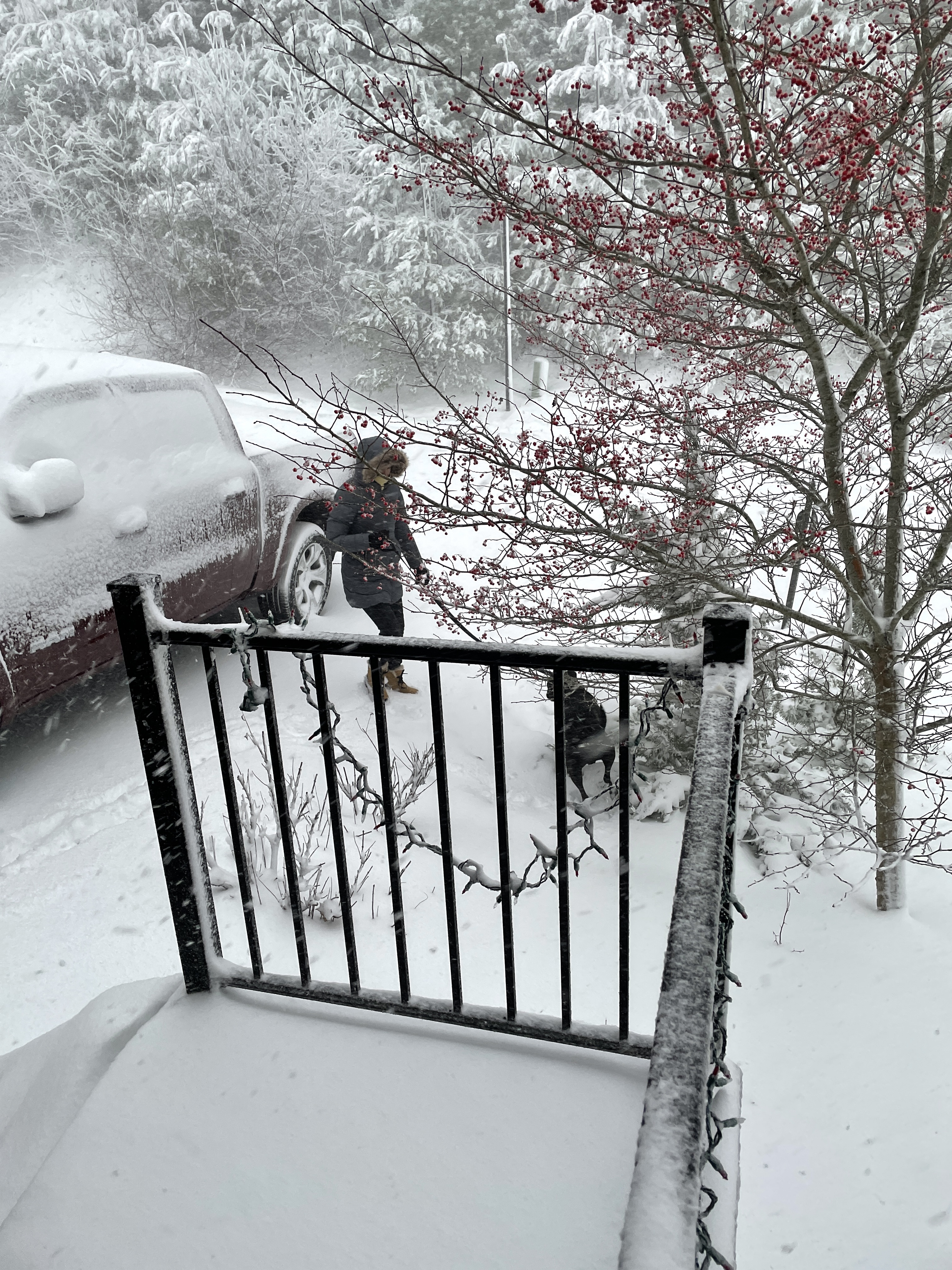
Winter hit here up in the mountains. I’m lucky that I have 4 wheel drive on both my truck and my dog.
No one is going anywhere. It’s an introverts dream
In case you don’t get the title, it is a Jimmy Buffet song.

“In all recorded history there has not been one economist who has had to worry about where the next meal would come from.”
I suppose that being an economist is like being a weather forecaster. You are more likely to be wrong about your guess, but people still tune in the next day in case you might be right.
“The nice part about being a pessimist is that you are constantly being either proven right or pleasantly surprised. ”
George Will
Yes, you are never wrong when you do this. Covid/China/Wuhan/whatever virus deaths were off by millions. You can’t really trust a weather forecast until the time you need it to be right. You can’t lose. Predict the worst with a probability and then you can’t really be wrong, just a little off.
I’m an optimist, but I want things to be correct, based on facts and history whenever possible. Forecasts can be based on these 2 things to get an accurate measurement, when you want it to be. I guess that’s the big gotcha for these 2.
 If you look dead east to the hurricane, you’d find where I lived 20 some odd years ago. It hit like an atomic bomb that make south Florida look like Hiroshima.
It sounded like a freight train all night long. We had a new born and were mighty scared for hours. Fortunately, it moved fast and was over by the next day.
I had to crawl out of a window with a chain saw to cut a tree off of my front door so that we could get out of the house. We were lucky as it was a relatively compact storm and hit only about 40-50 miles south of where our house was. That was the difference between our house standing vs. being a pile of bricks.


 Delusions of Adequacy