Google will no longer back up the Internet: Cached webpages are dead

I for one am glad. I’m old enough that most of my fucking up in life was before the internet and only I really know the story of my misdeeds and untoward activity.

A lot of people say stupid shit online, or brag about stuff they shouldn’t to show off or get likes. Until now, the internet was forever. It may still be if you search hard enough, but Google is evil and presents the worst of behavior easily. Now, the idiots may be protected.

Story

Google will no longer be keeping a backup of the entire Internet. Google Search’s “cached” links have long been an alternative way to load a website that was down or had changed, but now the company is killing them off. Google “Search Liaison” Danny Sullivan confirmed the feature removal in an X post, saying the feature “was meant for helping people access pages when way back, you often couldn’t depend on a page loading. These days, things have greatly improved. So, it was decided to retire it.”

The feature has been appearing and disappearing for some people since December, and currently, we don’t see any cache links in Google Search. For now, you can still build your own cache links even without the button, just by going to “https://webcache.googleusercontent.com/search?q=cache:” plus a website URL, or by typing “cache:” plus a URL into Google Search. For now, the cached version of Ars Technica seems to still work. All of Google’s support pages about cached sites have been taken down.

Cached links used to live under the drop-down menu next to every search result on Google’s page. As the Google web crawler scoured the Internet for new and updated webpages, it would also save a copy of whatever it was seeing. That quickly led to Google having a backup of basically the entire Internet, using what was probably an uncountable number of petabytes of data. Google is in the era of cost savings now, so assuming Google can just start deleting cache data, it can probably free up a lot of resources.

Cached links were great if the website was down or quickly changed, but they also gave some insight over the years about how the “Google Bot” web crawler views the web. The pages aren’t necessarily rendered like how you would expect. In the past, pages were text-only, but slowly the Google Bot learned about media and other rich data like javascript (there are a ton of specialized Google Bots now). A lot of Google Bot details are shrouded in secrecy to hide from SEO spammers, but you could learn a lot by investigating what cached pages look like. In 2020, Google switched to mobile-by-default, so for instance, if you visit that cached Ars link from earlier, you get the mobile site. If you run a website and want to learn more about what a site looks like to a Google Bot, you can still do that, though only for your own site, from the Search Console.

click above for more, but I think you get the drift

Why Newspapers and The News Are Not Only A Dying Model, But Dead

“I do not take a single newspaper, nor read one a month, and I feel myself infinitely the happier for it.” – Thomas Jefferson

I don’t subscribe to the newspaper anymore, but I got one this morning.  I’m sure that it was a teaser to try to get me to subscribe.  Upon reading it, I realized I already knew everything in the paper except the local high school football scores from games after I went to bed.

A DYING MODEL

The subscription rates to newspapers are dying, not even a slow death.  Similarly, the evening news is also a dinosaur.  They report what we knew as much as a full day before.

I am on twitter and read blogs all day long.  I occasionally go to the news sites,  but as I discuss below, their bias (I hold both left and right guilty equally here) usually makes me fact check what I’m trying to find out which defeats the purpose of fact-finding, especially if it involves politics. That subject is pretty much unavoidable these days.

Nevertheless, I enjoy many other subjects which you could read about it on other blog entries if you have nothing better to do, and I find good information about them that is interesting and INSTANT.

I’m a boomer, although a technically savvy one having been in the IT industry all my life.  The Gen X,Y, millennials,  and whomever follows them demand even more instantaneous everything virtually dooming the news model of our prior generation.  Thank you Internet.

THE END OF THE BASTIONS OF NEWS

We have establish that we are now used to getting information instantaneously.  The other reason that the model is dying is that they are biased.  This is ok if you are a neo-con or a loony lefty, but for everyone else (the other 80% given 10% on the edges of left and right) we don’t trust them anymore.

Once, these two sources were the basis of our world and local information.  Besides being static rather than dynamic, they also have stopped being factual sources of information, rather they are partisan, with Fox on one side and CBS, NBC, ABC, CNN, NBC, MSNBC, NYT, WAPO, LA TImes, Reuters, AP, HuffPo, Local News, Local Papers and most other news sources on the other side of issues.  All are positioned in a place that position the facts from a point of view.   Some of them blatantly lie.   Reporting was supposed to be the facts of the story that let the reader make up their mind on their position.

We’ve actually learned that the news has been biased for at least as long as there has been television, we just didn’t have the instant fact checking that the internet and the other sources have provided.

There is a joke from Bernie Goldberg that said if they had been reporting on Moses at Mt. Sinai, the headline would read “Moses get the 10 Commandments from God, and here are the two that we think are important to you”.

Walter Cronkite said that the Viet Nam war was lost during the time that we were winning.  LBJ said that if he’d lost Cronkite, he’d lost America.  We’ve since learned that the then “most trusted man in America” was also one of the most biased.

LIFE MOVES ON

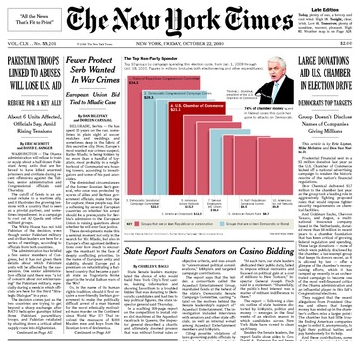
Other things have died and we have lived and moved on.  Black and white TV, network only channels vs. cable TV and landline phones vs. mobile (cell for those in the US) phones.  Such is the fate of newspapers and TV network news.  Here is just one fact concerning the NYT declining rates.  I’m sure you could find somewhere that their subscriptions are increasing, but this would seem deceitful given the nature of digital delivery.

So am I disturbed by this trend?  Actually I didn’t even notice it until I saw the paper in my yard this morning.  I haven’t subscribed for news in many years (note: I get the Sunday paper for the coupons as long as they pay for the 1 day delivery – my sister calls me a tightwad but it leads to becoming this).

I get my news from the above stated sources and know more about what is going on than the anchors have time to present in their biases manner.

So as they say, life moves on.