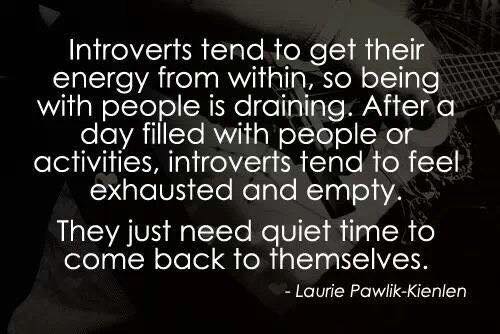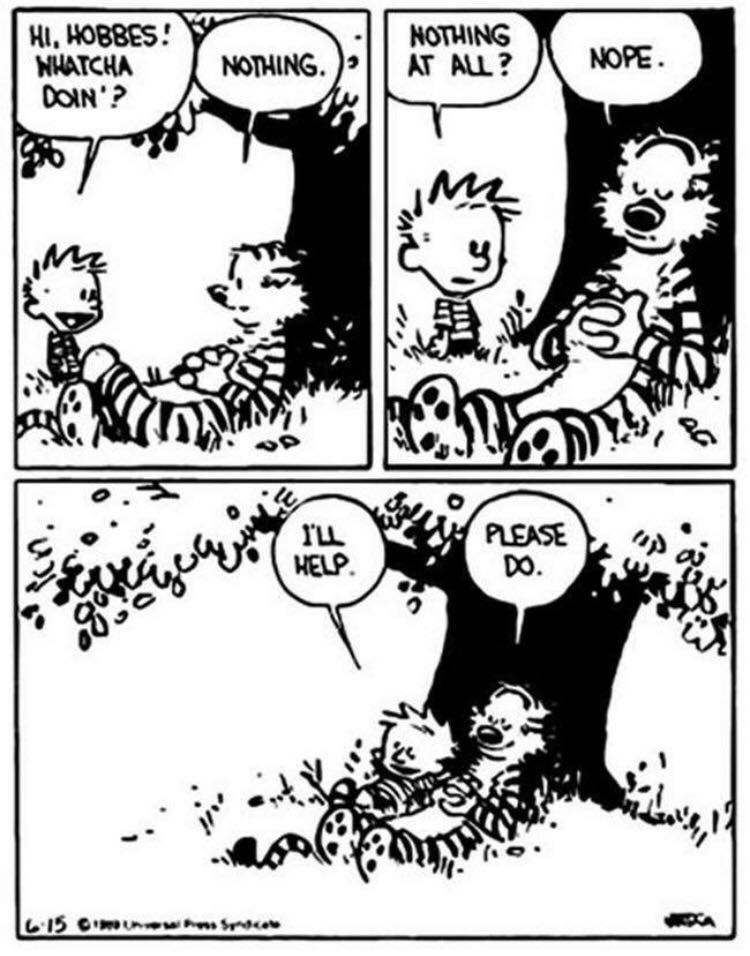
Of course, Introverts will be uniting together, separately and alone. Hopefully the extroverts won’t try to butt in and want to small talk.

Of course, Introverts will be uniting together, separately and alone. Hopefully the extroverts won’t try to butt in and want to small talk.
So says an article published by the Washington Post.
Having discussed high IQ people including those with a perceived higher intelligence a number of times (this one with the highest Google ranking), I like to ponder on these things.
The first in this article tends to reference dwelling among all people as it relates to happiness:
They use what they call “the savanna theory of happiness” to explain two main findings from an analysis of a large national survey (15,000 respondents) of adults aged 18 to 28.
First, they find that people who live in more densely populated areas tend to report less satisfaction with their life overall. “The higher the population density of the immediate environment, the less happy” the survey respondents said they were. Second, they find that the more social interactions with close friends a person has, the greater their self-reported happiness.
Why would high population density cause a person to be less happy? There’s a whole body of sociological research addressing this question. But for the most visceral demonstration of the effect, simply take a 45-minute ride on a crowded rush-hour Red Line train and tell me how you feel afterward.
One would tend to think that if you weren’t in such a densely populated area, that it might lead to greater happiness. No wonder New York, Chicago and other highly populated cities have such low rankings in this category.
THE NEED TO BE ALONE
I can’t prove it, but there is a tendency for “Smart People” to be either introverted or have a need to spend time alone to gather their thoughts when making contributions to inventions, theorem’s, calculations and other notable achievements. (Note: the link above describes things introverts won’t tell you, but you should know).
Being an author, I know that I prefer quiet to gather my thoughts and increase the powers of concentration on what I am trying to write. It’s hard to clear your mind when there is a bombardment of distractions either from people, social media or other causes.
The article does state the obvious, long commutes, traffic, waiting in line and crowds are tedious, monotonous, and can grate on anyone over time. The infrastructure is usually older (see the lead in the water in Flint, Mich.) I’ve often wondered why anyone would want to live in a place like that if they really had a choice. Maybe that is why there is such a large population outflow to Florida upon retirement.
Kanazawa and Li’s second finding is a little more interesting. It’s no surprise that friend and family connections are generally seen as a foundational component of happiness and well-being. But why would this relationship get turned on its head for really smart people?
I posed this question to Carol Graham, a Brookings Institution researcher who studies the economics of happiness. “The findings in here suggest (and it is no surprise) that those with more intelligence and the capacity to use it … are less likely to spend so much time socializing because they are focused on some other longer term objective,” she said.
Think of the really smart people you know. They may include a doctor trying to cure cancer or a writer working on the great American novel or a human rights lawyer working to protect the most vulnerable people in society. To the extent that frequent social interaction detracts from the pursuit of these goals, it may negatively affect their overall satisfaction with life.
The article and researchers discuss a “Savannah theory of happiness” which is a bit of a reach since there weren’t iPhones for cavemen, although an ability to deal with new challenges seems obvious.
FEAR OF MISSING OUT OF SOMETHING FOR SOME, LOATHING PEOPLE FOR OTHERS
There is a need for many in the general population to gain happiness from their social interactions. I have relatives who suffer from FoMo syndrome, generally indicating that they derive their happiness and/or satisfaction from others or the perception of others.
When drilling down and specifically targeting high IQ people, there is a distinct difference from the last sentence in the above quote:
Second, they find that the more social interactions with close friends a person has, the greater their self-reported happiness.
But there was one big exception. For more intelligent people, these correlations were diminished or even reversed.
“The effect of population density on life satisfaction was therefore more than twice as large for low-IQ individuals than for high-IQ individuals,” they found. And “more intelligent individuals were actually less satisfied with life if they socialized with their friends more frequently.”
Let me repeat that last one: When smart people spend more time with their friends, it makes them less happy.
Again, an observation from the high IQ group and personal introspection, there seems to be less of a need to find your happiness in others or what others think of you in this space. It might be in the above stated pursuit of goals:
Hell might actually be other people — at least if you’re really smart.
That’s the implication of fascinating new research published last month in the British Journal of Psychology. Evolutionary psychologists Satoshi Kanazawa of the London School of Economics and Norman Li of Singapore Management University dig in to the question of what makes a life well-lived. While traditionally the domain of priests, philosophers and novelists, in recent years survey researchers, economists, biologists and scientists have been tackling that question.
There’s a twist, though, at least as Kanazawa and Li see it. Smarter people may be better equipped to deal with the new (at least from an evolutionary perspective) challenges present-day life throws at us. “More intelligent individuals, who possess higher levels of general intelligence and thus greater ability to solve evolutionarily novel problems, may face less difficulty in comprehending and dealing with evolutionarily novel entities and situations,” they write.
It appears that the high IQ might actually have another less socially accepted skill that is less politically correct as defined by the masses. They may just have thought out that they are able to be happier or more satisfied while being alone rather than by having to try and satisfy others definition of their happiness.
Conversely, they might find being around other people annoying, especially the chatty or needy.
Once you are able to happy alone, the ability to be happy with others is icing on the cake, but shouldn’t be the definition of the cake.
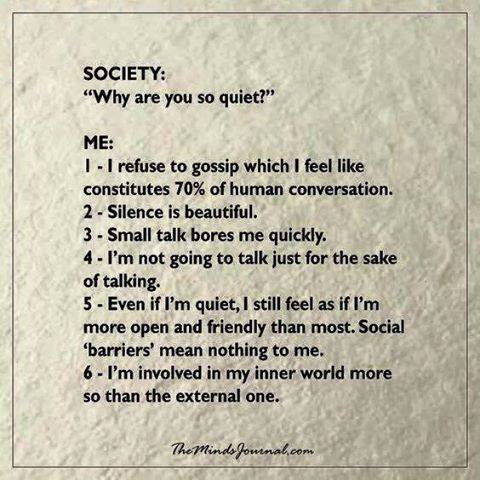
 I read this article and could hardly believe it. It was me. I’ll editorialize between the lines based on past and current experiences, but people should realize that people are different and here is one group that is virtually unnoticed but should be understood.
The link is now broken, but here is the annotated article:
Introverts catch a lot of shit for being introverted. The whole world seems
so enamored by extroverts – the people we know who just want
to be around people all the time. While we introverts might
not want that, it doesn’t mean we’re depressed or
suicidal or anything wacky like that. There are
some things you should know about us.
1. Small talk sucks.
We’re just not very good at it. We’re typically the big-thinking types.
We like big ideas and theories. Small talk is uncomfortable.
We don’t care about the weather or how
your cat has been doing.
It is very annoying because it mostly is useless to us.
If you need to share so badly,
check with an extrovert who can’t wait to share back.
You just won’t get good
feedback from us.
2. Being alone is fine.
Seriously, we’re doing okay, even if we hole up in our houses for a while.
We don’t need other people for stimulation. We find that ourselves.
We’d almost always rather be alone. We don’t want to be hermits,
but we are good at keeping ourselves busy and this is
our comfort zone for life.
We don’t have to be with a crowd to do something,
although we might come
along once in a while.
3. We aren’t rude or uptight.
We might seem like that at first, but get to know us. We’re still a fun bunch
of friends, we just don’t always acclimate to unfamiliar settings and people
so quickly.
Mostly because you are loud and want to be the center of attention,
something we can’t relate to. When we find out who you really are
behind the facade, it’s easy to get to know us, unless you are phony.
4. Sometimes, we swing both ways.
We might be introverts, but sometimes we are just so the life of the
party. We do this willingly when we’re up to it, but we can’t always
keep that kind of energy going. If we throw a party, great! But give
us some time to recover.
Recover is the key word. We can be with or in a crowd, but afterwords,
we need time alone.
5. We have friends. And they like us! Probably.
People hear the word ‘introvert’ and think of the goth kid sitting alone
at the food court. That’s a whole different thing entirely. We love having
friends, and our friends love having us! We put in a conscious effort for
people we think are worth it.
We see through those who are not worth it and move on as those who
have a constant self centered need for attention aren’t real people,
and likely are far more insecure than we are.
6. When with the right people, we feel safe.
Having the right people in our lives is amazing. we really give our
best selves to the best people. We shine in the right company.
But sometimes it takes a while to find those people.
7. We like to write things out.
Writing is easier than talking for us sometimes. Email is the best
because it helps us get the thoughts out of our heads without
being interrupted. Thinking about giving us a call? Try a text or email instead.
8. We’re super productive.
Sometimes at least. Usually in our alone time, we’re able to really
rock and roll on projects that we need to finish. The solitude helps us,
as we tend to be a bit more distractible than most.
Especially when you constantly talk about nothing just to talk. At work,
the people who have to comment on everything are the worst as
it usually isn’t productive. See small talk.
9. If we don’t like you, you won’t know it.
It’s the truth of the matter. We hate conflict. So even if we don’t like you,
we’ll still be nice. It’s a lot easier than being real with you. Especially if
your feelings are inconsequential enough that confronting you on your
bullshit isn’t even worth the time. Sorry. Well, not sorry.
And we move along without you as you just aren’t worth it.
10. Networking events suck.
Seriously. Is there a mailing list we need to opt out of? There are few
things more uncomfortable than a networking party. Except maybe a
dentist’s networking party that we’ve just been accidentally invited to.
Yes, so why do extroverts keep trying to drag us into this nightmare?
11. We don’t like crowds.
Though I find that after a few beers, I can tolerate it. Introverts tend to
get overstimulated easily, so big crowds are tough to deal with.
It’s just not worth it. Those who have MOP (miss out phobia)
have to be with the crowd, not us. See number 2.
12. Sorry, we probably weren’t listening to your story.
We care deeply about our friends, but people outside of that
circle will have a tough time maintaining our attention. It’s not
that we have ADD or anything like that, we just don’t really
care about you. On the plus side, we won’t judge you, so feel
free to tell us all the fucked up things you said to your ex.
People will tell me anything and everything because
I won’t repeat it. But usually won’t remember it either.
13. Don’t make a fuss out of our birthdays.
For the longest time, I had a great deal of difficulty
understanding why I hated my birthday so much.
Everyone I ever knew would come out and party
with me! But then I realized: that’s the problem!
We don’t need to make a fuss out of our birthdays,
so please don’t do it to us.
Or any holiday for that matter. It’s just another day.
14. We don’t want to make a fuss out of your birthday.
We can quietly honor the annual birthday, right?
It’s your day. You have everyone else making a big deal about it.
Let them.
15. If we’ve chosen to be friends with you, appreciate it.
We value our alone time. If we see you often, it means that we
really love you. Just don’t get too bummed out when we
don’t hang for a week at a time sometimes.
We’ll likely be the most reliable friend you have, the one
you can call on when your loud friends let you down.
But visitors are like fish, they smell after 3 days.
Hat tip to Higher Perspective.
What they might not tell you but you need to know is that they are good for your business.