
When I worked with Chris Wong, obviously Chinese, at IBM, he told me the key to understanding how to work with China is simple. They ignore the 10 commandments. That’s right, lie, steal, coven and all the rest of them.
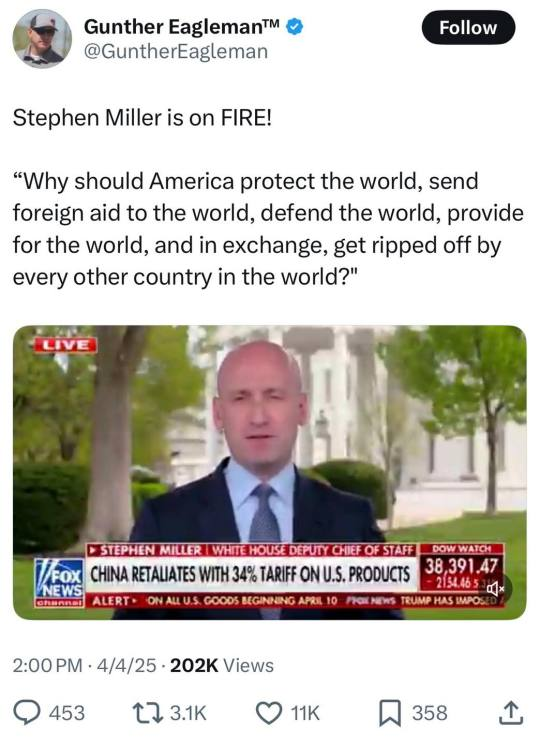
Here’s the result:
China claims that President Trump started the trade war against China by imposing reciprocal tariffs.
What China conveniently omits is that they have been waging a full-scale trade war against America for decades. Not only does China systematically violate just about every term of every trade agreement, they have been stealing trillions worth of American industrial technology and intellectual property.
China Steals at Least $225 Billion Every Year
According to a 2024 report from the House Committee on Homeland Security, China steals between $300 and $600 billion worth of American technology and intellectual property every year. This is in line with findings from a 2017 report from the Commission on the Theft of American Intellectual Property.
If we assume a middle-of-the-road figure, and extrapolate these findings back to 2001, when China joined the World Trade Organization, then we can assume that China has stolen some $9.9 trillion worth of American technology and intellectual property. As we will see below, this does not even encapsulate all the ways that China steals technology.
Perhaps surprisingly, only 29% of espionage targets were military in nature. The vast majority of China’s efforts have been focused on procuring industrial technology, including manufacturing processes, formulas, and designs. This theft costs American businesses at least $180 billion annually.
American businesses also lost out on big profits from counterfeit goods. A report from the Organization for Economic Co-operation and Development (OECD) notes that 60% of all counterfeit goods sold globally originated in China. The proportion is even higher for America’s consumer market, with 87% of the counterfeit goods sold in America originating in China. This deprives American companies of some $291 billion in lost revenue.
\Another report compiled by the United States Trade Representative discusses theft perpetrated on Chinese e-commerce markets. In particular, this “cause[s] great losses for U.S. Right holders involved in the distribution of a wide array of trademarked products, as well as legitimate film and television programming, music, software, video games, books and journals.”
Although this loss cannot be specifically quantified, it is likely significant. Consider that in 2024 Chinese e-commerce transactions were valued at an estimated $2.16 trillion USD. According to the above reports, approximately 40% of all products sold on these markets were pirated or counterfeit. Thus, we can estimate that these transactions deprived foreign — mostly American — businesses of $864 billion in profits.
How China Steals American Technology
Reports on China’s malfeasance typically focus on espionage and outright corporate theft. However, the main vectors of technological theft are not conventional theft. Instead, China focuses on acquiring ownership stakes in strategic American corporate assets, and strongarms American companies doing business in China.
America runs a large trade deficit with China, worth at least $300 billion per year over the last decade. How does America pay for this deficit? By selling assets and debts — this is called the balance of payments.
Assets include shares – ownership — of American corporations. Chinese investors coordinate to buy shares in American industrial and technology companies. They then use these shares to facilitate the transfer of proprietary technology.
Perhaps this is not technically theft, but it is a coordinated effort by the Chinese state and pseudo-state actors to acquire American technology. Further, these “owners” clearly breach their fiduciary duties to the American companies — once the technology is pillaged, they are free to liquidate their holdings.
The second main vector for technology transfers occur when American companies offshore their production to China. American companies are required to “partner” with a Chinese company, who handles all staffing and operational management of the factory. As a part of this deal, the Americans share their propriety technology with the Chinese company, and train the Chinese workers.
American businesses are happy to trade technology for short-term profits. Of course, this comes back to bite them. Once the Chinese have acquired the technology and knowhow, they often make copycat products and begin competing with their former employer.
A good example of this is the Pearl River Piano Group. They were contracted to build Steinway’s Essex line, lower-end manufactured pianos. After acquiring the technology, industrial capital, and experience in manufacturing pianos, Pearl River rolled out its own copycat lines: Pearl River and Ritmüller. In effect, Steinway created its own competitor.
This is just one example. The reality is that almost all Chinese companies have been built on stolen technology. Huawei, for example, is one of the biggest technology companies in the world. Huawei invented precisely nothing — all the foundational technologies were either “gratuitously” transferred through the above mechanisms, or stolen through outright corporate espionage.
The total amount of technology “stolen” in this way is unquantifiable. Consider that in 1983 most of China was pre-industrial — with economic development lower than that of colonial America. Since then, China’s industrial economy grown to be three times larger than America’s, and in some ways, more advanced.
America needs high and stable tariffs in order to reshore America’s factories, and stem the most egregious vectors of technological theft. If not, then America will continue to feed China until the dragon has grown past the point of taming or slaying.
source



 Delusions of Adequacy