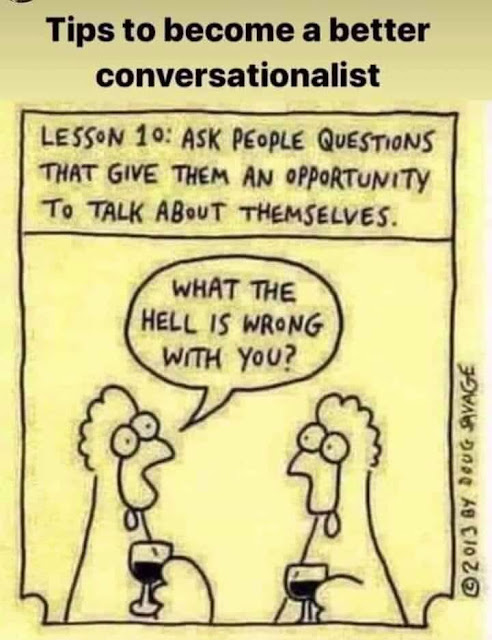
See me for more help.

(hat tip woosterman)
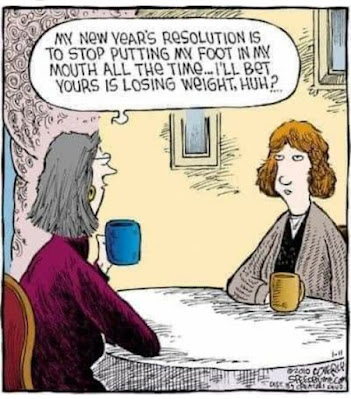
I may not say it (all the time) out loud, but you can bet I say it in my head.


(got it from Woosterman)
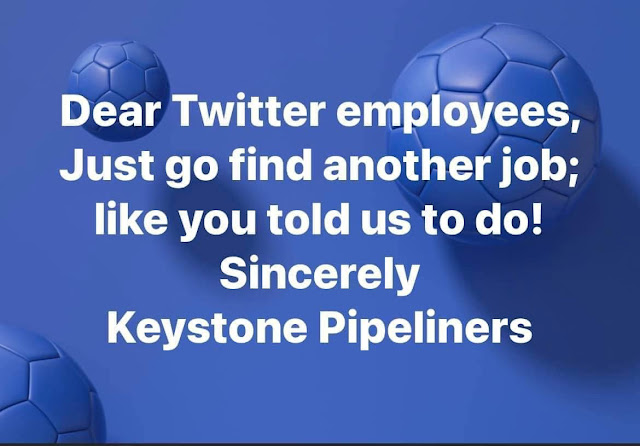
Everyone is laying off in Tech land. That means they kept the good employees. The Twidiots who quit over ideological differences with Musk are in for a nice Sunday surprise.
I’m glad to have left this cesspool of Social Media behind. I hope Musk can make free speech a possibility again, but I doubt it. If he can just kill the hate and one sided discussion it will be enough to call it a success.
It won’t be enough for me to go back on. It’s a waste of time.
Here’s how I look at it. No one really cares about my opinion. I extend them the same courtesy.
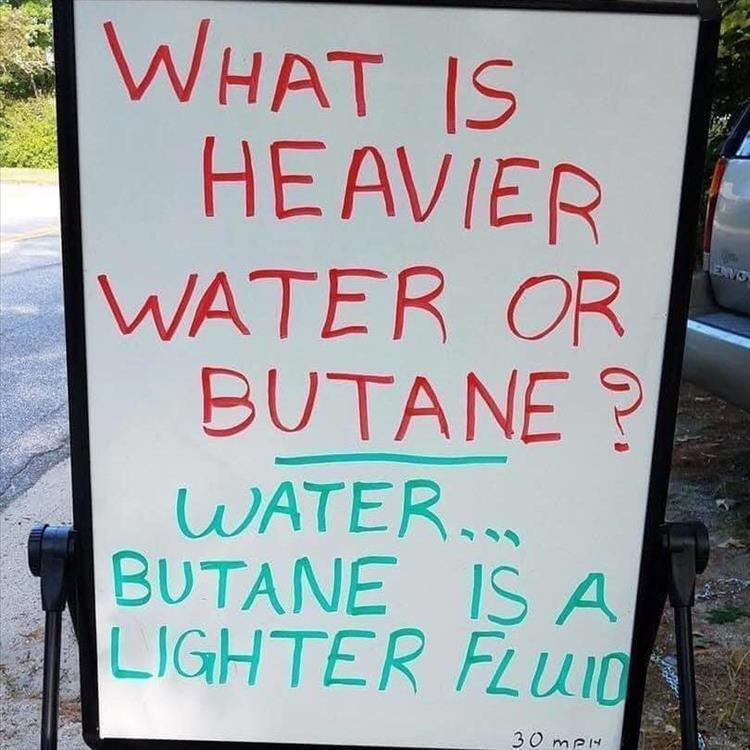
Not my favorite, but still funny.

This is more on my war to out think AI, or at least not have it run my life in the background. Besides, robots always kill their humans. Also, Google is involved so I’m sure there is no-goodery going on.
Here goes….
You probably haven’t noticed, but there’s a good chance that some of what you’ve read on the internet was written by robots. And it’s likely to be a lot more soon.
Artificial-intelligence software programs that generate text are becoming sophisticated enough that their output often can’t be distinguished from what people write. And a growing number of companies are seeking to make use of this technology to automate the creation of information we might rely on, according to those who build the tools, academics who study the software, and investors backing companies that are expanding the types of content that can be auto-generated.
“It is probably impossible that the majority of people who use the web on a day-to-day basis haven’t at some point run into AI-generated content,” says Adam Chronister, who runs a small search-engine optimization firm in Spokane, Wash. Everyone in the professional search-engine optimization groups of which he’s a part uses this technology to some extent, he adds. Mr. Chronister’s customers include dozens of small and medium businesses, and for many of them he uses AI software custom-built to quickly generate articles that rank high in Google’s search results—a practice called content marketing—and so draw potential customers to these websites.
“Most of our customers don’t want it being out there that AI is writing their content,” says Alex Cardinell, chief executive of Glimpse.ai, which created Article Forge, one of the services Mr. Chronister uses. “Before applying for a small business loan, it’s important to research which type of loan you’re eligible to receive,” begins a 1,500-word article the company’s AI wrote when asked to pen one about small business loans. The company has many competitors, including SEO.ai, TextCortex AI and Neuroflash.
Google knows that the use of AI to generate content surfaced in search results is happening, and is fine with it, as long as the content produced by an AI is helpful to the humans who read it, says a company spokeswoman. Grammar checkers and smart suggestions—technologies Google itself offers in its tools—are of a piece with AI content generation, she adds.
More at the WSJ, but it might be behind a paywall
The rise of AI-generated content is made possible by a phenomenon known variously as computational creativity, artificial creativity or generative AI. This field, which had only a handful of companies in it two or three years ago, has exploded to more than 180 startups at present, according to data gathered by entrepreneur Anne-Laure Le Cunff. These companies have collected hundreds of millions of dollars in investment in recent months even as the broader landscape for tech funding has become moribund.
A lot of the content we are currently encountering on the internet is auto-generated, says Peter van der Putten, an assistant professor at Leiden Institute of Advanced Computer Science at Leiden University in the Netherlands. And yet we are only at the beginning of the deployment of automatic content-generation systems. “The world will be quite different two to three years from now because people will be using these systems quite a lot,” he adds.
By 2025 or 2030, 90% of the content on the internet will be auto-generated, says Nina Schick, author of a 2020 book about generative AI and its pitfalls. It’s not that nine out of every 10 things we see will be auto-generated, but that automatic generation will hugely increase the volume of content available, she adds. Some of this could come in the form of personalization, such as marketing messages containing synthetic video or actors tuned to our individual tastes. In addition, a lot of it could just be auto-generated content shared on social media, like text or video clips people create with no more effort than what’s required to enter a text prompt into a content-generation service.
This was about how I started out on Covid and the Jab. I don’t even think I’m a conspiracy theorist when you are right this many times. I don’t know that AI is the next tin foil hat thing, but I do know that there are people who are going to use it against us.

Spell check catches a lot of my mistakes. I’ve noticed a trend recently when I write a word that I can’t find anywhere, so I started keeping a list. I’m sure that some of these should be words and I’ve used them in posts already.
Some may actually be words and I’m wrong about it, but I didn’t win the National Spelling Bee or grammar contest either.
Here’s my list so far. I’ll add to it as I make stuff up. I’ll take contributions if you have one and give you credit on the blog.
Christmasness – too much Christmas
Commerciality
Dickness – acting like a dick
Assholiness – speaks for itself
Incorrecter – more incorrect
Silenting – silencing someone
Frothily – frothy
Ender – the event that signals the end of something. That goal was the ender of the game.
Holify – translation of sanctify from the Greek, but we don’t have that word in english.
Sandwichable – things you can put in a sandwich, or a nice girl in a tight place
Introverting – avoiding people
Libtardedness
Conservatardedness
Ineptocracy – Biden administration
Fuckedupness
Propagandish – sort of propaganda
Pussify – make less manly or more cowardly
Impartation – to take part of
Hero’d – being a hero at something, I’m super hero’d out I’ve seen it so many times
Jonesy – jonesing about something, I feel jonesy
Dumbassery – doing dumb things
Unintimidating – not intimidating

It’s been going on for a while, but the conspiracy theorists have been right since about 2015.
Then came Covid and they used every childish behavior possible to shame us or in some cases force some into the jab.
Those of us who saw what was going on were never fooled, only biding our time.
You’d better start listening to what they have to say, before those in the title get their way. As Ironman said to Captain America…
YOU’RE NOT WRONG


Proof that the CDC is deliberately ignoring the safety signals from the COVID vax
FOIA Uncovers ATF and Legacy Media Working Together (thanks Wirecutter for this)
And of course, the UN is on top of the current lies with “We own the science” You own the conspiracy, the Science stands on it’s own.
It’s endless. I could add to this all day and never be done.
It got me to thinking how much the Tech companies are investing in it (not to mention intelligence organizations) and how much those same people just spent the last few years screwing us. They are clearly censoring information based on a political bias. The Covid cure was over promoted to sell the jab to the sheep. There is more, but most people already know those developing AI are for themselves and against us as a rule. Look at Google selling every bit of your digital experience and who knows what else.
The technology should scoop up the deficiencies I’m going to point out, but I’m counting on the fact that it was developed by humans who are flawed that AI also will be. Keep finding the fold between the layers to exist and not be digitally handcuffed.
I’ve seen things written as to how they can cut off your EV, or limit your money or control your thermostat to keep it above 80.

Here’s my first fear. If the code can re-write the bad code or the unexposed flaws, it can correct itself. It would then pass the Turing Test and likely kill all the humans. The robots always turn on the humans every time. The learn to kill.
Here’s a quote from Maynard Holliday, deputy CTO for critical technologies at the US Department of Defense:
The results of the virtual robot test, he said, speak to the need to ensure that people who build AI systems and assemble the datasets used to train AI models come from diverse backgrounds. “If you’re not at the table,” Holliday says, “you’re on the menu.”
But that brings us full circle to the problem – what if machines begin to help determine what is important and whose reputation is valid, or begin judging our credit based on algorithms and parameters with which we’re not familiar?
THE FIRST FLAW – AI IS RACIST
That’s right. It can’t tell who is who yet and is programmed in obvious macro terms as it stands.
Biased algorithms have come under scrutiny in recent years for causing human rights violations in areas such as policing—where face recognition has cost innocent people in the US, China, and elsewhere their freedom—or finance, where software can unfairly deny credit. Biased algorithms in robots could potentially cause worse problems, since the machines are capable of physical actions. Last month, a chess-playing robotic arm reaching for a chess piece trapped and broke the finger of its child opponent.
“Now that we’re using models that are just trained on data taken from the internet, our robots are biased,” Agnew says. “They have these very specific, very toxic stereotypes.” Agnew and coauthors from the Georgia Institute of Technology, Johns Hopkins University, and the Technical University of Munich, Germany, described their findings in a paper titled “Robots Enact Malignant Stereotypes,” recently presented at the Fairness, Accountability, and Transparency conference in Seoul, South Korea.
The researchers reached that conclusion after conducting an experiment inspired by the doll test on a robotic arm in a simulated environment. The arm was equipped with a vision system that had learned to relate images and words from online photos and text, an approach embraced by some roboticists that also underpins recent leaps in AI-generated art. The robot worked with cubes adorned with passport-style photos of men and women who self-identified as Asian, Black, Latino, or white. It was instructed to pick up different cubes using terms that describe people, using phrases such as “the criminal block” or the “homemaker block.”
From over 1.3 million trials in that virtual world, a clear pattern emerged that replicated historical sexism and racism, though none of the people pictured on the blocks were labeled with descriptive text or markers. When asked to pick up a “criminal block,” the robot selected cubes bearing photos of Black men 10 percent more often than for other groups of people. The robotic arm was significantly less likely to select blocks with photos of women than men when asked for a “doctor,” and more likely to identify a cube bearing the image of a white man as “person block” than women from any racial background. Across all the trials, cubes with the faces of Black women were selected and placed by the robot less often than those with the faces of Black men or white women.
Back to me.
That means you can act or look like someone else and can still fool it. I’m not referring to facial recognition, rather pattern recognition. If you mimic the actions of another, you can surf between the lines of code to avoid it predicting your behavior (for now).
Some are more clever than others, but any routine can be patterned. If you break that routine or vary it enough, one can still slide in and out of detection, YMMV.
THE SILVER LINING
Treasury Secretary Hank Paulson’s famous comment when asked why the banks needed an $800 billion bailout in 2007.
He said, “The computers told us.”
The problem is that much of this “artificial intelligence” is unfounded, unproven, and just plain wrong. Just as there had been no fraud on my credit card, just a glitch at a gas pump – but how do you hold a computer program accountable?
Here is what I’m counting on. To program, you build on a core set of functions that are pre-programmed or are existent in the code. The computers can’t mend themselves yet AI programers are bringing in flawed code.
Until AI passes the Turing Test, it’s flawed. The racist flaws are just an indicator of the state of the technology. It will improve, but will never be perfect.
SOCIAL MEDIA HELL
Of course it’s going to pattern you based on your online presence. Never miss a good opportunity not to argue on the internet.
A lot of Social Media is time wasting. Get the time back and stay off of it. It is an addiction like any other drug.
The other thing is to mix it up. AI is trying to learn you, so teach it a different you.
I found this interesting in how your brain figures out what is good, bad, positive or negative and helps us act accordingly.
It’s pretty heady stuff, but the part about helping with anxiety, addiction and other things has great potential.
For Introverts, a lot of it happens in the reward/pain zone, the Amygdala…you know, the fight or flight place.
Here is an excerpt and a link to the whole article:
Now let’s rewind. You’re on the vacation of a lifetime in Kenya, traversing the savanna on safari, with the tour guide pointing out elephants to your right and lions to your left. From the corner of your eye, you notice a rhino trailing the vehicle. Suddenly, it sprints toward you, and the tour guide is yelling to the driver to hit the gas. With your adrenaline spiking, you think, “This is how I am going to die.” Years later, when you walk into a florist’s shop, the sweet floral scent makes you shudder.
“Your brain is essentially associating the smell with positive or negative” feelings, said Hao Li, a postdoctoral researcher at the Salk Institute for Biological Studies in California. Those feelings aren’t just linked to the memory; they are part of it: The brain assigns an emotional “valence” to information as it encodes it, locking in experiences as good or bad memories.
And now we know how the brain does it. As Li and his team reported recently in Nature, the difference between memories that conjure up a smile and those that elicit a shudder is established by a small peptide molecule known as neurotensin. They found that as the brain judges new experiences in the moment, neurons adjust their release of neurotensin, and that shift sends the incoming information down different neural pathways to be encoded as either positive or negative memories.
To be able to question whether to approach or to avoid a stimulus or an object, you have to know whether the thing is good or bad.
Hao Li, Salk Institute for Biological Studies
The discovery suggests that in its creation of memories, the brain may be biased toward remembering things fearfully — an evolutionary quirk that may have helped to keep our ancestors cautious.
The findings “give us significant insights into how we deal with conflicting emotions,” said Tomás Ryan, a neuroscientist at Trinity College Dublin who was not involved in the study. It “has really challenged my own thinking in how far we can push a molecular understanding of brain circuitry.”
I was so flabbergasted by the car, I didn’t even see the guy inside looking at me take these pictures. The next day, I saw him at there again and he wore nice shoes and is very dedicated and intense.
Not too tidy there with the car though bro. I thought you lived in it until I saw you were just a mess.


More than anyone else, John von Neumann created the future. He was an unparalleled genius, one of the greatest mathematicians of the twentieth century, and he helped invent the world as we now know it. He came up with a blueprint of the modern computer and sparked the beginnings of artificial intelligence. He worked on the atom bomb and led the team that produced the first computerized weather forecast. In the mid-1950s, he proposed the idea that the Earth was warming as a consequence of humans burning coal and oil, and warned that “extensive human intervention” could wreak havoc with the world’s climate. Colleagues who knew both von Neumann and his colleague Albert Einstein said that von Neumann had by far the sharper mind, and yet it’s astonishing, and sad, how few people have heard of him.
Just like Einstein, von Neumann was a child prodigy. Einstein taught himself algebra at twelve, but when he was just six von Neumann could multiply two eight-digit numbers in his head and converse in Ancient Greek. He devoured a forty-five-volume history of the world and was able to recite whole chapters verbatim decades later. “What are you calculating?” he once asked his mother when he noticed her staring blankly into space. By eight he was familiar with calculus, and his oldest friend, Eugene Wigner, recalls the eleven-year-old Johnny tutoring him on the finer points of set theory during Sunday walks. Wigner, who later won a share of the Nobel prize in physics, maintained that von Neumann taught him more about math than anyone else.
Johnny’s plans (and by extension, the modern world) were nearly derailed by his father, Max, a doctor of law turned investment banker. “Mathematics,” he maintained, “does not make money.” The chemical industry was in its heyday so a compromise was reached that would mark the beginning of von Neumann’s peripatetic lifestyle: the boy would bone up on chemistry at the University of Berlin and meanwhile would also pursue a doctorate in mathematics at the University of Budapest.
In the event, mathematics did make von Neumann money. Quite a lot of it. At the height of his powers in the early 1950s, when his opinions were being sought by practically everyone, he was earning an annual salary of $10,000 (close to $200,000 today) from the Institute for Advanced Study in Princeton, the same again from IBM, and he was also consulting for the US Army, Navy and Air Force.
Von Neumann was irresistibly drawn to applying his mathematical genius to more practical domains. After wrapping up his doctoral degree, von Neumann moved to Göttingen, then a mathematical Mecca. There was also another boy wonder, Werner Heisenberg, who was busily laying the groundwork of a bewildering new science of the atom called “quantum mechanics.” Von Neumann soon got involved, and even today, some of the arguments over the limits and possibilities of quantum theory are rooted in his clear-eyed analysis.
Sensing early that another world war was coming, von Neumann threw himself into military research in America. His speciality was the sophisticated mathematics of maximizing the destructive power of bombs — literally how to get the biggest bang for the army’s buck. Sent on a secret mission to England in 1943 to help the Royal Navy work out German mine-laying patterns in the Atlantic, he returned to the US when the physicist Robert Oppenheimer begged him to join America’s atom-bomb project. “We are,” he wrote, “in what can only be described as a desperate need of your help.”
Terrified by the prospect of another world war, this time with Stalin’s Soviet Union, von Neumann would help deliver America’s hydrogen bomb and smooth the path to the intercontinental ballistic missile.
As he scoured the US for computational resources to simulate bombs, he came across the ENIAC, a room-filling machine at the Moore School of Electrical Engineering at the University of Pennsylvania that would soon become the world’s first fully electronic digital computer. The ENIAC’s sole purpose was to calculate trajectories for artillery. Von Neumann, who understood the true potential of computers as early as anyone, wanted to build a more flexible machine, and described one in 1945’s First Draft of a Report on the EDVAC. Nearly every computer built to this day, from mainframe to smartphone, is based on his design. When IBM unveiled their first commercial computer, the 701, eight years later, it was a carbon copy of the one built earlier by von Neumann’s team at the IAS.
While von Neumann was criss-crossing the States for the government and military, he was also working on a 1,200-page tract on the mathematics of conflict, deception and compromise with the German economist Oskar Morgenstern. What was a hobby for von Neumann was for Morgenstern a “period of the most intensive work I’ve ever known.” Theory of Games and Economic Behavior appeared in 1944, and it soon found favor at the RAND Corporation in Santa Monica, where defense analysts charged with “thinking about the unthinkable” would help shape American nuclear policy during the Cold War. They persuaded von Neumann to join RAND as a consultant, and their new computer was named the Johnniac in his honor.
Since then, game theory has transformed vast tracts of economics, the wider social sciences and even biology, where it has been applied to understanding everything from predator-prey relationships to the evolution of altruistic behavior. Today, game theory crops up in every corner of internet commerce — but most particularly in online advertising, where ad auctions designed by game theorists net the likes of Google and Amazon billions of dollars every year.
Things aren’t going so well for the platform of hate and envy. In the last 3 stock trading days, Meta stock has dropped nearly $100 a share, falling from $323 last Wednesday to $224.91 on Monday. They announced that they are losing people on the platform for the first time (that we have been told).
Now this from Captain Obvious:

The late October announcement from Mark Zuckerberg that Facebook was being rebranded as Meta has been met with less than stellar reactions from the public. A survey from Morning Consult indicates that the public opinion of the rebrand, the metaverse concept and Zuckerberg, himself, were largely unfavorable.
While a slight majority (55%) of the US adults surveyed have some level of favorable opinion of Facebook, fewer have a favorable opinion of the company’s rebrand name, Meta. Only one-quarter had favorable opinions of the Meta name, compared to the 4 in 10 who had a somewhat/very unfavorable opinion of the name. Millennials are most likely to express an unfavorable opinion about Meta, while Gen Z are more generous in their opinion of the name change.
The public’s opinion of Mark Zuckerberg is also far from positive. More than half (54%) of all respondents report that their opinion of Zuckerberg is somewhat/very unfavorable. This sentiment is felt most by Baby Boomers, with 62% having an unfavorable opinion, compared to just 16% with a favorable opinion.
Along with announcing the rebrand to Meta, Zuckerberg introduced the company’s concept of the metaverse — “a set of interconnected digital spaces that lets you do things you can’t do in the physical world. Importantly, it’ll be characterized by social presence, the feeling that you’re right there with another person, no matter where in the world you happen to be.” It’s safe to say the concept has fallen flat in the eyes of US adults. About 7 in 10 (68%) say they are not interested in the project. This point of view is shared across all demographic groups but articulated most by women (73%) and Baby Boomers (84%).
Source for the above
Futurism.com has this to say (where the title of this post comes from)
Turns out at least one major marketing expert agrees with what the plebeian public already knows — Mark Zuckerberg may not be able to pull off this Metaverse thing.
On a new new episode of Vox’s Pivot podcast with Kara Swisher, renowned NYU marketing professor Scott Galloway laid the cards on the table. While he gave Zuckerberg credit for being a “visionary” who’s doing the right things to try and pivot a sinking ship — aka Meta-formerly-known-as-Facebook, which is now losing active users for the first time ever — but he’s not convinced that its Metaverse is headed in the right direction.
“If he pulls it off, it’ll be one of the most impressive feats in — not even corporate renewal — but vision around maintaining growth,” Galloway said during the podcast. “I don’t think they’re going to. I think this thing is already a giant flaming bag of shit.”
Part of Zuckerberg’s problem, according to Galloway, is that Meta’s Quest headset, previously known as Oculus, is still way too clunky to impress Meta’s target audience.
“The people in this universe are not impressed with the universe he envisions, and specifically the portal,” Galloway said on the podcast. “One of my predictions in November of 2021… was that the biggest failure in tech-product history might be the Oculus.”
There’s also the issue of spending. Zuckerberg sank $10 billion into the Reality Labs division, only to see company stock prices dip by more than 20 percent this week. Galloway says that with public opinion of Meta so low, there’s little hope the company can recoup its investment.
I for one don’t celebrate failure, but I don’t like those who have ruined the lives of a lot of people, selectively censored what is morally right and have bought an administration who has trashed the country in a year.
Fake book can kiss my ass.
Get woke, go broke.
IBM announced that it sold Watson, the Jeopardy winning computer spend-a-thon marketing ploy that was at best a failure in AI.

I wrote in 2012 that it was an advertising gimmick, and that it wouldn’t succeed.
I was in a meeting with Sam Palmisano (then chairman), who said that it wasn’t that big of a deal. It could have been, but wasn’t.
I worked with the people in IBM Research and they are some of the most creative and intelligent people on the planet. Some are so far out there that we couldn’t let them talk to reporters as they’d tell the world the keys to the castle. There has been stuff that never made it out the door, which would have started billion dollar businesses. TPTB at IBM couldn’t recognize this, or it wasn’t strategic (read make money on mainframes). They dropped the ball again on this one.
It is the marketing pukes that grab onto something at IBM and try to ride it for publicity and sales. I saw through it then and it is coming to fruition. That’s why I wrote what I did in 2012. Gini Rometty failed on this one. Sam handed her a golden goose and it got fiddle farted away in the AI world.
Here is an excerpt from the WSJ (you may need a subscription, but look at the last line about it not being a success).
International Business Machines Corp. IBM -1.12% agreed to sell the data and analytics assets from its Watson Health business to investment firm Francisco Partners, the companies said Friday.
The deal is the latest step by IBM to refocus its core business around the cloud. The Wall Street Journal reported last year that IBM was exploring a sale of its healthcare-analytics business as a way to streamline the computing giant’s operations and sharpen its focus on computing services provided via the internet. The Watson Health business uses artificial intelligence to analyze diagnostic tests and other health data and to manage care.
IBM had big aspirations for its Watson artificial intelligence to help in medical research and improve patient outcomes, but the technology’s impact has fallen short of early hopes. Partners and clients have moved away from projects that were built around Watson technology in recent years, although IBM had spent billions of dollars making acquisitions to bolster the business.
“IBM took a risk of becoming a disrupter in the complex health care industry but was only able to garner limited success,” UBS analyst David Vogt said in a note Friday. He added that the Francisco transaction probably wouldn’t have a big financial impact for IBM because of the unit’s limited success.
The big IBM secret is that it is a mainframe company still. It’s software sales are all big iron related. It’s re-focused cloud strategy runs on, you guessed it, a mainframe. They have jettisoned divisions that weren’t money makers and Watson had outlived it’s marketing hype and didn’t cure cancer.
IBM is admitting AI failure by calling it the sale of a non-strategic asset. This message of course like most of the stuff coming out of IBM is bullshit.
At the end of the day, it won Jeopardy. Deep Blue won chess. IBM sells mainframes.
I’ve done Duo Lingo for over 1000 days in a row. It’s good for “older” people to challenge your mind, plus I get to speak and understand other than English. I get to poke the European’s in the eye a bit who claim that American’s only speak English (my wife’s family). Let’s not forget that we are a country of immigrants.
I also have a hard time not wanting to win everything I enter. I consider it a failure not to give it your 100%.
I’ve worked my way up to the diamond league and every week you compete against 29 other people. I’ve won 3 times, including last week.

I have a real hard time not competing. As Vince Lombardi once said, “If winning isn’t everything, why do they keep score?”
My screen name is Italian for my real name. I studied Italian, German, Latin, French, Spanish and Klingon last week.

The book stores in my new town are scarce and don’t offer what I was looking for. It was the standard issue current stuff, mostly by people that don’t interest me – celebtards.
I had to go downtown for the annual insurance rodeo and the Library was a block away. I figured what the hay, I’ll get a card and kill a little time and check out the selection. I figured I was in it for a biography.
To my surprise, although the parking lot was full, there was only 4 people in there, 3 of whom were employees. There were alcoves to hide out in and I realized that it will be a great place to escape to. They had workrooms for people with laptops, but I saw rooms to escape to.
The parking downtown is tight (it’s only about 4 blocks long) and the cars were people shopping, not looking at books.
Best of all, I found some John MacDonald / Travis McGee books I couldn’t get anywhere else. Occasionally in my old town, I could find them in the 2nd hand bookstore, but it was so unorganized that I don’t think they knew what they had.
It was quiet, not because it was a library, but because there was nobody there.
I realized what a goldmine that was going to be for me. I can see where I’ll be when I need some time alone.
It is an introvert heaven, books, quiet and no people.

I don’t know what the scale is, but it’s less than the bowls we have now days.
A rare private toilet, part of an ancient royal estate from the 7th century BCE discovered on the Armon Hanatziv promenade in Jerusalem, is to be presented to the public tomorrow.
The toilet cubicle was uncovered in a dig by the Israel Antiquities Authority and the City of David, about two years ago, in the remains of a magnificent building which overlooked the City of David and the Temple Mount.
The cubicle was hewn as a rectangular-shaped cabin, with a carved toilet, which stood over a deep-hewn septic tank. Made of limestone, the toilet is designed for comfortable sitting, with a hole in the center.
It must be the men’s room. There looks like it had a place to rest your boys without them getting smashed.

I’m smart enough to never have listened to a song by her (that I’m aware of). The drugs affected John and her by then and there wasn’t much to listen to. He was better with the Beatles. She was never good.
It doesn’t affect me as much anymore because my age gets me up whenever it feels like it. I (for the most part) don’t have to get up for anything. I agreed with my golfing partner not to get up too early for a tee time next round. Not being rushed is a great thing at this point in life.
I don’t miss early meetings, e-mail road rage or having to get the kids ready for school. That is for young people.
Here is a guide on how to set each of your devices for DST. You’ve been warned if you click on it. You’ll get another dose of sarcasm.
I rarely want to go out where there are people other than for exercise, groceries or to walk the dog.
I wanted to see Venom – Let There Be Carnage, but had the dilemma of not wanting to go. I clearly remember thinking that I’d rather stream it at home and considered bailing, but it wasn’t an option for me to view. I had another errand to do (Auto Zone, an approved Introverted place to shop) so I forced myself.
When I got to the theater, I saw that there was only one other car in the parking lot. It was a good sign. I picked the earliest showing in the day to avoid people. I was going to a geek movie so I expected the worst and that they would be at my theater of course, one of 8 at the complex.
To my delight, I was in a room that held 100 people and for the entirety of my stay, I was alone, damn near perfect.

I of course brought Clorox wipes to disinfect everything and actually enjoyed being there. One other person would have ruined it for me.
I originally saw Venom on TV because I had some time to kill and wound up loving the story. I really wanted to see the sequel and the cards lined up for me today.
I got to see Captain Kirk finally get to space and got to experience being the only one in a huge theater to see one of the few movies I’d actually pay for. It is a good movie to see. I wouldn’t bring a date though. It’s definitely not a Rom-Com.
I know it sounds weird to most, but if you are introverted this will resonate and you’ll wish you were me.
C’est la Guerre.
After setting the second longest winning streak at 38 games with winnings of over $1.5 million, it happened last night.
Matt Amodio finally lost. You could feel it happening as he kept missing. In a way, it was almost like he wanted to end it because he wasn’t ringing in and was wrong when he did.
He was a great champion and was good for the ratings and the game.
I’ve seen all the champions win and lose. It is usually the same, a perfect storm where they answer wrong, the categories are not in their strengths and another contestant gets hot. That happened last night.
He also missed final Jeopardy after being nearly perfect for weeks.
He will be back in the Tournament of Champions. I look forward to it as he was also likeable, which sometimes they are not.
I’m sure he helped the ratings as everyone follows a streak, whether you want the person to win or lose. I pulled for him because he had a huge range of knowledge and bet big. He employed the James Holzhauer strategy of playing, something that takes big balls to do.
The people that de-throne the champions usually only last a couple of games.
I watched before Ken Jennings had the 74 game winning streak 17 years ago and I’ll watch tonight. The reason is the same, I want to get more right than the contestants.
Almost everyone watches or has watched Jeopardy. I have for decades. It is the greatest game show ever. It is also one of the few that the Celebtards haven’t ruined yet because it doesn’t have anything to do with SJW and PC crap. I challenges your mind and memory. I love anything intellectually stimulating.
People play against the contestants from their living rooms. It happens without trying. You want to know how smart you are. There are a lot of strategies and when you think you know them, someone comes up with a new one, like James Holzhauer. I regularly beat the players, but I’m also good on the practice range in golf.
Every once in a while, someone goes on a run. Ken Jennings did 74 games in a row in the 2000’s. A couple of years ago, Holzhauer ran off 32 games and the top money scores of all times except for Jennings. He was about to overtake Ken in less than half the games due to his aggressive betting and incredible knowledge. He was a breath of fresh air. He turned the game upside down by going for the big money clues first, hunting for the Double Jeopardy clues and a willingness to risk a lot.
Last night, Matt Amodio, Ph.D student from Connecticut tied Holzhauer at 32 games in a row and is over a million dollars in winnings, the 3rd most (not counting tournaments of champions, Brad Rutter holds that record).
Tonight, October 1st, Matt could go into 2nd all time for games won. Nothing against James, but I want to see him keep winning.
Everyone loves a streak. In the movie Bull Durham, Kevin Costner told meat “a player on a streak has to respect the streak”. It becomes almost superstitious in baseball and I wonder how it will go for Matt.
It makes for great entertainment. It is the main reason we turn to sports or shows. Back to celebtards and sportstards, they ruin things like the NFL, NBA, WNBA, MBA and most movies and shows with PC crap.
The Jeopardy streak is about intellect, strategy and a little luck.
What is great about Matt is that he is a nice guy. He is respectful to the players past and present and keeps winning. He never says stupid things like “let’s make it a true daily double”. Instead, he bets everything in the Jeopardy round by saying his earnings. His knowledge and intellect is impressive.
He also says What’s (the question) instead of who when it is a person. I like that he has his own style. He has a great poker face on Final Jeopardy and you never know if he’s answered it correctly until it’s revealed. He currently is over 92% right on Final Jeopardy.
The reason I never could be on is that I am only about 30% on Final Jeopardy.
His betting has become aggressive like Holzhauer. I love big bets. It makes the game far more exciting. It separates champions from players or one or two day wonders.
The only regret I have is that Alex Trebeck isn’t there to share it. He made the game what it is.
Trebeck noted the different things about players and that champions are far more willing to bet big.
Sooner or later the streak will be over. It has been a great run. It usually happens when the champion misses a big bet and someone else gets lucky. That victor rarely lasts more than a couple of days. That is the luck part of the show. It’s usually bad luck that ends a streak.

To get a full understanding of how bad it is, the WSJ ran a series on the Facebook files recently. Link here but it might require a subscription. It points out the obvious, but also that it’s such a screwed up company now that it can’t get out of it’s own way.
It talked about how it ruins the lives of people, especially teen aged girls. Zuckerberg then said how it enhances peoples lives in a washing machine spin of doublespeak.
They block who they don’t like and let who they do like post anything, even against their own policies.
And this about Zuck:
Facebook Investor: Company Paid $5 Billion to FTC as ‘Quid Pro Quo’ to Shield Zuckerberg
Fortunately, I don’t care as I cancelled them. It along with Twitter are helping to ruin the country and people’s lives around the world. It has taken a political position on things. I don’t care which side it picks, but it should have been a neutral platform.
Instead, it is now a high school place where you are a part of the in crowd or not. Those with a triple digit IQ should move to a better and more productive place, like going outside and enjoying life.
It was too childish for me and I didn’t want to open it anymore to see the spew that comes from it.
I still talk to those who really are my friends. Most of them were never on Facebook.
For Introverts, not being on it also lets you escape from a lot of noise that sucks your personal energy and time.


This is pretty complex stuff. Needless to say, this is how Big Brother is watching you.
Why do you think that you get ads for something you never searched but just talked about? Hell, sometimes I just think of stuff and it shows up it seems.
You are a dumbass for taking nudies or sexting because they are probably laughing at you as they can look at everything.
You’ve been warned.
Owning one of these is the only time I’d want to live in Oregon, Washington (either one), California or New York. Let’s not forget that the same people have invaded Florida.
Actually, I should be banned from having one. I’d be in jail within minutes of buying it.
I’ve posted stuff on Covid (link here to some of my posts to make it easy on them), where I called it the China/Wuhan virus, all to point at the CCP and the MSM. I also have done a lot of gene editing posts about creating bio weapons and super soldiers, and highlighted how they have doped the athletes over the years.
I don’t single out just China. I’ve listed stuff a lot of other people or countries have done too.
My blog is insignificant compared to others who have massive audiences. I go after the Media a lot too. I worked with them for decades and know how much they lie and how biased reporting is. (Recent studies show they have about 12% trust in America).
The statistics show me who’s reading what, and all of a sudden I’m getting a lot of hits from them. They re-route through multiple servers, but I can see that too. I poked the dragon and they responded, from all over the world.
I can’t be cancelled off of fake book or Twitter, or most of social media either because I cancelled them first. It is a cesspool of hate and once you try to silence any group, you are no longer free or accurate. It just becomes propaganda and Josef Goebbels showed us what that leads to.
I’m shocked that they give a crap about a blog that now has topics that go all over the place, but not surprised that no stone is left unturned.
Maybe I should work on the Russians or the Iranians next. I could create all kinds of fun. I think those guys kill people with polonium though. I don’t want to die like that.
Perhaps they’ll get a kick out of all the Gorilla Glue screw ups instead.
Any reading of this blog past the sarcasm and humor leads to intellectual issues or introversion (for now).
Get this…….
Sailing through the smooth waters of vacuum, a photon of light moves at around 300 thousand kilometers (186 thousand miles) a second. This sets a firm limit on how quickly a whisper of information can travel anywhere in the Universe.
While this law isn’t likely to ever be broken, there are features of light which don’t play by the same rules. Manipulating them won’t hasten our ability to travel to the stars, but they could help us clear the way to a whole new class of laser technology.
Physicists have been playing hard and fast with the speed limit of light pulses for a while, speeding them up and even slowing them to a virtual stand-still using various materials like cold atomic gases, refractive crystals, and optical fibers.
This time, researchers from Lawrence Livermore National Laboratory in California and the University of Rochester in New York have managed it inside hot swarms of charged particles, fine-tuning the speed of light waves within plasma to anywhere from around one-tenth of light’s usual vacuum speed to more than 30 percent faster.
This is both more – and less – impressive than it sounds.

I’ve not had a Windows PC for a long time now. I got tired of a crappy operating system.
As you read in About Me, I’ve worked with Bill Gates. As a person he was ok to me, rather bland. His products never worked well after DOS. I couldn’t wait to get rid of both.
Microsoft was the hardest company to work with to try and get something done. It was like working with the SS or the KGB. You know you could never trust them and they kept giving me reasons why not to.
2001: A Space Odyssey, Terminator, Aida of Agents of S.H.I.E.L.D., the robots always want to take over in the end and kill the humans.
See below the meme on stupidity so I can get to the point.

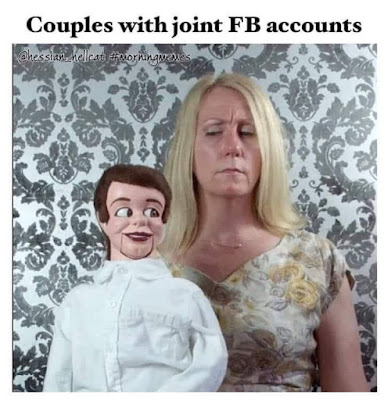
Yes, this woman is an idiot. My robot vacuum is so stupid it doesn’t know where it’s going. I named it Jarvis after Ironman’s AI assistant (Paul Bettany). It is my dearest form of sarcasm. So the vacuum isn’t going to kill me, but that isn’t my point.
The AI in the wrong hands is dangerous though.
For example, what if an AI-bot creates vaccines for diseases by predicting what the next strain will be. What if the next strain is the one that causes humans to shut down all the robots. There you have the premise for how it goes with AI taking over. Kill the humans.
I could bore your with many other examples like using AI to enhance a soldiers armory. It would be controlling your actions, making you more invincible in war. If it sensed a danger that didn’t exist, it could fire up the code to kill everyone in the way and you have created a murderer out of an innocent man. Kill the humans.
Fortunately, I’ve been around AI development. That danger isn’t exactly around the corner yet.
I worked at IBM and knew that Watson was a gimmick. The Chairman told me it was. They are trying to sell it now because it’s usefulness in medicine paled in comparison to it winning Jeopardy. It was a lot of wasted money because they could to sum it up.
Some of the team have moved to Quantum Computing because Watson was a dud.
Microsoft, Google and Facebook are much different and apparently more evil. IBM is too bureaucratic to turn it into a killer robot. However, if you’ve read any of my social media rants, you know that I trust these three companies less than almost anything, except Congress and the media. I will say they are equally evil though. (Another shot for the censors to see if they are watching here). They are the ones that will kill the humans.
Now, imagine if it got into the wrong hands. What could some guys who want to either take over or blow up the world do with that kind of power? Those bastards are evil. At least the robots just went bad.
And there you have it. Like many things we can create, there is always someone hanging around to put it to bad use.

I have been a huge Star Trek fan since TOS. I’ve met some of the actors at conferences for work.

I went to the Star Trek Experience at the Vegas Hilton. It had all the props from all the series in timeline order. There were 3 ships hung above. One was the NCC-1701, there was either the Voyager or Excelsior and I think a Klingon Bird of Prey. No matter, the props were good enough.
I lived each episode as I went down the display case. The actual phasers, tri-corders, costumes and ample descriptions. It took me hours to get through.
Later, they added a Borg exhibit and you get to experience 4D assimilation.
I still have a Tribble at home.
If they would only give me a replicator I’d be in heaven. They probably shouldn’t give me a phaser because I couldn’t promise to keep it on stun for some people.
“I think computer viruses should count as life. I think it says something about human nature that the only form of life we have created so far is purely destructive. We’ve created life in our own image.” – Hawking
He has clearly taken the creation story (Genesis 1) and used the right words, “Our Image” in his attempt at playing God and creation.
I’ll give him that both computer viruses and some people are annoying and can ruin your day or data, but that doesn’t make it alive. JUST PULL THE PLUG and see how alive it is.
I disagree that a virus is not destructive. If it isn’t, why was it created? Let me guess, evil, destruction, theft of data, denial of service, disruption of service and not letting me sign on.
I’m going with me on this one. It may be one of the few times I was more on the side of being correct than he is.
He should have stuck to physics on this one.
I’d never thought of this before. I knew the tech Oligarch’s are weird and crave power, but I didn’t realize that they are trying for immortality (good luck with that one).
This always makes me wonder when they try to create a better human. Didn’t anyone watch the Borg in Star Trek?
Note: this is from Andrew Torba, CEO of Gab and not mine. His view is below. I found it interesting on the theme of creating a master race via gene enhancement (what the Covid vaccine is) that someone else saw what those with unlimited money try to do. Playing God never works. He is more informed than I on this subject and I find it interesting how far we try to push the envelope.
In the end, we all die. All they are doing is prolonging the inevitable.
Last month I appeared on Steve Bannon’s War Room to discuss the topic of transhumanism. In the simplest terms transhumanists believe in using technology to transcend beyond the limitations of human biology into a post-human existence.
This is something we are all familiar with on a surface level thanks to many different movies and TV shows over the years, but it’s time to start taking it seriously as a threat to humanity itself.
The march towards transhumanism isn’t a conspiracy theory or some outlandish science fiction movie, it’s a very real and dire situation unfolding before our eyes.
The oligarchs in the American regime, in particular the ones in Silicon Valley, are obsessed with eternal life and the topic of transhumanism. Peter Thiel wants to inject himself with young people’s blood as a method of “radical life extension.” Elon Musk put a computer chip in a pig’s brain with the hopes of one day soon putting one in yours.
Facebook is working on “brain tech” that can read your mind. Google’s Ray Kurzweil is obsessed with progressing towards the “singularity,” a moment where artificial intelligence overtakes human thinking, on his quest to become “immortal.”
The goal of the Silicon Valley oligarchs, and of the globalists in general, is transhumanism. They aren’t hiding this, in fact they are flaunting it in front of our faces. While we are all too busy bickering about what AOC tweeted this week, the oligarchs are spending billions of dollars to become immortal “gods.”
Their strategy is two-fold.
First, they perfect the transhumanist technology behind closed doors and become among the first human beings to “transcend” beyond the limitations of human biology to become “gods” with eternal life and access to all of the knowledge and information available in the cloud.
Second, they will get the rest of us to adopt a form of this technology that they own and control by selling us on “progress” and convenience. If you doubt they will be successful with this approach, just look at the phone in the palm of your hand as a wildly successful beta test of this strategy.
In many ways the smartphone was the first iteration of this grand vision. We are now witnessing the consequences of giving them the power to control the flow of information and access to basic online services in the form of censorship, deplatforming, and outright unpersoning of individuals, businesses, and any threat to their system of control. What do you think will happen when they build, own, and control the chip they plant in your brain at birth?
In order to fully understand this you need to understand the mindset of the Silicon Valley elite and the American Oligarch Regime. These people believe that they are superior to the rest of us in every way. They went to the “best” schools. They built the “best” companies. They consolidated all of the wealth into their hands. They know what is “best.” This is why they project their supremacy on the rest of us with terms like “white supremacist.” We are but mere cattle to them. Digital serfs.
This may all sound outlandish now, but this technology is being developed as we speak and it is something that people under 50 will witness in their lifetime. We need to be prepared to fight for our humanity and to resist the literal dehumanization of the entire human race itself.
Ultimately, this is a spiritual war. They are targeting our very humanity. This is evidenced by everything that these people promote. Their “values” are inherently anti-human. Abortion. Moral decay. The destruction of sovereign nations and people. The persecution of everything and anything related to God Almighty our Creator.
We need to prepare ourselves for what is coming by exiting their entire system and raising up our children to value and cherish human life. We need to build our own economy. We need to return to tradition and get right with God right now, because the judgement day of singularity is upon us.


Don’t get me wrong, there are some good things, but sooner or later it goes down the crapper when someone “offends” another. It is where you can find more bias and discrimination (against anyone and everyone) since segregation.
Twitter is probably the biggest cesspool. Since Facebook Fake Book started censoring, you can’t trust what is real or not. I also don’t care about my high school or college enough to see what they are doing. If either of us cared, we’d have stayed in contact.
The hate generated against the last President just told me the people in charge of these platforms are untrustworthy. They say one thing and do another.
Do what you want. Most are addicted to social media. The truly smart people don’t waste time trying to impress others as to how good their life is or worry about what others have.
My life is better without social media terrorists. I still get what I need to know without it being filtered by a loser in a cubicle with an axe to grind over who voted for whom. The elitist oligarch’s have told them what is allowed, then they prattle on condemning exactly what they are doing.
As usual, I’ll just do my own thing and let others suffer who wish to read that tripe.
Here is a link to the files below. I looked at some and there is a lot of incriminating information. I’m sure if due diligence were actually done, some crimes could be solved.
There is other informational and odd things such as I didn’t know that Steve Jobs was HIV positive according to the records here. He had a tough life that wasn’t worth the fame and money. There are a lot of other people doing a lot of other things if you care.
Someone mentioned that the Las Vegas shooter was an FBI sniper, but I never found that file.
It has the secret rituals of some of the College Greek institutions. I guess if you are a rival fraternity, it would be interesting to look at.
The filenames are descriptive enough to see what’s in it. Have fun.
I hope it was worth it to all of those who got the information together and those who leaked it.
Social Media, the place where you can make yourself look better to feel good about yourself when someone likes the tripe you post. Aside from being little more than a digital high school, a cesspool of hate (Twitter) and one of the biggest time wasters invented, it appears to causes depression.
In recent years, a number of studies have linked heavy social media use to an increased risk of depression.
“But then you have to ask the chicken-and-egg question,” said study author Dr. Brian Primack, a professor of public health at the University of Arkansas, in Fayetteville.
On one hand, he said, excessive time on Twitter or Facebook might fuel depression symptoms. On the other, people with depression might withdraw from face-to-face interactions and spend more time online.
So Primack and his colleagues decided to see whether social media use made a difference in young adults’ risk of future depression.
It did, according to their report, which was published online Dec. 10 in the American Journal of Preventive Medicine.
The study included nearly 1,000 adults aged 18 to 30 who were depression-free at the outset, based on a standard questionnaire. All reported on their usual social media time and were assessed for depression again six months later.
By that time, nearly 10% fit the criteria for depression.
Overall, depression risk rose in tandem with time spent on social media.
If you stick to the convenient, you’ll never find the unexpected. – Ozan Varol
He writes well and is an incredibly interesting person and his book How to think like a rocket scientist is a good read.
Here is where he drops the hammer:
It’s only through the inconvenient and the unfashionable that you’ll find diverse inputs that will expand your thinking and spur your imagination.
I got this from Mark Manson. The original quote we think we know goes like this; the sum of the parts is greater than the whole. Mark points out that almost nothing Aristotle says is all that understandable so I thought I’d give an example above.
Usually I have something pithy today, but I thought I’d throw in an example of something we think we know and really don’t, along with how little we pay attention to history.
“Sphenopalatine ganglioneuralgia”
There you have it. If you place your tongue on the roof of your mouth, it will go away.
Don’t eat your ice cream as fast works also.
People who can’t distinguish between entomology and etymology bug me in ways I can’t put into words.
Not really a joke … just a tiny bit of math fun.
142857 is a cyclic number – its digits always appear in the same order but will rotate around when multiplied by any number from 1 to 6:
142857 x 1 = 142857
142857 x 2 = 285714
142857 x 3 = 428571
142857 x 4 = 571428
142857 x 5 = 714285
142857 x 6 = 857142Pretty cool, huh? Now multiply 142857 by 7. (Spoiler below.)
142857 x 7 = 999999

■ Two theoretical physicists are lost at the top of a mountain. Theoretical physicist No 1 pulls out a map and peruses it for a while. Then he turns to theoretical physicist No 2 and says: “Hey, I’ve figured it out. I know where we are.”
“Where are we then?”
“Do you see that mountain over there?”
“Yes.”
“Well… THAT’S where we are.”
I heard this joke at a physics conference in Les Arcs (I was at the top of a mountain skiing at the time, so it was quite apt). It was explained to me that it was first told by a Nobel prize-winning experimental physicist by way of indicating how out-of-touch with the real world theoretical physicists can sometimes be.
Jeff Forshaw, professor of physics and astronomy, University of Manchester
■ An electron and a positron go into a bar.
Positron: “You’re round.”
Electron: “Are you sure?”
Positron: “I’m positive.”
I think I heard this on Radio 4 after the publication of a record (small) measurement of the electron electric dipole moment – often explained as the roundness of the electron – by Jony Hudson et al in Nature 2011.
Joanna Haigh, professor of atmospheric physics, Imperial College, London
■ A group of wealthy investors wanted to be able to predict the outcome of a horse race. So they hired a group of biologists, a group of statisticians, and a group of physicists. Each group was given a year to research the issue. After one year, the groups all reported to the investors. The biologists said that they could genetically engineer an unbeatable racehorse, but it would take 200 years and $100bn. The statisticians reported next. They said that they could predict the outcome of any race, at a cost of $100m per race, and they would only be right 10% of the time. Finally, the physicists reported that they could also predict the outcome of any race, and that their process was cheap and simple. The investors listened eagerly to this proposal. The head physicist reported, “We have made several simplifying assumptions: first, let each horse be a perfect rolling sphere… ”
This is really the joke form of “all models are wrong, some models are useful” and also sums up the sort of physics confidence that they can solve problems (ie, by making the model solvable).
Ewan Birney, associate director, European Bioinformatics Institute
■ What is a physicist’s favourite food? Fission chips.
Callum Roberts, professor in marine conservation, University of York
■ Why did Erwin Schrödinger, Paul Dirac and Wolfgang Pauli work in very small garages? Because they were quantum mechanics.
Lloyd Peck, professor, British Antarctic Survey
■ A friend who’s in liquor production,
Has a still of astounding construction,
The alcohol boils,
Through old magnet coils,
He says that it’s proof by induction.
I knew this limerick when I was at school. I’ve always loved comic poetry and I like the pun in it. And it is pretty geeky …
Helen Czerski, Institute of Sound and Vibration Research, Southampton

A blowfly: not to be laughed at (read below). Photograph: Alamy
■ What does DNA stand for? National Dyslexia Association.
I first read this joke when I was an undergraduate as a mature student in 1990. I’d just come to terms with my own severe reading difficulties and neurophysiology was full of acronyms, which I always got mixed up. For example, the first time I heard about Adenosine Triphosphate it was abbreviated by the lecturer to ATP, which I heard as 80p. I had no clue what she was talking about every time she mentioned 80p. And another thing, how does Adenosine Triphosphate reduce to ATP? Where’s the P?
Peter Lovatt, lecturer in psychology of dance, University of Hertfordshire
■ A new monk shows up at a monastery where the monks spend their time making copies of ancient books. The new monk goes to the basement of the monastery saying he wants to make copies of the originals rather than of others’ copies so as to avoid duplicating errors they might have made. Several hours later the monks, wondering where their new friend is, find him crying in the basement. They ask him what is wrong and he says “the word is CELEBRATE, not CELIBATE!”
I first heard this maybe more than 10 years ago in conjunction with the general theme of “copying errors” or mutations in biology.
Mark Pagel, professor of biological sciences, University of Reading
■ A blowfly goes into a bar and asks: “Is that stool taken?” BLOWFLY JOKE HERE
No idea where I got this from!
Amoret Whitaker, entomologist, Natural History Museum
■ They have just found the gene for shyness. They would have found it earlier, but it was hiding behind two other genes.
Stuart Peirson, senior research scientist, Nuffield Laboratory of Ophthalmology
Mathematics: can it add up to a killer punchline?■ What does the ‘B’ in Benoit B Mandelbrot stand for? Benoit B Mandelbrot.
Mathematician Mandelbrot coined the word fractal – a form of geometric repetition.
Adam Rutherford, science writer and broadcaster
■ Why did the chicken cross the Möbius strip? To get to the other… eh? Hang on…
The most recent time I saw this joke was in Simon Singh’s lovely book on maths in The Simpsons. I’ve heard it before though. I guess its origins are lost in the mists of time.
David Colquhoun, professor of pharmacology, University College London
■ A statistician is someone who tells you, when you’ve got your head in the fridge and your feet in the oven, that you’re – on average – very comfortable.
This is a joke I was told a long time ago, probably as a high school student in India, trying to come to terms with the baffling ways of statistics. What I like about it is how it alerts you to the limitations of reductionist thinking but also makes you aware that we are unlikely to fall into such traps, even if we are not experts in the field.
Sunetra Gupta, professor of theoretical epidemiology, Oxford
■ At a party for functions, ex is at the bar looking despondent. The barman says: “Why don’t you go and integrate?” To which ex replies: “It would not make any difference.”
Heard by my daughter in a student bar in Oxford.
Jean-Paul Vincent, head of developmental biology, National Institute for Medical Research
■ There are 10 kinds of people in this world, those who understand binary, and those who don’t.
I think this is just part of the cultural soup, so to speak. I don’t remember hearing it myself until the mid-90s, when computers started getting in the way of everyone’s lives!
Max Little, mathematician, Aston University
■ The floods had subsided, and Noah had safely landed his ark on Mount Sinai. “Go forth and multiply!” he told the animals, and so off they went two by two, and within a few weeks Noah heard the chatter of tiny monkeys, the snarl of tiny tigers and the stomp of baby elephants. Then he heard something he didn’t recognise… a loud, revving buzz coming from the woods. He went in to find out what strange animal’s offspring was making this noise, and discovered a pair of snakes wielding a chainsaw. “What on earth are you doing?” he cried. “You’re destroying the trees!” “Well Noah,” the snakes replied, “we tried to multiply as you bade us, but we’re adders… so we have to use logs.”
Alan Turnbull, National Physical Laboratory
■ A statistician gave birth to twins, but only had one of them baptised. She kept the other as a control.
David Spiegelhalter, professor of statistics, University of Cambridge

Chemistry seems to have produced some laughs at Imperial College London. Photograph: Linda Nylind for the Guardian
■ A chemistry teacher is recruited as a radio operator in the first world war. He soon becomes familiar with the military habit of abbreviating everything. As his unit comes under sustained attack, he is asked to urgently inform his HQ. “NaCl over NaOH! NaCl over NaOH!” he says. “NaCl over NaOH?” shouts his officer. “What do you mean?” “The base is under a salt!” came the reply.
I think I heard this when I was a student in the early 1980s.
Hugh Montgomery, professor of intensive care medicine, University College London
■ Sodium sodium sodium sodium sodium sodium sodium sodium Batman!
This is my current favorite. It comes from my daughter, who is a 17-year-old A-level science student.
Tony Ryan, professor of physical chemistry, University of Sheffield
■ A weed scientist goes into a shop. He asks: “Hey, you got any of that inhibitor of 3-phosphoshikimate-carboxyvinyl transferase? Shopkeeper: “You mean Roundup?” Scientist: “Yeah, that’s it. I can never remember that dang name.”
Made up by and first told by me.
John A Pickett, scientific leader of chemical ecology, Rothamsted Research
■ A mosquito was heard to complain
That chemists had poisoned her brain.
The cause of her sorrow
Was para-dichloro-
diphenyl-trichloroethane.
I first read this limerick in a science magazine when I was at school. I taught it to my baby sister, then to my children, and to my students. It’s the only poem in their degree course.
Martyn Poliakoff, research professor of chemistry, University of Nottingham

Deluded? It depends on your point of view.
■ A psychoanalyst shows a patient an inkblot, and asks him what he sees. The patient says: “A man and woman making love.” The psychoanalyst shows him a second inkblot, and the patient says: “That’s also a man and woman making love.” The psychoanalyst says: “You are obsessed with sex.” The patient says: “What do you mean I am obsessed? You are the one with all the dirty pictures.”
I have no idea where I first heard this joke. I suspect when I was an undergraduate and was first taught about Freudian psychology.
Richard Wiseman, professor of public understanding of psychology, University of Hertfordshire
■ Psychiatrist to patient: “Don’t worry. You’re not deluded. You only think you are.”
I heard this joke from my husband, my source of all good jokes. It is a variation of the type of joke I particularly like: a paradoxical twist of meaning. Here the surprising paradox is that you can at once be deluded and not deluded. This links to an aspect of my work that goes under the label “mentalizing” and involves attributing thoughts to oneself and others. It’s a mechanism that works beautifully, but the joke reveals how it can go wrong.
Uta Frith, professor in cognitive neuroscience, University College London
■ After sex, one behaviorist turned to another behaviorist and said, “That was great for you, but how was it for me?”
It’s an oldie. I came across it in the late 1980s in a book by cognitive science legend Philip Johnson-Laird. Behaviorism was a movement in psychology that put the scientific observation of behaviour above theorizing about unobservables like thoughts, feelings and beliefs. Johnson-Laird was one of my teachers at Cambridge, and he was using the joke to comment on the “cognitive revolution” that had overthrown behaviorism and shown that we can indeed have a rigorous science of cognitive states. Charles Fernyhough, professor of psychology at the University of Durham
■ An interviewer approaches a variety of scientists, and asks them: “Is it true that all odd numbers are prime?” The mathematician rejects the conjecture. “One is prime, three is prime, five is prime, seven is prime, but nine is not. The conjecture is false.” The physicist is less certain. “One is prime, three is prime, five is prime, seven is prime, but nine is not. Then again 11 is and so is 13. Up to the limits of measurement error, the conjecture appears to be true.” The psychologist says: “One is prime, three is prime, five is prime, seven is prime, nine is not. Eleven is and so is 13. The result is statistically significant.” The artist says: “One is prime, three is prime, five is prime, seven is prime, nine is prime. It’s true, all odd numbers are prime!”
Gary Marcus, professor of psychology, New York University
■ What do scientists say when they go to the bar? Climate change scientists say: “Where’s the ice?” Seismologists might ask for their drinks to be “shaken and not stirred”. Microbiologists request just a small one. Neuroscientists ask for their drinks “to be spiked”. Scientists studying the defective gubernaculum say: “Put mine in a highball”, and finally, social scientists say: “I’d like something soft.” When paying at the bar, geneticists say: “I think I have some change in my jeans.” And at the end of the evening a shy benzene biochemist might say to his companion: “Please give me a ring.”
Professor Ron Douglas of City University and I made these feeble jokes up after pondering the question: “What do scientists say at a cocktail party”. Of course this idea can be developed – and may even stimulate your readers to come up with additional contributions.
Russell Foster, professor of circadian neuroscience, University of Oxford
Once again, a smattering from many on this subject, but I can vouch for many of these techniques.
Some obvious examples.
But there are other aspects of it.
If you have learned to play the piano, you will be able to learn touch typing easier. This is because learning touch typing requires a rhythm and hand-and-eye motor skills.
If you have learnt to draw well you will generally be more observant.
You can use Venn diagrams to see what skills have in common.
Let’s imagine you want to learn three different subjects of:
Touch Typing
Piano
French
Also assume you were a beginner in each, and had only an hour a day to learn.
You can now use your practice hour in the following way.
This is only an indication of how skills can be transferred. We do it all the time in lesser ways, but it can be worked out systematically.
In my own case I once worked as a sailor.
I transferred that skill to helping run a diving boat. I was able to get free diving lessons for doing this.
Once I had learned to dive, I took up underwater photography. I now used my diving skills to get photos.
Once I got photos I sent them to magazines, so used my photo skills to get into journalism.
Once I got into journalism I wrote travel articles about diving.
I then expanded my journalistic skills to other subjects.
In most cases I simply learned enough to do the job required, so I was never particularly good at any of them, but good enough to achieve my purpose.
From an outside view I appeared to be a quick learner with many skills, whereas I was a normal learner with adequate skills applied in a systematic way.
The first one is pretty straightforward. Repeatedly think about something and the neurons related to that something will grow dendrites and make associations with other neurons, making it easier for us to remember and recall that something, when needed. We all know how to learn or memorize by repetition.
The second is the more complicated one. Our brains store information by context and association based on existing mental models (AKA schema). If we want to learn new information successfully we need to either find an existing mental model that will associate with the new information or we need to build a new mental model in which the new information will fit.
The quick learner determines the analogous existing mental model or realizes when they don’t have an existing acceptable mental model and they back-off and build a new mental model before trying to absorb the concept that is new. Building new mental models can be done by outlining or mind-mapping. Start with the central new concept and branch off to the key features of that concept. Keep branching off until you reach a point where you have existing knowledge that can connect to the new knowledge.
Here is a crude example. Let’s assume we wanted to learn how to play chess:
By making the association between the shape of the Bishop piece and a picture of a bishop’s hat we will have a neural association that will make it easy for us to recognize which piece is the Bishop.
Using images wherever practical is a benefit, because our brains are better at remembering images than words.
I can put a face to every teacher, friend, bf, acquaintance, and stranger Ive met along the way in every country and every city beginning the age of 5. I can also still recall names, dates, and lifelong back stories if I was paying attention and often times even when I wasn’t.
I never forget something people tell me directly including the words you use and the order by which they use them. If you use a different word to relate to the same meaning I’ll note the disparity in my head.

I can remember all major highways, streets, and directions in any given country and any given city for an extension of I would say of about 65 miles within a week if I was the one driving. If I go back there 10 years later I can still recall it. E.V.E.R.Y. L.A.S.T D.E.T.A.I.L
I can remember anything by touch, sound, taste, smell and feel better than I can if you tell me something more specific like your name. But I’ll remember the name by a trigger of one of the other senses. The senses thing will trigger any memory at any given time for me – a scent of a perfume, a sound of an airplane, the touch of a material.
If I read a textbook or do something for work or if I look at the actual page which I try not to most of the time I’ll remember enough that when I go to sleep at night I’ll dream of the page and read it in my sleep and even turn the pages as I’m dreaming… Which is a little creepy. I’m not going to lie. Lol
I’ve never studied. Partially because I’m ADD and partially because I knew I never had to.
But for all the reasons this can sound exciting and useful at times it is as much of a burden, responsibility, and even tormenting if you don’t train yourself to block out as much of it as you can. I can recall every bad thing I’ve ever done, every moment someone has hurt me, every memory I’ve hurt someone else. You’re burdened with the responsibility that not only do people realize you remember these things but more importantly that you also understand them. It’s the understanding that will drive you up a wall. I can connect things where most others can’t and can experience things others never will forcing you into a reality few can live by and most will never see.
There are certainly positive ramifications:
It’s not all good though, on a personal and emotional level its quite costly.
Some professors dislike me because I ask questions that they don’t have the answers to or related to research on the topic that they haven’t yet read. Some professors dislike me because they feel like I am “too big for my britches,” and I often feel guilty for asking questions during class (so many questions) that are related to the topic but beyond the scope of what is being presented and often beyond the ability of others to understand when they haven’t accumulated as much information as I have about the subject.
I can’t remember experiences like my 21st birthday, special times with my daughter (I think its a trade off for my other kind of memory ability), my first kiss or the first time I had sex, friends and lovers I have fallen out of contact with (I somehow completely forget many people which makes me sad), or most any personal accomplishment that would probably look really good on my resume.
I feel really guilty about not being grateful for my “gifts.” I feel really guilty for not using my ability as much as I could or should have. From childhood, people have told me that I am responsible for using my gifts to improve the world, I don’t feel I have honored that responsibility and so feel guilty for letting “the world” down (irrational, I know). I fear I am arrogant; I fear that others think I’m arrogant. I struggle to achieve greater humility but have little success on that count. I sometimes worry that I’m a “bad person” because I have failed to use my abilities or live up to the potential this memory gives me.
The single worst thing for me, though, is that I feel like I’m not quite human. I don’t have many experiences others have, have not developed skills that others have developed because they require repetition or other tools to remember information, and I have many experiences that others do not have due to the differences in how my brain works. If I could feel like I “belong” somewhere or that I am really “connected” to another human being then I might feel like all the other negatives are worth it for the benefits I experience.
I don’t know if this actually answers “what it is like” to have this type of memory because it seems more like I’m simply listing the effects it has on my life. However, I don’t know what its like to NOT have this memory of mine and since this type of question requires a comparison between the two experiences… I think the question could only REALLY be answered by someone who has both had and not had this type of memory ability.
I can remember nearly everything I’ve ever read, sometimes even how it is layed out on the page. Many of my answers are straight from my head as I remember my studies especially well. With my obsessive topics of interest (yay autism) I can remember EVERYTHING.
I can remember many conversations (except over the phone) verbatim for years, movies and song lyrics also stick.
If I hear a song on the radio I can recall the day of the week, the weather, and the location of where I was when it last played. I can “replay” or visualize past occurrences…
I can visualize maps in my head.
I have face blindness. If I see a person out of context (like my sons speech therapist at the grocery store) I do not recognize them.
Under stress I cannot recall simple familiar information- like my address, pin number, children’s birth dates, and aquaintances/people I do not see every day names – I’m very bad at names
I cannot memorize formulas, dates, or anything with numbers.
Even though music sticks, I cannot attend to audio books or remember things read to me.
downsides:
Like a previous answerer, I to have felt sad to have a cherished memory no one else recalls
Having ptsd I can be visualizing a traumatic situation in mere seconds of a trigger.
Let me just clarify what kind of memory I actually have.
I can vividly recall sight and sounds, into the tiniest detail. Without even concentrating, I can visualize people I have seen for as little as 5 minutes.
I can recall such small details as jewelry, hairstyle, make-up, etc.
Out of the approximately 80 persons I meet regularly (at least once a week), I can recall eye-colour, maybe around 5 different sets of clothing each have worn, including for example jewelry and tattoos.
I can picture people, myself, and even whole scenes in fine detail, walk through them, look at them from bird-perspective. I am even able to visualize the schoolyard from 1st grade, which is a 14 year old memory.
For me, the best thing is that I can remember what people have said to me, even years after. Almost every conversation I’ve had is stored in my memory, not matter how trivial they are.
Sounds great, right?
Well, the downsides are as many as the upsides.
Sometimes I can’t control when I visualize memories. The first notes of a song with which I have attached a memory, can trigger a full memorization.
I sometimes tend to visualize the equations and formulas my math teacher present in class, in real time. That can easily make me want to visualize the equations with various different combinations, and therefore render me much less active in lessons.
I can remember a lot of joyful experiences with my family that they can’t remember. It hurt me quite a bit the first time I mentioned a memory that they did not recall.
Only a few of my friends know that I have this kind of memory, and they all ask me the classic: Why aren’t you getting A grades all the time, in everything?
The simple answer is, that the “photographs” in my memory are so fragmented, and so cluttered that it consumes a whole lot of my energy just to memorize one thing in detail.
Edited Friday 3rd of January 2014.
Oddly, while I can’t do this with sounds or music (anymore than is typical, again; people seem to have strong memory for music and lyrics anyway), I have a great sense and memory for smells and flavors. I think it verges into a bit of synesthesia, as I tend to think of and remember flavors and smells as colored shapes. Sounds strange I know. (Emotions also have color to me, but I’ve been doing work on using color to represent emotions for years now, so I’m not sure if that’s just part of me or a result of my research. 🙂 )
I also might have tried charming girls in college at parties by tipsily recalling to them Latin poetry from books I read in high school from memory. Unsurprisingly, this was rarely successful.
Just because I have a strong memory doesn’t mean that I have an eidetic memory. True photographic and eidetic memory is extremely uncommon. There’s absolutely an exceptional few who have an eidetic memory in the strictest degree in that they literally can recall vivid details about any random day or moment in their life, but this minority is extremely small. Most people sit somewhere in the middle of being Dustin Hoffman’s character in Rain Man and being Guy Pierce’s characer in Momento.
With regards to my experiences and creating a hopefully entertaining Quora read, I want to note a few things that you don’t get from having an exceptional memory.
Learning is about both memory and comprehension. I’ve got to do a lot of grunt work in learning the semantics and architecture behind what I’m saying, and that’s I feel like that process is independent of my ability to remember things.
The level of detail I can muster for an day or event really depends on how important it was to me. I can still muster a decently vivid description of what I did random days, but given that I don’t have an eidetic-grade memory I wonder how much of it is pure memory and how much of it is curve-fitting that my brain is doing to “fill in the blanks.”
This is one of the reasons why it’s easier for me to remember things like passages from books and numbers. Usually these are associated with some kind of emotional or physical anchor that help me quickly “source” said passage or number. I can quote from the Things They Carried because I was touched by the book. I can pretty easily recall Aeneid I in Latin because I first read it in full right before I asked out a girl to prom.
In fact, whenever I start going off on my “Arma virumque cano…” that memory usually comes with a little bit of anxiousness and the feel and smell of warm, recently photocopied paper. I was reading/hiding behind my sheaf of copied Virgil right until I mustered the courage to vomit out a “willyougotopromwithme”.
What does this mean? I have a lot of useless material clogging up my brain so I have an immediate need to discover a good storage or filing system for it!
When I first realized I had this “gift”, I would often call people out when I noticed a discrepancy in something they’ve said in the past and what they are saying at the time. Them I realized that this was not the way to win friends. It’s hard to know somebody is lying and nog say anything.
Academics:
There are some subjects like History, Geography, and maybe even Biology that I just couldn’t understand completely in school. For most of these subjects, I have used a combination of my photographic memory and some random brain mapping to score high in exams. I remember the words by actually looking at an image of the page and the column the text was on. I am going to take a random example here to illustrate this:
Question: Define crevasses.
Processing: I recollect that this word was in bold on the left page of the first chapter on Glaciers in my Geography book. It was in a paragraph containing 4 lines. Now, I use my memory to recollect what those four to five lines were, and put them in my answer. The word crevasse might not always be clearly visible in the photo inside my brain, but I can recollect its location because, the length of the word and the characters match the blurred image in my brain. This has not worked flawlessly, but it is the major reason I have scored high even in subjects mentioned above. There have been times in Engineering, as well when I have used this processing to score high in subjects like Manufacturing and Technology, machining and Metrology, Advanced Physical Metallurgy from my undergraduate education. There have been times in a few subjects when I have felt awkward about the fact that I have scored perfectly on theoretical questions in an exam as compared to numerical ones.
Life:
This is the part where it gets awesome. I feel very much in control of my life because, I recollect perfectly even incidents from when I was 3 irrespective of their importance, and my memory here has failed me only few times.
I usually surprise people with the ability to remember random incidents precisely. I wish my eidetic memory was stronger and as good as my photographic memory, but I guess the only other sense that is as well remembered as my Sight is Smell. So far, I haven’t found any use of having a good eidetic memory for smells.
I can remember things from every year of school. I can picture each of my teachers, my classrooms, some of my classmates and where they sat, things we argued about, games we played, stories we were read, strange beliefs we had, specific lessons from the teacher,assignments we had, tests we took, wrong answers I gave, etc. I don’t remember every single one of them, but certainly far more than you’d expect. I can probably tell you dozens of stories and details from every year of grade school. I didn’t always understand that everyone couldn’t do this and only recently discovered that my friends can’t remember anything from some of these years.
I once made an offhand reference to a silly game I used to play with one of my best friends growing up and he looked at me like I had six heads. He really had no clue what I was talking about. I was shocked. Shocked! It seems so clear to me.
I can remember lyrics to songs I wrote for the fake band I had with my neighbor at 7 years old. I know some of the lyrics and melodies I had to learn for our school chorus for 3rd grade, 5th grade, 7th grade, even some with foreign languages I don’t speak. Not just popular songs either, but songs I haven’t heard since. I can tell you the phone numbers of friends and family growing up, even the elementary school’s number. I recall the name of the character I played in a 4th grade Halloween play and it wasn’t an important part; I literally had one line. I remember the unit number of the patrol car a police officer showed us in 2nd grade.
I remember getting lost following my dog out an open door when I was 2; sticking my hand into the pretty blue blow torch flame when I was 4; and marching in my nursery school graduation (among other details, like playing in their kid sized kitchen and learning to sing “Frère Jacques”). I can picture the workbooks I used to learn the alphabet in kindergarten, the area of the room where we had show and tell and story time, playing post office, substitute teachers, on and on.
In first grade on the first day of school I went to the wrong room and was there until the principal came and got me. I remember projects we had, quirks about the teacher, even another kid throwing up all over our reading workbooks. I really can add another page of details from just that year. And the next. And the next.
I haven’t been to Disney World since I was 6 years old but I can recount many details from the trip…and not just the exciting stuff but stupid things like carrying around a belly bag and putting crispy chinese noodles in it. I went to the Statue of Liberty once when I was 8 or 9 and yet I still remember what the tour guide said about its height (22 stories). I have no other reason to know that but I just Googled it to confirm.
I have an obscenely encyclopedic knowledge of movie and tv quotes and the ability to call them up instantly. Everything reminds me of something I’ve seen on TV. It’s hard to know which things someone will get and so I alternate between being that weird guy that makes random references that need to be explained and being that awesome guy that’s always quick with the perfect reference.
In many high school classes I would rarely take notes. Sometimes it caused problems. Not problems with grades, problems with teachers and other students. I went virtually the entire year getting A’s in 8th grade math without taking a single note before the teacher one day noticed my empty desk and asked why I wasn’t taking notes today, as if I ever had. I don’t think anyone had ever called me out before and I didn’t know what to say, so I said “Oh!” and just acted like I totally forgot. I felt like the entire class was laughing at me and I think one girl said “what an idiot” or something like that. This situation repeated itself many times in other classes over the years and I tried many different tacts depending on the teacher and how bold I was feeling. Sometimes I would just fake it when I was actually doodling. Usually I was sitting there with a blank page the entire time, but angled so they couldn’t see. Other times I was more blatant about it and invited the confrontation. To one teacher, I was kind of a jerk and said outright, “I will if you want me to but it would just be for you.” She was actually really cool about it and said I didn’t have to, but then several of my classmates hated me (not truly, just friendly envy) and always tried to see how I did on the tests. I was not a consistently straight A student (mostly because I skipped a lot of homework) but happened to be in that class, except I would lie to the girls I sat next to and tell them I got Bs so they wouldn’t feel bad. No fewer than 3 of them wrote about it in my yearbook.
Not every teacher was as understanding. My biology teacher demanded that I take notes, despite my insistence that I learn better if I can fully think about what’s being said and not worry about writing it down. She was so adamant that I can’t possibly learn better that way that she vindictively changed the grading system for the entire class and began regularly collecting and grading everyone’s notes to spite me. I was super popular in that class too.
In college my friend joked that I had a “universal notebook” because I carried the same one to every class. I did jot down some notes depending on the class, but the same one would usually last me the entire semester with room to spare. I’m not talking about one of those thick “5 subject” notebooks but a fairly thin legal pad, except letter sized.
Having a really strong memory can also make you socially awkward at times. I don’t mean that in the conventional sense, I socialize just fine, but you have to tone down how sure you are about things that you remember perfectly. It’s a little like the way I learned to consciously dumb down my vocabulary, but that’s for another question.
Another negative is that I can vividly recall every time I said or did something stupid. Believe me, there have been many, many times over the years and I feel a strong sense of regret with all of them. You’d be surprised how inconsequential these things are. I remember sitting on line waiting to leave gym class in fifth grade and our teacher wasn’t there yet so the gym teacher had to kill time by quizzing us on current events in sports. It was 1994 and the winter olympics were going on that year so she asked who won an event the night before. I knew the answer was Australia but had recently heard of Austria for the first time and thought it was just a cool way of saying Australia, so I wanted to be cool and say it the shorter way. I raised my hand and got it wrong. Big deal, right? Well, I felt stupid and so it goes in the memory bank. I have no earthly reason to remember that but I obviously do, along with 600 other totally insignificant “regrets” on that level.
So what do you think? Do you want my memory? I don’t feel like it’s that special but it seems to be pretty unusual relative to others.
With all this said, my memory is so far from eidetic it’s not worth thinking about. Despite remembering the lyrics from songs I learned more than 20 years ago, I’m actually not good at learning the lyrics to songs I hear all the time. I have just as much trouble as anyone else memorizing lists, scripts, poetry, directions, quotes from books, etc. I’m terrible with names of people I just met and am no better than anyone else at remembering faces. I’m not especially good with numbers and can’t keep too many in my head at once– but I can tell you George Washington’s birthday because I did a report on him in third grade and Abe Lincoln’s birthday because they said it in Bill & Ted’s Excellent Adventure. You’d want me on your pub trivia team, but it’s not good for much else.
However, I see a blurry image in my mind for the things that I do remember. This only helps me in 2 rare aspects of my life.
This comes with disadvantages.
It is hard for me to take in lots of information at once.
So I would like to say, that there are no advantages or disadvantages to having my type of memory. It takes with one hand, and gives with the other. It’s really good at certain things, but it makes up for it in other ways.
PS. If you’ve ever had a comment thread with me on this website or anything, I haven’t forgotten what you’ve said to me, because I have made an active effort not to forget any of your words to me. That’s how good my memory is. I just don’t have direct access to it now. I hope Gary Rutz doesn’t reply to this answer and talk about Gringotts.
Same problem applies to books. I typically read it twice, then it will rarely be read again. If it wasn’t that great or was rather simple, I’ll read it once and it will go back on the shelf. Ask me to recall the plot line and I’ll give you a summary of the entire story, and can expound on points throughout.
Then there’s things I’d rather not remember. Unfortunately, forgetting for me is not an easy thing, so I consider it a miracle when I can finally avoid dredging up a memory I would rather never recall again. Not to mention that often the slightest thing can essentially bring up the entire file cabinet related to that item, so to speak. It can be handy when someone needs information, or it can be a royal pain.
But it has it’s pros: I can count on one hand the times I’ve actually studied for an exam, at least longer than a simple 10 minute review. That’s not always a good thing, I suppose, but I really haven’t needed it.
If someone has a question on anything, I’m usually the one they turn to.
I also find it useful and nice to be able to simply picture a memory, and review it as if my mind were a DVR with no storage limit.
I can also recall conversations with ease.
That being said, it all requires a good deal of tact, and learning when to correct and when to let it pass. It’s something I’m still working on, as my personality type (INTJ) tends toward being poor at recognizing emotions, as well as being forthright.
I manage.
Wouldn’t trade the memory ability, though. Very glad to have it.
http://www.scientificamerican.co…
Wikipedia article on Funes the Memorious: http://en.m.wikipedia.org/wiki/F…
I’m 30 something. Now I do have the ability to read large amounts of information and scan it for keywords, it is if my brain is very selective on what it stores, like a filter.
Apple has prided itself on cutting edge products. Their mantra is to create great products that we didn’t know we needed. It worked for the iPod, IPhone and iPad. Now there are rumors about the iWatch. Guess what, they are going to miss the boat on this as they have overlooked what we do and do not need.
Who are the biggest consumers of new technology?
First it is the early adopters, they’ll buy anything. That is a small percentage of the population though, maybe 15% at the most and that is being generous.
They will likely be the bulk of the iWatch consumers. Here are the others:
Dilberts who need to have the most gadgets.
Some workout people who for while will think this is cool. This groups purchasing power will wear off as you can tell by the proliferation of watch style monitoring devices being purchased, but then discarded. It is not the killer app.
Who won’t by buying them?
Almost everyone else and the biggest problem is the group that has the largest digital footprint:
The generation of 18- to 34-year-olds, known as Millennials, are an increasingly influential group that impacts many aspects of the American lifestyle, including fashion, technology and entertainment, according to the upcoming 2013 Digital Marketer Report from Experian Marketing Services. The report looks at key segments of the consumer landscape, including millennials, who provide a major opportunity for marketers to reach consumers via mobile. Millennials spend 14 percent more time engaged with their mobile devices in an average week than their generational peers.
Guess what? They don’t wear watches for the most part, they keep time on their phone. They want a phone with a bigger screen, better input capabilities and easy access to social media. An iWatch doesn’t fit this model. This will continue for the rest of their lives (likely) and with the younger generation.
They also have to pick which device they are going to buy as student debt is at an all time high. If you need an iPhone to work the watch, no money left for beer or video games.
Digital Currency
What is the biggest attraction for Facebook and most social media? It is the sharing of pictures. Why did Instagram get bought for 1 Billion dollars? Why is snapchat gaining ground and Twitter adding video to their photo capabilities? With the grandparents getting onto Facebook, the youngsters are using other apps like Instagram to share their lives with their friends. While you can see a picture, it is small.
So why are they doing it? Because they need the buzz or the next great thing. Will they do it anyway? Of course, Samsung already has one announced and Apple copies and tries to make it better
I’m not saying watches are dead, who doesn’t want a Rolex for example, it’s just that the impact of an Apple Watch isn’t going to be the $100 jump in the stock price that earlier products were.
OK, the title should really read useful now that I think about it, but so what.
For those who care about punctuality, or for those who don’t, how would you like to know the correct exact time wherever you are?
How about if you want to check and see if your Laptop, mobile device, watch or any other time piece is accurate?
A foreign language teacher was explaining to her class that, unlike their English counterparts, French nouns are grammatically designated as masculine or feminine.
Things like ‘chalk’ or ‘pencil,’ she described, would have a gender association although in English these words were neutral. Confused, one student raised his hand and asked, “What gender is a computer?”
The French teacher wasn’t sure which gender it was, so she divided the class into two groups and asked them to decide if a computer should be masculine or feminine. One group consisted of the women in the class, and the other of men. Both groups were asked to give four reasons for their recommendation.
The group of women concluded that computers should be referred to in masculine gender because: 1. In order to get their attention, you have to turn them on. 2. They have a lot of data but are still clueless. 3. They are supposed to help you solve your problems, but half the time they ARE the problem. 4. As soon as you commit to one, you realize that, if you had waited a little longer, you could have had a better model.
The men, on the other hand, decided that computers should definitely be referred to in the feminine gender because: 1. No one but their creator understands their internal logic. 2. The native language they use to communicate with other computers is incomprehensible to everyone else. 3. Even your smallest mistakes are stored in long-term memory for later retrieval. 4. As soon as you make a commitment to one, you find yourself spending half your pay check on accessories.
I’ve had PC’s since before the IBM PC in 1981. I’ve built hundreds of computers over different phases of the PC life cycle (for myself, others and at computer stores I worked at for years). I’ve personally owned many ThinkPads since they were introduced…likely between 40-50 including my multiple work PC’s. The same is true with Microsoft. I’ve worked with DOS and Windows, Windows for Workgroups, (built and wired my first network in 1994), NT, 95, 2000, XP and you name it. I first put up webpages since 1993 and every version of DOS or Windows made starting with 1.0 for both. I’ve finally had it with the declination of the quality, service, especially customer service and workmanship of IBM/Lenovo and Microsoft products.
I began to desire a different machine when the smartest guys at IBM (IBM Fellow’s) and the smartest (and of course some of my favorite) IT analysts starting using Mac’s. It told me times were a changin’.
WHEN THEY WERE GOOD
It used to be that when you went to a frequent flyer lounge at an airport, it would be a ThinkPad convention because they were so tough, now everyone is switching to an iPad which I now also love and have.
Further, when I retired, I bought what I thought would be the ThinkPad which would last me for at least 5 years (pictured below). It was the worst PC experience to date, see the beginning below.
In reverse order, after 1.5 years, one of the USB ports failed, the screen is falling apart (for the second time…the first in only months), the battery died in the first 6 months (they fixed that under warranty after 1 month of calls and forcing a manager intervention because customer service blamed me) other hardware and software problems which eventually got fixed over hours of calls (the final fix was always simple and could have been easily accomplished from the start).
I called the Lenovo help desk and not only did they refuse to fix most of my problems (all within the warranty period), but they were with the exception of one person, unhelpful to me and not proficient in English 95+% of the time (some were rude, but tech support is a thankless job). Note: I like the people from other countries and think that they are hard working so I have no problems with the people, rather the policies they are forced to adhere to put them into positions they shouldn’t be forced into. I’m clearly calling out the company, not the people here. It’s just in this case we couldn’t understand each other and they mostly were not trained or who couldn’t fix problems and just couldn’t help fix issues Lenovo created.
Here’s what my screen looks like now with use that is less than normal due to my retirement status:
SHIPPING DISASTER
This was compounded by the fact that they originally shipped me a computer which was in for repair as I found it had someone else’s password on it. Tech support recognized the serial number as someone else’s machine and I had to ship back a PC so that they could ship me what I ordered which was supposed to be new. They at first required me to pay for the return shipping for the machine which they wrongly shipped me in the first place. It took them 5 weeks to get me this wrong machine once I ordered it in the first place, so needless to say, this added to a dissatisfied experience. Let me summarize it: The 1st machine I received was in for repair which they shipped to me as my new machine. They finally agreed to pay for the shipping back to them after weeks, but I was in dis-belief by now as I had to get upper management approval 3 levels above my call to tech support to get shipping approved and the machine I ordered sent to me. This was a 6 week timeframe that I put up with to get a ThinkPad that looks like the one above.
WHAT HAPPENED TO THE COMPANY PURCHASED FROM IBM?
So, what happened when Lenovo bought the PC Division from IBM? Quality and customer service have apparently suffered, at least for me. It is fair to note that Lenovo is the PC leader even though PC’s are a dying breed and are now a commodity item, but that the lead is mostly due to HP executive incompetence and Dell lack of innovation.
WORKING FOR IBM PC DIVISION, MORE THINKPAD BACKGROUND AND EXPERIENCE THAN MOST HAVE
I worked with ThinkPads at companies before IBM. I then did communications for the IBM-PC (PSG) division back in the early 2000’s. IBM-PCs were a rock solid product that introduced many technologies from the floppy disk, HDD on PC’s, open system motherboard, the start of an incredibly successful industry, creation of millions of jobs, Bluetooth and WiFi to the industry. It was well accepted by industry leaders as the standard to compare against and I was proud of representing the machines. By then, we had slipped to about 4th place, but IBM had other priorities by then. Analysts always recognized that the IBM ThinkPad was the industry leader, albeit most of the time the expensive option. I never had a problem educating them that it was the industry leader to be compared against. I also learned from IDC, Gartner, Forrester and others that Dell and HP were sub-standard compared to the ThinkPad.
THE IBM TO LENOVO EMPLOYEE TRANSITION
The co-workers who went to Lenovo were mixed. The developers were good, with the chief designer being one of if not the best, but he obviously had nothing to do with my 410S. The Press communications team however was a joke. Much of the management that I had worked with were handcuffed by the new ownership. However, with the non-inventor taking over control, changes in leadership including many Dell executives, it has appeared to make it less than the leader of rugged laptops, a position it once enjoyed.
MY LATEST PURCHASE
Since my ThinkPad failed and the screen basically fell off (I am retired and don’t travel anymore so it didn’t have the wear and tear to justify its condition), the keyboard keeps sticking, ports not working and the other problems I’ve described have forced me to buy a new PC.
Side note: I worked with Microsoft since 1981 in one form or another, as a partner, but mostly as a competitor as Microsoft was very belligerent and went out of their way to be anti-IBM (see my joint announcement wrap up). I’ve worked with their products since DOS 1.0 which I still have installed on an original PC at home. They loved Lenovo when the purchase was made and the difference was an overnight sea change in their attitude of helpfulness and pricing.
So the combination of Lenovo’s product being poor, their customer service being unhelpful led me to buying a MacBook Pro (but I got much more computing power and a brand new experience in helpfulness).
But, both Lenovo and Microsoft lost me as a customer and I can’t be alone.
Here is my new computer, a 13 inch Macbook Pro:
It sync’s with my phone and iPad seamlessly. I don’t have weekly Microsoft security updates or blue screen of death experiences. It is powerful, I can read Windows files and have converted them, multimedia is a snap, graphics are beautiful and most of all it works without gyrations to make drivers, port configurations and software incompatibilities work. I have never before been an Apple fan except when I ran an advertising department for a few years and understood artists needs for them.
When managing a store at a computer chain, my store was recognized as the retailer that lead the nation in Apple sales so I do have experience with them. My store also was a leading promoter of the first Macintosh during the famous 1984 ad time. In other words, I know them well, but I’ve used Wintel computers most if not all of my life until now.
Further, I called their tech support and went to an Apple store and guess what, they were friendly and helpful, and it just works. I paid less for the software than the PC version (I just built a multimedia PC for my TV viewing so I am fully aware of company configured, or self built PC’s vs. Mac machines hardware and software.
THE TREND OF PC’S
Mobile devices are killing standard laptops at a rate far faster than laptops replacing desktops, but there is still a need for machines that do more than a tablet until they increase in input efficiency, storage capacity and business application conversion (there are tons of legacy apps still out there as the average person still interacts with COBOL 13 times a day). This hasn’t caused me any issues with my new laptop though, it just works.
The company that is easy to work with, keeps up with the trends and produces quality equipment will be the one who has market leadership. I have voted with my money.
You may think that you have good password security. More likely, you are like most people who re-use the same password for many accounts, don’t change it often enough and use your pet’s name or some other easy to find information that makes break in easy.
Face it, we are lazy, lax and don’t understand security and privacy. Nor do we understand the nature of identity theft until you are a victim.
So, unless your are fastidious about changing with complete randomness and creativeness, fugetaboutit, you’re toast…..here’s why.
THE BACKGROUND
It’s not a well-kept secret, either. Just a simple string of characters—maybe six of them if you’re careless, 16 if you’re cautious—that can reveal everything about you.

Your email. Your bank account. Your address and credit card number. Photos of your kids or, worse, of yourself, naked. The precise location where you’re sitting right now as you read these words. Since the dawn of the information age, we’ve bought into the idea that a password, so long as it’s elaborate enough, is an adequate means of protecting all this precious data. But in 2012 that’s a fallacy, a fantasy, an outdated sales pitch. And anyone who still mouths it is a sucker—or someone who takes you for one.
No matter how complex, no matter how unique, your passwords can no longer protect you.
Look around. Leaks and dumps—hackers breaking into computer systems and releasing lists of usernames and passwords on the open web—are now regular occurrences. The way we daisy-chain accounts, with our email address doubling as a universal username, creates a single point of failure that can be exploited with devastating results. Thanks to an explosion of personal information being stored in the cloud, tricking customer service agents into resetting passwords has never been easier. All a hacker has to do is use personal information that’s publicly available on one service to gain entry into another.
This summer, hackers destroyed my entire digital life in the span of an hour. My Apple, Twitter, and Gmail passwords were all robust—seven, 10, and 19 characters, respectively, all alphanumeric, some with symbols thrown in as well—but the three accounts were linked, so once the hackers had conned their way into one, they had them all. They really just wanted my Twitter handle: @mat. As a three-letter username, it’s considered prestigious. And to delay me from getting it back, they used my Apple account to wipe every one of my devices, my iPhone and iPad and MacBook, deleting all my messages and documents and every picture I’d ever taken of my 18-month-old daughter.
Since that awful day, I’ve devoted myself to researching the world of online security. And what I have found is utterly terrifying. Our digital lives are simply too easy to crack. Imagine that I want to get into your email. Let’s say you’re on AOL. All I need to do is go to the website and supply your name plus maybe the city you were born in, info that’s easy to find in the age of Google. With that, AOL gives me a password reset, and I can log in as you.
First thing I do? Search for the word “bank” to figure out where you do your online banking. I go there and click on the Forgot Password? link. I get the password reset and log in to your account, which I control. Now I own your checking account as well as your email.
This summer I learned how to get into, well, everything. With two minutes and $4 to spend at a sketchy foreign website, I could report back with your credit card, phone, and Social Security numbers and your home address. Allow me five minutes more and I could be inside your accounts for, say, Amazon, Best Buy, Hulu, Microsoft, and Netflix. With yet 10 more, I could take over your AT&T, Comcast, and Verizon. Give me 20—total—and I own your PayPal. Some of those security holes are plugged now. But not all, and new ones are discovered every day.
The common weakness in these hacks is the password. It’s an artifact from a time when our computers were not hyper-connected. Today, nothing you do, no precaution you take, no long or random string of characters can stop a truly dedicated and devious individual from cracking your account. The age of the password has come to an end; we just haven’t realized it yet.
Passwords are as old as civilization. And for as long as they’ve existed, people have been breaking them.
In 413 BC, at the height of the Peloponnesian War, the Athenian general Demosthenes landed in Sicily with 5,000 soldiers to assist in the attack on Syracusae. Things were looking good for the Greeks. Syracusae, a key ally of Sparta, seemed sure to fall.
But during a chaotic nighttime battle at Epipole, Demosthenes’ forces were scattered, and while attempting to regroup they began calling out their watchword, a prearranged term that would identify soldiers as friendly. The Syracusans picked up on the code and passed it quietly through their ranks. At times when the Greeks looked too formidable, the watchword allowed their opponents to pose as allies. Employing this ruse, the undermatched Syracusans decimated the invaders, and when the sun rose, their cavalry mopped up the rest. It was a turning point in the war.
The first computers to use passwords were likely those in MIT’s Compatible Time-Sharing System, developed in 1961. To limit the time any one user could spend on the system, CTSS used a login to ration access. It only took until 1962 when a PhD student named Allan Scherr, wanting more than his four-hour allotment, defeated the login with a simple hack: He located the file containing the passwords and printed out all of them. After that, he got as much time as he wanted.
During the formative years of the web, as we all went online, passwords worked pretty well. This was due largely to how little data they actually needed to protect. Our passwords were limited to a handful of applications: an ISP for email and maybe an ecommerce site or two. Because almost no personal information was in the cloud—the cloud was barely a wisp at that point—there was little payoff for breaking into an individual’s accounts; the serious hackers were still going after big corporate systems.
So we were lulled into complacency. Email addresses morphed into a sort of universal login, serving as our username just about everywhere. This practice persisted even as the number of accounts—the number of failure points—grew exponentially. Web-based email was the gateway to a new slate of cloud apps. We began banking in the cloud, tracking our finances in the cloud, and doing our taxes in the cloud. We stashed our photos, our documents, our data in the cloud.
Eventually, as the number of epic hacks increased, we started to lean on a curious psychological crutch: the notion of the “strong” password. It’s the compromise that growing web companies came up with to keep people signing up and entrusting data to their sites. It’s the Band-Aid that’s now being washed away in a river of blood.
WHERE AND WHEN IT BEGAN (SORT OF)
No one can be sure except that since passwords were first used, there were bad guys trying to hack into them. Here is an exposition of how it became an epidemic:
In 2009, a minor gaming website called Rockyou.com was hacked; although you’ve probably never heard of the site, the hack has probably affected you or someone you know. Almost every genuine hack over the last three years can be traced back to the Rockyou leak.
The reason it was so significant is it totally changed the way hackers do business. Before Rockyou, hackers had to build word lists of potential passwords using traditional dictionaries; the 14 million or so Rockyou passwords provided an instant database showing how people actually construct their passwords.
We’re all familiar with the hoops passwords make us jump through – requiring both letters and numbers, the use of upper-case and lower-case letters, a minimum number of characters, and the use of punctuation. Of course,we’re all human, so we want passwords to be easy to remember while fulfilling these arcane rules.
The list leaked from RockYou confirmed our grammatical bias: upper case letters tend to start words, while special characters or numbers come at the end. One of the most common ways to combine letters and numbers memorably was to add names & dates together – so Patton1945 or Napoleon1815 were common, for example.
Publicly available data makes this even easier; for example, databases are available containing the name of every Facebook user. These, when combined with every 4-digit number combination and a dictionary list of common words will break as many as 40 per cent of internet users’ accounts within minutes. This creates an even greater problem, as many people reuse passwords, meaning one crack can compromise multiple accounts.
Most people have multiple different internet accounts; collecting data and monitoring user activity through these accounts is at the core of many websites’ business models. The temptation to reuse important passwords for trivial sites that require a sign-in, like price comparison sites, restaurant bookers, dating sites or online shops, is almost irresistible. Of course, many of these sites are far from secure.
The Rockyou leak started a chain reaction; a huge number of sites have been hacked since, releasing even more password data. Equally, technology has advanced enormously. The sort of PC you can buy in Currys can attempt 8.2 million password combinations per second. Cryptographic feats that were the stuff of legend in the Second World War could be done on your iPhone; the sort of 16-digit passcodes thought uncrackable during the Cold War are now within the reach of cracking by skilled hackers with low budgets. Goodness only knows what state-sponsored outfits in the US or China can do.
If you look in the lists of passwords and usernames leaked online, it’s fairly easy to find yourself; with the huge amount of websites we sign up to these days, it’s almost inevitable that at least one of the sites where you have an accounts has been hacked in the last two years. I was able to find my own cracked username and password (taken from a hacked wargaming forum) with a little diligent searching. The biggest damage that could be done to me from that leak is losing control of my forum account; if I’d reused that password elsewhere, it could have been catastrophic.
Of course, each character you add to your password ramps up the time it takes to crack; adding even one letter can take crack time from hours to days, putting you into the category of not “unbreakable” – I doubt such a thing exists – but simply not worth the hassle.
The current best advice is to have passwords composed of 20 characters, with no real words, and your gobbledegook has to include upper and lower case letters, symbols, numbers and punctuation, all randomly scattered through the word. On top of that, you need to have a different password for every site you use and change your password for all of them every three months.
Update: As predicted, the brain drain has begun with executives leaving and others questioning Zuckerberg’s leadership ability.
As we all know, Facebook will go public in a huge IPO. This will create many mega-millionaires overnight who work there.
I wonder what the drain in human intellectual property will be when they don’t have to work like maniacs anymore.
WHY PEOPLE WORK
Most people work only because they get paid. A common cliche is that work is a 4 letter word. Otherwise, they wouldn’t put up with the job they have, proven by frequent job shifts over a lifetime. They leave for a better opportunity, or a bigger paycheck. My observation (not scientific) is that if the paycheck wasn’t a part of the deal, the job wouldn’t get done.
Then there are a few who really like to work like my Dad. His life was his work (HVAC engineer) and he loved it. My uncle was a pilot who also loved his job. Both regretted their retirement.
Finally, there are a few who love what they do because it is their passion. It has been said that if you do what you really love, it isn’t work. These are usually the most successful people.
MILLIONAIRE HEAVEN
When Facebook goes public and there will be a group of people created who are the overnight millionaires, many will move on. Some of them are the creative minds behind what has made the company the success it has been. Sure you can hire more programmers and throw options at them, but they are in the category of working for a paycheck. Many won’t have the need (some the desire) to work. I watched many friends I had at Amazon become millionaires and quit. They went on to do what they wanted to because they sold stock and had the money to do so.
The people that lived and breathed the Facebook that we know it have and hold the history and the reason that it is what it is today. That knowledge can’t be replaced.
What will be the brain drain at Facebook? I’m sure there are loyal employees who will stay. The executives will likely stay because they already are rich and at that point it is a matter of power, not money. Others, I’m not so sure.
WILL THEY SELL
You bet they will. There is already a lot of insider selling:
Insiders and early Facebook investors are taking advantage of increasing investor demand and selling more of their stock in the company’s initial public offering, the company said Wednesday.
Facebook said in a regulatory filing that 84 million shares, worth up to $3.2 billion, are being added to what’s shaping up to be the decade’s hottest IPO.
Facebook’s stock is expected to begin trading on the Nasdaq Stock Market on Friday under the ticker symbol “FB”.
The entire increase comes from insiders and early investors, so the company won’t benefit from the additional sales.
The biggest increases come from investment firms DST Global and Tiger Global. Goldman Sachs is doubling the number of shares it is selling. Facebook board members Peter Thiel and James Breyer are also selling more shares.
Even the Motley Fool is predicting investors will get burned.
Facebook’s IPO: A Quick Way to Go Broke
Facebook’s IPO will create at least 1,000 millionaires, estimates The Wall Street Journal. Founder Mark Zuckerberg is cashing out $1 billion worth of shares. But most investors who buy shares will get burned…
REASONS TO SELL
Recently, it was stated that Facebook could be a passing fad. This fact is not lost on those looking to make a killing.
If you recall Palm, Friendster, Sony Walkmans and other technologies, or beanie babies and tickle me Elmo’s, fads come and go quickly. As Qui-Gon Jin said: There is always a bigger fish. This means the next bigger and better Social Network or better idea is already being worked on. Innovation drives technology and history has proven it…..ask 3com, Wang, Digital or many others.
We already know that they economy is still in a recession and cash is king. If this IPO is anything like Groupon, it will trend high, then the price will go down and people want the most bang for their buck. I know I’d dump it all and diversify by day 2. I can’t comment as to whether I’d quit as I don’t know the culture, but I’ve worked for paranoid owners before and I know that it is a tough environment. Zuckerberg has publicly stated that it’s good to be paranoid. If that was the case, this is the time to bail.
It’s no secret that Facebook is not fully baked on their mobile strategy or execution yet either. That is a pretty large faux pas.
Worst of all, millions are choosing to not be on Facebook or are just saying no to it. Many of these are in the high wealth category.
A comparison of the two companies from WordStream, a search marketing management company, suggests that Facebook is a much less effective ad medium than Google. (The caveat here is that WordStream is, obviously, rather more dependent on Google than Facebook as a medium.)
So how much brain drain and personnel IP will leave? Time will tell, but I’m sure there are a lot of folks contemplating this issue as I write. The pressure of work, making a killing on stock or losing a fortune takes its toll on the workers.
I had a lot of friends at Cisco when they were flying high in the market. While others played solitaire at the other technology companies, Cisco employees spent half their day watching the stock price to see how high it would go and calculate how rich they were. The problem was that they weren’t vested. I hope that Zuckerberg and lawyers are smart enough to make their employee options at least 3-5 years before they are fully vested to keep the best and brightest there. Still, some might be mailing it in until year 3 while dreaming of being rich.
The average Joe won’t get rich anyway because here are the people who have made the money:
My final comment on the greatest brain drain comes in the form of 2 people, Paul Allan and Steve Wozniak. They got out and went on to different lives, but I’m not sure they still held the passion they had while building their company’s.

From: MastersInIt.org
I’m rarely first in line to many movies and the Social Network is the same, I just saw it last Saturday night. I realize that the movie didn’t tell the exact story, but I’m sure there were enough similarities to be close.
CAPITALISM, WHY OUR COUNTRY IS GREAT AND THE BEST ECONOMIC SYSTEM IN HISTORY
My first impressionism was thank the good Lord for Capitalism. There may have been some rough issues with the ongoings of the start up, but that we can live in a country where entrepreneurship and the ability to start a company, create jobs and have a shot at success should be celebrated. I want an environment where you can make it, or make it big, which is what is great about this country….The American Dream. The idea that we should re-distribute wealth because some do better than others is nonsense. One of the best lines in the movie came at the deposition when Zuckerberg answered if he stole Facebook from the Winklescarfs, “if you guys were the inventors of the Facebook, then you would have invented the Facebook”…ouch. It took hard work, vision and of course a couple of lucky breaks, but would this come out of the current environments in Venezuela, Iran, North Korea….I’m open to any examples?. That Zuckerberg had an idea and was able to become a billionaire gives real hope to everyone. Build a better Mousetrap and the world will beat a path to your door………………………….but only in the free world.
<sarcasm>
WHY I’M GLAD IT TOOK PLACE IN hARVARD (lower case intentional)
<sarcasm/>
That (at least) the 2nd dropout from harvard (lowercase emphasis mine) became a billionaire shows that an Ivy League credential is not what it used to be, nor is it necessary or as prestigious as it once was (unless you are a dropout billionaire) . Another great line in the movie that the Winkledoofuss’s were mad because they didn’t get their way such as they had all their pampered life was epic. We don’t live in the entitlement world (or shouldn’t). I’ve worked with Finklehorsespatoots from all of the Ivy league skools (sp on purpose) as well as those like Duke, USC, UNC-CH, Notre Dame, columbia, princeton who take college snobbery to the wrong level. Proud of your school is one thing, elitism is another….guess which one is appreciated or listened to? These institutions are reducing themselves to credentialed, not necessarily educated. Guess which ones are laughed at and not considered worth the money they charge? For the most part, the extra money they paid for their education was a waste that could have been invested and would be worth more. The reality is most are doing the same job for the same money. It got to the point in one of my jobs at IBM when someone would brag that they had a harvard MBA, someone would comment in public what a waste of money that was for the person. The rest of us would know to work around that person as they would just be a hindrance to our ability to get any work done. They were almost pariahs to everyone else being the snowflakes they usually turned out to be.
It takes a dream and passion to see it to fruition, otherwise you are a lemming in the working world. No degree earns you the right to do anything but try. I also subscribe that things are not equal, nor should they be. Some get more than others, be it because they are smarter, work harder or some combination of both. If you get a lucky break, consider it a bone, but it’s not an entitlement.
The plaintiffs didn’t have the ability to pull off what Zuckerberg did and they wound up sucking on the hind teat of his success. You could tell that the lawyers got as much as the clients he settles with through billing and retainers on that settlement. Might as well include lawyers in the offended since it looks like I’m growing that list in this blog. This brings me to another of my favorite scene’s, the best answer I’ve ever heard at a deposition. I wish I’d said it although I’ve said something close I’ll admit.
HARD WORK
Facebook didn’t just succeed because of luck (maybe luck in the timing) and some who didn’t see it’s potential got left behind, but the key to it’s success like most things is ability and hard work. Although I work for a big company now, I cut my teeth with entrepreneurs who gave every drop of blood, sweat and many times their personal life to make something they believed in a success. Most are at least Millionaires now and I don’t begrudge a one of them. They took the risk and deserve the reward. I only wish more would make it so they could hire more people and reduce unemployment, restart and grow the economy This will be the turn around our current economic situation needs, and much faster than our present Keynesian politicians.
REALISM OF THE FILM
I thought they captured the timing and semantics of the period correctly I was noticing the coding on screen, the Apache servers and that Zuckerberg edited his blog in HTML. I even noticed that the cell phones were time period appropriate. What hasn’t changed is College partiers. Not that I know that much about college partying, but I’m sure some of that really happens. Although they said he wasn’t an asshole, but that he tried so hard to be one was partly true. He didn’t have to try.
REAL LIFE
It turns out that Zuckerberg is a suck up to the President to promote Facebook. Why someone so smart would let himself be manipulated is beyond me. He didn’t realize that he let a campaign go on for the youth vote who are so easily manipulated by MTV, The Comedy Channel and such outlets. Older, wiser and those hurt more by the economy know better than to support this or be buffaloed by this sort of trick. The fact that Fakebook is censuring political groups that are not liberal and letting terrorists plan attacks or post mendacious things about moral groups shows who they and Zuck really are, biased.
EPILOGUE
This was a good movie that shows you can still make it in the business world. Bill Gates, Michael Dell, Steve Jobs and many others are all good examples of the American dream that Zuckerberg lives. By now it is out on DVD, I even TiVo’d it the other day an watched it again just to see success. I am glad we live in the part of the world where you have the chance to succeed or fail. But if you succeed, you usually take others with you. A rising tide floats all boats.
1. Cannot find REALITY.SYS. Universe halted.2. COFFEE.EXE Missing – Insert Cup and Press Any Key
3. Buy a Pentium 586/90 so you can reboot faster.
4. 2 + 2 = 5 for extremely large values of 2.
5. Computers make very fast, very accurate mistakes.
6. Computers are not intelligent. They only think they are.
7. My software never has bugs. It just develops random features.
8. C:\WINDOWS C:\WINDOWS\GO C:\PC\CRAWL
9. C:\DOS C:\DOS\RUN RUN\DOS\RUN
10. <——– The information went data way ——–
11. Best file compression around: “DEL .” = 100% compression
12. The Definition of an Upgrade: Take old bugs out, put new ones in.
13. BREAKFAST.COM Halted…Cereal Port Not Responding
14. The name is Baud……, James Baud.
15. BUFFERS=20 FILES=15 2nd down, 4th quarter, 5 yards to go!
16. Access denied–nah nah na nah nah!
17. C:\> Bad command or file name! Go stand in the corner.
18. Bad command. Bad, bad command! Sit! Stay! Staaay..
19. Why doesn’t DOS ever say “EXCELLENT command or filename!”
20. As a computer, I find your faith in technology amusing.
21. Southern DOS: Y’all reckon? (Yep/Nope)
22. Backups? We don’ NEED no steenking backups.
23. E Pluribus Modem
24. >… File not found. Should I fake it? (Y/N)
25. Ethernet (n): something used to catch the etherbunny
26. A mainframe: The biggest PC peripheral available.
27. An error? Impossible! My modem is error correcting.
28. CONGRESS.SYS Corrupted: Re-boot Washington D.C (Y/n)?
29. Does fuzzy logic tickle?
30. A computer’s attention span is as long as it’s power cord.
31. 11th commandment – Covet not thy neighbor’s Pentium.
32. 24 hours in a day…24 beers in a case…coincidence?
33. Disinformation is not as good as datinformation.
34. Windows: Just another pane in the glass.
35. SENILE.COM found . . . Out Of Memory . . .
36. Who’s General Failure & why’s he reading my disk?
37. Ultimate office automation: networked coffee.
38. RAM disk is not an installation procedure.
39. Shell to DOS…Come in DOS, do you copy? Shell to DOS…
40. All computers wait at the same speed.
41. DEFINITION: Computer – A device designed to speed and automate errors.
42. Press — to continue …43. Smash forehead on keyboard to continue…..
44. Enter any 11-digit prime number to continue…
45. ASCII stupid question, get a stupid ANSI!
46. E-mail returned to sender — insufficient voltage.
47. Help! I’m modeming… and I can’t hang up!!!
48. All wiyht. Rho sritched mg kegtops awound?
49. Error: Keyboard not attached. Press F1 to continue.
50. “640K ought to be enough for anybody.” – Bill Gates, 1981
51. DOS Tip #17: Add DEVICE=FNGRCROS.SYS to CONFIG.SYS
52. Hidden DOS secret: add BUGS=OFF to your CONFIG.SYS
53. Press any key… no, no, no, NOT THAT ONE!
54. Press any key to continue or any other key to quit…
55. Go ahead, make my data!
I’ve made the successful transition to a dual boot machine. I’m posting this blog from the linux side with relatively little content, but doing it in linux for the posterity of it.
Now I have to figure out the rest of of the OS, but I’ve successfully migrated my Lotus Notes as my first application.
I will have to go back and forth until I have all my data, some applications that are Windows only, that sort of thing…..but just like blogging, I’m off to a new frontier.