
1

2

3
4
5
6

7

8
9
10
12
13

14
15

16

17


Introverts hate being put on the spot, icebreakers, and networking events. My Brother in law (who I nicknamed Flounder from Animal House) did this to me on one of the 2 worst Thanksgivings I’ve had. He was at the other one also. I mumbled some answer when I should have just passed and felt awkward the whole meal.

Football
The 19 NFL Teams With The Best (And Worst) Records On Thanksgiving
1st Superman Comic Book
It’s a Bird! It’s a Plane! It’s a Superman Comic for $9.12M
Google Denies Claims That It’s Reading Gmails to Train Its AI – And the Dead Sea isn’t salty either
Islam
History Shows Us the Three Phases of an Islamic Takeover [VIDEO] – the end of the story is the same, death, destruction and peoples lives destroyed. Get those Burkas ready
Economics
More Relief on the Way as Economic Wins Bring Savings to Gas Pump, Thanksgiving Table – Make America Great Again
WNBA
WNBA Star Admits That Elite 8th Graders Could “Probably” Beat WNBA Players – She’s not wrong. It’s why no one takes it serious. It already happened to the Womens US Olympic Soccer team
Trannies
Gender-Benders Shellacked by Truth in HHS Report
Censorship
“Absolutely Breathtaking” – Exposing The Censorship Industrial Complex’s Power Grip In Germany – Is anyone afraid of the 1930’s in Germany yet?
Clean Energy
Waste Of The Day: California’s Clean Energy Investment Doesn’t Pay – There isn’t much about the climate scam that is working the way they said it would.
GOP 2028 Poll
New Poll Shows Front-Runner of 2028 GOP Primary and It’s Not Even Close
RUSH: Well, happy Thanksgiving, everybody. I hope it is as great as you want it to be, getting together with family, friends, hangers-on, people that got nothing to do trying to horn in on your action, whatever it is. Well, you know that happens. You get a call, “Hey, what are you doing for Thanksgiving?”
“Ah, got the family coming over. What are you doing?”
“Nothing.”
“Really? You want to come over with us?”
“Yeah! Yeah! I would love that.” Whatever happens, whatever’s going on with you, we hope it’s a great one. Do you realize next year will be the 400th anniversary of Thanksgiving? Four hundred years since the Pilgrims arrived without guaranteed reservations at Plymouth Rock.
Greetings, my friends. Welcome to the Thanksgiving edition of Rush Limbaugh program. We are going to do what we always do. We will recite to you the real story of Thanksgiving as first written about by me in my best-seller, See, I Told You So, Chapter 6: “Dead White Guys, or What the History Books Never Told You. The True Story of Thanksgiving.”
BREAK TRANSCRIPT
RUSH: Look at this, folks. I went to the computer during the break just to check and see if anything had happened, and I got a message. I got a message from the guy that used to mow my lawn when I lived in Kansas City. When I lived in that shack and worked for the Royals, I couldn’t pay anybody to mow the lawn, but I was able to get him Royals tickets. His name is Dan. So I got a message from Dan. He says, “I wish you could see this. Maria and I are driving out to Colorado Springs.”
They live in Kansas City still. They’re driving out to Colorado Springs for a wedding over Thanksgiving. “I’m in the backseat of the minivan because I’m rehabbing from a hip replacement. Anyway, five minutes ago, I hear this cheer. Maria cheers like the Chiefs have won the Super Bowl. But of course the Chiefs haven’t won the Super Bowl. No, it was because you are on live today. No guest host! Our minivan is cheering that you’re there. So bless you. Have a great Thanksgiving.”
BREAK TRANSCRIPT
RUSH: Happy Thanksgiving to one and all from all of us. And, of course, this begins the — here, anyway, the official beginning of the holiday season, which is a great time of year. But you know what suffers during the holiday season is normalcy. You’ve got less action happening than normally does, business is slowed down in a sense. I mean, sales pick up, hopefully. But conflicting times, but we hope it’s joyous for all of you, as joyous as it can be.
BREAK TRANSCRIPT
RUSH: We’re here on Thanksgiving eve as we start the holiday season. It’s an annual tradition. It’s actually not quite 30 years now we’ve been reading from my second book, See, I Told You So, Chapter 6: “Dead White Guys, or What the History Books Never Told You: The True Story of Thanksgiving.” I also have George Washington’s Thanksgiving Proclamation, the very first one, and also the truth of how the Indians screwed the Pilgrims out of Manhattan. Everybody thinks that we screwed the Indians and gave ’em a bunch of garbage for Manhattan.
It’s the other way around, actually — and it’s something I look forward to every year. And you know what? Despite doing it every year, with millions and millions and millions of people having heard it, there’s still a bunch of caca out there about Thanksgiving. I mentioned earlier that the College Fix website has a headline: “Students say it’s NOT okay to celebrate Thanksgiving,” that it’s “‘based off of the genocide of indigenous people.’”
What’s being done to young skulls full of mush via the education system in our country and cumulatively over decades is nothing less than obscene. Yesterday at the College Fix website, they posted a video where their correspondent, Kyle Hooten, interviewed students at Macalester College, St. Paul, Minnesota, and asked them about Thanksgiving, and here’s about 45 seconds of it…
WOMAN #1: I think that, like, Thanksgiving has been misconstrued a lot, especially in textbooks, and it’s kind of just based off of the genocide of indigenous people. And I don’t really any that we actually give thanks on Thanksgiving. We just eat a bunch of food and a bunch of capitalist bulls(bleep)t.
HOOTEN: Is it okay to celebrate Thanksgiving?
MAN #1: Nnnno. It’s probably not as bad as Christmas or Easter but, like, I don’t know.
HOOTEN: So what do you think the real Thanksgiving story is?
MAN #2: I don’t know what it is (snickers) ’cause I wasn’t there and ’cause I don’t have the — all the historical information.
WOMAN #2: I mean, the public school education — ugh! — tells you that this Thanksgiving was this great meeting where, you know, the Native Americans showed the Pilgrims how to, you know, grow corn — and obviously that’s not true. But what legitimately happened on Thanksgiving? I have no idea.
RUSH: If you have no idea, then what the hell was the answer, “Well, you know, what’s being taught is we gave thanks to the Indians gave thanks, the Indians teaching how to grow corn, maize, popcorn, and all that”? It is amazing when you stop and think about it. I don’t know what you were taught about Thanksgiving, but I was taught a version that goes like this: The Pilgrims showed up, and they were incompetents. They were well-intentioned good-hearted people but incompetent, and they didn’t know how to do anything. They were stumbling and bumbling around in a foreign place, had no idea even where they were.
And as they’re on the verge of starvation, the Indians stumbled upon ’em — across them — and showed them how to basically live, gave them everything, showed them how to grow crops and kill turkey and build tepees and stuff, and so the Pilgrims survived, and we were giving thanks, that Thanksgiving is to acknowledge the Indians’ role in saving the first Pilgrims. Now, it’s a quaint story, and it has attached itself to a number of people, but it is nothing to do…
Well, I can’t say that it’s nothing to do, but it is very far removed from what the first Thanksgiving is really about. Thanksgiving. George Washington first proclaimed it, Thanksgiving. Well, who was thanking who for what? That’s the root of the error. The root of it is that the Pilgrims must have been giving thanks to the Indians for saving them. That’s not what the Pilgrims were thankful for, as you will soon hear.
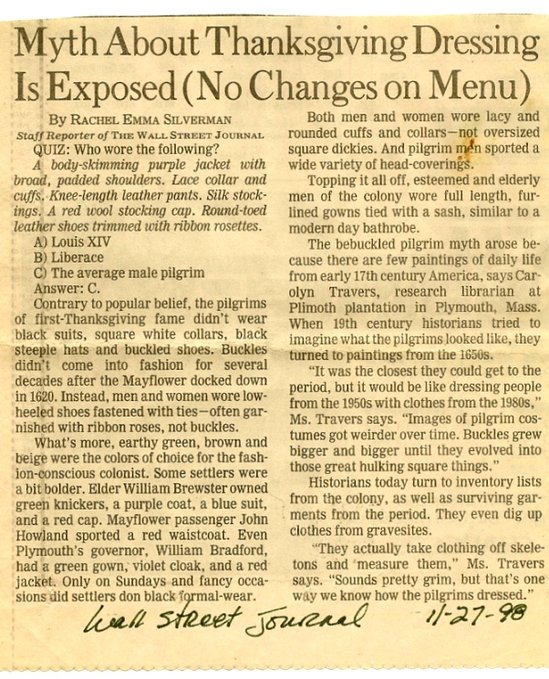
“The story of the Pilgrims begins in the early part of the seventeenth century (that’s the 1600s for those of you in Rio Linda, California). The Church of England under King James I was persecuting anyone and everyone who did not recognize its absolute civil and spiritual authority.” The first Pilgrims were Christian rebels, folks. “Those who challenged [King James’] ecclesiastical authority and those who believed strongly in freedom of worship were hunted down, imprisoned, and sometimes executed for their beliefs” in England in the 1600s.
“A group of separatists,” Christians who didn’t want to buy into the Church of England or live under the rule of King James, “first fled to Holland and established a community” of themselves there. “After eleven years, about forty of them” having heard about this New World Christopher Columbus had discovered, decided to go. Forty of them “agreed to make a perilous journey to the New World, where [they knew] they would certainly face hardships, but” the reason they did it was so they “could live and worship God according to the dictates of their own consciences” and beliefs.
“On August 1, 1620, the Mayflower set sail. It carried a total of 102 passengers, including forty Pilgrims,” now known as Pilgrims, “led by William Bradford. On the journey, Bradford set up an agreement, a contract, that established” how they would live once they got there. The contract set forth “just and equal laws for all members of the new community, irrespective of their religious beliefs,” or political beliefs. “Where did the revolutionary ideas expressed in the Mayflower Compact come from? From the Bible.
The Pilgrims were a “devoutly religious people completely steeped in the lessons of the Old and New Testaments. They looked to the ancient Israelites for their example. And, because of the biblical precedents set forth in Scripture, they never doubted that their experiment would work.” They believed in God. They believed they were in the hands of God. As you know, “this was no pleasure cruise, friends. The journey” to the New World on the tiny, by today’s standards, sailing ship. It was long, it was arduous.
There was sickness, there was seasickness, it was wet. It was the opposite of anything you think of today as a cruise today on the open ocean. When they “landed in New England in November, they found, according to Bradford’s detailed journal, a cold, barren, desolate wilderness. There were no friends to greet them, he wrote. There were no houses to shelter them. There were no inns where they could refresh themselves.” There was nothing.
“[T]he sacrifice they had made for freedom was just beginning. During the first winter, half the Pilgrims — including Bradford’s own wife — died of either starvation, sickness or exposure.” They endured that first winter. “When spring finally came,” they had, by that time, met the indigenous people, the Indians, and indeed the “Indians taught the settlers how to plant corn, fish for cod and skin beavers” and other animals “for coats.” But there wasn’t any prosperity. “[T]hey did not yet prosper!” They were still dependent. They were still confused. They were still in a new place, essentially alone among likeminded people.
“This is important to understand because this is where modern American history lessons often end. Thanksgiving is actually explained in some textbooks as a holiday for which the Pilgrims gave thanks to the Indians for saving their lives, rather than what it really was. That happened, don’t misunderstand. That all happened, but that’s not — according to William Bradford’s journal — what they ultimately gave thanks for. “Here is the part that has been omitted: The original contract” that they made on the Mayflower as they were traveling to the New World…
They actually had to enter into that contract “with their merchant-sponsors in London,” because they had no money on their own. The needed sponsor. They found merchants in London to sponsor them. The merchants in London were making an investment, and as such, the Pilgrims agreed that “everything they produced to go into a common store,” or bank, common account, “and each member of the community was entitled to one common share” in this bank. Out of this, the merchants would be repaid until they were paid off.
“All of the land they cleared and the houses they built belong to the community as well.” Everything belonged to everybody and everybody had one share in it. They were going to distribute it equally.” That was considered to be the epitome of fairness, sharing the hardship burdens and everything like that. “Nobody owned anything. It was a commune, folks. It was the forerunner to the communes we saw in the ’60s and ’70s out in California,” and other parts of the country, “and it was complete with organic vegetables, by the way.
“Bradford, who had become the new governor of the colony, recognized that” it wasn’t working. It “was as costly and destructive…” His own journals chronicle the reasons it didn’t work. “Bradford assigned a plot of land” to fix this “to each family to work and manage,” as their own. He got rid of the whole commune structure and “assigned a plot of land to each family to work and manage,” and whatever they made, however much they made, was theirs. They could sell it, they could share it, they could keep it, whatever they wanted to do.
What really happened is they “turned loose” the power of a free market after enduring months and months of hardship — first on the Mayflower and then getting settled and then the failure of the common account from which everybody got the same share. There was no incentive for anybody to do anything. And as is human nature, some of the Pilgrims were a bunch of lazy twerps, and others busted their rear ends. But it didn’t matter because even the people that weren’t very industrious got the same as everyone else. Bradford wrote about how this just wasn’t working.
“What Bradford and his community found,” and I’m going to use basically his own words, “was that the most creative and industrious people had no incentive to work any harder than anyone else… [W]hile most of the rest of the world has been experimenting with socialism for well over a hundred years — trying to refine it, perfect it, and re-invent it — the Pilgrims decided early on,” William Bradford decided, “to scrap it permanently,” because it brought out the worst in human nature, it emphasized laziness, it created resentment.
Because in every group of people you’ve got your self-starters you’ve got your hard workers and your industrious people, and you’ve got your lazy twerps and so forth, and there was no difference at the end of the day. The resentment sprang up on both sides. So Bradford wrote about this. “‘For this community [so far as it was] was found to breed much confusion and discontent, and retard much employment that would have been to their benefit and comfort.
“For young men that were most able and fit for labor and service did repine that they should spend their time and strength to work for other men’s wives and children without any recompense,’” without any payment, “‘that was thought injustice.’ Why should you work for other people when you can’t work for yourself? What’s the point? … The Pilgrims found that people could not be expected to do their best work without incentive.
“So what did Bradford’s community try next? They unharnessed the power of good old free enterprise by invoking the undergirding capitalistic principle of private property. Every family was assigned its own plot of land to work and permitted to market its own crops and products. And what was the result? ‘This had very good success,’ wrote Bradford, ‘for it made all hands [everybody] industrious, so as much more corn was planted than otherwise would have been.’ …

“Is it possible that supply-side economics could have existed before the 1980s. … In no time, the Pilgrims found they had more food than they could eat themselves. Now, this is where it gets really good, folks, if you’re laboring under the misconception that I was, as I was taught in school. So they set up trading posts and exchanged goods with the Indians. The profits allowed them to pay off their debts to the merchants in London.
“And the success and prosperity of the Plymouth settlement attracted more Europeans and began what came to be known as the ‘Great Puritan Migration.’” The word of the success of the free enterprise Plymouth Colony spread like wildfire and that began the great migration. Everybody wanted a part of it. There was no mass slaughtering of the Indians. There was no wiping out of the indigenous people, and eventually — in William Bradford’s own journal — unleashing the industriousness of all hands ended up producing more than they could ever need themselves.
So trading post began selling and exchanging things with the Indians — and the Indians, by the way, were very helpful. Puritan kids had relationships with the children of the Native Americans that they found. This killing the indigenous people stuff, they’re talking about much, much, much, much later. It has nothing to do with the first thanksgiving.
The first Thanksgiving was William Bradford and Plymouth Colony thanking God for their blessings. That’s the first Thanksgiving. Nothing wrong with being grateful to the Indians; don’t misunderstand. But the true meaning of Thanksgiving — and this is what George Washington recognized in his first Thanksgiving proclamation.
BREAK TRANSCRIPT
RUSH: Thank you for being with us today, folks. Have a great rest of the Thanksgiving weekend. And know without doubt how truly thankful for you I personally am and all of us are. Never forget it. Can’t say it enough that we love you. See you back here on Monday. We will be here.
This essay was first published on Daily Pundit in 2017. More applicable now than then, I think.
——
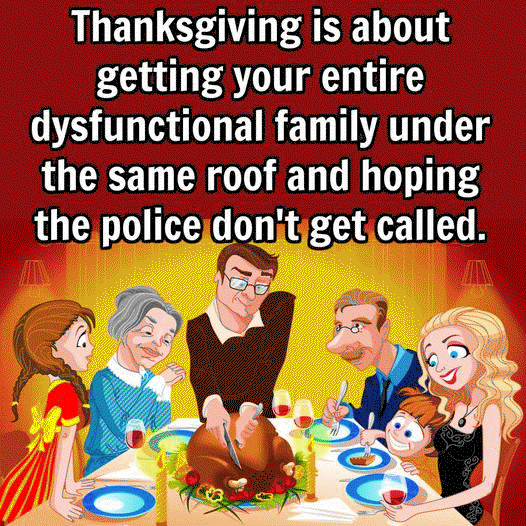
I have one. You have one. We all have a tard in our family circle. If you’re lucky it’s not a blood relative, just a boyfriend or in-law, but they’ll be showing up at the big family get-together for Thanksgiving.
Not just any tard, either. A Progtard.
They’re sort of like the Terminator: They can’t be bargained with. They can’t be reasoned with. And they absolutely will not stop, ever.
Unlike the Terminator, progtards aren’t dangerous except in large groups or if they’re in the position to ambush you from behind or to file a bogus complaint with your employer. Progtards are mostly pathetic, and they’re even more amusingly pathetic when they’re angry and self-righteous.
Herewith, a guide for dealing with the tard at the table. This will be most useful if you have someone to work with, someone contemptuous of sloppy thinking, of feeeewings, and of self-entitlement.
(If you’re the sole hard thinker at the table and you’re surrounded by progtards, you can still use these suggestions, but I wouldn’t bother. I’d just grab the carving knife and lay into everyone at the table. But that’s just me.)
College Mockery
Mocking modern education — indoctrination, rather — is a good place to start. Many progtards are in college or have recently gotten out. (I’m not saying “graduated” because so many don’t, especially not within the old normal of four years.) This is in large part due to many people being soft-headed progs before they grow up and get the stupid knocked out of them. College is for most a prolonged childhood that allows them to avoid growing up. It certainly doesn’t educate them in any meaningful sense. And it costs an arm and a leg.
Thus, our first line of attack.
(Remember, we’re not trying to enlighten the progtards. That’s hopeless. All we’re doing is entertaining ourselves by getting them all riled up.)
“So, how much does your college cost per year? That much? Wow. How can you afford that?”
This can lead to criticism about mooching off of parents or taxpayers. That’s unlikely to impact the progtard directly, on account of an inflated sense of entitlement, but might help to get others on your side.
“How much are you having to borrow every year? Ouch. So you’ll be a hundred grand in debt. Oh, it’s taking you six years to graduate? A hundred fifty grand. Wow. That going to be, what, a grand a month for twenty years?”
“So, how are you going to make a living so you can pay that off and still have a place to live and get a car and stuff?”
“That’s a good goal, but how are you going to get there from here? How do you get your foot in the door to get started? Is your BA in Music History going to get you a job at all? Will it let you pay your school loans? ”
“Wouldn’t you have been better off not going to college? You could have lived at home, interned for minimum wage or even for free for a working musician, gotten some real experience, and not had any debt when you were done.”
“Does anyone really think that degree is worth anything? Why did you even bother getting it?”
“My nephew did two years of electrical tech in community college, lived at home, and worked part time to pay for it. He got a job with the power company straight out of school. He didn’t have any debt and he just bought his first house. He’s twenty-three years old.”
There’s meat left on those bones, but that’s enough to start the poo flying.
Communism, Socialism, and Progressivism
Don’t miss the chance to bring up the repeated failures of socialism and its inbred kin. You can’t quite say that every progtard truly believes that socialism et al would make the world a better place, but if you did say that you’d be off by only a few. Note the comment above about getting the stupid knocked out of you — socialism and such are stupid ideas that sound like they should work, and they sure do appeal to the lazy and untalented and envious, and you don’t realize they don’t work until you’ve had the stupid knocked out of you by the real world. Students, educators, bureaucrats, and some other so-called adults who have lived their lives as hothouse flowers never quite learn that a lot of nice-sounding ideas don’t actually work.
“You know the amazing thing about socialism? It’s so good at destroying wealth that it doesn’t matter if everyone’s equal. They’re poorer than even the poor people in the oh-so-unequal capitalist countries.”
“No, I take that back. The most amazing thing about socialism and communism is the number of people they’ve killed.”
“Tell me, how many more times does socialism need to be tried before it’s ‘real’?”
“Have you ever noticed how often socialist countries have to be bailed out by capitalist countries after natural disasters? Why doesn’t it ever go the other way?”
“Socialized medicine. What a cute idea! Too bad it never works for long. Back in the 1980s, American socialists pointed at England’s national health system as the best example of how nationalized medicine would work for everyone. Then when that started to show problems, they started pointing to Canada. Canada’s socialized medicine had just started and looked good … until rationing and problems became obvious a few years later. Now anyone wanting to show an example of socialized medicine done right has to just lie about all the problems it has everywhere. But next time for sure, right?”
Keeping the Poo Flying
There are a few miscellaneous poo bombs you can throw if the conversation and acrimony are slowing down.
And lots and lots more, but we’re up to 1200 words, and that’s plenty enough.
I’m stuck at a family dinner that I thought I’d get out of, but no, I have to be there.
Enjoy your dinner!
Not like we learned or drew in grade school. Also, my hand turkeys were just that, turkeys. It’s why I wasn’t an artist.
Enjoy your day and be thankful for being in the country that has been the greatest in history for helping others.
Don’t forget that they were thankful that God spared enough of them so that we can be at the table today.
Money, Politics and Religion, Ha!
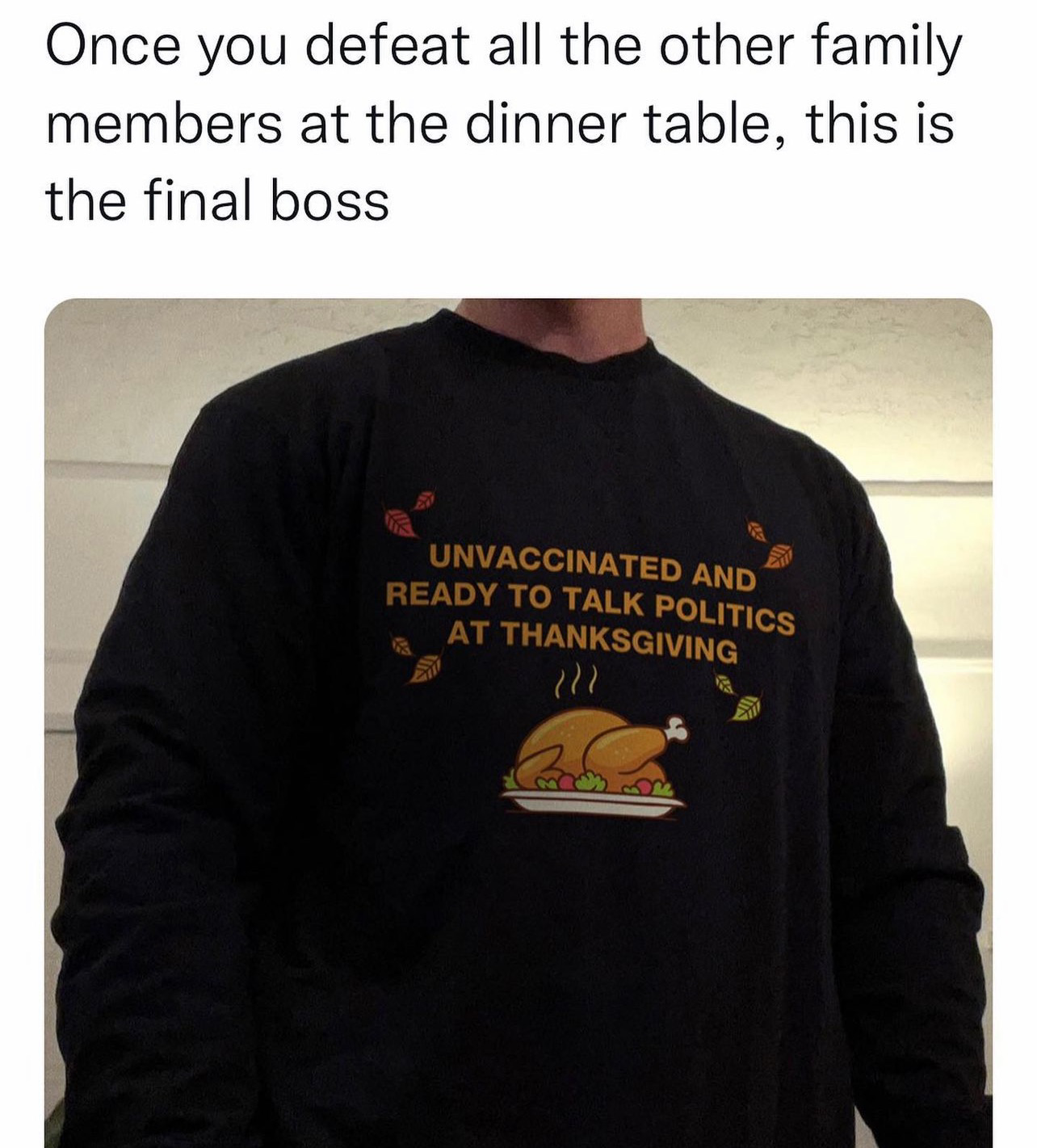
This year you say something stupid and it’s going to be you sound vaccinated. I am loaded for bear should anyone question who got things right the last few years and who is a conspiracy theorist.
Since I’m the only unjabbed person I know, I’m the final boss. Always be the boss.

While I’m being sarcastic, if your family and friends bug you and you want some quiet holidays, this will help your Christmas be less stressful. Nothing gets to me as an Introvert like holidays and fake feelings, fake fun and people. Anytime I can tone it down, I will. It’s much easier to take that way. Why do people have to act different just because they are told to?
Pick either side, you don’t even have to believe in it. Pick Biden or Trump and say how bad or good they are. Don’t worry, you will piss someone off either way. Use woke subjects like BLM or LGBT2+WXYZ or whatever it is now and take sides (see what I did there? Some woke person just got mad).
I hate the false build up that comes with the holidays. They’ve expanded it to before Thanksgiving now. I went shopping today and the Christmas stuff is already out. SMH.

“Whereas it is the duty of all Nations to acknowledge the providence of Almighty God, to obey his will, to be grateful for his benefits, and humbly to implore his protection and favor, and Whereas both Houses of Congress have by their joint Committee requested me “to recommend to the People of the United States a day of public thanksgiving and prayer to be observed by acknowledging with grateful hearts the many signal favors of Almighty God, especially by affording them an opportunity peaceably to establish a form of government for their safety and happiness.”
Now therefore I do recommend and assign Thursday the 26th day of November next to be devoted by the People of these States to the service of that great and glorious Being, who is the beneficent Author of all the good that was, that is, or that will be. That we may then all unite in rendering unto him our sincere and humble thanks, for his kind care and protection of the People of this country previous to their becoming a Nation, for the signal and manifold mercies, and the favorable interpositions of his providence, which we experienced in the course and conclusion of the late war, for the great degree of tranquility, union, and plenty, which we have since enjoyed, for the peaceable and rational manner in which we have been enabled to establish constitutions of government for our safety and happiness, and particularly the national One now lately instituted, for the civil and religious liberty with which we are blessed, and the means we have of acquiring and diffusing useful knowledge and in general for all the great and various favors which he hath been pleased to confer upon us.
And also that we may then unite in most humbly offering our prayers and supplications to the great Lord and Ruler of Nations and beseech him to pardon our national and other transgressions, to enable us all, whether in public or private stations, to perform our several and relative duties properly and punctually, to render our national government a blessing to all the People, by constantly being a government of wise, just and constitutional laws, discreetly and faithfully executed and obeyed, to protect and guide all Sovereigns and Nations (especially such as have shown kindness unto us) and to bless them with good government, peace, and concord. To promote the knowledge and practice of true religion and virtue, and the encrease of science among them and Us, and generally to grant unto all Mankind such a degree of temporal prosperity as he alone knows to be best.” – George Washington’s Thanksgiving Proclamation, 1789




 Delusions of Adequacy