
1

2

3

4

5

6

7

8

9
10

11

12
13
14

15

16

17

Las Vegas Hotels
‘Security Knows This’: Worker Cautions Against Staying At Iconic Las Vegas Hotel. Then He Reveals Chilling Reason Why – It’s a freaking dump. It’s been a dump since the 80’s when some of my colleagues had to stay there.
Cars
Crazy Dirt Racing Crash At Tulsa Shootout Ends With Car Lodged In Dumpster After Jumping Fence – Hey, you pay for entertainment, you might as well get some
Twin-Turbocharged 6.4L V-8, Automatic
Climate Hoax
Financial Times: ‘Climate policy suffers blistering setbacks in 2025’ – ‘US retreat much worse & faster than expected in 2nd Trump admin’ – I’m laughing at the Euroweenies and the Climatards who bought into this. They were either stupid enough to believe it, or smart enough to grab as much cash on the scam before it imploded for lack of facts or substance. Al Gore got famous for a few years, but He’ll be looked on by history as a dickhead Don Quixote chasing Windmills.
Travel
Flu Is Rising Rapidly, Driven by a New Variant – I admit to being a germaphobe. I wipe down the seat, armrests, and everything I might have to touch. Actually, I’d rather not get on a plane. God forbid I stay in a hotel room where the people did whatever right before me and the hotel staff gave it the half-assed wiped down at best before I check in.
No wonder the flu is spreading. Wash your hands at least. People are disgusting.
Proof of Daycare Fraud
‘Learing’ Center Finally Fixes Misspelled Sign
Harvard, Ground Zero For DEI Failure
DIE Forced Harvard to Teach Remedial Math – They let in people who not only can’t pay for it, they can’t read, write or do math either. What an embarrassment
Top 10 Media Hoaxes of 2025
Here Are the 10 Biggest Media Hoaxes of 2025 – really, just pick any 10 stories about Trump. That will do the same thing. They are all the same and all just as biased.
Travel
Top Bucket List Destinations for 2026 – maybe for some people.

I’m married to Dane. For decades, they bragged about all the free shit they get such as education, healthcare, and retirement. They have to pay 70% taxes to afford this for the country. I believed them at first, but the truth came out ,and they aren’t happy about paying so much for everything.
Every one of her (not mine) relatives who has had surgery has had it messed up. From ankles to stomachs, botched every time. They wait 6 weeks to see a doctor (a cold is gone in 1 to 2). Even their pension isn’t as much as Social Security, the pittance that it is.
They aren’t fooling me. I see how they live. They avoid the government because everything is so expensive. They buy all their stuff in the US instead. They are next to obnoxious to protect a tiny country which hasn’t been great since the Vikings.

They brag how everyone is equal (a big lie, her nephew Brian can’t stop talking about how much he has and paid for it). The other lie is they are the happiest. When you set your standards to zero, you can meet them everytime. They aren’t happy and will barely talk to a stranger there.
I said I wasn’t going there again and meant it
Have you ever wondered why Scandinavian countries are often hailed as the gold standard of social equality? It’s a compelling narrative: nations like Sweden, Denmark, and Norway seem to have cracked the code on blending prosperity with fairness. But what if the story we’ve been sold isn’t the full picture? As someone who’s always been skeptical of too-good-to-be-true promises, I decided to dig deeper into the so-called Scandinavian model. What I found was a system far more complex—and, frankly, more troubling—than the rosy image painted by its admirers.
The term Scandinavian socialism gets thrown around a lot, often with a sense of awe. People point to high taxes, generous welfare programs, and impressive human development rankings as proof of a utopian system. But here’s the thing: what’s labeled as socialism in Scandinavia isn’t quite what you might think. It’s not about collective ownership of production or some grand egalitarian dream. Instead, it’s a carefully crafted system where the state plays a heavy-handed role in managing resources, wealth, and opportunity—often to the benefit of a select few.
At its core, this model is less about empowering the average citizen and more about maintaining state control. The state doesn’t own businesses outright, but it sets the rules, picks the winners, and ensures compliance through a web of regulations and taxes. It’s a system that looks free on the surface but operates with an iron grip beneath. Let’s break it down and see what’s really going on.
Back in the late 19th century, Scandinavian countries faced a unique challenge. They were resource-rich—think timber, iron, and fisheries—but lacked the robust middle class needed to fully exploit these assets. Unlike their European neighbors, who had thriving industrial bases, these Nordic nations couldn’t rely on state-run enterprises to drive growth. Their solution? Outsource production to a handpicked group of industrialists and corporations, both local and foreign, who were granted special privileges in exchange for loyalty and hefty tax contributions.
The state didn’t abolish private enterprise; it tamed it, turning businesses into extensions of its own agenda.– Economic historian
This wasn’t socialism in the classic sense. It was a hybrid—a mix of state favoritism and market dynamics. The government didn’t seize factories or mines; instead, it created a system where only those who played by its rules could thrive. This approach allowed Scandinavian nations to industrialize rapidly, but it came at a cost: a rigid hierarchy where the state and its chosen allies held all the power.
One of the biggest selling points of the Scandinavian model is its promise of equality. High taxes fund universal healthcare, education, and pensions, creating the illusion of a classless society. But is it really as fair as it seems? In my view, the system’s equality is more about uniformity than true fairness. Citizens are funneled into a state-managed existence, where their role is to maintain the system, not to innovate or break free.
The average Scandinavian doesn’t own significant capital or run their own business. Instead, they’re often locked into roles as employees within a tightly regulated economy. Their reward? A safety net of welfare benefits that ensures stability but discourages independence. It’s a trade-off: security for autonomy. And while that might sound appealing to some, it’s worth asking—does it truly empower people, or does it keep them tethered to the state?
Perhaps the most striking aspect of Scandinavian socialism is its reliance on a small, politically connected elite. These are the industrialists, corporate leaders, and bureaucrats who benefit from the state’s legal monopolies and administrative privileges. They’re not your typical capitalist entrepreneurs—they’re state-sanctioned players who thrive because of their proximity to power.
This dynamic creates a kind of corporate feudalism, where the state acts as a lord, granting favors to loyal vassals. In return, these elites generate revenue that funds the welfare state, keeping the system afloat. It’s a clever setup, but it’s not exactly the democratic paradise it’s made out to be. The average citizen has little access to this inner circle, and their economic mobility is often capped by design.
Fast forward to today, and the Scandinavian model is starting to show its age. The system was built on the back of abundant natural resources and a compliant workforce, but those foundations are crumbling. Aging populations, declining competitiveness, and shrinking resource revenues are putting pressure on the welfare state. The machine, as I see it, is grinding to a halt.
What happens when the money runs out? Historically, states in this position turn to desperate measures. In Scandinavia, that could mean wealth confiscation or outright nationalization of private assets. It’s not hard to imagine governments doubling down on their control, especially when the promise of welfare is at stake. After all, if the system’s built on dependency, what choice do they have?
Scandinavian countries consistently rank high on global happiness indices, which often fuels the myth of their success. But is this happiness genuine, or is it a byproduct of a system that prioritizes compliance over ambition? In my experience, true contentment comes from freedom and opportunity, not just material security. When you’re locked into a system that limits your potential, can you really call that happiness?
The data paints a mixed picture. While citizens enjoy high standards of living, they also face some of the highest tax burdens in the world. Personal savings rates are low, and entrepreneurship is stifled by red tape. It’s a system that works—until it doesn’t. And when it fails, the fallout could be severe.
As the Scandinavian model faces growing challenges, the question is whether it can adapt. Some argue for reforms—lower taxes, deregulation, and a shift toward true market freedom. Others fear the state will tighten its grip, moving closer to outright nationalization. Either way, the myth of Scandinavian socialism as a perfect balance of equality and prosperity is fading fast.
For those of us watching from the outside, there’s a lesson here: systems that promise everything often deliver less than they claim. The Scandinavian model isn’t a blueprint for utopia; it’s a cautionary tale about the costs of control. Perhaps it’s time we rethink what equality and freedom really mean.
There is more here, but it says the same thing.
Look to the leadership and if it’s rd or blue and a lot of this makes sense. Although I loathe San Francisco, I’m glad it is there so the people that live in that shithole stay there and don’t come to my state.
The past year has been a true test of the effectiveness of local leadership. City leaders have had to deal with economic difficulties like high inflation, as well as other issues such as mass shootings with over 500 reported in 2024, keeping gun crime in the political spotlight.
| 136 | Chicago, IL | 102 | 140 |
| 137 | Flint, MI | 145 | 95 |
| 138 | Stockton, CA | 137 | 121 |
| 139 | Los Angeles, CA | 58 | 143 |
| 140 | Long Beach, CA | 51 | 144 |
| 141 | Fresno, CA | 117 | 139 |
| 142 | Tacoma, WA | 125 | 136 |
| 143 | Baltimore, MD | 136 | 132 |
| 144 | Philadelphia, PA | 128 | 138 |
| 145 | New York, NY | 23 | 147 |
| 146 | Oakland, CA | 99 | 146 |
| 147 | Detroit, MI | 148 | 126 |
| 148 | San Francisco, CA | 57 | 148 |
more, including the best run cities
The NYPD has just revealed to the New York Post just how bad migrant crime has gotten in the Big Apple and it’s unreal.
According to the NYPD, out of all arrests for crimes like assault, robbery and domestic violence, 75% of them are from illegal immigrants.
That number is above 60% in Queens.
And the biggest contributing factor, aside from the massive influx of illegals into the city, is the fact that New York is a sanctuary city.
NY is being exposed for the shit hole that it has become. Thank you liberals, for nothing.
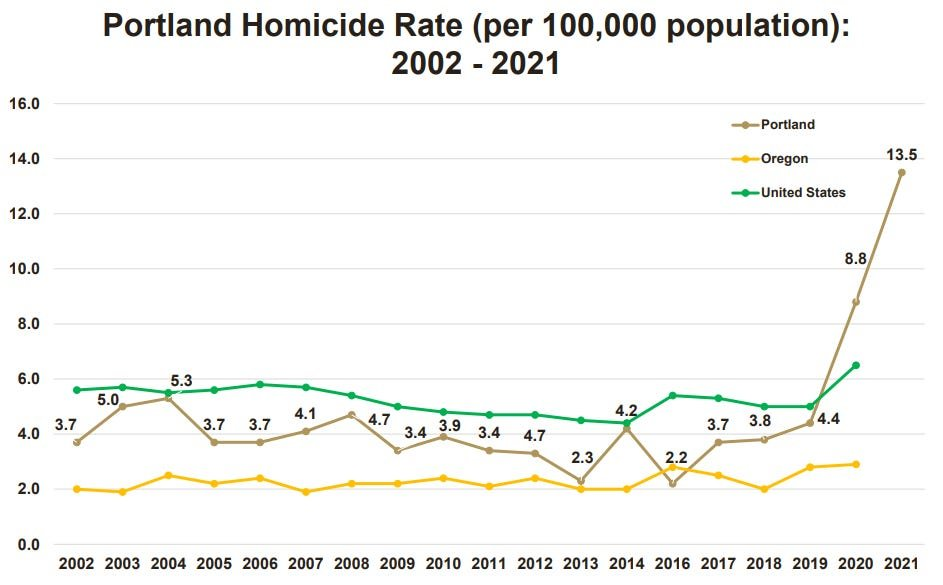
Portland, here is what happened when they de-funded the police. They turned make Portland weird into make Portland a crime zone.
I have a relative there and have to go in a few weeks. I can’t say how little I’m excited to go travel.
Hopefully, I’m not on a Boeing plane that is missing bolts or stuck next to traveler who starts a fight. Both seem to be a trend lately.
When I get there, the homeless and the crazies have destroyed the city, so I can’t say I’m looking forward to that either.
Like all trips, the best part is leaving and coming home.
As for being an introvert, as soon as I committed to going, my irritation level shot up. My social battery is not able to recharge because it can’t knowing I have to face this. A countdown to leaving (to come home) automatically begins in my head, I can’t stop it from happening.
It will be over in a bit, but for now I’m suffering until it is over and I’m back home.
And of course the one that exists today.
I’m not excluding Portland Oregon either. There is another shithole. Both run into the ground by liberals and woke thinking.

I’ve written before, tongue in cheek about this, but here we are. Who thought this was a good idea? Who is going to control these killer bots? What if they become sentient, then they kill on their own.
Sure it’s in the shit hole San Francisco, but once there is a hole in the dike, the dam bursts. If they allow it there, it goes everywhere.
In a dystopian turn of events, the San Francisco Police Department is considering giving robots the license to kill.
Last week, San Francisco’s rules committee unanimously approved a version of a draft policy stating that robots can be ‘used as a deadly force option when risk of loss of life to members of the public or officers is imminent and outweighs any other force option’.
Members of the city’s Board of Supervisors Rules Committee have been reviewing the new policy for several weeks as reported by Mission Local.
The original version did not mention robots until Aaron Peskin, the Dean of the city’s Board of Supervisors, initially added that ‘robots shall not be used as a Use of Force against any person’.
However, the SFPD amended Peskin’s addition and replaced it with a line that could give robots the authority to kill suspects if the life of public or police was at risk.
According to Mission Local, Peskin eventually decided to accept the change because ‘there could be scenarios where deployment of lethal force was the only option’.
The equipment policy states that the SFPD currently has 17 remotely piloted robots, of which only 12 are functioning.
In addition to granting robots the ability to use deadly force, the proposal also authorizes them for use in ‘training and simulations, criminal apprehensions, critical incidents, exigent circumstances, executing a warrant or during suspicious device assessments’.
While most of the robots listed in the SFPD’s inventory are primarily used for defusing bombs or dealing with hazardous materials, newer models have an optional weapons system.
The department’s QinetiQ Talon can also be modified to hold various weapons — a weaponized version of the robot is currently used by the US Army and can equip grenade launchers, machine guns, or even a .50-caliber anti-materiel rifle.
If they can multiply, humans are doomed.















































 Delusions of Adequacy