
I have to drive through there at least 20 times a year. I’d never live there. #shithole
Tag: safety

More Fun In Travel: Denver Airport Lost Air Traffic Control for 90 Seconds
n what is becoming an all too familiar scenario over the past month, Denver International Airport lost all communications for nearly 90 seconds earlier this week, Denver7 reported.
As many as 20 pilots flying into the airport Monday afternoon were unable to communicate with air traffic controllers for a minute and half, the Federal Aviation Administration confirmed.
“Part of the Denver Air Route Traffic Control Center (ARTCC) experienced a loss of communications for approximately 90 seconds around 1:50 p.m. local time on Monday, May 12, when both transmitters that cover a segment of airspace went down,” according to the FAA.
First, it was Newark, now Denver. When has it failed that we weren’t told about it?
Share this:

Air Traffic Controllers Face 1,000 Tech Failures a Week
In more good news that makes you want to travel, a system that Musk says is being run off of diskettes has 6 months of life left. It’s already breaking down
Air traffic controllers in the U.S. have experienced about 1,000 equipment failures a week due to ancient equipment, a former federal aviation official and several airline industry insiders told the New York Post.
The report comes less than a week after a 90-second equipment failure at Newark Liberty International Airport caused air traffic controllers’ communications to go dark, sparking hundreds of flight delays and disrupting travel for thousands for days.
The cause was a single unsheathed copper wire at the air traffic control center in Philadelphia.
“This is a copper wire system, and frankly the FAA is experiencing almost 1,000 outages a week,” one airline industry official told the Post, referring to the Federal Aviation Administration.
“Some outages are worse than others — but the bad thing about them is you can’t predict them.”
All of this makes me really want to jump on a plane
Share this:

Why I Don’t Want To Fly Anymore – 2024 Deadly Year For Aviation
Recent Rash Of Crashes Turns 2024 Into Deadliest Year For Aviation Since 2018
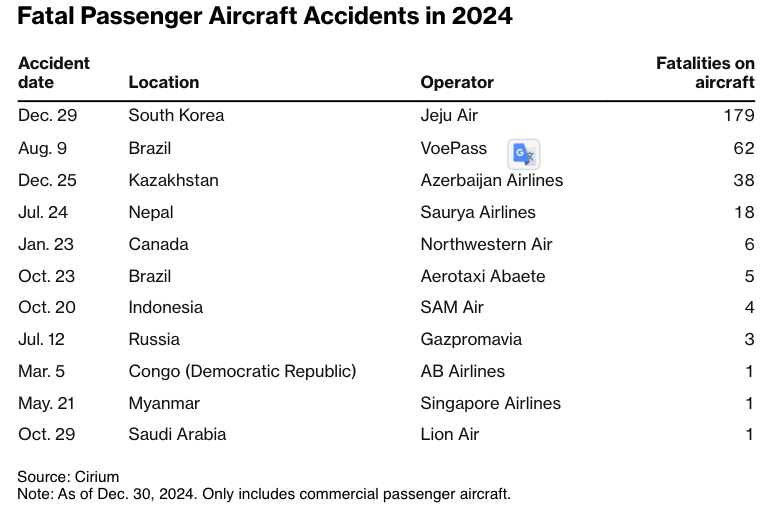
The commercial aviation industry faced a turbulent week with four plane crashes, making this one of the deadliest years since 2018. The most shocking mid-air aviation disaster occurred on Sunday when a Jeju Air 737-800 jet crashed at Muan International Airport in South Korea.
- December 25: Azerbaijan Airlines Crash
- December 28: KLM Airlines Plane Skids Off Runway In Norway
- December 28: PAL Airlines Dash 8-400 Catches Fire in Canada
- December 29: 179 Dead In South Korea’s Worst-Ever Aviation Disaster
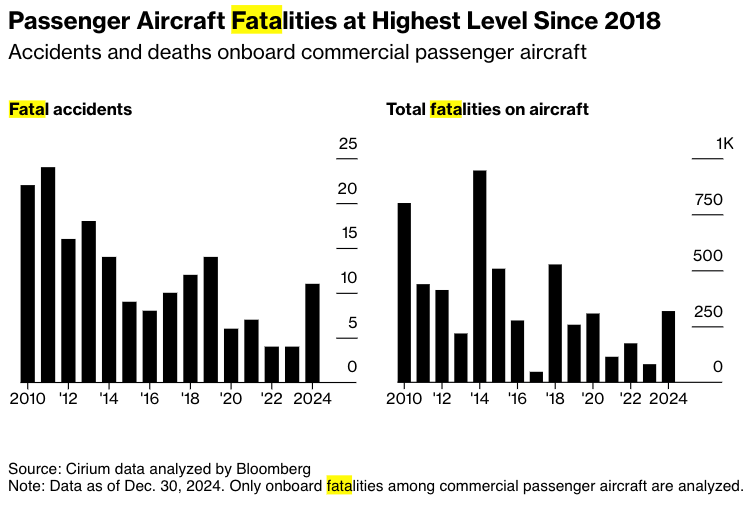
Amid the latest mid-air mishaps and several others, onboard passenger fatalities on commercial flights have risen to 318 this year, according to Bloomberg, citing data from Cirium.
This marks the highest death toll since 2018, when 500 lives were lost—a year defined by the first of two fatal Boeing 737 Max crashes.
Sure, it’s a cheap out for me who hates airports, lines, TSA, people, germs, hotels and flying, but hey it works for me.
Let’s not forget all the DEI in the FAA, air traffic control, Boeing, and the Airlines. They could have hired quality instead of quota
Share this:

Another Jet Plunges In Mid Flight, 8 Hurt
Remember when flying was the safest form of travel? Then came woke and DEI. I bailed on traveling this week because I hate the planes, the travel experience and their safety track record.
Twelve passengers and crew were injured on a Qatar Airways flight after a packed Boeing passenger jet plunged mid-flight.
Eight passengers aboard a commercial Boeing Dreamliner jet required hospital treatment upon landing in Ireland on Sunday.
The aircraft had reportedly suffered turbulence en route from Qatar, according to official statements.
“Qatar Airways can confirm that flight QR017 a Boeing B787-9 from Doha to Dublin has landed safely,” Qatar Airways stated in a post on X.
“A small number of passengers and crew sustained minor injuries in flight and are now receiving medical attention.”
The jet was on its way from Doha to Dublin when it began shaking as it flew over Turkey.
Airport authorities confirmed that the jetliner landed on schedule just before 1:00 p.m. at Dublin Airport.
“Upon landing, the aircraft was met by emergency services, including Airport Police and our Fire and Rescue department, due to 6 passengers and 6 crew [12 total] on board reporting injuries after the aircraft experienced turbulence while airborne over Turkey,” they said in a statement.
Share this:

Boeing’s Uncontrolled Descent, How the Aerospace Manufacturing Company Declined over the Decades
The history of Boeing over the past thirty years is a story of a critical American institution that sold off its engineering culture and embraced an asset-light focus on margin instead of product vision, and then executed that strategy poorly. In 2024, Boeing is producing fewer planes than it did a decade ago and faces an onslaught of headlines about spectacular accidents, nagging regulators, and disappointing earnings.
A large part of the issues can be traced back to the Boeing-McDonnell Douglas merger in 1997. The deal seemed like a good idea at the time. By 1996, McDonnell Douglas commanded only 4% share in U.S. commercial aviation, and its production lines were languishing. Meanwhile, Boeing had a $100 billion backlog, and needed more assembly capacity to ramp deliveries and fulfill its orders. Yet in the event, the joke on Wall Street became that “McDonnell Douglas bought Boeing with Boeing’s money.” McDonnell Douglas CEO Harry Stonecipher and John McDonnell, the chair of McDonnell Douglas’ board, became the largest shareholders of the combined entity after a stock swap worth $13 billion and they brought McDonnell Douglas’ bureaucratic defense contractor culture of margin-focused, risk-averse financial engineering with them.
But DEI is only part of the problem. Historically, Boeing has achieved great results by centralizing authority and control in the hands of the most exceptionally talented engineers. Today, the culture at Boeing is the opposite: listening sessions with the downtrodden, coddling the broken, and tiptoeing around the oppressed. Authority diffused throughout an entire organization’s hierarchy is no authority at all; accountability to technical results becomes challenging, if not impossible, when managers are serving two masters.
Meanwhile, management is rearranging deck chairs to make them more diverse. In 2022, Boeing tied managers’ incentive compensation to the ‘diversity’ of their interview slates, meaning that their bonuses depended on whether or not they considered women, racial minorities, and the disabled for positions they were hiring for. In Boeing’s Global Equity, Diversity, and Inclusion (GEDI) 2023 Report, Sara Bowen, vice president of GEDI, Talent Intelligence, and Employee Listening, wrote: “We know diversity must be at the table for every important decision our company makes — every challenge we face, every innovation we design. Equity, diversity and inclusion are core values because they make Boeing — and each of us individually — better.”
Share this:

Aircraft mechanic shortage reaches ‘critical’ point
I don’t even want to get on an airplane right now. Between DEI in the Air Traffic Control and woke pilots, not to mention sudden deaths from the Covid Jab the pilots were forced to take, it’s a gamble now to fly.
A new report from AAR Corp., a company that provides aviation services to commercial and government operators, MROs, and OEMs, warns that the aircraft mechanic shortage has reached a critical point.
The company’s 2023 Mid Skills Gap report urges employers to “break down silos” and collaborate with high schools, colleges, non-profit organzations, and elected officials to expand early access to aviation maintenance curriculum and training.
“Mid skills” describes careers that require industry certifications but not a college degree, including aviation mechanics, according to officials with AAR, which has been putting together the report since 2011.
The 2023 report includes several suggestions to increase the number of aviation mechanics, including:
- Work with lawmakers and state agencies, nonprofits and educators to launch a national campaign to raise awareness of aviation careers.
- Encourage training programs to teach people with industry experience how to instruct others to build the faculty population.
- Ask lawmakers to pass common sense immigration policies that allow aviation companies to recruit talent from abroad to meet demand and keep airplanes flying safely.
- Make it easier for veterans to quickly transition their skills to appropriate industry jobs.
- Push to eliminate restrictions on AMTs taking the FAA general exam as pilots can do with their written exams. Getting these exams completed early will lead to increased certifications for the industry, officials noted.
- Increase training capacity by creating programs to make experienced retirees instructors in education programs.
Share this:

The CEO Of United Shows Why We Should Never Fly On Them Again
Airline safety is no place for diversity hires. It starts at the top with United. This guy is off his rocker. I’m never flying them because I don’t want to die because some DEI hire isn’t the best qualified candidate for safety, rather they checked enough boxes for image over knowledge.

How could the board at United have considered this nonsense, or continued to put up with it after this:
United Airlines CEO Scott Kirby admitted in a recent interview that they are no longer seeking the most qualified candidates to transport their passengers on commercial flights safely.
Instead, he is committed to ensuring that diversity wins out at the expense of safety and white males. “We have committed that 50% of the classes will be women or people of color,” he boasted.
It turns out the woke, racist Kirby has a bizarre fetish as well. Videos of him performing in drag are going viral today thanks partly to Libs of Tiktok, who first uncovered Kirby’s disturbing interview.
Below is footage of Kirby dressing up as Lady Gaga and rocking out to her famous song “Bad Romance.” This was part of the US Airways Halloween performance posted to YouTube in 2010. Kirby was president of the airline company at the time.
Share this:

Not Flying United Either – United Airlines CEO Admits to DEI Quota Because There are too Many White Men Flying Airplanes
Look, I don’t care what color the pilot is. I want the one that is going to get my ass there without crashing, not one that got hired on diversity. Racism is racism no matter what the color you discriminate against.

Meritocracy is dead.
United Airlines CEO Scott Kirby, in a recent interview, admitted that they are no longer seeking the most qualified candidates to safely transport their passengers on commercial flights.
Instead, Kirby says, “We have committed that 50% of the classes will be women or people of color,” instead of the most qualified individuals they can find.
What could go wrong with putting one’s skin color or gender over safety and competency?
Anti-whiteness appears to be evolving into a trend in the airline industry.
Wall Street Silver, a popular finance account on X, warned people that they should not fly with an airline that puts woke DEI standards over safety:
“At this point, I think people really need to think twice about flying on United. The top priority of any airline on 100% of their hiring, especially pilots and mechanics, needs to be safety. Anyone who thinks DEI (racism) should play any role in hiring, that person needs to be removed from the process. The board of directors should terminate the CEO immediately and focus on safety, and only safety.”
Elon Musk also chimed in, saying, “This is messed up.”
And this: United Airlines questioned about DEI impact on hard landing in Houston
The hard landed occurred on July 29th as a previously uneventful United Airlines Boeing 767-300ER flight from the Newark Liberty International Airport to the George Bush Intercontinental Airport (IAH) in Houston turned awfully dramatic.
“According to the [National Transportation Safety Board’s] preliminary report, while landing at IAH, the First Officer was flying and, despite best efforts to keep the nose wheel from bouncing, the nose wheel made contact with abnormal force,” as reported by Simple Flying, an aviation news source.
“The airplane appeared to bounce, and he reacted by pulling aft on the control yoke, in an effort to keep the nose wheel from impacting the runway a second time. Subsequently, the speed brakes deployed, and the auto brakes engaged which resulted in a second bounce of the nose wheel.”
These bounces reportedly caused significant damage to the airplane.
Share this:

I Don’t Want Diversity In Hiring For Air Travel, I Want To Make Sure We Don’t Crash
This is the worst headline I’d ever want to read about travel. FAA’s diversity push includes focus on hiring people with ‘severe intellectual’ and ‘psychiatric’ disabilities. No, give me the best there are only and don’t base it on anything but qualifications and not flipping out.
The Federal Aviation Administration is actively recruiting workers who suffer “severe intellectual” disabilities, psychiatric problems and other mental and physical conditions under a diversity and inclusion hiring initiative spelled out on the agency’s website.
“Targeted disabilities are those disabilities that the Federal government, as a matter of policy, has identified for special emphasis in recruitment and hiring,” the FAA’s website states. “They include hearing, vision, missing extremities, partial paralysis, complete paralysis, epilepsy, severe intellectual disability, psychiatric disability and dwarfism.”
The initiative is part of the FAA’s “Diversity and Inclusion” hiring plan, which claims “diversity is integral to achieving FAA’s mission of ensuring safe and efficient travel across our nation and beyond.” The FAA’s website shows the agency’s guidelines on diversity hiring were last updated on March 23, 2022.
The FAA, which is overseen by Secretary Pete Buttigieg’s Department of Transportation, is a government agency charged with regulating civil aviation and employs roughly 45,000 people.
story
Share this:

Why You Should Think Twice About Flying First Class
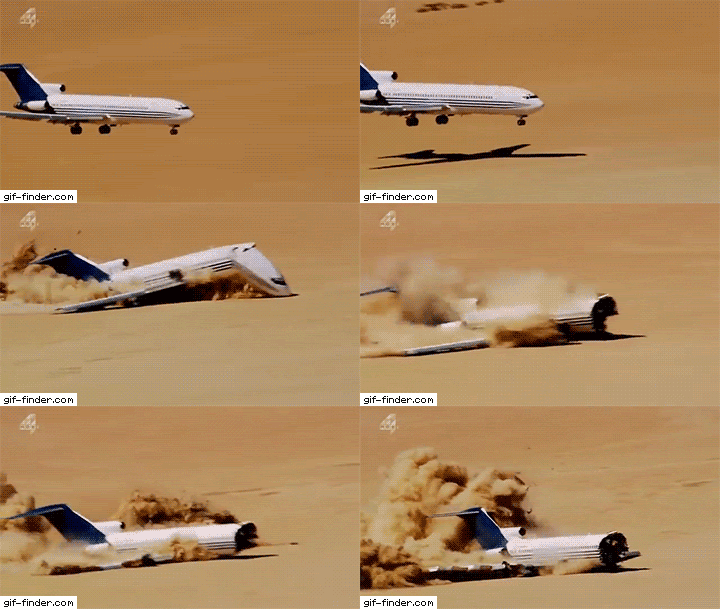
I dated a flight attendant who survived the Dallas Crash where they discovered wind sheer. She made it when only about 30 of 300 survived. She was at the back of the plane. I read that you have a better chance of surviving statistically in the back of a crashing plane.
I’d just rather not crash.
I’m exercising my Covid excuse not to go somewhere right now by just not flying.

 Delusions of Adequacy

