Early Headlines: Wind Farms Ravishing Nature, AI Debt Bubble, Self Driving Cars Crashing, China And Mexico Laundering US Dollars, Trump Welcomes Back Italians….and more

Climate

Green Energy’s High Price: Wind Farms Are Ravaging Nature, Biodiversity – Bird and Whale murderers

Artificial Intelligence

AI Is Now A Debt Bubble Too, Quietly Surpassing All Banks To Become The Largest Sector In The Market

EV’s

NHTSA Probing Tesla Full Self-Driving After Reports Of Red-Light Runs, Collisions – I’ll take the wheel for now. It used to be we only had to look out for drunk drivers, now this.

Social Media

15 Years Of Instagram – still causing teens to commit suicide after all these years

Investing

US Stock Ownership Is High But Unequally Distributed

Gold Is Saying The Fiat Currency Experiment Is Ending Globally; Rubino – Gold going up against Fiat Monies

Tech

America’s Growing Pushback Against Data Centers

International Crime

The Student Mule Economy: A Billion-Dollar Problem Hiding In Plain Sight – How China and Mexico are laundering drug money from the US

Elections

Former GOP Election Official Acquires Dominion Voting Systems, Affirms Commitment to Domestic Staffing and Paper Ballots

Italy

“We’re Back, Italians!”: Trump Signs Columbus Day Proclamation

Entertainment

Disney Jacks Up Its Prices on Tickets and Extras — Fed Up Americans REACT – I grew up next to Disney. It ruined our town and our lives. It’s not that great and certainly not worth the money. It’s also not the happiest place on earth as they claim. It’s hot, (used to have) long lines, expensive and not worth it. Occasionally, there is a Waffle House type fight. That’s the best attraction left.

Space

New study claims the giant impact that created the Moon’s South Pole-Aitken Basin was oblique, from the south

They’re hiding something: All of Europe was ‘seconds’ away from total blackout…

The recent massive blackout across Spain, Portugal, France, and Belgium has sparked new debates about the state of Europe’s energy infrastructure, especially as these countries have moved toward renewable energy.

We’ll get into that shortly…

READ MORE: Female pilot killed nearly 70 people seconds after ignoring a direct warning…

On Monday, Spain and Portugal experienced a massive power outage. Spain lost about 60 percent of its electricity within about five seconds. France and Belgium were also hit, and everybody experienced some level of disruption to their transportation, communication, and overall daily life.

At first, rumors spread that the blackout was caused by some “rare cosmic phenomenon.” But that was quickly ruled out.

Investigations have also ruled out cyberattacks and weather-related events. The early findings suggest that a sudden loss in solar power in southwestern Spain is what triggered everything.

Watch:

This incident shines a light on the growing debate over renewable energy sources and not having proper backup systems.

Think about it: this small little change instantly impacted four countries and nearly brought down two of them.

Take a look:

Spain is one of Europe’s leaders in renewable energy, with over 75% of its electricity coming from renewable sources at the time of the outage.

Net Zero isn’t reality, but that’s exactly what Spain is pushing.

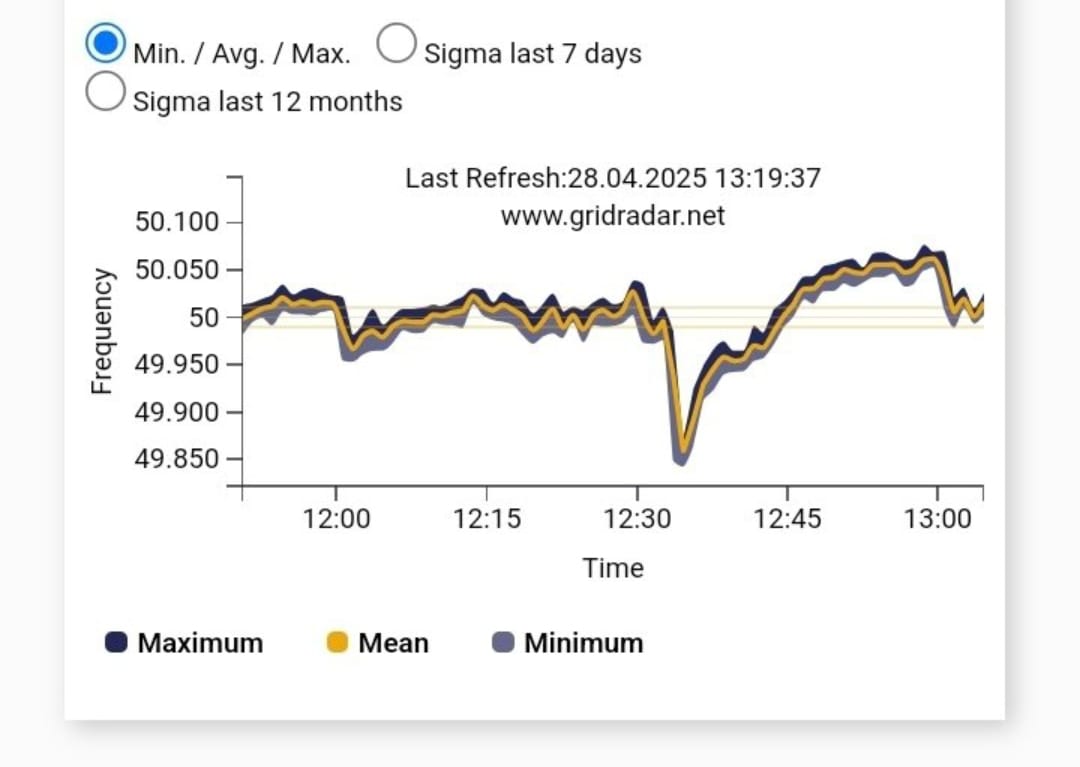
This is truly bananas: all of Europe appears to have been seconds away a continent-wide blackout.

The grid frequency across continental Europe plunged to 49.85 hertz — just a hair above the red-line collapse threshold.

The normal operating frequency for Europe’s power grid is 50.00 Hz, kept with an extremely tight margin of ±0.1 Hz. Anything outside ±0.2 Hz triggers major emergency actions.

If the frequency had fallen just another 0.3 Hz — below 49.5 Hz — Europe could have suffered a system-wide cascading blackout.

At that threshold, automatic protective relays disconnect major power plants, and collapse accelerates.

And it’s disturbingly easy to imagine multiple scenarios where that could have occurred…

ImageRenewables don’t risk blackouts, said the media. But they did and they do. The physics are simple. And now, as blackouts in Spain strand people in elevators, jam traffic, and ground flights, it’s clear that too little “inertia” due to excess solar resulted in system collapse.

more

One of America’s priciest green boondoggles likely going offline after sucking up subsidies and incinerating birds

Here’s something for DOGE to cut funding to. Not much bigger waste or boondoggle than this.

One of the most expensive green energy projects ever undertaken in American history looks like it is now on borrowed time after eating up massive amounts of taxpayer dollars and killing thousands of birds.

Pacific Gas and Electric (PG&E) — a major utility company — announced in January that it is terminating power purchase contracts with the owners of Southwestern California’s Ivanpah Solar Power facility, a massive and unique solar project that received hundreds of millions of subsidy dollars as it launched in 2014. Just over a decade after it started operations, the facility appears to be headed toward its demise after killing thousands of birds because it could not provide the utility sufficiently cheap energy.

“PG&E determined that ending the agreements at this time will save customers money,” the company said in its Jan. 17 statement on the plant. The original owners of the plant — which cost about $2.2 billion to build — included Google and NRG Energy, according to the Las Vegas Review-Journal.

The Los Angeles Times reported in 2016 that the Ivanpah project killed an average of 6,000 birds each year, with some of the unlucky creatures colliding with the development’s 40-story towers and others being incinerated instantly upon flying through concentrated sunlight while chasing prey. The project received tax breaks, a $1.6 billion loan guarantee from the Obama Department of Energy (DOE) and a further $535 million subsidy from the Obama Department of Transportation (DOT), but it failed to reach advertised power output levels, according to analysis by Benjamin Zycher, an energy-focused senior fellow at the American Enterprise Institute (AEI).

story

Lessons From Germany’s Economic Contraction

If there ever was a lesson for being energy independent and ditching the climate scam, read this.

The effect of the green agenda can be summed up as a long path to the gradual degradation of Europe’s energy security and a resulting path to de-industrialization. The Ukraine conflict only exacerbated it…

Germany’s once-envied efficient economy is in freefall, and the climate change cult and European Green Deal are directly to blame. State policies subsidizing EVs and other products, shutting down coal and nuclear plants, and mandating forced conversion to untested, unimplemented “renewables” resources for energy have decimated industrial efficiency. Industries and blue-collar jobs are fleeing Germany for polluting, profitable operations in China, India, and elsewhere abroad. Will the United States follow suit?

As natural gases skyrocket during a European cold snap, and Russian gas pipelines through Ukraine are shut down for the first time since 1991, Germany has transitioned from Europe’s economic darling to its leading economic anchor. Followed closely by France and the UK, similarly weighted by economically destructive climate fantasies that are crashing to Earth like ideological meteors, the latest blow to gas supplies compounds the crisis occasioned by the mysterious sabotage of Nord Stream 1 and 2.

The results of this disastrous state-controlled economic carbon dioxide experiment continue to be as evident as explosives in a controlled demolition. Germany terminated massive EV subsidies at the end of 2023; EV sales promptly fell 69%. Despite gushing economic promises of “high-paying jobs” in the renewables industry, Germany announces more layoffs almost daily. Chinese companies, unhindered by escalating energy and regulatory costs, are leading in EV and other manufacturing technologies while spewing more chemicals into the ecosystem than German manufacturing industries.

The climate cult is pushing jobs and pollution out of Europe, amplifying both for nations like India. German icon Volkswagen has threatened to close factories for the first time in its history, and recent layoffs of 35,000 (and wage reductions for 120,000) employees are harbingers of more to follow. Consumers are burdened by high energy prices for heat and travel. Fund managers and NGOs may be profiting from renewables manufacturing policies, but workers, consumers, and the ecosystem are all being systematically eviscerated in the boondoggle pursuit.

Will the U.S. continue to follow Germany’s demonstrable folly? If the legendary German industrial model is being crippled by destructive climate change policies, the anemic American one (with unpredictable tariffs looming) is similarly threatened.

However, there is hope stateside — the United States possesses precious natural gas supplies that Germany now lacks and has not shuttered its fossil fuel production. Renewables manufacturing, as well as the production of plastics, cement, steel, and fertilizers, all depend on high-temperature processes only available through fossil fuels or nuclear power. They cannot be replaced with solar, wind, or other energy sources, as Germany is proving despite big plans to convert its entire economy to renewables overnight. (Indeed, cutting traditional energy production in Germany fueled a vicious economic cycle by inflating natural gas prices.)

more

Trump plans to unleash fossil fuels and mining in 2025, unraveling Democrats green new deal

Just for the record, the Green New Deal is a Communist inspired strategy to spend money we don’t have until banrupt. Reagan did this to bring down the USSR. Learn from history. They only thing it would have helped would have been the bank accounts of the people supporting it.

Coming with the new year is a new president with a very different vision on energy than President Joe Biden, who campaigned on a promise to “end fossil fuel.”

President-elect Donald Trump is dismissive of the immediate “climate crisis” narrative that drove much of Biden’s energy policies. He promises to establish American “energy dominance” and focus policy on bringing down the cost of energy. 

While Trump can overturn Biden’s industry-punishing executive orders and create a friendlier regulatory environment for the oil, gas, coal and mining industries, experts say there are economic and technical limits to what the outcomes of his policies will be. Looking ahead to 2025 and beyond, here’s what we might expect for energy and industry in the second Trump administration. 

Market forces

During a speech at the Economic Club of New York luncheon in September, Trump said he would end the Biden-Harris administration’s “anti-energy crusade and implement a policy of energy abundance, energy independence, and even energy dominance.” This would include, he said, getting the price of gasoline down below $2 per gallon, which would decrease the cost of all goods and services. 

The rest of the story, including bringing economic sanity back to our country and reducing inflation

Should Have Just Used Gas Or Coal – Now Pay The Piper

“Electricity bills in New England are poised to experience a sharp increase driven by the clean energy mandates in five of the six states, which require duplicative, overbuilt renewable energy.”

Connecticut ratepayers suffered sticker shock this summer when they opened their July electric bills. While their energy consumption was relatively flat, the “public benefits” component doubled for some and tripled for others. The culprit was not hard to find given a legislative requirement for utilities to itemize the cost components of monthly bills.

“Public benefits” cover the cost of subsidies the state provides for low-income electricity customers and energy-efficiency programs. They also include solar, electric vehicle, and other renewable energy incentives.

The wide array of renewable energy subsidies and aid to low-income residents who cannot afford high-cost electricity, growing everywhere, is an increasing cost burden for power users in the Northeast.

Connecticut: Worst of the Worst

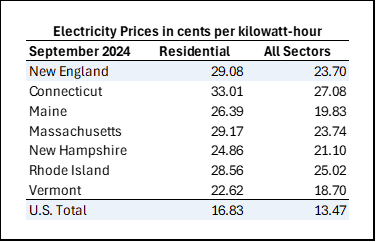
The Northeast has become the most expensive region in the continental United States for electricity. Connecticut has the most expensive electricity in the 50 states outside of Hawaii. Connecticut’s overall electricity price for this September, according to the Energy Information Administration, was 27.08 cents per kilowatt-hour (ȼ/kWh), compared to Hawaii’s 35.46 ȼ/kWh.

When I worked in sustainability at IBM (a joke in itself there), the Northeast was the most smug and misguided about the whole energy/carbon/climate issue. Never have I seen so many smart people (inside and analysts paid by IBM) get an issue so wrong because of ideology.

Well, take your smugness to the electric company and out of your bank account.

Gas is cheap and efficient. It’s not the bogeyman that you made it out to be. You picked your poison, now drink it.

story

Should Have Dumped The Renewables – German manufacturing firms are looking at options as sky-high energy costs weigh on bottom line

German manufacturing firms are considering scaling back production or relocating operations as the high cost of energy in the renewable-committed nation cuts into their profits, according to a new survey

The German “2024 Energy Transition Barometer,” which was published by the Association of German Chambers of Industry and Commerce, surveyed firms employing 500 people or more. 

“The trust of the German economy in energy policy has been severely damaged. Policy makers have failed to show companies that they can have reliable and affordable energy supply,” said Achim Dercks, the association’s deputy managing director, according to OilPrice.com

A report in May from the Federation of German Industries concluded that Germany had lost a decade’s worth of growth in production since before the outbreak of the pandemic in 2019. 

Story

Another failure for Green and unfortunately Germany.

Drill baby drill.

Exploding the Myths of “Green” Energy (Renewables Can’t Survive On Their Own And Increase The Cost Of Electricity)

As you read the proof that renewables is a farce, make sure to keep in mind the cost of EV’s.

American Experiment’s Isaac Orr and Mitch Rolling tell you what you need to know to respond to ill-informed advocates for “green” energy. There is much more at the link, but here is an overview:

1. Renewables can’t survive on their own

The renewable energy industry is a subsidy-based industry, as wind and solar are largely dependent on lucrative state and federal subsidies. However, renewable advocates justify these perpetual subsidies by claiming thermal generators receive more subsidies than wind and solar. This assertion is not based on reality….
***
In 2022, wind and solar generators received three and eighteen times more subsidies per MWh, respectively, than natural gas, coal, and nuclear generators combined. Solar is the clear leader, receiving anywhere from $50 to $80 per MWh over the last five years, whereas wind is a distant second at $8 to $10 per MWh.

Poor solar energy! No matter how many billions the government pours down the solar rathole, no one has figured out a way to generate solar power after the sun goes down.

2. Renewables increase the cost of electricity

Renewable advocates often claim that the adoption of more wind and solar will lead to lower electricity costs, but the opposite is true. In a previous Substack, we wrote in detail about how utility companies with the largest rate increase requests in the country admit the energy transition is a major reason behind increasing electricity prices for families and businesses.

“Green” advocates fake the numbers for wind and solar by the simple expedient of only counting a fraction of their costs. This chart shows the actual cost of the various energy systems if all costs are included:

More

Electric cars pollute 1,850 times more than fuel-based vehicles, study finds

A 2022 study found that electric vehicles (EVs) which left-leaning governments in Canada, the United States, and elsewhere are pushing on the population, pollute at a rate far higher than their gasoline or diesel-powered counterparts. 

The 2022 study from the U.K.-based Emissions Analytics group found that during a 1,000 mile journey, EVs release 1,850 times more pollutants into the surrounding environment than gas-powered vehicles, due to the heavier weight which eats through tires.

While many think of emissions from exhaust, tire wear plays a significant role in emitting pollutants. The synthetic rubber used to create tires include certain chemicals that get released into the air, and because EVs are significantly heavier than conventional cars due to massive lithium batteries. 

Overall, EVs weigh about 30 percent more than gas-powered vehicles, and cost thousands more to make and buy. These issues are in addition to the fact that they are not suitable in colder climates (such as Canada and the northern U.S.), offer poor range and long charging times (especially in cold weather), and have batteries that take tremendous resources to make and are hard to recycle.  

More

No Amount Of Subsidies Will Ever Make A Wind/Solar Electricity System Economically Feasible

More COP28 lying….the math never works.

The COP 28 climate confab opened today in Dubai. Some 70,000 true believers in the energy transition are said to be gathering. And not one of them appears to be either willing or able to do the simple arithmetic that shows that this can’t possibly work.

So far, no country that has made a commitment to “net zero” has officially backed off. (Argentina may soon become the first.). Things proceed as if all that is needed is to build sufficient wind and solar generation facilities, until eventually you have enough of them to meet demand. But that’s not how this works. The absurdity becomes more obvious every day. Can somebody please tell the poor people making fools of themselves in Dubai?

Let’s consider the latest from Germany. According to Statista here, Germany consumed 511.59 TWh of electricity in 2021 (latest year given, although the numbers have recently changed very little from year to year). Divide by 8760 (number of hours in a year) and you learn that Germany’s average usage of electricity is 58.3 GW. So, can you just build 58.3 GW of wind and solar generators to supply Germany with electricity?

Absolutely not. In fact, Germany already has way more wind and solar electricity generation capacity than the 58.3 GW, but can’t come anywhere near getting all its electricity from those sources. As of June 2023 Germany had 59.3 GW of generation capacity from wind turbines alone, and (as of end 2022) another 67.4 GW of generation capacity from solar panels. The total of the two is 126.7 GW — which would supply more than double Germany’s usage at noon on a sunny and breezy June 21. But, according to Clean Energy Wire here, through the first three quarters of 2023, the percent of its electricity that Germany got from wind and solar was only 52%. Capacity seemingly sufficient to supply double the usage in fact only supplies half. That’s because the supply does not come at the same time as the demand, and the wind/solar generation system provides no mechanism to shift the supply to a time to meet the demand.

And why doesn’t Germany just double the amount of its wind/solar generation, so that those sources would go from supplying 52% of usage to 100%. Because it doesn’t work that way. If they double the wind and solar generation, then on the sunny/breezy June 21 mid-day they will now have over 250 GW of electricity generation — more than 4 times what they need — so they will have to discard or give away the rest. But on a calm night in January, they will still have nothing and need full backup from some other source. Multiplying the wind/solar generation capacity by 10 or even 100 (referred to as “overbuilding”) will increase the costs of the system exponentially, but will never be enough to keep the lights on all the time. Or you can try energy storage to save up the surpluses to cover the deficits, but that also multiplies the costs of the system exponentially. For more than you will ever want to know about energy storage and its costs, read my December 2022 energy storage report, “The Energy Storage Conundrum.”

Read The Whole Thing Here at WUWT