Millions of Americans dutifully fill their recycling bins each week, motivated by the knowledge that they’re doing something good for the environment. But the sad fact is that much of what is tossed in the recycling bin is eventually heaped into landfills.
While this bombshell might be jarring – especially if you’re someone who dutifully cleans their recyclables before caringly placing them in bins – Thomas Kinnaman, an environmental economist from Bucknell University, says it’s actually not as bad as you think.
As Kinnaman discovered in a 2014 study – a complete life cycle analysis of the recycling process – it doesn’t make much economic or environmental sense to recycle plastic and glass in much of the developed world. Despite claims that plastics are recyclable, really only PET and HDPE (types 1 and 2 in North America) can be readily reused. In total, only 9% of plastic is melted and reformed. The rest goes into landfills or the wider environment.
City Journal science journalist John Tierney pointed out in Stossel’s segment that the economics of recycling have only worsened over time. Both plastic and glass are fairly easy on the environment to produce, but are often very tricky, costly, and intense to recycle. When you factor in all of the water used to decontaminate plastic and glass, the immense distances traversed transporting them (usually by truck, train, or ship), and the mechanical and chemical processes utilized to transform them into new goods, it becomes clear that they are better off in a landfill.
source
there is more there to show why it is not the panacea it is made out to be, but the dirt worshipers won’t believe it so I don’t try anymore.
The facts are the fact at the end of the day. It is a socialist crowd conditioning exercise that leads to people being sheep to feel better about themselves. They will gladly take a vaccine that doesn’t work and did more damage than the actual disease (Covid-19).
On March 22, 1987, the barge Mobro 4000, loaded with six million pounds of garbage and towed by tugboat Break of Dawn, departed Islip, New York. It was bound for Morehead City, North Carolina — but never did dock there. Instead, it spent the next five months at sea, turned away by multiple states and three foreign countries. It became big news when journalist Dan Rather called it “the most watched load of garbage in the memory of man.” But another load of garbage was the story the media spun about it. In reality, no one would accept the Mobro because of a rumor that it was carrying medical waste. But that’s not the narrative the media pushed.
It advanced the notion that the Mobro’s fate was a result of a lack of dump space.
The “solution,” of course, was recycling. The timing was perfect, too, as there already was increasing public concern about waste. Oh, never mind that, as Reader’s Digest reported decades ago, 1,000 years of America’s trash could fit in an area 50 miles square (one m2 per state) and 200 feet high — the average modern dump’s height. “Never let a crisis go to waste,” and this one wasn’t wasted: The story helped catalyze the recycling movement. The Mobro 4000 might have been adrift, but recycling proponents’ ship had come in.
Of particular concern, too, is plastic, with stories of the material polluting our oceans. But what if plastic recycling is a myth, if not a scam, that is not only wasteful but environmentally damaging?
Yes, it is one of the biggest scams in history and you can read about how little it really matters at the link above.
Don’t forget that getting the guilty to recycle is no different than lining up the sheep for a jab. It is to get a group to behave the way the government wants them to act. In other words, it’s just another step toward socialism through behavioral acts of perceived service. Socialism is just one step away from communism, what the assholes in DC want anyway.
Don’t be a sheep. Throw it away, just not on the street. It’s cheaper to treat it as garbage than as recycling as you can read and you are not helping the environment by recycling.
Every time I get reminded to recycle, I show articles like this and remind the other person that it is socialist behavior and how bad it is for our health. Since I’m related by marriage to a bunch of socialists in Scandinavia, it sort of stops them from their favorite sport, trashing America.
Well, here are the facts, it doesn’t work and it’s been a first class hoax since inception.
The industry knew decades ago that recycling was never viable in the long term, and now we’re all being poisoned by its product.
Hardly any plastics can be recycled. You’d be forgiven for not knowing that, given how much messaging Americans receive about the convenience of recycling old bottles and food containers—from the weekly curbside collections to the “chasing arrows” markings on food and beverage packaging. But here’s the reality: Between 1990 and 2015, some 90 percent of plastics either ended up in a landfill, were burned, or leaked into the environment. Another recent study estimates that just 5 to 6 percent are successfully recycled.
While those numbers may surprise you, these sorts of statistics aren’t news to the companies that produce plastics. For more than 30 years, the industry knew precisely how impractical it is to recycle them, according to a new report from the Center for Climate Integrity. A trade association called the Vinyl Institute concluded in a 1986 report that “recycling cannot be considered a permanent solid waste solution” to plastics, as it merely prolongs the time until an item is disposed of.” Still, facing public backlash over the growing amount of plastics being incinerated and piling up in landfills, manufacturers and their lobbyists sold recycling as an easy solution, warding off potential legislation to ban or limit plastics.
This, of course, has echoes of Big Tobacco and Big Oil, both of which withheld crucial information from the public for decades—causing untold damage to human health and the planet, respectively. Both industries are payingdearly for it. Is Big Plastic due for a similar reckoning?
In some sense, a reckoning is already happening—just not (yet) because of the industry’s decades of alleged deception, disastrous environmental justice record, and mass proliferation of microplastics into human bloodstreams. At the beginning of this year, S&P Global found that the petrochemicals industry—responsible for producing the suite of typically oil- and gas-derived compounds known as plastics, as well as pesticides and industrial chemicals—faces uncertain prospects over the coming years. “Overall, global petrochemicals prices appear to have reached a peak in October and are forecast to grind lower into early-2024 following energy and feedstock prices lower,” the consultancy found, forecasting a “supply-drive surplus” through 2026.
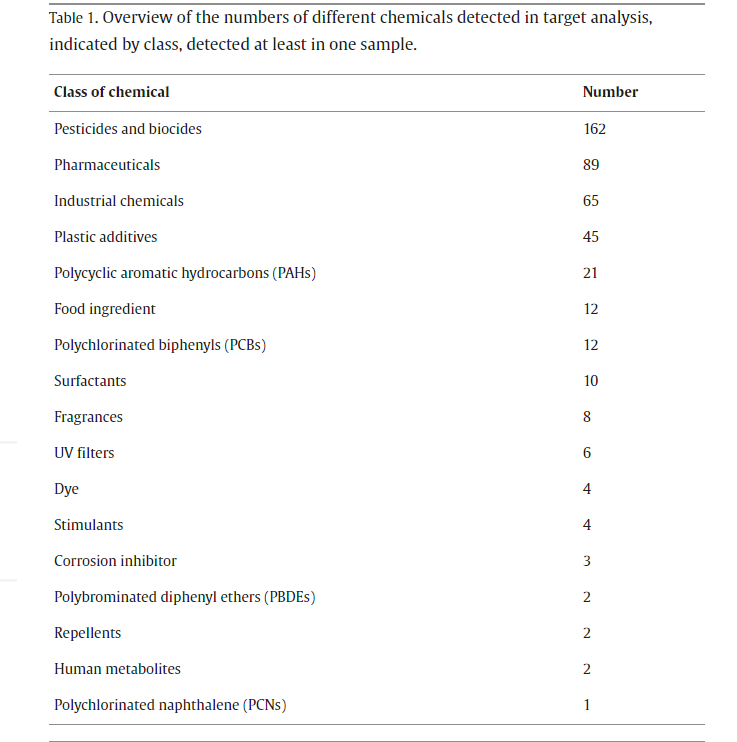
Researchers tested plastic pellets from recycling plants in 13 different plants across the world. They found 491 readily identifiable organic compounds, with a further 170 tentatively identified. As you can see from the table below, they span a wide variety of chemical classes.
The study, published this month and titled “Global mass of buoyant marine plastics dominated by large long-lived debris,” used “observational data” from coastlines, the ocean surface, and the deep ocean to conclude that the amount of plastic pouring into the oceans every year is about 500,000 metric tons. The researchers’ abstract said that “recent estimates of the oceanic input of plastic are one to two orders of magnitude larger than the amount measured floating at the surface.”
Though this may still sound like a lot, but a widely relied upon 2015 study overshot the “accepted” number by a whopping 1,600%.
Referring to the data cited from the 2015 study led by Dr. Jenna Jambeck from the University of Georgia, the new study explains that “This discrepancy could be due to overestimation of input estimates, processes removing plastic from the surface ocean or fragmentation and degradation.”
The 2015 study with the now-challenged estimate was been adopted as authoritative by a range of media outlets, environmental activists and government agencies.
Nancy Wallace, Marine Debris Program Director at the National Oceanic and Atmospheric Administration (NOAA), called the 2015 study “significant” in a New York Times article. Though she conceded it wasn’t an exact figure, she said it “gives us [NOAA] an idea of… where we might need to focus our efforts to affect the issue.”
To date, Dr. Jambeck’s 2015 study is listed on the NOAA website. Just the News contacted Wallace and NOAA’s media team for comment.
Other entities who accepted the 2015 data as a fact include The World Economic Forum, who said “At this rate, there will be more plastic than fish in the world’s oceans by 2050” and suggested that plastic pollutants “are adding to the climate change problem.” Other proponents of the “conventional wisdom” include UNESCO, The National Geographic Society, Time magazine, The Washington Post, as well as dozens of environmental organizations, such as “Environmental Action” and “Ocean Conservancy” all of whom have cited the “8 million metric tons of plastic pollution” figure.
Outlets like The New York Times, which propped up the 2015 study, have appeared to downplay the new number and double down on pushing a fearful narrative. “There Might Be Less Plastic in the Sea Than We Thought. But Read On,” reads their headline about the new data. “The new research might seem like good news, but the full picture is complicated: The amount of plastic in the ocean is still increasing by about 4 percent every year, according to the study,” the Times added.
Stephen Guertin, Deputy Director of U.S. Fish and Wildlife at the Department of The Interior, also used Jambeck’s study in his 2019 testimony before Congress, repeating that “it is believed that at least 8 million tons of plastic end up in our oceans every year, and make up 80 percent of all marine debris from surface waters to deep-sea sediments.”
And while America has been continually criticized for its role in plastic pollution, with many states passing legislation to severely restrict the use of plastic products, Manhattan Institute waste expert John Tierney says “virtually all the consumer plastics polluting the world’s oceans comes from ‘mismanaged waste’ in developing countries.”
“The Environmental Protection Agency has promoted recycling as a way to reduce carbon emissions, but its own figures show the benefits are relatively small and come almost entirely from recycling paper products and metals, not plastic,” he wrote in a New York Post op-ed, adding that rather than Americans sending plastic to a landfill, “most” of it ends up being shipped overseas to developing nations.
I tell my wife that it’s just another socialist tactic. I see 6 different containers in her home country of Denmark (which is socialist) and they clutter the streets while making the population get in line and obey.
The truth is that if you bury it, it doesn’t get micro plastics in the air and water, where it is far more dangerous. But that would be against the narrative. I could be broken down easily, but that doesn’t let people get controlled like good little commies, handcuffed to the recycling prison chain gang. They are dutiful sheep that are probably also vaxxed against Covid.






 Delusions of Adequacy