 Notice that I didn’t use the words becoming rich. Having a full life, belief in God, friends, family or a passion for doing something is rich. Becoming a millionaire is about money.
Next, this subject has been addressed by the more knowledgeable than I, but I’m going to talk to the average Joe like me, which is the likely reader here.
Finally, I don’t claim to know it all, nor do I claim to be in any financial category. I do observe trends and try to learn from them. Hopefully I’m eating my own dogfood.
HOW IT IS DONE
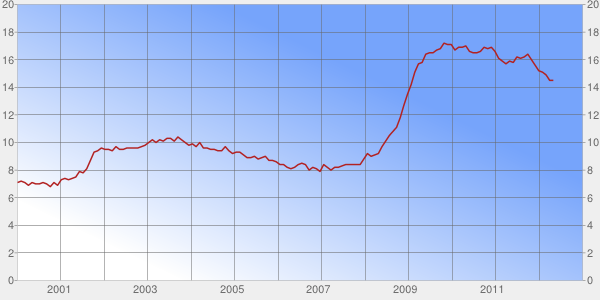
It is simple math. You either make money or spend less, or a combination of the two. I realize that we have a burdensome government, a tough economy and a next to impossible IRS tax code. In fact the real unemployment number is not what you read in the main stream media, but the U6 rate which as of this writing is 14.5%.
For the purposes of becoming a millionaire, we will assume employment. That means get a job instead of living on entitlements, because that will disqualify you from this discussion.
Sure it is easy to have received Facebook stock or have invented Facebook, but the average millionaire doesn’t have that at their discretion.
USE YOUR MONEY TO MAKE MONEY
This means compounding what you have in ways other than just putting it in the bank. I had a roommate who was a stockbroker and he told me many stories of secretaries making minimum wage who came to him at retirement with 7 figure 401K accounts. They saved in a way that maximized the return on their investment. This usually involves a company match and some diversification. It also assumes that you take risk when you are younger and seek advice or study investing voraciously as it is a mystery to most….despite the fact that everyone thinks they know about it.
Part of your diversification also means not putting everything in the stock market. As an example, real estate has just undergone a busted bubble (thanks to the Community Reinvestment Act which never should have been enacted), but it means there are properties to be had for a song right now and are ripe for the picking. They will grow and become more valuable. My advice is no different from what you’d expect. Start out small and work your way up. That process allows you to learn about what value really is, and compound your earnings into larger investments that have bigger payoffs.
There are many other ways, but the concept is the same, save and invest wisely by starting small and growing your profits and portfolio. You must also study and read or you could throw your money down the drain if you think you know everything. It also involves patience. If you recall the story from my roommate, it was saving and investing over a lifetime
HOW TO LEARN
There are articles ad-infinitum to read about the aforementioned. The other way is to talk to people who have done this. I suggest that you start with Dave Ramsey or Crown Financial Ministries if you are starting out (or are in trouble, or anywhere in between). It is a tried and true method of handling you money.
Who you talk to also matters. There are people who talk in $10’s of thousands, $100’s of thousands, millions or Zuckerberg’s and Gates’. I suggest you seek out those who are in the highest category possible as you need to think big in making and investing. I don’t have coffee with Warren Buffet, but his advice is readily available.
Find those who are successful and ask them how they did it. I’m betting that you’ll find there is no secret code or magic key, they just worked at it and kept their long-term goals of financial independence in mind, and kept check over their human nature.
SAVE YOUR MONEY
The other side of the equation is savings. In other words you need to spend less and when you do, spend wisely. Of the people I worked with at my last job, many were high salaried executives who were in debt because they had a keeping up with (or passing) the Jones mentality. This was especially true of those in the New York area for some reason (but demographics shouldn’t really matter). They had big houses with unfurnished rooms because they were house poor. Living within your means is important which is my next segue.
NEED VS. WANT

Including the basics of food, clothing and shelter, one has to look at the way one buys things. Most buy what they want rather than what they need. If you adopt the buy it tomorrow instead of now mentality, you likely will realize that you don’t really want it as badly as you think.
There is the adequacy (not delusions of adequacy ;-)) vs. luxury mentality also. A Casio, Timex or Seiko watch tell as good of time as does a Rolex, so unless you have money to burn, why are you buying the Rolex? This applies to cars, clothes or virtually any tangible item. Ask yourself, self do I need this/do I need to have the very best/am I showing off or would what I can really afford what I have? I have relatives who have to have the very best, but have wasted as much money as I’ve earned on things to show off.
My son said that some people need to wear their paycheck. You can see them coming down the road in cars that are raised with shiny rims and a 24 thousand watt stereo. Others have to order the best wine, food and show off at restaurants (my brother-in-law).
Back to the person who knows this better than most, here is a story about expensive car drivers:
But what if Ranger Rich is like many people who define rich in terms of income instead of net worth? Certainly many drivers feel the need to display their socioeconomic achievements by acquiring prestige makes of motor vehicles. They may think that those who are successful in generating high incomes drive luxury brands. And correspondingly drivers of more common makes have dull normal income credentials. But the hard data suggest that the level of prestige of a car and the income of its driver are not anywhere near being perfect correlates. In fact, many drivers of luxury makes have neither the levels of income nor net worth which would qualify them as high economic achievers.
Along these lines, Joann Muller, writing for Forbes.com, poses “what the rich people really drive.” She defines rich people in terms of income, not net worth.
. . . the richest people were the most likely to buy luxury brands [39% for people with household income above $250,000 vs. 8% for those people who earn less than $100,000 a year].
. . .61% of people who earn $250,000 or more aren’t buying luxury brands at all.
Her analysis indicates that those households with high incomes are more likely to drive luxury cars. But just because someone is driving a luxury brand it does not necessarily mean that the driver has a high income or a high net worth, for that matter.
Further, here is a story about how the average millionaire deals with car buying.
You have to spend on things that will appreciate, not sparkle. Again, my relatives are the worst offenders who have overspent on toys, baubles, cars and anything else they can waste their money on. It baffles me. When they bought real estate, they over paid, over leveraged and bought for show instead of ROI.
DEBT AND LEVERAGE
This gets most people in trouble. If you can’t pay off your credit card each month, you effectively are paying more for what you bought (because of the interest). Compounding works for debt in the same way as it does for savings. It is the accumulation that is the issue. I’m not just picking on credit cards, anything can be substituted here. If you saved first, you could buy it for less and your want will likely decrease.
For housing, it used to be that you had to put at least 10% down, but due to the above mentioned CRA (can you tell I loathe that legislation?) one could buy a house they couldn’t afford because they were told they qualified for it…. with no money down. You were PLAYED for a fool on this. Living below your means is the best policy.
If you care to splurge on something, it’s OK….just don’t borrow.
The same can be said for leverage. I’ll stay on housing here. Banks will always want you to buy more as the more you borrow, the richer they get. Typically one is paying at least 3 times the amount for a big-ticket item buy leveraging which brings me to my next segue.
PAY OFF YOUR HOUSE
The wisest know that man can not serve two masters. When you have a huge mortgage hanging over your head, it is your boss/master/slave driver/keep you up at night worry/cause of divorce or many other calamities. The bank won’t be calling on you to take your home away nor will you have to file bankruptcy (again, my relatives).
Besides owning a house within or below your means, paying it off early is the best way to get out of debt and improve your cash flow. Take out a mortgage less than 30 years, pay more than the minimum and do everything you can to pay it off early.
Forget the argument that it is a tax deduction. Congress is aiming at trying to take that away as I type. Also, any money you get back on taxes is just an interest free loan to the government at your expense.
By doing this, for most people it will likely be one of the best long-term financial decisions they can make.
CONTROL YOUR DESTINY
Note: I am quoting Dr. Thomas Stanley here. It is better told than I could say it, but it clearly is the moral to the story and what I would have said:
In The Millionaire Next Door I quoted the words of a corporate sales professional, a millionaire whom I interviewed. He like other self made millionaires said that he had a “go to hell fund. . . just in case my employer suggests (insists) that I leave Austin for corporate headquarters in Rottenchester.” He never had to leave Austin and he added, “PTL.” In other words, [the millionaires next door] have accumulated enough wealth to live without working for ten or more years.
I was reminded of these words of wisdom after reviewing an email from Ms. F who currently resides in a lovely community in the Southern United States:
I went to my local library this morning, hoping to borrow The Millionaire Next Door. However, the only available book was in Spanish, so I borrowed “Millionaire Women Next Door” instead. By the time I completed the second paragraph on page 8, I had collapsed in a fit of “craughter” – simultaneously crying and laughing at my sad truth. My newest work assignment is no less than 8,200 miles, 18 hours of flying time and 12 time zones away from everyone who means the most to me in this world. Simply put, the situation stinks, but I had convinced myself that it was necessary to pay the bills. Suffice it to say that I have renewed by concerted efforts to become a cultivator of wealth, and I plan to share my transformation with you soon. Thank you for creating this compilation of evidence-based encouragement!
What precipitated Ms. F “crying and laughing?” Consider the words from Millionaire Women Next Door:
Aren’t you growing tired of being among the ranks of hunter-gatherers? Do you enjoy your hyper consumption lifestyle so much that you must fly out of town every week to earn a paycheck to pay your bills? . . . begin making the transformation to a cultivator of wealth. Think about that the next time you are ten thousand miles from home, surrounded by strangers, and flying in dreadful weather. It is up to you. Do you want to spend your life as a hunter and gatherer of income, earning a million mileage points? . . . those financially indpendent folks. . . . They make their own decisions about their next destination. Right now, you and your career are essentially corporate property. Neither one of you has the luxury of self-determination.
I also stated that:
The [millionaire business] women profiled herein will not tolerate such an existence. They are free. They are cultivators of wealth and satisfied with life. They are in control of their own destiny.
INCOME AS A PERCENTAGE OF WEALTH
More from Frank Stanley, their income is only 8.2% of their wealth:
People who believe that they will never become wealthy generally fulfill this hypothesis. I explained to Brit, who was once a member of the ultimate income statement affluent club, that he has an excellent chance of becoming a millionaire next door type and that the typical millionaire next door is 57 years old. The Bible states that those with faith and hope can achieve a great deal. Even those with faith the size of a grain of mustard seed will likely reach their intended goals.
The will and discipline that this couple demonstrated in paying off its considerable debt is telling. The same determination can be used in setting aside at least 15% of their income for savings and investing.
What should you anticipate as a typical member of the millionaire next door fraternity? One, given the calculation via the Wealth Equation, actual net worth exceeds its expected value by a factor of 2 or more. Two, the market value of the home is less than 20% of net worth. Three, debt totals the equivalent of less than 5% of net worth. Four, annual income tax is the equivalent of about 2% of net worth. Five, total annual realized income is approximately 8.2% of net worth [median], or the equivalent of $8.20 of income for about every $100 of wealth.
This $8.20 figure from my own research is fairly congruent with the findings of other researchers. For example, three scholars employed by the Treasury Department, Johnson, Raub and Newcomb, compared the wealth characteristics of millionaires via 36,352 federal estate returns who passed away in 2007 with the incomes of these decedents when they were living. Those millionaires who were married and under the age of 70 [like the large majority of the millionaire next door types that I have surveyed] realized the equivalent of $8.45 for every $100 of their net worth. This figure is within approximately 3% of the dollar figure ($8.20) that was determined from my surveys.
IN CONCLUSION
There is no conclusion, just work and keep your long term goal in mind. I may talk later about other basic ideas that contribute to this like paying cash instead of credit (briefly mentioned here), couponing, buying the store brand instead of the premium name brand and other tricks. Nevertheless, adhering to the above puts you well on your way to being the average Joe millionaire.
My relatives laughed at me all my life for watching what I spent, how I lived and called me a skinflint. I knew that I had a long term plan for financial security. Today, at retirement age, they work just to keep up. Who’s laughing now?


 Delusions of Adequacy