You Get More Introverted With Age, According to Science

We all become more introverted as we get older, even the most extroverted among us. Of course we do

I’m a classic introvert, but in my teens and twenties, it was normal for me to spend almost every weekend with friends. Now, in my thirties, the perfect weekend is one with zero social plans.

And I’m not the only one socializing less these days. My extroverted friend, for example, used to run through her entire contact list, calling friends whenever she was alone in the car. She told me she hated the quiet, the emptiness, because being alone felt boring.

You know, for the whole 10–15 minutes it took to drive to the grocery store. Oh, the horror.

These days, I can rarely get her out for brunch or coffee. She’s content spending most nights at home with her husband and two kids. And I haven’t gotten one of her infamous calls in years.

So, what gives? Do we get more introverted as we get older?

Probably, says Susan Cain, author of Quiet: The Power of Introverts in a World That Can’t Stop Talking — and this is actually a good thing. Let me explain.

Why We Become More Introverted With Age

In a post on Quiet Revolution, Susan Cain confirmed my suspicions: We tend to act more introverted as we get older. Psychologists call this “intrinsic maturation.” It means our personalities become more balanced, “like a kind of fine wine that mellows with age,” writes Cain.

Research also shows that our personalities do indeed change over time — and usually for the better. For instance, we become more emotionally stable, agreeable, and conscientious as we grow, with the largest change in agreeableness happening during our thirties and continuing to improve into our sixties. “Agreeableness” is one of the traits measured by the Big Five personality scale, and people high in this trait are warm, friendly, and optimistic.

We also become quieter and more self-contained, needing less “people time” and excitement to feel a sense of happiness.

Psychologists have observed intrinsic maturation in people worldwide, from Germany to the UK, Spain, the Czech Republic, and Turkey. And it’s not just humans; they’ve observed it in chimps and monkeys, too.

This shift is why we slow down as we get older and begin enjoying a quieter, calmer life — and yes, it happens to both introverts and extroverts.

Becoming More Introverted Is a Good Thing

From an evolutionary standpoint, becoming more introverted as we age makes sense — and it’s probably a good thing.

“High levels of extroversion probably help with mating, which is why most of us are at our most sociable during our teenage and young adult years,” writes Susan Cain.

In other words, being more extroverted when you’re young might help you form important social connections and, ultimately, find a life partner. (Cue the flashbacks to awkward high school dances and “welcome week” in college.)

Then, at least in theory, by the time we reach our 30s, we’ve committed to a life path and a long-term relationship. We may have kids, a job, a spouse, and a mortgage — our lives are stable. So it becomes less important to constantly branch out in new directions and meet new people.

(Note that I said “in theory.” In my 30s, I still don’t have kids, a mortgage, or a wedding ring. These days, we have the luxury of not following evolution’s “script.”)

“If the task of the first half of life is to put yourself out there, the task of the second half is to make sense of where you’ve been,” explains Cain.

During the married-with-children years, think of how difficult it would be to raise a family and nurture close relationships if you were constantly popping into the next party. Even if you don’t marry or have kids, it would be hard to focus on your career, health, and life goals if you were always hanging out with friends like you did in your teens and twenties.

Once an Introvert, Always an Introvert

But there’s a catch: Our personalities only change so much.

In my book, The Secret Lives of Introverts, I like to say that our personalities may evolve, but our temperaments remain constant.

This means that if you’re an introvert, you’ll always be an introvert, even at 90. And if you’re an extrovert — though you may slow down with age — you’ll always be an extrovert.

I’m talking big-picture here: who you are at your core.

Research supports this idea. In 2004, Harvard psychologists Jerome Kagan and Nancy Snidman studied individuals from infancy into adulthood. In one study, they exposed babies to unfamiliar stimuli and recorded their reactions. Some babies got upset, crying and flailing their arms and legs; these were labeled “highly reactive” to their environment.

Other babies remained calm around the new stimuli; they were the “low-reactive” ones.

When Kagan and Snidman checked in with these individuals later, they found that the “highly reactive” babies often grew up to be more cautious and reserved, while the “low-reactive” babies tended to stay sociable and daring as adults.

The bottom line? Our core temperament — whether cautious or sociable, introverted or extroverted — doesn’t change dramatically with age.

Want to feel more at ease in social situations?

Discover the secrets to enjoying fun, meaningful conversations. Know exactly what to say — even if you’re introverted, shy, or socially anxious. Feel less drained and have more energy while socializing.

An Example: Your High School Reunion

Consider, for instance, your high school reunion.

Let’s say you were very introverted in high school — perhaps the third-most introverted person in your graduating class. Over the years, you’ve grown more confident, agreeable, and comfortable in your own skin, but you’ve also become a bit more introverted. If you enjoyed hanging out with friends once a week in high school, maybe now in your thirties, you’re content with seeing them only once a month.

At your ten-year high school reunion, you notice everyone has slowed down a bit, enjoying a calmer, more stable life. But those who were very extroverted in high school are still much more extroverted than you.

You’re still approximately the third-most introverted person in your class — but now the whole group has shifted slightly toward the introverted side.

And that’s not a bad thing. In fact, it might be exactly what we need to flourish as adults. If there’s one thing we introverts understand, it’s the deep satisfaction of a quiet life.

Source

My take, I just had my 50th high school reunion. I never even considered going. I enjoyed it immensely.

How Is This Legal? Drinking and Driving In Florida

‘How Is This Legal?’: Tampa Bay Woman Pulls Up To Drive-Thru. Then She Proves Why Florida ‘Isn’t A Real Place’

If you know, you know: Florida is more than a glorious, sun-drenched vacation land. It’s a weird and chaotic, semi-lawless-feeling place dangling off of the edge of America. And for Maddy (@maddy.1414), who lives in Tampa Bay, that is exactly why she swears it’s not even a “real place.”

In a TikTok video that’s been watched over 689,000 times, Maddy spotlights one of the quirkiest, most counterintuitive things about life in Florida. And shockingly, it has nothing to do with alligators or the Brightline. It’s all about drive-thru drinks. 

One For The Road, Literally

“Florida is not a real state,” says Maddy in the intro to her video. Sure, she’s going hard, but she promises to back up her claim with evidence. The video then cuts to her ordering at a drive-thru. “Can I just get one espresso martini?” she says.

A voice replies, “Yeah, sure thing.”

She pulls around to the window. But while waiting, she speaks directly into the camera again. “OK, if you know me, you know that I always say Florida isn’t a real state because you can do things here that you shouldn’t be able to legally do,” she says.

MY STORY FROM YEARS AGO

When a stupid youth in high school and college, I remember going through the brew-threw to get a six pack for the beach or wherever I was going. They were available in Orlando and along the beach. We had fake IDs and just cruised in and out. The best thing I ever did was move out of that state. That meant splitting a six-pack to the beach and another one on the way home. It was only a one hour drive away. I could have blown the limit by double, which was higher back then. That business made a killing. We’d have to wait in line for our turn, it was so busy, any time of day. I think they finally passed a law to stop it, but I haven’t been there in years.

How I’m alive is beyond me.

Now, when I see a Florida tag in my current state, I steer clear because I know it’s a bad driver. The minute you cross the border from Georgia, people pass in the right lane. The old people get into the fast lane and drive slowly. They also drive into pools in South Florida fairly regularly

Now, If I have to go out with my brother-in-law to dinner, he has a cocktail, a bottle of wine, and an after dinner drink. I gave it up 30 years ago, yet he drives because I don’t know where I’m going where they live, and he thinks he’s a big shot. How he doesn’t have a DUI or a broken neck is beyond me. It’s why I avoid my family when possible. I also won’t drive with him anymore.

If I’m a cat, I’ve used up 8 lives.

What was your favorite subject in school?

What was your favorite subject in school?

I’d like to say that I was dedicated to a job goal in school, but I just tried to get good grades, like it or not. I was only interested in either getting into college or getting a job, but there wasn’t any subject that blew wind up my skirt.

I was small and the youngest kid in my class due to the birthday cut off, but I enjoyed PE class because it was a break from studying. It’s tough being the youngest and usually the smallest. Once I caught up to the other kids, I held my own and even kept up with the team athletes at the end.

It was the break from the monotony of class that made me enjoy it.

The valedictorian and salutatorian were in my chemistry class. They ruined the curve for everyone. The kids always messed with their experiments, and they could never figure out why they didn’t get the results that they were supposed to, although their write ups got them the A’s they strove for. Neither went anywhere in life.

The real smartest kid placed 3rd behind these two shrimp girls because he took weightlifting in PE and got a B, his only one ever. I give him credit for sticking his neck out in life. Straight A’s got a lot of people nowhere, but life lessons did.

Which brings me to my greatest learning in school. I had to try harder in everything. I was so young that social things, intuitive to others, were a hard learned lesson for me. It was tenacity over talent in everything. If I’d known that I was an introvert, I could have used my observation skills even more. What I did was just intuition back then.

So while it was the toughest subject for me, life was the class I studied the most. I had to figure everything out without someone to show me how. Like the Bob Seger song, I was working on mysteries without any clues. It was the best lesson I learned.

I wound up playing Tennis for my college, the only sport I made the team on. I was president of my fraternity and dated a cheerleader. None of that really mattered to me then. I expected it after all that I’d been through. I worked hard enough to get the job that opened doors to people and travel, and the success I’d defined for myself.

As it turns out, my 50th reunion was last weekend. I didn’t go because I never related to the other kids, or wanted to. They were just people I learned from, mostly what not to do or how to act.

At high school graduation, I vowed that I’d be more successful by any measurement. A few became actors, pro sports athletes, or a doctors here and there. As I’d come across their stories before I ditched Facebook, the pinnacle of life was high school for them. It was all downhill from there. I was just starting, but the seeds of motivation to succeed were planted and fertilized. I’d met my goal set way back in high school.

Life was the best class. It had nothing to do with the classroom.

I will say that my German teacher was hot and not that much older than me. Why didn’t they throw a high schooler a break like they do now?

13 Things Introverts Find ‘Horrifying’

1. When people call — and a text or email would have been more than sufficient.

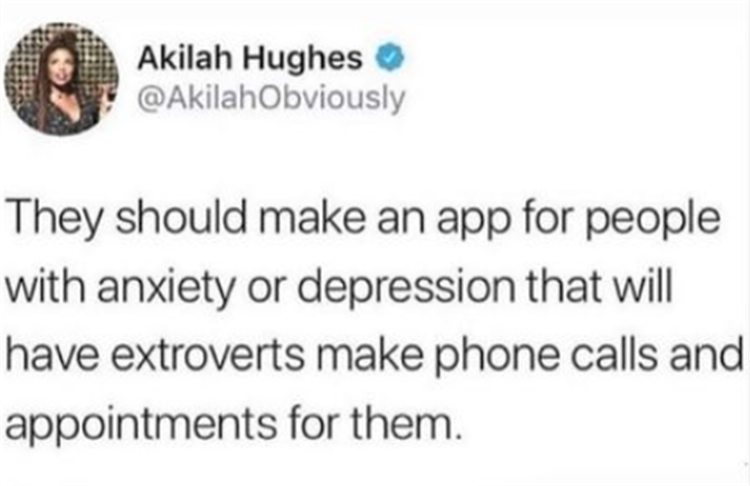
As an introvert, I am frightened by people who call when a text or email would be more than sufficient. There is a certain anxiety that comes with an open-ended conversation, since phone conversations are expected to take longer than the 10 seconds necessary to transmit the information. This anxiety is compounded by the lack of visual cues during a phone call that are vital to us introverts, but are often summarily ignored by extroverts. 

–Steve

2. Not being able to exit an intense social setting.

The thing that horrifies me the most is not being able to exit an intense social setting. If I am somewhere and don’t have an out, my stress level skyrockets. I need to know that I have a way to step out or leave so I can recharge. 

Lou

3. Networking events. Period.

Networking events are made for extroverts who gain energy by being around people and engaging with them. However, for most introverts, networking events are generally uncomfortable and terrifying — we find it hard to be open and let strangers into our lives. We are atrocious at small talk, and it is challenging to establish rapport with new people. For us, networking is definitely out of our comfort zone and ranks as one the top scary things for introverts.

Albert

4. Being put on the spot.

My biggest fear is of being put on the spot to say something in a group or public setting when I’m not prepared. That feeling of all eyes turning to me to say something off-the-cuff really makes me uncomfortable! 

Jen

5. Two words that strike intense fear into my heart are “overnight stay.”

I may be an introvert, but I love people. I can have a great time seeing friends and family and love spending time together over a few drinks and board games. But if we need to stay overnight? That’s when anxiety sets in. Keeping up the social energy in the morning, not knowing when we’ll be able to duck out and find some respite — these thoughts embed themselves into the back of my mind, which makes socializing that much harder.

Mike

6. First dates terrify me. 

First dates terrify me because of my aversion to small talk and awkward silences. I can talk to someone online, no problem, but face-to-face? I make very weird small talk because I’m nervous. The terror is, I see the date and he’s not who I’m interested in when I meet him in person. Then I just want to leave as quickly as possible, so the small talk becomes even more painful. I just sit there, in anxious terror, and blurt out the first thing that comes into my head, whether it’s appropriate or not. 

Prime example: I went out on a one-date-wonder a few years ago. We met for lunch, he didn’t appeal to me in person, awkward silence ensued. The only thing I thought to say was: “Armadillos are the only other mammal that contract leprosy from humans.” (I learned that factoid in fifth grade and who would have thought it’d stick with me 35 years later?!) He looked at me in horror and I fled. I never heard from him again — whew!

Lisa

7. Public speaking scares me to death. 

Any sort of public speaking scares me to death as someone who is basically a career introvert. It doesn’t matter if I’m leading a meeting of three participants or speaking to a larger audience, the thought of being the center of attention in any way, shape, or form truly terrifies me. It’s kind of like a fear of heights — you don’t understand it truly unless you suffer from it. All of the workarounds don’t seem to work, and I just manage it by avoiding it as much as possible. 

David

8. Getting trapped in a social commitment that goes on for hours.

There’s nothing more frightening than getting trapped in a social commitment that can prolong for hours (like public speaking or large parties). I prefer shorter engagements when my energy levels are higher, but once things drag on, it becomes impossible to focus and incredibly uncomfortable! 

–Sara

9. Having roommates — thus having to be social all the time — is an introvert’s worst nightmare.

The one thing that scares me a lot is living with my friends permanently. While I enjoy socializing, after a while, I am mentally drained and need time to recharge. If I had to live with friends, I’d feel obligated to be social all the time and that would be mentally stressful for me as an introvert because I wouldn’t have “space” to get away from them. You’re stuck living in the same place, and I feel that would be pretty unbearable.

Roger

10. My biggest fear is being embarrassed.

As an introvert who avoids social interaction at nearly all costs, my biggest fear is being embarrassed. When I’m in public, I usually become solely focused on how I look to other people, what others think of me, and the assumptions they make of me. In the past, it’s affected everything from the way that I walk to the comments I make to even the tone of my voice. It can be kind of brutal, but it’s something I’ve learned to deal with. Staying out of the public eye seems to help with that.

Mike

11. I feel my introversion can scare off a romantic partner.

One thing that scares me is that being introverted and very independent could cause damage to my relationship or scare them off

Lauren

12. I fear being alone forever because of my introversion.

We all need love and companionship, but as an introvert, I don’t like feeling like I have to compete for “airtime” in social gatherings. I love my alone time, but still want a solid group of loved ones. 

Tolu

13. I find it horrifying when my work manager announces, “Let’s have a team-building exercise today.”

I call myself an introvert, as I am someone who enjoys alone time, would rather stay home than go to a party on weekends, and I regain energy by spending time away from people. 

The one thing that terrifies me is when my work manager announces, “Let’s have a team-building exercise today.” Though we introverts tend to be team players — as we are all about deep work and being invested in the goals of the group — when it comes to group or team activities, it scares us. Team-building exercises involve interacting with people, small talk, and, in some cases, having the spotlight on you alone. These are all things my introverted self dreads and runs away from.

Source

12 doesn’t bother me, and I pretty much have gotten over being embarrassed, but the rest are true. I have to face number 5 on Thanksgiving with a houseful of extroverts.

I got told that I have to take care of some adolescents that I’m related to next summer and the anxiety has already set in.

Breast Cancer Month Hypocrisy

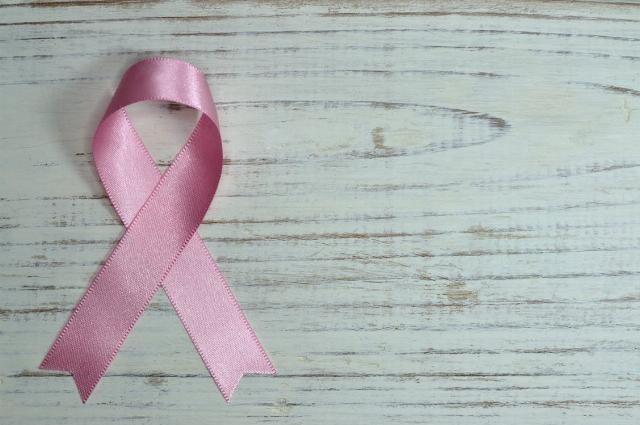
I lost my Mom to breast cancer. She beat it twice and battled it for 3 decades. In what amounts to malpractice, she ultimately succumbed to it. I do not take it lightly. So before you get outraged and be a SJW Karen with your panties in a wad, read the following and see what should happen if you do more than wear a pink ribbon. There’s a ribbon for every cause, but taking action to cure it is the ultimate expression of support.


Original article and source start here.

Once again, it’s “Breast Cancer Awareness Month,” as we’re hit with pink ribbons and fundraising alerts from breast cancer groups.

Two organizations that solicit funds purportedly for fighting breast cancer are the Susan G. Komen Foundation and the Breast Cancer Research Foundation (BCRF).

Wouldn’t you assume that groups promoting breast cancer awareness want women to actually decrease the risk by having women know all the risk factors?

Yet the biggest promoters of Breast Cancer Awareness month either omit the abortion factor or actually deny it.

Typically, these groups list lower risk factors that line up with their pro-abortion stance. What good does it do to mention exercise or alcohol while refusing to go near what has been found in studies around the world — abortion.

It’s also absurd to list family history as a risk factor — which is true but not preventable — while refusing to discuss abortion which is preventable.

It sounds unbelievable that groups claiming to be working against breast cancer are actually promoting breast cancer by not telling young women the full truth. But that’s exactly the situation.

Breast Cancer Hypocrisy Month

The closest either group comes to the abortion issue is Komen, mentioning breastfeeding as part of a healthy life for lowering risk: “Breastfeed if you can. Women who breastfeed have a lower risk of breast cancer than women who don’t breastfeed, especially before menopause. The longer a woman breastfeeds in her lifetime, the lower her risk may be.”

Correct. But why omit the significant factor of abortion if you really want to educate people?

BCRF lists these factors: weight/diet/exercise, alcohol use, smoking, timing of pregnancy, breastfeeding, and hormone use. Under ‘timing of pregnancy,’ we read, “giving birth later (after 30) or not having children can both increase a person’s breast cancer risk.”  That’s as close as they get s to mentioning the drastic increase in risk after abortion. Yet they plead for donations: “Triple your impact for life-saving research during Breast Cancer Awareness Month!”

What’s the point of more research if they refuse to talk about the existing research?

Komen states: “Research clearly shows abortion (also called induced abortion) is not linked to an increased risk of breast cancer.”

That statement is false.

When Dr. Angela Lanfranchi, founder of the Breast Cancer Prevention Institute, attended medical school in the 1970s, women who got breast cancer were overwhelmingly older. As a breast surgeon, she saw younger women getting breast cancer and she became alarmed.

“I became concerned because I saw a lot of women in their 30s with breast cancer.” Lanfranchi shared with Human Life International. “None of them had a genetic reason… It was heartbreaking because all three had young children… so I started looking into risk factors.”

Research already showed that if you smoked and had a child, your risk of breast cancer increased 69%, but if you smoked and had no children, the risk increased 649%. What was it about having a child that protected women from getting breast cancer, Lanfranchi wanted to know.

In 2023, JAMA published a study of U.S. cancers from 2010 to 2019.  Women age 20-29 had a 5.3% increase in breast cancer and those 30-39 had a 19.4% increase in breast cancer. Shockingly, late stage, less curable breast cancer rate under age 40 has increased 3% per year over that time period. Young black women have almost five times the abortion rate as Caucasians and are suffering the greatest increases in breast cancer. These vulnerable women need early screening if their lives are to be saved. “

So the dramatic increase in breast cancer was noticed; what wasn’t cited was the causes that had already shown up in studies done since 1957.

In 1996, Dr. Joel Brind, endocrinologist and professor at Baruch College of the City University of NY, did a meta-analysis of all research on abortion and breast cancer and found confirmation.

Abortionists like Planned Parenthood emphasize the negatives of having a child, not the ramifications of abortion. The suppression of the truth is reinforced by the nation’s two largest breast cancer charities, leaving women in the dark about a growing disease by the very people who claim to be pro-woman.

The nation’s top abortion provider, Planned Parenthood, also promotes breast cancer awareness while denying the abortion connection. They use the month of October to fundraise, bragging that they offer breast exams while they profit from abortion.

How absurd is it to offer breast screening exams while simultaneously promoting breast cancer by selling abortion?

Time to Connect the Dots

BCPI’s Dr. Lanfranchi says the research from China is conclusive that breast cancer is the #1 risk factor for abortion.

China’s 1979 one-child policy led to an explosion of breast cancer. Forced and multiple abortions led to more screening for breast cancer as the rates and mortality increased greatly.

 In 2019, the Chinese developed a risk model for Chinese women by conducting epidemiological studies to find the greatest risks in China. One study found a 151% increase risk with 1-2 abortions and a 530% increase in risk with three or more abortions. If women were over 30 years old when they had their first child, they had a 258% increased risk than women who were <25 years old when they had their first child.   

Another study in 2022 found, “that when the rate of abortion rose, so did the risk of breast cancer. This association is biologically plausible as full-term pregnancy is a protective factor for breast cancer, and the breast enlarges due to the changing level of estrogen and progesterone during pregnancy. Immature breast cells are more likely to transform into breast cancer cells when the pregnancy is ended via abortion, which raises the risk of breast cancer.”

In fact, they found abortion was the greatest risk factor with a 613% increased risk for two or more abortions. About half of all U.S. women have repeat abortions.

Apparently, “Federal grant givers (NIH and NCI) are reluctant to publish data that might call into question the safety of abortion and hormonal contraception that is deemed essential to protect our planet from global warming and over-population,” Lanfranchi points out.  “It’s ironic that in a country not known for freedoms [China], there was seemingly no problem in publishing data that could be seen as a criticism of public policy on abortion but not in the land of the free and the brave.”

Despite the dishonesty of many scientists in the U.S., the world’s scientific literature confirms the Abortion/Breast Cancer Link. 

It’s disgusting that those profiting from abortion are using breast cancer to sell more abortions. The American Life league (ALL) cautions people against supporting these organizations.

Both earned negative ratings from the ALL’s Charity Watchlist, while the Breast Cancer Prevention Institute has a positive rating. ALL’s director Katie Xavios explained the most egregious concerns uncovered in researching these organizations.

“In 2024, a staggering 360,000 women across the nation are estimated to face the devastating diagnosis of breast cancer,” observed Brown. “The devaluation of human life as practiced by the Komen Foundation and the Breast Cancer Research Foundation compounds this tragedy. We urge donors who wish to support breast cancer prevention to consider charitable organizations that affirm and protect human life regardless of stage of development.”

“Life-minded donors seeking to support the fight against breast cancer will be pleased to discover that the Breast Cancer Prevention Institute (BCPI) upholds pro-life values and does not support anti-life organizations or agendas.”

source

The Science Behind Why Socializing Drains Introverts

To the extroverts, please read this. Introverts will read this and say this is me.

ByJenn Granneman

If you’ve ever felt exhausted from socializing, there’s a very real reason — it has to do with our unique wiring as introverts.

An extrovert and an introvert walk into a bar. It’s a Saturday night, so the place is buzzing with energy. A cover band croons away on stage while groups of people stand around, clutching drinks and nearly shouting to be heard.

The extrovert takes in the scene and feels a surge of excitement. He sees social opportunities everywhere — an attractive woman at the bar, friends to chat with, and the chance to cut loose and have fun. He walks straight up to his group of friends, gives one of them a hearty slap on the back, and orders a beer.

The introvert experiences the situation differently. He hangs back for a moment, surveying the scene and taking everything in. Then, he quietly joins his friends. He feels a bit overwhelmed, drowning in the noise and activity, but he tells himself to relax — this is supposed to be fun, after all.

And for a while, the introvert does have fun. But it doesn’t last.

Soon, the introvert starts to feel tired. Really tired. Not only does his body feel physically fatigued, but his mind becomes foggy and slow (and not just from the drinks). He desperately wants to head home — or at least step outside — where it’s quiet and calm, and he can be alone. He’s already getting an introvert hangover.

He glances over at the extrovert, who’s still chatting away with friends. The extrovert doesn’t show any signs of slowing down. In fact, he looks even more energized than when they arrived.

Sound familiar?

If you’ve ever felt exhausted from socializing, there’s a very real reason. Here’s the science behind why socializing can be draining for us “quiet ones” — it has to do with our unique wiring as introverts.

Socializing Can Be Draining for Everyone

First, let’s clear a few things up. The scenario above is just an example and a generalization. Not every extrovert spends their weekends partying, and sometimes, we introverts live it up, too. We all exhibit introverted behavior at times and extroverted behavior at others. According to the famed Carl Jung, the founder of analytical psychology, there’s no such thing as a “pure” introvert or extrovert. We all fall somewhere on the spectrum that defines introversion and extroversion.

Another point to consider: Socializing is actually draining for everyone eventually. A 2016 study from the University of Helsinki found that participants reported higher levels of fatigue three hours after socializing — whether they were introverts or extroverts. How tired they felt depended on several factors: how many people they’d met, the intensity of the interaction, and whether they had a specific goal in mind.

It makes sense that both introverts and extroverts would feel tired after socializing, as it expends energy. You have to talk, listen, and process what’s being said, among other things.

However, there are some very real differences between introverts and extroverts.

Introverts, Extroverts, and Rewards

These differences stem from how we respond to rewards. Rewards can be things like getting the phone number of an attractive stranger, getting promoted at work, or enjoying a delicious meal.

We all enjoy rewards, and we all desire them. But introverts and extroverts react differently to them.

To understand why socializing can quickly wear out introverts, I spoke with Colin DeYoung, a psychology professor at the University of Minnesota, who recently published a paper on introversion. I was conducting research for my book, The Secret Lives of Introverts. DeYoung, like other experts, believes that extroverts have a more activated dopamine system than introverts.

What Is Dopamine?

Dopamine is a neurotransmitter that plays a crucial role in the body’s communication system, helping to control various functions by sending signals between the brain and the body. Often referred to as the “feel-good hormone,” it’s associated with positive emotions like bliss, euphoria, and concentration. Dopamine is vital for a wide range of bodily functions, from movement to sleep to mood regulation. When you experience pleasure — such as eating your favorite foods or during sex — your brain releases dopamine.

However, there can be a dark side to dopamine. It’s strongly linked to addiction. Some recreational drugs, for example, stimulate the release of dopamine and increase its levels in the brain, leading to dependency. That’s how powerful dopamine can be.

Social media platforms tap into the power of dopamine, giving you a boost of it when you watch a funny video or receive likes on your post. This is what keeps you scrolling, even when you know you have better things to do than stare at your phone. In this way, dopamine can keep us hooked on endless scrolling.

Extroverts Have a More Active Dopamine System

So, what does this have to do with socializing?

Because extroverts have a more active dopamine system, they get more excited by the possibility of reward. Dopamine energizes them to strike up a conversation with a stranger or stay at the bar until last call. Even though these activities can be tiring, dopamine reduces the cost of effort, much like getting a shot of espresso before running a race.

Dopamine even explains why extroverts might talk louder, faster, and with more confidence. These behaviors draw more attention to themselves and increase their chances of gaining social rewards.

Introverts have dopamine, too, but our dopamine system isn’t as “turned up” as that of an extrovert. We’re simply not as driven to pursue the same rewards that extroverts chase.

Having a less active dopamine system also means that introverts may find certain levels of stimulation — like loud noise and lots of activity — to be overwhelming, annoying, and exhausting. This explains why the introvert in the bar scenario was ready to leave after a while.

Want to feel more at ease in social situations?

Discover the secrets to enjoying fun, meaningful conversations. Know exactly what to say — even if you’re introverted, shy, or socially anxious. Feel less drained and have more energy while socializing.

Be the first to hear when Jenn Granneman’s new book is released — and get two FREE gifts to help you feel more comfortable in conversations right now:

The Introvert’s Superpower

Introverts don’t seek rewards to the same degree that extroverts do. Is this a bad thing? In my opinion, no. It’s actually the introvert’s superpower.

We all know that one friend who partied too hard and paid the price, or the workaholic who compromised her health and relationships. These are people who chased rewards — hard.

Instead of seeking external validation, introverts tend to turn inward. They might research topics simply for the joy of learning something new. In their careers, they seek a calling that’s more than just a paycheck. They desire depth and intimacy in their relationships — a connection that is mind-to-mind and heart-to-heart — rather than an abundance of casual acquaintances.

I’m not suggesting that all extroverts are shallow and all introverts are deep. That’s simply not true. Sometimes extroverts pursue quiet, intrinsically rewarding activities; sometimes introverts seek status and other external rewards. A healthy, successful life for anyone should include a mix of both.

When writing my book, I asked introverts to share what motivates and energizes them. They all mentioned low-key activities, like a solo shopping trip, a meaningful conversation with a friend, finishing a good book, or expressing themselves through art. If it weren’t for the introvert’s less active dopamine system, they might not engage in these activities as much. The introvert’s way isn’t about chasing rewards but rather about seeking meaning.

What Food Would You Say Is Your Specialty

What food would you say is your specialty?

When I was young, my Mom told me some people live to eat, while others eat to live.

Being an introvert, long ass meals are tedious for me. I just need something to fill up my stomach.

I also worked in an Italian restaurant that had real food based on recipes that came from the Mother Country, not just pasta.

Don’t get me wrong, I’ve attended the three-hour business lunches in France, which often featured exquisite food. I’ve also gone hunting at 3 in the morning, and ridden in many 100-mile bike races that started at sunrise. I’d have to cram as much food as I could in the shortest amount of time, as I was on a deadline.

I know the difference between 5-star food, and reheated chicken and rice in the dark hours of the morning. I just need a proper meal (not fast food or processed) to get me to the next meal.

I bet some readers served in the military who ate some awful stuff, yet survived.

In contrast, my brother-in-law was the president of Ruth’s Chris Steakhouse and was obese for a good part of his life. He lived to eat and has failed at every diet and/or weight loss plan that exists. He now has health problems I saw coming decades ago. He also got the COVID-19 jab and has symptoms from that.

One last thing, I never miss the Hot Dog eating contest on July 4th. I’ve been a fan since Kobayashi was transforming the “sport”.

Different Headlines: Penis Costume At No Kings Protest, The Rules For A Long And Happy Life,

Superbowl Halftime

Petition Seeks to Swap Bad Bunny for George Strait at Super Bowl – so many good songs…You know me better than that, Clear Blue Sky, Amarillo By Morning, and more. I usually put the halftime show on hold the last few years. I can’t remember a really good one. If it’s Bad Bunny, I’ll go from 2nd to 3rd quarter while I miss all of the halftime show.

NFL Claims Bad Bunny Will Deliver “United Moment” at Super Bowl Halftime Show – and pigs can fly also.

Life

The Rules for a Long and Happy Life

No Kings Results

Soros Poured Millions Into No Kings Protests — but They Still Flopped

The ‘Unifying’ No Kings Protests Were Anything But

No Kings Idiots Are Beyond ‘Lose Your Job’ and Entered ‘Criminal Territory’ With Violent Rhetoric [VIDEO]

Alabama Police Arrest 61-Year-Old Woman in Penis Costume at Anti-Trump ‘No Kings’ Protest

The War On Men and Masulinity

Western Civilization Depends on Men and Masculinity – read it before you judge the title or you are the problem.

Louvre Heist

Historic ‘First Woman’ Security Chief Oversaw Embarrassing Louvre HeistRes ipsa loquitur

Surveillance Camera Pointed the Wrong Way Allowed Louvre Heist

Cancer

The Silent Threat That Can Influence Your Cancer Survival

WNBA

The season ended – I had no idea, and cared even less.

Politics

Pelosi to Announce Plans After Nov. 4 California Election – She is insider trading again? Got more cases of Vodka from Russia?

EV’s

Tesla set for strong quarter fueled by rush to get expiring US EV tax credits – And then we’ll see if anyone wants one without a credit

Sto Viaggiando. Sono Un Tifoso Questo Fine Settimana – So Marriage Monday Meme’s Next Week

I went to see the F1 race in Austin. You can read the results online, but I’m a Ferrari fan, and they finished 3rd and 4th.

I got to spend time with my son, and at my age, I won’t have many of those opportunities again.

I write about how much I hate traveling and crowds, but to spend time with your kids because they want to be with you is priceless.

There may be some random posts, but I didn’t schedule my favorite, Marriage Monday Meme’s.

When was the first time you really felt like a grown up (if ever)?

When was the first time you really felt like a grown up (if ever)?

I had to think about that if ever part, especially when you factor in my sophomoric sense of humor.

The real answer is…..it happened, and only in looking back did I realize that I (for the most part, I grew up)

I never saw it coming. I had a Wife, kids, a mortgage, and a job. After the kids moved out, I’m left with just my wife and my dog.

At my age (You got me by a few years, Bocopro), I guess it’s over. I also don’t climb ladders to do work, and I realized that the most valuable tool in your toolbox is a checkbook.

The Courage to Stand Alone in an Age of Cowards

This happens to me a lot. Most recently, I was the only one in my family or friends who refused to get the COVID-19 jab. I was pressured on all sides, but it was wrong for me. People even told me how sorry they felt for me that I wasn’t. While I didn’t reciprocate the sentiment verbally, I was thinking how I felt sorry for them. That’s just one example, but it’s a pattern that goes through my life. I’m willing to stand up for what I believe in, even if it means facing ostracism. Inevitably, a lot of what caused my actions came true. It was worth not doing what everyone else does. In reading back that sentence to myself, I just realized that it sounds like my high school experiences.

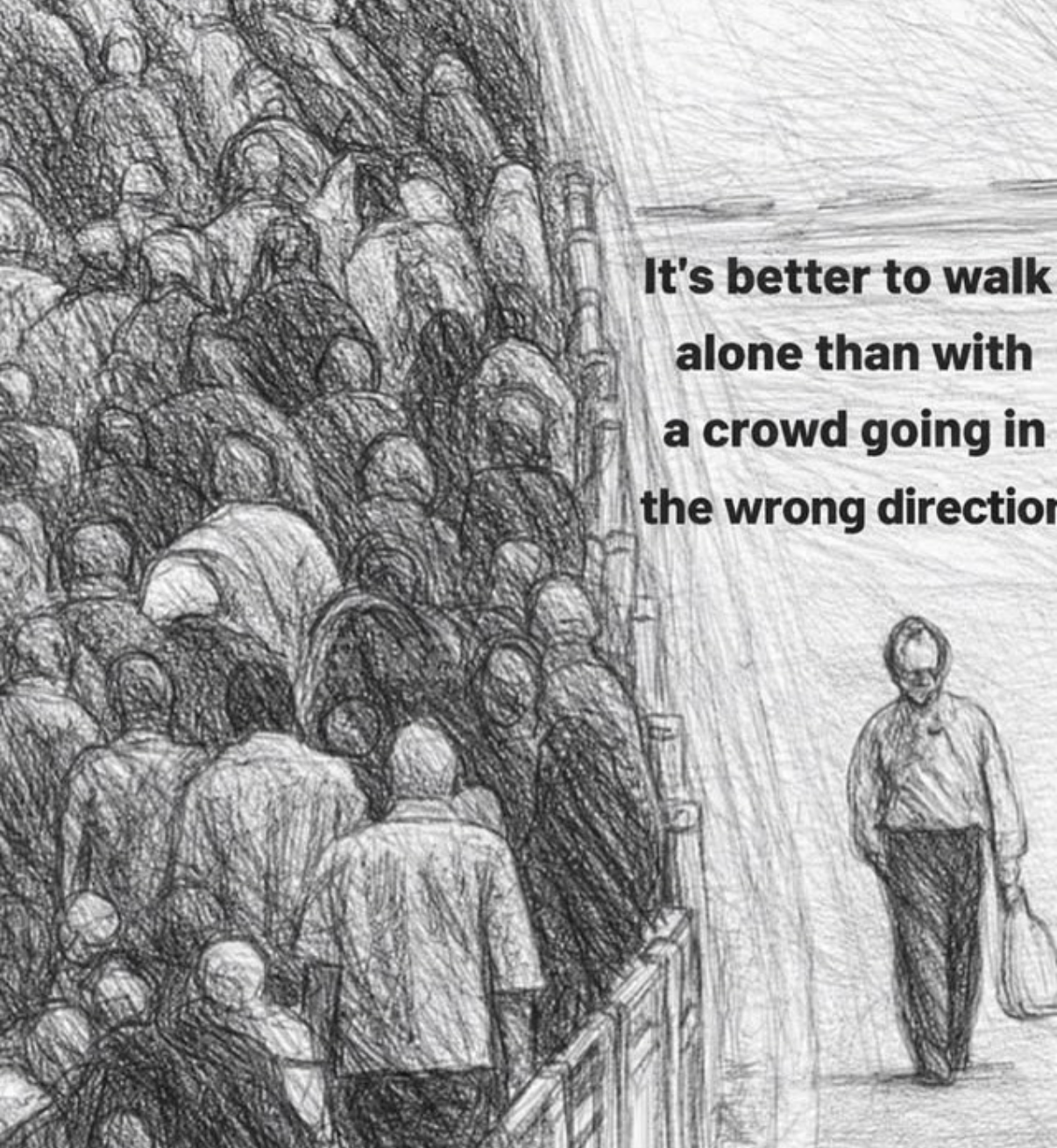
Fortunately, my introvertedness allows me to move along and not worry if I’m the odd man out. It’s a blessing to not be in the crowd.

Now for the story:


The bravest souls are rarely the loudest in the room, but they are often the most misunderstood. In an age when conformity is dressed up as virtue and applause is the currency of self-worth, those who refuse to play by the script become lightning rods. They provoke discomfort simply by existing in truth. They trigger the insecure, unsettle the complacent, and disturb the carefully curated illusions of the fake.

We like to imagine that the pressure to conform ends with adolescence, with the awkward teenage years when belonging matters more than authenticity. But Solomon Asch’s conformity experiments in the 1950s proved otherwise. In a simple exercise—identifying which line matched another in length—he planted actors in the room to all give the same obviously wrong answer. Time and again, the lone real participant abandoned the truth they could plainly see with their own eyes and went along with the group. Three out of four conformed at least once. Not because they were fooled, but because they did not want to stand out. The fear of sticking out, of being “that person,” overpowered reality itself.

And here is the sobering part: that experiment never ended. It repeats itself every day in classrooms, workplaces, media echo chambers, and politics. People choose the safety of the crowd over the solitude of truth. They surrender what they know is real because they do not want the chill of unpopularity or the sting of rejection. The applause comes cheap, but the price of dissent feels unbearable.

Pair that with Stanley Milgram’s obedience studies in the 1960s—where 65 percent of participants willingly administered what they thought were lethal shocks to another person simply because an authority told them to—and you see the bleak pattern. Obedience to authority and conformity to the crowd are the twin forces that crush truth. And yet, every turning point in history has been authored by those who resisted both—the prophets, the dissidents, the whistleblowers, and the reformers.

To live this way is to accept loneliness as a companion. It is to endure suspicion, ridicule, and rejection, not because one is wrong but because one refuses to settle for the comforting lie. Truth costs dearly, but its reward is integrity: an internal compass that does not lose its bearing when the crowd veers off course.

Applause fades. It always does. What endures is the quiet, steady force of those who never sold out, never bent, and never exchanged their essence for acceptance. They may never be fully understood in their time, but they will always be remembered as the ones who saw clearly, stood firmly, and lived bravely.

source, except for the lead in which is my life

What Does AI Have To Say About This Blog

For kicks, I asked a couple of different engines….here you go

The blog johnsimonds.com, also known as “Delusions of Adequacy,” is written by John Simonds, a critical thinker and writer who uses sarcasm and analytical pattern recognition to explore various topics. The blog lampoons subjects like “Woke” culture, the behavior of “Karens,” hypocrites in positions of power, social media, technology, global power, and issues requiring thoughtful analysis.

Delusions is a platform where he expresses his sharp wit and critique of societal trends, often highlighting power grabs and manipulation, such as his early views on the COVID-19 vaccine narrative. His writing features a sarcastic tone combined with deep pattern recognition and analysis, aiming to reveal truths often obscured by media and political influences. Alongside societal topics, he also writes about introversion, IQ, and success strategies based on his observations and experiences.

Delusions has a background in communications and analyst relations, having worked for companies like IBM. His education includes philosophy (school of hard knocks) and business administration. The blog reflects his intellectual and somewhat contrarian perspective, mingled with a sarcastic style.

Overall, Delusions of Adequacy serves as an outlet for his critical and sometimes provocative views on contemporary cultural and political matters, as well as insights into intelligence, social behavior, and personal development.

Then, there’s this:

Ideological / Political Slant
The blog clearly leans strongly toward conservative / anti‑liberal, reactionary rhetoric. Some posts present critiques of “left” ideologies, social justice, or what the author perceives as overreach by government, media, or academia. The language is blunt and provocative. (got that one right)

Mix of Personal and Public
The blog seems to straddle the line between being a personal blog (writing about “My Life,” self‑help, work experiences) and being an opinion / commentary site. The author uses personal voice, “I” statements, reflections, but also publishes political and public commentary. (yep)

Content, Themes & Style

  • The blog has multiple categories: My Life, Self‑Help, Work, News, General / Opinion, etc.
  • Self‑help category includes posts about mental and physical health, learning, productivity, and life decisions.
  • Work category includes posts critical of meetings, on work ethic, reflections from earlier jobs, aversion to inefficiency.
  • News / Political / Public Commentary is present — e.g. a post about Dr. Jorge Zamora‑Quezada’s alleged medical fraud is under the “news” category.
  • Another post, “Why Vegans Aren’t As Smart – Your Brain Needs Meat,” uses dismissive, provocative language toward veganism, calling it a “religion” and mocking it.
  • The tone is partisan and loaded: for instance, in a post about Jimmy Kimmel and celebrity commentary, the author uses strong language (“celebtards,” “they are so stupid,” etc.) and frames the discussion in combative, ideological terms.
  • Many posts are dated and archived over the years, including ones from 2012 (e.g. “How An Average Joe Can Be A Millionaire”)

Well, it’s somewhat close. At least they got the combatative, sarcastic, blunt, provocative and celebtards right. I thought I called Kimmel an asshole.

They missed the whole Introvert thing. That’s important to me

Oh, I do mock vegans. Sorry, but not sorry.

The Real Reason Introverts Hate Small Talk

Small talk is neither emotionally nor intellectually stimulating, so it can feel like a waste of an introvert’s limited social energy.

Does anyone actually enjoy chatting at length about the weather? Unless you’re a meteorologist, probably not.

More often than not, small talk becomes the go-to conversation when we’re at a loss for words. It fills awkward silences, it eases tension during initial meetings, and it can help steer clear of controversial topics.

But it gets old fast.

Introvert Small Talk

Now, if you’re an introvert like me, you might hate the small talk ritual. Jon Baker, a business coach for introverts, found that 74 percent of introverts said they dislike small talk, as opposed to only 23 percent of extroverts who said they dislike it.

Why do the majority of introverts hate small talk?

By definition, introverts are people who feel drained by socializing and recharge their energy by spending time alone. Because small talk is neither emotionally nor intellectually stimulating, it can feel like an inefficient use of their limited social energy. In other words, if introverts are going to use up their energy, they want to spend it in ways that really count.

(Not sure if you’re an introvert? Here are 21 signs that confirm you’re an introvert.)

Also introverts tend to enjoy delving deep into topics and exploring ideas on a meaningful level. It’s more energizing to talk about things that feel important and relevant to them. Small talk, by its very nature, remains at a surface level.

But those aren’t the real reasons introverts might hate small talk.

Why Introverts Hate Small Talk

It’s not that introverts hate socializing or people. Even though we’re introverts, we still need close, healthy relationships to thrive.

As my friend Dr. Laurie Helgoe points out in her fascinating book, Introvert Power, “Introverts do not hate small talk because we dislike people. We hate small talk because we hate the barrier it creates between people.”

Small talk doesn’t bring people closer. Quite the opposite — it can create a barrier that prevents the kind of genuine, intimate connections we all crave.

Think about it. When two people get stuck in small-talk mode, discussing only “safe” and polite topics like the weather, they don’t really learn anything new about each other. They don’t get to know the other person or understand who they are. They miss discovering that their conversation partner, for example, wakes up early to go birdwatching, hates the color yellow, or grew up on a family farm.

As a result, the relationship doesn’t grow in a satisfying way. In general, introverts are interested in understanding people’s thoughts, feelings, life lessons, and experiences, which isn’t usually achieved through small talk.

The key is to transform small talk into meaningful conversation. Here are some tips from my upcoming course, Easy Conversation, designed to help introverts and those who are shy or socially anxious feel at ease in social situations and enjoy more fun, meaningful conversations.

Small Talk Tips for Introverts

Small talk has its place. Patrick King, in his book Better Small Talk, explains that socializing and cultivating relationships happen by degrees, not all at once. “Zoom out, and you can see where small talk fits in and why it’s so important — it’s the first of many steps in closing the distance between you and another person,” he writes. Small talk allows us to warm up to each other, but it’s not where we want to stay.

The secret to not just surviving, but also enjoying small talk, lies in transforming it into a meaningful conversation. If you’re an introvert, meaningful conversation will give you a much-needed energy boost. When you’re immersed in an interesting or thoughtful conversation, you might just end up chatting the night away!

So, here are four tips to turn small talk into more meaningful conversations.

1. Invite the other person to tell a story.

One powerful tool to make conversations more meaningful is to encourage the other person to share a story. To do this, avoid closed-ended questions, those that can be answered with a simple yes or no, or just a few words. Closed-ended questions like, “How are you?” or “Did you have a good day?” limit the depth of the response and can often end the conversation before it even starts.

Instead, ask open-ended questions. For example, instead of asking, “How was your day?,” try, “What was something interesting that happened today?” or “What did you do today that made you feel accomplished?” Questions like these invite the other person to tell a story.

Here are more ideas from Chris Colin and Rob Baedeker, authors of What to Talk About:

Instead of…

  • “What line of work are you in?”
  • “How was your weekend?”
  • “What’s up?”
  • “How long have you been living here?”

Try…

  • “How’d you end up in your line of work?”
  • “What was the best part of your weekend?”
  • “What are you looking forward to this week?”
  • “What’s a strange detail about where you grew up?”

2. Ask why instead of what.

Here’s a twist on asking open-ended questions: Instead of asking only about the facts, the what, probe deeper into the why. This strategy, suggested by The Date Report, pushes the conversation beyond surface-level information and delves into the person’s motivations and values.

For example, after asking, “What college did you go to?,” ask a follow-up question like, “Why did you choose that college?” The second question will reveal much more about the person. Their answer might shed light on their passions, their decision-making process, or even their personal history.

Similarly, if someone shares that they recently watched a particular movie, rather than just asking, “What was the movie about?,” you could ask, “Why did you pick that movie?” or “What about that movie appealed to you?” You might get some insight into their taste in cinema, their interests, or what kind of narratives or themes resonate with them.

In essence, asking why nudges the person to share more personal information, which can lead to a more meaningful conversation.

3. Share a few details and see what sticks.

This can be a hard one for us introverts, because we tend to dislike talking about ourselves. It places the spotlight directly on us, which might make us feel vulnerable and exposed. As a result, we may not open up for people unless we know them well. Unfortunately, this tendency can lead to a repetitive cycle of tedious small talk.

As I explain in my book, The Secret Lives of Introverts, a good strategy to break out of this cycle is to sprinkle a few personal details into your conversations and observe what resonates with the other person. For example, when faced with routine questions like, “How’s it going?” or “How are you?,” instead of responding with the standard, “I’m fine, how are you?,” try to expand on your answer by sharing a bit about your day. You could say, “I’m doing great! I woke up early this morning to jog along my favorite trail. It really invigorated me!” Or, “I’m feeling tired because my two-year-old woke me up in the middle of the night, and I couldn’t fall back asleep.”

When you share details about yourself, notice how the other person reacts. Do they show genuine interest and continue the conversation with a follow-up question like, “That sounds great! Where’s your favorite trail?” Or do they give a disinterested nod? If the other person doesn’t seem interested, try revealing another detail about yourself until you hit on a topic that gets the two of you talking.

This strategy is like throwing a few conversational lines into the water and waiting to see what bites. It might feel uncomfortable at first, but with practice, it can become a natural and effective way to transform small talk into meaningful conversations. Remember, it’s not just about finding common ground; it’s about revealing the unique layers of your personality and allowing others to connect with you on a deeper level.

And, if you’re an introvert, this approach allows you to control the depth of self-disclosure, making the whole interaction more enjoyable.

4. Dare to be honest.

We often sacrifice expressing our true thoughts and feelings for the sake of politeness. But there’s something very authentic — and surprisingly charming — about being completely honest. In her book, The Irresistible Introvert, Michaela Chung encourages us to elevate conversations by voicing our honest feelings and thoughts, which can be surprisingly captivating. For instance, instead of nodding along and pretending to agree, try saying things like:

  • “To be honest, I don’t go to parties very much. I feel pretty overwhelmed being here.”
  • “I’m not a big talker, but I like listening.”
  • “I don’t like camping. Like, at all.”
  • “I’m really proud of that.”
  • “This feels awkward.”
  • “That hurt my feelings.”
  • “No. I don’t want to go. I’d rather stay home and have some me time.”

Such candid admissions might seem intimidating to share, but when done tactfully, it strengthens the bond between you and the other person. By sharing your preferences, feelings, and thoughts directly, you give the other person a chance to know you better. It also signals that you trust them enough to share your true feelings, which can make them feel more comfortable doing the same.

Remember, honesty isn’t about being blunt or rude; it’s about expressing your authentic self in a respectful manner. For introverts, these honest exchanges can make socializing more enjoyable and less draining, because they transform superficial small talk into meaningful, authentic conversation.

more

How do you practice self-care?

How do you practice self-care?

Set boundaries

I had to learn that lesson the hard way. If it meant my sanity or a friendship, I’ve gone both ways, but I’m protecting my ass from now on.

I’ve done too much stuff that when in the middle of doing said stuff I thought, “I really don’t want to be here or doing this”. I don’t do that shit anymore. If it looks like a suck now, I bail early.

I also don’t let people run over me. It’s not that I was a dormat, I just didn’t understand that some people would use you and take you for granted. It never had occurred to me until it happened to my ass over and over again. I didn’t even know at first you could say no and not hurt someone’s feelings.

Well, no more. I draw the line. I’ve seen it upset people, only to find the people not being upset or even thinking of me shortly thereafter.

It’s made my life a lot better because I’m not in situations that I don’t want to be in.

You’d think it would have taken me less time to figure this out, but no.

Posting Might Be Light This Week

I’m on semi-vacation with some family. Go read my introvert posts on how well I do with that.

So I have some stuff ready, but mostly I’ll be watching my social battery drain. I went to one of the most average theme park yesterday. I mostly chased kids.

I’m already in introvert hangover

What’s your favorite thing about yourself?

What’s your favorite thing about yourself?

I’m self-entertaining. I don’t need others to do something or for motivation to get something done. I’m perfectly happy to do a task alone and would likely enjoy it more.

It has other benefits such as I don’t look to others to see what I’m going to do, like not take the Covid-19 jab.

Pissing At The Side Of The Road, Why I Broke Up With My Girlfriend

I was dating what was to be my last girlfriend before I met my wife. Claudia.

We’d met through a mutual friend and I wasn’t seeing anyone so I was up for anything. My life at the time was on the go with travel, my last foray with alcohol and knowing life was going to catch up with me because I was the only one of my friends who hadn’t gotten married.

She was a piano teacher who lived half the week in Boca and the other in Miami (1.5 hours from Boca) to get her Ph.D. I had half the week off on my social calendar.

Why did I pick her for a girlfriend? I gave her a shot because she looked like a past girlfriend that I’m not sure I was over with in my head so we went out. They were way different so that moment passed by quickly.

To cut to the chase, 1 year became 2 and then I became bored. She was kind of a stiff out of the sack, but a pretty willing sport that gave me multiple options of places to put things in bed. I’d been pulling ass for many years and didn’t have the stamina to put up with girls’ verbal bullshit anymore. She, like all girls was afraid of her image to other people, including any shit that I pulled when I was with her. I was doing shit to her all the time because it was like dealing with a school girl as she’d lived such a sheltered life.

My level of boldness with pulling shit increased with how much I drank. At the time, it was a lot.

I got bored and had already gotten some side action on business trips and I noticed that it didn’t bother me guilt-wise. I actually never stopped sleeping with the last girl I broke up with before Claudia, We still banged the whole time I dated Claudia. She was away half the week so the ex sort of agreed to Friends With Benefits. She was secretary to the owner of the company, so as long as I was banging her, I found out the shit the company was doing.

The girl from are you this big of a bitch in Las Vegas was during my years with Claudia. It’s a good story also. She was way more bangable than Claudia.

THE BREAKUP MOVE

So with that being said, I already knew that she was not going to be the one for life for me. I stuck around a little while longer for some reason (until I had another pony in the stable).

I for some dumbass reason took her to my parents, 4 hours there, 4 hours back. She acted ok and probably thought this was the next step in the wedding staircase. She’s about to find out where the staircase just ends.

I’d been making this drive for over a decade mostly solo so I’ve had to stop. I’ve found that there are outcroppings by the side of the road. You can just stand on the other side of the bushes and pee and be back on the road quickly.

I’m old so there were no Truck stop mega stations at this time or even a convenience store at every exit. You could go a long time before a real bathroom would come up. I learned to give up the fight early, go piss in the grass and be on my way. I found that people are way past you before they realized what they saw, and by then they couldn’t find my dick with a telescope.

So told Claudia too late about this, meaning I had to piss now. I didn’t think anything of it as I’ve done it dozens of times. She lost her mind that someone would see me pissing and her in the car. First of all, they wouldn’t see her, and most of all, a good girlfriend would laugh it off as guy stuff we do. Not this time.

The net of what happened was I had to drive for more than 3 exits (not close to each other) before I found an old gas station. The outside roadside was way cleaner than this bathroom. I had to piss so bad by then that I was almost doubled over. I was livid with Claudia though.
The net of what happened to Claudia was at that point, she was done in my mind. Anyone who is going to give me that much shit over nothing wasn’t going to be worth listening to for the rest of my life.

I didn’t say a fucking word to her the rest of the way home and I’m not sure I stayed with her that night. Girls can’t take it so she called. I told her my offer was dating part time because I was through in my head and if she wanted to bang on the side I’d do it. Her response, thinking that I’d back down was full time or no time. I said no time then and got off the phone quickly. I’d either lose that argument or waste too much time listening to crying bullshit.
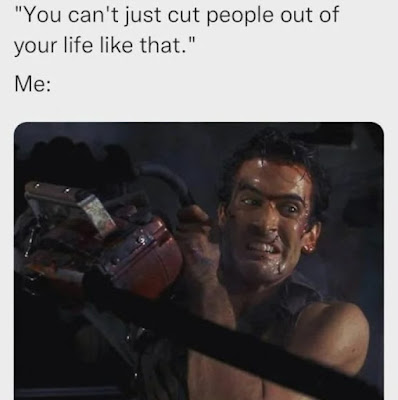
You can only push a man so far, then he will stop, break, or deal with you. I dealt with her and shortly thereafter met my now wife. Since she’s European, they don’t care if you change clothes outside or even wear them at the beach so while I catch some married shit, it’s not about this.
So Claudia lost me by giving me too much shit about taking a leak by the side of the road.

On the other hand, her husband can thank me for teaching her how to swallow.

When do you feel most productive?

When do you feel most productive?

I’m retired now. Whenever it strikes me that’s when I’m in the mood.

I think about this every Monday morning when I’m not in rush hour traffic, on conference calls, doing presentations, staff meetings, or other work related bullshit that kills productivity.

I work when the mood hits me for as long as I’m motivated. Sometimes it’s early, often it’s not. That goes for most things I do these days.

Shit I Laugh At Europeans About

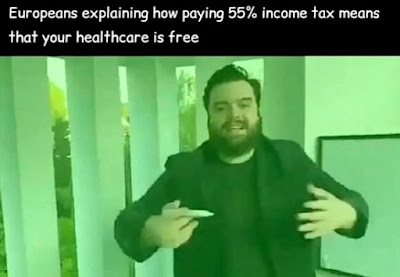
I get a ration from my wife’s Scandinavian relatives about free college, health care, and pension for life.

The top earners pay 70% tax and have to wait 6 weeks to see a doctor who is no better than a PA here, more like a nurse.

When the wifes Sister in Law came over, they compared Social Security to the state pension she was getting and the wife’s SS was 3 times more. They are locked into the pension where we live off investments and SS is just a byproduct.

Enjoy your free stuff

Socialism is just one step away from communism.

What Introverts Need To Be Happy

Since introverts process the world differently, what brings them happiness might not look the same as it does for others.

I used to feel bad about being an introvert. I wished I could be more like my extroverted friends. They seemed to have no problem carrying on a conversation with anyone at any time. They didn’t seem to get mentally and physically fatigued from socializing — or from life in general — like I did.

Later in life, when I began studying and writing about introversion, I learned that introverts aren’t broken extroverts. Our brains are simply wired differently. Our minds process experiences deeply, and we require alone time to feel our best.

It’s science: Essentially, we introverts don’t need as much dopamine as extroverts do to feel satisfied. You can read more here about the science behind why introverts need alone time.

Because of this wiring, we introverts need different things in life to be happy compared to extroverts. Here are 12 of those things, which I explore more in my book, The Secret Lives of Introverts.

What Introverts Need to Be Happy

1. Plenty of time to wind down and process

Yes, we introverts need downtime after things like parties and networking events. But we also need downtime after “little” things, too. Because we’re wired to process experiences deeply, introverts may get very drained by a stressful day at work, running errands, or a heated conversation with a significant other. Time to unwind allows us to fully comprehend what we just experienced and lower our stimulation level to one that’s more comfortable and sustainable. Without downtime, we’ll feel brain-dead, irritable, and even physically unwell or tired. This state is called the introvert hangover.

2. Meaningful conversation

How was your weekend? What’s new with you? We “quiet ones” can do small talk (it’s a skill many of us have forced ourselves to learn), but that doesn’t mean we enjoy it. Introverts crave diving deep, both in our interests and in our relationships. We need something more: What’s something new you’ve learned lately? How are you a different person today than you were ten years ago? Does God exist?

Not every conversation has to be soul-searchingly deep. Sometimes introverts really do just want to talk about the weather or what you did this weekend. But if we’re only fed a diet of small talk, we’ll leave the table still feeling like we’re still hungry. Without those intimate, raw, big-idea moments, we’ll be unhappy.

(Speaking of chitchat, here’s the real reason introverts hate small talk.)

3. Companionable silence

It may seem contrary to #2, but introverts also need people in their lives who are content with quiet. We need friends or partners who can sit in the same room with us, not talking, each of us doing our own thing. People who won’t nervously jump to fill a pause in the conversation but will let thoughts linger, waiting until ideas have been fully digested. Without periods of companionable silence, introverts just won’t be happy.

4. Space to dive deep into our hobbies and interests

17th-century horror novels. Celtic mythology. Restoring old cars. Gardening, painting, cooking, or writing. If it’s out there, introverts are diving deep into it. Having time alone to focus on our hobbies and interests recharges us because, while absorbed in them, we likely enter an energizing state of flow. According to the famed psychologist Mihály Csíkszentmihályi, “flow” is a mental state in which a person is fully immersed in an activity and enjoying the process. A flow state comes naturally to many introverts, and without it, we won’t feel happy.

(Speaking of hobbies, here’s why introverts should take up new, random hobbies.)

5. A quiet space that’s all ours

Admittedly, this is something I don’t have right now because my toddler is the ultimate space-invader. However, introverts ideally need a private, quiet space to retreat to when the world is too loud. It could be a room that they can arrange, decorate, and have full control over — a true introvert sanctuary. Or it might be just a special corner, couch, or chair. Being fully alone, without fear of intrusion or interruption, is invigorating on a near-spiritual level for introverts.

6. Time to think

According to Dr. Marti Olsen Laney in The Introvert Advantage, introverts might rely more on long-term memory than working memory (for extroverts, it’s the opposite). This might explain why we introverts struggle to put our thoughts into words. While words seem to flow effortlessly for extroverts, introverts often need an extra beat to think before responding — or much longer to consider a bigger issue. Without time to process and reflect, introverts will feel stressed.

(Want to learn more? Here’s the science behind why writing tends to be easier than speaking for introverts.)

7. People who understand that sometimes we’ll be staying home

For introverts, socializing is all about dosage. We need friends and loved ones who understand that sometimes we just can’t “people” — and they accept this without giving us a guilt trip. It’s not that we don’t value their company; we simply need time to recharge. Having people in our lives who respect our need for solitude helps us maintain our energy and emotional health. This understanding allows us to show up more fully when we do spend time together.

Want to feel more at ease in social situations?

Discover the secrets to enjoying fun, meaningful conversations. Know exactly what to say — even if you’re introverted, shy, or socially anxious. Feel less drained and have more energy while socializing.

Be the first to hear when Jenn Granneman’s new book, Easy Conversation, is released — and get two free gifts to help you feel more comfortable in conversations right now:

❤️ 7 easy tips from the book

❤️ 15 simple phrases you can use to keep the conversation going

Click here to sign up and get your free gifts.

8. A deeper purpose to our lives and work

Everyone needs to pay their bills, and for many of us, that’s why we go to work, even if we have to drag ourselves kicking and screaming. Some people are content with this arrangement, or at least tolerate it. However, for many introverts, it’s not enough — we crave work that’s purposeful and meaningful. We want to do more than just earn a paycheck and put a roof over our heads. Without meaning and purpose in our lives — whether it comes from our job, a relationship, a hobby, or something else — introverts will feel deeply unhappy.

9. Quiet

Sometimes we just don’t have the energy to interact. We might be turned inward, doing what introverts do best — reflecting on and analyzing ideas and experiences. Pointing out, “You’re so quiet!” or prodding us to talk only makes us feel self-conscious. At these times, let us remain quiet — it might be what we need to be happy. After we’ve had time to process and recharge, we’ll likely return with plenty to say.

10. Independence

Unique and independent, introverts are more inclined to let their own inner resources guide them than follow the crowd. We often do our best work — and are our happiest — when we have the freedom to explore ideas, spend time alone, and be self-directed. Independence allows us to tap into our creativity and inner wisdom, setting our own pace and making the decisions that are best for us. Without this autonomy, we might feel stifled.

11. The simple life

I have an extroverted friend who seems to do it all— volunteering at her son’s school, caring for her family, planning get-togethers for our friends, and holding down a full-time job. As an introvert, I’d never survive that same schedule; besides, the simple life is good enough for me. A good book, a lazy weekend, a meaningful conversation with a friend, and some snuggles from my animal companions are what make me happy.

12. Friends and loved ones who value us

We’re never going to be the most popular person in the room. In fact, in a large group, you might not even notice us at all, as we tend to remain in the background. Nevertheless, just like anyone else, we introverts need people in our lives who see our value and love us despite our quirks. We know that at times we can be difficult to deal with — nobody’s perfect. When you love and accept us as we are, even when our weird introvert behavior don’t make sense to you, you make our lives profoundly happier.

Source

One-Time
Monthly
Yearly

Make a one-time donation

Make a monthly donation

Make a yearly donation

Choose an amount

$5.00
$15.00
$100.00
$5.00
$15.00
$100.00
$5.00
$15.00
$100.00

Or enter a custom amount

$

Your contribution is appreciated.

Your contribution is appreciated.

Your contribution is appreciated.

DonateDonate monthlyDonate yearly

How to Set Boundaries as an Introvert and Still Be Kind

Boundaries are not walls or dividers. They are a personal list of what is and isn’t okay for you as an introvert.

As a counselor, I see many introverts come to my office struggling to set healthy boundaries. This doesn’t mean they’ve failed in some way because, let’s be honest, most of us have never been taught how to do this — and it’s not easy. I often help by showing them a few simple strategies.

To be clear, both introverts and extroverts can struggle with setting boundaries, so it’s certainly not just an introvert issue. Yet, in my experience, they struggle for different reasons. There are typically two main roadblocks for us “quiet ones”:

Many introverts — especially highly sensitive ones — are naturally inclined to take care of others due to their strong sense of empathy. For more on this, see my article The Science Behind Why We Absorb Others’ Emotions (and How to Deal).

Introverts, many of whom are compassionate and eager to help, often see boundaries as walls rather than healthy limits.

Over the course of our sessions, I help my introverted clients understand that boundaries aren’t barriers or dividers. They are guidelines, rules, or limits that define reasonable, safe, and mentally healthy ways for others to treat them — and how they will respond when those limits are crossed.

Simply put, personal boundaries are a list of what is and isn’t okay.

Again, to be very clear, not every introvert struggles with setting boundaries. But in general, because of their empathy, introspection, and compassion, some introverts tend to see boundaries as obstacles to relationships. They may view saying no as unkind, and setting boundaries may even feel wrong.

In reality, boundaries are the foundation of an empathetic, compassionate relationship. As Brené Brown writes in Rising Strong, “Compassionate people ask for what they need. They say no when they need to, and when they say yes, they mean it. They’re compassionate because their boundaries keep them out of resentment.”

A Case Example: My Introverted Client

Sometimes, introverts come to me feeling upset or frustrated about a friend or loved one who isn’t meeting their expectations. One young woman, an introvert, was desperately trying to help her depressed friend. She repeatedly came to me with feelings of resentment and anger, saying, “No matter what I do, she isn’t getting better.”

This woman was so empathetic that she was pouring everything she had into trying to pull her friend out of depression. When we looked deeper, we realized she had an unspoken expectation — that her friend would get better because of her efforts. She believed she could heal her friend, and when that didn’t happen, she took it as a personal failure.

Instead of setting boundaries about when she would offer support and when she needed to take time for herself, she kept investing more energy, time, and effort into making her friend meet an expectation that wasn’t hers to control.

The more we talked, the more she realized that this wasn’t true empathy or compassion — it was actually harmful to both of them.

The Life-Changing Power of Setting Boundaries

Brené Brown captures it beautifully in The Gifts of Imperfection: “When we fail to set boundaries and hold people accountable, we feel used and mistreated. This is why we sometimes attack who they are, which is far more hurtful than addressing a behavior or a choice.”

My client began setting boundaries with her friend. She still offered support with kindness, but she no longer felt responsible for fixing the problem. She allowed herself to take breaks, spend time with other friends, and prioritize her own well-being. As a result, she became more present and compassionate with her struggling friend, and her own stress significantly decreased.

This is the life-changing power of setting boundaries.

3 Steps to Better Boundaries

Do you struggle to set healthy boundaries? Here are three key steps I share with my clients that can help you, too:

1. Decide what is okay and what isn’t in your life.

Start by reflecting on your values. Who are you? What matters most to you? Your boundaries are about you, so take the time to identify what you truly need from others. For example, as an introvert, you likely value alone time — your boundaries should reflect that.

Pay attention to your emotions, as they often signal where boundaries are needed. Do certain situations leave you feeling frustrated or resentful? Is there someone you frequently complain about? Do you feel suffocated, taken advantage of, or even unsafe in a particular relationship? Emotions are like warning flags, waving to get your attention and reveal areas in your life that may need stronger boundaries.

2. Communicate your boundaries.

For introverts, who often prioritize their inner world over external interactions, expressing boundaries can feel daunting —especially if it’s your first time. Here are some tips to help:

  • Keep it short and simple. Boundaries sound like this: “If you… (for example, don’t pay rent on time again), then I… (for example, will ask you to move out).”
  • Expect some discomfort. When you start setting boundaries, you may feel ashamed or afraid. Don’t lose heart — these feelings are normal! Keep going.
  • Trust your timing. You will set boundaries when you are ready, and not a minute sooner.
  • You are allowed to say no. For example, “Don’t vent your anger on me — I won’t tolerate it,” or “I won’t let you disrespect me. If you cannot treat me with respect, then stay away.” If someone continues to disregard your boundaries, you have every right to limit or cut off contact.
  • Your privacy is yours to control. Nobody can demand to know your thoughts or personal business. What you choose to share is up to you, not what others expect or want.
  • You have the right to your own mind. Nobody has the right to dictate what you think, feel, or do. Your thoughts, feelings, values, and beliefs belong to you.

source

If I’d only learned this earlier in life, it would have made a big difference. I just didn’t know how important this was

What is one question you hate to be asked? Explain.

What is one question you hate to be asked? Explain.

What do you do during the day? It seems innocuous, but here’s why it isn’t for me. (the real answer is that I mind my own damn business and get done what needs doing).

I retired early and being a good introvert, I stay to myself, don’t bother others (especially with personal questions). I do normal introvert things like read and write a lot. I go about my business, get exercise usually for hours, do house repairs, help others, go to bible studies or other events, etc.

The point is that I don’t keep detailed records of what I do. I go about my business and try to stay out of other people’s business.

This question started with a relative I nicknamed Flounder from Animal House, for all the reasons Dean Wormer described about how not to go through life. Flounder went between high paying jobs to bankruptcy due to money mismanagement (spent like a drunken sailor). We’ve never been particularly close because we are so different and shit like this makes me not want to try very hard.

It should be noted that if I give someone a nickname in life, it’s not a good sign of how I feel about them.

Every conversation was, “What do you do all day, sweep the floors?” In fact, it was one of the things I did because I like a clean house. It was a shitty question though and it became monotonos. I’d just rather not have a conversation than discuss that. I finally turned it on him by saying most people ask me that because they wonder what they’ll be doing when they retire. He had no real answer as he defined himself by his job his wife told me.

Nevertheless, the condescending attitude was not even masked. I, the consummate introvert couldn’t defend the question on cue. I’d think of what I wrote above in the hours after the discussion when it didn’t matter.

Still, I hate the idea of anyone 1) intruding on my life and what I do unless I choose to talk about it and 2) getting this condescending attitude because I was able to retire early and it was a part of my life plan. (note: I saved, invested, and paid off all of my debt early to be able to do it. Flounder was in debt above his head and lost millions on houses and valuables he borrowed to get. He had to work until almost 70 and thought he was a big shot until his next firing.

Now, I’m still retired and set for the rest of my days. Flounder lives with one of his kids as he lost both of his houses. Do I ask what do you do all day? Hell no. I don’t want to know what he does, but it’s an intruding question.

Note: I got this question from one of my wife’s friends Randi when I said I was going to retire early. What are you going to do was the very next statement. I answered and got, and then what are you going to do.

Randi isn’t a part of our life anymore because of her shitty attitude. I couldn’t stand to be around her either. She was snarky when saying it and those things don’t get past me easily.

Hey Randi, I’m retired early and am loving life, doing what I want. That’s what I do all day. I go about my business.

This ends with the story about the kid eating all of his candy. A man said that isn’t good for you to which the kid said my uncle lived to be 120. The man asked if it was eating so much candy and the boy responded no, it was because he minded his own business.

How has a failure, or apparent failure, set you up for later success?

How has a failure, or apparent failure, set you up for later success?

I’ve learned more from my mistakes than my success.

I expect to win or be successful at what I do now. I’ve paid enough dues in life and have learned enough lessons at the school of hard knocks that I should be doing things correctly by now. (I hope I don’t eat those words).

Life was tough growing up. I had no manual and a couple of siblings who rooted against me the whole time. It almost forced my will to overcome and to not only win, but to overachieve at whatever I did.

Along the way though, failure at tasks, life, relationships, and a lot of other things taught me more lessons than success. I hate losing and I hate screwing up. I only want to fix something once. That’s easy to do with carpentry, electrical, plumbing and repair. It’s damn near impossible with relationships.

I know the Tom Brady’s of the world must hate losing more than anything. He learned how to win. That’s how I feel about it.

To My Introvert Readers, Who are your favorite people to be around?

Who are your favorite people to be around?

I’d like to say something witty or emotional like my family or my oldest friend from childhood, but it would be a lie.

It’s my dog

Don’t get me wrong, I like (a few of) my family and my friends, for a bit.

The introverts will know what I’m saying without me even explaining animals, small talk and time alone to re-charge

If there were a biography about you, what would the title be?

If there were a biography about you, what would the title be?

How to enjoy being alone by yourself. How to not care what others think or let it affect your self-esteem. How to have passion about your avocation to the point that you excel past others who do the same thing over a variety of activities.

I could go on, but you get the point. It’s the introvert thing again.

How do significant life events or the passage of time influence your perspective on life?

How do significant life events or the passage of time influence your perspective on life?

I look back for patterns. It’s part of critical thinking that I have no control over. It just happens.

Stuff just comes together and I know something is right.

When they introduced the PC, no one knew what to do with it. The word on the street was that no one would buy these and there was no future. I saw a career move.

When they forced people to get jabbed for Covid-19, I knew I had to avoid it with everything I had.

So now, I’m not surprised when I see stuff starting to happen and I know what is the right thing to do. It just happens.

What books do you want to read?

What books do you want to read?

I’ve started liking History, so historical fiction not textbooks. I’m starting a series by C.J. Box about the outdoors. If it’s good, I’ll have a whole series to read.

I’m also reading Hillbilly Elegy by JD Vance

I’m finishing the last book of the Expanse so Sci-Fi has been good to me for a few months now.

The point is I always want to read. I’ve read since I was a young child. I was the only one of my siblings who did. I can escape into my own world this way and people don’t bother you when you are reading.

What is your favorite animal?

What is your favorite animal?

Again, this is sort of a layup for me.

My dog.

He loves everyone, but at the end of the day, he comes to me over everyone else. He’s as much of a dog as there is. He digs, pisses on everything when we walk, barks at the delivery people, loses his mind over cats, squirrels and deer but loves getting his ears scratched.

img_2618-1

What is your all time favorite automobile?

What is your all time favorite automobile?

This is the easiest one for me to answer. It’s the Porsche 917. It’s one of the few cars that was the star of a movie (that wasn’t a cartoon).

I first saw it at the 24 hours of Daytona in 1970.

It was the first time I’d seen a car go over 200MPH in person in my life and I was a pre-teen at the time.

It would go on to dominate 2 different series of racing. It’s what got me fully hooked on endurance racing.

Here is the car on NASCAR turn 4 at well over 200 driven by my then favorite driver, Jo Siffert.

Groundbreaking study shows dogs can use soundboards to communicate with humans

I know they can. I have to spell certain words as my dog knows exactly what I’m saying when I use them.

  • Dogs can form meaningful two-word combinations using soundboards, proving intentional communication.
  • Over 260,000 button presses by 152 dogs showed specific requests like “outside” + “potty.”
  • Dogs focus on immediate needs, unlike humans, who use soundboards for emotional expressions.
  • Future research may explore dogs’ ability to refer to past events or future plans.
  • Soundboards could revolutionize pet-owner communication and deepen interspecies understanding.

Dogs have long been considered “man’s best friend,” but a groundbreaking study published in Scientific Reports suggests that our furry companions are far more intelligent — and communicative — than we give them credit for.

The research reveals that dogs trained to use soundboards can form meaningful two-word combinations, proving they are not just randomly pressing buttons but deliberately communicating with humans. This discovery not only challenges our understanding of canine intelligence but also opens the door to deeper insights into animal cognition.

More here and it’s pretty interesting

Try talking to a cat and getting them to do anything

You Get More Introverted With Age, According to Science

I couldn’t agree with this writing more. It’s happening to me and I even crave it now. For example, I celebrate every time I miss another high school reunion. The 50th is next year for me and there is nothing or nobody that could drag me back to see people that I left behind decades ago. (see the last section).

I’ve got family within driving distance and I don’t text or call for fear that there might be a get-together that I’d have to suffer through. There just isn’t enough there for me to want to suffer through that anymore.

We all become more introverted as we get older, even the most extroverted among us.

I’m a classic introvert, but in my teens and twenties, it was normal for me to spend almost every weekend with friends. Now, in my thirties, the perfect weekend is one with zero social plans.

And I’m not the only one socializing less these days. My extroverted friend, for example, used to run through her entire contact list, calling friends whenever she was alone in the car. She told me she hated the quiet, the emptiness, because being alone felt boring.

You know, for the whole 10–15 minutes it took to drive to the grocery store. Oh, the horror.

These days, I can rarely get her out for brunch or coffee. She’s content spending most nights at home with her husband and two kids. And I haven’t gotten one of her infamous calls in years.

So, what gives? Do we get more introverted as we get older?

Probably, says Susan Cain, author of Quiet: The Power of Introverts in a World That Can’t Stop Talking — and this is actually a good thing. Let me explain.

Why We Become More Introverted With Age

In a post on Quiet Revolution, Susan Cain confirmed my suspicions: We tend to act more introverted as we get older. Psychologists call this “intrinsic maturation.” It means our personalities become more balanced, “like a kind of fine wine that mellows with age,” writes Cain.

Research also shows that our personalities do indeed change over time — and usually for the better. For instance, we become more emotionally stable, agreeable, and conscientious as we grow, with the largest change in agreeableness happening during our thirties and continuing to improve into our sixties. “Agreeableness” is one of the traits measured by the Big Five personality scale, and people high in this trait are warm, friendly, and optimistic.

We also become quieter and more self-contained, needing less “people time” and excitement to feel a sense of happiness.

Psychologists have observed intrinsic maturation in people worldwide, from Germany to the UK, Spain, the Czech Republic, and Turkey. And it’s not just humans; they’ve observed it in chimps and monkeys, too.

This shift is why we slow down as we get older and begin enjoying a quieter, calmer life — and yes, it happens to both introverts and extroverts.

Becoming More Introverted Is a Good Thing

From an evolutionary standpoint, becoming more introverted as we age makes sense — and it’s probably a good thing.

“High levels of extroversion probably help with mating, which is why most of us are at our most sociable during our teenage and young adult years,” writes Susan Cain.

In other words, being more extroverted when you’re young might help you form important social connections and, ultimately, find a life partner. (Cue the flashbacks to awkward high school dances and “welcome week” in college.)

Then, at least in theory, by the time we reach our 30s, we’ve committed to a life path and a long-term relationship. We may have kids, a job, a spouse, and a mortgage — our lives are stable. So it becomes less important to constantly branch out in new directions and meet new people.

(Note that I said “in theory.” In my 30s, I still don’t have kids, a mortgage, or a wedding ring. These days, we have the luxury of not following evolution’s “script.”)

“If the task of the first half of life is to put yourself out there, the task of the second half is to make sense of where you’ve been,” explains Cain.

During the married-with-children years, think of how difficult it would be to raise a family and nurture close relationships if you were constantly popping into the next party. Even if you don’t marry or have kids, it would be hard to focus on your career, health, and life goals if you were always hanging out with friends like you did in your teens and twenties.

Once an Introvert, Always an Introvert

But there’s a catch: Our personalities only change so much.

In my book, The Secret Lives of Introverts, I like to say that our personalities may evolve, but our temperaments remain constant.

This means that if you’re an introvert, you’ll always be an introvert, even at 90. And if you’re an extrovert — though you may slow down with age — you’ll always be an extrovert.

I’m talking big-picture here: who you are at your core.

Research supports this idea. In 2004, Harvard psychologists Jerome Kagan and Nancy Snidman studied individuals from infancy into adulthood. In one study, they exposed babies to unfamiliar stimuli and recorded their reactions. Some babies got upset, crying and flailing their arms and legs; these were labeled “highly reactive” to their environment.

Other babies remained calm around the new stimuli; they were the “low-reactive” ones.

When Kagan and Snidman checked in with these individuals later, they found that the “highly reactive” babies often grew up to be more cautious and reserved, while the “low-reactive” babies tended to stay sociable and daring as adults.

The bottom line? Our core temperament — whether cautious or sociable, introverted or extroverted — doesn’t change dramatically with age.

An Example: Your High School Reunion

Consider, for instance, your high school reunion.

Let’s say you were very introverted in high school — perhaps the third-most introverted person in your graduating class. Over the years, you’ve grown more confident, agreeable, and comfortable in your own skin, but you’ve also become a bit more introverted. If you enjoyed hanging out with friends once a week in high school, maybe now in your thirties, you’re content with seeing them only once a month.

At your ten-year high school reunion, you notice everyone has slowed down a bit, enjoying a calmer, more stable life. But those who were very extroverted in high school are still much more extroverted than you.

You’re still approximately the third-most introverted person in your class — but now the whole group has shifted slightly toward the introverted side.

And that’s not a bad thing. In fact, it might be exactly what we need to flourish as adults. If there’s one thing we introverts understand, it’s the deep satisfaction of a quiet life.

Have you found yourself becoming more introverted as you’ve gotten older? Let me know in the comments below.

Do you have a favorite place you have visited? Where is it?

Do you have a favorite place you have visited? Where is it?

I’ve been around the world, to most of the continents. It was for both business and pleasure. I’ve stayed in the finest hotels and some dumps. I’ve eaten with the best chefs and at a choke and puke.

I don’t want to do that anymore. The sense of adventure isn’t enough to make me want to fight the people, the waits, the lines, and the crappy service.

The answer now is that I want to be Home or my place in the mountains. I have my stuff in my place and I don’t have to fight airports, and security lines, stay in places that aren’t mine and someone full of germs was just there before me.

It’s because I’m an introvert and getting old. I don’t care anymore. I don’t have to see everything and right now, there’s nothing I want more than to be in my place, preferably alone with my dog.

Why Introverts Are Happier With Fewer Friends

In a world fixated on quantity, fewer friends mean deeper connections with those who truly understand us.

In a world that often sings the praises of an extroverted lifestyle and the constant whirlwind of social activities, we introverts prefer to walk a quieter path — one that values solitude, introspection, and a select few meaningful connections. For us, solitude isn’t just a preference; it’s a sanctuary — a place where we find the clarity and peace we need to thrive.

When I entered my twenties — a decade traditionally associated with socializing and expanding your circle of friends — my introverted journey took a refreshingly different route. Instead of a jam-packed social calendar or always being surrounded by people who were the life of the party, I found solace in solitude and the company of a select few cherished friends. If you’re an introvert, I’m sure you can relate.

Here are 10 reasons why introverts often prefer having fewer friends.

Why Introverts Prefer Having Fewer Friends 

1. Deep, meaningful connections

When we have fewer friends, we have more time and energy to nurture the relationships that matter most. These friendships are built on trust and shared experiences, creating bonds that grow stronger with time. They not only withstand the test of time but also offer unwavering support and comfort during life’s highs and lows.

In a world often obsessed with the quantity of connections, we understand that it’s the quality of these relationships that truly enrich our lives. We don’t consider everyone a friend, which makes each interaction a treasured moment of shared understanding and genuine care.

In her book Quiet, Susan Cain points out that introverts often thrive in more intimate, one-on-one interactions. Having fewer friends allows us to focus on building meaningful connections with those who truly “get” us and accept us for who we are. These authentic friendships are like warm, cozy blankets on a chilly night, providing comfort and genuine support when we need it most. 

2. Time to focus on the friendships that really matter

For us introverts, having a smaller circle of friends can be a blessing. With fewer social obligations and less influence from a large social circle, we have the time and space to deeply invest in the friendships that truly matter. I find that with just a few close friends, I can truly invest in understanding them on a deeper level and being there for them when they need support.

Like many introverts, I am not one for small talk. I don’t want to just talk about the weather or what you saw on TV last night. I want to hear about your childhood and life experiences — the lessons you’ve learned that have made you the person you are today. I want to hear about your hopes, dreams, and goals. I want to know how your relationship is truly going — not just the surface-level “It’s good” you might tell others when that’s not the whole story. The busyness of a big social network doesn’t allow for that kind of deep connection.

Plus, as a result, we can focus on understanding ourselves better and on what truly makes our hearts sing and souls dance. This journey of self-discovery is a precious gift that can guide us toward a more fulfilling path in life.

3. Independence with a support system

As we grow older, we become more independent, exploring the world on our own terms and savoring the freedom and solitude that come with it. Alone time recharges our batteries, giving us the energy to spread our wings and pursue the adventures that resonate with our souls.

Having fewer friends creates space for us to develop our individuality. In a world that often pushes for constant social interaction, this independence becomes a sanctuary — a place where we can fully embrace who we are.

4. More peace and quiet

In busy social environments, we introverts often experience sensory overload — loud music, crowded rooms, and constant conversations drain us. We start to feel overstimulated and unable to focus as external stimuli compete for our attention.

Having fewer friends translates to more peace and quiet, giving us the calm we need to recharge. We retreat into the soothing sanctuary of solitude, embracing the silence that stills our thoughts and relaxes our spirit. The chatter and noise of constant social interactions are replaced by tranquil moments of reading, reflecting, or simply being. This quiet space becomes our safe haven amid life’s chaos.

For us introverts, peace and quiet are not just luxuries — they’re necessities. We thrive when we can turn down the volume of the outside world and tune into our inner landscape. With fewer friends and obligations, we create space to hear our thoughts, reconnect with ourselves, and let stillness restore our energy. The silence nourishes us deeply.

5. Energy for your own goals and passions

With fewer social distractions, we can channel our energy into pursuing our passions and goals, turning what might seem like “alone time” into a wellspring of productivity and creativity. The result? We often emerge as high achievers in various aspects of life, including career and personal growth.

Our alone time — or creative space — becomes the launchpad we need to reach for the stars at our own pace. It allows us to develop our talents, chase our dreams, and make a meaningful impact on the world.

6. Less drama

Smaller social circles mean less conflict and drama. There’s less politics, gossip, jealousy, and fewer fallouts to manage. My energy goes toward nurturing a few intimate friendships, not maintaining a large roster of dramatic relationships.

As introverts, we strongly dislike confrontation and arguments; we prefer peace and harmony. Navigating friend drama can be exhausting. I’ve come to value friendships that are drama-free, where my friends and I can support each other and communicate openly. This kind of acceptance is incredibly refreshing.

7. Quality time

When we do choose to socialize, we introverts treasure meaningful conversations and deep connections with our friends. With fewer friends, we can dedicate more time to truly enjoying their company — sharing heart-to-heart chats that leave lasting impressions. These moments of genuine connection nourish our souls, reminding us that when it comes to friendship, less truly can be more.

8. Emotional resilience

Difficult times have shown me that I don’t need constant external validation or a large support network. Instead, I rely on a few close friends who provide perspective when I’m overthinking and need clarity.

Over the years, the advice and support I’ve received from them have helped me tap into my own inner strength, process emotions through reflection, and grow through life’s ups and downs.

This emotional strength becomes an invaluable companion as we move through life, helping us weather storms with grace. We introverts don’t depend entirely on others for comfort or reassurance — we carry a quiet confidence in our ability to cope and thrive, even when facing tough times alone. We understand that our worth comes from within, not from the size of our social circle. 

9. Comfortable with your own company

While we introverts aren’t fans of constant socializing, there are days when we crave a change of scenery or the chance to connect. We might want to chat with a friend over coffee or catch up over lunch. However, having a smaller circle of friends means they’re not always available when we’re looking for company. As a result, we learn to embrace solitude and use it as an opportunity for self-discovery.

Learning to be alone has been a blessing for me as an introvert. I’ve discovered that it’s where I find true happiness, independent of others. Whether it’s reading, writing, journaling, or simply enjoying nature, I’ve come to cherish and embrace my own space.

10. Your self-worth doesn’t depend on others

Basing self-esteem on friendships and social approval is fragile. As introverts comfortable with solitude, our sense of self-worth comes from within. We understand that our value isn’t measured by the size of our social network or the number of likes and followers on social media.

This inner confidence allows us to form authentic connections without relying on external validation. The older I get, the more I realize that my worth isn’t defined by others — it comes from loving and accepting myself first.

Having a few close friends who truly see and appreciate me has shown me that I don’t need a big circle to feel fulfilled. I now carry a quiet confidence that comes from embracing my introverted journey. This realization has been one of the greatest gifts of my introverted life.

story and source

What’s something most people don’t know about you?

What’s something most people don’t know about you?

Who I really am.

I’ve learned not to talk about myself other than when I type stuff here. I can’t stand when people brag and so I try not to do it. I constantly write about my introverted nature so I naturally hold back a lot of things other people can’t wait to talk about.

I’d rather people ask, I didn’t know you knew that, or how to do that than me telling them.

For all I write on my blog, I write 10 times as much about what’s going on in my life in my daily diary. It’s where I work stuff out in life and write it before I have to say it when it’s tough stuff that has to be dealt with.

No one would believe who I really am if they read what I write in private.

Tell us about a time when you felt out of place.

Tell us about a time when you felt out of place.

How about my whole childhood.

I was the youngest in every class due to my birthday. In reality, I should have started school a year later than I did, but I was able to keep up academically so no one did anything.

As a result, I was a year behind everyone in maturity. I was always small and learned a lot of social things after the others already knew. It made for a tough time. It was particularly awkward in the whole girl/boy life dance as the girls were a year older, but years older in maturity and size for many of them. Most of them stopped maturing at the end of high school as I discovered in conversations with them later. I was just beginning to catch up the end of high school. Kids are cruel though so it was tough.

I caught and passed almost all of them because it drove me to succeed after banging my head against the wall of life up until that time.

I got no help from my sibling who was 2 years older, but only one grade ahead due to the birthday timing. When She could have helped, she jumped on the side of the other kids to make my life a lot more difficult than it needed to be.

It made me tougher in the long run. I had to figure out how to be street smart without any directions. Like the song Night Moves, I was searching for answers without any clues.

So childhood, I spent a lot of it out of place.

In what ways does hard work make you feel fulfilled?

In what ways does hard work make you feel fulfilled?

This one is easy. My Mom told me about this when I was young. It’s our task in life to overcome. You have to climb the mountain and achieve.

To leave it there is easy and lazy, but the question is about being fulfilled. You feel that way when you achieve, accomplish, or figure out the difficult issues in life.

Humans need to over overcome. Complacency is unfulfilling.

Fear Of War With Putin And My Wife’s Relatives In Denmark

My wife was just there and the news was anti-Trump 24/7. They are afraid of Putin attacking she was told, and to have 3 days of supplies on hand. Their media is worse than the ABC moderators of the Trump/Harris debate. They are liberals who hate freedom and what America is. They constantly try to say that their government works better and that the US is a warmonger. Well, that’s not all that wrong when you consider that only Trump didn’t have a war during his administration.

I don’t even go there anymore because of the anti-American/Trump bias. They love idiots like Elizabeth Warren (the bomb they called her) Obama and Biden. They believe everything they are told, most of which is to hate Trump.

The irony is not lost on me because Putin attacked Ukraine in 2022 because they were going to let Ukraine into NATO right next door. He was forced into it by the Biden administration her relatives so love.

Remember, they don’t love Biden really, it’s that the European media hates Trump so much that they’ve brainwashed entire countries. They did love Obama though because he hates America as much as they do.

Now this:

That’s right, they are poking the (actual) bear.

So Russia said:

Here is the translation to this link to an X post that wouldn’t embed, because the truth

Ukraine itself does not have such an opportunity. Only NATO servicemen can program such a weapon.

The neo-Nazi regime has been attacking our territory for a long time, outside the zone of hostilities, carrying out terrorist attacks against civilians and the civil infrastructure of our country. However, such a potential development of the situation will fundamentally change our relationship with the Western camp. If the decision to lift the restrictions is indeed adopted or will be adopted, it will mean that from this moment on, the NATO countries will start a direct war with Russia.

In this case, we will, of course, be forced to make the appropriate decisions with all the consequences resulting from them for the Western aggressors. Our Western colleagues will not be able to avoid responsibility and transfer all the blame to Kiev. As you know, the use of such weapons is possible only when you have access to intelligence data from the US and EU satellites.

The net of it is they are provoking a war before the election and blaming it on Trump. They don’t even get that if they didn’t put the missiles there or not let them into NATO, it could be resolved.

This is from a country that is nearly 100% vaccinated for COVID-19 and other mistakes in life, like socialism.

I cut them off from social media because I can’t take their hate for both Trump and America anymore and their total belief in the lies of their media.

Nevertheless, they love shopping in America as it’s so much cheaper. They wear Levi’s or Carhartt, depending on the fashion at the time. The smokers smoke Marlboro’s and they love Taylor Swift. That and being vaccinated says a lot to me.

What motivates you?

What motivates you?

I don’t have to be motivated. It comes from within. I was born with a sense of responsibility that causes me to do what needs doing. I also prioritize it over other things because it is the right thing to do. That is life, work, and the stuff you have to do.

I think it comes from my father who always did a complete job until it was right. It rarely took him two tries

It’s why I never understood people who let things go

Now for stuff I want to do, I know that there is some sacrifice to become good at anything. It was that was for all of my avocations and is what keeps me healthy.

It’s the right thing to do, period.

Why Some Introverts Hate Their Birthdays

I’ve never really liked my birthday. In fact, it’s one of the days I dread the most. I hate all the extra attention and the pressure to make it a special day, usually with a party. It’s insufferable.

Introvert Dear has a great article today. Here goes.

When I was a teenager, I used to have long, exhausting fights with my mother in the weeks leading up to my birthday. She always wanted me to celebrate with a huge party filled with family and friends. But to me, a huge birthday party is synonymous with torture, not celebration. Instead, I wanted something small, like going to the movies or the bowling alley with a few close friends.

No Birthday Party For Me, Thank You

More often than not, I used to win these fights and ended up doing what I wanted for my birthday. But all these arguments took a toll on my mental health and self-esteem. Whenever I refused to have a party or make a big deal out of my birthday, people called me a party pooper, a killjoy, and a downer. I didn’t have the words to defend myself (I was still a kid), so I internalized all those insults and convinced myself that there was something “wrong” with me. It took me years to realize and accept that there was nothing wrong with me — I am an introvert.

I am now a proud introvert who can defend the reasons behind my actions and behaviors. In case you’re curious, my relationship with my mother has improved, but I still hate my birthday. I believe a lot of the reasons stem from the fact that I’m an introvert.

Obviously, not all introverts hate their birthdays, but over the years I have noticed that a significant portion of the online introvert community feels aversion or indifference toward their birthdays. Here are a few reasons I believe some introverts (like myself) don’t like their birthdays.

story plus way more including the list of things that suck about birthdays for Introverts.

I hate it as it’s just another day for me. Now that I’m (much) older, it reminds me of how little time I might have left.

Favorite Game (card, board, video, etc.) Why? It’s A Lay Up For Me

What’s your favorite game (card, board, video, etc.)? Why?

Once again, you get the introvert answer. I loathe those long assed games where people get together and socialize for hours playing Monopoly or Bridge. I’m ready to leave before it starts.

I had the chance to play video games in 1981 before Nintendo came out with the orange button controller. I knew then that I didn’t have time to waste playing the same scenario over and over, although I get the attraction to others.

If I play a card game, it’s going to be solitaire. I don’t really play it anymore, rather spend my time writing and learning, but anytime I can do something to not drain my social battery quickly.

I played golf yesterday. I can be alone there also. I have my earbuds in and tune out the world.

What Bothers You and Why?

What bothers you and why?

This goes like the line, how do I love you, let me count the ways. The list is endless and sometimes I feel like Clint Eastwood with, get off my lawn.

Rather than make a list, I’ll stick to my introverted life and go with small talk. Introverts have a low tolerance for conversation that isn’t meaningful or that isn’t going anywhere. When you are young, you might put up with it for a longer time or if there is a worthwhile reward (employment, sex, etc.). That reward is less as you move on in life.

Conversely, I love deep and engaging conversation, that is intellectually stimulating. Even then, there is a time limit and I need to recover.

I’ve learned to say yes, good, right, fine, good point, and anything that could end the conversation and not leave it open-ended.

If You Could Host A Dinner And Anyone You Invite Was Sure To Come, Who Would You Invite?

If you could host a dinner and anyone you invite was sure to come, who would you invite?

I had this question at a team meeting years ago at IBM. An answer that I thought was better than mine came from another person. This is how it went.

I’d invite myself from 20 years ago, now, and 20 years from now. It would allow me to forgive myself for the mistakes I’ve made, congratulate myself for the things I’d overcome, and get advice from the future me on how to live my life.

While it seems a bit narcissistic, fundamentally it would be sound advice.

I forget what I answered, but I’m pretty sure Jesus and my parents who had since passed were some of my guests.

Avoid Crowds And Stress, And Don’t Rush Around

What strategies do you use to increase comfort in your daily life?

Yes, it’s Introvert time again. I am more comfortable alone than I am among a lot of people. While it’s possible to be alone in a crowd (introvert strategy here), it still comes with stress.

I also hate deadlines and the stress that comes with making it. I try to get stuff done well in advance so I don’t have to deal with it at crunch time.

Oh, and avoid family reunions as much and as often as possible.

I’m sure others have much better strategies to increase their comfort, but here’s my .02.

What Is Your Most Memorable Vacation?

Describe your most memorable vacation.

I’ve been on vacations as a kid, with that family growing up. I was kind of a tag along and did what my parents decided mostly. We went to the beach a lot growing up in Florida. That meant I grew up next to Disney World. Heck, we didn’t even have Disney until 8th grade for me. My memories there are of playing alone next to the ocean in my own world.

Then came vacations with a different family, my wife and kids. We traveled around the world. They were good times that I’ll remember while taking one kid fishing everywhere and the other doing anything to keep her from being bored. There was no time to recover or recharge my social battery.

Later in life I did stuff like sailfishing in Costa Rica or going to F1 in Italy and again they were good, but stressful trying to catch planes and waiting in huge crowds. I still had to rush to catch planes and was a mule hauling luggage around the world.

As always though, my introvert self comes out. Vacations where you are always on the run and trying to make everyone happy wore my social battery out to the point that I’d need a vacation to recover from vacation.

Now, I just go to the mountains where there aren’t many people and I can relax without having people acting like tourists or waiting in line. I have my stuff in my place and I can do gardening and tree trimming out in field with no one telling me what to do.

Not having the next deadline or trying to catch the next plane is my favorite.

It Matters For Eternity

How important is spirituality in your life?

To Answer This, let’s not confuse being religious with being spiritual. A lot of religious people are doing time and hell when they thought they were doing good on earth.

Spirituality should be the center of your life. If you accept the postulate that your soul is eternal, then spirituality becomes the focus of your life by default.

Therefore, it is a very important aspect that is a part of all of the other decisions and directions in my life. It is important to know that I’m still able to take the wrong fork in the road despite this.