What is The Best Advice A Dad Ever Gave You, An Internet Compilation

My Dad and me have had tons of conversations growing up and even now  when I go home, It is usually Friday evenings that we spend from late  afternoons till late nights just talking about everything that comes to  our mind. 🙂 It always brings us closer.

After my first break up, It was one of the best piece of advice he gave me. He said

“Never  be naive enough to think love happens only once in your life. It will  happen again, I cant say when, but it will. She was your first love and  you wont have your first love with anyone again. but love, It will  happen. You will find someone who is strong enough to stand up for you  and along with you and not leave you in the first sign of hardship. It  is her you should not miss in life”

There are a few other gems as well.

  • Marks will only get you so much. make sure you learn what is being taught and you can use it when you need to.
  • Never let someone treat you badly. They are doing it because you let them.
  • Drink because you enjoy it and not to get drunk. Don’t smoke.

I just wish I can be as much a father to my son as my Dad was to me!

My dad had always been a big inspiration to me. I realized that after he passed away in an accident.
When he was in front of me, I never took him seriously, just like any other teenager. But I have always been thanking him for all the words of wisdom.
There is one story he always told me about his friend who cleared an IAS – Indian Administrative Services exam.
He used to write his dreams and stick in on the walls of his room his study table and even his wall ceiling above. Wherever he looked up in despair, he saw his DREAMS, which he always strived for till the end.

“Never ever keep your eye away from your goals. If you always keep getting distracted, imagine yourself winning the accolade which provided you the motivation to fight in the first place. Cover your surroundings with people who always bring you closer to your goals.”

“Always try to be the best of the lot. Even if you fail, you will always be motivated to do better the next time.”

“No matter what you do in life, always keep your character clean. People actually remember the good ones.”

“Never betray anyone in your life. You wont be able to live with the guilt inside.”

For the first 25 years of your life, you decide your habits. For the rest of your life, your habits decide you. Don’t ever give in to peer pressure.

My father is a recluse. Even though I lived at home after college, he and I rarely exchanged more than a few sentences. Last fall, I snagged my first full-time corporate job, earning nearly thrice as much as when I taught kids at a nonprofit. Life was beginning to stabilize, and I was happy to assist my parents, but I felt a deep sadness.

One night, my dad was asking me about work as usual. I gave him the customary, trite responses. Instead of walking off to his bedroom, he stood there, looking pensive, and broke the silence:

“Please, please, don’t chase after money. Don’t worry about supporting me and your mother. You come from a family that strives for higher ideals. I know you love painting, writing, music. You love learning. Pursue your passion – money is secondary. Your happiness is more important to me.”

If Wealth is lost nothing is lost, if health is lost something is lost and if character is lost everything is lost….

When I saw a man drawing a beautiful picture I said
– “I’d love to draw like that!”
– “Then what are you doing to accomplish that?” – my father replied

Every person you meet in life, even the last wretch on the street can teach you something.

Since then I don’t judge people but try to learn from them / their state.

My father was a Vietnam vet and a lifelong hunter. He was quiet and didn’t show much affection but he loved me and my siblings fully, in his own way. The advice he gave me that stuck with me the most was the following:

“Never bring a weapon to a fight that you aren’t prepared to use. It will be taken and used against you.”

I’m a nonviolent person but I see wisdom deep in that advice, even now as an adult. I interpret it as always be prepared to keep your word. If I threaten to turn the car around and you keep yelling, I will turn the car around.

“Trees with the deepest roots are those which have bore through the worst of storms.”

Sitting down in the soothing sun, one winter afternoon my dad explained to me the importance of going through hardships in life.

He showed to me that, the trees having the deepest of roots are the ones which have gone through the worst of storms, but those are the ones which persisted, survived and set in deeper.

The same is with us, hardships never hurt us they only make us stronger. And sometimes the best comes out of us when we are facing the worst situations.

A tender sapling pampered in an over protective environment would not last long even in a mild storm, but a young tree nurturing it self in the wild would grow stronger in those storms.

I am blessed to have a dad who knew when to let us fight our own battles, when to leave us to tough times and when to come to our aid.

My father was too busy as a New York area psychiatrist to ever do anything like come to a soccer game or track meet. So I didn’t expect to see him at all when I was at a major east coast track championship about to anchor the final 440 yards for a mile relay team. In fact, spectators were not allowed in at that meet held in the Armory (in upper Manhattan or the Bronx, I forget). I’d been doing high school sports for several years and it had never crossed his mind to watch me. And we lived out in the suburbs. This championship was held in the city.

But, as I was warming up for the race, he walked right up to me, having driven up from a meeting in midtown.

I was dumbfounded. I asked “How the heck were you even allowed in”?

He answered “Always act as if you own the place.” and then added “Now let’s see you own the track”.

I won that race for the team with something like a 58.5 second run (which could win back then). Then I remember throwing up in a bucket he found for me in anticipation of what I’d be like when I finished.

But it wasn’t my “motivated run” that I remember so much, nor the sentimental aspect of a dad remembering a track meet. That’s B movie material. That’s just a checkmark on the box that says “my dad did that too”.

It was the way he walked right in there and onto the track like he was Donald Trump…and then delivered that powerful advice.

“Charge what you’re worth.” This advice from my dad, who has been successfully self-employed my whole life, was hugely helpful when I struck out on my own as a freelancer.

“Sleep on it. You shouldn’t make life changing decisions when you are angry.”

I did. And I changed my mind.

Hire people who are smarter than you.

67


Always remember the kid you were. You´re that child, she´s still on you. Remember how she is, the things she likes, the way she sees the world and how she enjoys life. Now, you go and take care of that girl and don´t you ever forget to make her happy.
41


Andy Tider, Founder – Munchly

My dad is a character and an inspiration. He’s given me some gems over the years that I’ve applied in a simple and streadfast way to become the person I am.”You can do anything you want. You just have to want it badly enough.”

My dad was a special ed teacher for 30 years. He wanted his kids to have lots of wonderful experiences, but these things cost money and teachers don’t make a ton. He wanted to have a safe, reliable car to drive us places – so he became a real estate agent on the side so that he could write the car off as a business expense. Still not satisfied with the life he could provide for his family as a teacher/real estate agent, he once attended a seminar given by a lawyer about real estate law. As he sat in the class, he thought, “This is bulls**t. I can do this.” So he went to law school. At night. While teaching, and doing real estate and having three kids under 5 years old. He sometimes recounts this time in his life as “the best time ever” because he would come home and all three of us would want to crawl into his lap and have him read to us. He had real estate to sell and law to study, but he sat with us and read until we all fell asleep in his arms. Then he did his work. In the months leading up to the bar exam, his father got sick. He came to live with us and my parents tried their best to make him comfortable as he slowly faded away. The day before the bar exam, his father passed away.
Then he went in and took the exam he had been staying up nights studying for for months. And he failed. By one point.

He retook the test and passed. He got a job as a lawyer at a firm. But they expected him to bill 80 hour weeks (while still doing his teaching job) and he wasn’t getting to spend time with his family. So he quit the firm.

He started his own practice. Out of our house so he could be around. The practice did well and he continues it to this day. He loves to fight for the little guy. One of his proudest achievements is that because of what he did, we were all able to start our adult lives without any student debt.

Another important one was, “This too, shall pass.”

Sometimes, when life is particularly dark, a simple message can be the candle light that gets us through the storm. This one is worth holding on to.

Don’t wait for something to happen. Or suddenly you’re 40 and nothing has happened.
My dad taught me a lot.Here are some of the more priceless gems:

  • Math is patterns.  Look for the patterns.
  • The lottery is a tax on people who don’t know math.
  • No matter what you do… don’t be an idiot.
  • Marry someone you’re friends with.  Love is great, but you need friendship to make it work.
  • Sometimes the rest of the world will be wrong, and you will be right.  But if they’re that dumb… can you really expect to change their minds?
  • Don’t cut your thumb off.  It hurts.

I’m Just Not In That Big of a Hurry

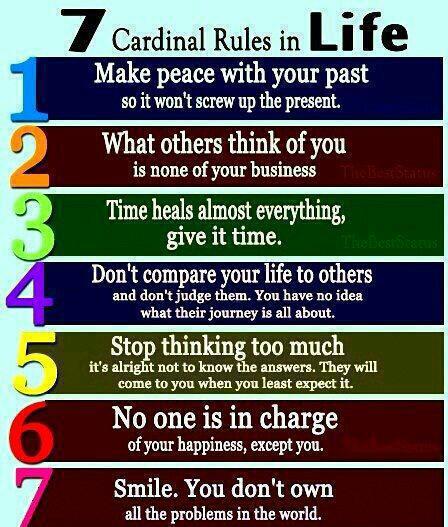
7 cardinal rules lifeI’ve decided to that hurrying through life just doesn’t have the payback it seems.  The hustle and bustle of busy work, conference calls, email and social media keep some in a coffee enhanced mode glued to their screen and missing out on life just isn’t worth it.  I got to thinking about this and decided to take some stress off of things and so whenever possible, I now work on my schedule.  I’ll get around to what is needed to do, but I’m not going to let it keep me up at night.  I’m not as worried that my comments on social media or political diatribes that upset me really don’t matter all that much.  Once you get used to this, those pesky deadlines that are mostly self inflicted become less important.  After all, most of the above described issues are nuisances at best.

WHERE DO WE GET THIS CULTURE?

For many, they just can’t wait to grow up fast (not me).  Then can’t wait to get promoted (partly me),  can’t wait for kids to grow (not me) and finally can’t wait to retire (me even thought I’m working again, but for myself).  Work seems to exacerbate it the most with demands endless meetings (Meeting = a cul-de-sac where ideas get strangled and go to die), phone calls, emails, instant messages, texts and incessant demands from bosses (the less competent usually are the worst like 3 of my last 4 before I retired, on my terms).

head_up_assMy last couple of Boss’s in this picture

It turns out that this extra stress can lead to brain damage.

On the social side, I have a relative with MOP (miss out phobia) who is afraid something is going to happen without her.  Her sibling just doesn’t give a rats rump what others think and has far less pressure socially, but missed out on some things in life.  Striking a balance is good.

The Wall Street Journal recently published an article on when not to accept a promotion.  There is a myriad of reasons given including family life, unrewarded extra burdens for the less than promised  climb up the ladder.  I personally turned down 2 promotions as they wanted me to move to New York where I would get a 30% higher cost of living, three times the responsibility that I wouldn’t be compensated for and a back stabbing culture of ladder climbers.  My real reason for not doing it is that I didn’t want to raise a family there and wanted to bring them up in a better part of the country.  After that, I was happy not to be there stressing out more.  Since I’d already been on every rung of the ladder, the need to be at the top was less than taking care of my kids.  I still managed to beat the system to be rewarded better than the curve and on my terms.

All of this adds up to the rat race.  I’m not sure why I didn’t think about it before, but it’s a terrible way to go through life.  Now that I think about it, I just knew that taking it easy and beating the system was the way to get ahead the right way, and not sell your soul in the process

MOUNTAIN TIME AND ISLAND TIME

Having spent time in both places, I noticed that the folks there just don’t seem to be in a rush.  It truly is a New Yorker’s nightmare not to have someone jump when they say how high or to have to be busy in crisis mode over everything.  Don’t get me wrong, I’m for punctuality, but these two groups set a different deadline (sometimes internally) and usually meet it.  They don’t die early from stress usually.

I noticed it in the Caribbean islands first.  They are not in a hurry for anything.

I then noticed it in the mountains that they get around to things..eventually.  It was enough of a coincidence that I quickly connected the dots between the two.

I’M GETTING THINGS ACCOMPLISHED

To be fair, I’m busy and am accomplishing more under my own direction than when under the gun of a manager overlooking by shoulder.  I’m the manager now.  It’s just that I’m making the deadlines and am meeting all of them.

So I’m happier in life and wish that for others and hope that this 24/7/365 mentality doesn’t overtake your priorities.  It’s corny, but true in this video below:

What Does the Internet Say Are Great Pieces of Advice for Life?

Not all of these are my idea, rather they were gathered from a collection of many, many others as I’ve run across them.  Nevertheless, they are interesting to ponder.  I’m sure there a thousands more, but they are here for you to share:

Don’t stop learning: If you start coasting through life, you’re gonna lose. Always stretch your intellect.
Don’t always try to be original: Just tell the story or paint the canvas or whatever.
Focusing on “fairness” will lead to stagnation.
If you’re not failing, you’re doing it wrong. (It’s OK to make mistakes.)
Don’t try to reason with mindless, irrational people.
Don’t stress yourself out with news and “staying informed” too much.
Do something that’s not for money.
The key to happiness is BUILDING stuff, not GETTING stuff.
Time passes by a lot faster than you’d think. This effect accelerates with age.
Wealth is relatively unimportant.
Some things can’t be learned; they can only be experienced.
Figure out who you are, then ACCEPT that person, and then BE that person.
Don’t wait for permission. Give yourself the okay.
Don’t lie to yourself.
Forgive as much as possible. Grudges achieve little.
Be humble (especially to the “little” people).
You and you alone control how happy you allow yourself to be.
Find a mentor and BE a mentor.
Find what you like and let it kill you.
You don’t have to eat everything that’s on your plate.
You don’t have to pick up a phone that’s ringing.
Always take action on things. People regret inaction more than action.
The past is something you learn from.  It is not something you live in.
Wealth is measured by your happiness and not by your financial statement.
Your mind decides what is hopeless.  Your circumstances do not.
More things will happen to you that you have absolutely no control over than things you do have control over. You ALWAYS Have the power to choose how you will react.
Remember that their is a God and don’t stop seeking him.
Do one thing at a time. All that huzzah about multi-tasking? BS
Don’t compare yourself with others. It’s an inaccurate measuring stick. It is more accurate to compare from within. Compare yourself with yourself. How much progress have you made? How have you changed? What negative behavior have you stopped engaging in? That’s what matters.

Don’t believe what you think. Never make up stories in your head about what other people are thinking or why they do certain things. Your made-up stories are making you miserable. You’re often wrong about other people are thinking anyway (I cannot count the number of times I’ve overhead “I think x hates me.”) Quit it. Remember, people are by nature benevolent). The criticism you hear about you is only ever one person’s opinion about you. If it becomes a pattern, then you can re-evaluate course and improve. More power to you.

Learn to handle criticism. Don’t take it personally. Criticism of an idea or project is not criticism of the creator as a person. Everything can always be improved; criticism is the vehicle to allow you to improve. Only apply remedial measures if the criticism has value. ”Criticism is something we can avoid easily by saying nothing, doing nothing, and being nothing.” – Aristotle

Quit idealizing authority. Don’t try to impress people. If you feel a need to you’re implicitly de-valuing yourself and asserting “I don’t think you’ll like me for who I am, so I will try to “impress” you instead.” You’re not allowing yourself to fully connect with someone when you put them on a pedestal.
Don’t take anything personally. It’s easy to get offended and internalize what others say. Recognize that when you ask someone for advice, responses can be all over the place. Understand that others opinions’ are a reflection of their own world and a product of their own reality. It has nothing to do with you.
Never get into a victim mentality. If you focus on what’s right and wrong, you’ll stagnate. Instead, accept things the way they are. Once you do this you can to start to change things and have the power to redirect the future the way you want to.
Value the people in your life. Everyone wants to feel like they’re important. Look at everyone as if they had a star on their forehead that said, “make me feel special.” People hunger for sympathy. Give it to them, and they will love you. Stop wasting time and energy thinking about how people should be different.
Be happy for other people who are happy. Train your mind to be sincerely happy for happiness and catch your resentments and jealousies before they run off too far. It’s easy to resent people for being happy.
Embrace vulnerability. Embrace discomfort. Doing this will increase your luck surface. Allow yourself to be hurt. When you trust yourself, you’ll be confident enough that you will rise up again when you fall.
Just because you don’t feel like doing something doesn’t mean that you shouldn’t do it.
You never have anything to lose. You could lose all your money, and become homeless for a while, but you can’t lose who you are, your essence. Be okay with getting your hands dirty and screwing things up – in believing that you have nothing to lose, you will have the power to move through your own life and create change.

Improving Your Credit Score, Continuing Personal Financial Principles


This came from Christian Personal Finance, but is in my theme of taking control of your personal finances and helping yourself to use your money wisely and understand successful financial principles.  These days you need to take control of your economic situation and not rely on the government to take care of you as they will take your money in taxes at any chance they can.

If your credit score has fallen recently, due to a missed payment or two, or perhaps you have too much credit outstanding, there are some simple ways you can improve on your credit score that will get it back on the right track. Doing a combination of several of these could see your credit score rise significantly in just the next few months – and that goes for your credit score at each credit repository.

If you’d like to check your credit score,
click to get your credit score for free.

1. Pay your bills on time from now on.

This may sound beyond obvious, but if you have any late payments in the past year or two, they’re having a disproportionately negative impact on your credit score. You can’t fix this overnight, but the best strategy going forward is to make sure that it doesn’t happen again.

One of the more fortunate aspects of credit scores is that the older negative information gets, the less impact it has. This is why it is so critical that you put any negative credit situations into your past as soon as possible. If you have a late payment that you made three months ago, you may not be able to do anything about that now, but if you make your payments on time for the next nine months, you’ll put that late payment one year into your past. By then, your credit scores should once again begin to rise. But this will happen only if there are no delinquencies in the future.

2. Take a time out on credit.

The credit scoring models favor older, established debt. Conversely, they take a dimmer view of new debt. For this reason, if you’re looking to improve your credit scores, it will help to avoid applying for and accepting new loans. This will be even more important if you have taken a new loan or two in the very recent past.

This will help your credit scores on two fronts. First, any time you apply for credit, your credit report will show a credit inquiry. While credit inquiries do not have a big impact on your credit score, the one they have is definitely negative. If you apply for credit with several lenders over a space of one or two months, the combined impact could be more significant. By not applying for new credit, you will not be adding new inquiries to your credit report.

The second of course is that any time you take a new loan, you receive a negative hit on your credit reports because of the lack of payment experience. You’ll avoid this hit by not taking any new loans.

3. Pay off small balance accounts.

Another factor the credit scoring models consider is the number of loans you have outstanding. In general, a person with three outstanding loans will have a better credit score that someone who has ten outstanding loans.

For this reason, you might want to pay off some of your loans starting with the smallest. If you have seven loans outstanding, and you can pay off three of them with combined balances of $1,000, you will have reduced the number of loans with outstanding balances down to four.

While this may not cause your credit scores to rise by a hundred points, it could cause a smaller increase but one that will happen pretty quickly. This is one of the best ways to get upside action on your credit scores in short order.

4. Pay down a few debts.

This one is big time, and is usually referred to as credit utilization. The credit repositories measure the percentage of outstanding debt against your amount of available credit. If you have $15,000 in outstanding balances on open credit lines of $20,000, your credit utilization is 75% (or $15,000 divided by $20,000).

For comparison sake, credit repositories generally consider a credit utilization of 80% or greater to be a negative. Less than 80% is considered a positive. It is of course a matter of degree; the lower the credit utilization, the more positive the impact on your credit scores. The higher the credit utilization, the greater the negative impact will be.

Credit utilization is considered one of the best predictors of debtor default. This is why it carries such a heavy impact on your credit scores. And even if your credit scores are good despite a high credit utilization, a lender may still make a decision not to extend a loan to you.

In order to improve on this critical metric it is important that you pay your loans down to a level in which they will be at least below 80% of available credit. You should try to get each loan account down below this percentage, as well as for the combination of all of your loan accounts. This is another strategy that can improve your credit scores pretty quickly – by lowering your credit utilization, you lower your risk of default according to the credit scoring models.

5. Check your credit report for errors.

You should review your credit report at least annually to look for errors. Many contain errors that have a negative impact on your credit scores. For example, you could have loan accounts included in your credit report that are not yours. This will increase the amount of debt that you’re carrying, and lower your credit scores.

Worse is if you have derogatory credit that is either not yours, or is reported in error. Unfortunately, when you have derogatory credit, the responsibility to clear it up rests completely upon you – even if the entry is in error. You’ll have to contact the creditor to ask them to correct the information reported. Usually, in order to do that, you’ll have to present some sort of tangible evidence that what the creditor reported was in fact an error. If you don’t have this evidence, the creditor will probably not remove the information.

Once any errors are corrected, you’ll have to specifically request that the creditor remove the derogatory information from your credit report. You should also obtain written confirmation that the entry was an error from the creditor. Just in case the creditor doesn’t get around to reporting the corrected information to the credit repositories, you will then have written evidence to do it yourself.

6. Pay off any collections, charge-offs or other past due amounts.

If you have any outstanding obligations – even if they’re well in the past – they will still be having a negative affect on your credit scores as long as they are showing up in your credit report. Make arrangements to pay them off, and make sure that you get a letter of confirmation from the creditor. The creditor should report this information to the credit repositories, but once again, if they don’t you will have to do it yourself.

Never assume that outstanding balances don’t matter because they’re five or six years old. Paying them off is another way to provide a quick lift to your credit scores, especially if you’re paying off more than one.

Take as many of these steps as you can, and you should be able improve all of your credit scores in just a few months, if not sooner.

If you need additional help improving your credit score you can hire a credit repair company like CreditRepair.com or Lexington Law.


Why Dogs Don’t Live As Long As Humans – Explaned By a 6 Year Old

This story Melt My heart  so I wanted to share it. enjoy.

Being a veterinarian, I had been called to examine a ten-year-old Irish Wolfhound named Belker. The dog’s owners, Ron, his wife Lisa, and their little boy Shane, were all very attached to Belker, and they were hoping for a miracle.

I examined Belker and found he was dying of cancer. I told the family we couldn’t do anything for Belker, and offered to perform the euthanasia procedure for the old dog in their home.

As we made arrangements, Ron and Lisa told me they thought it would be good for six-year-old Shane to observe the procedure. They felt as though Shane might learn something from the experience.

The next day, I felt the familiar catch in my throat as Belker ‘s family surrounded him. Shane seemed so calm, petting the old dog for the last time, that I wondered if he understood what was going on. Within a few minutes, Belker slipped peacefully away.

The little boy seemed to accept Belker’s transition without any difficulty or confusion. We sat together for a while after Belker’s Death, wondering aloud about the sad fact that animal lives are shorter than human lives.
Shane, who had been listening quietly, piped up, ”I know why.”

Startled, we all turned to him. What came out of his mouth next stunned me. I’d never heard a more comforting explanation. It has changed the way I try and live.

He said,”People are born so that they can learn how to live a good life — like loving everybody all the time and being nice, right?” The Six-year-old continued,

”Well, dogs already know how to do that, so they don’t have to stay as long.”

Live simply.

Love generously.

Care deeply.

Speak kindly.

Remember, if a dog was the teacher you would learn things like:

When loved ones come home, always run to greet them.

Never pass up the opportunity to go for a joyride.

Allow the experience of fresh air and the wind in your face to be pure Ecstasy.

Take naps.

Stretch before rising.

Run, romp, and play daily.

Thrive on attention and let people touch you.

Avoid biting when a simple growl will do.

On warm days, stop to lie on your back on the grass.

On hot days, drink lots of water and lie under a shady tree.

When you’re happy, dance around and wag your entire body.

Delight in the simple joy of a long walk.

Be loyal.

Never pretend to be something you’re not.

If what you want lies buried, dig until you find it.

When someone is having a bad day, be silent, sit close by, and nuzzle them gently.

ENJOY EVERY MOMENT OF EVERY DAY!

What Are The Biggest Time Wasters of Your Life

I found this from Anuj Agarwal, Founder Feedspot.com. but I wish I’d known about it earlier in life as I could have been more productive.
Common things:

  • Anger
  • Worry
  • Regret
  • Procrastination
  • Watching TV
  • Dwelling on the past
  • Not learning from past mistakes
  • Trying to change things outside of your control
  • Seeking revenge
  • Quarreling
  • The Internet/Social Media
  • Thinking too much about the future
  • Working hard and nothing is coming out of it.
  • Facebook
  • Facebook (2)
  1. The fear of missing out. – If you feel anxious because you constantly feel like you’re missing out on something happening somewhere else, you’re not alone.  We all feel this way sometimes.  But let me assure you,you could run around trying to do everything, and travel around the world, and always stay connected, and work and party all night long without sleep, but you could never do it all.  You will always be missing something.  So let it go, and realize you have everything right now.  The best in life isn’t somewhere else; it’s right where you are, at this moment.  Celebrate the perhaps not altogether insignificant fact that you are alive right now.  This moment, and who you are, is absolutely perfect.  Take a deep breath, smile, and notice how lovely it is.
  2. Avoiding pain and defeat. – Not to spoil the ending for you, but everything is going to be OK – you just need to learn a lesson or two first.  Don’t run from the realities of the present moment.  The pain and defeat contained within is necessary to your long-term growth.  Remember, there is a difference between encountering defeats and being defeated.  Nothing ever goes away until it teaches you what you need to know, so you can move on to the next step.
  3. Holding on to what’s no longer there. – Some of us spend the vast majority of our lives recounting past memories, and letting them steer the course of the present.  Don’t waste your time trying to live in another time and place.  Let the past, go.  You must accept the end of something in order to begin to build something new.  So close some old doors today.  Not because of pride, inability or egotism, but simply because you’ve entered each one of them in the past and realize that they lead to nowhere.
  4. Retelling a self-defeating story. – If we continue to repeat a story in our head, we eventually believe that story and embrace it – whether it empowers us or not.  So the question is: Does your story empower you?  Don’t place your mistakes on your mind, their weight may crush your current potential.  Instead, place them under your feet and use them as a platform to view the horizon.  Remember, all things are difficult before they are easy.  What matters the most is what you start doing now.
  5. Attempting to fit in by becoming someone else. – The hardest battle you’re ever going to fight is the battle to be you, just the way you are in this moment.  We cannot find ourselves if we are always searching for, or morphing into, someone else.  In this crazy world that’s trying to make you like everyone else, find the courage to keep being your awesome self.  Be your own kind of beautiful right now, in the way only you know how.
  6. The picture in your head of how it’s supposed to be. – What often screws us up the most in life is the picture in our head of how it’s supposed to be.  Although every good thing has an end, in life every ending is just a new beginning.  Life goes on – not always the way we had envisioned it would be, but always the way it’s supposed to be.  Remember, we usually can’t choose the music life plays for us, but we can choose how we dance to it.
  7. Berating yourself for not being perfect. – Don’t be too hard on yourself.  There are plenty of people willing to do that for you.  Do your best and surrender the rest.  Tell yourself, “I am doing the best I can with what I have in this moment.  And that is all I can expect of anyone, including me.”  Love yourself and be proud of everything that you do, even your mistakes.  Because even mistakes mean you’re trying.
  8. Waiting, and then waiting some more. – Stop waiting for tomorrow; you will never get today back.  It doesn’t matter what you’ve done in the past.  It doesn’t matter how low or unworthy you feel right now.  The simple fact that you’re alive makes you worthy.  Life is too short for excuses.  Stop settling.  Stop procrastinating.  Start today by taking one courageous step forward.  If you are not sure exactly which way to go, it is always wise to follow your heart.

Carroll Shelby RIP, Life Is Short and You Are Only But a Vapor

Carroll Shelby died last Thursday night.  It should be a reminder of how short life really is. He was the longest living heart transplant survivor, but unfortunately, no one can escape death.

He will be remembered as the creator of some of the worlds (American) best sports cars, not to mention beating the Ferrari powerhouse in racing in the 60’s.

OUR LEGACY

However, some of us will vanish quicker than others, but we must remember that we are but a vapor in life, you can’t grasp a vapor.  You don’t know today what will happen tomorrow.  Don’t boast about tomorrow for you don’t know a day will bring forth (Proverbs 27:1).


Here is a poem about life, all too true.  Remember, a cemetery is full of people who have plans.

When I was a child I laughed and wept and time crept;

When I was a youth, I dreamed and talked and life walked;

When I became a full grown man, time ran;

When older still I daily grew and time flew;

Soon I shall be traveling on, time will be gone.

COUNT THE DAYS YOU HAVE

How long will you live?  The average American lives to the age of 77 (Shelby was 89):

If you are 15 you have 744  months to live.

If you are 25 you have 624  months to live.

If you are 35 you have 500 months to live.

If you are 45 you have 384 months to live.

If you are 55 you have 264 months to live.

If you are 65 you have 144 months to live.

If you are 75 you have 24  months to live.

After that, you are beating the curve, don’t buy green bananas.

So when it is over, then you have eternity to deal with.  Many have contemplated this thought in different ways.  The unpredictability and brevity of life reminds us that we are short sighted.

We all contemplate these questions even if you deny it:

Where did I come from? Why am I here?  Where will will I go when I die?

Here is a thought to contemplate.  Carroll is doing it now.

Life Isn’t Fair, So What is New? Why Are We Trying To Kill The American Dream?

After reading an article by one of the top economists we should listen to, it occurred to me that life isn’t fair, but that alone is fair.

An excerpt from the article starts us off:

Some years ago, for example, there was a big outcry that various mental tests used for college admissions or for employment were biased and “unfair” to many individuals or groups. Fortunately there was one voice of sanity– David Riesman, I believe– who said: “The tests are not unfair. LIFE is unfair and the tests measure the results.”

If by “fair” you mean everyone having the same odds for achieving success, then life has never been anywhere close to being fair, anywhere or at any time. If you stop and think about it (however old-fashioned that may seem), it is hard even to conceive of how life could possibly be fair in that sense.

Even within the same family, among children born to the same parents and raised under the same roof, the first-borns on average have higher IQs than their brothers and sisters, and usually achieve more in life.

Unfairness is often blamed on somebody, even if only on “society.” But whose fault is it if you were not the first born? Since some groups have more children than others, a higher percentage of the next generation will be first-borns in groups that have smaller families, so such groups have an advantage over other groups.

TRYING TO EQUALIZE THE RESULTS HAS LESS CHANCE OF SUCCESS THAN CREATING AN ENVIRONMENT TO SUCCEED

I propose that Life isn’t fair, now get over it and try harder.   The American dream is to work hard, be successful and get ahead.  We shouldn’t kill that dream which is what is being proposed for those making over $250,000.  Further, it was said that “cursed is the ground because of you; through painful toil you will eat of it all the days of your life.  it will produce thorns and thistles for you, and you will eat the plants of the field.  By the swat of your brow you will eat your food until you return to the ground, since from it you were taken; for dust you are and to dust you will return.”

Some are richer, some are born into more prosperity than others, some are smarter, some have more ambition….the list goes on forever.

Here are two good examples of those that exemplify that some have it easier than others, just for being born into the right family.

To try and make it otherwise is usually a result of envy or jealousy of others success.  There is no way to legislate tenacity to succeed, one’s ability vs. others, familial or environmental factors and many other causes.  Some have more and do better than others, GET OVER IT.

We live in a country where people have come to because of the American Dream defined as:

The American Dream is a national ethos of the United States in which freedom includes the opportunity for prosperity and success, an upward social mobility achieved through hard work. In the definition of the American Dream by James Truslow Adams in 1931, “life should be better and richer and fuller for everyone, with opportunity for each according to ability or achievement” regardless of social class or circumstances of birth.[1] The idea of the American Dream is rooted in the United States Declaration of Independence which proclaims that “all men are created equal” and that they are “endowed by their Creator with certain inalienable Rights” including “Life, Liberty and the pursuit of Happiness.”[2]

Any effort to equalize things by wealth redistribution is socialistic and doomed to failure.  I beg for someone to show me an example of where communism or socialism has succeeded.  Ask Greece, the USSR, most European countries….

Why?

Margaret Thatcher once said that ‘The trouble with socialism is that eventually you run out of other people’s money’?
Frank Zappa said “Communism doesn’t work because people like to own stuff.”

TO TRY AND MAKE IT EQUAL ALWAYS FAILS

There has been some talk during regarding those who make over a certain amount should give more, also called redistribution.  This is directly from the mouth of a famous person in history:

From each according to his ability, to each according to his need (or needs) is a slogan popularized by Karl Marx in his 1875 Critique of the Gotha Program.

Socialism in general has a record of failure so blatant that only an intellectual could ignore or evade it.
Thomas Sowell

Politicians love to say things like, “We’re just asking everyone to pay their fair share.” But government is not about asking. It is about telling. The difference is fundamental. It is the difference between making love and being raped, between working for a living and being a slave. The Internal Revenue service is not asking anybody to do anything. It confiscates your assets and puts you behind bars if you don’t pay.
Instituting wealth re-distribution, taxing folks who make over $250,000 and then waxing poetically that it is “fair” is no more than an attempt to kill the American Dream.  I have a belief however that folks will find a way around it, the disadvantaged will still want to come here for success and
Governments aren’t invested with moral qualities; only people are. This basic understanding of the world is one of the distinctions between the progressives/socialists and conservatives.

A free market will create big differences in wealth. That wealth disparity is simply a byproduct of freedom — vastly diverse individuals competing to serve consumers will arrive at vastly diverse outcomes.

That disparity is not unfair — if it results from free exchange.

The free market (which, sadly, America doesn’t have) is fair. It also produces better outcomes. Even “losers” do pretty well.

A more astute observer than Moore might show how unfair government intervention is. Licenses, taxes, regulations and corporate subsidies make it harder for the average worker to start his own business, to go from being a “little guy” to being an independent owner of means of production. Most new businesses fail, but running your own business is the best route to prosperity and — surveys suggest — happiness, too.

So the conclusion is that Life isn’t fair and there will be some Warren Buffetts, Bill Gates and Mark Zuckerbergs that get richer and they should.   If the Government would stay out of the free market, more would prosper.  A rising tide floats all boats
Nikki Newman and Mark Ehrnstein have plenty in common. They both work at Whole Foods’ headquarters, and they share a passion for the Earth-friendly, healthy and egalitarian values the company espouses.Ask them why they work at Whole Foods, and you get a lot of the same answers.Ask them about their paychecks, though, and you get two different stories.

Newman, the receptionist at the company’s corporate offices, has worked for Whole Foods for six years and now makes about $17 an hour. She lives comfortably in a rented duplex, but she admitted money can get tight on occasion – like the time her dog needed a surprise $750 worth of dental care.

Ehrnstein, on the other hand, is Whole Foods’ global vice president for team member services, a position that pays him a six-figure annual salary. He and his wife, Renee, have worked more than 30 years combined at Whole Foods. They own a 3,151-square-foot home, according to Travis County Central Appraisal District records.

“I feel very grateful to be in the role I’m in, but most of all I feel grateful to work for a company that aligns with my values,” Ehrnstein said. “I feel connections with our team members in that sense. But certainly, the compensation affords different opportunities.”

This is not the stereotypical story of the gap between rich and poor. Few would criticize the wage disparity between Newman and Ehrnstein given their tenures and responsibilities at the company. Plus, the gap from top to bottom is much narrower at Whole Foods than other large grocers because it pays higher entry-level wages and caps executive pay at 19 times the salary of its lowest-paid employee.

To which I say so what.  The higher up in the company they are or the more responsibility one has, the more they should earn.  Their actions will bear the legal responsibility and shape the course and success of the company. 

I don’t give a rats rump that someone has the chance to make more than me.  We should have the opportunity to make the most money we can possibly make without the government restricting that chance.  That is why we compete, innovate, work and strive for success.  I say screw the idea of socialism because that is what makes America great.  We compete to be the best and try to out do the other guy.  It’s how we (the US) beat the Soviet’s to the Moon, *(humans) invented cars, trains, planes, computers, telephones, cellphones and is also the reason there is Apple, Facebook, Ford, steel, iPads and every other success that has been invented.  We have the cure for polio, vaccines and advancements in medicine that socialized societies would never have had the incentive to create.

The planet Neptune has never been seen by anyone looking at the night sky through just their own eyes. So distant is it from the sun that the light it reflects toward the Earth is so faint that the planet is effectively invisible in the darkness of night. And yet, the outermost large planet of our solar system was discovered by astronomers who knew exactly where to look….

Following William Herschel‘s discovery of Uranus in 1781, the world’s astronomers went to work to observe and describe the seventh planet of the solar system, taking detailed measurements of its trajectory in space.Illustration of the Pull of a More Distant Planet Forty years later, French astronomer Alexis Bouvard published detailed tables describing Uranus’ orbit about the sun. More than that however, his tables incorporated the lessons learned about planetary orbits from Johannes Kepler and Sir Isaac Newton to chart the path Uranus would follow into the future.

But then, something strange happened. Significant discrepancies between Bouvard’s projected path for Uranus and its actual orbit began to be observed – irregularities that were not observed in the tables he had created to describe the orbital paths of the planets Jupiter and Saturn using the same methods. Soon, observations and detailed measurements confirmed that Uranus was moving along a path that was not described by Bouvard’s careful calculations.

These irregularities led Bouvard to hypothesize that an as yet unseen eighth planet in the solar system might be responsible for what he and other astronomers were observing.

Voyager 2 Image of Neptune, emphasizing the 'Great Dark Spot' Over twenty years later, astronomer Urbain Le Verrier was working on the problem, taking a unique approach to resolving it.

What made Le Verrier’s work unique is that he applied the math developed by Sir Isaac Newton to describe the gravitational attraction between two bodies to solve the problem. Here, he used Newton’s theory to anticipate where an as yet unknown, but more distant planet also orbiting the sun would have to be to create the effects observed upon the position of the planet Uranus in its orbit.

Le Verrier completed his calculations regarding the position of the hypothetical eighth planet on 1 June 1846. A little over three months later, on 23 September 1846, the planet Neptune was observed for the first time at almost exactly the position in space where Le Verrier predicted it would be, confirming Newton’s gravitational theory in the process.

We’re going to do something similar today to explain why household income inequality in the United States has increased over time, even though there has been no change in individual income inequality.

From Darkness to Discovery

Our first chart below is based on data taken from the U.S. Census’ data [Excel spreadsheet] on the inflation-adjusted median and mean income for all Americans from 1947 through 2010, which we’ve presented in terms of constant 2010 U.S. dollars. For reference, we’ve also indicated the NBER’s official periods of recession in the U.S. during this period with the shaded red vertical bands on the chart:

U.S. Individuals Real Median Income with Recessions from 1947 through 2010

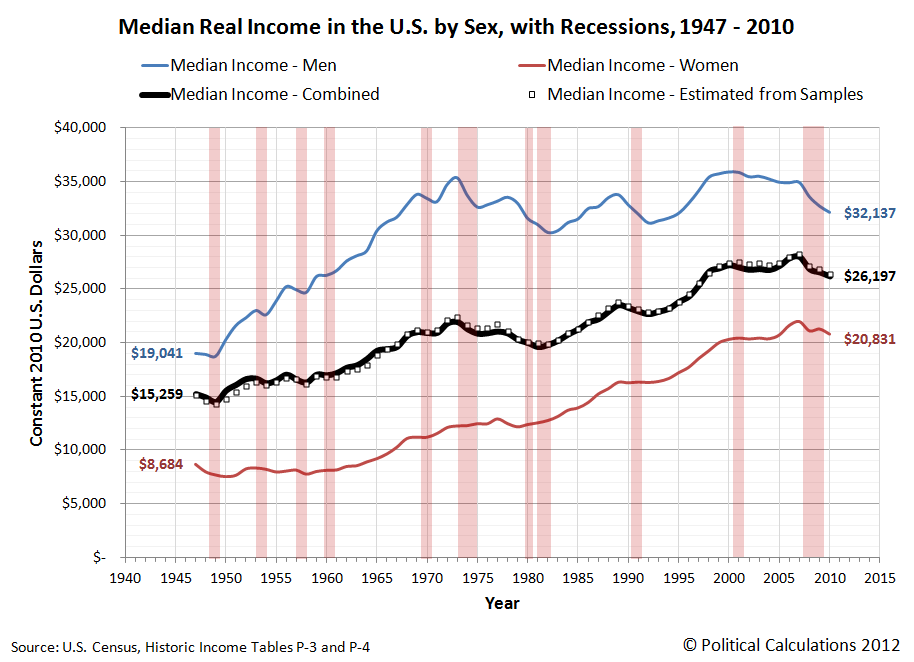
Next, we took the U.S. Census’ breakdown of inflation-adjusted median income for both men and women for each of these years [Excel spreadsheet] and used the math that applies to log-normal distributions to construct the combined median income that applies to individuals. Our results are shown in the chart below, along with the actual median incomes reported by the U.S. Census so we can compare our calculated results with them:

U.S. Individuals Real Median Income by Sex with Recessions from 1947 through 2010

As you can see, our calculated results in creating a weighted median from the subsets of median income data for men and women are very close to the actual real median income numbers for all individuals. Here, because per capita income has been demonstrated to follow a log-normal distribution, we are able to use this math to either combine or extract subsets of data that have never been officially presented.

As an aside, we achieved the results above by treating the reported median income data the way we might calculate a weighted average. The beauty of the log-normal distribution math is that we can do this with medians, which we ordinarily could not do otherwise.

In the chart above, you can see the effect of the changing composition of the U.S. workforce, as the relative share of women earning incomes in the United States has increased since 1947. In 1947, the median income for individuals is much closer to the median income for men than it is for women. By 2010 however, we see that the median income for individuals is about halfway in between the median incomes for men and for women, reflecting that nearly equal share that both sexes now have among all individual income earners in the U.S.

Extracting The Unseen

The U.S. Census Bureau provides the median income data for individuals (or persons), men and women. It also reports median income data for both male and female wage or salary earners [Excel spreadsheet], whom we’ll simply describe as Working Men and Working Women.

Using the math we demonstrated above with this data, we can extract the median incomes for two categories of people for whom the U.S. Census has never reported median incomes: men and women with incomes who do not earn wages or salaries, or as we’ll describe them from now on, Non-Working Men and Non-Working Women! Today, we’re putting what we found for all U.S. individual income earners together for the first time:

U.S. Individuals Real Median Income by Sex and Working Status with Recessions from 1947 through 2010

Constructing Households

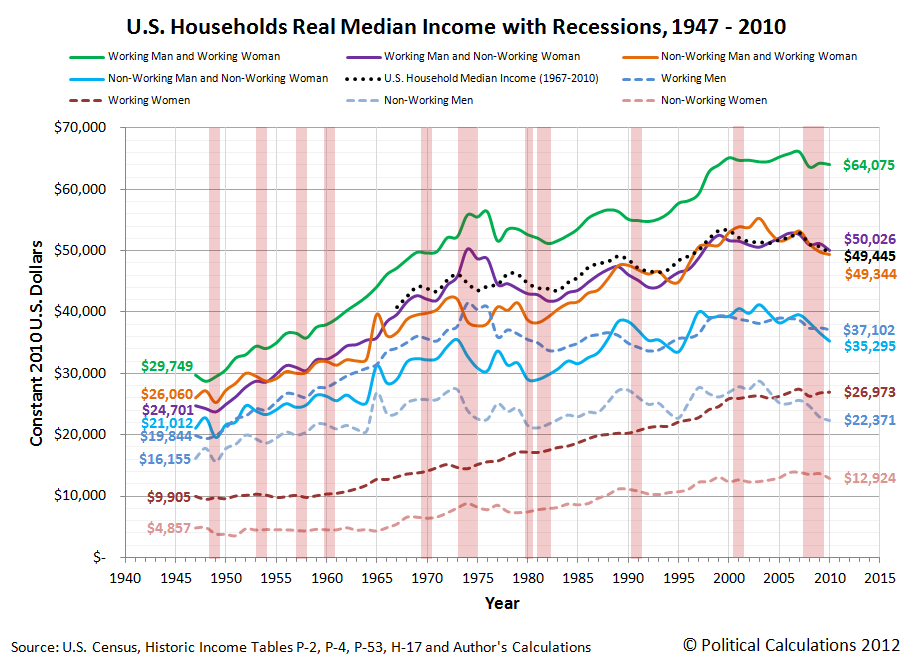
Now, let’s combine our median income earners into two-person households, pairing working men and women, working men and non-working women, non-working men and working women and finally non-working men and non-working women. We’ve shown our results below, along with the U.S. Census’ official median income for U.S. households:

U.S. Couples Median Real Income with Recessions, 1947-2010

Well, look at that! The households formed by our single-wage and salary income earning couples from 1947 through 2010 closely parallels the actual real median income for U.S. households with a working man and non-working woman over that time (except for the years 1974 through 1977, where there seems to be an anomaly in the Census’ data for working men – and here, the actual median splits the difference!) Also keeping in mind that the actual median household income might include the income contributions of additional people (say individuals between the ages of 16 and 24 who might be working part time at minimum wage jobs while also attending school and living at home with their parents), which likely accounts for the difference between the two, we’ve pretty much just demonstrated that we can successfully model basic U.S. households using just the data that applies for U.S. individuals.

But wait! What about single person households? Our next chart throws them into the mix as well!

U.S. Households Median Real Income with Recessions, 1947-2010

Using the figures for 2010, we approximated the income percentiles for each of our single and two-person median income earning households. The table below reveals our results (our model should put each approximated percentile within 0.2 of the actual percentile!):

Household Type 2010 Median Income Approximate Income Percentile
Working Men and Working Women $64,075 61.4
Working Men and Non-Working Women $50,026 50.7
Working Women and Non-Working Men $49,344 50.1
Non-Working Men and Women $35,295 36.7
Working Men Only $37,102 38.6
Working Women Only $26,973 27.7
Non-Working Men Only $22,371 22.4
Non-Working Women Only $12,924 11.5

It occurs to us that all we would need to increase the income inequality among households in the United States is to increase the nation’s percentage of single person households among all households. That would work by increasing the number of households at the lower end of the income spectrum, even though it would have absolutely no effect upon the measured income inequality for individuals. The U.S. Census Bureau shows the change in the number of single person households since 1960:

U.S. Census Bureau: Percent of Single Person Households, 1960-2011

Here’s the U.S. Census Bureau’s Gini index measure of the amount of income equality among U.S. households for the years from 1947 through 2010:

Phil Wendt's Studio: Figure 1. Gini Index of Income Dispersion, 1947-2010

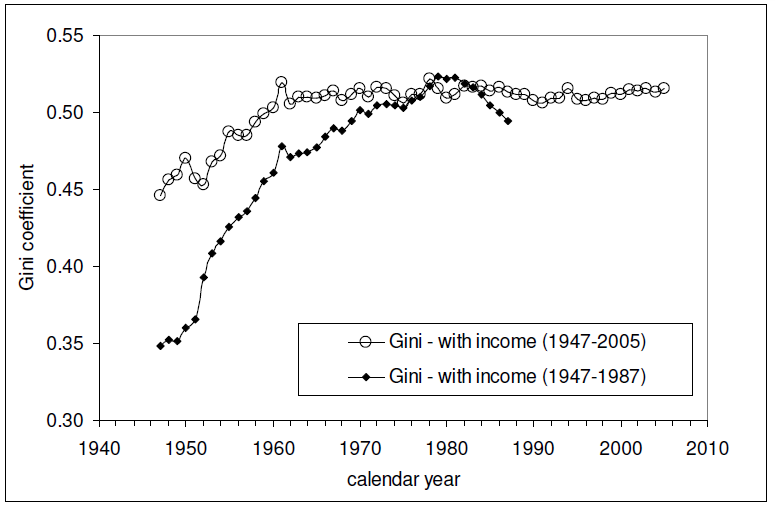
And here is the Gini index measure of the amount of income equality among U.S. individuals for the years from 1947 through 2005 (the data since 2005 is presented here – it’s similar to all that recorded since 1960 in the chart below):

The relevant data in the chart above is the Gini measure indicated with the hollow circles, which is based on the “fine”, or more detailed, income bins reported by the U.S. Census in its annual Current Population Survey. The other data in the chart, indicated by solid diamonds, represents income distribution data reported by the U.S. Census in larger, or more “coarse” income bins, which are less detailed and are therefore a much less accurate measure of the nation’s level of income inequality in any given year.

Intersections and Connections

Looking at where all the data in these three charts intersect and overlap, What we find is that since 1960, the level of income inequality for U.S. individuals as measured by the “fine” Gini index is nearly constant, but has increased significantly for U.S. households. What has changed over that time is the composition of U.S. households, with a steady increase in the percentage of single person households.

Without a corresponding increase in the measured income inequality for U.S. individuals, the increase in the measured income inequality for U.S. households has been almost entirely driven by the increase in the number of single person households over time.

So income inequality among U.S. households isn’t increasing because the rich are getting richer. That means that policies intended to right this situation by going after the rich in the name of “fairness” are guaranteed to fail, because the real cause of the increase in income inequality among U.S. households over time is something that cannot be fixed by such actions.

If only the people pushing such policies could see that….