
1
2

3

4
5
6

7
8
9
10

11
12
13

14

15

15

16

17
This if the final chapter of what he wrote. These are the links to the first part of the story. It is all firsthand from a kid who had to grow up as soon as he graduated from high school to commanding men and learning to fly what was then the most complex plane ever built, and very similar to the ones that dropped the Atomic Bombs on Japan.
My Uncle’s Contribution To WWII – A B-29 Pilot
My Uncle’s Contribution To WWII – A B29 Pilot – Part 2, Pearl Harbor To Tokyo
We flew three Prisoner of War missions wherein we dropped food, clothing, and medical supplies to our prisoners in their prison camps. One of the conditions stipulated in the Japanese surrender was that they must clearly mark all of the Prisoners of War camps with a large red cross on the roof, or in the yard, so it could be seen by aircraft flying over. We flew to camps located in Formosa (now called Taiwan), Shikoku and Tokyo. After dropping the POW supplies in Tokyo, we flew at approximately 500 feet over the remains of the city at our leisure, as did several other B-29 crews. The devastation of the city was unbelievable.
On October 2, 1945, our crew was assigned to be in the first group of airplanes to start home in Sunset Project #5. I flew airplane numbered A Square 47 named “Sweat’erOut” to Kwajalein, Oahu, and Fairfield-Suisun Field at Sacramento, California, landing October 5, 1945. Approximately two hours out, we had to feather a prop because an engine was running out of oil. Accordingly, my last landing in a B-29 was a three-engine landing. That was my last flight in a United States Army B-29.
The entire military establishment was in a state of extreme confusion after the War ended. It had millions of men in uniform, and most wanted to get out, but not all. I elected to remain in the U.S.Army because I was married and had no skill other than knowing how to fly. I was given 45 days of Rest, Relaxation and Recuperation leave and told to report to my unit, the 73rd Bomb Wing (VH) at March Field, Riverside, California, on December 4, 1945. That date was extended to January 10, 1946. Orders were changed while I was on leave, and we were now told to report to McDill Field, Tampa, Florida on January 10, 1946…but I didn’t get the change notice. Margaret and I bought our first car, a used one, from Holler Chevrolet on West Central Boulevard in Orlando. It was a 1942 black two-door Chevrolet Cabriolet. We drove it from home on leave in Orlando to Riverside, California, carrying my brother John as far as White Sands, New Mexico, where he was to be stationed. We rented a bedroom living accommodation with an Indian family in Riverside, Calif. before I got the word that we should be in Tampa, Florida. We hopped in our car and drove rapidly back across the United States to Tampa.
While I was based at McDill Field in Tampa, there was a surplus of officers with nothing to do, and I elected to attend an officer’s maintenance-training course across the field. I also got a part-time job ferrying new Luscombe Silvaires from their factory in Garland, Texas, near Dallas, to a privately owned Fixed Base Operator at Clearwater, Florida, for $100.00 each ferry trip. I made four or five ferry flights for him. On one flight, I landed in Orlando to spend the night, and the next day I took Margaret and my sister Mary for a ride in the brand new Luscombe Silvaire. Because it was a two-seat airplane, I had to make a second flight to take my sister up. It was the first time either of them had ever flown. It was while I was ferrying these airplanes that I became aware that Eastern Air Lines was hiring pilots in Miami.
My last flight in a U.S. Army airplane was a four-hour ride (required to be eligible for flight pay) in a B-25 on July 9, 1946.
July 18, 1946, I was transferred to Ft Bragg, North Carolina, to be separated from the U.S. Army Air Corps. My date of discharge was effective September 30, 1946.
I had served in the Army for a total period of four years and six months. First, I was an enlisted man for six months, an Aviation Cadet for nine months, and an officer for three years, six months, and six days. I was 23 years old when my military career ended.
The three Medals and decorations I was awarded were for what I consider rather modest accomplishments:
I was awarded the Air Medal with one oak leaf cluster (in lieu of a second Air Medal)
I was awarded the Asiatic-Pacific Campaign Medal with two stars (for two different battles in which I participated)
I was awarded the American Campaign Medal for having been in a branch of the military service.
To be employed by any airline, a pilot must have a Flight Instrument Rating endorsement on his civilian flying certificate. On July 24, 1946, I started flight training for my instrument rating in a Fairchild 24 light airplane at the Cannon-Mills airport located in east Orlando. It was located approximately where the 100 block of South Semoran Boulevard runs today. I obtained the instrument rating on September 19, 1946. I was hired as a pilot by Eastern Air Lines on October 6, 1946, six days after my military terminal leave ended. At Eastern, I flew for 38 years until I reached the mandatory retirement age of 60 on my birthday, January 14, 1983.
P S I was recalled to Active Duty with the newly created United States Air Force on June 1, 1951 during the Korean War. Because my civilian employment was with an airline, I was assigned to the military airline, called Military Air Transport Service, based in Mobile, Alabama, at the Brookley Air Force Base. MATS was the acronym of the military’s airline. I flew the huge unpressurized C-74 Globemaster (equipped with the R-4360 engine) airplanes across the Atlantic Ocean usually to Tripoli, Lybia but occasionally to England or Germany. I was released from Active Duty one year and four months later on September 12, 195,2 and returned to our home in Coral Gables, Florida, to resume my civilian career as a pilot with Eastern Air Lines, for whom I flew the next 38 years.
Interestingly enough, in May of 2001, I was qualified to fly as co-pilot of the only existing B-29 that still flies, owned by the Commemorative Air Force of Midland, Texas. It was 56 years since I last flew in that type of airplane.
Beef
Meet Boots, the Record-Setting $320,000 Steer Raised by a 13-Year-Old South Dakota Girl
Irony
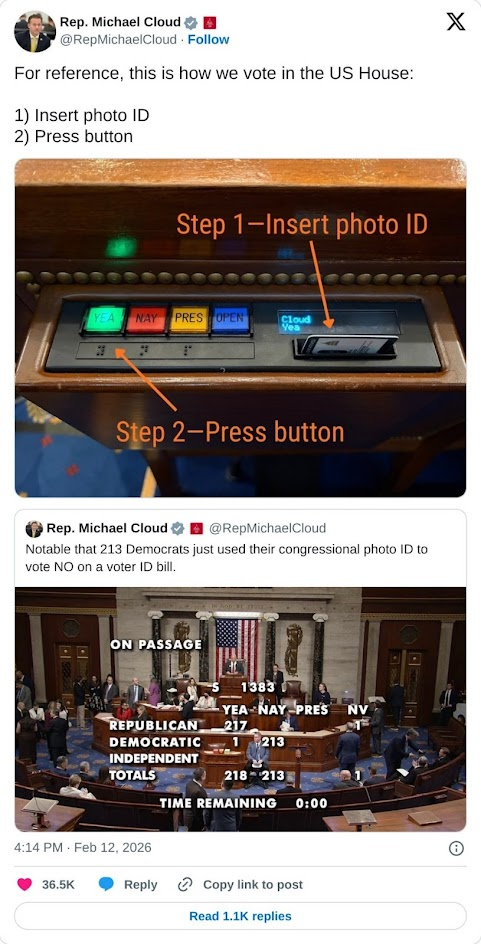
Democrat Senator Requires Photo ID to Enter Campaign Event While Opposing Voter ID for Elections
Life
Seattle Seahawks Super Bowl LX Star Derick Hall Had Just A 1 Percent Chance To Live After Birth – this proves a baby is not just a clump of cells. I’m looking at you abortion lovers
That’s a lot of fish sticks
Quebec Ice Fishermen Land Record-Setting 244-Pound Atlantic Halibut In The Name Of Science
Super Bowl Halftime
Kid Rock Crushes Bad Bunny in TMZ Poll on Competing Super Bowl Halftime Shows
The NFL’s stranglehold on American culture was just shattered…
Did You Catch All the MK-Ultra Moments at the Super Bowl?
Breaking Down California’s Insane “Super Bowl Tax” – Sam Darnold lost money to play in the game
Air Travel
Affirmative Action Quotas in Question as Female, Minority Pilots Caused Half of Pilot-Error Crashes – DEI results
Identity Politics
Identity Politics and Therapy Culture Are Two of the Main Reasons Society Is Going Crazy [VIDEO]
Cars
Are EVs the Most Expensive Boondoggle in Human History?
The 12 Stupidest Cars of the 1950s You’ve Never Seen Before [VIDEO]
Coffee
Air Travel
‘These Airlines Are Robbing Us Blind’: Expert Warns Against Buying New Carry-On Bags In 2026. Why Are People Getting Gate-Checked, Charged By Delta, United? – do they sit around and think of ways to make it worse for travelers?
Olympics
The Origins Stories Behind The 5 Most Unique Events At The Winter Olympics
Non Liberal Women
The woman globalists fear most
Police Bodycam Footage Surfaces of Charlie Kirk’s Killer From 3 Years Ago
Mortgage Rates Fall to Three-Year Low Under Trump
North Sea ‘Has Three Times More Oil and Gas’ Than Government Claims
Sleepless And Stressed: How Insomnia Fuels Dementia, Obesity, Heart Risks
Teen Rescues Baby Beaver From River While Tubing
Is Pedro Pascal the Ultimate Hollywood Hypocrite?
Truck Driver Distracted By Porn Before Deadly Crash Sentenced To Prison
‘We Should Kill Him’: AI Chatbot Encourages Australian Man to Murder His Father
Europe
Visualizing Europe’s Housing Cost Burden By Country
Germany’s Machinery Industry Faces Catastrophic Collapse
US Pauses Some Arms Sales to Europe, Citing Shortages
Lawmaker claims ‘assisted dying’ is the new penicillin
Asia
Number of US Student Visas Issued to Asians Tumbles
Japan Confirms Over 600,000 Citizens Killed by Covid ‘Vaccines’
Huawei’s New Ascend Chips Aim To Close China’s AI Gap With US
BWBB
Japan’s population of people aged 100 or older just crossed the 99,000 mark, a figure that would have seemed like science fiction just a few decades ago. As of September 1, 2025, the Ministry of Health, Labor and Welfare tallied 99,763 centenarians, an increase of 4,644 from the year before. This milestone comes as the nation marks its 55th straight year of breaking its own record for longevity, with women comprising the overwhelming majority—88 percent, or 87,784 individuals—compared to 11,979 men.
At the top of this remarkable group sits 114-year-old Shigeko Kagawa, a retired obstetrician and gynecologist from Nara Prefecture who didn’t hang up her stethoscope until age 86. Kagawa made headlines in 2021 by carrying the Olympic torch at 109, a testament to the vitality that defines so many in her cohort. The oldest man, 111-year-old Kiyotaka Mizuno, rounds out a picture of endurance that the rest of the world can only envy.
What fuels this extraordinary lifespan? Officials point to a combination of disciplined eating habits and an unyielding commitment to staying in motion, even as the years pile on. Japan’s rates of heart disease and cancers like breast and prostate remain among the lowest globally, thanks in large part to meals built around fish, vegetables, and soy, while steering clear of excessive red meat and salt.
Japan is paying tribute to more than 3 million war dead as the country marks its surrender 80 years ago, ending World War II, as concern grows about the rapidly fading memories of the tragedy of war and the bitter lessons from the era of Japanese militarism.
In a national ceremony Friday at Tokyo’s Budokan hall, about 4,500 officials and bereaved families and their descendants from around the country will observe a moment of silence at noon, the time when the then-emperor’s surrender speech began on Aug. 15, 1945.
Just a block away at Yasukuni Shrine, seen by Asian neighbors as a symbol of militarism, dozens of Japanese politicians and their supporters came to pray.
Prime Minister Shigeru Ishiba stayed away from Yasukuni and sent a religious ornament as a personal gesture instead of praying at the controversial shrine.
But Shinjiro Koizumi, the agriculture minister considered as a top candidate to replace the beleaguered prime minister, prayed at the shrine. Koizumi, the son of popular former Prime Minitser Junichiro Koizumi whose Yasukuni visit as a serving leader in 2001 outraged China, is a regular at the shrine.
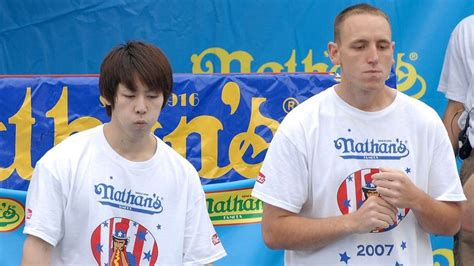
I became enamored with this contest by phenom eater Kobayashi, a skinny kid from Japan who revolutionized competitive eating. It also grosses out my wife. That means I’ve been watching for decades.
Kobayashi was defeated by Joey Chestnut who will not defend his championship this year because of a conflict with the sponsor, Nathan’s hot dogs and others (see below). I’ll still watch, but we will be in the 30 or 40 dog range to win, versus the 60 to76 that we’ve been treated to by Chestnut.
his Fourth of July, Joey Chestnut will be doing what Joey Chestnut does better than any human being alive:
Eating hot dog after hot dog after hot dog after hot dog after hot dog after hot dog after hot dog after hot dog after hot dog after hot dog after hot dog after hot dog after hot dog after hot dog after hot dog after hot dog after hot dog after hot dog after hot dog after hot dog after hot dog after hot dog…
And on and on, down the hatch, with stunning pace and a strange sort of grace.
Chestnut—aka “Jaws,” the Michael Jordan of competitive eating, the Picasso of Pork, the Federer of Frankfurters, the GOAT of bloat, a man who once ate a world record 76 hot dogs in 10 minutes—will spend the holiday competing casually alongside members of the U.S. military at Fort Bliss in Texas in a quickly-assembled event airing on his YouTube channel.
Though Chestnut is honored for the opportunity, the stunning news is where the 40-year-old won’t be–parked at a table outside Nathan’s Famous in Coney Island, N.Y., dominating a legendary hot dog eating contest he has won a staggering 16 times.
“Bittersweet,” Chestnut told me in an interview this week.
Behind Chestnut’s absence is a dispute involving his nascent relationship with Impossible Foods, the plant-based food maker. The partnership chafed the powers behind Major League Eating and the Nathan’s Famous competition, who felt Chestnut was getting cozy with a rival.
So Chestnut is out, casting a footlong shadow over the annual beachside showdown—and riling a fan base that can’t believe the iconic competition will happen without its signature stomach.
No Joey Chestnut in Coney Island on the Fourth of July? It’s like asking a bald eagle to stay home in the nest.
“Stop being such weenies!” New York City mayor Eric Adams wrote in a pun-tastic tweet.
“The entire country’s [expletive] bummed,” said ESPN’s biceps curl Cronkite Pat McAfee. “I don’t even know if people are going to light off fireworks now.”
“Let the guy suck down dogs!” McAfee pleaded.
Chestnut, who won his first Nathan’s event in 2007 and parlayed his talent into global fame and a full-time occupation, sounded plenty bummed by the conflict. He doesn’t see his relationship with Impossible Foods as a deal-breaker–he’s still a devoted carnivore who sees plant-based food as a supplement to his meat diet, not a replacement.
He compared it to Tom Brady endorsing Under Armour cleats and also Ugg boots–an interesting choice, given that Tom Brady would sooner eat an Adirondack chair than a meaty hot dog.
“You can eat meat and you can also eat plant-based meat,” Chestnut said. “I feel like that should be OK with people.”
Impossible Foods had no issues with Chestnut consuming meat products at the Nathan’s event–or anywhere else, said the company’s CEO, Peter McGuinness.
“He’s a flexitarian,” McGuinness said. “He is our target audience. We’re not a vegan company and we need to be appealing to meat eaters.”
Major League Eating’s president, Richard Shea, echoed Chestnut’s term to describe the situation: bittersweet. The issue was a brand conflict, he said. He went on to rave about Chestnut’s talent and indelible mark on the annual competition, which is televised by ESPN.
“We love Joey, we wish he was there, we support his choice and think it’s a cool tribute, what he’s doing with the troops in Texas,” Shea said. “He’s a great champion.”
After the initial dust-up, MLE and Nathan’s Famous offered to put aside their issues and allow Chestnut to participate in 2024 – but the offering couldn’t bring the hot dog Hoover vac back to the table.
The relationship may need further repair. Chestnut believed his team was still negotiating when the controversy spilled into view with a Major League Eating statement that they were “devastated” at Chestnut’s decision to partner with “a rival brand that sells plant-based hot dogs.”
Having the impasse go public felt like a gut-punch to Chestnut, the contest’s most identifiable winner, long ago surpassing the competitive eating godfather Takeru Kobayashi of Japan.
“It’s hard to rebuild trust once bridges have been burned a little bit,” Chestnut said.
Chestnut trains like an endurance athlete, with vigorous eating sessions to prepare him to push his physical limits. He practices breathing techniques to stay calm and loose and even asks people to come yell at him in practice to try and simulate a noisy contest environment.
The champion felt on pace for a potentially record-setting Fourth of July.
“It was definitely my best training in years,” he said.
While consuming even a half dozen hot dogs would curl me into a fetal ball for a month, Chestnut said he’s in good health. He said he gets his blood regularly checked, and that his doctor remains comfortable with his career choice.
“He told me whatever I’m doing, I can keep doing it,” Chestnut said.
After the event at Fort Bliss, Chestnut will turn his attention to a brand-new event–a showdown with storied rival Kobayashi to be shown on Netflix. Billed as “Chestnut vs. Kobayashi: Unfinished Beef” the mano-a-mano gulletpalooza will go down on Labor Day, Sept. 2.
“I want to make him uncomfortable and he wants to make me uncomfortable,” Chestnut pledged.
As for a future return to Coney Island, the champ is trying to stay optimistic.
Can it really be the Fourth of July without Joey Chestnut dogging dogs near the Brooklyn boardwalk?
“I love that contest,” said the hot dog gawd. “I would do anything reasonable to make it back there.”
303? That’s next to nobody. That is how you protect you borders.
Japan granted asylum to 303 individuals in 2023 – a record high – but still small compared to the 98 percent whose applications were rejected.
The Japanese Ministry of Justice (MoJ) revealed this number in March, surpassing the 202 individuals granted asylum in 2022. Despite this increase, the approval rate for asylum seekers remained low at just 2.2 percent.
All in all, the total number of asylum seekers who lodged their applications in the Land of the Rising Sun reached 13,823 in 2023. According to Kyodo News, this is the second-highest number after the 19,629 people who sought asylum in 2017.
The increase comes amid changes to the stringent Japanese immigration laws, which created a quasi-refugee status for foreign nationals fleeing active conflict zones. Kyodo News also provided a breakdown of the 303 refugees whose asylum applications were approved.
Japan has seen a significant increase in refugee applications from countries such as Afghanistan, Myanmar and Ethiopia – representing more than a threefold increase from 2022 figures. A majority of the accepted refugees, 237 individuals, hailed from Afghanistan. Many of the refugees from Afghanistan were employees of the Japan International Cooperation Agency who fled the country after the fall of Kabul, officials said.
The Japanese Immigration Services Agency (ISA) meanwhile said 27 refugees from Myanmar were granted asylum. There were also six nationals from Ethiopia whose applications for asylum were accepted, the agency added.
Of the 13,823 applications for refugee status recorded by Japanese authorities, the highest number of applicants came from Sri Lanka at 3,778. Applications from Turkey and Pakistan ranked second and third highest.
No one gives Japan any shit about discrimination, racism or any of that other BS. That’s only reserved to hate America. No one is flying planes into buildings in Japan either. They don’t have Fentanyl problem coming from China through Mexico
I’ve already posted about my fears that this might happen at this link.
Now, it’s not just jabbed blood, it’s also HIV infected blood
Now, it’s coming true and it looks like I’m not the only one.
(The Epoch Times)—Receiving blood transfusion from COVID-19-vaccinated individuals could pose a medical risk to unvaccinated recipients since numerous adverse events are being reported among vaccinated people worldwide, according to a recent study from Japan.
The preprint review, published on March 15, examined whether receiving blood from COVID-19-vaccinated individuals is safe or poses a health risk. Many nations have reported that mRNA vaccine usage has resulted in “post-vaccination thrombosis and subsequent cardiovascular damage, as well as a wide variety of diseases involving all organs and systems, including the nervous system,” it said.
Repeated vaccinations can make people more vulnerable to COVID-19, it said. If the blood contains spike proteins, it becomes necessary to remove these proteins prior to administration, and there is no such technology currently available, the authors wrote.
Contrary to earlier expectations, genes and proteins from genetic vaccines have been found to persist in the blood of vaccine recipients for “prolonged periods of time.”
In addition, “a variety of adverse events resulting from genetic vaccines are now being reported worldwide.” This includes a wide range of diseases related to blood and blood vessels.
Some studies have reported that the spike protein in the mRNA vaccines is neurotoxic and capable of crossing the blood-brain barrier, the review stated. “Thus, there is no longer any doubt that the spike protein used as an antigen in genetic vaccines is itself toxic.”
Moreover, people who have taken multiple shots of mRNA vaccines can have several exposures to the same antigen within a small time frame, which may lead to them being “imprinted with a preferential immune response to that antigen.”
This has resulted in COVID-19 vaccine recipients becoming “more susceptible to contracting COVID-19.”
Given such concerns, medical professionals should be aware of the “various risks associated with blood transfusions using blood products derived from people who have suffered from long COVID and from genetic vaccine recipients, including those who have received mRNA vaccines.”
The impact of such genetic vaccines on blood products as well as the actual damage caused by them are currently unknown, the authors wrote.
“In order to avoid these risks and prevent further expansion of blood contamination and complication of the situation, we strongly request that the vaccination campaign using genetic vaccines be suspended and that a harm–benefit assessment be carried out as early as possible.”
Repeated vaccination of genetic vaccines can also end up causing “alterations in immune function” among recipients. This raises the risk of serious illnesses due to opportunistic infections or pathogenic viruses, which would not have been an issue if the immune system were normal, the review said.
The facts are going against the narrative. The state run Newspeak Ministry of Truth (MSM, Social Media/government/woke/Hollywood) are having a hard time keeping the lid on the fact that the vax is failing and Ivermectin is working.
This is a relatively long post, but I have broken it up into sections for easy digestion. The net of it is how we are being lied to by Government/Pharma and that lie is being covered up by Big Tech/MSM/Social Media. The WEF is trying to use it for the Great Reset, but the facts are there to show the big lie.
I am giving you scientific information to make your own decisions.
Here are the facts:
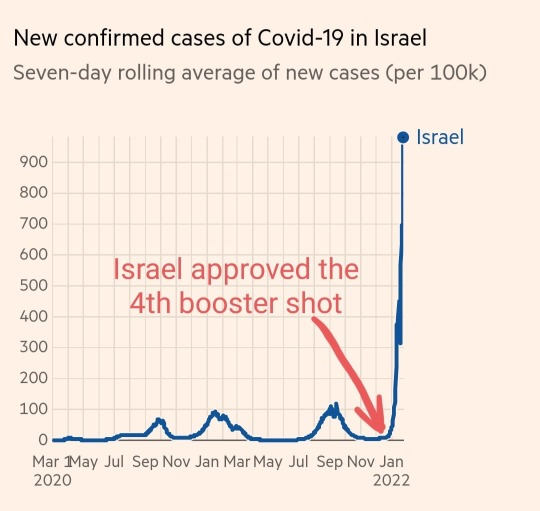
ISRAEL – THE MOST VACCINATED COUNTRY
From the Times of Israel. More COVID cases confirmed in Israel in January than all of 2021, data shows:
The most vaccinated country in the world has the highest percentage of Covid.
There were more COVID-19 cases identified in Israel during January this year than the entirety of 2021, according to a report released Thursday.
The Coronavirus National Information and Knowledge Center said some 960,500 coronavirus cases were identified during 2021, while in January alone, as of Wednesday, more than 1,160,000 have tested positive.
The massive rise in cases has been blamed on the fast-spreading Omicron variant. On Wednesday, 67,723 new cases were recorded, according to Health Ministry data published Thursday. With more than 307,000 PCR and antigen tests carried out on Wednesday, the positivity rate stood at 24.58 percent.
As of Thursday afternoon, 480,501 Israelis were actively infected, with 2,483 hospitalized, 931 of those in serious condition, and 212 of them on ventilators. A week ago, serious cases stood at 587, and two weeks ago the figure was just 283.
Over the past week, more than 520,000 Israelis have tested positive for COVID, with experts believing that the actual figure could be several times higher. Also in the past week, 146 Israelis with COVID died — a 73.8% increase over the previous week — bringing the total death toll since the start of the pandemic to 8,541. A month ago, the average weekly death toll was less than 10.
Click on the above link for more.
JAPAN SWITCHES FROM THE JAB TO IVERMECTIN AND VOILA, IT’S WORKING AGAINST OMICRON AND ALL STRAINS (note at the bottom where the USA still “has problems with it”)
Ivermectin Shows Antiviral Effect Against Omicron: Japanese Pharma Firm
A Japanese conglomerate that is studying the anti-parasitic drug ivermectin has found that the medication had an antiviral effect on Omicron, according to joint non-clinical research.
Kowa Co. Ltd., a conglomerate with interests in trading, hospitality, and electronics, along with health and medical applications, issued a press release (pdf) on Jan. 31 stating that ivermectin has been found to be effective against Omicron in in vitro studies. The firm is also in the process of carrying out a Phase 3 clinical trial on the use of ivermectin to treat COVID-19 patients, though the company’s remarks on effectiveness pertain to the findings of lab-based research.
Kowa representatives didn’t respond to a request for comment by press time.
The company, working with Kitasato University based in Tokyo, said that ivermectin has the “same antiviral effect” on all “mutant strains,” including Alpha, Delta, and Omicron. Kowa added that ivermectin suppresses invasion of the virus and inhibits its replication.
“[Ivermectin] is expected to be applied as a therapeutic drug (tablet) for all new coronavirus infectious diseases,” the report said.
Ivermectin has been used by the World Health Organization for over 30 years to treat parasitic infections. Volunteers have distributed the drug in African countries where it has been found to be extremely effective, said the Kowa report.
However, the treatment has been mired in controversy during recent times as the U.S. Food and Drug Administration (FDA) has not approved the use of ivermectin as a treatment for COVID-19, even though the drug is used in humans to treat a variety of conditions.
Dr. Paul Marik, a supporter of using ivermectin, testified that ivermectin “is one of the safest drugs on the face of this planet.”
Marik, who is a co-founder of the physician-comprised advocacy group Front Line COVID-19 Critical Care Alliance, said ivermectin is approved for the treatment of viruses in 79 countries.
“So somehow Japanese people, Indian people, Brazilian people can tolerate it safely, but it’s toxic in Americans. You have to be kidding,” Marik said.
JOHN’S HOPKINS SHOWS GOVERNMENT CURE WORSE THAN THE DISEASE
WASHINGTON – […] The lockdowns during the early phase of the pandemic in 2020 reduced COVID-19 mortality by about 0.2%, said the broad review of multiple scientific studies.
“We find no evidence that lockdowns, school closures, border closures, and limiting gatherings have had a noticeable effect on COVID-19 mortality,” the researchers wrote. But the research paper said lockdowns did have “devastating effects” on the economy and contributed to numerous social ills.
“They have contributed to reducing economic activity, raising unemployment, reducing schooling, causing political unrest, contributing to domestic violence, and undermining liberal democracy,” the report said.
“Such a standard benefit-cost calculation leads to a strong conclusion: lockdowns should be rejected out of hand as a pandemic policy instrument,” the paper concluded. (read more)
MALONE IVERMECTIN STUDY SHOWS COVID BEING CURED
The Study:
Background: Previously, we demonstrated that ivermectin use as prophylaxis for COVID-19 was associated with reductions in COVID-19 infection, hospitalization, and mortality rates, and in the risk of dying from COVID-19, irrespective of regularity and accumulated use of ivermectin, in an observational, prospectively obtained data from a strictly controlled city-wide program in a city in Southern Brazil (Itajaí, SC, Brazil) of of medically-based, optional use of ivermectin as prophylaxis for COVID-19.
In this study, our objective was to explore the data obtained from the program to evaluate whether the level of regularity of ivermectin use impacted in the reductions in these outcomes, aiming to determine if ivermectin showed a progressive dose-, regularity-response in terms of protection from COVID-19 and COVID-19 related outcomes.
Materials and methods: This is a prospective observational study of the program mention above, that used ivermectin at a dose of 0.2mg/kg/day for two consecutive days, every 15 days. We obtained and analyzed the data regarding the accumulated dose of ivermectin use, in addition to age and comorbidities, to analyze the patterns of reduction of COVID-19 infection, hospitalization, and mortality rates, and risk of dying from COVID-19, according to the regularity and amount of ivermectin used in a 5-month period.
Following definitions of regularity, we considered as strictly regular subjects that used at least 180mg of ivermectin (180mg = 30 tablets), and as sporadic users subjects that used 60mg (= 10 tablets) or less during the 5-month period.
Comparisons between subjects that did not use ivermectin and these two levels of regularity of ivermectin use were performed. Analysis of the intermediate levels of ivermectin use are present in the supplement appendix of this study. To analyze hospitalization and mortality rates, we utilized the database of COVID-19 infections of all participants, from Itajaí and outside. To analyze COVID-19 infection rate and risk of dying from COVID-19 we utilized the Itajaí city database.
Propensity score matching (PSM) was employed, followed by multivariate adjusted analysis for residual differences (doubly adjusted analysis).
Results:
Conclusion: Non-use of ivermectin was associated with a 10-times increase in mortality risk and 7-times increased risk of dying from COVID-19, compared to strictly regular use of ivermectin in a prospectively collected, strictly controlled population.
A progressive dose-response pattern was observed between level of ivermectin use and level of protection from COVID-19 related outcomes and consistent across different levels of ivermectin use.
The results of this study clearly demonstrate that prophylactic use of ivermectin must be initiated immediately for people in high risk categories in the United States and worldwide. This includes individuals with one or more co-morbidities and the middle aged/elderly. Our “design-to-fail” government funded clinical trials for early treatment and governmental obstructionism regarding life saving treatments to patients must end now.
Yamamoto was educated in the US and knew us well. He also knew that we were a sleeping industrial giant. He was well aware of the 2nd Amendment and how much we believed in it (We still do for the Islamic Jihad Terrorists). He also knew he couldn’t attack the US, but a surprise attack would and could cripple us for a while until the industrial might of a sleeping giant was woken up. Luck was not on his side that day as the US Carriers were out at sea and the Battleships (an aging, but vital weapon) was all that was harbored in Pearl Harbor.
Here is the take by the Pacific War.com

JAPANESE PREPARATIONS FOR THE ATTACK ON PEARL HARBOR


Admiral Yamamoto plans the Destruction of the United States Pacific Fleet

These aircraft are superb reproductions of the Nakajima Type 97 carrier torpedo bombers (Allied code-name “Kate”) that attacked the United States Pacific Fleet at Pearl Harbor. They were used in the gripping and historically accurate 20th Century Fox film Tora, Tora, Tora! (1970).
In conformity with this traditional approach to naval warfare, the Japanese Naval General Staff intended to limit naval operations in support of Japan’s military thrust into South-East Asia to offensive actions against local American, British and Dutch naval forces defending their country’s colonial possessions in South-East Asia. To the conservative admirals of the Naval General Staff, a direct confrontation in the central Pacific Ocean between their navy and the United States Navy was unthinkable.
In early 1941, Vice Admiral Isoroku Yamamoto was appointed Commander-in-Chief of Japan’s Combined Fleet, and he immediately took issue with the cautious policy of the Japanese Naval General Staff. Yamamoto did not believe that the United States Pacific Fleet would remain idle at Pearl Harbor while Japan attacked and seized America’s Philippines, and British and Dutch colonial possessions in South-East Asia. He believed that Japan must cripple the United States Pacific Fleet at the same time as it launched its attacks on countries of South-East Asia.
With this firm conviction, Admiral Yamamoto began to consider a surprise carrier-launched air attack on the United States Pacific Fleet at its Pearl Harbor base timed to coincide with Japan’s military aggression in South-East Asia. Yamamoto instructed Rear Admiral Takijiro Onishi, Chief of Staff of the 11th Air Fleet, to assess the feasibility of an attack on Pearl Harbor by carrier-launched aircraft. Onishi enlisted the assistance of Commander Minoru Genda, a brilliant staff officer and tactician serving with Japan’s 1st Air Fleet. Genda studied the problem and came to the conclusion that an attack on Pearl Harbor could succeed if (a) the attack took the Americans completely by surprise, (b) the attack occurred early on a Sunday morning when American defence preparedness would be at a low level, (c) all six of Japan’s best aircraft carriers were used, and (d) highly skilled aircrews were used in the attack. To ensure complete surprise, Genda’s plan precluded alerting the Americans to their danger by a prior declaration of war.
Admiral Yamamoto’s plan for a surprise peacetime attack on the United States Pacific Fleet at Hawaii would involve a strike force which included Japan’s six largest and most powerful aircraft carriers. His task was made much easier by President Roosevelt’s decision to relocate the United States Pacific Fleet from California to Hawaii. As Yamamoto saw it, the destruction of the American Pacific Fleet would give Japan time to seize the Philippines, Malaya, British Borneo, Burma and the Netherlands East Indies (now Indonesia), and gain access to the oil, minerals, rubber and other resources that Japan needed to sustain its aggressive war machine. He was hopeful that, with its Pacific Fleet destroyed or crippled, the Americans would be willing to accept a peace settlement that allowed Japan to keep its new conquests in South-East Asia.
The Japanese Naval General Staff initially rejected Admiral Yamamoto’s plan for an attack on Pearl Harbor as being too great a gamble. They doubted that surprise could be achieved when the strike force would be at sea for two weeks before the attack. Japan had eleven aircraft carriers, and the admirals felt that Yamamoto’s plan could put at risk their six best carriers. They also felt that diverting Japan’s six most powerful aircraft carriers to Hawaii would leave the southern attacks on the Philippines and British Malaya dangerously unprotected. In the end, Yamamoto only overcame their opposition by threatening to resign.
Although the admirals of the Naval General Staff were reluctantly persuaded by Yamamoto to abandon the policy of defensive naval war in favour of attack, the years of night warfare training and the highly accurate, long range torpedoes associated with the defensive policy would give the Japanese Imperial Navy a significant edge over Allied navies in night actions during the Pacific War.
Training for the Pearl Harbor Attack
Early in 1941, despite the fact that the Chief of the Naval General Staff, Admiral Osami Nagano, had not yet approved a surprise attack on Pearl Harbor, Admiral Yamamoto directed that intensive planning and training for such an attack was to be undertaken.
Japanese naval aircrews had already honed their war skills flying sorties against the poorly equipped and trained Chinese air force and army. However, Pearl Harbor offered special challenges to an enemy force proposing to use air-launched torpedoes. The harbor was comparatively shallow and a large area in the centre of the harbor was occupied by Ford Island. The American battleships were moored on the eastern side of Ford Island. The water area between the battleships and the eastern shore of the harbor was narrow. Japanese torpedoes would have to be redesigned for use in shallow harbor waters, and torpedo aircrews would have to learn to drop their torpedoes with great precision so that they would land in the narrow stretch of water between the eastern shore of the harbor and the battleships. The Japanese aircrews went about this training with great enthusiasm and dedication. By November 1941, they were ready for the attack.
On 3 November 1941, the Chief of the Japanese Naval General Staff finally gave his approval to Admiral Yamamoto’s plan to attack the United States Pacific Fleet at its Pearl Harbor base.
The Japanese Carrier Strike Force departs for Hawaii
To distract the American government while it secretly positioned a powerful aircraft carrier strike force for the “sneak attack” on Pearl Harbor, the Japanese government had ordered its envoys in Washington to engage the American government in intensive diplomatic negotiations.AdmiralYamamoto’s aircraft carrier strike force, under the command of Vice-Admiral Chuichi Nagumo, left Japan on 26 November 1941.

The fast and powerful aircraft carrier Akagi was regarded as the “Queen” of the Japanese Imperial Navy. It is shown here in 1941. It was the flagship of Vice Admiral Chuichi Nagumo for the attack on Pearl Harbor.
Preserving strict radio silence, Nagumo’s carriers steered well clear of normal shipping lanes and headed for a stand-by point about 1,000 miles (1,600km) north of Hawaii. The carrier strike force comprised Japan’s six largest fleet aircraft carriers, Akagi, Kaga, Soryu, Hiryu, Shokaku, and Zuikaku. Each of these aircraft carriers would later play a role in the major sea battles closely related to Australia’s survival in 1942. The last two would take part in the crucial Battle of the Coral Sea. The first four would take part in the pivotal Battle of Midway. The carriers were supported by battleships, cruisers, destroyers and submarines.
Japan’s Prime Minister Tojo threatens Britain and America with War
In the last week of November 1941, at a time when Admiral Nagumo’s aircraft carriers were sailing towards Pearl Harbor with hostile intent, Japan’s militarist Prime Minister, General Hideki Tojo, issued a blunt warning to Britain and the United States that Japan would “purge East Asia of US -British power with a vengeance”. General Tojo’s threat appeared on the front page of the New York Herald Tribune on Sunday, 30 November 1941, exactly seven days before the Japanese attack on America’s Pacific Fleet at Pearl Harbor.
Despite the clear threat of war contained in Tojo’s warning, and despite having no knowledge of the whereabouts of Japan’s six largest fleet aircraft carriers, no steps were taken at Hawaii to bring the United States Pacific Fleet or the United States Army Air Corps to a state of war alert.
The Americans had broken the Japanese diplomatic code in September 1941, and were able to read coded messages from Tokyo to Japan’s embassies in Berlin and Washington. The United States government knew that Japan had warned its diplomats in Washington that certain unspecified events would occur after 29 November 1941. However, the Americans believed that the warning fore-shadowed possible aggressive moves by Japan against the Philippines or British or Dutch colonial possessions in South-East Asia. Although they did not believe that an attack on Pearl Harbor was planned by the Japanese, the American commanders in Hawaii took steps to guard against possible hostile action by Japanese submarines and sabotage to military aircraft or installations on the main island of Oahu. To guard against sabotage, Major General Short lined up his aircraft on the runways as if for an inspection. They would prove easy targets for Japanese aircraft when the attack came.
The Order to attack the United States Pacific Fleet
When the Japanese aircraft carrier strike force reached its stand-by point north of Hawaii, it waited to receive either final confirmation to proceed with the attack on Pearl Harbor or an order to return to Japan. On 1 December 1941, the Japanese government reached a firm decision to make war on the United States. On 2 December 1941, a radio signal containing the code words “climb Mount Niitaka” was received by Vice Admiral Nagumo aboard his flagship Akagi. The code message was an order to attack Pearl Harbor on Sunday, 7 December 1941. The Japanese were well aware that most Americans at this time observed Sunday as a holy day, and they had carefully timed the surprise attack to occur when many Americans in Hawaii would be preparing for or attending church services.
Surprise was considered vital to the success of the attack on the American fleet. There would be no prior declaration of war to alert the Americans to their danger.
Admiral Nagumo’s carrier strike force refuelled at sea on 5 and 6 December. Its approach to Hawaii was screened from American reconnaissance aircraft by low, dense cloud cover.
Japanese intelligence informed Nagumo on 6 December that the American battleships and a large number of smaller warships were in Pearl Harbor. However, Nagumo’s primary targets were the American aircraft carriers, and they were all absent from the harbor. The Japanese believed that the American aircraft carriers Lexington, Saratoga, Enterprise and Yorktown were all based at Pearl Harbor at this time. Their intelligence was faulty. Having undergone routine dry-docking, Saratoga was at San Diego on the American west coast. Yorktown was stationed with the newly commissioned Hornet in the Atlantic at this time. Only Lexington and Enterprise were actually based at Pearl Harbor on 6 December 1941, and fortunately for the United States and Australia, both carriers were at sea when the Japanese attack took place. Despite this setback, Nagumo was under orders to proceed with the attack.
On 6 December 1941, President Franklin D. Roosevelt intervened personally in the cause of peace by sending a direct appeal to the Emperor of Japan. It fell on deaf ears in Tokyo. The Japanese government was determined on war and had no intention of recalling the Japanese carrier force.
 Review of 20th Century Fox Pearl Harbor attack film “Tora! Tora! Tora! (1970)
A question that has interested historians and researchers for decades is: why? Why did Japan launch an attack that, in hindsight at least, they clearly had no chance of winning? The obvious answer is that they thought they could, but military and naval strategists know the answer is not so simple.
Precisely because its resources were so depleted by the war with China, it is accepted wisdom that Japan was hoping to expand its territories in the Pacific. If these areas belonged to Japan, they would, almost by default, become customers for Japan’s industrial and resource sectors.
But the Japanese underestimated America’s resolve to defend itself, for however long, and by whatever means necessary. If Japan hoped that America might take a “c’est la vie” attitude to the prospect of losing a battle in the Philippines, it was sorely mistaken. Nor was America still weary from the First World War.
Japan also underestimated the extent of Americans’ outrage at the bombing in 1941. It fueled the nation’s desire to win at almost any cost. No democratic government on earth can move forward without the will of the people, and after Pearl Harbor, the American people’s will was ferocious.

Here is the text and a link to the speech that FDR made after the attack at Pearl Harbor.
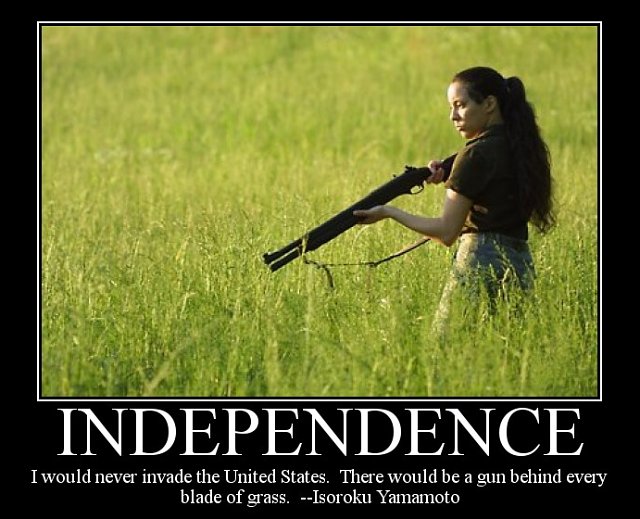
I read the Biography of Admiral Yamamoto, the architect of the attack. He believed that the only way to defeat the United States of America was a surprise attack that would disable our military in the Pacific. He clearly stated that he feared that if the attack was not completely successful, it would awaken a sleeping giant that the Empire of Japan could not defeat in standard battle. It must haunt his legacy.
Tactically, the mistake was not destroying the aircraft carriers which were out at sea that day or his plan may have succeeded.
As it turned out, he was shot down only a few years later in a surprise attack by a squadron of P-38’s heading to an inspection in the Pacific.
Here is the Youtube speech by FDR
I find ironic the words of the second half of the speech, if applied to 9/11, would be appropriate. Also ironic is that Japan was extending its reach for economic resources.
The United States was at peace with that nation and, at the solicitation of Japan, was still in conversation with its Government and its Emperor looking toward the maintenance of peace in the Pacific. Indeed, one hour after Japanese air squadrons had commenced bombing in Oahu, the Japanese Ambassador to the United States and his colleague delivered to the Secretary of State a formal reply to a recent American message. While this reply stated that it seemed useless to continue the existing diplomatic negotiations, it contained no threat or hint of war or armed attack.
It will be recorded that the distance of Hawaii from Japan makes it obvious that the attack was deliberately planned many days or even weeks ago. During the intervening time, the Japanese Government had deliberately sought to deceive the United States by false statements and expressions of hope for continued peace.
The attack yesterday on the Hawaiian Islands has caused severe damage to American naval and military forces. I regret to tell you, very many American lives were lost. In addition, American ships have been reported torpedoed on the high seas between San Francisco and Honolulu.
Yesterday the Japanese Government also launched an attack against Malaya.
Last night Japanese forces attacked Hong Kong.
Last night Japanese forces attacked Guam.
Last night Japanese forces attacked the Philippine Islands.
Last night Japanese forces attacked Wake Island.
This morning the Japanese attacked Midway Island.
Japan has, therefore, undertaken a surprise offensive extending throughout the Pacific area. The facts of yesterday and today speak for themselves. The people of the United States have already formed their opinions and well understand the implications to the very life and safety of our nation.
As Commander in Chief of the Army and Navy, I have directed that all measures be taken for our defense.
But always will our whole nation remember the character of the onslaught against us.
No matter how long it may take us to overcome this premeditated invasion, the American people in their righteous might will win through to absolute victory.
I believe I interpret the will of the Congress and of the people when I assert that we will not only defend ourselves to the uttermost but will make very certain that this form of treachery shall never endanger us again.
Hostilities exist. There is no blinking at the fact that our people, our territory, and our interests are in grave danger.
With confidence in our armed forces-with the unbounded determination of our people-we will gain the inevitable triumph–so help us God.
I ask that the Congress declare that since the unprovoked and dastardly attack by Japan on Sunday, 7 December 1941, a state of war has existed between the United States and the Japanese Empire.
Here is the only color film of the event. Listen to how excited the Japanese are and their commitment to give everything, including lives to this war:


 Delusions of Adequacy