Feeling Drained? Here Are 12 Signs You Have an Introvert Hangover

An introvert hangover can leave you feeling exhausted, making you want nothing more than to escape to a quiet place alone.

Does this sound familiar?

You’ve spent the whole day with your friends or family. You’ve had a great time eating, playing games, and catching up. But now, you’re so exhausted you can barely see straight, while everyone else seems as energetic as ever. In fact, they’re already setting up the next game as you’re wondering how you can slip out the door.

The next day, after the event is over, is no better. You might have a headache, and your body may feel sore and drained, almost like the onset of the flu. You’re tired — so very tired.

If this resonates with you, you might be experiencing something we call an “introvert hangover.”

What Is the Introvert Hangover?

Introvert, Dear writer Shawna Courter coined the term “introvert hangover” in this article to describe the exhaustion she felt after celebrating Christmas with her in-laws. She writes:

“An introvert hangover is a pretty terrible thing to experience. It starts with an actual physical reaction to overstimulation. Your ears might ring, your eyes start to blur, and you feel like you’re going to hyperventilate. Maybe your palms sweat. And then your mind feels like it kind of shuts down, building barriers around itself as if you had been driving on a wide open road, and now you’re suddenly driving in a narrow tunnel. All you want is to be at home, alone, where it’s quiet.”

Yes, the introvert hangover is real. It’s a funny term that describes the serious social burnout many introverts experience, marked by significant mental and physical fatigue.

Here are 12 signs that you might have an introvert hangover, which I discuss in more detail in my book, The Secret Lives of Introverts. You don’t need to experience all these symptoms to have one, and your symptoms might vary.

Signs of an Introvert Hangover

1. Every little thing gets on your nerves.

When you have an introvert hangover, even small annoyances can overwhelm you. Normally, you might brush off a sarcastic comment from your partner or stay calm when you misplace your keys — but not in this state. An introvert hangover can make it feel as though your head is so full it might burst, leaving no room for even the smallest extra bit of information. Because you’re so tired, you may find it hard to control your emotions.

2. You struggle to make decisions.

Even small decisions become difficult. Paper or plastic? Pumpkin pie or cherry? Normally, these choices wouldn’t be hard, but when you have an introvert hangover, your brain is so tired that it doesn’t function properly. For bigger issues, you might find yourself obsessively thinking about the situation to the point of frustration. You’re searching for that one piece of information that will show the right way forward, but because you’re so exhausted, your mind can’t focus enough to find it.

3. You can’t think clearly.

Similar to the previous point, you’re so tired that it feels like your mind is processing everything in slow motion. You might struggle to recall details of things you should easily know, like your daily schedule, where you left your phone, or even common passwords.

4. Your speech changes.

You might speak slower, with unusually long pauses between your words. Sometimes, you might use words that are close to what you mean but not quite right — for instance, “dessert” becomes “candy” and “where’s my coat” becomes just a vague gesture. You might even seem a bit intoxicated, even if you haven’t had much or any alcohol. You might slur your words together, mispronounce them, or both.

5. You feel physically unwell.

Some introverts report experiencing headaches, muscle aches, upset stomachs, or other physical symptoms.

6. You’re tired.

Like, really tired. It feels like you’ve just finished an intense workout at the gym. If someone offered you a quiet spot to nap, you’d accept it immediately. After the social event, you find yourself collapsing on the couch, skipping your usual evening routine, or heading straight to bed.

7. You’re zoning out.

You find it hard to focus. Someone might be speaking, but you’re not absorbing their words. Your expression may appear blank, sad, or even angry, but you’re not necessarily upset. Your mind is simply wandering, perhaps lost in thought or daydreaming.

8. You feel anxious.

For some, an introvert hangover can intensify their anxiety. In social situations, they might feel particularly nervous, worried about how others perceive them and concerned they might say or do the wrong thing. They may also find themselves overthinking a particular decision, unable to escape an anxious thought spiral due to their fatigue.

Want to feel more at ease in social situations?

Discover the secrets to enjoying fun, meaningful conversations. Know exactly what to say — even if you’re introverted, shy, or socially anxious. Feel less drained and have more energy while socializing.

9. You feel depressed.

An introvert hangover can also trigger feelings of depression. You might find yourself overwhelmed by pessimism and cynicism, questioning past decisions, and experiencing dark thoughts. Everything in life may seem bleak or not okay.

10. You’re not acting like yourself.

You might be quieter or not as cheerful as usual. Something seems off, and those close to you are likely to pick up on it.

11. You can’t handle small talk anymore.

When you’re experiencing an introvert hangover at a social event, you might find it hard to keep up with conversations. You’ve run out of small talk. Your mind is just too tired to think of anything polite or interesting to say.

12. You have an intense desire to be alone.

When you’re dealing with an introvert hangover, all you crave is solitude. Whether it’s sneaking off to the bathroom during a social gathering or cozying up in your pajamas afterward, you just need some time for yourself. For introverts, there’s nothing quite like the comfort of being alone after a hectic day or social gathering.

What Causes an Introvert Hangover?

Research shows that everyone eventually gets tired from socializing, including extroverts. Socializing requires energy, and after a while, everyone reaches their limit. However, introverts experience social burnout more quickly and intensely.

Why is this the case? Introverts are generally more sensitive to noise and other forms of stimulation compared to extroverts. Their dopamine systems are less active, meaning that an overload of dopamine — the “feel good” neurotransmitter — can leave them feeling tired and overstimulated. In contrast, extroverts often feel energized by the same levels of dopamine, which can help them push past social fatigue.

To learn more about why introverts need time alone and why they get easily drained from socializing, click here.

The Cure for an Introvert Hangover

The best way to recover from an introvert hangover is to spend time alone in a peaceful, quiet environment. Do your favorite self-care activities or hobbies — anything that helps uplift your mood and energy. For introverts, solitude is as essential as food and water.

If you can’t be completely alone, look for small ways to take a break. You could listen to soothing music with headphones, go for a walk, or find a quiet corner to read. Even short breaks can make a difference.

As introverts, we might feel pressured to fit into a society that often values extroverted behavior. You might worry that prioritizing your needs could inconvenience others or hurt their feelings. This pressure can lead you to hide or deny what you really need, causing more stress.

Remember that your needs as an introvert are valid. It’s perfectly okay to leave a party early or to spend time alone. Your needs are real and deserve respect.

Source

The holiday season is here. It’s the worst 2 months of the year for me. What is telling is that as soon as the presents are opened, people go right back to the other 10 months of the year.

I cringed when I saw the decorations for sale in September, and they started going up 50 days before Christmas near me. My energy started draining on the spot


These Memes Perfectly Explain Introverts’ Thoughts at Holiday Parties

from Introvert Dear, but I can relate and I bet other Introverts can also. I don’t go if at all possible and am better for it.

Because introverts don’t just get ready for a holiday party — they gather strength for one.

Oh no, oh no, oh no. It’s today, isn’t it? The holiday party. And there’s another one tomorrow. A red-and-green glitter bomb of social obligation has exploded all over your calendar. Sure, you love your family, but the truth is, you’re an introvert, and big parties are utterly exhausting — even on those rare occasions when you actually enjoy them. Loud, crowded rooms and yet another round of “So, what’s new with you?” probably leave you dreaming of a white Christmas at home in your pajamas.

But the holidays only come around once a year, so you’ll rock around the Christmas tree anyway. That said, you’ll probably have some thoughts like these. Introverts, can you relate?

Want to feel more at ease in social situations?

Discover the secrets to enjoying fun, meaningful conversations. Know exactly what to say, even if you’re introverted, shy, or anxious. Feel less drained and have more energy while socializing. Click here to secure your spot in Jenn Granneman’s upcoming course, Easy Conversation.

Thoughts Introverts Have at Big Holiday Parties

1. Is it too late to cancel?

a meme about cancelling plans last minute


Saying yes to the big holiday get-together seemed like a good idea when you RSVP’d. You even threw in some exclamation points (soooo excited to see everyone!!) and offered to bring your famous apple dumplings. But that was two weeks ago — you were younger then, full of hope. Now, in a moment of panic and desperation, you’re seriously considering canceling because you’re “sick.” Besides, didn’t you promise your dog you’d binge Netflix together tonight?

2. Sigh. I’m going.

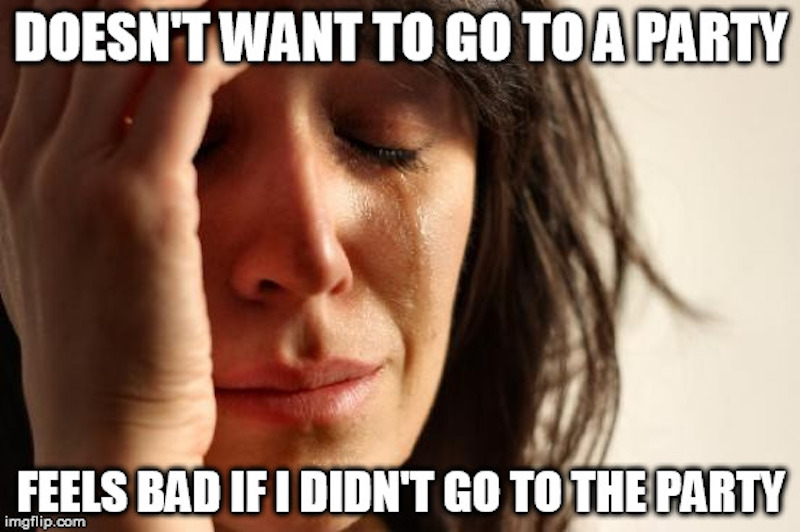
a meme about feeling guilty about not going to the party

It is your family we’re talking about. And it is the holidays. That’s the double-edged sword of being an introvert — just thinking about skipping the party makes you feel guilty, even if it would be better for your mental health. You don’t want to let anyone down, even if saying yes means draining your energy completely.

3. I’ll just go for a little while.

a meme that reads I came, I saw, I left early

Yes, that’s it — the perfect compromise! You’ll say your hellos, grab some food, and even give nosy Aunt Gladys the most basic updates about your life, complete with a polite smile. Then you’ll make a swift exit, just like a certain snowman who knew better than to stick around when the sun was hot that day.

4. I can do this, I can do this…

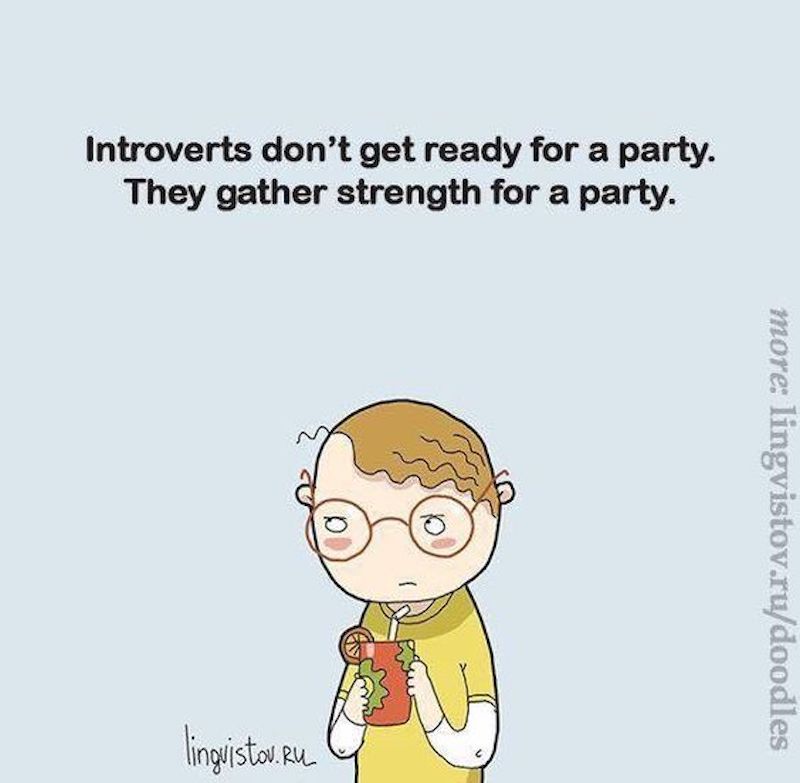
a meme that reads introverts don't get ready for a party, they gather strength for a party

You’re doing this. You’re really doing this. You take a few deep breaths, savor the last moments of peace and quiet, and silently swear on Aunt Gladys’s fruitcake that you’ll be back home soon.

5. It’s so loud!

people are too damn loud meme

You’re at the party, and it’s SO LOUD. Christmas carols are blaring, everyone is talking at once, and your inner introvert is screaming for an escape to somewhere quieter. The noise feels like a physical force, crashing over you and draining your energy. You’re no Grinch, but suddenly his decision to live alone with his dog on a mountain makes perfect sense — it was quiet!

6. Small talk, whyyyyyy…

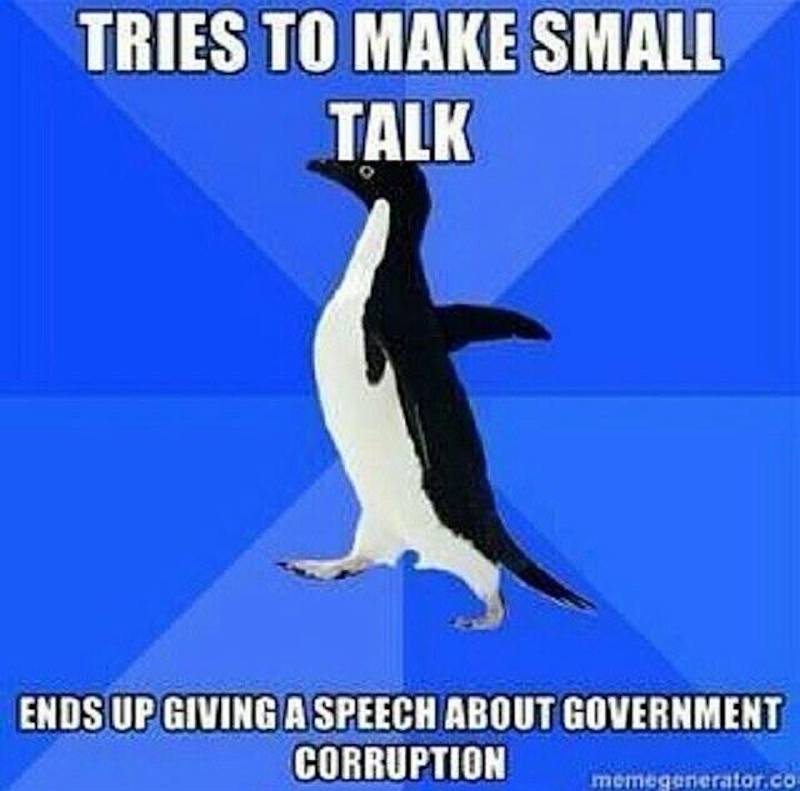
a meme about making small talk

Let’s face it — small talk has never been your thing. Gossip and chatter about weekend plans? It all feels so, well, boring. As an introvert, you’d rather dive into big ideas or, at the very least, something that feels authentic and meaningful. At the party, you do your best to stick to socially acceptable chitchat, but somehow, it always veers off into… something else entirely.

7. This is getting awkward…

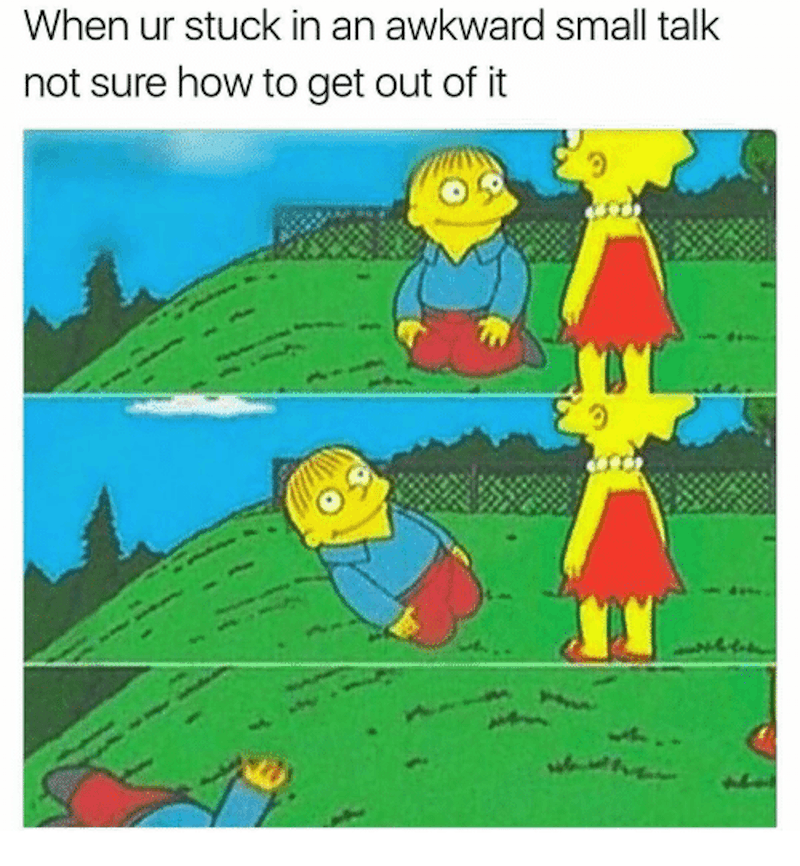
stuck in awkward small talk eme

…so, so awkward.

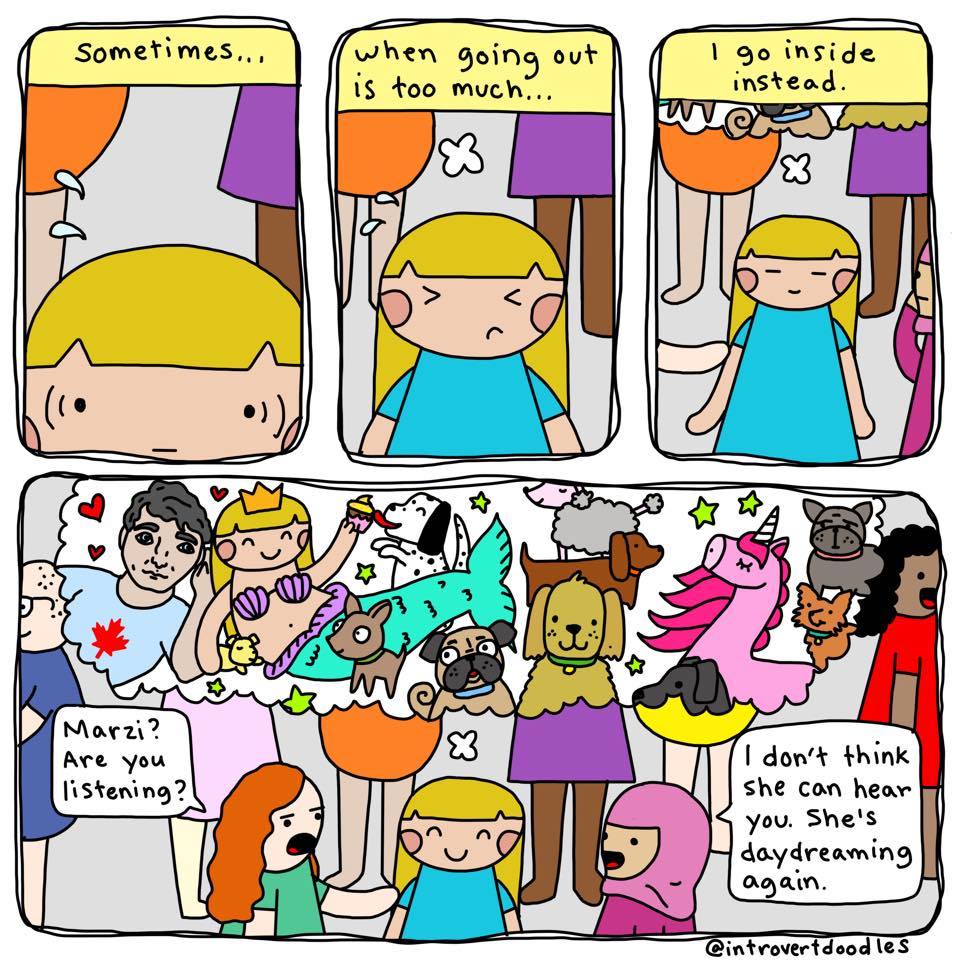
8. There’s so much going on that I’m zoning out.

Introvert Doodles daydreaming introvert meme
Marzi Wilson/Introvert Doodles

Despite how it might look to others, you’re not angry, bored, or depressed — you’re simply turning inward to block out the overwhelming stimulation. The noise, the flurry of activity, and the endless social cues to process can be too much for introverts, who naturally thrive in calmer, more low-key environments.

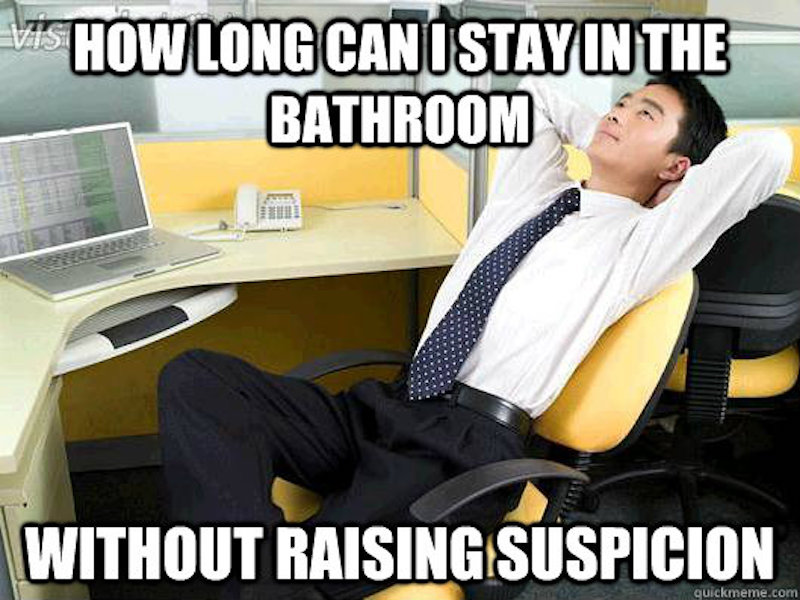
9. But seriously, how long?

meme how long can I stay in the bathroom

This quiet moment alone is bliss. No small talk, no noise — just you, recharging in peace.

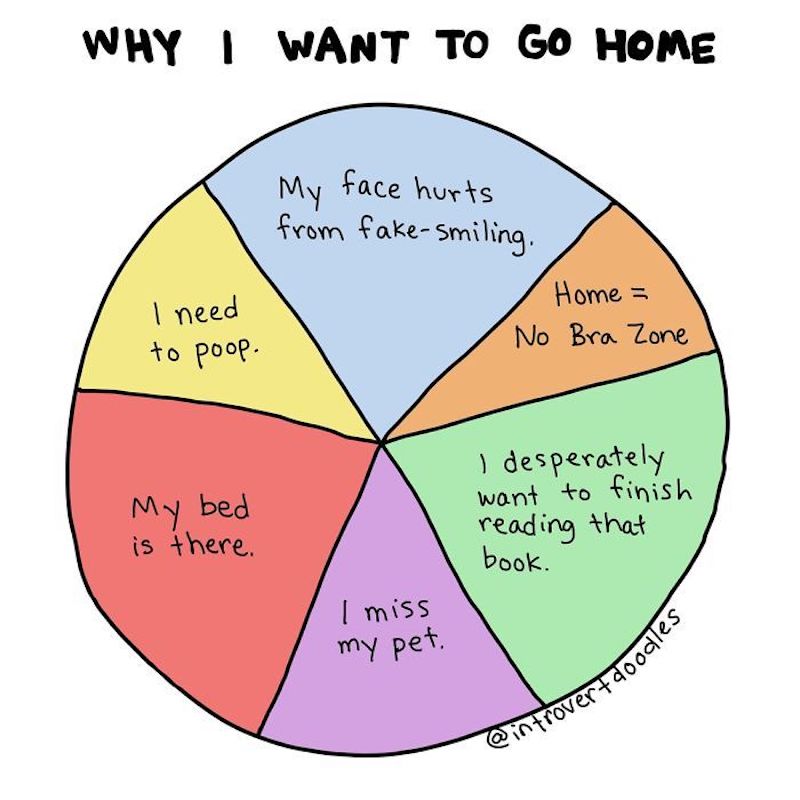
10. It’s not that I don’t like you, it’s just that…

why I want to go home meme
Marzi Wilson/Introvert Doodles

…there’s waaay too much fake smiling happening at this holiday party.

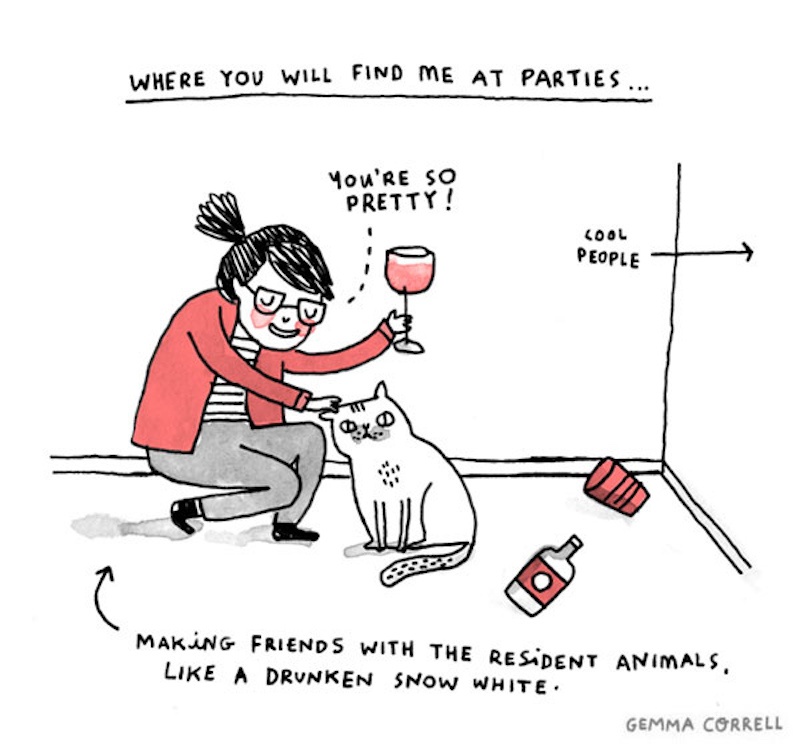
11. A pet! I’m saved!

where you will find me at parties meme
Gemma Correll

Many introverts are devoted animal lovers because our four-legged companions are the perfect match for us. They offer unconditional love without expecting small talk or fake smiles in return (see above). And unlike some extroverts, they’ll never talk your ear off or complain that you’re too quiet.

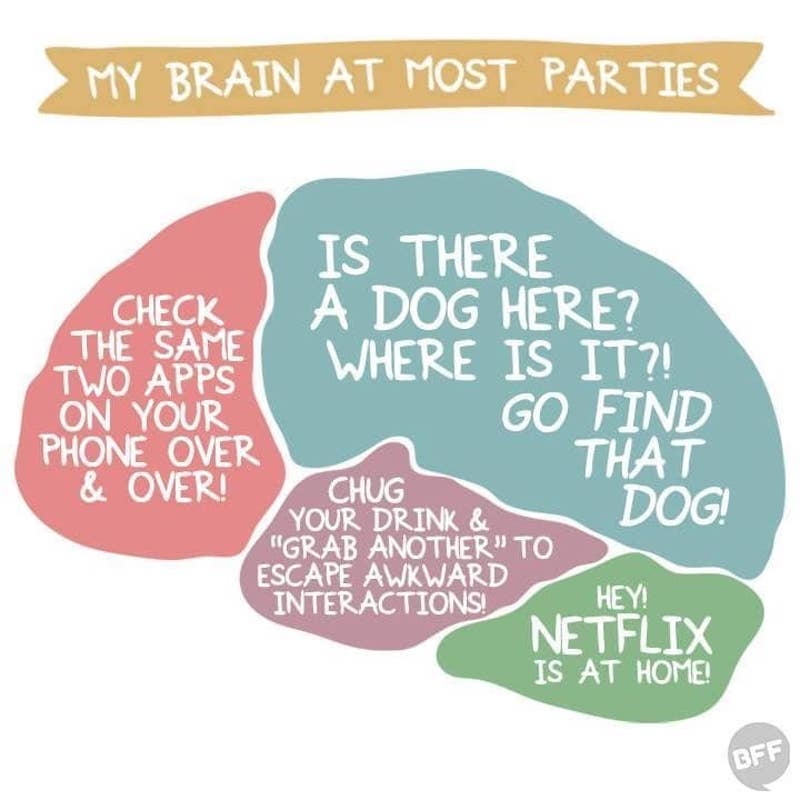
12. “Hey, sorry, can’t talk — too busy checking my phone!”

my brain at most parties meme
Buzzfeed

Pulling out your phone and pretending to be completely absorbed in it? A classic introvert move.

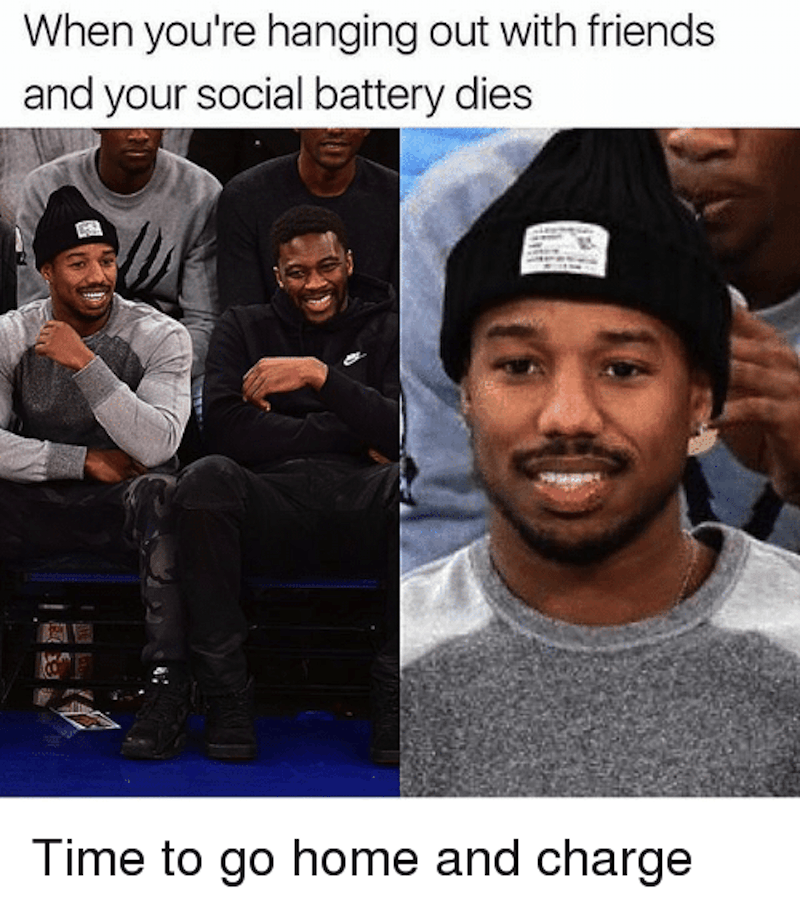
13. I’m actually having fun! And then…

when you're hanging out with friends and your social battery dies meme

Sometimes, even we introverts surprise ourselves by enjoying a social event. There’s something comforting about feeling included — even if half the time was spent dodging personal questions from family and quietly checking your phone. And let’s be honest, the holidays bring a certain warmth and nostalgia that’s hard to resist. Maybe you even found another introvert to chat with — or an extrovert who respected your quiet vibe. It feels good to connect, even for us fiercely independent introverts.

But then, the inevitable happens. No matter how much fun you had, you’re still an introvert — and that means your social battery only lasts so long. Time to head home and recharge!

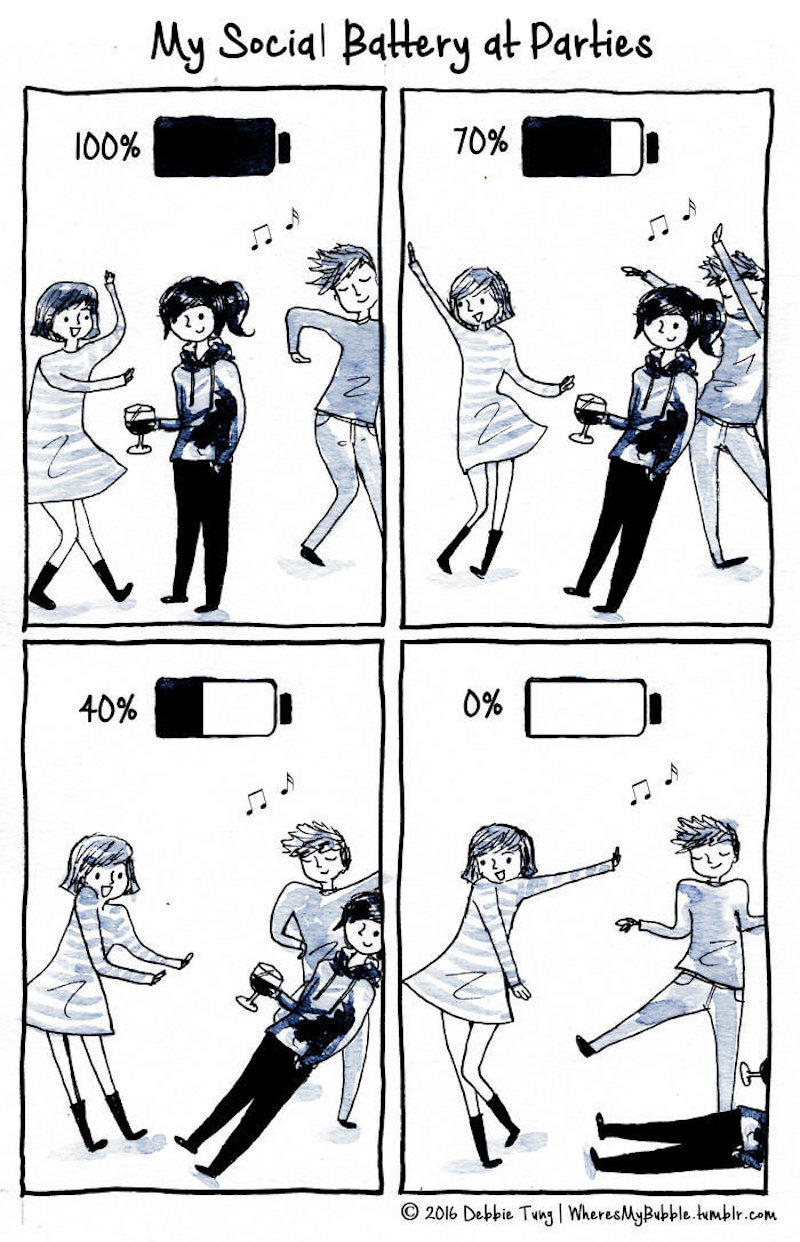
14. Seriously, I have zero energy left.

my social battery at parties meme
Debbie Tung/Where’s My Bubble

And that’s okay — it’s nothing to be ashamed of. It’s just the way you’re wired.

15. If only extroverts understood what it’s like to be completely “peopled out”..

introvert tools meme
Aaron Caycedo-Kimura/INFJoe

…but let’s be real, a lot of them just don’t.

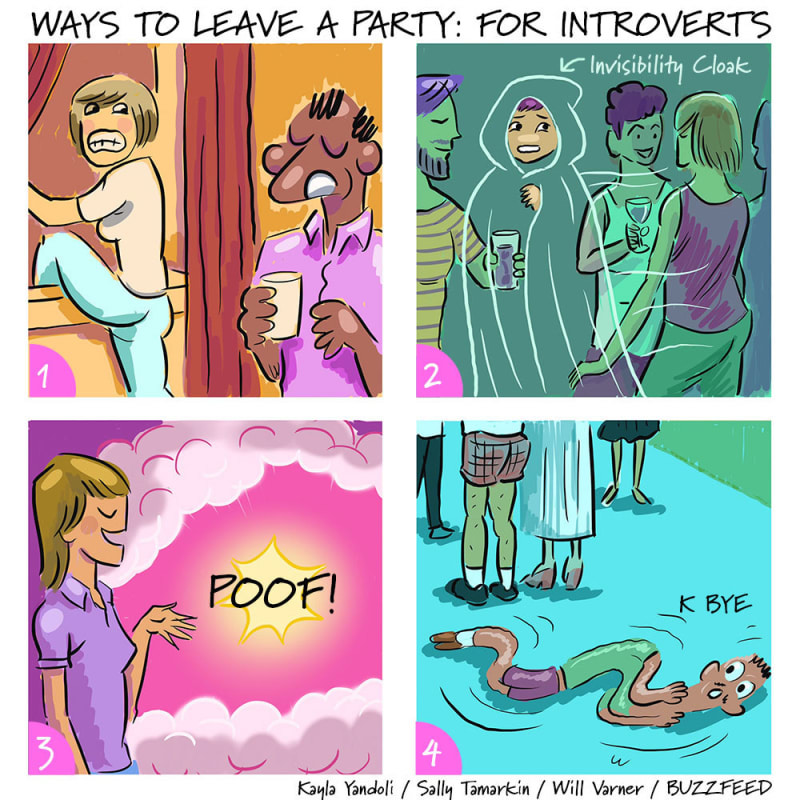
16. I’m so exhausted I don’t even want to say goodbye.

ways for introverts to leave a party meme
Kayla Yandoli/Sally Tamarkin/Will Varner/Buzzfeed

Dang, you forgot to pack your invisibility cloak. But it’s time to make your escape. Fingers crossed no one hits you with a “You’re leaving so soon?” as you quietly slip out the door.

17. I’m home! Hallelujah, I’m home!

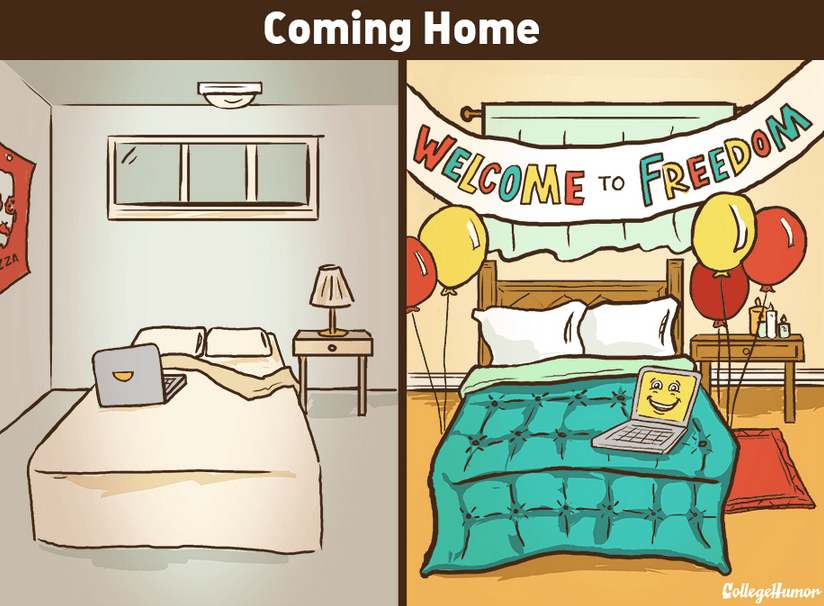
introvert coming home meme
College Humor

On the left: What it looks like.

On the right: What it feels like.

18. And I am completely and utterly exhausted.

me after too much peopling introvert meme

The party might be over, but that doesn’t mean your energy magically returns. In fact, this is when the real exhaustion sets in. Cue the dreaded introvert hangover. For many introverts, social burnout isn’t just mental and emotional fatigue — it’s physical, too. The symptoms are real: headaches, muscle aches, and an overwhelming sense of feeling unwell. It’s your body’s way of saying, time to rest.

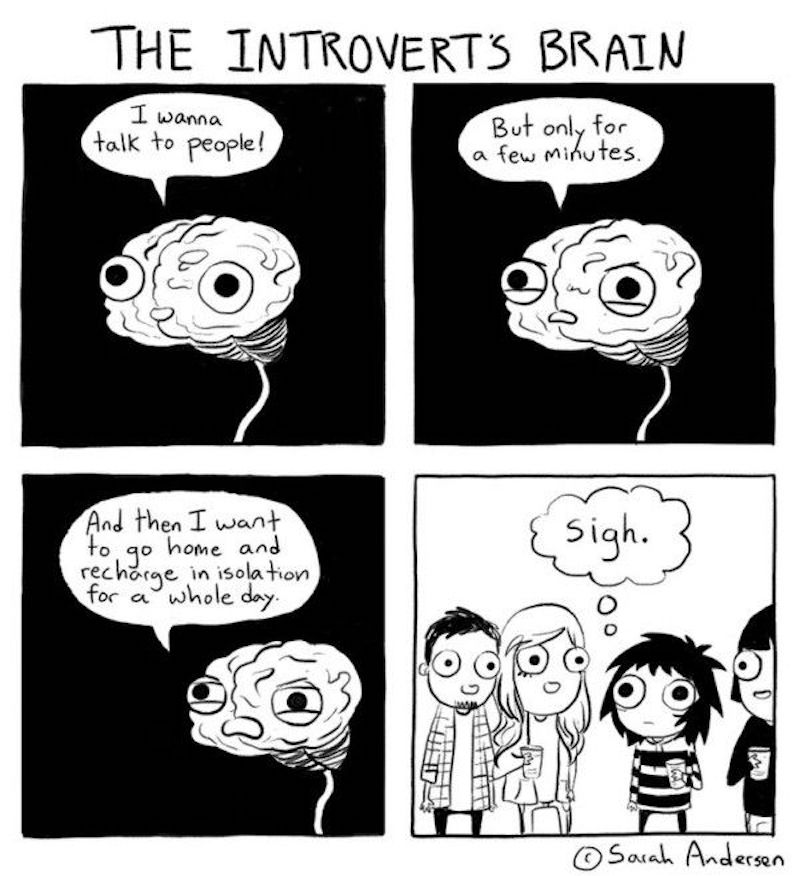
19. Because this is how my brain works:

the introvert's brain meme
Sarah’s Scribbles/Sarah Andersen

A WHOLE DAY.

20. Me:

meme every time I socialize

Can we make it 12?

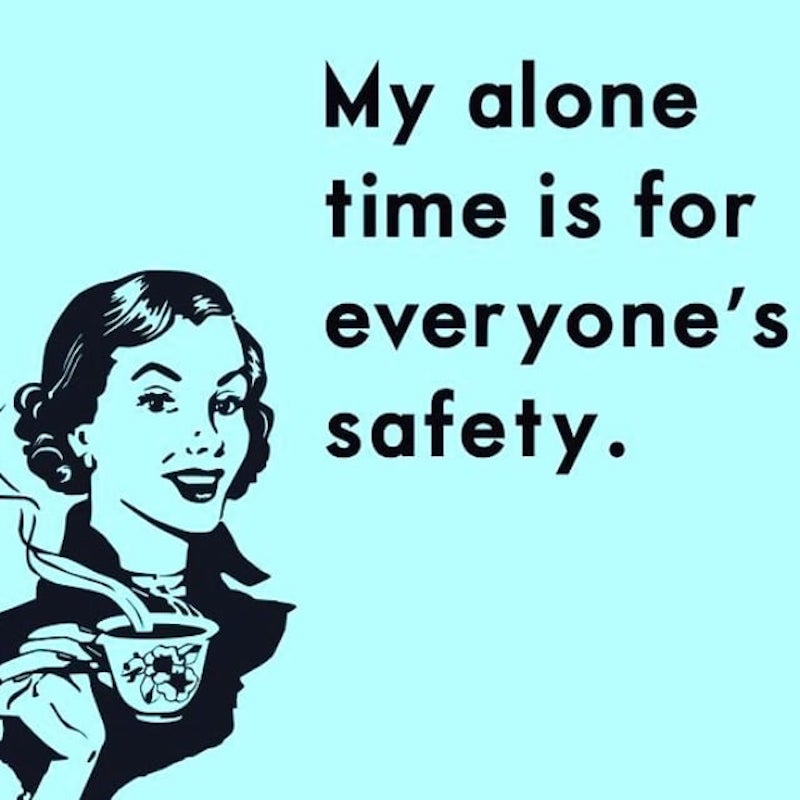
21. Just back away slowly and close the door.

alone time is for everyone's safety meme

You shut your bedroom door and breathe in the sweet, glorious relief of solitude. If you have kids, you might try to pass them off to your spouse for a little while — because let’s face it, the only cure for an introvert hangover is downtime. Alone in your room, free from everyone’s expectations, you’re finally in your most comfortable, natural habitat. This time to decompress isn’t just nice — it’s necessary. Seriously, it’s for everyone’s safety!

The True Story Of Thanksgiving

RUSH: Well, happy Thanksgiving, everybody. I hope it is as great as you want it to be, getting together with family, friends, hangers-on, people that got nothing to do trying to horn in on your action, whatever it is. Well, you know that happens. You get a call, “Hey, what are you doing for Thanksgiving?”

“Ah, got the family coming over. What are you doing?”

“Nothing.”

“Really? You want to come over with us?”

“Yeah! Yeah! I would love that.” Whatever happens, whatever’s going on with you, we hope it’s a great one. Do you realize next year will be the 400th anniversary of Thanksgiving? Four hundred years since the Pilgrims arrived without guaranteed reservations at Plymouth Rock.

Greetings, my friends. Welcome to the Thanksgiving edition of Rush Limbaugh program. We are going to do what we always do. We will recite to you the real story of Thanksgiving as first written about by me in my best-seller, See, I Told You So, Chapter 6: “Dead White Guys, or What the History Books Never Told You. The True Story of Thanksgiving.”

BREAK TRANSCRIPT

RUSH: Look at this, folks. I went to the computer during the break just to check and see if anything had happened, and I got a message. I got a message from the guy that used to mow my lawn when I lived in Kansas City. When I lived in that shack and worked for the Royals, I couldn’t pay anybody to mow the lawn, but I was able to get him Royals tickets. His name is Dan. So I got a message from Dan. He says, “I wish you could see this. Maria and I are driving out to Colorado Springs.”

They live in Kansas City still. They’re driving out to Colorado Springs for a wedding over Thanksgiving. “I’m in the backseat of the minivan because I’m rehabbing from a hip replacement. Anyway, five minutes ago, I hear this cheer. Maria cheers like the Chiefs have won the Super Bowl. But of course the Chiefs haven’t won the Super Bowl. No, it was because you are on live today. No guest host! Our minivan is cheering that you’re there. So bless you. Have a great Thanksgiving.”

BREAK TRANSCRIPT

RUSH: Happy Thanksgiving to one and all from all of us. And, of course, this begins the — here, anyway, the official beginning of the holiday season, which is a great time of year. But you know what suffers during the holiday season is normalcy. You’ve got less action happening than normally does, business is slowed down in a sense. I mean, sales pick up, hopefully. But conflicting times, but we hope it’s joyous for all of you, as joyous as it can be.

BREAK TRANSCRIPT

RUSH: We’re here on Thanksgiving eve as we start the holiday season. It’s an annual tradition. It’s actually not quite 30 years now we’ve been reading from my second book, See, I Told You So, Chapter 6: “Dead White Guys, or What the History Books Never Told You: The True Story of Thanksgiving.” I also have George Washington’s Thanksgiving Proclamation, the very first one, and also the truth of how the Indians screwed the Pilgrims out of Manhattan. Everybody thinks that we screwed the Indians and gave ’em a bunch of garbage for Manhattan.

It’s the other way around, actually — and it’s something I look forward to every year. And you know what? Despite doing it every year, with millions and millions and millions of people having heard it, there’s still a bunch of caca out there about Thanksgiving. I mentioned earlier that the College Fix website has a headline: “Students say it’s NOT okay to celebrate Thanksgiving,” that it’s “‘based off of the genocide of indigenous people.’”

What’s being done to young skulls full of mush via the education system in our country and cumulatively over decades is nothing less than obscene. Yesterday at the College Fix website, they posted a video where their correspondent, Kyle Hooten, interviewed students at Macalester College, St. Paul, Minnesota, and asked them about Thanksgiving, and here’s about 45 seconds of it…

WOMAN #1: I think that, like, Thanksgiving has been misconstrued a lot, especially in textbooks, and it’s kind of just based off of the genocide of indigenous people. And I don’t really any that we actually give thanks on Thanksgiving. We just eat a bunch of food and a bunch of capitalist bulls(bleep)t.

HOOTEN: Is it okay to celebrate Thanksgiving?

MAN #1: Nnnno. It’s probably not as bad as Christmas or Easter but, like, I don’t know.

HOOTEN: So what do you think the real Thanksgiving story is?

MAN #2: I don’t know what it is (snickers) ’cause I wasn’t there and ’cause I don’t have the — all the historical information.

WOMAN #2: I mean, the public school education — ugh! — tells you that this Thanksgiving was this great meeting where, you know, the Native Americans showed the Pilgrims how to, you know, grow corn — and obviously that’s not true. But what legitimately happened on Thanksgiving? I have no idea.

RUSH: If you have no idea, then what the hell was the answer, “Well, you know, what’s being taught is we gave thanks to the Indians gave thanks, the Indians teaching how to grow corn, maize, popcorn, and all that”? It is amazing when you stop and think about it. I don’t know what you were taught about Thanksgiving, but I was taught a version that goes like this: The Pilgrims showed up, and they were incompetents. They were well-intentioned good-hearted people but incompetent, and they didn’t know how to do anything. They were stumbling and bumbling around in a foreign place, had no idea even where they were.

And as they’re on the verge of starvation, the Indians stumbled upon ’em — across them — and showed them how to basically live, gave them everything, showed them how to grow crops and kill turkey and build tepees and stuff, and so the Pilgrims survived, and we were giving thanks, that Thanksgiving is to acknowledge the Indians’ role in saving the first Pilgrims. Now, it’s a quaint story, and it has attached itself to a number of people, but it is nothing to do…

Well, I can’t say that it’s nothing to do, but it is very far removed from what the first Thanksgiving is really about. Thanksgiving. George Washington first proclaimed it, Thanksgiving. Well, who was thanking who for what? That’s the root of the error. The root of it is that the Pilgrims must have been giving thanks to the Indians for saving them. That’s not what the Pilgrims were thankful for, as you will soon hear.

“The story of the Pilgrims begins in the early part of the seventeenth century (that’s the 1600s for those of you in Rio Linda, California). The Church of England under King James I was persecuting anyone and everyone who did not recognize its absolute civil and spiritual authority.” The first Pilgrims were Christian rebels, folks. “Those who challenged [King James’] ecclesiastical authority and those who believed strongly in freedom of worship were hunted down, imprisoned, and sometimes executed for their beliefs” in England in the 1600s.

“A group of separatists,” Christians who didn’t want to buy into the Church of England or live under the rule of King James, “first fled to Holland and established a community” of themselves there. “After eleven years, about forty of them” having heard about this New World Christopher Columbus had discovered, decided to go. Forty of them “agreed to make a perilous journey to the New World, where [they knew] they would certainly face hardships, but” the reason they did it was so they “could live and worship God according to the dictates of their own consciences” and beliefs.

“On August 1, 1620, the Mayflower set sail. It carried a total of 102 passengers, including forty Pilgrims,” now known as Pilgrims, “led by William Bradford. On the journey, Bradford set up an agreement, a contract, that established” how they would live once they got there. The contract set forth “just and equal laws for all members of the new community, irrespective of their religious beliefs,” or political beliefs. “Where did the revolutionary ideas expressed in the Mayflower Compact come from? From the Bible.

The Pilgrims were a “devoutly religious people completely steeped in the lessons of the Old and New Testaments. They looked to the ancient Israelites for their example. And, because of the biblical precedents set forth in Scripture, they never doubted that their experiment would work.” They believed in God. They believed they were in the hands of God. As you know, “this was no pleasure cruise, friends. The journey” to the New World on the tiny, by today’s standards, sailing ship. It was long, it was arduous.

There was sickness, there was seasickness, it was wet. It was the opposite of anything you think of today as a cruise today on the open ocean. When they “landed in New England in November, they found, according to Bradford’s detailed journal, a cold, barren, desolate wilderness. There were no friends to greet them, he wrote. There were no houses to shelter them. There were no inns where they could refresh themselves.” There was nothing.

“[T]he sacrifice they had made for freedom was just beginning. During the first winter, half the Pilgrims — including Bradford’s own wife — died of either starvation, sickness or exposure.” They endured that first winter. “When spring finally came,” they had, by that time, met the indigenous people, the Indians, and indeed the “Indians taught the settlers how to plant corn, fish for cod and skin beavers” and other animals “for coats.” But there wasn’t any prosperity. “[T]hey did not yet prosper!” They were still dependent. They were still confused. They were still in a new place, essentially alone among likeminded people.

“This is important to understand because this is where modern American history lessons often end. Thanksgiving is actually explained in some textbooks as a holiday for which the Pilgrims gave thanks to the Indians for saving their lives, rather than what it really was. That happened, don’t misunderstand. That all happened, but that’s not — according to William Bradford’s journal — what they ultimately gave thanks for. “Here is the part that has been omitted: The original contract” that they made on the Mayflower as they were traveling to the New World…

They actually had to enter into that contract “with their merchant-sponsors in London,” because they had no money on their own. The needed sponsor. They found merchants in London to sponsor them. The merchants in London were making an investment, and as such, the Pilgrims agreed that “everything they produced to go into a common store,” or bank, common account, “and each member of the community was entitled to one common share” in this bank. Out of this, the merchants would be repaid until they were paid off.

“All of the land they cleared and the houses they built belong to the community as well.” Everything belonged to everybody and everybody had one share in it. They were going to distribute it equally.” That was considered to be the epitome of fairness, sharing the hardship burdens and everything like that. “Nobody owned anything. It was a commune, folks. It was the forerunner to the communes we saw in the ’60s and ’70s out in California,” and other parts of the country, “and it was complete with organic vegetables, by the way.

“Bradford, who had become the new governor of the colony, recognized that” it wasn’t working. It “was as costly and destructive…” His own journals chronicle the reasons it didn’t work. “Bradford assigned a plot of land” to fix this “to each family to work and manage,” as their own. He got rid of the whole commune structure and “assigned a plot of land to each family to work and manage,” and whatever they made, however much they made, was theirs. They could sell it, they could share it, they could keep it, whatever they wanted to do.

What really happened is they “turned loose” the power of a free market after enduring months and months of hardship — first on the Mayflower and then getting settled and then the failure of the common account from which everybody got the same share. There was no incentive for anybody to do anything. And as is human nature, some of the Pilgrims were a bunch of lazy twerps, and others busted their rear ends. But it didn’t matter because even the people that weren’t very industrious got the same as everyone else. Bradford wrote about how this just wasn’t working.

“What Bradford and his community found,” and I’m going to use basically his own words, “was that the most creative and industrious people had no incentive to work any harder than anyone else… [W]hile most of the rest of the world has been experimenting with socialism for well over a hundred years — trying to refine it, perfect it, and re-invent it — the Pilgrims decided early on,” William Bradford decided, “to scrap it permanently,” because it brought out the worst in human nature, it emphasized laziness, it created resentment.

Because in every group of people you’ve got your self-starters you’ve got your hard workers and your industrious people, and you’ve got your lazy twerps and so forth, and there was no difference at the end of the day. The resentment sprang up on both sides. So Bradford wrote about this. “‘For this community [so far as it was] was found to breed much confusion and discontent, and retard much employment that would have been to their benefit and comfort.

“For young men that were most able and fit for labor and service did repine that they should spend their time and strength to work for other men’s wives and children without any recompense,’” without any payment, “‘that was thought injustice.’ Why should you work for other people when you can’t work for yourself? What’s the point? … The Pilgrims found that people could not be expected to do their best work without incentive.

“So what did Bradford’s community try next? They unharnessed the power of good old free enterprise by invoking the undergirding capitalistic principle of private property. Every family was assigned its own plot of land to work and permitted to market its own crops and products. And what was the result? ‘This had very good success,’ wrote Bradford, ‘for it made all hands [everybody] industrious, so as much more corn was planted than otherwise would have been.’ …

“Is it possible that supply-side economics could have existed before the 1980s. … In no time, the Pilgrims found they had more food than they could eat themselves. Now, this is where it gets really good, folks, if you’re laboring under the misconception that I was, as I was taught in school. So they set up trading posts and exchanged goods with the Indians. The profits allowed them to pay off their debts to the merchants in London.

“And the success and prosperity of the Plymouth settlement attracted more Europeans and began what came to be known as the ‘Great Puritan Migration.’” The word of the success of the free enterprise Plymouth Colony spread like wildfire and that began the great migration. Everybody wanted a part of it. There was no mass slaughtering of the Indians. There was no wiping out of the indigenous people, and eventually — in William Bradford’s own journal — unleashing the industriousness of all hands ended up producing more than they could ever need themselves.

So trading post began selling and exchanging things with the Indians — and the Indians, by the way, were very helpful. Puritan kids had relationships with the children of the Native Americans that they found. This killing the indigenous people stuff, they’re talking about much, much, much, much later. It has nothing to do with the first thanksgiving.

The first Thanksgiving was William Bradford and Plymouth Colony thanking God for their blessings. That’s the first Thanksgiving. Nothing wrong with being grateful to the Indians; don’t misunderstand. But the true meaning of Thanksgiving — and this is what George Washington recognized in his first Thanksgiving proclamation.

BREAK TRANSCRIPT

RUSH: Thank you for being with us today, folks. Have a great rest of the Thanksgiving weekend. And know without doubt how truly thankful for you I personally am and all of us are. Never forget it. Can’t say it enough that we love you. See you back here on Monday. We will be here.

story

How do you celebrate holidays?

How do you celebrate holidays?

I avoid them as much as possible.

I hate my birthday because the only real birthday happened a long time ago.

Christmas starts in September now and I’m fatigued by the time it comes. I don’t think most people believe in the real reason for Christmas anyway. They just want to decorate and get gifts. I question their sincerity when they are all nice in the season, yet give me the finger while driving.

As usual, because I’m an introvert, I have a hard time processing the attention and wish that it would just be over.

One Of The Things I Hate About Christmas

There is a long list of commercialized things overdone about it, but here is another.

I’m down to gift bags now as I can’t be bothered.

As an Introvert, there is too much going on for too long. By the time Christmas finally comes, my social battery is negative. I hate all the attention about something people don’t care about the rest of the year, including the people they buy presents for.

I see it is corrupting why we really celebrate Christmas, but it’s been ruined for me for life.

It’s already started, too early again. The stores were full of Christmas before Halloween.

On top of being an introvert nightmare for too much attention for the wrong reasons and this makes it a tough season for me.

I see these unhappy people for 11 months and then they pretend that everything is great. I know who they are the rest of the year and don’t believe their lies.

Going Out Or Staying In – The Introvert Dilemma

I was reading a few years back and saw this gem. It was around Christmas time of year and I was fatiguing from the festivities.

For me, that is one of the worst times of the year. The fake happy from people who’s true nature I know is difficult to take. I see it anywhere I go

As I thought about it, I realized that it is so true. It’s really why I don’t go to many social events, especially Christmas parties.

I got tired of pretending to be social and/or having a good time, all they while wishing I could leave. Hell, I usually plan leaving before I go.

Most socials are like fakebook posts. Tell as much as you can about yourself to get likes.

Conversation should be about asking others about them and what is important that they would like to talk about. What I watch is people waiting for a response so that they can talk again. I don’t even try and a lot of time. I’ll just see how long people will talk about themselves and see if I can not say anything. They rarely notice. I won’t offer any information unless I think someone truly cares, but that’s only if I had to go and I’ve already got my exit plan in place.

Happy VD

Since it is a fake holiday made up by the companies to sell you stuff and make single people feel bad, I don’t give this a check mark as a real holiday worth celebrating.

It also is amateur day that gets people out on the road/town to do stuff that costs more on this day only. It’s also like New Years Eve when a lot of people get drunk that aren’t prepared for it and do stupid stuff like drive. The difference is that on VD, they get drunk and have kids they weren’t planning.

I thought it was stupid in school when we had to get a pack of cards for every kid in the class. I never knew if I got one from everyone because I didn’t care enough to check. I wasn’t insecure like the kids that took offense if they didn’t get one from everybody. Today, they are Karen’s.

I never like it when you are held hostage to do something (like all of the Christmas holidays) instead of one that you voluntarily do, like this holiday. It’s far more fun for guys and seems a lot more sincere.

Anyway, here’s my lack of effort to celebrate a fake day.

Thanks Phil for this one.

Things To Do This Thanksgiving, Introvert Advice

While I’m being sarcastic, if your family and friends bug you and you want some quiet holidays, this will help your Christmas be less stressful. Nothing gets to me as an Introvert like holidays and fake feelings, fake fun and people. Anytime I can tone it down, I will. It’s much easier to take that way. Why do people have to act different just because they are told to?

Pick either side, you don’t even have to believe in it. Pick Biden or Trump and say how bad or good they are. Don’t worry, you will piss someone off either way. Use woke subjects like BLM or LGBT2+WXYZ or whatever it is now and take sides (see what I did there? Some woke person just got mad).

I hate the false build up that comes with the holidays. They’ve expanded it to before Thanksgiving now. I went shopping today and the Christmas stuff is already out. SMH.

Happy Chanukah, The Story

I am not Jewish except through the grafting of the family of Japheth into Shem (Gen 9:18  And the sons of Noah, that went forth of the ark, were Shem, and Ham, and Japheth: and Ham is the father of Canaan.
Gen 9:19  These are the three sons of Noah: and of them was the whole earth overspread.)

I still believe that the Jews are God’s chosen people to deliver the Messiah, so any anti-Semitic comments will not be allowed on this post.

This is the story of Chanukah anyway, so i looked it up on a Jewish website and here is what I found:  There is more at the link if you wish to explore for yourself.  If you wish to add more meaning or correct any accuracies, I gladly will accept them.

Chanukah, which begins on the 25th day of the month of Kislev and lasts eight days, is known mainly for the ritual of lighting the Menorah, an eight branched candelabra. Before we discuss this and other rituals and observances associated with Chanukah, a little historical background about Chanukah is in order.

Chanukah, unlike the other Rabbinically ordained observances (Purim, the Four Fasts), is not mentioned explicitly at all in Scripture. Even in the Talmud, there is little discussion about Chanukah. The Gemora in the tractate of Shabbos (21b) writes: “What is (the reason for) Chanukah? For our Rabbis have taught ‘On the 25th of Kislev, the days of Chanukah, which are eight (start), on which eulogies and fasting are not permitted.’ – For when the Greeks entered the sanctuary of the Temple, they made all of the oil there ritually impure (and therefore unfit for use in the Temple). When the Hashmonean dynasty gained the upper hand and defeated them, they searched and found only one flask of oil on which the seal of the High Priest remained (which indicated it was not defiled). There was only enough in this flask to light (the Menorah in the Temple) for one day. A miracle occurred and they were able to light (the Menorah) with it for eight days. The next year, they established and made (these days) a holiday, with Hallel (praises of G-d) and expressions of thanks (to G-d).”

There are many commentators who elaborate on the Gemora. One of these is the Aruch HaShulchan. His words, which follow, add to the very general description that the Gemora offers. There are more detailed historical works which deal with the background of Chanukah. However, the general description of the Aruch HaShulchan is a good starting place for the discussion of Chanukah which will follow in later issues.

The Aruch HaShulchan (Orech Chayim 670) writes that: At the time of the Second Temple, during the reign of the wicked kings known as Antiochus, decrees were issued on the nation of Israel. These decrees had the effect of anulling the practice of the holy Jewish religion. The Jews were not permitted to study Torah or perform Mitzvos. The money of the Jews was confiscated, and the Jewish daughters were snatched. They went into the Temple where they performed improper acts and defiled the ritually pure. They pained the nation of Israel and pressured them immensely until the point where Hashem, the G-d of their forefathers, had mercy on them and saved them from the evil hands that were persecuting them. Hashem saved them through the hands of the holy and pure Hasmoneans, who were high priests, with Mattisyahu and his sons, who fought with Antiochus. The victory occurred in a way that went against the laws of nature, as the Hashmoneans, with their righteous troops, were very small in number, while Antiochus fell upon them with a great number of people, with many elephants, and with horsemen and chariots. However, Hashem favored His nation of Israel and therefore let the strong fall into the hands of the weak, the wicked into the hands of the righteous, the impure into the hands of the pure. Furthermore, those traitors from the nation of Israel who sided with Antiochus fell into the hands of those who studied Torah. Then, the name of G-d was elevated and sanctified in the world, and the light of Torah with its purity shined, and the name of the nation of Israel reached a level of great stature amongst the nations of the world .

This miracle came to a completion on the 25th day of Kislev. There was, however, another miracle. When the nation of Israel entered the Temple to purify it, all of the people were ritually impure because they came into contact with the dead during the course of the battles. A person who is impure because of contact with the dead can only become pure through a process which takes seven days. It was only after these seven days that people were able to obtain a supply of pure oil. Furthermore, it took 8 days to make the round-trip needed to obtain pure oil. Only one flask of pure oil, which still bore the unbroken seal of the High Priest, was found in the Temple. Hashem performed a miracle, and this flask of oil which should only have lasted for one day was able to be used to light the Menorah in the Temple for eight days, until which time no additional pure oil was available. We therefore have eight days on which we praise and give thanks to Hashem.

I wish to all my Jewish friends and those grafted in a Happy Chanukah.