My Uncle’s Contribution To WWII – A B-29 Pilot

I recently posted a WordPress question asking whether I was patriotic. Unferth commented that I should write about my Uncle and my Father’s experience.

Before he died, my Uncle sent this document. It’s long, so I’m going to break it over a couple of days so it is readable.

He went from high school to commanding a bomber fleet over Tokyo on the last mission of WWII.

Enjoy

THE WORLD WAR II EXPERIENCES OF JOSEPH A. SIMONDS.
649 Balmoral Road, Winter Park, FL 32789
Serial Number O-799083

Written August 3, 1992. The following was written for no specific purpose. I just thought I might set down a few dates and experiences for my own personal benefit. If the reader enjoys perusing this effort, the writer will be happy. Probably the two most significant events are 1) being on the initial flight into the Pinecastle Army Air Field in 1943, which is now called Orlando International Airport, and 2) flying the very last mission of World War II, dropping the last bombs on Japan.

I was born on January 14, 1923 in the General Hospital in Orlando, Florida. I graduated from the only high school in town, Orlando Senior High School, on Friday, June 6, 1941. I was 18 years old at the time. I enrolled as a freshman at the University of Florida the following September. While in High School, I had taken a couple of rides in an airplane. My first time aloft was in the back seat of a barnstorming Howard airplane from the Orlando Municipal airport. I don’t know in what year that occurred, but it was during the depression years. I enjoyed the flying experience, but I never thought I would ever go up in an airplane again. However, in High School, I joined a fraternity named Omega Xi (a very socially select small group), and one of the members, Mac Nangle, was a pilot. His father owned a side-by-side two-place Taylorcraft, which he kept on a private airport in his orange grove in western Orange County. Mac took me up two or three times. I’m not sure Mac had a pilot’s certificate, but he knew how to fly and had access to an airplane. Sadly, Mac was later killed during the war in an Army basic training aircraft in Oklahoma.

During this era, the people of the United States were about equally divided on the issue of World War II, which was going on in Europe. It had started in September of 1939 when Germany invaded Poland and conquered all of Europe except England. It had been underway for two years when I graduated from high school. In this country, I was among those who favored Isolationism, for I did not believe the U S should again fight in a European war.

On Sunday, December 7, 1941, the Japanese suddenly and secretly bombed Pearl Harbor. The entire world was shocked by this dastardly attack. The United States was thereby thrust into World War II. The exact moment I heard the news I was in a football uniform on the P.K. Younge School grounds in Gainesville, Florida, practicing for the annual football game between my Phi Delta Theta fraternity and the Sigma Nus. It was in the Phi Delta Theta fraternity house living room that I heard Franklin D. Roosevelt’s “Day of Infamy” speech the following day.

In early January 1942 I finished my first semester at the University of Florida and withdrew from school to join the military service. I only considered the Army Air Corps…never gave the Navy a thought.

March 30, 1942 I became an Aviation Cadet in the U.S. Army Air Corps. I was sworn in as a Private at the Orlando Air Base on March 30, 1942 with Serial Number 14052578. I was classified as “Private Unassigned” and sent to my home address in Orlando to await further orders. The pay of a Private was $21.00 per month.

On June 1st, I received a telegram ordering me to “active duty” and telling me to report to U.S. Army Camp Blanding, Starke, Florida on June 13, 1942. While there for only a day or two, we slept in square, eight-man canvas tents, sans uniforms.

June 15, 1942 I was appointed an Aviation Cadet and transferred to the Air Force Cadet Classification Center at Maxwell Field, Montgomery, Alabama. I rode in a private car owned and driven by Ralph L. Smathers of Orlando, from Camp Blanding to Maxwell Field with John Stonecipher, Jack Lee, and two other Orlando boys who were also newly appointed Aviation Cadets. At Maxwell Field, I was issued my Aviation Cadet uniforms and insignia. Also, there I took various tests to determine if I was to become a pilot, a navigator, or a bombardier. On June 26, 1942 I was classified as a pilot trainee, assigned to Class 43-C, and issued orders to report to the AAF Pre-Flight (Pilot) Training Center at Maxwell Field on July 10, 1942. Because we had a few days of freedom, we all climbed in Ralph Smather’s car and drove to Orlando to show off our new uniforms. Margaret’s mother was very impressed with the quality of my military uniform. I recall sitting on her front porch at 520 Anderson Street in Orlando as she examined my hat very carefully. She had, of course, already lost a son in the war when her middle child Joe Baker’s ship was sunk by a German submarine on May 25, 1942 in the Gulf of Mexico. He was probably Orlando’s first fatality of World War II. We drove back to Maxwell Field to report for duty on July 10, 1942. I spent approximately two months in Pre-Flight training at that base.

On September 9, 1942 after completing the Pre-Flight training I, along with about 180 other Cadets, was issued orders to report to The Civilian Elementary Flying School AAFTD, Southern Aviation School, Camden, South Carolina. I reported there on September 13, 1942. The “troop train” ride from Montgomery, Alabama, through Atlanta, Georgia to Camden, South Carolina was my first experience riding on a troop train. There were many such adventurous train rides to follow. When we arrived in Camden, South Carolina, about ten in the morning, we got off the train and looked up at the sky to find it filled with many, many PT -17 training airplanes. And we noted that many airplanes had differently colored lower wings on opposite sides of the airplane. Some were blue, some were yellow, and some were silver. Some airplanes had both wings the same color, but many did not. Before we left Camde,n we learned that the P T -17 has a “ground looping” characteristic which frequently caused the lower wing to be damaged, and therefore changed. It was obvious that the mechanics simply installed any new lower wing they had in inventory, no matter what the color.

On September 15, 1942 I took my first: 32 minute flying instructions in an Army airplane with my instructor Frank W. Poe 3rd (certificate number C-93789). The airplane was a primary trainer Stearmen PT-17. Woodruf Field at Camden, S.C. was a grass airport with no pavement at all. I loved it.

On October 2, 1942 I soloed in that airplane after having received 9:27 hours of dual instruction. My solo flight was from an auxiliary field located north of the main Camden airport, and lasted 20 minutes with several landings. On my first solo landing, I dragged the lower left wing along the ground, but the airplane went straight, and I avoided that dreaded “ground loop” for which this airplane was noted. I taxied to the side of the airport to a buildin,g and a mechanic came out to examine my airplane. I kept the engine running while he shook the lower wing up and down once or twice, then indicated to me that it was O.K. and I taxied out for some more landing practice. I flew 60:00 hours in this airplane at Camden, S.C., before I finished the course and was transferred from a Primary Flight school to a Basic Flight school.

I, along with approximately 140 other Cadets who had not yet “washed out,”, was transferred on November 16, 1942 to the AAF Basic Flying School, Cochran Field, Macon, Georgia. There, I flew the Vultee BT-13 basic trainer airplane for approximately 70:15 hours. I did my first night solo work here. My brother John, who was also in the Army based at Camp Blanding, Florida, somehow managed to visit me briefly while I was based at Cochran Field. This was the first Christmas I spent away from home, and I hardly left my barracks room on Christmas Day because there was no military activity, and I was a very blue aviation cadet.

On January 26, 1943 I was transferred to the United States Army Advanced Flying School at Turner Field, Albany, Georgia. While there, I flew Beechcraft AT-10 and Curtiss Wright AT-9 advanced twin-engine trainer-type airplanes.

On March 25, 1943 I graduated from the U.S. Army flying school at Turner Field, Albany, Georgia in Class 43-C with a grand total of 272 hours flying time. On that date, I was discharged from my assignment as an Aviation Cadet, Serial Number 14052578, and appointed a Second Lieutenant in the Army of the United States with a new Officer’s Serial Number O-799083.

My first Active Duty assignment was to report to the Army Air Force School of Applied Tactics, Bomb Department in my hometown of Orlando, Florida on March 27th 1943. Mother, Dad, and my sister Mary (who had ridden the train to attend my graduation) were delighted, as was I. I reported there and was assigned to the 5th Bomb Squadron, 9th Bomb Group Heavy, located on the Signal Hill portion of the Orlando Air Base. I was assigned to fly as co-pilot on four-engine B-24 bomber airplanes. Soon thereafter, on April 15, 1943 our entire Squadron was transferred from the Orlando Air Base to the new Pinecastle Army Air Field, at Pinecastle, Florida. That was the first day any airplanes ever landed at Pinecastle airfield. The first airplane to land was piloted by our Squadron Commanding Officer, Major Role E. Stone. I flew a little Piper L-4 “Grasshopper” Liaison observation airplane solo between the two airports. The air base was later renamed McCoy Air Force Base and later became the Orlando International Airport.

to be continued….

Different Headlines: Golf Cart Babes, How Much Do They Make?; What do Bored Flight Attendents Ask for?; Dumbass Crook Robs Store On Shop with a Cop day; The War on White Men Is Real….and more

Golf Cart Babes

Phoenix Beverage Cart Girl Hits The Course On A Sunday. Then She Shares How Much She Takes Home In Tips: ‘I’m A Hustler Too’

Flight Attendendents Who are Bored

​​Chicago Flight Attendant Has PSA For Passengers Who Take Long Flights. She Says Other Flight Attendants Will Want To Put Her On A ‘No-Fly’ List For It: ‘I Have To Speak My Truth’ – It sounds like she is one of the few that has a brain and wants to actually do something. Most are robots who just want your order to be behind them as they hate their job serving cokes in the air, like a waitress, then a janitor.

Education

Metropolitan State U. of Denver Rejects Standard American English in the Name of ‘Anti-Racism’ – They don’t even realize they are the racists. The rest of us just want to be left alone and treated like humans. So do the students have to ax a question bruh? No wonder the kids are stupid with having this to deal with. Go to a real school that teaches you how to prepare for life.

Crime

Chronic Crook Picked Single Worst Day of Entire Year to Rob Store, Gets Classic Christmas Comeuppance – what a dumbass, who raised this person to be like this?

U.S. Murder Rate Experiences Largest Drop on Record — Nearly 20 Percent Decline in Last Year – get rid of the illegals that Biden let in and good things happen.

A sticky situation

Post-Christmas Disaster: How 26 Million Pounds of Molasses Killed or Injured 170 in the Streets of Boston in 1919 – how long were they cleaning this up?

Why America is not a Muslim Shithole

JD Vance “Always a Christian Nation” Christian Language in America’s Founding Documents

FAFO

DEVELOPING: ICE Agents in Maryland Open Fire on Driver Who Attempts to Run Them Over – They shot him

Racism

The War on White Men Is Real—Here’s the Proof – everyone hates number one and tries to take him down. Man up and don’t take this PC crap. Be the real man that made this country great. Don’t listen to the SJW BS saying we did anything but build the greatest country and help the most people around the world.

I just read that Europe will look up at the moon and know they’ve never been there and will never go, unless it is on an American spaceship.

Artificial Intelligence

Woman Suffers “AI Psychosis” From Obsessively Generating AI Images of Herself – figures it would be a liberal white woman. It’s our biggest problem right now

Order up 72 more Virgins, Israel Got another Quds Leader

Cars

2016 Lamborghini Aventador Pirelli Edition

6.5L/691 HP V-12, Automatic, 1 of 88 Produced

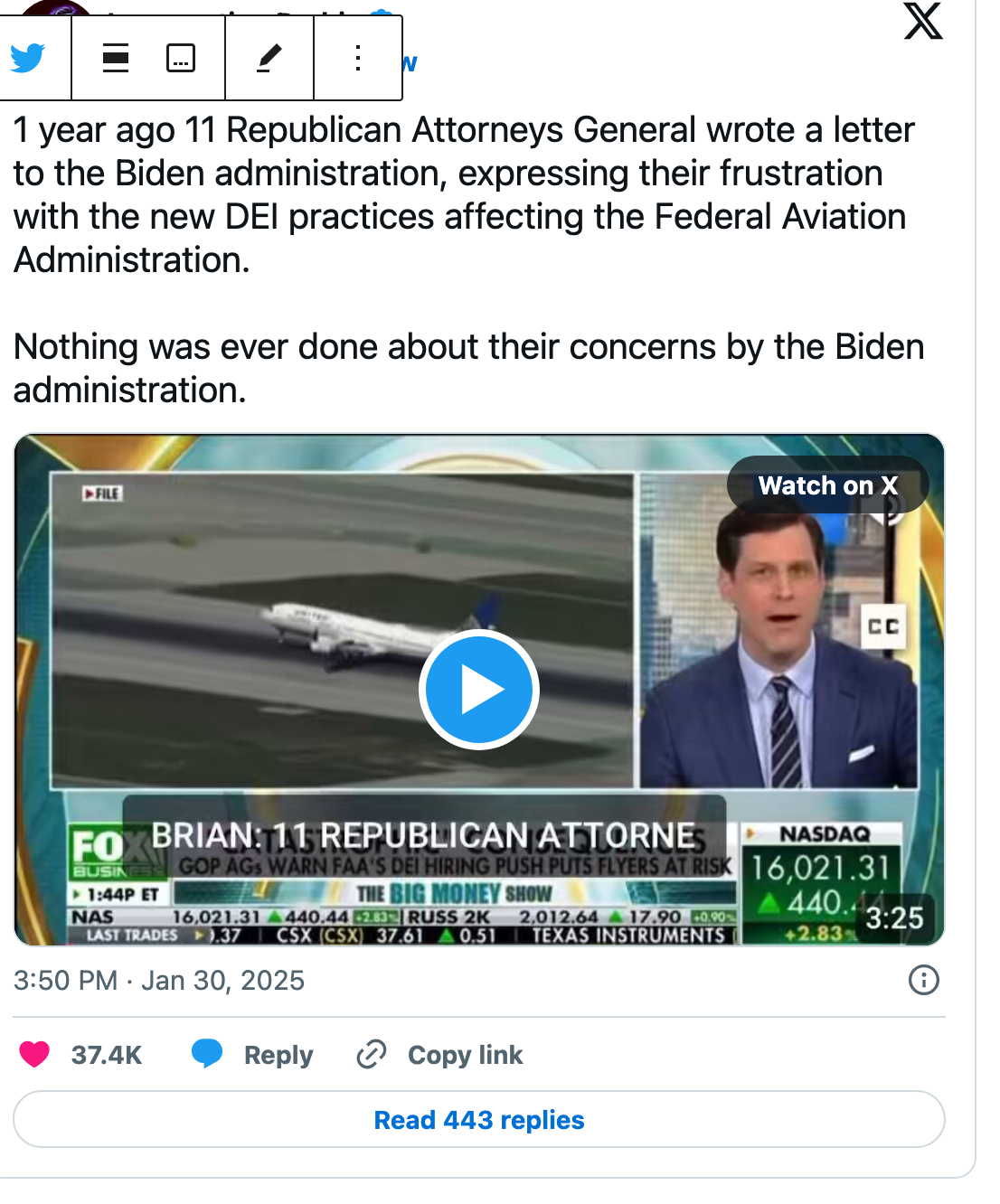
It’s Not Like They Didn’t Try To Fix The FAA In Washington…..A Year Ago

And it started with Obama in 2010, hire the unqualified

Aircraft mechanic shortage reaches ‘critical’ point

I don’t even want to get on an airplane right now. Between DEI in the Air Traffic Control and woke pilots, not to mention sudden deaths from the Covid Jab the pilots were forced to take, it’s a gamble now to fly.

A new report from AAR Corp., a company that provides aviation services to commercial and government operators, MROs, and OEMs, warns that the aircraft mechanic shortage has reached a critical point.

The company’s 2023 Mid Skills Gap report urges employers to “break down silos” and collaborate with high schools, colleges, non-profit organzations, and elected officials to expand early access to aviation maintenance curriculum and training.

“Mid skills” describes careers that require industry certifications but not a college degree, including aviation mechanics, according to officials with AAR, which has been putting together the report since 2011.

The 2023 report includes several suggestions to increase the number of aviation mechanics, including:

  • Work with lawmakers and state agencies, nonprofits and educators to launch a national campaign to raise awareness of aviation careers.
  • Encourage training programs to teach people with industry experience how to instruct others to build the faculty population.
  • Ask lawmakers to pass common sense immigration policies that allow aviation companies to recruit talent from abroad to meet demand and keep airplanes flying safely.
  • Make it easier for veterans to quickly transition their skills to appropriate industry jobs.
  • Push to eliminate restrictions on AMTs taking the FAA general exam as pilots can do with their written exams. Getting these exams completed early will lead to increased certifications for the industry, officials noted.
  • Increase training capacity by creating programs to make experienced retirees instructors in education programs.

story

A Place That Is DEI Free

I wish the rest of Air Travel and the military were also

Why You Should Think Twice About Flying First Class

I dated a flight attendant who survived the Dallas Crash where they discovered wind sheer. She made it when only about 30 of 300 survived. She was at the back of the plane. I read that you have a better chance of surviving statistically in the back of a crashing plane.

I’d just rather not crash.

I’m exercising my Covid excuse not to go somewhere right now by just not flying.

Things Airline Pilots Won’t Tell You

A collection of stories written by pilots
I’m an airline pilot flying domestically under the banner of a major airline.  Most people are unaware of how much of their flying is done by a “regional” airline.  Regional airlines today fly a huge percentage of the actual seat miles flown for their Major airline partner (Delta, United, US Air, etc.).  However we are paid a fraction of what the major airline pilots are paid, and even these major airline pilots are paid significantly less than their counterparts several years ago.
Many regional airline first officers make the same as your friendly pizza delivery driver.  (It is typical for most of them to make no more than 16K/year the first year.)Here are a few things we won’t tell you:-Don’t drink the coffee.  The potable water the aircraft is serviced with is absolutely disgusting.  Chemicals are inserted into the water tanks to prevent bad things from growing, but the bad taste of the coffee isn’t the coffee–its the chemicals…

-We don’t know where we are most of the time…  (kidding for the most part)  In all actuality there are much more sophisticated avionics units on most small general aviation aircraft.  Those units display many aspects of geographic awareness where most of ours simply display the route that we programmed in the flight management computer before departure.  We can tell you how far away we are from the next navigation facility and where we are in general terms, but aside from that and what we can see out the window, we typically only have a general idea of where we are when at cruise altitude.  Of course we all carry maps, but not too many of us will open the map and follow our progress on a 3 hour flight.  (That all changes as we begin descending toward the airport.  Situational Awareness is extremely important then.)

-We forget about the fasten seatbelt sign all the time.  When you look up at the sign (and disregard it typically) and it has been illuminated for the last 45 minutes in smooth air, we simply forgot.  Lots of guys will leave it on all the time.  However, sometimes we do have reports of choppy air ahead and will leave it on until we either experience it or take a wild guess that the air ahead will be smooth.

Some of us carry guns.  This is certainly public knowledge, but Federal Flight Deck Officers can carry a firearm in the cockpit.  Lots of protocol exists to ensure that the training, concealment, and utilization is standardized.

They never announce, “That was close !!” As in, a near mid-air encounter with other air traffic.Only from personal experience and asking the pilot as I disembarked from the aircraft, can I relate this story.Landing at Newark airport in 1986, I was sitting in a window seat about mid section, left side of the plane. I was looking out of the window for a good view of NYC. After seeing that, I was watching the area around the airport as we came in to land. We were about 300′ altitude, or less, and all of a sudden I was stunned to see another plane taking off. It was very close as it took off, nearly underneath our plane as it was climbing out. I don’t know how close we were, just that I could see the passengers in the windows of the other plane close enough to see if they were male or female. My view only lasted about 5 seconds, but I thought they were my last! When I got to the front of the plane and the pilot was standing there I said, “That was close…?” He said, “No, not really.” Very calmly.

I wonder how often that happens, and I bet they NEVER tell the passengers that piece of news!

Most pilots won’t tell you that “air traffic control delays” aren’t really ATC’s “fault”; these delays would be better termed “overscheduling delays”.The vast majority of what the airlines and system term “ATC delays” are actually from a pretty simple supply-and-demand situation.  There’s too many airplanes (demand) trying to land in a limited number of arrival slots (supply) at a given airport over a given time period.Airports have what are known as “arrival rates”.  A standard, one-runway airport with well-designed taxiways (including “high speed” taxiways) can safely handle, in good weather, around 60 operations an hour- one per minute.

This can be 60 landings in an hour, or 60 takeoffs in an hour, or 30 of each, or whatever combination you want to come up with, but that’s about the limit.

(This is a bit of an oversimplification with really good design, you can usually depart faster than arrive, but bear with me for now.)

So say you’ve got this airport, and say it’s got more than enough gates for all the airlines and planes that want to use it.  The only limiting factor is that 60/hour number, right?

Yeah- until crappy weather shows up.  Now they can only land 30 planes per hour.

Unfortunately, the ATC system- run by the FAA- does not regulate how many flights can be scheduled into an airport.  (That’s what deregulation gave us.)  So the airlines that operate in there all schedule as many as they think they can get passengers for.

So during this hour, the airlines have scheduled 60 arrivals, but only 30 planes can land because it’s a cloudy, rainy day.

What happens to the other 30 flights?  They get delayed.

And who delays them?  ATC.

And what do the airlines call these delays?  “Supply and demand delays”?  “Weather delays?”  Nope.

“ATC delays.”

But the reality is that they’re overscheduling delays.  If the airlines and/or the airports would limit the number of flights to the BAD weather limits, the number of delays in the system would be massively shrunk.

That the Airbus A320 is known to have routine cockpit power outtages.  And that this plane that you are on right now, which is among the most popular in the world, might not be fixed!

Such as United Flight 731 which “had no way to communicate with air traffic controllers or detect other planes around them in the New York City area’s crowded airspace.” [1]That “France-based Airbus told NTSB investigators in 2008 that 49 electrical failures similar to the Newark emergency happened on its planes in the U.S. and abroad before that episode. Nearly half involved the loss of at least five of six cockpit displays.” [1]And…that a mere 46 hours and $6,000 is the only thing holding back every single plane in the air from this crucial upgrade due to “economics”

The Airbus A320 family includes the A318, A319, A320 and A321 models — passenger jets with 100 to 220 seats.

And you wonder why I take trains and boats????

Note: these came from other people and I don’t guarantee 100% accuracy