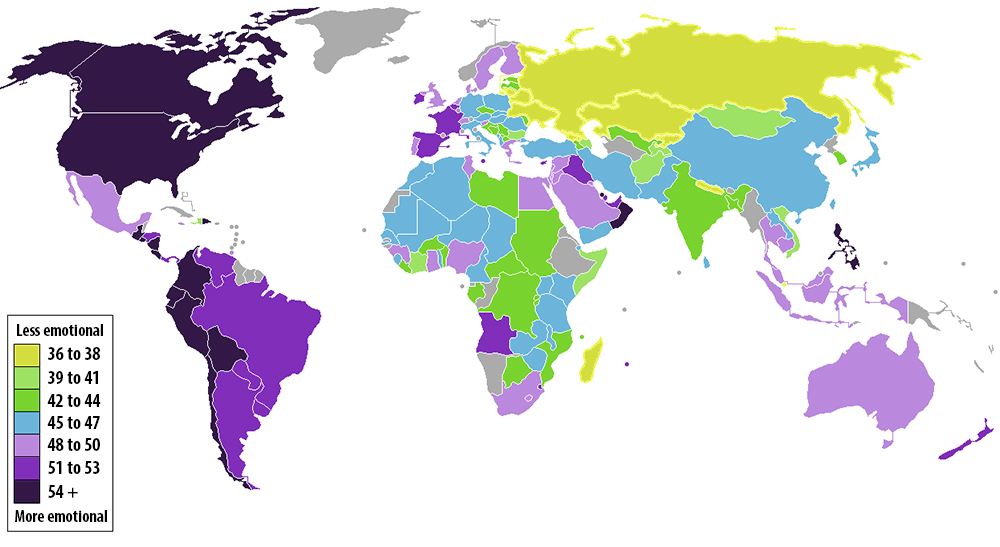
 This is not my data, rather a Bloomberg study. What I can’t figure out is how the US is so emotional except for the political discord recently (the article below says they are happy). I much more expected it from the Latin countries.
According to Bloomberg, the source of this map, here are the real reasons:
Singapore is the least emotional country in the world. ”Singaporeans recognize they have a problem,” Bloomberg Businessweek writes of the country’s “emotional deficit,” citing a culture in which schools “discourage students from thinking of themselves as individuals.” They also point to low work satisfaction, competitiveness, and the urban experience: “Staying emotionally neutral could be a way of coping with the stress of urban life in a place where 82 percent of the population lives in government-built housing.”
The Philippines is the world’s most emotional country. It’s not even close; the heavily Catholic, Southeast Asian nation, a former colony of Spain and the U.S., scores well above second-ranked El Salvador.
Post-Soviet countries are consistently among the most stoic. Other than Singapore (and, for some reason, Madagascar and Nepal), the least emotional countries in the world are all former members of the Soviet Union. They are also the greatest consumers of cigarettes and alcohol. This could be what you call and chicken-or-egg problem: if the two trends are related, which one came first? Europe appears almost like a gradient here, with emotions increasing as you move West. (their emotions are sedated)
People in the Americas are just exuberant. Every nation on the North and South American continents ranked highly on the survey. Americans and Canadians are both among the 15 most emotional countries in the world, as well as ten Latin countries. The only non-American countries in the top 15, other than the Philippines, are the Arab nations of Oman and Bahrain, both of which rank very highly. (they have it good there)
English- and Spanish-speaking societies tend to be highly emotional and happy. Though the Anglophone nations of the world retain deep cultural links, it’s not clear if Spain’s emotional depth has anything to do with Latin America’s. According to Gallup, “Latin America leads the world when it comes to positive emotions, with Panama, Paraguay, and Venezuela at the top of that list.” Yes, even Hugo Chavez’s Venezuela is apparently filled with happy people. (they have to say that or be imprisoned)
Africans are generally stoic, with some significant exceptions. The continent is among the world’s least emotional, though there is wide variation, which serves as a non-definitive but interesting reminder of Africa’s cultural diversity. Each could be its own captivating case study. It’s possible that South Africa’s high rating has to do with its cultural ties to Western Europe, for example, and Nigeria’s may have to do with the recent protest movement in the south and sectarian violence in the north. (life is tough for them, they cope)
The Middle East is not happy. Gallup notes, “Negative emotions are highest in the Middle East and North Africa, with Iraq, Bahrain, and the Palestinian Territories leading the world in negative daily experiences.” Still, that doesn’t quite fully explain the high emotions in the Levant and on the Arabian peninsula, compared to the lower emotions in Libya, Algeria, and Morocco. Perhaps this hints at how people in these countries are being affected by the still-ongoing political turmoil of the Arab Spring. (they are rife with terrorists who brim with hate)
What am I missing? Every color-coded national boundary here tells a story. Why is Haiti so bereft of emotion compared to its neighbors? Why is Angola so heavy with feeling? Leave your thoughts in the comments or reach me on social media. (Haiti was founded on voodoo so they believe in the devil).


 Delusions of Adequacy