Ranked: The Worldโ€™s Most Expensive Cities to Live in 2025

From rent to groceries, the cost of living varies widely around the world.

In recent years, rising price pressures have only sharpened these disparities. While tech and financial hubs often face the steepest costs, local factors like currency and imports also drive up prices.

This infographic ranks the most expensive cities worldwide, based on data from Numbeo.

The Top 15 Most Expensive Cities Globally

For the rankings, cities are compared to New York City, which is set as the baseline of 100.

To provide a broad view of urban affordability, cities were analyzed on everyday expenses like food, transportation, and utilities, and housing costs. These were measured in a โ€œCost of Living Plus Rent Indexโ€, with data as of mid-year 2025: entries per pageSearch:

RankingCityCountryCost of Living Plus Rent Index
1New York, NY๐Ÿ‡บ๐Ÿ‡ธ U.S.100
2Zurich๐Ÿ‡จ๐Ÿ‡ญ Switzerland93.2
3Geneva๐Ÿ‡จ๐Ÿ‡ญ Switzerland90.6
4San Francisco, CA๐Ÿ‡บ๐Ÿ‡ธ U.S.85.3
5Basel๐Ÿ‡จ๐Ÿ‡ญ Switzerland83.9
6Lausanne๐Ÿ‡จ๐Ÿ‡ญ Switzerland83.4
7Boston, MA๐Ÿ‡บ๐Ÿ‡ธ U.S.81.2
8Singapore๐Ÿ‡ธ๐Ÿ‡ฌ Singapore80.9
9San Jose, CA๐Ÿ‡บ๐Ÿ‡ธ U.S.80.4
10Lugano๐Ÿ‡จ๐Ÿ‡ญ Switzerland79.1

The rest of the list is here

So not only do you get to live in a shithole with the most rats of any city, you get to pay more than anyone else.

Screw Global Warming – Companies Grabbing As Much Energy Possible For AI

AI took us from micromanaging light bulbs to Microsoft re-starting 3 Mile Island because they need the power to run their engine. It’s like the made up climate crisis never happened.

Now, companies (and China) are racing to get their hands on as much power-generating capacity.

Here are some links and info:

Google to Spend $9 Billion in Oklahoma to Expand AI, Cloud Infrastructure

Zuckerberg “Focused” Onย Building Megaย Gigawatt-Size Data Centers

How Much Power Do Data Centers Use? (link below)

Data center demand is rising at a break neck speed, with little signs of slowing.

As the electricity consumption of AI rises, by 2028, a projected 12% of U.S. electricity demand could be driven from data centers. Beyond America, countries are pouring billions into AI sovereignty efforts which require data center facilities running 24/7 to power them.

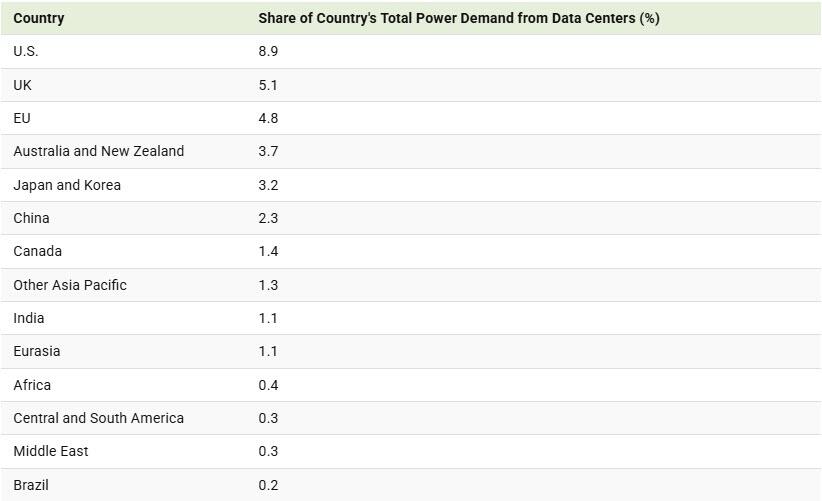
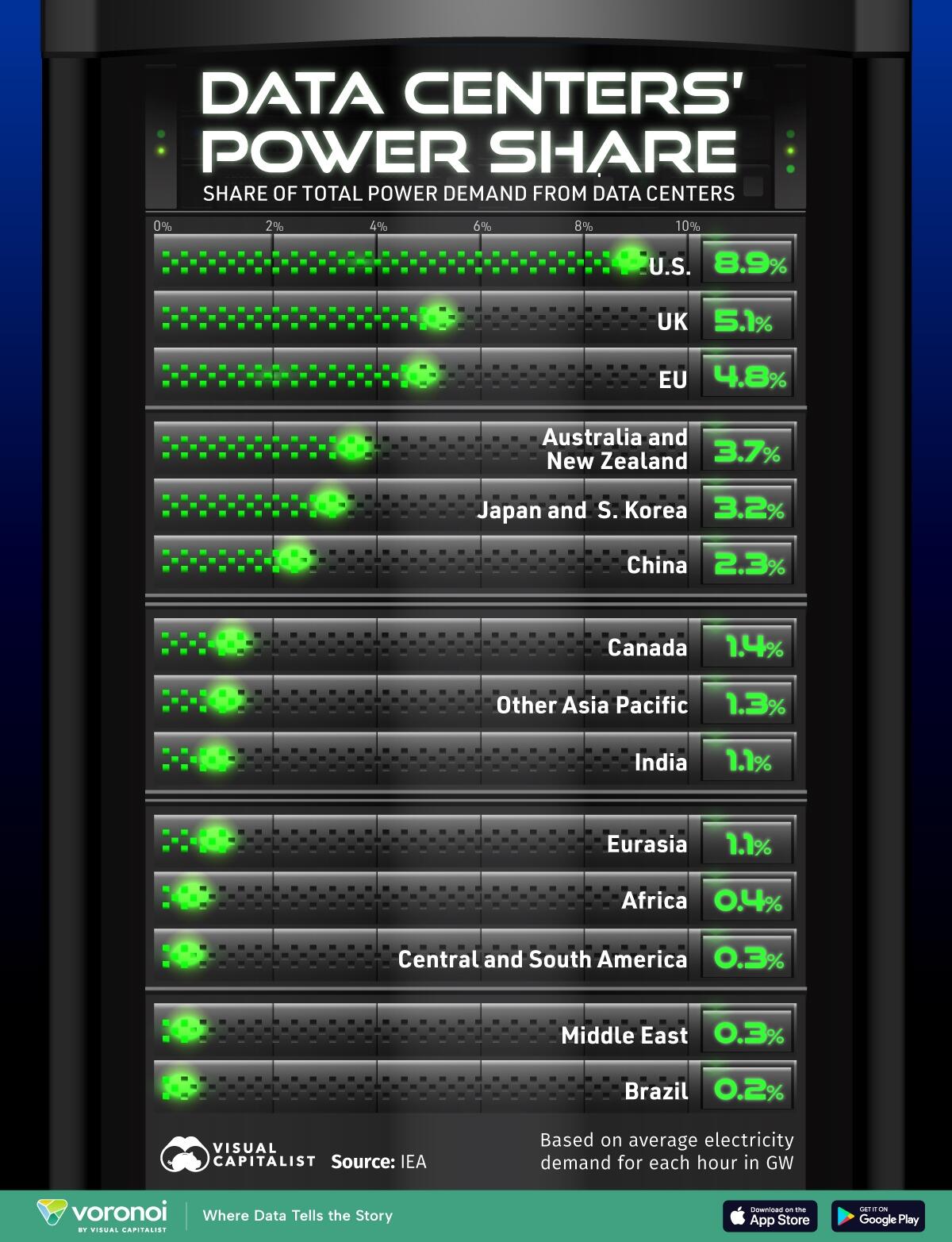
This graphic, via Visual Capitalist’s Dorothy Neufeld, shows data center demand as a share of total power consumption, based on data from the IEA.

The Boom in Data Center Demand

Here is the share of each regionโ€™s total power demand that is driven by center centers:

As we can see, Americaโ€™s data center demand leads globally, at 8.9% of total power consumption.

In Virginia, data centers account for 26% of the stateโ€™s total power consumptionโ€”or nearly triple the national average. This year, the stateโ€™s leading utility firm expects to connect 15 new data centers given surging demand.

As big tech ramps up AI spending, a significant share is being funnelled into massive data centers along with the energy sources that power them. In particular, demand for nuclear is expanding at the fastest rate in decades.

By comparison, data centers comprise 4.8% of the total power share in the European Union and 2.3% in China.

Source

Germany Gets Dunkelf**ked Again, Norway to Dismantle Power Cables To Europe

What is it with Europe right now. The UK has gone Bats**t crazy and is converting to Islam faster than Iran, not this.

Another wind drought has led to soaring electricity prices across Europe. Norway, which exports power to its European neighbors, has seen enough.

Europeโ€™s electricity prices soared on Thursday amid a wind drought.
Source: Alexander Stahel on X.

For the second time in a month, Germanyโ€™s electric grid has been hit by a wind drought, known in German as a Dunkelflaute. The lack of wind sent Europeโ€™s electricity prices soaring to their highest levels since the end of 2022, when Europe was in the midst of an energy crisis due to concerns about supplies of Russian gas. Thatโ€™s saying something since Europe โ€” and Germany in particular โ€” now appears to be amid a permanent energy crisis.

Yesterday, German consumers paid an average of $400 per megawatt-hour for electricity. During peak times, prices in Germanyโ€™s wholesale power market came close to $1,000 per MWh, the highest level in 18 years. Hereโ€™s how a reporter with Spainโ€™s El Pais newspaper explained the situation:

Dunkelflaute is a cursed word in the German electricity sector. The combination, typical of cold anticyclones, of low temperatures (which increase demand) and the almost total absence of wind (which hinders wind generation) configures one of the worst possible scenarios for the price of electricity: it forces the burning of more gas in combined cycle plants, which are much more expensive, and that substantially increases the billโ€ฆThe main factor behind this escalation is the lack of wind. While at this time of year Germanyโ€™s powerful wind power sector (onshore and offshore) usually averages almost 20 gigawatts (GW) of power, according to data from the specialist portal Montel, thus becoming the countryโ€™s main source of electricity, on Wednesday it will just exceed 3 GW. With the cloudy skies, solar photovoltaic power is also operating well below its potential and forces combined cycle plants โ€” in which gas is burned to obtain electricity โ€” to operate at a higher rate than usual, driving up prices.

The wind drought isnโ€™t just hitting Germany. As shown in the graphic at the top of this article, electricity prices across Europe soared amid the wind drought. In response, Norwegian politicians are promising to dismantle the undersea power cables that connect Norwayโ€™s grid to mainland Europe to protect Norwegians from Europeโ€™s tumultuous electricity market. Electricity prices in Norway, which gets 90% of its power from hydro, hit record prices this week despite having full hydro reservoirs.

According to the X account of Visegrรกd 24, a Norwegian news outlet, the two links that connect Norway to Europe will reach their technical lifetimes in 2026 and 2027. The two cables have 9 GW of exchange capacity, of which 5.1 GW connects to Denmark, Germany, Netherlands, and the UK.

more

Hey dumbasses, gas is cheap and efficient. You bought the global warming lies and look what it is costing you.

Another Car Maker Giving Up 2035 EV Mandate

Another Lie goes down.

Back in 2022, I reported that Toyota Motor chief Akio Toyoda remains skeptical of moving to only producing electric vehicles (EVs). Toyoda also indicated that most people who work in the auto industry agree with him.

โ€œPeople involved in the auto industry are largely a silent majority,โ€ Toyoda said. โ€œThat silent majority is wondering whether EVs are really OK to have as a single option. But they think itโ€™s the trend so they canโ€™t speak out loudly.โ€

Now BMWโ€™s CEO Oliver Zipse argues that Europeโ€™s 2035 ban on internal combustion engines (ICE) is unrealistic and could increase reliance on Chinese batteries.

BMW wants Europe to relax its plan to ban new petrol and diesel-powered cars from 2035 onward, in an effort to reduce the regionโ€™s reliance on batteries from China. While many automakers have fully embraced electrification, BMW is opting for a more diversified strategy.

In addition to battery electric vehicles (BEVs), the company is investing in alternative technologies such as e-fuels and hydrogen fuel cells, betting that the future of mobility wonโ€™t be driven by batteries alone.

BMW Chief Says Europeโ€™s 2035 EV Mandate is โ€œNo Longer Realisticโ€

They just want to force their climate nonsense on us when in fact it’s a control issue by the Climate wienees. They tried making us act like sheep during Covid and we’re not going to do it again. This level of technology of battery-powered cars is not the answer, especially when they can turn them off for social non-compliance.

Tech Companies Going For Nuclear Powered AI

Now there will be less electricity for cars and other things that shouldn’t be electrified. For the rest of us, we’ll just get a bigger power bill for our houses.

Tech companies are increasingly looking to nuclear energy to meet their evolving power needs, potentially at the expense of grid reliability and ordinary American ratepayers, The Wall Street Journal reported.

The owners of about one in every three American nuclear plants are negotiating with technology firms to reach deals in which the plants would sell tech companies nuclear-generated electricity to operate their power-hungry data centers, key infrastructure that the tech firms need to support the artificial intelligence (AI) boom, according to the WSJ. The trend could divert reliable energy generation away from the rest of the power grid at a time when grid watchdogs are warning of longer-term reliability problems as electricity demand is expected to grow rapidly in the coming years due to the proliferation of data centers, electric vehicles (EVs), advanced manufacturing facilities and more.

For example, Amazon Web Services (AWS) is close to reaching an agreement with Constellation Energy to buy electricity from an East Coast nuclear plant, and AWS also spent $650 million on a nuclear-powered data center in Pennsylvania earlier this year, according to the WSJ. The Pennsylvania data center can receive enough electricity to keep the lights on in hundreds of thousands of households, and its purchase spurred tech sector interest in similar deals that allow companies to buy power directly from plants without needing to spend much on additional grid infrastructure to access that electricity.

Data centers may end up accounting for as much as 9% of all power consumption in America by 2030, according to the WSJ, and some officials โ€” such as Pennsylvania Consumer Advocate Patrick Cicero โ€” are concerned that the tech sectorโ€™s union with nuclear energy could hurt ordinary consumers by driving up prices and commanding a large share of the nationโ€™s reliable carbon-free power.

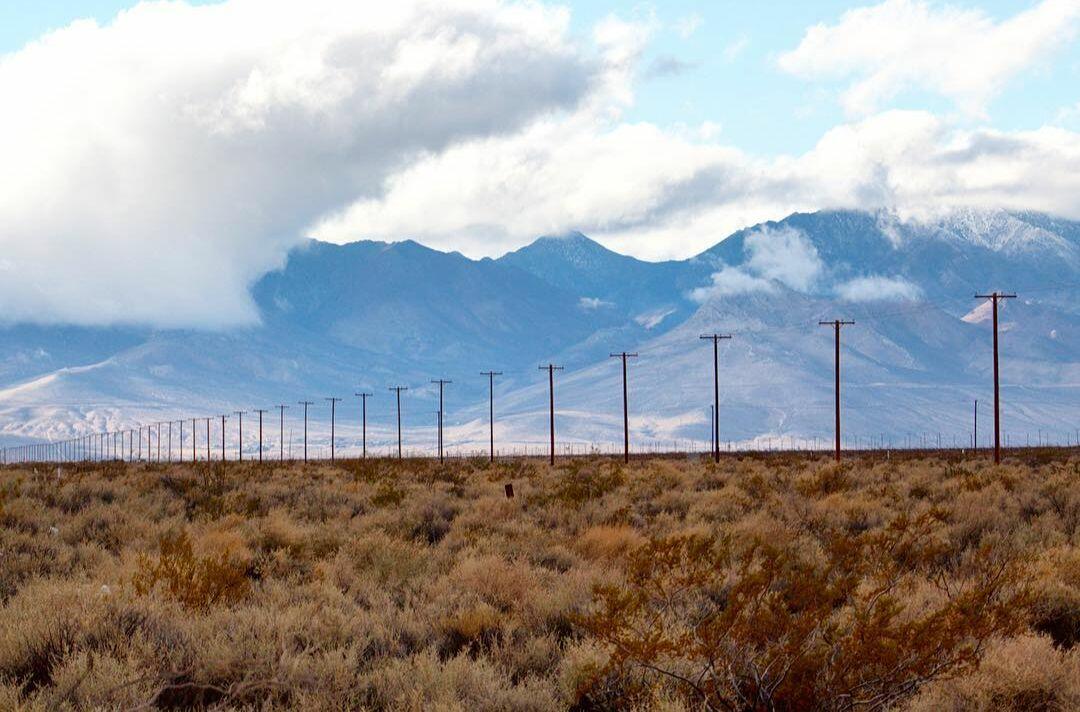
Electric Transmission Buildout Could Cost Americans Trillions Of Dollars

Though windmills and solar panels get the headlines, the big energy topic in Washington is electric transmission. Whether it is Congressโ€™s newfound interest in permitting reform, the U.S. Department of Energyโ€™s new Grid Deployment Office, or the Federal Energy Regulatory Commissionโ€™s (FERC) upcoming final rule on transmission planning and cost allocation, how to build and pay for long-range transmission to connect generators to customers is considered the final piece in the quest to meet net-zero goals.   

Like so many issues in Washington, the need for more transmission lines is accepted without question and the costs are not considered. But for American consumers, especially low-income and elderly, as well as small businesses and energy intense manufacturers, building new transmission lines could result in much higher monthly bills and leave them on the hook for stranded assets.

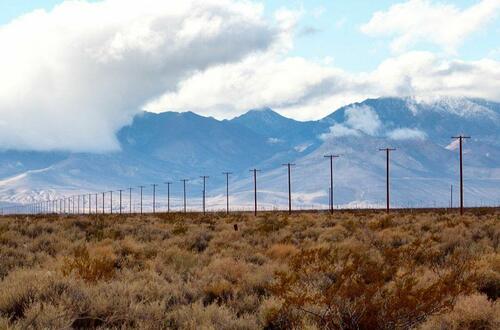
Traditionally, high-voltage transmission lines, consisting of 150-foot lattice towers crossing the landscape for hundreds of miles, were planned for by local utilities to meet their customersโ€™ energy needs and subject to approval by state public utility commissions. But public policy goals to promote renewables are changing how the grid is being developed.

Over the past few years, States established renewable energy mandates; Congress enacted over $1 trillion in taxpayer subsidies for renewable energy; and President Biden issued an executive order setting net-zero goals for electricity generation by 2035. To fulfill these policies, the grid needs new high-voltage transmission linesโ€”lots of themโ€”and they will be expensive.

According to the โ€œNet-Zero Americaโ€ analysis published by Princeton researchers, achieving net zero goals with 100% wind and solar by 2050 will require an additional $3.5 trillion in capital spending for new transmission lines. If net-zero goals are pursued with a mix of renewables, nuclear, and natural gas generation (which may include carbon capture), then a significant portion of this transmission investment would be unnecessary. Furthermore, a balanced resource mix of dispatchable and renewable resources would enhance grid reliability without overbuilding renewables or transmission.

More

Heating With Natural Gas Cuts Costs 40% Vs Electricity – So Why Is Biden Trying to Screw The Country?

Heating homes this winter using natural gas is estimated to cut down energy costs by more than 40 percent compared to electricity, according to a recent report by the U.S. Energy Information Administration (EIA).

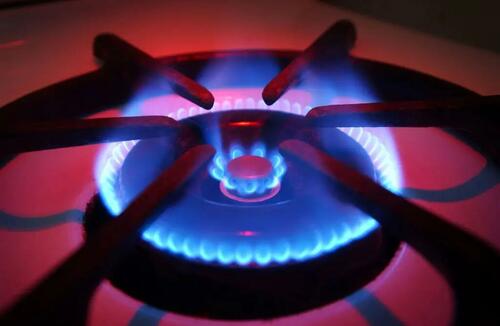
Blue flames rise from the burner of a natural gas stove in Orange, Calif., June 11, 2003. (David McNew/Getty Images)

Households using electricity to heat homes are projected to pay $1,063 on average between November and March, according to a Nov. 7 winter fuels outlook report by the EIA. In comparison, households using natural gas are only expected to shell out $601.

Region-wise, the biggest difference is in the Midwest, where electric heating is expected to cost $1,213โ€”more than double the gas cost of $581. In the Northeast, gas heating is projected to be cheaper by $704, in the South by $507, and in the West by $417.

Natural gas heating is also cheaper compared to other alternative energy sources such as propane and heating oil, which are expected to cost $1,343 and $1,851 respectively.

High heating costs borne by households using electricity come as the Biden administration is pushing an electrification agenda.

The administration is already imposing several restrictions on the use of gas-powered appliances. The U.S. Department of Energy (DOE) has announced new efficiency standards for residential gas furnaces, pool pumps, battery chargers, dehumidifiers, ceiling fans, incandescent light bulbs, and gas stoves that would severely curtail their use.

Secondly, the Biden administration is offering rebates on the use of electric appliances in homes. The 2022 Inflation Reduction Act set aside $8.8 billion in rebates for home energy efficiency and electrification projects.

In a June 2 interview with The Epoch Times, O.H. Skinner, executive director of the Alliance for Consumers, said the Biden administrationโ€™s push for electrification of home appliances is bad news for Americans.

โ€œThat will make it so that nearly the majority of the current products on the market donโ€™t meet the standards and have to be redesigned or removed from the market,โ€ he said.

โ€œEveryday things that people actually want are going to get more expensive or disappear, and the products that will be available will be more expensive but not better. People are going to wonder why life is worse.โ€

story

And Kamala posted Christmas pictures of the natural gas stove at her house.โ€‚Remember that when voting this year.

Electric Car Hoax Explained

California is the idiot state again.

Stuff That Doesn’t Have To Happen: EV’s, (Not) Charging and Big Brother Controlling Thermostats

And in Germany, who was warned not to trust their energy needs by a recent president or they would lose their self-sustenance. Instead, they closed all the petroleum fired plants :

German Food & Ag Minister: Some Of You Will Have To Starve, And That Is A Sacrifice Iโ€™m Willing To Make

The zealots of the Sustainable Organic Church Of The Carbon Apocalypse are no longer hiding the fact that they expect many of you to die in order for them to achieve their green utopia. (Isnโ€™t it weird how left-wing utopias always have such an awful body count?)

The German Food and Agriculture Minister, Cem ร–zdemir, recently stated thatย “Hunger is no argument against bio diversity and protection of the climate.โ€

And in Colorado:

Tens of thousands of Colorado residents found themselves unable to turn down their smart thermostats after energy company Xcel took control of them, citing an โ€œenergy emergency.โ€

On Tuesday, around 22,000 customers of Xcel, a Minnesota-based energy company who supplies customers across a number of western states, found themselves unable to turn down the temperature in their homes, despite the outside temperature reaching into the 90s, Summit News reported.

#NBADJT

A Message About EV’s And Sustainability

I have nothing against an EV, just the arguments that it somehow is good for the environment. It isn’t good for the kids who are digging the precious metals for the battery.

And for the beta males….