When I was young, my Mom told me some people live to eat, while others eat to live.
Being an introvert, long ass meals are tedious for me. I just need something to fill up my stomach.
I also worked in an Italian restaurant that had real food based on recipes that came from the Mother Country, not just pasta.
Don’t get me wrong, I’ve attended the three-hour business lunches in France, which often featured exquisite food. I’ve also gone hunting at 3 in the morning, and ridden in many 100-mile bike races that started at sunrise. I’d have to cram as much food as I could in the shortest amount of time, as I was on a deadline.
I know the difference between 5-star food, and reheated chicken and rice in the dark hours of the morning. I just need a proper meal (not fast food or processed) to get me to the next meal.
I bet some readers served in the military who ate some awful stuff, yet survived.
In contrast, my brother-in-law was the president of Ruth’s Chris Steakhouse and was obese for a good part of his life. He lived to eat and has failed at every diet and/or weight loss plan that exists. He now has health problems I saw coming decades ago. He also got the COVID-19 jab and has symptoms from that.
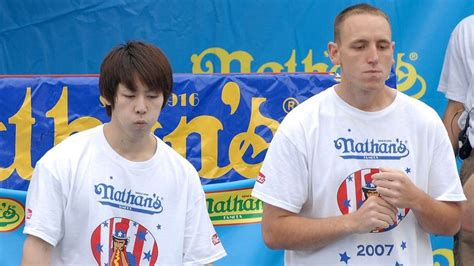
One last thing, I never miss the Hot Dog eating contest on July 4th. I’ve been a fan since Kobayashi was transforming the “sport”.
I became enamored with this contest by phenom eater Kobayashi, a skinny kid from Japan who revolutionized competitive eating. It also grosses out my wife. That means I’ve been watching for decades.
Kobayashi was defeated by Joey Chestnut who will not defend his championship this year because of a conflict with the sponsor, Nathan’s hot dogs and others (see below). I’ll still watch, but we will be in the 30 or 40 dog range to win, versus the 60 to76 that we’ve been treated to by Chestnut.
his Fourth of July, Joey Chestnut will be doing what Joey Chestnut does better than any human being alive:
Eating hot dog after hot dog after hot dog after hot dog after hot dog after hot dog after hot dog after hot dog after hot dog after hot dog after hot dog after hot dog after hot dog after hot dog after hot dog after hot dog after hot dog after hot dog after hot dog after hot dog after hot dog after hot dog…
And on and on, down the hatch, with stunning pace and a strange sort of grace.
Chestnut—aka “Jaws,” the Michael Jordan of competitive eating, the Picasso of Pork, the Federer of Frankfurters, the GOAT of bloat, a man who once ate a world record 76 hot dogs in 10 minutes—will spend the holiday competing casually alongside members of the U.S. military at Fort Bliss in Texas in a quickly-assembled event airing on his YouTube channel.
Though Chestnut is honored for the opportunity, the stunning news is where the 40-year-old won’t be–parked at a table outside Nathan’s Famous in Coney Island, N.Y., dominating a legendary hot dog eating contest he has won a staggering 16 times.
“Bittersweet,” Chestnut told me in an interview this week.
Behind Chestnut’s absence is a dispute involving his nascent relationship with Impossible Foods, the plant-based food maker. The partnership chafed the powers behind Major League Eating and the Nathan’s Famous competition, who felt Chestnut was getting cozy with a rival.
So Chestnut is out, casting a footlong shadow over the annual beachside showdown—and riling a fan base that can’t believe the iconic competition will happen without its signature stomach.
No Joey Chestnut in Coney Island on the Fourth of July? It’s like asking a bald eagle to stay home in the nest.
“Stop being such weenies!” New York City mayor Eric Adams wrote in a pun-tastic tweet.
“The entire country’s [expletive] bummed,” said ESPN’s biceps curl Cronkite Pat McAfee. “I don’t even know if people are going to light off fireworks now.”
“Let the guy suck down dogs!” McAfee pleaded.
Chestnut, who won his first Nathan’s event in 2007 and parlayed his talent into global fame and a full-time occupation, sounded plenty bummed by the conflict. He doesn’t see his relationship with Impossible Foods as a deal-breaker–he’s still a devoted carnivore who sees plant-based food as a supplement to his meat diet, not a replacement.
He compared it to Tom Brady endorsing Under Armour cleats and also Ugg boots–an interesting choice, given that Tom Brady would sooner eat an Adirondack chair than a meaty hot dog.
“You can eat meat and you can also eat plant-based meat,” Chestnut said. “I feel like that should be OK with people.”
Impossible Foods had no issues with Chestnut consuming meat products at the Nathan’s event–or anywhere else, said the company’s CEO, Peter McGuinness.
“He’s a flexitarian,” McGuinness said. “He is our target audience. We’re not a vegan company and we need to be appealing to meat eaters.”
Major League Eating’s president, Richard Shea, echoed Chestnut’s term to describe the situation: bittersweet. The issue was a brand conflict, he said. He went on to rave about Chestnut’s talent and indelible mark on the annual competition, which is televised by ESPN.
“We love Joey, we wish he was there, we support his choice and think it’s a cool tribute, what he’s doing with the troops in Texas,” Shea said. “He’s a great champion.”
After the initial dust-up, MLE and Nathan’s Famous offered to put aside their issues and allow Chestnut to participate in 2024 – but the offering couldn’t bring the hot dog Hoover vac back to the table.
The relationship may need further repair. Chestnut believed his team was still negotiating when the controversy spilled into view with a Major League Eating statement that they were “devastated” at Chestnut’s decision to partner with “a rival brand that sells plant-based hot dogs.”
Having the impasse go public felt like a gut-punch to Chestnut, the contest’s most identifiable winner, long ago surpassing the competitive eating godfather Takeru Kobayashi of Japan.
“It’s hard to rebuild trust once bridges have been burned a little bit,” Chestnut said.
Chestnut trains like an endurance athlete, with vigorous eating sessions to prepare him to push his physical limits. He practices breathing techniques to stay calm and loose and even asks people to come yell at him in practice to try and simulate a noisy contest environment.
The champion felt on pace for a potentially record-setting Fourth of July.
“It was definitely my best training in years,” he said.
While consuming even a half dozen hot dogs would curl me into a fetal ball for a month, Chestnut said he’s in good health. He said he gets his blood regularly checked, and that his doctor remains comfortable with his career choice.
“He told me whatever I’m doing, I can keep doing it,” Chestnut said.
After the event at Fort Bliss, Chestnut will turn his attention to a brand-new event–a showdown with storied rival Kobayashi to be shown on Netflix. Billed as “Chestnut vs. Kobayashi: Unfinished Beef” the mano-a-mano gulletpalooza will go down on Labor Day, Sept. 2.
“I want to make him uncomfortable and he wants to make me uncomfortable,” Chestnut pledged.
As for a future return to Coney Island, the champ is trying to stay optimistic.
Can it really be the Fourth of July without Joey Chestnut dogging dogs near the Brooklyn boardwalk?
“I love that contest,” said the hot dog gawd. “I would do anything reasonable to make it back there.”
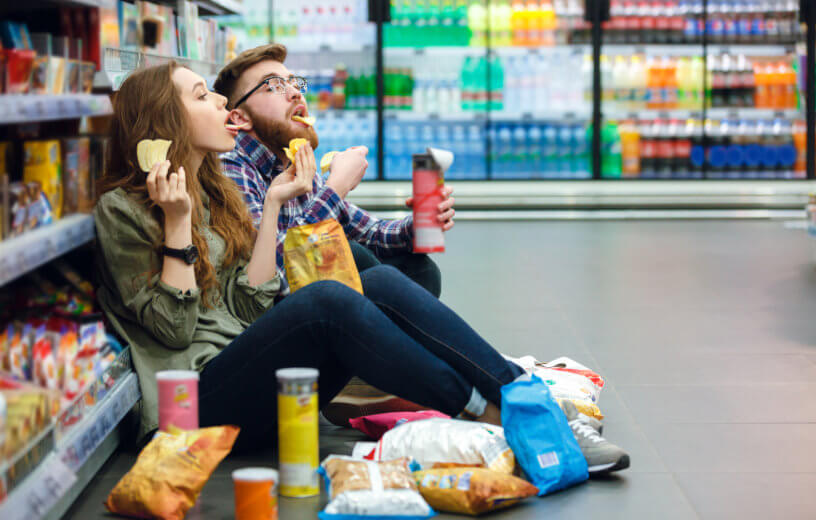
COLUMBUS, Ohio — A concerning new study reveals American adults are adding an “extra” meal to their plates every day — simply by snacking too much. Researchers from The Ohio State University analyzed data from over 20,000 individuals and discovered that Americans consume between 400 and 500 calories from snacks daily, often surpassing the caloric intake of breakfast and lacking nutritional value.
“The magnitude of the impact isn’t realized until you actually look at it,” says study senior author Christopher Taylor, a professor of medical dietetics in the School of Health and Rehabilitation Sciences at Ohio State, in a university release. “Snacks are contributing a meal’s worth of intake to what we eat without it actually being a meal. You know what dinner is going to be: a protein, a side dish or two. But if you eat a meal of what you eat for snacks, it becomes a completely different scenario of, generally, carbohydrates, sugars, not much protein, not much fruit, not a vegetable. So it’s not a fully well-rounded meal.”
The study utilized data from the National Health and Nutrition Examination Survey, which collects detailed 24-hour dietary recalls. It categorized participants based on their HbA1c level, an indicator of glucose control, into groups such as nondiabetes, prediabetes, controlled diabetes, and poorly controlled diabetes. Findings showed that snacks accounted for 19.5 to 22.4 percent of total energy intake, primarily consisting of convenience foods, sweets, and sugary beverages.
An interesting observation was that individuals controlling their Type 2 diabetes tended to snack less and consume fewer sugary foods compared to those without diabetes or with prediabetes.
Probably because the parents let them be that way. Fighting the good fight to be a responsible parent means that you are not trying to be their friend, rather you are trying to prepare them for life.
Part of this preparation is to be able to eat whatever is put in front of them. You never know when they will be in a new situation, new country or perhaps in survivalist mode.
1. Parents are afraid to say no. It’s not just that they don’t want to create an ice cream binger. It’s also that feeding our children is a way to nurture them and show our love. It is so tempting to give them treats like French toast or chocolate chip cookies just to see their joyful faces, especially if that was one of the ways our own parents showed their love. The question is, can we break this cycle and express our love with healthy foods?
2. Parents think it’s okay for kids to eat junk food in moderation. Even though parents themselves might not indulge, we are told kids can eat it “in moderation.” But what exactly is “moderation”? Once a week? Once a day? What would be a moderate amount of a chemical like artificial color, which some studies have linked to hyperactivity? Perhaps we are lulled into thinking kids have years to go before they have to worry about calories or fat. But the truth is that even babies have been found to have the early stages of plaque in their arteries, childhood obesity is considered an epidemic, and type 2 diabetes, once only an adult disease, is now all too common in children.
3. Doctors recommend it and schools provide it. Many of our pediatricians tell us we are supposed to feed our kids Cheerios® starting at 10 months old so they can work on their pincer grasp, never mind that the cereal is highly processed and full of simple carbohydrates which quickly turn into sugar in the body. Besides, anyone with kids knows they fine tune their pincer grasp by picking up the tiniest specks of dirt off the floor and skillfully putting them in their mouths. In addition to the doctor’s office, the other surprising place kids get exposed to unhealthy foods is school. It begins with the Mommy and Me groups, where children are handed Goldfish crackers to snack on, despite that they are high in sodium and simple carbohydrates; or, worse, Graham Crackers, which are nothing more than cookies hiding out in a box labeled “crackers,” along side apple juice, another hefty serving of sugar. By preschool my kids were served cookies or cupcakes, often with bright pink or blue frosting, at least once a week to celebrate a birthday or holiday.
4. It is appealingly easy to make a ready made meal we know our kids will eat. “Nuking” chicken nuggets that have been scientifically formulated to please the little ones or boiling up pasta takes a lot less energy than standing in the kitchen for an hour or two to make a meal. Understandably, after working all day inside the home or out, that may not be so enticing, especially in our over-scheduled, highly intense culture, where spending hours in the kitchen is no longer considered time well spent.
Whatever the cause, the question is, what to do now? Whether you have a clean slate with an infant or are trying to change directions with an older child, here are some suggestions.
1. Make sure your children are really hungry for dinner (or whatever meal you are serving). So, for example, don’t allow them to have any sweets or too much bread after school. If it is two or three hours before meal time, provide only fruits and vegetables if they are hungry.
2. Only keep food in your home that you want them to eat. “Sorry, we don’t have any Oreos” is so much easier than “Sorry, you can’t have any Oreos.”
3. Let them be involved with some aspect of food prep. My son once found some kid-friendly recipes online and became totally enthused about making and eating ants-on-a-log (nut butter and raisins on celery). Or, with your careful oversight, let them cut up or peel some veggies, or even just turn on the blender. It only takes me twice as long when my kids help me make a recipe, but it’s worth it (usually!) because they are so much more interested in tasting what they made.
4. If you can sit down to eat together, do it. Kids are so affected by what they see their parents and each other eat. Mind you, I haven’t had a relaxing dinner in the three years since we started eating with our kids, but I remain optimistic that one day soon it will happen.
5. Don’t push kids to eat something if they really don’t want to. When my daughter, the pickiest eater in the family, was younger and would balk at the lentils and brown rice I’d cooked for dinner, I would have easy, healthy back-up options available that I knew she liked, such as a handful of pistachios or whole grain crackers and hummus. Eventually, whether it was that she was bored of the back-up foods or inspired by seeing everyone else eat the lentils and rice, she started eating it, too.
6. Your child may need to try a new food 10-15 times before he is willing to eat it. That’s how it was with my daughter and vegetarian chili. Now she eats it, more or less happily, as long as I pick out the carrots and onions before I serve it to her!
7. Feed your children the same food you eat. This is particularly helpful if your children are fairly new to eating solids. As long as your children can chew the food, there is no reason their menu at home and restaurants should look any different than yours. That way they will have the opportunity to experience the textures and colors of ‘real’ food and not become partial to the soft, white food kids are usually offered.
8.Your children are smart! Talk to them. Explain why you are making the changes you are making — that you love them and are concerned about their teeth and their bodies. You want them to grow up to be healthy and feel well. They may not like the changes, but understanding them should help.
9. Don’t underestimate your kids. My oldest just had his 8th birthday with 14 friends, most of whom eat standard American fare. Although he convinced me to serve regular pizza (I had resisted for many birthdays), I put out piles of grapes, sliced apples and cucumbers all along the table instead of chips. By the end of the party, almost all were gone. I considered the victory to be mine!





 Delusions of Adequacy