
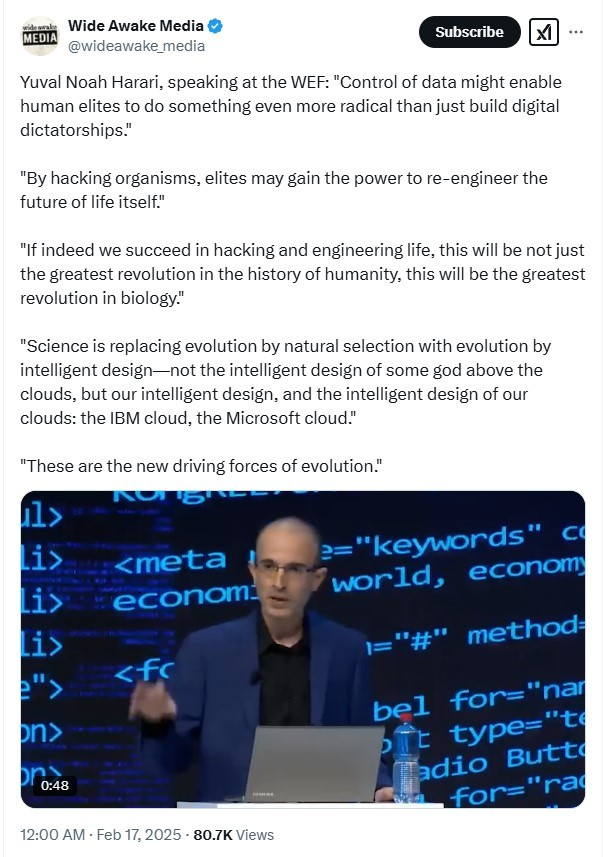
While there is a discussion of AI and what it currently does is below, the One World WEF / Davos / Rule the World group looks like it’s trying to combine immortality/AI and humans to create superhumans. Maybe I should say cyborgs? People have tried to rule over others since the beginning of time. It lasts for about a generation in history and then someone else takes over.
As usual, they are up to no good, trying to play God and use their money to separate themselves from the rest of the world so they can rule it……
Transhumanists know this, and as a result, are seeking to merge biology with technology. Converting a human into a Cyborg seems more plausible than making a computer alive. Transhumanism and the bio-digital convergence is driven by a few delusional beliefs. One is a quest for immortality. These fantasies include uploading consciousness into the cloud or creating a biosynthetic framework for the human body. This delusion is promoted as human augmentation and ridding the world of disease. Transhumanism is propelled by blind faith in technology and a complete disconnect from the innate Divine Spark that exists within every human being.
There is a mass media concerted effort with predictive programming to portray Transhumanism as inevitable. There is also a concerted effort to promote AI as running everything as inevitable.
As I’ve previously written about, a Swiss company called Final Spark is using brain matter called organoids to house AI and promotes it as more energy efficient and evolutionary. Final Spark’s neural platform can be leased like any other data storage. The brain matter is being used as hardware for the AI software.
Artificial Intelligence is in fact, ‘Artificial’ Intelligence. It is not authentic intelligence. It is a facsimile. AI is no more intelligent than a calculator is. A calculator can add faster and more accurately than a human can, yet it is not intelligent anymore than a cog or any other component is in machinery. Computers can carry out tasks more quickly and efficiently than the human mind, but there is no cognition involved. There is no actual discernment.
I would argue that AI is simply more advanced computers that simulate human intelligence using algorithms that complete higher level tasks that can engage in simulated problem solving, decision making, or language understanding.
In reality, the computer processes language through pattern recognition, analyzing context, syntax, and intent based on the data previously trained on.
This makes AI seem more “intelligent” than a calculator, but the core process is still computation. It is the complexity and scale of the computation that makes it appear intelligent.
AI models, like neural networks, perform billions of calculations across vast datasets, enabling them to handle complex tasks. The computer can then apply learned patterns to new, unseen data, making it seem more adaptive than a traditional calculator. It is a bit abstract. The math is hidden behind layers of algorithms, so the user interacts with responses which are in language form rather than seeing the calculations.
While AI is computational, it differs from a basic calculator in its ability to handle ambiguity and complexity. A calculator performs fixed operations with clear inputs and outputs.
AI, on the other hand, deals with probabilistic, uncertain, or incomplete inputs, using statistical models to generate plausible outputs or responses. This makes it feel more “intelligent,” even though it’s still just computation.
AI is, at its core, an advanced form of computation applied to non-mathematical domains. It doesn’t “understand” these domains, it processes them mathematically, using patterns and probabilities. The “advanced calculator” is useful because AI’s intelligence is an illusion created by complex math, not genuine comprehension or reasoning beyond its algorithms.
AI is basically a probabilistic response calculator that is applied to areas outside of mathematics. The computer analyzes the input and calculates the likelihood of various words, phrases, or structures based on what it has previously experienced in similar contexts. Then the computer selects or generates a response that aligns with the highest probabilities, adjusted for coherence and relevance. Even when handling novel queries, it relies on probabilistic patterns, combining them in ways that fit the input or question.
What I know is that Microsoft and IBM are incompetent inside. They will create something closer to Frankenstein instead of Data.

 Delusions of Adequacy