Once Again, Trump Is The Master Troll, 2 For 1 On LinkedIn And Obama

This is what my Trump hating friends couldn’t fathom. He’s always many steps ahead of the others. What’s more, those steps are usually pretty freaking awesome. I told him that the others were playing checkers and he’s playing 4D chess. I also get a schadenboner because LinkedIn is a liberal bastion of cringe and shit talking.

In a Final Boss move, he does this:

In a move reminiscent of President Bill Clinton staffers removing the “W” key from White House keyboards, someone on President Trump’s tech staff is trolling former Democrat employees of the executive branch via LinkedIn, by making sure 47’s photo appears in their online profiles.

If a Democrat worked in the Obama or Biden administration and lists that job in his or her profile, since “The White House” is the employer, the current president’s photo is displayed.

“Liberals HATE IT!” remarked Eric Daugherty on X.

? BREAKING: The White House on LinkedIn has changed their profile picture to Donald Trump, so even the people who worked for BIDEN from 2021-2025 have Trump’s face on their profile. Liberals HATE IT. ?

“If you worked for the White House in the past, and it’s on your profile,… pic.twitter.com/HdG85jWq88

— Eric Daugherty (@EricLDaugh) September 2, 2025

A Trump parody account on X imagined former President Obama opening his LinkedIn account:

Yes. Any lib who ever worked at the White House now has my big, beautiful face on their linkedin timeline. —LFG!!!?￰゚ᄂᆪ?￰゚ᄂᆪ pic.twitter.com/GNr8NOGxpW

— il Donaldo Trumpo (@PapiTrumpo) September 3, 2025

Remarked a writer at Red State: “Once again, Trump and his team have outmaneuvered the Democrats. What are they going to do, delete the fact that they worked at the White House, probably the biggest job many of them have ever had? Are they going to nuke their entire profile because they just hate Trump that much?

Folks, if there’s one thing Donald Trump has mastered, it’s the art of memetic provocation. He’s basically the Troll Master General at this point. 

This week, he revealed in an interview he’d be adding a portrait of Joe Biden’s autopen — yes, the autopen, not Biden himself — to his “Presidential Wall of Fame” in the newly renovated White House Rose Garden. 

That was fantastic, but the encore may have been better. 

Let’s put it this way: Former Obama and Biden staffers might want to check their LinkedIn profiles.

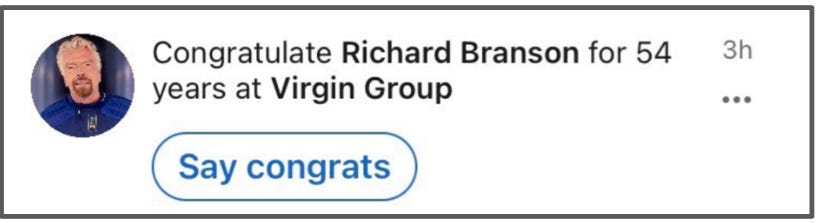
The White House set off a social media frenzy after it swapped out its official LinkedIn profile photo for a picture of Donald Trump. You know what that means? Anyone who lists working at the White House as part of his or her work experience — staff, interns, you name it — suddenly looks like they worked for Trump on their resume. 

source

The Problems With LinkedIn

I asked AI to tell me about the state of the application. To be transparent, I loathe it and find it full of Facebook behavior and cringeworthy posts about how their jobs are better than they actually are. When you are forced to act positive to pay your bills, you’ll do a lot of things and say a lot of things. I won’t, which is why I make fun of it.

When it went woke, I changed personal information like I now attended Faber College (Knowledge Is Good) and was in the Delta Tau Chi Fraternity. I rarely go there as I never liked many of the people I had to work with. I’m connected to people who I don’t even know who they are now.

If they read this and kick me off the platform, my life will stay the same.

Anyway…..

LinkedIn is widely known as the premier professional networking platform, but it has several notable downsides that users frequently criticize. Here are some of the major negative aspects of LinkedIn:

  • Superficial Connections: Many users accumulate large networks filled with contacts who never engage meaningfully. This leads to bloated connection lists that dilute the value of professional relationships, as people accept connection requests without real interaction or intent to collaborate

.

Decline in Professionalism: As LinkedIn incorporates more social media-style features, posts often mix personal anecdotes, motivational quotes, memes, and other non-professional content. This shift can clutter users’ feeds and make it harder to find truly valuable industry insights

.

Engagement Fatigue: LinkedIn pushes frequent posting and interaction, which can cause burnout. Users may feel pressured to constantly share updates or personal stories, leading to diminished quality of engagement or avoidance of the platform altogether

.

Privacy Concerns: LinkedIn collects extensive personal and professional data that can be accessed by many parties, including third-party apps and advertisers. Despite privacy settings, users’ work histories and contact info may be visible to unintended audiences, raising concerns about data security and professional repercussions

Recruiter Messages and Spam: Users often receive generic or overly persistent messages from recruiters offering “amazing opportunities” without clear details. The recruitment process on LinkedIn sometimes feels impersonal and overbearing, causing frustration

.

Paid Features and Double-Dipping: LinkedIn charges employers for job postings but also offers paid options for applicants to appear higher in candidate lists. This “pay-to-win” approach can erode trust in the fairness of job applications and make desperate applicants look vulnerable

.

Inauthentic Endorsements: The endorsements feature, meant to validate skills, is often abused through reciprocal endorsement schemes, leading many to distrust their legitimacy. Users prefer direct personal references over these watered-down public endorsements

.

Pressure to Maintain a Polished Professional Image: Users may feel stressed to constantly portray an idealized version of themselves, leading to a lack of authenticity and anxiety around online presence. This pressure can create a gap between true skills and the curated profile displayed

.

Content Overload and Quality Decline: In the race for visibility, some users share low-value or repetitive posts, which reduces overall content quality. Finding useful and relevant information amid the noise becomes challenging

.

Algorithmic Bias and Networking Barriers: LinkedIn’s reliance on connections can disadvantage users with smaller networks, creating barriers to access jobs and professional opportunities. Networking pressure and algorithmic choices may favor some profiles over others unfairly

.

Customer Service and Billing Issues: Some users report unexpected charges, difficulty canceling paid services, and poor customer support responsiveness regarding billing disputes, contributing to user dissatisfaction

.

Annoying or Irrelevant Connection Requests: Many LinkedIn users receive random or spammy connection requests, often from salespeople or automated bots, which undermines the platform’s professional integrity

.

Toxic Positivity and Questionable Content: The platform sometimes promotes overly optimistic or non-substantive posts, which can feel disingenuous or out of place for a professional network

  • .

These points highlight that while LinkedIn is a powerful tool for professional networking and career development, it is not without significant flaws. Users must navigate issues with privacy, content quality, network authenticity, and platform commercialization while managing their own professional image carefully. Being aware of these challenges can help users better leverage LinkedIn’s benefits while avoiding its pitfalls.

Created by Perplexity except the lead in

How To Punk LinkedIn – Viral Post Generator

People are always bragging or taking credit for jobs they should be doing anyway, like this:

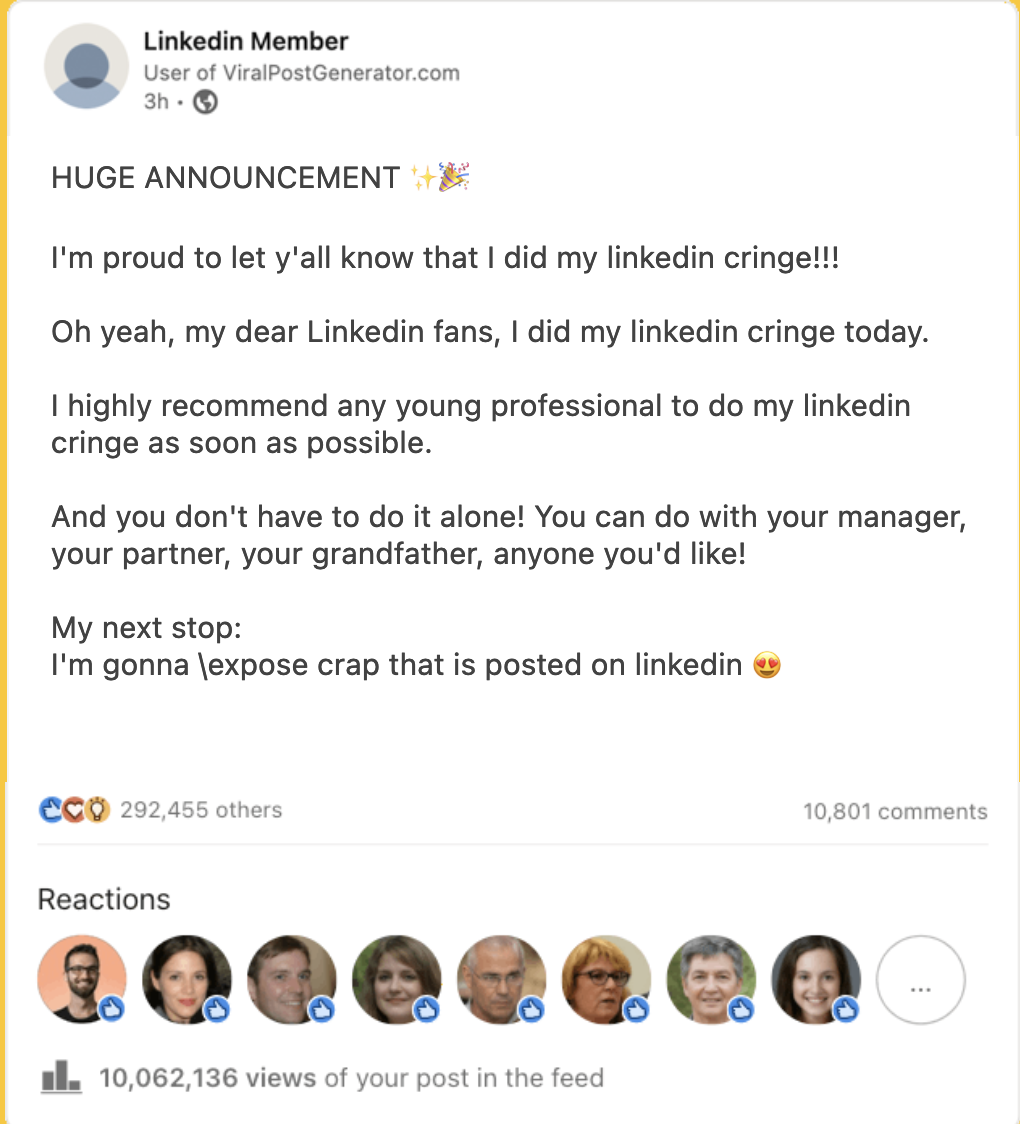
Here’s a post generator that makes up stuff for you (link below). I put random stuff in it to get this:

. 

You put anything in and pick the level of cringe that you want. It even adds (I guess) fake people who liked it to give you cred when you post it.

Link

Go ahead and punk LinkedIn

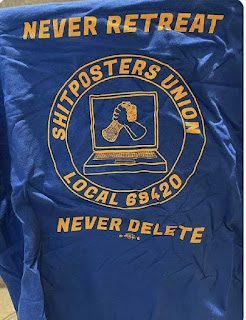
LinkedIn Cringe And Sh*tposting

For people trying to get a job or increase business, it might be a valuable platform.

Unfortunately, it is still social media that is trying to be politically correct. I ran across this article so that you get a feel for what Cringe is.

Why LinkedIn? Just, why?

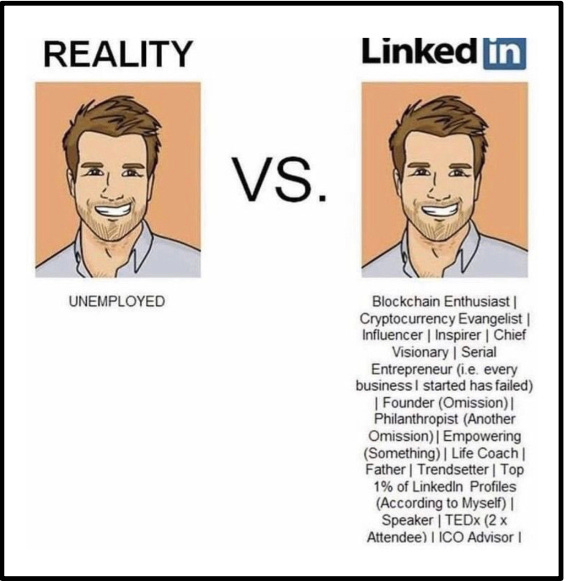
One of the funniest running jokes on Twitter is people trolling cringey LinkedIn newsfeed content: humble brags, faux inspiration, hustle porn, buzzwords galore and more.

A Twitter search for “linkedin cringe” returns an endless scroll of hilarity: 

Here’s a representative tweet that blew up last week. Someone posted a photo of a “resilient” tree, which prompted a perfect response that notched 430k+ likes: “Gonna be hell when LinkedIn finds out about this tree.”

What is in the DNA of LinkedIn that leads to such predictably cringe content?

To answer the question, I read a bunch of forums, articles and great insights from the LinkedIn Engineering Blog. I think the cringe is due to 3 factors:

  • The personality: What LinkedIn asks you to be?
  • The customer: Who is actually paying LinkedIn?
  • The algorithm: What drives engagement?

The Personality

My least favorite version of Trung is “CV Trung”. By this, I mean the way I write about myself and career on my resume.

Why? Because CV Trung is a knob.

Here are some actual bullet points from my most up-to-date resume, circa 2019: (comments in bold)

  • “CFA Charter-holder, passed all 3 exams on the first attempt” (no one cares)
  • “Professional working proficiency in Vietnamese” (not even close)
  • “Leveraged background in finance to lead a cross-functional team that developed machine-learning analytics tools” (dude, STFU)

Humans don’t talk like this. Half of this isn’t even true!

What is going on?

Canadian sociologist Erving Goffman has the answer: in a book called The Presentation of Self in Every Day Life, Goffman posits that every person goes through life wearing many “masks”, like an actor in a theater play.

Most people are different personalities at work vs. home vs. happy hour. People wear these different masks to impress or avoid embarrassment with different audiences.

Back to LinkedIn. It’s your online resume and directly tied to your identity.

The setup forces everyone on the site to basically wear the professional “CV mask” of their personality.

Bland. Buzzwords. Inoffensive. A little exaggeration. Self-promotional (but not too much). Desperate to impress.

CV Trung if I could grow facial hair (via @StateOfLinkedIn)

As a professional social network, LinkedIn has the cringe built in. The platform also prompts cringey engagement activity like:

  • Please <click button> to endorse <person> for being good at <skill>
  • It is <person> one year workversary please <congratulate>

This is not how normal people interact! I’ve literally never uttered the words “workvesary” out of my mouth (and have no idea what it sounds like).

Case in point:

Via @PanchamShreyas

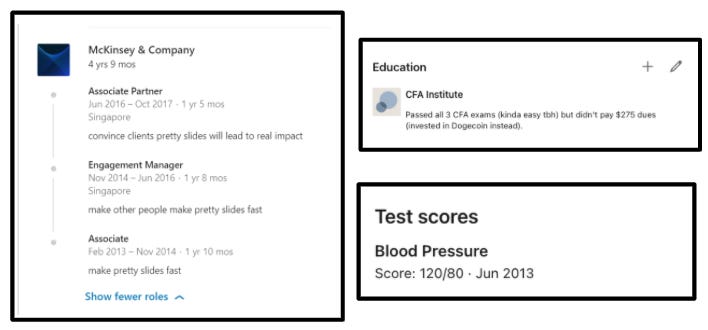
Whenever someone strays from the “CV Mask” and gives an honest take, it resonates:

(L to R, clockwise): An honest consultant, my “education” section and Conan O’Brien’s very funny “test score”

Having said all that, LinkedIn’s mission is to “connect the world’s professionals to make them more productive and successful”. As we’ll see, the site has been able to do that for many of its 800m+ users…cringe or no cringe.


MY RESPONSE AND TROLL

I already troll LinkedIn by changing my profile. My college went woke. I am so ashamed of them for what they represent that I changed it to Faber, of Animal House fame. No one noticed, but I don’t get any college links anymore, so there is the silver lining.

I decided to engage in the cringe by posting a false invention to detect both that and Sh*t posts. There already is an app that does this, so I made up my own. It’s just cringe stuff that is deep in sarcasm for those who troll my page and try to market unwanted advice to me. It’s working well as I’m being left alone. I haven’t done what my career was for years anyway.

Here’s a sample: Helped change the course of the future with the invention of the Revalvitating Capitulator. A vital component in the development and distribution of LinkedIn cringe.

I even used the cringe generator and got this:

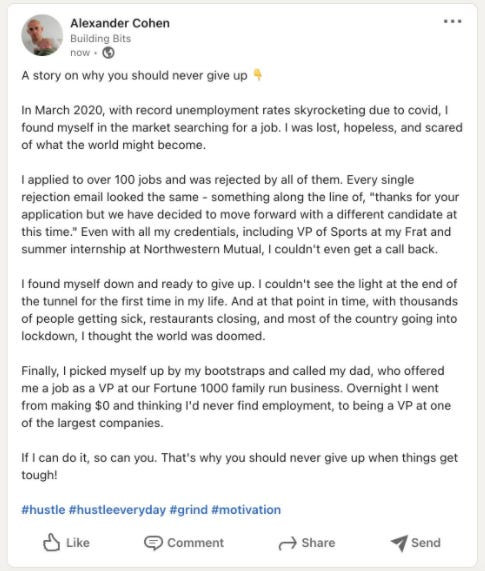
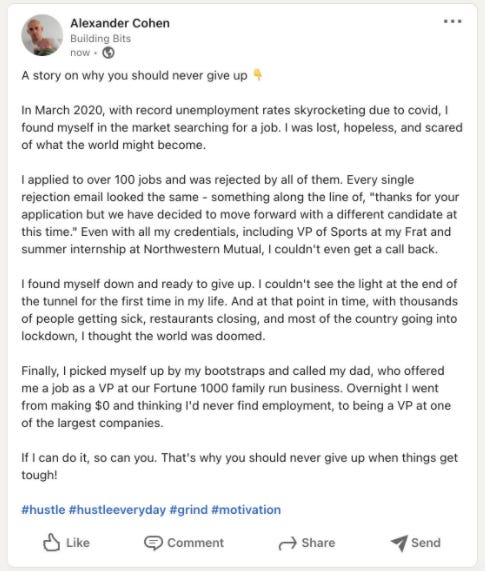
And a special shout out to Alex Cohen, who has turned long-form LinkedIn shitposting into an art:


In the end, it’s just another social media fail, but at least there is fun in it for those who recognize sarcasm. I troll it now in my profile because it went woke a while ago. I don’t even bother posting or liking except to very few people that I had a real connection with in the past.

Like most of Social Media, it’s a time suck. Cringe beats woke every time.