Not A One Of Them Is Made By IBM – These Are The World’s 10 Most Powerful Supercomputers

According to the latest supercomputer ranking from TOP500El Capitan is the world’s most powerful system, capable of achieving 1,742 petaflops.

In this graphic, Visual Capitalist’s Marcus Lu visualizes the performance and power consumption of the world’s top 10 supercomputers.
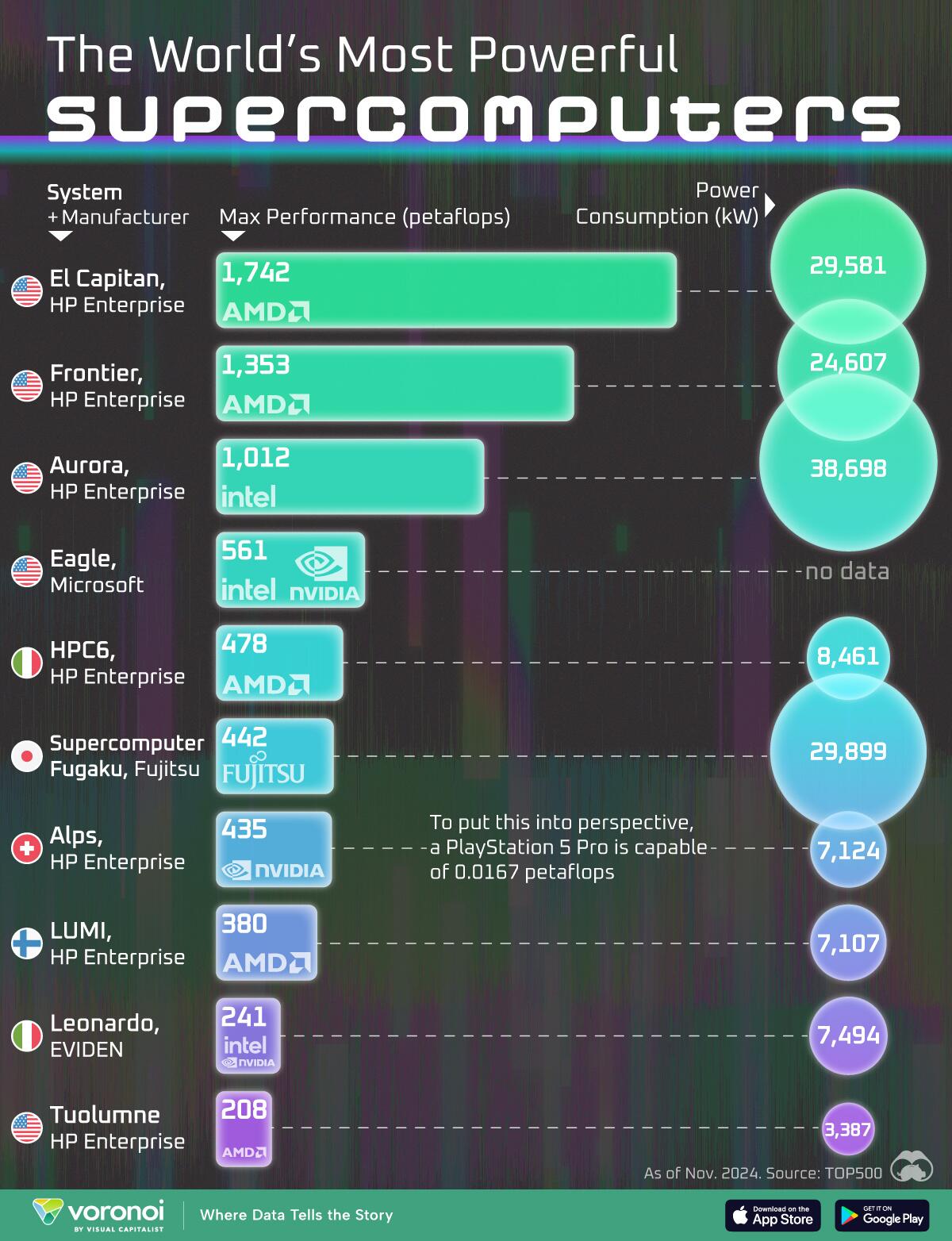
Data and Key Takeaways

The data we used to create this graphic is listed in the table below. Figures come from TOP500’s November 2024 ranking.
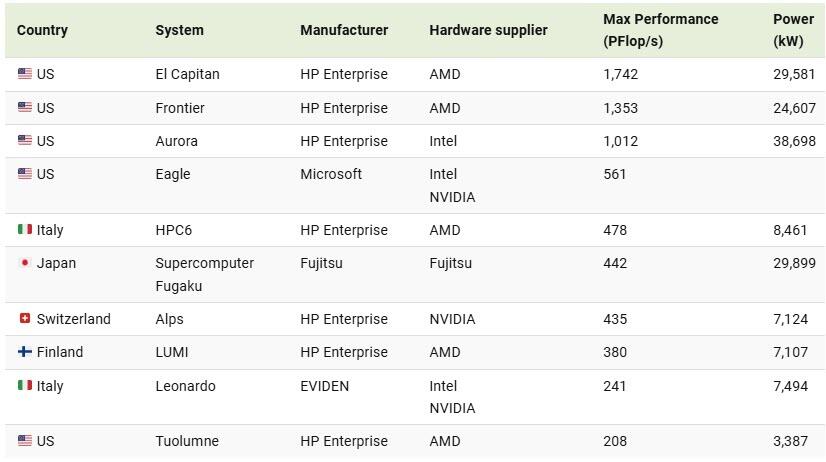
This ranking highlights America’s position as a global leader in computing power. For instance, the top three supercomputers are located in the U.S., and all of them are classified as exascale systems.

This is a significant change from the 2021 ranking, in which Japan’s Supercomputer Fugaku held the top spot.

The winner of this year’s ranking is El Capitan, which became operational in 2024 and is the third exascale system deployed by the United States.

Sponsored by the U.S. Department of Energy, El Capitan was manufactured by HP Enterprise Cray and features an unknown number of AMD Instict MI300A accelerated processing units (APUs).

More

I remember for decades it was IBM or Cray. It was kind of a bragging right. Years of mismanagement (Rometty) and I guess different priorities, but still isn’t what you have been known for since the 60’s?

Doing a Joint Announcement With The Competition, How to Cooperate

Recently, I’ve done joint announcements with Oracle, SAP, HP, Tibco, Software AG and HP. As you can imagine, I’ve had varying relationships with each and I’m happy to report that the state of the A/R industry is good and that we can work together.

When I was in PR, here is the link to the cat fight supreme with territorialism and turf wars. Most of the announcements I did with these companies when in Analyst Relations didn’t have that element. For the most part, the announcements were about standards, not products. So that went a long way towards working together. Still, if you include IBM, the companies I’ve named here aren’t known for being best buddies.

As an aside, I can say that the executives (who can be the source of most problems) all worked towards the cause of the best briefing possible.  They were helpful in this instance.  Many times, they are the fly in the ointment.

Some things are given, like in a certain area (we just did SOA) the analysts know the exec’s by company and the exec’s know each other so I’m happy to report they acted like grown ups.

TURF WARS

With the typical name calling (from the CEO’s) and because of the belief in your own products, the first issue to overcome is that the announcement is usually about a jointly created product or standard, not us vs. them.  That rule has to be set down first and if you don’t overcome that, you have no chance at building trust, the basis for working together.

DIVIDE THE DUTIES

One company can’t dominate the duties or it is not a joint announcement.   This also forces the companies to work together to approve what the others have created as their part of the announcement.   There are analyst lists, invitations, charts, follow-up issues and any number of duties that need to be attended to and dived up.  Once that is done, you must rely on each other and the level of trust inherently rises.

THE ANNOUNCEMENT

It’s important that the analyst see this as equal among the companies.  One company presenting more than another is a dead give away.  You can’t help Q and A as the analysts will direct the question directly to a company.

LESSONS LEARNED

You either put your differences aside and work together, or you’ll never get anything done.  It’s tough to do when your day job is to hammer the company that you are working with other than on the joint effort.  These are the days of co-opetition though.  You learn to get along or you’ll never make it to announcement day.