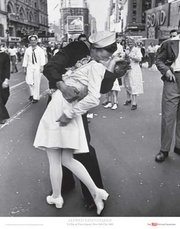
After a long battle with an enemy that would fight to the death rather than surrender, Japan signed an unconditional surrender to end WWII in the Pacific Theater.
Unlike the battle in the European theater which had previously ended, the Japanese fought on even when the result was known to both sides. It was a greater honor to die fighting, and the ultimate dishonor was to surrender. The US had to make an ultimate statement to convince Japan of the futility of fighting on, that total destruction awaited them if they didn’t give up the fight.
There was much happiness in the streets that it was over, but much work remained. The Allied forces occupied western Europe and Japan for some 10+ years (and still have a military presence) to help rebuild them and turn both into economic success stories as they embraced freedom, democracy and capitalism. I wonder if these lessons will be learned in the middle east?
Truly a turning point in the history of man with the ushering in of the nuclear age. Fortunately, it hasn’t been used again, but we’ve lived under the threat of nuclear “mutual self destruction” since then. Through the cold war to the bullying threats of North Korea and Iran, it stays in the back of our minds that the splitting of the atom is either an environmentally useful source of energy or a terrible weapon.
While many died at Hiroshima and Nagasaki (the second bomb did not strike it’s intended target so casualties were less than the first bomb), historians agree that it saved civilian lives by stopping the invasion of Japan by the Allied forces from fighting an extended battle. The Japanese have a proud history of being great warriors going back to the times of the Samurai, so giving up was not in the battle plan. Their will to perservere had to be broken or the invasion was inevitable.
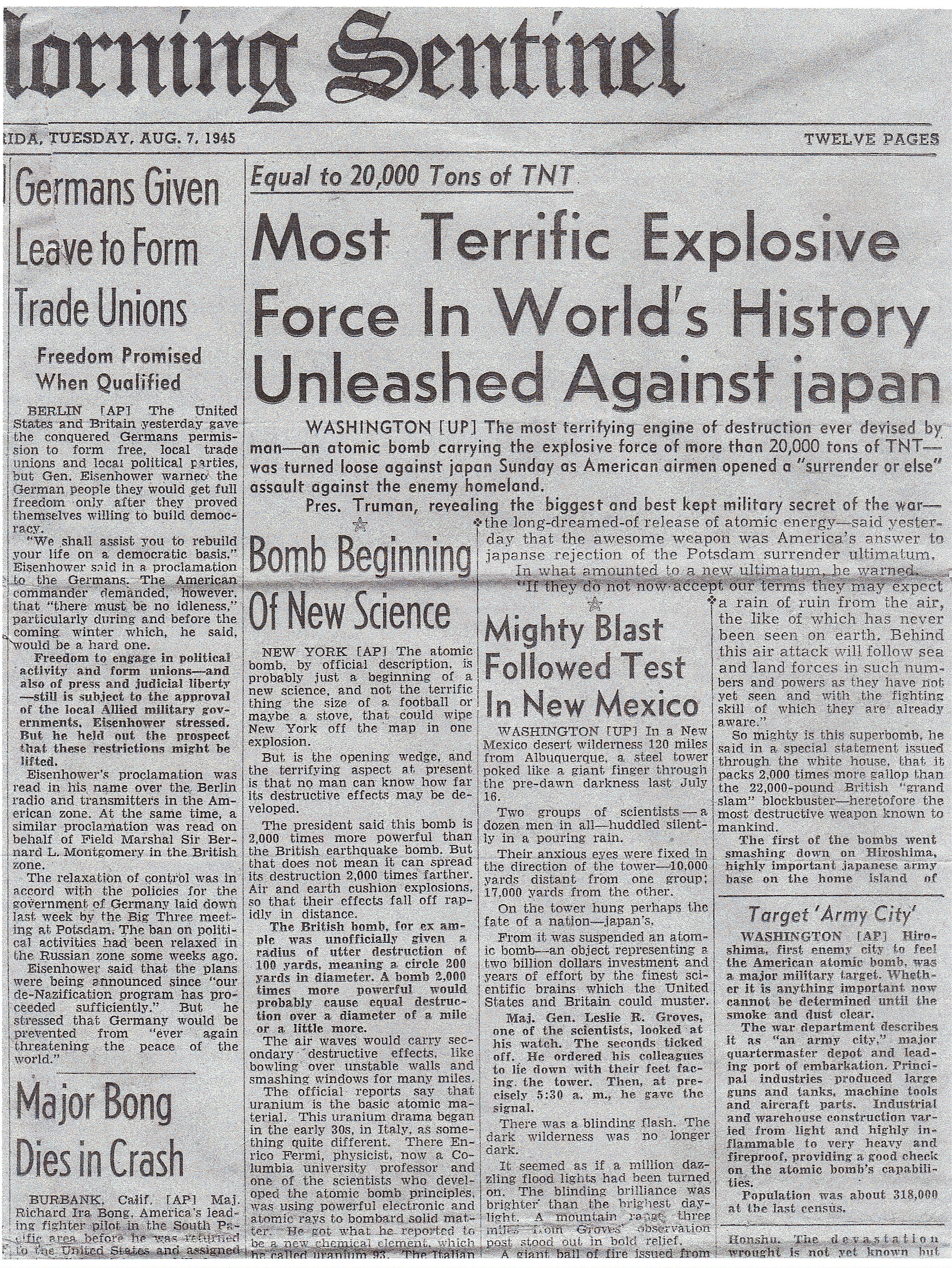
I ran across an archive of the story dated August 7, 1945 from the Orlando Sentinel when going through my father’s archives, which even then didn’t describe the magnitude due to the secrecy of this project. We had to hide the development from our enemy and use our ingenuity to create it before Hitler had the weapon, our then greatest fear.It’s a good thing the NY Times didn’t know about it and publish the story prior to attack. Interesting that it describes the target as an Army city.
It is known that the fuse for the bomb fuse was radio proximity technology, which my father helped develop during the war.
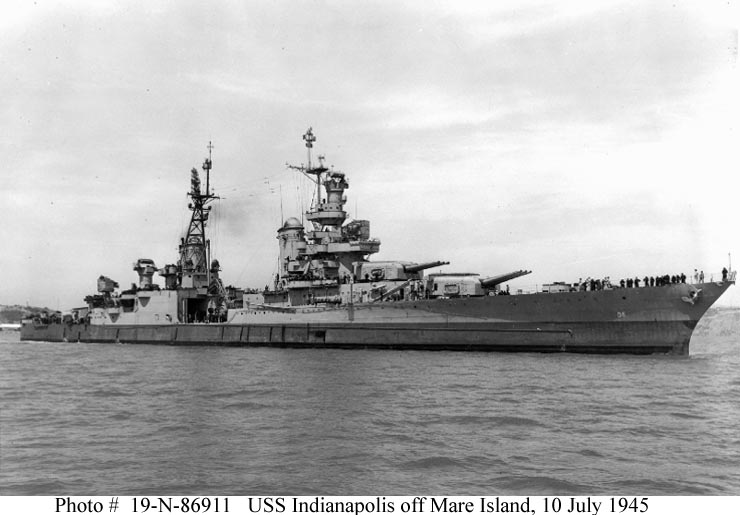
On July 30, 1945, the USS Indianapolis was sunk after delivering the Hiroshima bomb on a super secret mission. So secret, it was days before it was even noticed missing.
When it was hit, 900 of the 1196 men went into the water. Less than 300 came out when they were sighted by accident and rescued after those horrible days. If you recall the movie Jaws, Quint told the story of what happened to the men. Although some died from the torpedo blast, most drowned or were taken by sharks. I always thought as a kid that being eaten was the worst way to go, but I was thinking Lion at the time.
I watched a show on the History Channel about this fateful voyage. Most of the men didn’t even know that they were delivering the “bumb” as Quint called it.
Here’s the description from the movie that tells the gruesome details:
Hooper: You were on the Indianapolis? Brody: What happened? Quint: Japanese submarine slammed two torpedoes into our side, Chief. We was comin’ back from the island of Tinian to Leyte… just delivered the bomb. The Hiroshima bomb. Eleven hundred men went into the water. Vessel went down in 12 minutes. Didn’t see the first shark for about a half an hour. Tiger. 13-footer. You know how you know that when you’re in the water, Chief? You tell by looking from the dorsal to the tail. What we didn’t know, was our bomb mission had been so secret, no distress signal had been sent. They didn’t even list us overdue for a week. Very first light, Chief, sharks come cruisin’, so we formed ourselves into tight groups. You know, it was kinda like old squares in the battle like you see in the calendar named “The Battle of Waterloo” and the idea was: shark comes to the nearest man, that man he starts poundin’ and hollerin’ and screamin’ and sometimes the shark go away… but sometimes he wouldn’t go away. Sometimes that shark he looks right into ya. Right into your eyes. And, you know, the thing about a shark… he’s got lifeless eyes. Black eyes. Like a doll’s eyes. When he comes at ya, doesn’t seem to be living… until he bites ya, and those black eyes roll over white and then… ah then you hear that terrible high-pitched screamin’. The ocean turns red, and despite all the poundin’ and the hollerin’, they all come in and they… rip you to pieces. You know by the end of that first dawn, lost a hundred men. I don’t know how many sharks, maybe a thousand. I know how many men, they averaged six an hour. On Thursday morning, Chief, I bumped into a friend of mine, Herbie Robinson from Cleveland. Baseball player. Boatswain’s mate. I thought he was asleep. I reached over to wake him up. Bobbed up, down in the water just like a kinda top. Upended. Well, he’d been bitten in half below the waist. Noon, the fifth day, Mr. Hooper, a Lockheed Ventura saw us. He swung in low and he saw us… he was a young pilot, a lot younger than Mr. Hooper. Anyway, he saw us and he come in low and three hours later a big fat PBY comes down and starts to pick us up. You know that was the time I was most frightened… waitin’ for my turn. I’ll never put on a lifejacket again. So, eleven hundred men went in the water; 316 men come out and the sharks took the rest, July the 30th, 1945. Anyway, we delivered the bomb.
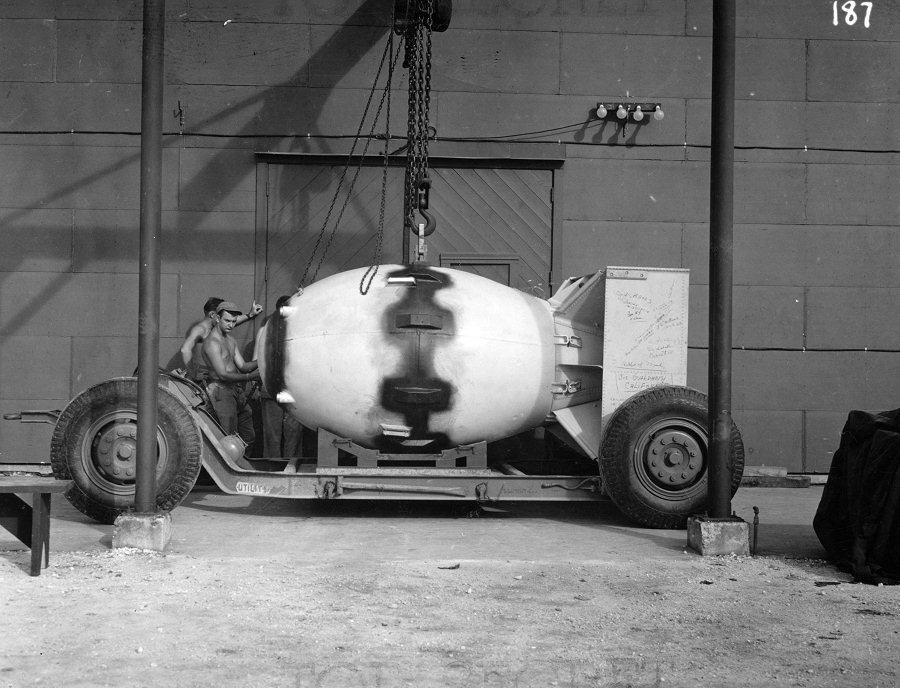
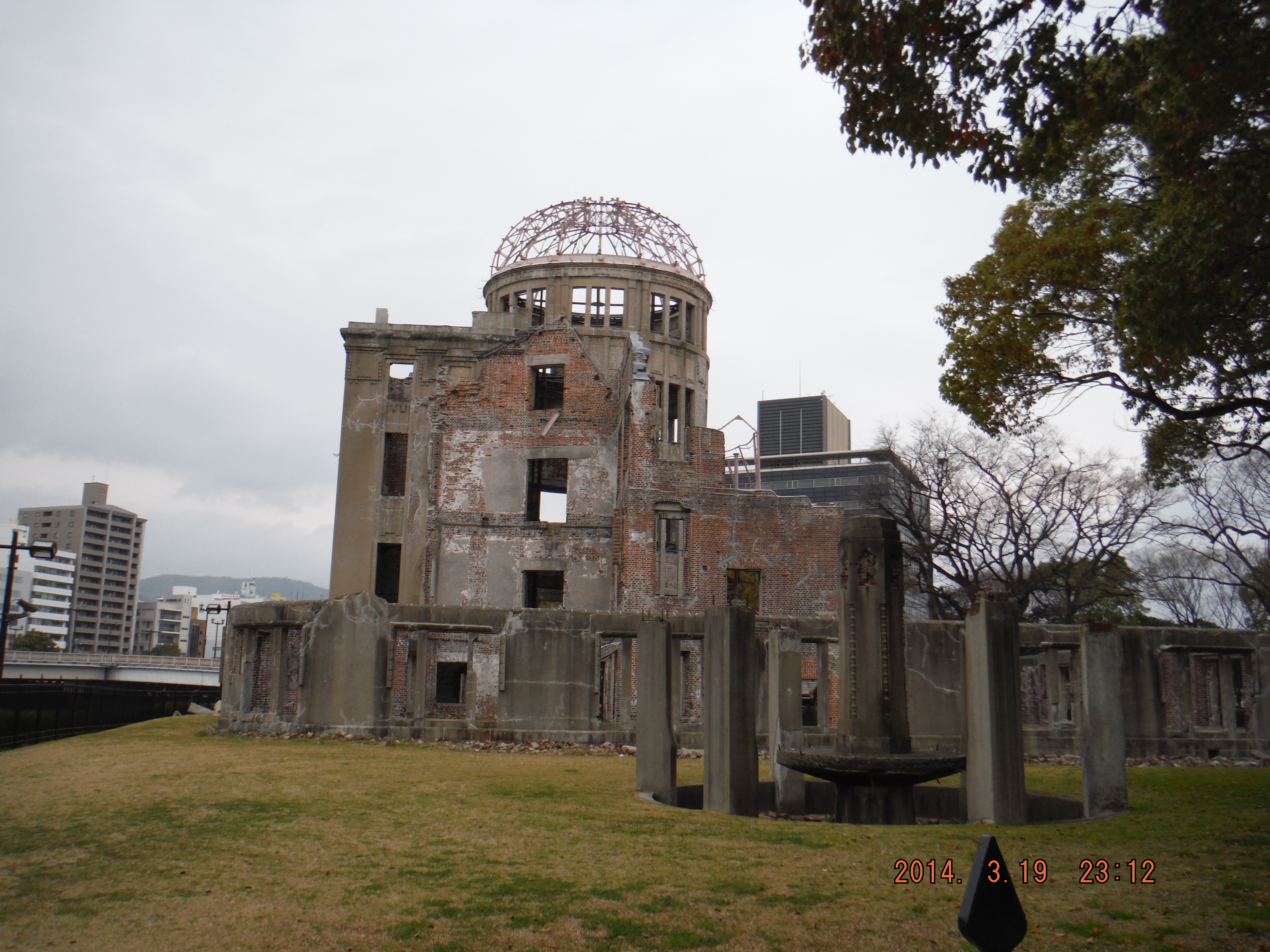
Here is a picture of the Fat Boy bomb that was on the Indianapolis. I recently visited ground zero and the Hiroshima museum. It made it clear from the pictures of women, kids and old people who were being trained to fight as both sides anticipated an invasion.
Ground Zero where it was dropped:
Shortly after this, the bomb was dropped and the war in the pacific theater was over. God bless those men who made the ultimate sacrifice for peace and freedom. They saved millions of lives as the Japanese were preparing to kill or die in an invasion. Upwards of 2 million lives were saved.
Nagasaki was chosen as the next target as it was mainly occupied by military forces, so it was both strategic and civilian collateral damage was held back.
Further, evidence was found that the Japanese had their own nuclear bomb and tested it on the Island of Hungnam days after the “bomb” was dropped on Hiroshima. So this act not only saved millions of lives, it now appears to have stopped a nuclear war. Reporter David Snell has documented this.
DID IT SAVE LIVES?
If you look at the last battle before dropping the bomb which was Okinawa, it was one of the most bloody battles of the Pacific. Japan would have been worse for both the US and the Japanese.
There were also some 2 million Japanese soldiers fighting throughout the Pacific, China and Burma — and hundreds of thousands of Allied prisoners and Asian civilians being held in Japanese prisoner of war and slave labor camps. Thousands of civilians were dying every day at the hands of Japanese barbarism. The bombs stopped that carnage as well.
The Soviet Union, which signed a non-aggression pact with Japan in 1941, had opportunistically attacked Japan on the very day of the Nagasaki bombing.
By cutting short the Soviet invasion, the bombings saved not only millions more lives, but kept the Soviets out of postwar Japan, which otherwise might have experienced a catastrophe similar to the subsequent Korean War.
World War II was the most deadly event in human history. Some 60 million people perished in the six years between Germany’s surprise invasion of Poland on Sept. 1, 1939, and the official Japanese surrender on Sept. 2, 1945. No natural disaster — neither the flu pandemic of 1918 nor even the 14th-century bubonic plague that killed nearly two-thirds of Europe’s population — came close to the death toll of World War II.
Perhaps 80 percent of the dead were civilians, mostly Russians and Chinese who died at the hands of Nazi Germany and Imperial Japan. Both aggressors deliberately executed and starved to death millions of innocents.
World War II was also one of the few wars in history in which the losers, Japan and Germany, lost far fewer lives than did the winners. There were roughly five times as many deaths on the Allied side, both military and civilian, as on the Axis side.
It is fine for Secretary of State Kerry and President Obama to honor the Hiroshima and Nagasaki victims. But in a historical and moral sense, any such commemoration must be offered in the context of Japanese and German aggression. What the president forgot were these actions that were stopped at Hiroshima:
He forgot the Bataan Death March conducted by the peaceful Japanese war machine.
He forgot the Sandakan Death March
He forgot murder and cannibalism on the Kokoda Track.
He forgot conscripting women for sexual slavery in Japanese Army brothels.
He forgot the mutilation and murder of Dutch civilians in Borneo.
He forgot the murder and cannibalism of captured American pilots.
He forgot the murder of American pilots and air crew at Midway.
He forgot the bombing of the hospital ship Manunda.
He forgot the sinking of the hospital ship Centaur.
Nazi Germany and Imperial Japan started the respective European and Pacific theaters of World War II with surprise attacks on neutral nations. Their uniquely barbaric war-making led to the deaths of some 50 million Allied soldiers, civilians and neutrals — a toll more than 500 times as high as that of Hiroshima.
The crews that dropped the atomic bombs on Hiroshima and Nagasaki were seen by Americans as saviors for ending the war. But over the years, the morality of atomic warfare and the need for the bombings has been questioned.
Mr. Van Kirk joined his fellow crewmen in unwavering defense of the atomic raids.
“We were fighting an enemy that had a reputation for never surrendering, never accepting defeat,” he said. “It’s really hard to talk about morality and war in the same sentence.”
He continued: “Where was the morality in the bombing of Coventry, or the bombing of Dresden, or the Bataan Death March, or the Rape of Nanking, or the bombing of Pearl Harbor? I believe that when you’re in a war, a nation must have the courage to do what it must to win the war with a minimum loss of lives.”
Nowadays, many question whether those bombs were necessary. Given that they killed almost exclusively civilians and that the second of the two was dropped only two days after the first, many people have concluded that the attack was immoral. Today, the typical American is likely to react to the words “Hiroshima” and “Nagasaki” with a vague sense that our country did something wrong.
But the nuking of Japan was a moral act: war is hell for those who do the actual fighting, so those two bombs put an end to their suffering. This was true for the soldiers on both sides (even a Japanese soldier must have felt relieved to know he was going to survive unscathed). A purely theoretical model for explaining why dropping nukes was bad appeals only to those who have no skin in the game.
The Japanese war had already killed millions, most of whom were civilians. The two nukes killed 140,000. Do the math. It is a distasteful application of arithmetic, but it is an application that soldiers have to do all the time in their struggle to win a war.
Takeru Kobayashi defends his title for the 6th year in a row by downing a new world record 53 and 3/4 hot-dogs in 12 minutes, narrowly edging out Joey Chestnut (50 dogs) and maintain his status as the champion eater in the International Federation of Competitive Eating. Sadly for the viewers, there were no “Reversals of Fortune”. There are 17,120 calories, 830 grams of Fat and 24,075 mg of sodium, versus a daily recommended intake of 600 in that many dogs. Tour de France.
Through 3 stages of the tour, there has been 3 different Maillot Jeunes or yellow jerseys….That’s the leader for NASCAR fans. It will be back and forth until stage 7, the time trial. That’s the first separation of the men vs. the boys. Three riders fell and broke collar bones in today’s stage, the scourge of tour riders. Muslims rioted in Paris again. Riots, work boycotts, whatever.
I’m taking a quick break from RSDC to pay homage to a very important day in history, without which we might not be here blogging at Disney. D-Day was a turning point in World War II where so much could have changed for the worse except for the bravery of so many men from many countries to fight for Freedom.
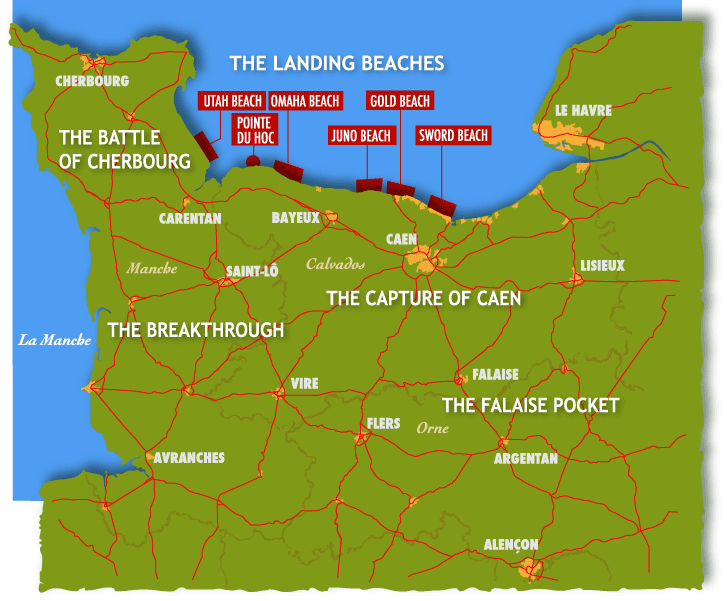
For History buffs, here is the battle plan. So much could have gone wrong, including the weather which didn’t cooperate. Many died in the surf never having made the beach due to the fortified Nazi bunkers. But soldiers who were high school students and factory workers just weeks ago, showed courage that in a way saved the world. They took the beach, then fought to Germany and secured the European theater.
Here is a visual of the battle plan.
So I salute those who made the ultimate sacrifice for the rest of us. May we be thankful for their efforts and appreciate their contribution to our freedom.
Today is Memorial day here in the states. It is the day that we remember the 800,000+ who gave their lives, paying the ultimate sacrifice for the freedom of America and other countries. Although this is an American remembrance, many from other counties also died for our freedom.
I shed a tear in church yesterday, the first since my fathers funeral. They called up the soldiers who were in either the Army, Navy, Airforce, Coast Guard or Marines and played their theme song. I was very proud to be an American and thought of the many they served with who couldn’t make the walk to the front of the church. It was a wake up call that we live in the land of the free and the home of the brave. We were also reminded that another paid the ultimate sacrifice for us 2000 years ago on the cross for our freedom.
But today is the day we stop to recognize that freedom is not free. It is defended by those who are brave. Many went to serve their country and didn’t return so that we can think and say what we want without a cruel dictator or regime censoring it, and many have tried over the years. I for one am grateful.
I’m also lucky as two generations of soldiers before me served and lived so that I can type this. My Grandfather who was in the Calvary in WWI….
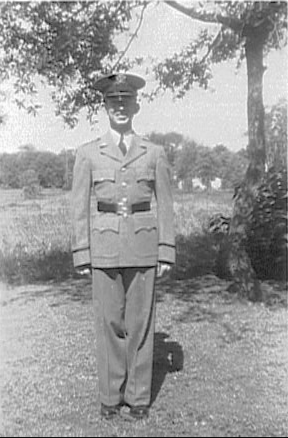
and my Father who served in WWII.
I was going through some old clippings and found one from the AP that documented my Dad’s efforts..
Today at 3 PM, there will be a moment of silence to honor and to remember these who didn’t ask to be chosen, but went anyway. Here is the text:
The White House Commission on Remembrance is an independent government agency whose missions include:
Promoting the spirit of unity and remembrance through observance of The National Moment of Remembrance at 3 PM local time on Memorial Day;
Ensuring the nation remembers the sacrifices of America’s fallen from the Revolutionary War to the present;
Recognizing those who served and those who continue to serve our great nation and reminding all Americans of their common heritage.
So while we splash in the pool, eat at a cook out and enjoy our activities, let us not forget that it was paid for with a heavy price.
I was watching qualifying for the Coca Cola 600 and the first car that came out had, no kidding, CatDaddy Carolina Moonshine as the sponsor. What a great combination.
Recalling history, during prohibition, moonshine was run through the backwoods of North Wilksboro, North Carolina by the forerunners of Nascar. They souped up their cars to beat the cops, then boys being boys had to see who was the baddest…
As it turns out, the company only has 3 employees, but the town turns out to help when it’s time to bottle up this years batch.
Yes, the day before the attack on Pearl Harbor, Franklin Roosevelt signed the secret documents to not only fund the research for developing a nuclear bomb, but he changed the view of science, innovation and destiny. Now, humans had a means for self destruction. More important, it now focused the world on bringing scientists previously doing disparate research together to solve a situation. They had to take a theoretical concept to fruition.
Not only didn’t they know how to do it, they had to invent everything along the way such as the first reactor to test whether fission would even work, and did all of this under fear that the Nazi’s were ahead in this same project and would deliver the nuclear bomb to Hitler first. After only a year on December 2, 1942, the first test of a nuclear chain reaction was tested in unprotected blocks of graphite. Hiroshima was just around the corner.
If Leo Szilard and Enrico Fermi hadn’t delivered two letters to Roosevelt signed by Alfred Einstein declaring that this was not only feasible but possible (and Hitler might get it first and use it to control the world), the ways of innovation may have been different.
In 1961, John F. Kennedy declared that The United States of America would put a man on the moon by the end of the decade, at a time where less computing power was available than in today’s simple GPS units. Again, much would have to be invented and built just to be able take the next step. We went from not being able to put a Satellite to another of the greatest feats in innovation.
The US came from having only the V2 rocket remains and Werner Von Braun to putting Neil Armstrong and Buzz Aldrin on the moon in 1969. For what it’s worth, my father worked in White Sands, New Mexico preparing the site and delivering the V2, the beginnings of America’s space program. Along with Neil Armstrong stepping on the moon, we have velcro, microwaves, spandex, freeze dried food, wireless telecommunications and it sped up the progress of computers, all resulting from moon rocket innovation. Oh and IBM was instrumental in the design, development, innovation and execution of the moon rocket program.
Much of this focused discovery and innovation now is in the private sector. BusinessWeek just published a story on the World’s most Innovative Companies. In the top ten were companies you’d recognize like Apple, Research in Motion, 3M. Others were interesting picks like Toyota and BMW. Toyota for having developed the Prius and driving research down to the development cycle with suppliers to save on all parts. Untold in the story is the $500 million that it is spending in Formula 1, the testbed of development and innovation for cars.
A newby and somewhat interesting company was Starbucks, whose use of Ethnography to fuel it’s innovation.
Leading off the story and in the top 10 was IBM, but for a company that has been around for decades, it shows staying power. IBM has reinvented itself a number of times, for example when committing from a typewriter and tabulation to a computer company in late 50’s/early 60’s, long before most on the list were even companies.
IBM is so focused on innovation that it was the theme of this years Leadership Forum in Rome held recently. To quote Businessweek, “IBM CEO Samuel J. Palmisano had made the day before: “The way you will thrive in this environment is by innovating — innovating in technologies, innovating in strategies, innovating in business models.” This doesn’t mean relying on a status quo maintenance model of business, rather to be like the Manhattan project, gather the best minds and drive to success, inventing and developing along the way. Of the top 10, only IBM, P&G and Nokia had all three Product, Process and Business model best practices.
What is interesting to me is that the chips that are in most of the computers, cars and maybe even a coffee maker, much of the technology in the computers that did the design of the products and software development of the companies in the top 100, came from IBM.
…I present you this flag in recognition of your husband’s heroic service to our country. Please accept our deepest sympathies on the loss of your husband, a soldier of the United States of America. And as I think back on it, it is an honor that the President was George W. Bush, not the current president. These powerful and moving words were spoken at my Dad’s internment when the Veteran’s Administration gave an American flag to my Mom. Those who know me know I bleed Red, White and Blue, so this is particularly meaningful to me. Having faith in God and belief in where Dad went and why, I grieved at losing him, but I took comfort in his new happiness. I’d like to publicly thank everyone who was kind enough either via this blog, email or other forms of communication to offer their condolences to my family and me on the loss of my father. Almost to a person, each boldly offered thoughts and prayers, which for me was quite comforting and heartfelt in these PC days. For the record, it was as tough a thing to go through as any I’ve faced. In closing, here is the letter he received from Harry Truman for his service in WWII. “To you who answered the call of your country and served in its Armed Forces to bring about the total defeat of the enemy, I extend the heartfelt thanks of a grateful nation. As on of the nation’s finest, you undertook the most severe task one can be called upon to perform. Because you demonstrated the fortitude, resourcefulness and calm judgment necessary to carry out that task we look to you for leadership and example in further exalting our country at peace.”
Take a dominant company with a large market share with essentially a proprietary product and have it grow to a large enough size based on a subscription or renewal/upgrade model, and you have either pre-Gerstner IBM or Microsoft today.
I have questions after hearing Vista is delayed, like how long can you miss your product introductions and keep credibility happy customers before they search for options (Linux, Workplace, name your new desktop platform here)? Um Bill, when Lou Gerstner took the reigns, people who missed deadlines had a career decision made for them as opposed to the pre-Lou years when things just went as they went. Look where that got us.
How long before external issues begat internal strife? Mini-Microsoft describes some management issues here calling for the leadership to be fired now.
How long before it affects your other products like Office? (StarOffice, OpenOffice anyone?)
Peter would be rolling in his grave right now to see this happening all over again. IBM went through this and almost didn’t survive. I’m not predicting a company death here, but if something doesn’t change, the market will change it for them as we vote with our dollars. Doesn’t anyone learn from history?
There are too many competitors out there today Microsoft, I know Steve Ballmer is firing shots across the bow at IBM, but I think that Oracle, Apple, Google and a host of others have more marketshare in mind than gathering crumbs under the Microsoft Thanksgiving table. Next time you shoot at IBM, you should look in the mirror and think if the following words mean anything to you? They do to the customers, the industry and history…..
Proprietary, Monopolistic, Bureaucratic, Schizophrenic about the competition.
Competition is good. It promotes Innovation and lower prices, oh yeah, it delivers your products on time or you get a career decision made for you.
Since plagiarism is a form of flattery, I took this idea from Grady Booch who reads a lot also. I always have about five or more books going at any time so I thought I’d post the current ones, lest anyone think I was getting too interesting.
Porsche Prototype Era 1964-1973 in Photographs by Bill Oursler, I love cars and history, and this let’s me relive my childhood, teens and early twenties regarding testosterone cars and incredible German engineering.
Sports Racing Cars by Anthony Pritchard, more history, more testosterone, this time going back to 1923 and covering all great sports cars.
Blink by Malcolm Gladwell (the author of the Tipping Point). A great discussion of Thin Slicing to make decisions on people and things. I’m reading this to write Not All Geeks are Wimps,Part II.
The Siege of Rabaul by Henry Sakaida, about the pacific theater from the Japanese point of view as warriors in WWII.
The World of Byzantium by Professor Kenneth W. Harl, Tulane University. The fall of Rome and the beginnings of the Eastern and Western Empires. It’s a university course that teaches how we got from then to now in Europe, Middle East, Africa and parts of Asia.
The Battle for the Beginning by John MacArthur, mostly about creationism and evolutionism, seems to be a hot topic these days.
The five love languages by Gary Chapman. It’s about marriage and how to communicate to your mate in his/her “language”.
How to Bring Your Children to Christ by Ray Comfort. You never can read enough on how to raise kids, they don’t come with a manual when they are born.
Last night, I took my family to the rodeo, the World’s Toughest Broncs and Bulls championship tour. Good wholesome family fun, and more pairs of Wangler Jeans, Justin Boots, big belt buckles and John Deere/camo-huntin’/fishin’/ Stetson Hats in one place than any Outdoor store. Boy did I feel at home.
Talking about culture, the jeans all fit where they should have rather than the prison girlfriend barely hanging on for dear life oversized tent pants that you see glorified on TV/video’s/movies and in high schools.
What a hoot! Bareback and saddle bronc busting,
Barrel racing by Cowgirls,
and the longest 8 seconds of life – Bull riding.
We’ve always had a love affair with Cowboys, and these were the real thing, not the farce that the recent movie Brokeback Mountain has tried to portray. The announcer joked about this movie and killed the crowd with laughter. They knew the truth. This was a packed house of families having a ton of fun. We sure did.
From the looks of these shots, there are some sore cowboys and backsides today. This was a competition tour for money, but think back to the old west when they had to break horses and herd cattle to live. Today, we’re desk jockey’s.
Here are some Cowboy facts, more of us could use these:
1. They were never looking for trouble.
2. But when trouble came, they faced it with courage.
3. They were always on the side of right.
4. They defended good people against bad people.
5. They had high morals.
6. They had good manners.
7. They were honest.
8. They spoke their minds and they spoke the truth,
regardless of what people thought or “political correctness,”
which no one had ever heard of back then.
9. They were a beacon of integrity in the wild, wild West.
10. They were respected. When they walked into a saloon
(where they usually drank only sarsaparilla),
the place became quiet, and the bad guys kept their distance.
11. If in a gunfight, they could outdraw anyone. If in a fist fight, they could beat up anyone.
12. They always won. They always got their man. In victory, they rode off into the sunset.
Richard Pryor 1940-2005. One of the true trailblazers in the comedy profession. Numerous comedians benefitted from his routines and the new ground that he broke.
He also fought several personal demon’s, but who has had a life paved with gold the whole way. It was from those demons and the personal struggles that some of his funniest sketches came from. Like the time he shot his car, or when he ran down the street on fire. Most of us would never want anyone knowing how we had fallen down, but Pryor made us laugh at it because the way he told it was hilarious.
He also broke down many racial barriers, poking fun at everyone, again in a way that was as ingenious as it was true.
A lot of people have him to thank for the careers that they have now. Me, I had a lot of laughs.
A question that has interested historians and researchers for decades is: why? Why did Japan launch an attack that, in hindsight at least, they clearly had no chance of winning? The obvious answer is that they thought they could, but military and naval strategists know the answer is not so simple.
Precisely because its resources were so depleted by the war with China, it is accepted wisdom that Japan was hoping to expand its territories in the Pacific. If these areas belonged to Japan, they would, almost by default, become customers for Japan’s industrial and resource sectors.
But the Japanese underestimated America’s resolve to defend itself, for however long, and by whatever means necessary. If Japan hoped that America might take a “c’est la vie” attitude to the prospect of losing a battle in the Philippines, it was sorely mistaken. Nor was America still weary from the First World War.
Japan also underestimated the extent of Americans’ outrage at the bombing in 1941. It fueled the nation’s desire to win at almost any cost. No democratic government on earth can move forward without the will of the people, and after Pearl Harbor, the American people’s will was ferocious.
Here is the text and a link to the speech that FDR made after the attack at Pearl Harbor.
I read the Biography of Admiral Yamamoto, the architect of the attack. He believed that the only way to defeat the United States of America was a surprise attack that would disable our military in the Pacific. He clearly stated that he feared that if the attack was not completely successful, it would awaken a sleeping giant that the Empire of Japan could not defeat in standard battle. It must haunt his legacy.
Tactically, the mistake was not destroying the aircraft carriers which were out at sea that day or his plan may have succeeded.
As it turned out, he was shot down only a few years later in a surprise attack by a squadron of P-38’s heading to an inspection in the Pacific.
I find ironic the words of the second half of the speech, if applied to 9/11, would be appropriate. Also ironic is that Japan was extending its reach for economic resources.
The United States was at peace with that nation and, at the solicitation of Japan, was still in conversation with its Government and its Emperor looking toward the maintenance of peace in the Pacific. Indeed, one hour after Japanese air squadrons had commenced bombing in Oahu, the Japanese Ambassador to the United States and his colleague delivered to the Secretary of State a formal reply to a recent American message. While this reply stated that it seemed useless to continue the existing diplomatic negotiations, it contained no threat or hint of war or armed attack.
It will be recorded that the distance of Hawaii from Japan makes it obvious that the attack was deliberately planned many days or even weeks ago. During the intervening time, the Japanese Government had deliberately sought to deceive the United States by false statements and expressions of hope for continued peace.
The attack yesterday on the Hawaiian Islands has caused severe damage to American naval and military forces. I regret to tell you, very many American lives were lost. In addition, American ships have been reported torpedoed on the high seas between San Francisco and Honolulu.
Yesterday the Japanese Government also launched an attack against Malaya.
Last night Japanese forces attacked Hong Kong.
Last night Japanese forces attacked Guam.
Last night Japanese forces attacked the Philippine Islands.
Last night Japanese forces attacked Wake Island.
This morning the Japanese attacked Midway Island.
Japan has, therefore, undertaken a surprise offensive extending throughout the Pacific area. The facts of yesterday and today speak for themselves. The people of the United States have already formed their opinions and well understand the implications to the very life and safety of our nation.
As Commander in Chief of the Army and Navy, I have directed that all measures be taken for our defense.
But always will our whole nation remember the character of the onslaught against us.
No matter how long it may take us to overcome this premeditated invasion, the American people in their righteous might will win through to absolute victory.
I believe I interpret the will of the Congress and of the people when I assert that we will not only defend ourselves to the uttermost but will make very certain that this form of treachery shall never endanger us again.
Hostilities exist. There is no blinking at the fact that our people, our territory, and our interests are in grave danger.
With confidence in our armed forces-with the unbounded determination of our people-we will gain the inevitable triumph–so help us God.
I ask that the Congress declare that since the unprovoked and dastardly attack by Japan on Sunday, 7 December 1941, a state of war has existed between the United States and the Japanese Empire.
Here is the only color film of the event. Listen to how excited the Japanese are and their commitment to give everything, including lives to this war:
Today is Veterans day, formerly Armistice day, to remember as Ralph Bennett puts it, “recalling that the massive blood-letting of the First World War ended precisely at the eleventh hour of the eleventh day of the eleventh month, November 11, 1918.”
Sgt Major Michael Gravans says, “after the ceremony he believes that Americans these days are thinking about veterans more and thinking better of them, “probably better than any time since World War II.”
But as new generations join the military, they need to be told of the sacrifices of those who have gone before them. “And I, as a leader, need to help them understand that sooner rather than later.”
Lt. Col. Michael Shinners, the brigade’s rear detachment commander, gave a brief history of Veterans Day to those gathered, tracing its history to the armistice signed following World War I.
Memorial Day, he said, is for those who have given their lives while serving their country. Veterans Day is for those who proudly served their country and those still serving.
Here is a link to some Veterans Day notes, blogs and activities…
Until today, I didn’t know he even lived. But the patriotic furnace inside of me burned when I read that he was one of the 7 remaining French veterans of WWI. My Grandfather fought in the Calvary for the US, enlisting as 18, but really was younger than that so he could serve his country.
It’s soldiers like that who’s sacrifices allow us the freedom we enjoy on the internet, speech and just about everything else in the free world.
Because of guys like Rene Moreau, I’m not typing in a Central Power language, or an Axis language only years later.
Today, I attended the 40th anniversary of RTP at the IBM site. There was a band playing music from the 60’s (On the Boardwalk, Sugar Sugar, My Cherie Amour) and food at 60’s prices. Here’s the advertisement for it:
On Thursday, September 22, IBM in the Triangle Area will observe the 40th Anniversary of its groundbreaking for the IBM RTP site. To celebrate this anniversary, we have an exciting event planned for all IBM employees in the building 002 courtyard from 11:30 a.m. to 1 p.m. Come enjoy a special, “1960’s prices,” luncheon menu, free IBM birthday cake, the finals of our IBM karaoke contest, a classic car show, skits and much, much more.
One of my favorite parts was the Gilligan’s Island event. 3 people were in rafts and the crowd got to shoot water balloons from bungee cords at least 50 yards away. I think one balloon made into a raft. One balloon went off target into the hot dog line. I would have shot them at the biggest crowd I could have found to watch them scatter like roaches in the morning when the lights turn on.
40 years is a long time. I read today that Tech companies rated RTP as the best place to have a company. I think it was woods or pasture 41 years ago. Now it has more Ph.D’s then almost anywhere else given the proximaty to Duke, UNC Chapel Hill, NC State and Wake Forest. Here’s the link to the story. http://www.newsobserver.com/business/story/2800957p-9243923c.html
So where did I fit in? I was in the car show. When I was 7, my dad bought this car.
(Photo by Dave Brainard)
It was his pride and joy. He willed it to me once he no longer could drive. I have kept it up in his memory and have entered it into car shows with good results. I’ve blogged about my Dad already and his WWII contributions:
There were other cars at the event.
Chris Bannister – 1967 Chevrolet Camaro
David Bannister – 1967 Chevrolet Camaro
David Brower – 1958 BMW Isetta 300 Deluxe
George Kavelak – 1967 Chevrolet Chevelle Super Sport
Clifford Meyers – 1966 VW Beetle
Mike Petersen – 1966 Dodge Coronet 500
The Coronet and the Chevelle SS had 427 and 426 cc engines (that’s 7 whopping liters), real get up and go. Good ole American grunt.
If you read the internet jokes that get passed around, one of them is why it’s great to be a guy. On this list is….you get to play with toys all your life. Today is a prime example, and yes is it great.
I’ll leave you with the text on the sign that I had made, which I use when showing the car.
(Photo by Dave Brainard)
1964 PORSCHE 356C
This car is kept in Historical condition. It was delivered in 1964 to its owner, my father who drove it for 38 years. The one and only mechanic to service this car until 2002 was originally employed by the Porsche factory until his relocation to Florida. This same mechanic also helped the factory racing team at the 24 Hours of Daytona and 12 Hours of Sebring in the preparation of legendary racers such as the Carrera 6, 910, 907, and 908.
It was given to me in 2002 and is kept in it’s original condition to honor the people who built this car, the mechanic that kept it in proper condition and my father.
I recently saw a show on the History Channel about the 5 deadliest weapons ever used. In no order, they were the Soviet 50 kiloton nuclear bomb, incendiary weapons, the VT fuse, machine gun and VX nerve gas. Why does this concern me? My dad helped the development of the VT or Radio Proximity fuse.
For a more detailed explanation of this, go to Radio Proximity Fuse. The net explanation is that instead of having to hit the target for a kill which was the centuries old way, the VT fuse detects a target by radar and detonates near (or in proximity) to the target, enabling a much higher kill rate.
So who cares?
It took over 2000 rounds to shoot down each kamikaze plane prior to the invention of the fuse. This was cut to under 400 rounds when using the VT fuse. It’s next to impossible to hit a plane diving at over 450 mph. This invention saved a lot of sailors lives who later came home and had families rather than having to pay the ultimate sacrifice. They cared.
Here’s what my Dad contributed. He helped with the testing and development of the Radio Proximity fuse at the Applied Physics Lab in John’s Hopkins University. Later he went to the European theater where he trained artillery units to use this device. Remember, they had no silicon chips, PC’s or CAD programs in 1941/42, they did it with slide rules and vacuum tubes.
Why does this matter?
The Germans were shelling London with the V1 “buzz bomb”. It was powered by a pulse jet that made a buzzing noise which gave it the name. When it ran out of fuel, the buzzing stopped and it fell to its target. The V1 traveled at near 600 mph, which made it very difficult for artillery to hit, or fighters that went 350 mph to shoot down. The intentions of the Germans was both terror and destruction in London. Remember that terrorism is used to cause fear in the intended victim and take away the spirit to fight. I don’t know about you, but I would find the sound of an air raid siren or a buzz bomb engine that quit very frightening as you count it down to explosion.
The British had their backs against the wall and the Germans were starting to demoralize them with this scare.
With the VT fuse, the kill rate approached 100%, making the V1 ineffective as either a bomb, or a weapon of terror. The fuse was a big factor in the Battle of the Bulge, helping to decide the outcome (no disrespect to the tacticians and soldiers here).
The fuse on the Atomic bomb was a Radio Proximity Fuse. It helped end the war.
SO WHAT WAS DID HIS EFFORT DO?
His contribution helped change the tide, the momentum and win in both Theater’s of the war. His work helped stop the kamikaze and V-1 terrorism against the Allies.
Later in the War, he raced jeeps around the Arc de Triomphe in Paris, but that doesn’t have a lot to do with physics or winning the war.
Growing up, he like most veterans he didn’t say much or brag about what they had accomplished. Rather, he said he was doing his job and was glad to help contribute in whatever way he could. That we could all have that attitude.