
The Make America Health Again (MAHA) movement has made quite a few waves in 2025. And by the end of the year, it will make at least one more: HHS Secretary Robert F. Kennedy Jr. has announced new dietary guidelines that will revise or revamp existing Dietary Guidelines Advisory Committee (DGAC) reports.
While these new dietary guidelines have yet to be released, we have quite a few details on what to expect. Some people believe they may be misleading or even dangerous. But as a cardiologist and heart surgeon of 30+ years, I’m very optimistic they will help reduce our rates of heart disease.
Below, I break down the most important principles to know, plus the guidelines’ ramifications for American heart health.
One quick note: this is not intended to be political commentary. There are plenty of party-based perspectives on these dietary guidelines, and lots of opinions from all sides. My goal here is to examine the facts and provide my honest perspective.
RFK guidelines versus traditional nutrition advice
First, a little background.
The Dietary Guidelines Advisory Committee releases an updated nutrition guideline every five years. This is a 400+ page report you can access at dietaryguidelines.gov, although it isn’t intended for public use. Rather, it’s a boilerplate of Federal guidelines for things like school lunches, military rations, and government assistance programs.
But RFK’s guidelines are set to be significantly shorter — just four to six pages. The goal is to create a set of “common sense guidelines” that anyone can use to make decisions about their nutrition.
Again, the guidelines themselves have yet to be released. But we have a pretty good idea of what they’ll include.
Here’s a closer look at some anticipated changes so you can compare and contrast with traditional guidelines.
Emphasizes whole, real foods
Traditional dietary guidelines such as the food pyramid and MyPlate categorize foods by the nutrients they provide.
So for example:
- 6 servings of grains
- 2 servings of protein
- 2.5 servings of vegetables
- 3 servings oils and fats
What it doesn’t account for is the qualities of these foods, or how processed they are. Fruit and gel cups still count as a serving of “fruit,” while sweetened yogurt tubes and Goldfish count as dairy and grains, respectively.
You don’t need to be a nutritionist to realize this leaves a very large gap for interpretation.
Because people don’t eat nutrients, they eat food.
RFK’s proposed guidelines help eliminate this confusion by emphasizing whole, real foods over arbitrary classifications (like whether or not you got your “servings” of grain today). This is also much more scientifically sound; it goes beyond categorizing nutrient types and makes it easier to isolate ultra-processed foods, or UPFs.
The current administration plans to develop a “government-wide definition” for ultraprocessed food. This likely means a working definition for whole, real food as well.
In my opinion, establishing a definition for ultra-processed foods is a net positive for everyone. Not only will people know how to better avoid unhealthy options, but they can also significantly decrease their risk of heart disease.
Encourages more saturated fat
While RFK’s new dietary guidelines won’t focus much on specific nutrients, there is one component likely to be emphasized more than others. In his own words, “[these] new dietary guidelines that are common sense, that stress the need to eat saturated fats of dairy, of good meat, of fresh meat.”
RFK has gone on record multiple times explaining that animal-based products deserve a higher priority in the everyday diet. But animal-based products contain more saturated fat — something of a boogeyman in traditional guidelines.
If these new guidelines do raise suggested intakes for saturated fat, it will go against decades of advice from the US DGA, and this is concerning some nutritionists. For context, traditional US guidelines recommended an intake of 10% of daily calories. The American Heart Association recommends even less, around 6%.
But we don’t have any evidence to suggest that limiting saturated fat intake actually prevents heart disease. Plus, increasing saturated fat intakes from whole, real sources is unlikely to negatively affect heart health. If anything, it may improve it.
That’s because some of the highest sources of saturated fat in the US are pizza and ice cream. Sandwiches, desserts, and sweet snacks aren’t far behind. These are ultra-processed foods that will have other, more serious ramifications (like spiking your blood sugar, for example).
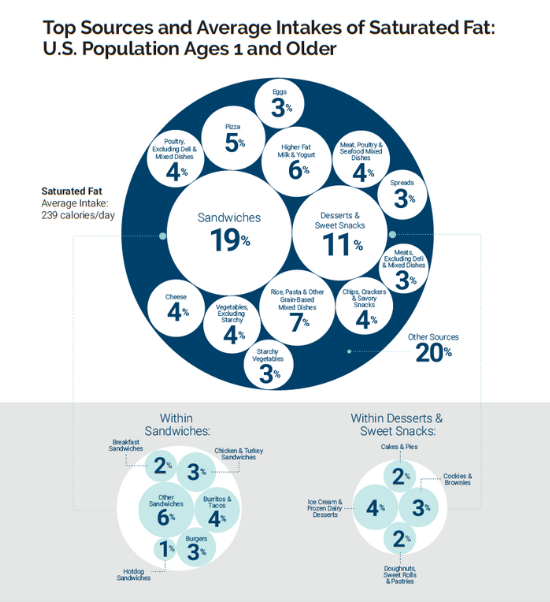
So what does this tell us? That whole, real foods like steak and eggs are not primary sources of saturated fat in the average American diet.
Demystifying saturated fat from whole, real food sources will play a substantial role in improving dietary quality and heart health.
What I’d like to see: A heart surgeon’s perspective on food guidelines
Contrary to popular belief, RFK Jr’s proposed dietary guidelines do not work adversarially to supporting heart health. I don’t say this flippantly, either: I am firmly dedicated to Making America Healthy Again, and will (and do) only support changes that match my research and opinions.
Here are the other components I would love to see added:
- Firmer guidelines about alcohol consumption. Alcohol is not your friend, and it certainly doesn’t do any favors for your heart. Adding educational information about how drinking interacts with heart health could be extraordinarily beneficial to those wanting to reclaim their metabolic health.
- A heavier emphasis on animal products. Many animal-based products make a world of difference in heart health maintenance and heart attack recovery. My hope is that the guidelines demystify animal products so they can become dietary staples instead of guilty pleasures. For example, eggs, milk, and ruminant meat such as beef, lamb, and venison.
- Education about limiting carbohydrate intake. People deserve to know how carbohydrates affect their bodies, and how overconsumption can lead to insulin resistance, inflammation, and heart disease. While not everyone needs to follow a low-carb diet, adding some concise information about how to avoid unnecessary starches could be enormously effective in limiting overconsumption.
Time will tell what the guidelines contain. We don’t have long to wait: they’re slated for release no later than the end of this year.
As we wait for its release, I highly encourage you to perform research of your own. I’ve written quite a few guides covering nutrition and heart health you can use to get more information.
Below are some resources to help get you started:
- Debunking Heart Disease Myths with Dr. Philip Ovadia
- Dr. Philip Ovadia Weighs in on Cholesterol & Carnivore Diet Controversy
- Is the European Diet Healthier Than the Standard American Diet?


 Delusions of Adequacy