
On Tuesday, I posited that the Pill may not only be driving women crazy, but it may also go a long way to explaining men’s declining sperm counts. Today, I’ve got a new theory about why men’s sperm counts are low and women struggle to get pregnant: It’s the underwear. While we’ve been focused on men’s tighty-whities as one of the problems behind their lower sperm count because they overheat men’s testicles, cooking sperm, the polyester that’s in almost everyone’s underwear may also be a problem.
In an era before “better living through chemistry” became a thing, to the extent people wore undergarments, they fit loosely and, of course, were made from natural fibers such as cotton, wool, linen, or silk. Having said that, chemistry began to infiltrate fabrics as early as the second half of the late 18th century, when arsenic was used to create a startling, very popular, and incredibly poisonous green dye. Alice in Wonderland’s Mad Hatter was also a victim of the mercury that hatters used to felt hats made from animal fur.
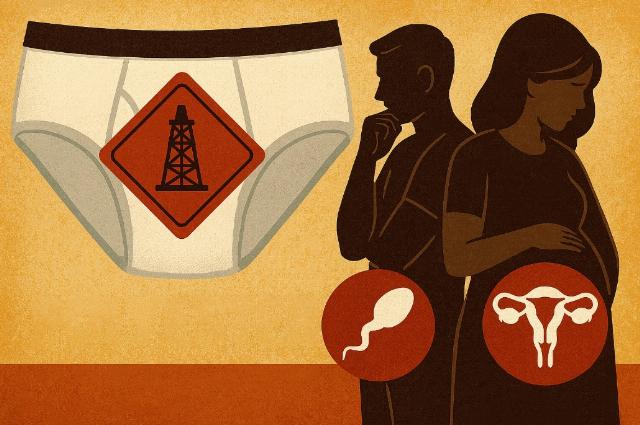
Image made using AI.
However, it was at the end of the late 19th century that chemistry and clothing really took off. The first artificial fabric was rayon, which Hilaire de Chardonnet developed in the 1880s using wood pulp. While wood is a natural product, the process to turn it into a thread was decidedly unnatural.
The next leap into artificial fibers was nylon, which Wallace Carothers, working at DuPont, invented in 1935. This fiber was ubiquitous in the years after WWII. Even growing up in the 1960s and 1970s, I remember everything being nylon, not just stockings. Nylon was entirely artificial, for it was made from petrochemicals.
During and after WWII, artificial fibers exploded in the fabric marketplace. Acrylic and polyester were invented in 1941. By 1958, figure-shaping Spandex or Elastane, marketed as Lycra, hit the marketplace. In the 1960s, Polypropylene fibers started being used for everything from carpets to sportswear. These fabrics later morphed into the microfibers of the 1980s. All these fibers are petroleum derivatives.
These fabrics are ubiquitous and affordable. Nowadays, you pay extra for all-natural products, so most people are wearing some form of petroleum-based product on their skin, including in their underwear. Finding underwear (especially women’s undies) without Spandex or polyester, both of which lend the fabric elasticity that makes the underwear fit better and enhances the wearing experience, is difficult and expensive.
In the same post-WWII era, the American birthrate has been rapidly declining. There are lots of reasons: affluence, which always pairs with smaller families; easily available birth control and abortion; climate changistas’ hostility to children; men’s decreased sperm counts; sterility from STDs; and women’s decreased fecundity all go a long way to explaining the problem.
Today, though, one X user put together a long thread that may also explain men’s lower sperm rates and women’s decreased fecundity: Petroleum-based polyester underwear may be affecting their hormones:


 Delusions of Adequacy
Quit wearin skivvies around 1970. Only reason I keep some around is that certain things require some modicum of decency.
For example, my dermatologist is a female, nice lady, and ALL of her staff are female as well. About once a year she wants to do a full-body check on my keratoses and seborrheae, so I wear white cotton briefs for the nonce.
And even after I’ve promised there are no lesions or growths on my naughty bits, she still pulls ’em down to check my butt. Just bein thorough, I reckon.
My first dermatologist, now retired and also a female, would pull my briefs back and check EVERYthing. I’m fairly certain that her preference in sexual partners was the same as mine, not guys.
LikeLike