
The young men and women of this country want life, liberty, and the pursuit of happiness. They are beginning to chart a new course that doesn’t include indoctrination programs from elite colleges and universities.
Early last year, The Independent Review published an intriguing article: Hyperpoliticization of Higher Ed Trends in Faculty Political Ideology, 1969–Present.
The authors, Phillip W. Magness (senior research faculty and director of research and education at the American Institute for Economic Research) and David Waugh (managing editor at the American Institute for Economic Research), assessed complex data obtained from surveys that evaluated the political views of higher education faculty [e.g., Carnegie Commission on Higher Education Faculty Survey (1969–1984), UCLA-Higher Education Research Institute Faculty Survey (1989–2016)]. The information confirms trends that Legal Insurrection has long noted: Since 2001, 2001 higher education faculty positions have taken a hard, and “professors on the political left are now approaching a supermajority.”
While their findings are interesting, a question they pose about the future consequences of this development is prescient.
A hyperpoliticized academy does not bode well for students, faculty, or anyone interested in serious learning. For many students and for an increasing share of the general public, this has turned the educational experience from one of intellectual pursuit into pure activist sophistry. The only remaining question, then, is how long the public will continue to pay for a university system that no longer aligns with its values or educational priorities.
The answer is: Not much longer.
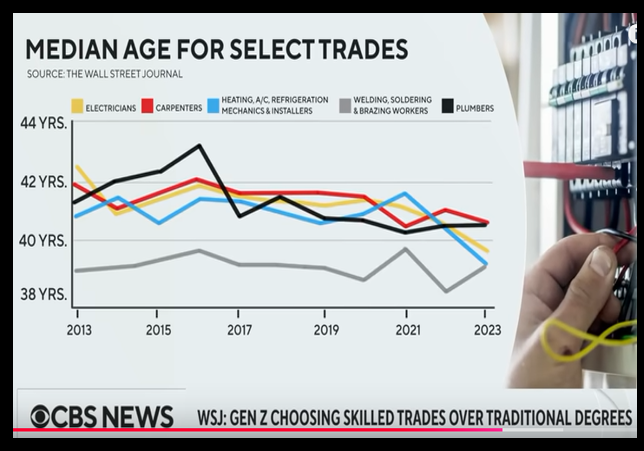
Unfortunately for the leftists dominating American higher education today, graduating students still have to earn a living. So, Gen Z is beginning to vote with its feet and is opting for 2-year trade schools free of hyped-up moral outrage and outrageous expenses.
Community colleges offering vocational programs witnessed one of the highest numbers of student enrollment in fall 2023, as students opting for higher education showed a slight improvement overall from declines seen during the COVID-19 pandemic, according to data from the National Student Clearinghouse Research Center.
Those community colleges with a focus on vocational programs saw registrations climb 16 percent, an increase of 112,000 students, substantially higher than the rate seen before COVID, when it rose 3.7 percent. Associate degree programs jumped more than 2.2 percent, to 96,000 students.
The interest in vocational education began to see increases in sign-ups going back to three years ago, Jennifer Causey, senior research associate at the National Student Clearinghouse Research Center, told Newsweek.
“Since Fall 2021, vocational programs have started to see upticks in enrollments, and specific program families such as Mechanic Repair Technologies grew 11.2 percent this fall alone,” she said.
much more at the link below
Gen Z is Quiet Quitting Higher Education for Trade Schools


 Delusions of Adequacy
Ome of my nephews is 23. After a series of jobs he recently enrolled in classes for HVAC certification. He has already received three bonafide offers from employers.
While going to classes he works at a grocery store. That employer, with 120 stores, has offered him a junior position in upper management.
He made the decision to stay in HVAC.
LikeLike