
Heritage Foundation releases guide to colleges that teach instead of indoctrinate
In an effort to find at least two universities in every state that are focused not on leftist and queer indoctrination but instead on free expression and open inquiry, the conservative Heritage Foundation has now put together an interactive map and guide that parents and high school students can use to choose a quality college to attend.
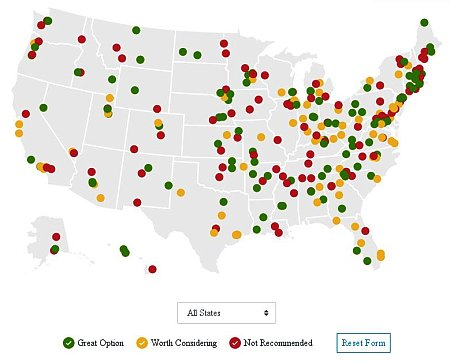
click on this link to find the colleges on the map above
The image to the right is a screen capture of that map, located here. You can click on each dot to get more detailed information about why Heritage recommends or not recommends it. For example, for Thomas Aquinas College in California the guide says the following in explaining why it lists it as a “great option.”
The mission of Thomas Aquinas College (TAC) is to renew “what is best in the Western intellectual heritage and to [conduct] liberal education under the guiding light of the Catholic faith.” TAC has an impressive “A+” rating from the American Council of Trustees and Alumni. It does not have a bias response team, nor does it require diversity statements for hiring. It has an impressive 80 percent four-year graduation rate. Thomas Aquinas College also accepts the Classical Learning Test for admission.
Meanwhile, the guide says the following in giving Cornell University, Duke, Brown, Harvard, and Tufts a “not recommended” status:
These universities exhibit a pervasive hostility toward diverse viewpoints and lack robust core curricular requirements, undermining a well-rounded education. These institutions are often heavily influenced by ideologically driven administration agendas and DEI bureaucracies, frequently resulting in limitations on freedom of expression. Moreover, these universities typically demonstrate weak returns on investment, evidenced by lower graduation rates and diminished post-graduation income, making them less favorable choices for students seeking both intellectual rigor and long-term success.
story at link above as well as , but maybe indoctrination will die and education will recover
I take my college classes at Hillsdale College


 Delusions of Adequacy
Does a correlation exist between kamalah Harris’s boycott of Israeli PM’s speech before the full House of the US Congress, and the British and French ministers boycotting the Israeli PM’s speech before the UNGA?
Recently, the Israeli PM gave a speech before the UN-nations General Assembly. A slew of nations spewed their contempt for the Jewish State and boycotted this speech by Bibi?
The German representative voice support for the previous UN-nation GA condemnation of Israel and demanded for an immediate Cease-Fire. Despite the speech Bibi gave before the full US Congress, boycotted by Kamala Harris. President Biden calls for an immediate cease-fire. Britain, France together with South Africa (who accused Israel of genocide) together walked out and boycotted PM Bibi’s speech before the UN General Assembly. Why?
Israel permits tons of food aid to Gazans. Therefore the charades parlor games of “Humanitarian issue” simply shallow propaganda. The US did not supply “humanitarian aid” to Northern Vietnam during that long war. The International Court of Justice (ICJ) fears of “famine” compares to the South African blood libel of “Genocide”! Great Power strategic interests concerning maintenance of their share of the balance of power in the Middle East makes me very skeptical of the so called “humanitarian aid issue” raised by foreign powers who promote a hostile to Israel “Cease-Fire Now” “Surrender Israel” agenda!
It’s essential to recognize that humanitarian aid isn’t always solely about political alignment or historical context. It’s true that the U.S. did not provide direct humanitarian aid to the North during that period. The geopolitical dynamics of the Cold War influenced decisions related to aid distribution. It’s crucial to differentiate between wartime policies and post-war humanitarian efforts; Israel currently fighting a war on 7 fronts: Gaza, Lebanon, Syria, Samaria, Iraq, Yemen, and Iran; over 60,000 Israelis “refugees inside their own country!”
Britain France and Germany oppose the Israeli war effort. As proven by Britain, French boycotting the speech given by the Israeli PM before the UNGA, as did Kamala Harris boycott the Israeli PM speech given to the full House of the US Congress.
Many Israelis perceive calls for a cease-fire as great power politically motivated rather than genuinely humanitarian; the US supplied no humanitarian aid to North Vietnam. Critics argue that cease-fire Great power demands serve only as a means to pressure Israel without adequately addressing its genuine security concerns. Israelis perceive these foreign international demands as attempts to undermine Israel’s right to defend itself. That self-centered great power foreign powers push for cease-fires to establish conditions favorable to their own strategic interests in the Middle East, rather than genuinely seeking peace or stability in the region.
All previous foreign imposed cease-fires have always led to renewed hostilities, making many Israelis distrustful and very skeptical concerning the sincerity of such Foreign imposed dictates of “peace”. The jargon rhetoric of peace ignores the key requirement that peace stands upon the foundation of trust. Post Shoah Israelis do not trust England, France or Germany.
The lack of U.S. humanitarian aid to North Vietnam is often cited as an example of how geopolitical considerations can overshadow humanitarian concerns. This historical lens informs current perceptions of foreign involvement in the Israeli-Palestinian conflict. The legacy of the Holocaust (Shoah) deeply affects Israeli perspectives on trust, especially toward countries that have historically been seen as unsupportive or even hostile.
This historical trauma influences contemporary views on international relations. Past cease-fires that resulted in renewed violence contribute to a pervasive distrust of international interventions. Many Israelis feel that without a solid foundation of trust, calls for peace are viewed as empty rhetoric. Ultimately, many Israelis seek a peace process rooted in mutual trust ie direct face to face negotiations with our Arab and Muslim peace partners. Israel outright rejects the role of the UN-nations and its non stop condemnations of Israel starting with British and French written UNSC 242. Chapter VI not Chapter VII Korean war dictates imposed by “international law” bogus rhetoric propaganda. International law stands only upon agreed and signed Treaties of alliance between nation states.
The UNGA mob rule routine condemnations of Israel exposes the unobjective forum of the UN-nations. Genuine peace between Israel and its Arab and Muslim partners and allies, built on Arab and Muslim countries recognizing and addressing the legitimate security needs of Israel.
The emphasis on treaties and agreements reflects a belief that international law should be based on mutual consent rather than unilateral condemnations. Many Israelis view UN resolutions as unbalanced and lacking legitimacy. These themes illustrate the complexity of the Israeli perspective on international relations, particularly in the context of the ongoing conflict. The interplay between historical trauma, security concerns, and skepticism of foreign motives continues to shape discussions about peace and stability in the region.
Many Israelis view calls for an immediate cease-fire from countries like Germany, France, Britain, and others as being politically motivated rather than genuinely humanitarian in nature. They see these demands as attempts to pressure Israel and undermine its right to defend itself, without adequately addressing Israel’s legitimate security concerns. Rooted in historical experiences, including the lack of U.S. humanitarian aid to North Vietnam and the legacy of the Holocaust, many Israelis are deeply skeptical of foreign powers’ involvement and mediation efforts.
There is a pervasive distrust of international interventions, especially from countries with a history of being seen as unsupportive or even hostile toward Israel.
Israel’s position emphasizes that any potential peace process must prioritize its security needs as a fundamental requirement. The rhetoric around humanitarian issues is viewed by many Israelis as a means to obscure the underlying geopolitical motivations of foreign powers, who may be more concerned with maintaining their strategic interests in the region.
In summary, the Israeli perspective presented in the context highlights the deep complexities and sensitivities surrounding the conflict, where historical experiences, security concerns, and distrust of foreign intervention shape the country’s response to international demands and mediation efforts. Addressing these core issues is seen as essential for any meaningful progress toward a lasting peace.
The opposition of Germany, France, and Britain to the Israeli war effort can be understood through the complex interplay of historical experiences, geopolitical interests, and perceptions of trust.
Historically, the Arab-Israeli War of 1948 and the United Nations’ role in brokered cease-fires have shaped the perceptions of foreign involvement in the region. The legacy of the Holocaust and the geopolitical dynamics of the Cold War further influenced decisions related to aid distribution and perceptions of trust.
Germany’s unequivocal support for Israel has eroded its soft-power footprint in the region, leading to growing condemnation from Arab countries who view the war as genocidal. Germany’s initial backing of Israel’s assault in Gaza has tarnished its reputation across the Middle East.
France, Germany, the United Kingdom, Italy, and the United States have issued a joint statement denouncing Hamas and pledging to ensure Israel’s ability to defend itself. However, the German government’s position is rarely shared by staff of German institutions with experience in the Middle East.
Many Israelis perceive calls for a cease-fire as politically motivated rather than genuinely humanitarian, and view these demands as attempts to pressure Israel and undermine its right to defend itself. The lack of trust in England, France, or Germany is rooted in historical experiences and perceptions of unsupportive or hostile attitudes.
In summary, the opposition to the Israeli war effort by these countries is influenced by a complex web of historical trauma, security concerns, and skepticism of foreign motives. Addressing these core issues is seen as essential for any meaningful progress toward a lasting peace.
The shifts in U.S. foreign policy can influence how Western European countries engage with issues like Israel and Palestine. Biden’s administration has been more aligned with European perspectives on human rights and diplomacy in the region, while Trump’s approach often aligned more closely with certain Israeli policies. Overall, these differences illustrate contrasting philosophies in U.S. foreign policy and how they affect relationships with European allies regarding strategic interests in the Middle East.
The DemoCRAPS Biden/Harris share a close diplomatic alliance with Germany England and France. However Trump, based upon his criticism of the failure of European countries to make a 2% Nato contribution to that alliance, that Trump does not hold close diplomatic relations with Western European strategic interests in the Middle East?
Under Biden and Harris, there has been an emphasis on restoring alliances with traditional partners in Europe, including Germany, England, and France. This includes a more collaborative approach on issues like the Middle East and NATO contributions, reflecting a commitment to multilateralism.
Trump often criticized European nations for not meeting the 2% NATO spending target, which affected diplomatic relations. His administration’s policies were characterized by a more unilateral stance, especially regarding the Middle East. Trump’s approach to foreign policy was often less aligned with traditional European strategic interests, focusing instead on specific alliances with countries like Israel and Saudi Arabia, sometimes at the expense of broader European collaboration.
LikeLike