
Chiefly, men’s superior mathematical ability explains why they are overrepresented in fields that require strong mathematical talent to succeed (e.g. physics).
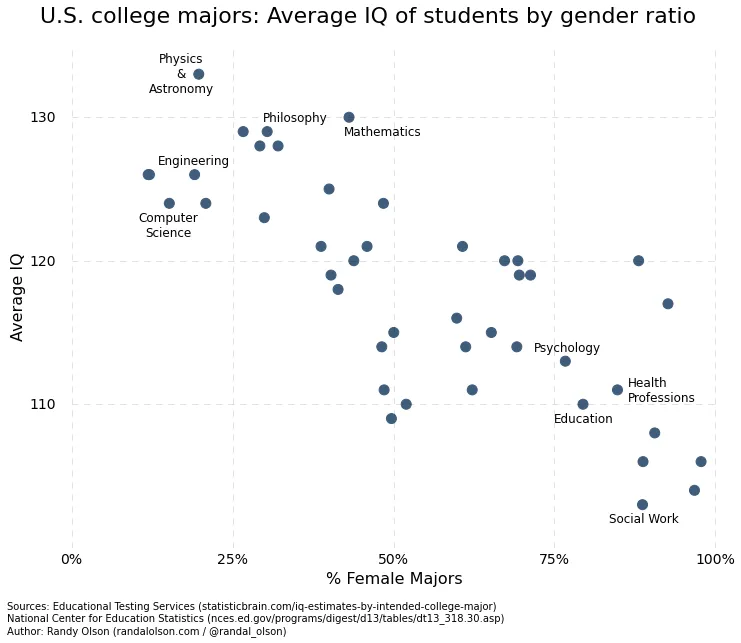
Leslie et al. (2015) advocated a model where a stereotype that a given field requires brilliance to succeed scares women away from the field, thus resulting in a self-fulfilling prophecy similar to stereotype threat. Leslie however ignored decades of findings in stereotype accuracy research, where stereotypes are generally known to accurately track real existing differences. As such, a simpler explanation for the data is that the brilliance stereotype results from real existing differences in academic ability between fields of study, which is also the variable that explains the different distribution of demographic groups in these fields due to differences in academic abilities.
As such, the rather obvious explanation for the correlation between field level “perceptions of brilliance” and female representation is that women are somewhat worse at math, don’t like math as much, and tend to avoid math heavy fields. A boring but accurate explanation.


 Delusions of Adequacy