Gun Control and Our Constitutional Rights, Once Politicians Get Their Foot In the Door…It is the Beginning of the End of Our Rights

My deepest sympathy goes out to the families in Colorado.  The killer was an idiot, but if we didn’t have guns he would have found another way to do what he did.  He was evil and had his mind made up already.  I am not afraid to call evil what it is and history shows they will do what they do with whatever tool they can find.  People blow themselves up in the middle east which he may have done the same thing last week.  Booby trapping his apartment showed he thought he was going to die anyway.

THE POINT OF THIS POST

What galls me is the politicizing of this tragedy by some who have an agenda.   I do not wish to get into left vs. right on this discussion as it is about protecting our constitutional rights.  Once they take one away, they can take any or all of them with precedent

I disagree with  Mayor Bloomberg, Attorney General Holder, and those who are using this event in order to get rid of our 2nd amendment rights, and we know who they all are.  Here are some sentiments from others who agree on the T shirt below. The box is the IQ level of those who think gun control works and would have stopped this madman.  Even the UN is trying to take away our right to bear arms.

Steve Chapman discusses it further here:

When someone is ill or anxious to avoid illness, he may be open to any possible treatments. That’s why quack remedies, untested formulas and obvious placebos often find takers. When a mass shooting occurs, the urge to find a cure is powerful. As a rule, though, those that emerge are sugar pills.

A nation with very few guns, exceedingly tight firearms restrictions and little interest in such weaponry would not experience these atrocities as often as ours does. But in a society with hundreds of millions of guns and huge demand for them, as well as high rates of violent crime of all sorts, the challenge borders on the insurmountable.

The tactics of the alleged killer in this case serve gun control supporters as a roadmap to what should be done. He had an AR-15 “assault weapon,” proving we should prohibit these guns. He had a magazine that can hold 100 cartridges, dramatizing the need to restrict magazine capacity. He bought some 6,000 rounds over the Internet, suggesting that the government should outlaw large purchases or monitor anyone who makes them.

All these conclusions sound perfectly plausible. And none of them offers any prospect of averting the next massacre.

Take the danger posed by “assault weapons.” It turns out the one recovered in Aurora, Colo., might have been illegal under the federal ban that was in effect from 1994 to 2004. Sen. Dianne Feinstein, D-Calif., calls for reviving that law on the ground that “these are weapons that you are only going to be using to kill a lot of people in close combat.”

What she and many others don’t realize is that “assault weapons” are functionally indistinguishable from ordinary semi-automatic hunting rifles. They don’t fire more rapidly, they don’t deliver more lethal rounds, and they don’t “spray” bullets. They only look like military arms.

The features that disqualified a gun under the federal ban were ones that didn’t affect destructiveness, such as pistol grips and bayonet mounts. If accused killer James Holmes had been prevented from buying this gun, he could have found plenty of others that would have served his purpose just as well.

Almost everyone who buys an AR-15 uses it to hunt small game or perforate targets. The number of customers who obtain guns like this only “to kill a lot of people in close combat” is just slightly above zero — a market that would be far too small to induce a company to make them.

Holmes reportedly equipped his rifle with a 100-round magazine — compared to the maximum of 10 allowed under the old federal law. But limiting magazine size would most likely be an exercise in futility.

In the first place, a halfway competent shooter can quickly replace an empty magazine with a fresh one, or else switch to another gun. (Holmes allegedly used three and had a fourth.)

The brief interruption a killer needs for reloading is helpful only if someone can seize the moment to subdue him — something more common in movies than in real life. Florida State University criminologist Gary Kleck says he knows of only one mass shooting in which that happened, in 1993. In the 2011 Tucson shooting, the suspect was overcome when his gun jammed after he reloaded.

Tracking anyone who makes large ammunition purchases? David Kopel, research director at the free-market Independence Institute in Denver, points out that more than a billion rounds are sold each year in the United States — many of them in bulk by target shooters who burn through hundreds or thousands every month.

If the Bureau of Alcohol, Tobacco, Firearms and Explosives were to investigate each of these buyers, it would have little time to do anything else. And it would probably catch no criminals, since they would buy in smaller lots to avoid detection.

Besides, most of the rounds that Holmes allegedly bought lay idle. The quantity of ammunition he is said to have used could have been obtained in a few purchases that would set off no alarms. The rest of his fearsome stockpile had no bearing on the outcome.

Ideas like these are proposed anytime a mass shooting takes place but lately, at least, never go anywhere. Supporters take that as proof of the vast, unhealthy influence of the National Rifle Association. But it could be Americans just have no appetite for solutions that don’t solve.

How well did that work out for those countries?  Bad guys have guns and if we take them away from those who are responsible and will defend others, the bad guys have already won.   History has proven that.

One of the Problems With Big Companies is Their Middle Management

There has been a dearth of articles about middle management issues with big companies recently.  Vanity Fair had a great article about how stacked performance reviews has killed innovation at Microsoft, but it really described the problems with most big companies.  The irony was that it pointed out how Microsoft made fun of IBM, yet  Microsoft had now repeated the same mistakes they IBM has suffered from for years.

Additionally, not to exonerate any big company, all of which have middle management problems, many also have stacked performance reviews which clearly has caused a big morale problem at companies I worked for which is also documented in the article at Microsoft.  From what I’ve heard from my associates around RTP, most of the companies (with the exception of NetApp) including but not limited to IBM, , Lenovo, and many others use this type of employee rating.  See Stacked Performance reviews below for a further discussion.

FIRST LINE MANAGERS, ONE OF THE WORST JOBS

When I worked as a plumber, they told me I only had to know 3 things to be qualified.  They were; 1) payday is Friday, 2) $h!t flows downhill and 3) the boss is an a$$h0le.  This is basically true in a lot of jobs.  The first line manager has to usually do their regular job, plus be a people manager for which most aren’t trained for and most are not good at.  They have extra work for the same pay just on the promise that they would get ahead, which almost none do.  It may finally pay off for some, but only when they reached VP or higher.  Directors have to take it from the VP’s, but at least can delegate the crummy work to the first line managers.

The reason this job is such a loser is that while you have to deal with the day to day issues, in this economy your managerial duties are to basically give bad news that there are little to no raises, people are being laid off so be happy you’re still working….also that there won’t be any bonuses this year.  I watched these managers get dumped on by their next level of management as they had to do the dirty work (some then got laid off just after they let others go).  Very few made it past this level of management as there just are so may executive jobs available, and there are many vying for those positions.  Plumbers rule numbers 2 and 3 apply here.

Here is an excerpt from Forbes which describes the problem with middle management.

I watched this phenomenon also ruin morale at my last company and David Williams nails some points starting here:

In my opinion, a company needs leaders—not managers.

What does that a leader look like? We start with two of our 7 Non Negotiables of leadership—we Trust and then we Empower. You know how leaders will typically say “I empower my people”—and then they don’t? The tendency is all too common. (This happened in my last job before I retired.  I was told by my then manager to be more independent, but I had to run everything by my him before I did anything, and trusted the opinion of a new hire over my review of a meeting that said new hire didn’t attend…talk about lack of trust and sending mixed messages to your employees).

The minute there’s a mistake it’s like a rope around your neck that snatches back—you either get your head taken off, or you get yanked back so hard the natural reaction is to hunker down and become “less” instead of growing to “more.”

With my own paired leadership partner, Fishbowl president Mary Michelle Scott, we start at the top of the company with a holistic, high altitude view of what we want to achieve. Then we bring in the department captains (there are 3 pairs) and say, “This is what we’re thinking. We think it’s time to open up Canada, the UK and South Africa.”

We give that big piece of meat to the captains. They chew on it for a while and come back with either 1) they don’t like it (generally coupled with a counter proposal), or 2) the multiple ways they see to go about achieving the goal. The captains are leaders who play a core role in the strategy’s formation. Then they run the day-to-day deployment of the strategy that’s been jointly created and set.

Yes, there’s a fine line between leadership and management—but there’s a massive difference as well, I maintain. Our approach makes the groups and leaders autonomous, but also interdependent. They are bright. All voices are heard. We decide on the “best” idea, no matter who originates it, and most of the time, we actually forget who brings the idea forward. Nobody worries about “the glory” because all will benefit as a team (my compensation strategy is here.) They come up with better answers than we could ever hope to achieve on our own.

(Editors note here: My view as the author of this blog is not everyone is cut out to be a manager.  There are a lot who think that it is their career path or a way to get ahead, but that doesn’t make them qualified.  I had a few managers who just were not people persons.  Some middle managers  held success against the top achievers when they out-performed the manager,  or couldn’t handle the fact that some made more than others including the manager.  They shouldn’t have let this guide their decisions, but they did. People like this shouldn’t have been allowed to be managers.  This guy also used age discrimination while at IBM to get rid of a competent worker, Bill Gesick and wouldn’t re-hire Sid Baker, a veteran coming back from Iraq and Afghanistan.  Further, this person whom his employees named Mr. Feckless bragged that he tried to get rid of me (because I  (made more money that he did) as well as bragged at how he gave no extra pay to others, which everyone promptly told me about.  I just tried to consistently do good job and was always more successful than he was with work. An example is this success story which I kept him out of on purpose so he couldn’t ruin it.  It was how I had to deal with him as did his peer managers as well as his boss (who later told me he wanted to get rid of him and would have had the company not been sold to Lenovo).  It is a clear case of a person that should have had a staff job.

This happens at every level.

Why leaders hear too many questions? – From The Leadership Freak

You’ve delegated tasks rather than results, vision, and resources. Delegating tasks is too granular and suggests your need for granular involvement. Delegating tasks causes others to focus on tasks. Delegating vision along with resources frees good people to make decisions on their own.

You may hear too many questions because you don’t have clear processes and procedures. People ask too many questions when they aren’t sure what’s next.  Establishing processes and procedures for repeated activities frees both leaders and employees.

On the other hand: The best leaders/managers I worked for had the following trait.

The captains don’t “manage” every day. They have just one meeting as captains per week. That meeting determines the deployment of strategy. We hand off to the captains—then they hand off to the teams, who hand off to the individuals who deploy day to day, and then they get out-of-the-way (as they resume their own production roles, side by side with their teams.)

Here is some advice on how to manage properly if most would take it.

Yes, there are some management components. But we try to stay away from the temptation to micromanage, which makes people so fearful of making a mistake, they feel they don’t dare to create something courageous. (Note: This happened with another manager who said she wanted each of us to take charge, but just couldn’t leave our work alone until we wound up having to do it as if we were her.  This made it very hard for our team as we all had different styles… none of them matched with the manager.  This of course killed our creativity and morale as we had to try to do things in the style as if we were her, all the while knowing that we knew how to do our jobs better and knew our area’s deeper.  The micro-management ruined our chances to succeed as well as our motivation).  We had to report every detail constantly making each task taking five times longer with way more revisions than it could have taken. She was one of the last managers I had, and certainly not a leader.

Conversely, the manager I had before her gave me the freedom to succeed by macro managing and encouraged me to try my own ideas which drove me to want to give it everything I have.  This fueled my creative juices including starting this blog and joining twitter.  I also wanted to help others learn social media, something the following manager didn’t support except by hiring a noob who turned out to be a loafer to basically handle tweet wrap ups.

The link above best describes how to do it this way:

Some managers fear empowering team members because a more powerful team might take some action or a make a decision that the manager would not have made. But you can’t over-control your teams. It’s the responsibility of a manager to know what’s going on but not to micro-manage.

It’s best if you can pick your own team and hire motivated workers who will inspire and enthuse other team members.

That 2nd manager of our Cross Brand team thought that she owned the ability to communicate and this just made it hard for us to get our jobs done.  The employees grouped together for self preservation.

The Leadership Freak comments appropriately here:

You may hear too many questions because you’re a control freak (see my micro-manager above). Your people are paralyzed by your need to know, control, and direct details. On a personal note, I don’t think of myself as a control freak, but I am. I mention that because you may not see your freakishness. In my opinion, leaders tend to be control freaks. Don’t toss this possibility aside without thinking it over.

You may hear too many questions because your people lack experience or need training.

You may hear too many questions because you punish rather than learn from mistake makers. Begin honoring both the lessons learned from and the persons with the courage to make mistakes. Obviously, mistakes from negligence, insubordination, or sabotage shouldn’t be honored.

Not all questions are good questions. Some questions indicate poor leadership. Are you hearing too many questions?

ANOTHER MANAGEMENT ISSUE: HOW STACKED PERFORMANCE REVIEWS ARE KILLING INNOVATION

excerpt From Vanity Fair:

Eichenwald’s conversations reveal that a management system known as “stack ranking”—a program that forces every unit to declare a certain percentage of employees as top performers, good performers, average, and poor—effectively crippled Microsoft’s ability to innovate. “Every current and former Microsoft employee I interviewed—every one—cited stack ranking as the most destructive process inside of Microsoft, something that drove out untold numbers of employees,” Eichenwald writes. “If you were on a team of 10 people, you walked in the first day knowing that, no matter how good everyone was, 2 people were going to get a great review, 7 were going to get mediocre reviews, and 1 was going to get a terrible review,” says a former software developer. “It leads to employees focusing on competing with each other rather than competing with other companies.”

Blog Editors note: At my last company, we also had to compete against equal employee “bands” (level of experience commensurate with pay and responsibility) across the company.  This was especially unfair for remote employees as those in the home office of New York had access to the management and knew the strategy well before it was disseminated.

TELECOMMUTERS ARE DISCRIMINATED AGAINST

From the HuffPo:

The millions of Americans who are skipping out on the daily commute may also be losing out on a promotion.

These so-called ‘telecommuters’ are less likely to receive positive performance reviews from superiors than their colleagues who show up in the office, a new study by MIT Sloan Management Review shows.

The report chalks up much of the discrepancy to managerial subjectivity. Managers are less likely to be comfortable with a worker they don’t actually see on a regular basis. In fact, they may become more irritated with someone who they perceive isn’t available at all times. Telecommuting employees are also less likely to reap the benefits of showing up early and leaving work late than their commuting coworkers.

Advances in internet technology have allowed for telecommuting to become more widespread. About 20 percent of workers worldwide report that they telecommute, while 10 percent report that they work from home on a regular basis, according to a recent Ipsos/Reuters poll. That same poll found that 34 percent of workers, when asked, stated that they would telecommute on a regular basis if they could.

But according to some critics, telecommuting creates cause for concern. For instance, telecommuting could prevent workers from being able to fully understand what their managers ask of them, according to PC World. That’s because non-verbal facial expressions are an important component of the workplace that telecommuting, which often takes place over instant messaging or phone, doesn’t allow.

This definitely happened at my last job even though they claimed it was not true.  If you did not work in NY (it was an old boys club with both men and women), you didn’t stand a chance for promotion unless you were in the High Potential (HyPo) group, which means you were destined for NY eventually.  What was almost funny was that some of the senior management even made fun of those not in NY as if we had a lower IQ.  In fact, we knew we could do the same job for 30% less cost of living and didn’t have to go to NY, we just knew that we would only go so far unless we moved there.

I’ve had managers who didn’t trust you if you weren’t there.  He projected his own lack of work ethic at home on the team.  Each of us were mature responsible workers, except for the middle manager.

One of my favorite worst management lines ever was on the first day of a new job, the  manager said to me, “I’m too busy with my new job, you are on your own to figure out how to do your job”.  He since has been demoted to a staff job after not succeeding at another company and came back to IBM.

16 THINGS SUCCESSFUL LEADERS NEVER DO – BY LEADERSHIP FREAK

Not doing is one side of finding success.

  1. Never let the bottom line be the bottom line.
  2. Never pretend things are ok when they aren’t.
  3. Never let what you’ve never done be the reason not to try.
  4. Never get ahead by resenting those who get ahead. – My former boss Ray G.
  5. Never let those who aren’t doing something prevent you for doing something.
  6. Never do on the road what you wouldn’t do at home.
  7. Never trust anyone who never admits mistakes.
  8. Never achieve greatness through negativity.
  9. Never pretend you can do what you can’t.
  10. Never let others fail before doing everything appropriate to help them succeed.
  11. “An executive has never suffered because his subordinates were strong and effective.” Peter Drucker
  12. Never find wisdom in excuses, defensiveness, or blame.
  13. Never think of loyalty as a gift.
  14. Never waffle when it comes to taking responsibility.
  15. Never waver when it comes to giving credit.
  16. Never make excuses. “Never make excuses. Your friends don’t need them and your foes won’t believe them.” JohnWooden

Bonus: Never create the future by recreating the past.

CONCLUSION

We can’t get away from having middle management, but companies need to vet who they let be in that position via a better method.  They should also give them better training and most of all, realistically set their expectations of the chances of moving up.  If they did this, it would weed out those who are only doing the job to move up or to get paid more.  Most however, are doomed to stay there and live with plumbers rules numbers 2 and 3.

Does Telecommunting or Working At Home Hurt Your Career?

According to a new study by Professors, Kimberly Elsbach of the University of California, Davis, and Daniel Cable of London Business School, it does.

A new study suggests workers are judged harshly for not showing up at the office. Despite advances in teleworking, smartphones, and Skype, face time, it seems, really does matter.

Getty Images
Working from home might not work for you.

Professors, Kimberly Elsbach of the University of California, Davis, and Daniel Cable of London Business School, looked at perceptions of employees’ performance based on whether they were in the office or not. The research measured “passive face time,” which is simply time spent in the office, regardless of whether the staffer is working hard or not.

The results aren’t pretty for employees who would rather work remotely, according to an article Elsbach and Cable wrote in MIT Sloan Management Review.

Workers who are seen at their desks during regular work hours are considered “responsible” and “dependable,” they wrote: “Just being seen at work, without any information about what you’re actually doing, leads people to think more highly of you.”

Work longer hours — early, late, or on weekends — and “rather than just being considered dependable, you can get upgraded to ‘committed’ and ‘dedicated,’” according to the article, which referenced a paper Elsbach and Cable published in the academic journal Human Relations.

Bosses, and peers, often don’t realize they’re forming views of workers’ competence based on whether they’re at their desk, Cable said in an interview with The Wall Street Journal.

“Without us knowing it, we are creating these assumptions about people based on physical presence,” he said. This isn’t just a perception. Bosses’ vague feelings that a worker does a better job can be seen on employee evaluations, especially when they’re encouraged to make subjective calls in performance reviews.

That leads to pay, promotion, and career-trajectory decisions. Cable estimates that more than 60% of companies are still using “1950s-style” evaluations that prioritize such subjective write-ups over hard data on sales wins, customer satisfaction, or other measures of the employee’s business performance.

So what can employees do to counter this pigeonholing, especially those who want to work from home?

If working long hours from the office isn’t an option, employees might consider sending emails early in the morning or late at night, to prove they are on the job at all times. They might also try using their time in the office to build strong connections to co-workers and superiors, like going to lunch with people or organizing in-person meetings?

Meanwhile, managers should be aware that they may be discounting remote workers’ contributions, albeit subconsciously. (Or, they may be monitoring their home-based workers, as The Journal’s Sue Shellenbarger writes.)

“The bottom line is that employees should be wary of work arrangements that reduce their office face time, and supervisors should be wary of using trait-based performance measures, especially when evaluating remote workers,” the article said. “Finally, employees working remotely need to make sure they are evaluated on objective outputs. Barring that, you might consider sending an e-mail to your boss tonight . . . say, around midnight.”

YOU ARE LESS LIKELY TO BE PROMOTED ALSO

According to an MIT study by the Sloan Management Review, you are less likely to get ahead:

The millions of Americans who are skipping out on the daily commute may also be losing out on a promotion.

These so-called ‘telecommuters’ are less likely to receive positive performance reviews from superiors than their colleagues who show up in the office, a new study by MIT Sloan Management Review shows.

The report chalks up much of the discrepancy to managerial subjectivity. Managers are less likely to be comfortable with a worker they don’t actually see on a regular basis. In fact, they may become more irritated with someone who they perceive isn’t available at all times. Telecommuting employees are also less likely to reap the benefits of showing up early and leaving work late than their commuting coworkers.

Advances in Internet technology have allowed for telecommuting to become more widespread. About 20 percent of workers worldwide report that they telecommute, while 10 percent report that they work from home on a regular basis, according to a recent Ipsos/Reuters poll. That same poll found that 34 percent of workers, when asked, stated that they would telecommute on a regular basis if they could.

But according to some critics, telecommuting creates cause for concern. For instance, telecommuting could prevent workers from being able to fully understand what their managers ask of them, according to PCWorld. That’s because non-verbal facial expressions are an important component of the workplace that telecommuting, which often takes place over instant messaging or phone, doesn’t allow.

But this doesn’t excuse managers from giving otherwise stellar employees poor reviews just because they telecommute, Daniel Cable of London Business School and co-author of the MIT Sloan report told The Wall Street Journal. Approximately 60 percent of firms still use highly subjective employee review standards that prioritize manager write-ups over hard data, Cable told WSJ. This often results in managers promoting sub par employees over superior candidates that telecommute.

STACKED REVIEWS

Most corporations are using stacked reviews.  This obviously pits employees against each other rather than trying to beat the competition.  Stay at home employees are working at a disadvantage here as the in office workers can brown nose their way to places that home workers can’t.  Here’s how it works.

Eichenwald’s conversations reveal that a management system known as “stack ranking”—a program that forces every unit to declare a certain percentage of employees as top performers, good performers, average, and poor—effectively crippled Microsoft’s ability to innovate. “Every current and former Microsoft employee I interviewed—every one—cited stack ranking as the most destructive process inside of Microsoft, something that drove out untold numbers of employees,” Eichenwald writes. “If you were on a team of 10 people, you walked in the first day knowing that, no matter how good everyone was, 2 people were going to get a great review, 7 were going to get mediocre reviews, and 1 was going to get a terrible review,” says a former software developer. “It leads to employees focusing on competing with each other rather than competing with other companies.”

FIRSTHAND EXPERIENCE, BAD OFFICE MEMO OF THE YEAR

At IBM, if you don’t go to New York, you don’t get ahead.  That is where the club is. The current Senior Vice President, Marketing and Communications said that Raleigh was “Smallville with no chance of going anyone going anywhere if you stay here” at a town-hall meeting with all the communications folks in attendance.  Jaws were dropping all over the floor and it was the topic of conversation for days. This was after he gave a speech that was supposed to be about communications careers, but was just an obviously recycled presentation that had been given to a different audience about EPS.  Everyone saw through it and no one got why he came to un”motivate” the troops.  IBM’s current vice president of external relations publicly made fun of the south as if NY was the mecca of IQ on a global call of all Comms folks.  Everyone mentioned how short sighted this was and what a limited view of what different populations worldwide had to offer (there were multiple IM sessions going on around the world on this clear example of prejudice and ego centrism).  Despite their high salaries, we are the smart ones spending more time with our kids and paying over 30% less in cost of living.  Plus we don’t have to live in New York and work with them especially since this guy yells and cusses you out way more than HR should allow.

I personally turned down 2 offers to move to NY to get ahead.  I’d been there many times and knew the unofficial rules that you had to be there to get anywhere.  I didn’t want to raise my kids there and my family was more important to me  than a job.  Because of that, I was labeled someone who didn’t want to climb the ladder which was fine by me, so I worked in the pack and was passed over for promotions after that.  My family is much better off having grown up where we wanted to live and I don’t regret it a minute.  My kids are killing the NY public school kids at college.  Plus, I would never send them to a den of socialism like Columbia or any other schools up there.  I need them to get a real education.

But the fact remains, you run a severe risk of not getting ahead if you don’t show up at the office.  Many will be able come up with some successful work at home employee story, but only to a certain level…. then you have to be in their face at the office.  Either way, it is expected that you’ll check into work at all hours of the night and weekends anyway.

There was one manager in a group I worked for that sent out a “rules of the road” memo (bad office memo of the year) that said if you weren’t working in the office, you weren’t considered really working.  Talk about generating trust on your team! He was viewed by his peers as the worst manager of the entire group, I was just lucky to have had the experience of working with him.

OFFICE COOLER TALK

You do miss out on hall meetings that allow you to find out things home workers miss.  It allows you to get ahead of the telecommuters on the first news or get into the executives office at a moments notice.  That is a drawback, but not enough to call me in.  When they sold the building I was working in and asked who wanted to be a home worker, my hand was up faster than Arnold Horshack to get out of there.

The flip side is you have to hear all the office gossip which I was glad to miss.  It is too distracting and usually it is never good about anyone, only what they are doing wrong, who is sleeping with whom or what some are getting away with.

Some people need the social interaction and have to be in the office for people contact.  I’m perfectly happy to miss that as most of it is idle banter that takes away from productivity.  I also don’t miss the hour commute.

Overall, I wouldn’t trade the home office for a cubicle anywhere, anytime. Being at home has more perks.

Happy Birthday to My Dog

It is now a year later and my dog  is 12  today.  The average lifespan of Boxer according to my vet is “around” 8-10 years, so I’m living on borrowed time.

I named her after the dog in Jonny Quest because she had a black face like the dog in the cartoon.

Since I’ve worked at home the whole time we’ve had her, she has been my day pal.  Now that my son has gone off to college, she is definitely my dog and I’m very attached to her.

Recently, I watched Marley and Me and I couldn’t bear the thought of losing her.  Fortunately, she is still full of energy and looks like she’ll be around for a while.

I’ve posted about her over the years, some of them being the most read entries I’ve written.

After the story of Shoep and John here is the link I am especially sensitive to her longevity and day to day life.  She has had cancer surgery and still has the energy to love my family, although she is especially attached to me.  It is mutual.

Here are some of the best of links:

Her surgery

Dogs are good for your heart

It’s a Dog’s Life

Boxer Rebellion

July 4th 2012, Top Posts Round-up

First of all if you read the dates on the gravestone, Happy Birthday Mom.

So it’s Independence Day, declared in 1776 from the rest of the World.  The USA has in its short life (compared with other countries) given more to others in benevolence, freed and saved more people, helped former enemies to recover, sacrificed more than others and established a new way of running a country other than a Monarchy.  Unlike the Monarchy’s around the world, the land wasn’t taken from others in a border dispute war or outright takeover like those we declared freedom from….. and has contributed more development, medicine and technology than most other countries combined.  So why are our leaders trying to run it in a way that has failed?

Ronald Reagan said, “The American dream is not that every man must be level with every other man. The American dream is that every man must be free to become whatever God intends he should become.”

Most of this is a blessing from our Creator, mentioned in all the documents of the Founding Fathers, yet the government of today is trying to leave that model and get back to the type of behavior we declared independence from.  Why?

First, let’s start off with the Star Spangled Banner.

Here is a round-up of the best posts for today.

Michelle Malkin – Happy 236th Birthday

John Ransom – Washington’s First Fourth

America joining the One World Crappola from the Daily Kos instead of celebrating why we are different (see our Judeo-Christian history) I tried finding something patriotic just for fairness, but it’s just a different world view I guess

America Haters from the Usual sources, Hollywierd

The other America Haters – The Media

Paul Greenberg – The American Idea

Rasmussen poll – Liberty and Justice for all

Speaker Boehner’s Independence Day Tribute: “Here’s to the Spirit of ‘76”

Joshpundit – America’s Birthday Edition (lots of links here)

Robert Samuelson – Love of Country 2012

Fleming: What Life Was Like in 1776

For levity, The Hot Dog eating contest where an American is the favorite

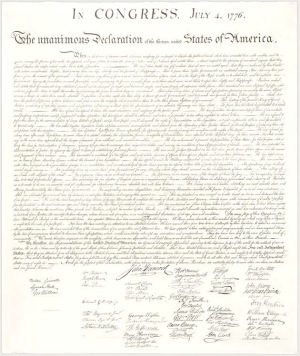
Finally, here is the Declaration of Independence, from tyranny and taxes.  Have we come full circle?

IN CONGRESS, July 4, 1776.

The unanimous Declaration of the thirteen united States of America,

When in the Course of human events, it becomes necessary for one people to dissolve the political bands which have connected them with another, and to assume among the powers of the earth, the separate and equal station to which the Laws of Nature and of Nature’s God entitle them, a decent respect to the opinions of mankind requires that they should declare the causes which impel them to the separation.

We hold these truths to be self-evident, that all men are created equal, that they are endowed by their Creator with certain unalienable Rights, that among these are Life, Liberty and the pursuit of Happiness.–That to secure these rights, Governments are instituted among Men, deriving their just powers from the consent of the governed, –That whenever any Form of Government becomes destructive of these ends, it is the Right of the People to alter or to abolish it, and to institute new Government, laying its foundation on such principles and organizing its powers in such form, as to them shall seem most likely to effect their Safety and Happiness. Prudence, indeed, will dictate that Governments long-established should not be changed for light and transient causes; and accordingly all experience hath shewn, that mankind are more disposed to suffer, while evils are sufferable, than to right themselves by abolishing the forms to which they are accustomed. But when a long train of abuses and usurpations, pursuing invariably the same Object evinces a design to reduce them under absolute Despotism, it is their right, it is their duty, to throw off such Government, and to provide new Guards for their future security.–Such has been the patient sufferance of these Colonies; and such is now the necessity which constrains them to alter their former Systems of Government. The history of the present King of Great Britain is a history of repeated injuries and usurpations, all having in direct object the establishment of an absolute Tyranny over these States. To prove this, let Facts be submitted to a candid world.

He has refused his Assent to Laws, the most wholesome and necessary for the public good.
He has forbidden his Governors to pass Laws of immediate and pressing importance, unless suspended in their operation till his Assent should be obtained; and when so suspended, he has utterly neglected to attend to them.
He has refused to pass other Laws for the accommodation of large districts of people, unless those people would relinquish the right of Representation in the Legislature, a right inestimable to them and formidable to tyrants only.
He has called together legislative bodies at places unusual, uncomfortable, and distant from the depository of their public Records, for the sole purpose of fatiguing them into compliance with his measures.
He has dissolved Representative Houses repeatedly, for opposing with manly firmness his invasions on the rights of the people.
He has refused for a long time, after such dissolutions, to cause others to be elected; whereby the Legislative powers, incapable of Annihilation, have returned to the People at large for their exercise; the State remaining in the mean time exposed to all the dangers of invasion from without, and convulsions within.
He has endeavoured to prevent the population of these States; for that purpose obstructing the Laws for Naturalization of Foreigners; refusing to pass others to encourage their migrations hither, and raising the conditions of new Appropriations of Lands.
He has obstructed the Administration of Justice, by refusing his Assent to Laws for establishing Judiciary powers.
He has made Judges dependent on his Will alone, for the tenure of their offices, and the amount and payment of their salaries.
He has erected a multitude of New Offices, and sent hither swarms of Officers to harass our people, and eat out their substance.
He has kept among us, in times of peace, Standing Armies without the Consent of our legislatures.
He has affected to render the Military independent of and superior to the Civil power.
He has combined with others to subject us to a jurisdiction foreign to our constitution, and unacknowledged by our laws; giving his Assent to their Acts of pretended Legislation:
For Quartering large bodies of armed troops among us:
For protecting them, by a mock Trial, from punishment for any Murders which they should commit on the Inhabitants of these States:
For cutting off our Trade with all parts of the world:
For imposing Taxes on us without our Consent:
For depriving us in many cases, of the benefits of Trial by Jury:
For transporting us beyond Seas to be tried for pretended offences
For abolishing the free System of English Laws in a neighbouring Province, establishing therein an Arbitrary government, and enlarging its Boundaries so as to render it at once an example and fit instrument for introducing the same absolute rule into these Colonies:
For taking away our Charters, abolishing our most valuable Laws, and altering fundamentally the Forms of our Governments:
For suspending our own Legislatures, and declaring themselves invested with power to legislate for us in all cases whatsoever.
He has abdicated Government here, by declaring us out of his Protection and waging War against us.
He has plundered our seas, ravaged our Coasts, burnt our towns, and destroyed the lives of our people.
He is at this time transporting large Armies of foreign Mercenaries to compleat the works of death, desolation and tyranny, already begun with circumstances of Cruelty & perfidy scarcely paralleled in the most barbarous ages, and totally unworthy the Head of a civilized nation.
He has constrained our fellow Citizens taken Captive on the high Seas to bear Arms against their Country, to become the executioners of their friends and Brethren, or to fall themselves by their Hands.
He has excited domestic insurrections amongst us, and has endeavoured to bring on the inhabitants of our frontiers, the merciless Indian Savages, whose known rule of warfare, is an undistinguished destruction of all ages, sexes and conditions.

In every stage of these Oppressions We have Petitioned for Redress in the most humble terms: Our repeated Petitions have been answered only by repeated injury. A Prince whose character is thus marked by every act which may define a Tyrant, is unfit to be the ruler of a free people.

Nor have We been wanting in attentions to our British brethren. We have warned them from time to time of attempts by their legislature to extend an unwarrantable jurisdiction over us. We have reminded them of the circumstances of our emigration and settlement here. We have appealed to their native justice and magnanimity, and we have conjured them by the ties of our common kindred to disavow these usurpations, which, would inevitably interrupt our connections and correspondence. They too have been deaf to the voice of justice and of consanguinity. We must, therefore, acquiesce in the necessity, which denounces our Separation, and hold them, as we hold the rest of mankind, Enemies in War, in Peace Friends.

We, therefore, the Representatives of the united States of America, in General Congress, Assembled, appealing to the Supreme Judge of the world for the rectitude of our intentions, do, in the Name, and by Authority of the good People of these Colonies, solemnly publish and declare, That these United Colonies are, and of Right ought to be Free and Independent States; that they are Absolved from all Allegiance to the British Crown, and that all political connection between them and the State of Great Britain, is and ought to be totally dissolved; and that as Free and Independent States, they have full Power to levy War, conclude Peace, contract Alliances, establish Commerce, and to do all other Acts and Things which Independent States may of right do. And for the support of this Declaration, with a firm reliance on the protection of divine Providence, we mutually pledge to each other our Lives, our Fortunes and our sacred Honor.


The 56 signatures on the Declaration appear in the positions indicated:

Column 1
Georgia:
Button Gwinnett
Lyman Hall
George Walton

Column 2
North Carolina:
William Hooper
Joseph Hewes
John Penn
South Carolina:
Edward Rutledge
Thomas Heyward, Jr.
Thomas Lynch, Jr.
Arthur Middleton

Column 3
Massachusetts:
John Hancock
Maryland:
Samuel Chase
William Paca
Thomas Stone
Charles Carroll of Carrollton
Virginia:
George Wythe
Richard Henry Lee
Thomas Jefferson
Benjamin Harrison
Thomas Nelson, Jr.
Francis Lightfoot Lee
Carter Braxton

Column 4
Pennsylvania:
Robert Morris
Benjamin Rush
Benjamin Franklin
John Morton
George Clymer
James Smith
George Taylor
James Wilson
George Ross
Delaware:
Caesar Rodney
George Read
Thomas McKean

Column 5
New York:
William Floyd
Philip Livingston
Francis Lewis
Lewis Morris
New Jersey:
Richard Stockton
John Witherspoon
Francis Hopkinson
John Hart
Abraham Clark

Column 6
New Hampshire:
Josiah Bartlett
William Whipple
Massachusetts:
Samuel Adams
John Adams
Robert Treat Paine
Elbridge Gerry
Rhode Island:
Stephen Hopkins
William Ellery
Connecticut:
Roger Sherman
Samuel Huntington
William Williams
Oliver Wolcott
New Hampshire:
Matthew Thornton

9 Things Successful People Do Differently

Some people are better than others for certain reasons.   Some are more political, better trained, work harder and so forth.  I read this and it is a good summary of how to be more successful.

Via the Havard Business Review:

1. Get specific. When you set yourself a goal, try to be as specific as possible. “Lose 5 pounds” is a better goal than “lose some weight,” because it gives you a clear idea of what success looks like. Knowing exactly what you want to achieve keeps you motivated until you get there. Also, think about the specific actions that need to be taken to reach your goal. Just promising you’ll “eat less” or “sleep more” is too vague — be clear and precise. “I’ll be in bed by 10pm on weeknights” leaves no room for doubt about what you need to do, and whether or not you’ve actually done it.

2. Seize the moment to act on your goals.
Given how busy most of us are, and how many goals we are juggling at once, it’s not surprising that we routinely miss opportunities to act on a goal because we simply fail to notice them. Did you really have no time to work out today? No chance at any point to return that phone call? Achieving your goal means grabbing hold of these opportunities before they slip through your fingers.

To seize the moment, decide when and where you will take each action you want to take, in advance. Again, be as specific as possible (e.g., “If it’s Monday, Wednesday, or Friday, I’ll work out for 30 minutes before work.”) Studies show that this kind of planning will help your brain to detect and seize the opportunity when it arises, increasing your chances of success by roughly 300%.

3. Know exactly how far you have left to go. Achieving any goal also requires honest and regular monitoring of your progress — if not by others, then by you yourself. If you don’t know how well you are doing, you can’t adjust your behavior or your strategies accordingly. Check your progress frequently — weekly, or even daily, depending on the goal.

4. Be a realistic optimist.
When you are setting a goal, by all means engage in lots of positive thinking about how likely you are to achieve it. Believing in your ability to succeed is enormously helpful for creating and sustaining your motivation. But whatever you do, don’t underestimate how difficult it will be to reach your goal. Most goals worth achieving require time, planning, effort, and persistence. Studies show that thinking things will come to you easily and effortlessly leaves you ill-prepared for the journey ahead, and significantly increases the odds of failure.

5. Focus on getting better, rather than being good.
Believing you have the ability to reach your goals is important, but so is believing you can get the ability. Many of us believe that our intelligence, our personality, and our physical aptitudes are fixed — that no matter what we do, we won’t improve. As a result, we focus on goals that are all about proving ourselves, rather than developing and acquiring new skills.

Fortunately, decades of research suggest that the belief in fixed ability is completely wrong — abilities of all kinds are profoundly malleable. Embracing the fact that you can change will allow you to make better choices, and reach your fullest potential. People whose goals are about getting better, rather than being good, take difficulty in stride, and appreciate the journey as much as the destination.

6. Have grit.
Grit is a willingness to commit to long-term goals, and to persist in the face of difficulty. Studies show that gritty people obtain more education in their lifetime, and earn higher college GPAs. Grit predicts which cadets will stick out their first grueling year at West Point. In fact, grit even predicts which round contestants will make it to at the Scripps National Spelling Bee.

The good news is, if you aren’t particularly gritty now, there is something you can do about it. People who lack grit more often than not believe that they just don’t have the innate abilities successful people have. If that describes your own thinking …. well, there’s no way to put this nicely: you are wrong. As I mentioned earlier, effort, planning, persistence, and good strategies are what it really takes to succeed. Embracing this knowledge will not only help you see yourself and your goals more accurately, but also do wonders for your grit.

7. Build your willpower muscle. Your self-control “muscle” is just like the other muscles in your body — when it doesn’t get much exercise, it becomes weaker over time. But when you give it regular workouts by putting it to good use, it will grow stronger and stronger, and better able to help you successfully reach your goals.

To build willpower, take on a challenge that requires you to do something you’d honestly rather not do. Give up high-fat snacks, do 100 sit-ups a day, stand up straight when you catch yourself slouching, try to learn a new skill. When you find yourself wanting to give in, give up, or just not bother — don’t. Start with just one activity, and make a plan for how you will deal with troubles when they occur (“If I have a craving for a snack, I will eat one piece of fresh or three pieces of dried fruit.”) It will be hard in the beginning, but it will get easier, and that’s the whole point. As your strength grows, you can take on more challenges and step-up your self-control workout.

8. Don’t tempt fate. No matter how strong your willpower muscle becomes, it’s important to always respect the fact that it is limited, and if you overtax it you will temporarily run out of steam. Don’t try to take on two challenging tasks at once, if you can help it (like quitting smoking and dieting at the same time). And don’t put yourself in harm’s way — many people are overly confident in their ability to resist temptation, and as a result they put themselves in situations where temptations abound. Successful people know not to make reaching a goal harder than it already is.

9. Focus on what you will do, not what you won’t do. Do you want to successfully lose weight, quit smoking, or put a lid on your bad temper? Then plan how you will replace bad habits with good ones, rather than focusing only on the bad habits themselves. Research on thought suppression (e.g., “Don’t think about white bears!”) has shown that trying to avoid a thought makes it even more active in your mind. The same holds true when it comes to behavior — by trying not to engage in a bad habit, our habits get strengthened rather than broken.

If you want to change your ways, ask yourself, What will I do instead? For example, if you are trying to gain control of your temper and stop flying off the handle, you might make a plan like “If I am starting to feel angry, then I will take three deep breaths to calm down.” By using deep breathing as a replacement for giving in to your anger, your bad habit will get worn away over time until it disappears completely.

It is my hope that, after reading about the nine things successful people do differently, you have gained some insight into all the things you have been doing right all along. Even more important, I hope are able to identify the mistakes that have derailed you, and use that knowledge to your advantage from now on. Remember, you don’t need to become a different person to become a more successful one. It’s never what you are, but what you do.

Heidi Grant Halvorson, Ph.D. is a motivational psychologist, and author of the new book Succeed: How We Can Reach Our Goals (Hudson Street Press, 2011). She is also an expert blogger on motivation and leadership for Fast Company and Psychology Today. Her personal blog, The Science of Success, can be found at www.heidigranthalvorson.com. Follow her on Twitter @hghalvorson

Heidi Grant Halvorson

Heidi Grant Halvorson

Heidi Grant Halvorson, Ph.D. is a motivational psychologist and author of the HBR Single Nine Things Successful People Do Differently and the book Succeed: How We Can Reach Our Goals (Hudson Street Press, 2011). Her personal blog, The Science of Success, can be found at www.heidigranthalvorson.com. Dr. Halvorson is available for speaking and training. Follow her on Twitter @hghalvorson.